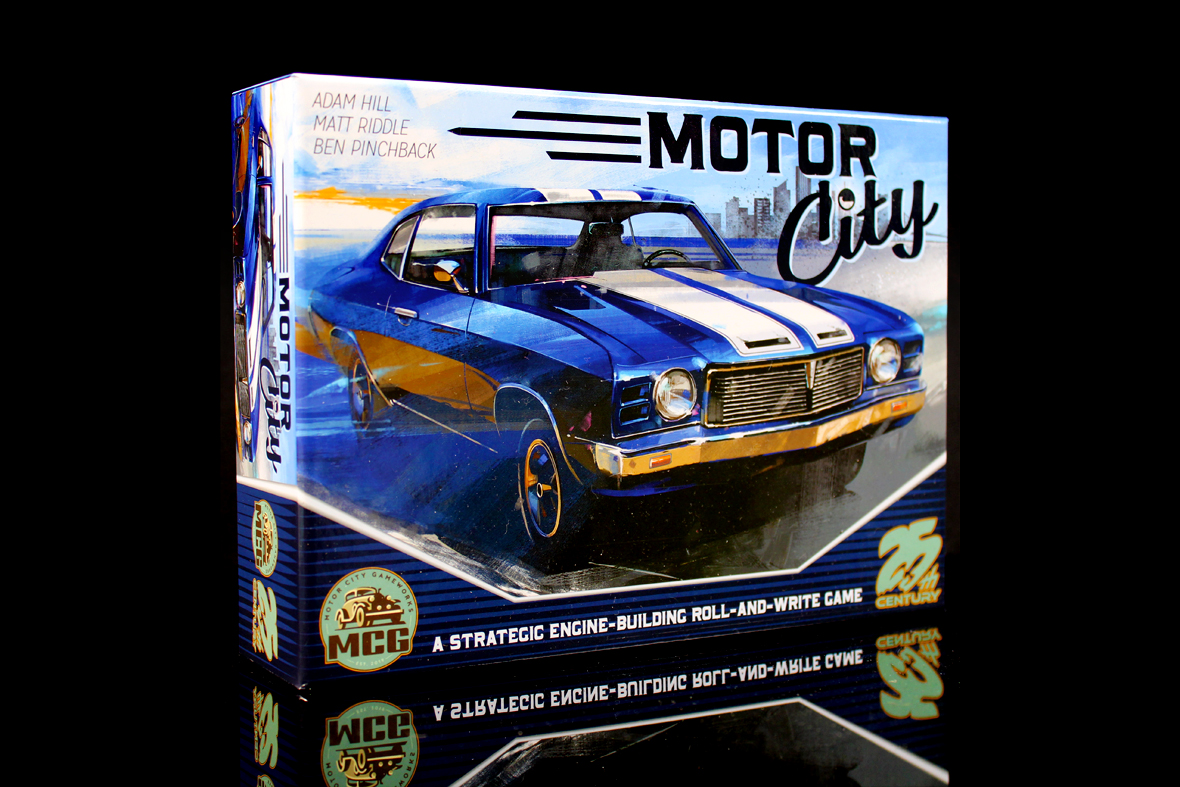
Base price: $30.
1 – 5 players.
Play time: ~45 minutes.
BGG | Board Game Atlas
Buy on Amazon (via What’s Eric Playing?)
Logged plays: 2
Full disclosure: A review copy of Motor City was provided by 25th Century Games.
The one nice thing about reviewing games is that some things allow me to be flexible in how I do reviews. I’ve been trying to have better work / life / other job balance, and part of that is figuring out how to streamline reviews. Long gone are the days that I was doing four-review weeks (I think, disturbingly, I did five reviews in one week a while back). Now, I am enjoying mixing things up by doing mini reviews, micro reviews, and standard reviews. We’ll see how that progresses. Plus, even though there isn’t setup and gameplay instructions here, you can always check out my friends at Kovray’s video on the subject (there’s even a playthrough, if that’s your thing). They roll, they write; they’re good dudes. In the meantime, though, let’s get to Motor City!
In Motor City, players take on the role of automakers at the height of Detroit’s storied manufacturing history. Put cars together, do some engineering and production and testing and sales; I have no idea how cars work. I’m not that kind of engineer. Beep beep car go, done. But I digress. Here, you’ll roll and write your way to automotive superstardom as you build up your various actions and draft dice to do what you need to do over eight rounds. It’s a tough business, but if making cars was easy, any jerk could do it. Will you be able to build up your engine to get your score where it needs to go?
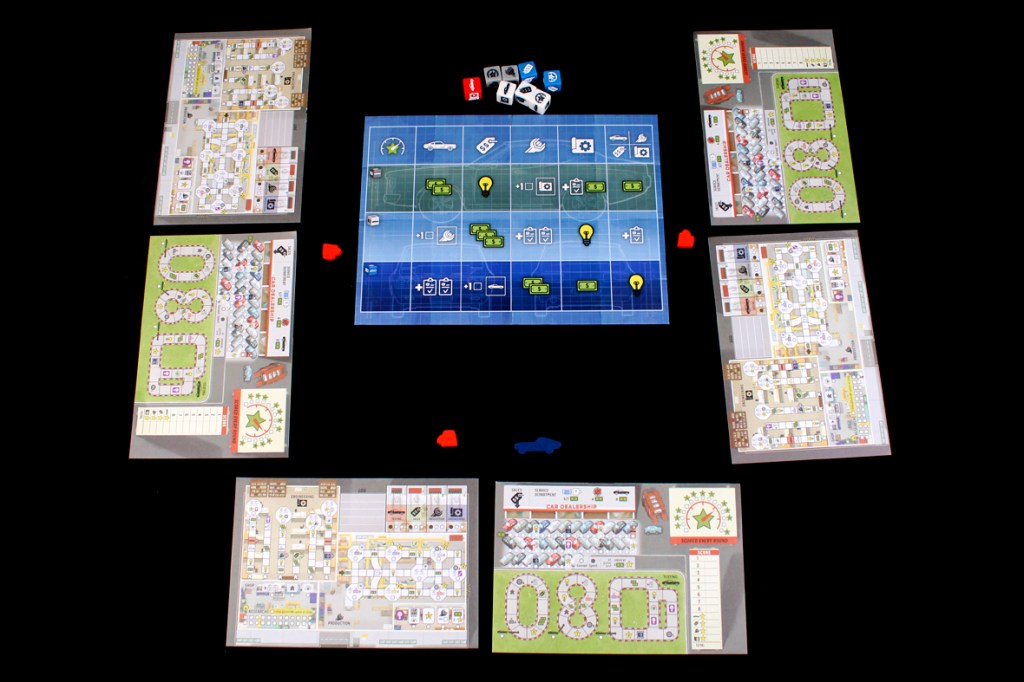

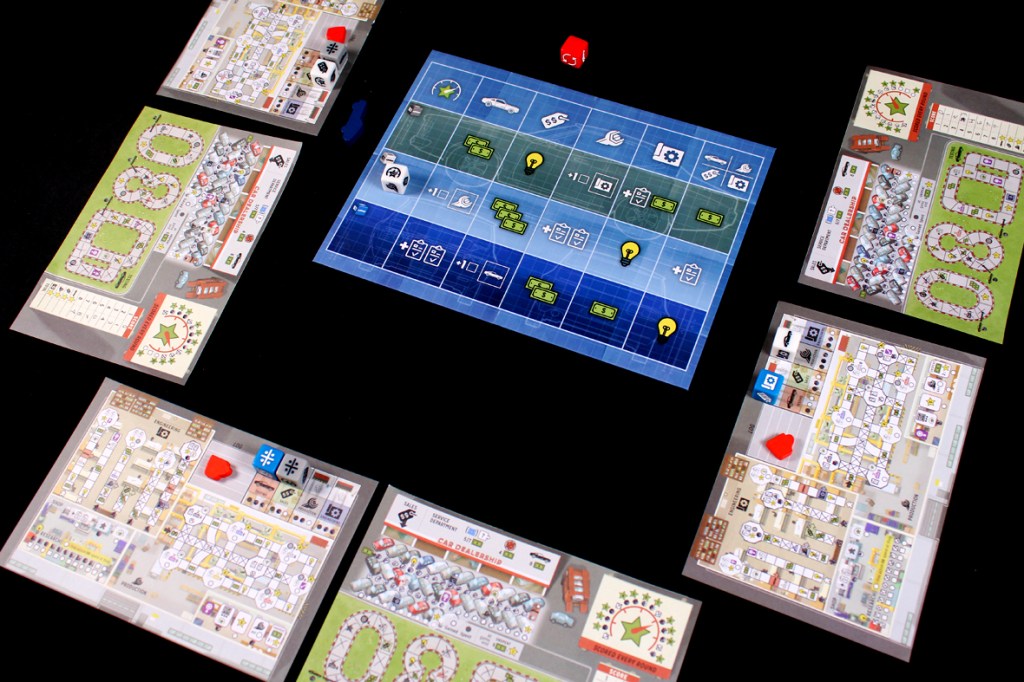
Contents
Player Count Differences

Very few, in this one! A lot of roll-and-write games make use of a race element to add some suspense and interaction to the game writ large. Motor City uses drafting, instead, to allow for player interaction. With more players, there are more dice involved, so you get a bit more variance in your options depending where you are in the player ordering in a given round. The nice thing is that there’s not really too much of a disadvantage in going later in the turn order. Each player takes one die at a time, so even at worst, you’ll get your fifth choice in a five player game if you’re going last. I found the game to be perfectly engaging with two and with more players, though I do have a soft spot for lower player counts. Just kind of my thing. But I generally don’t mind a mix of player counts for this one! I think Motor City does a nice job feeling pretty similar no matter how many people you’re playing it with.
Strategy

- Upgrading your Sales actions may not necessarily feel like the best move at first, but you do need money for just about everything. It’s always nice to have a fallback plan, and getting money has a nice way of eventually getting you other things that you want more (like extra test cars, for instance, or upgrades for your other actions). I wouldn’t neglect Sales entirely, is what I’m trying to say here.
- Getting a few Engineers in place early on can be pretty helpful; otherwise, you risk running out of tracks to progress on. I’d kind of advise against starting your first Engineer on the shortest track; you’ll run out almost immediately and then have no use for Engineering Actions, which can be used against you by enterprising opponents. Getting a few tracks independently started can be nice, but you might find that you either gravitate towards one or you overspread and you end up finishing none of them. Try not to do the latter thing.
- Similarly, having more than one test car can come in pretty handy. You need both the wheels and the crates for various other things, plus one of the tracks lets you gain a new engineer. You are unlikely to be able to finish all of them over the course of the game (though it’s not impossible, I suppose), so investing in additional cars is not a bad idea. Just, like Engineering (and Production), don’t spread yourself so thin that you have no hope of completing anything.
- Getting an early start on the speedometer is pretty useful; those points compound over eight rounds. Getting up to, say, 3 on the speedometer before the end of Round 1 means you’ll end up with at least 24 points from the speedometer over the course of the game (3 * 8), which is more than you’ll get from basically anything else! Don’t neglect things that add up over the course of the game.
- There are a lot of good bonuses on the blueprint table! Try to make them work for you. You’ll obviously want to decide what you want to get based on the action and the bonus, but when you have first pick there are usually a lot of great options. Take a look around your boards and see how you can leverage them in combos or to get other things you need down the line.
- You likely won’t be able to get through all the production hubs in one game; choose wisely and work towards them. This one’s pretty hard to do (similar to maxing out anything else, I suppose). But even if you can hit them all, they’re not as valuable without similar investments in Engineering and Testing, since you need certain things to activate the hubs! Focusing on a few and going after their prerequisites is going to be what helps you win.
- There are a number of things that are going to end up being fairly scarce over the course of the game; TPS reports among them. Planning ahead is going to be pretty critical to making sure your plans don’t run out of momentum. The worst thing you can do is misalign your priorities and end up wasting your TPS reports on hubs you’re not going to end up going after because you shifted your focus to other things. Planning ahead is good, but staying flexible will help you deliver on that.
Pros, Mehs, and Cons
Pros
- Thematically, this is super fun! Car manufacturing is fascinating. It’s a theme I haven’t gotten to explore much, since the game I’m most familiar with in this space is Kanban (and its various incarnations), but I love how much there is on the sheets! They’re fun to look at, even if, of course, most of the actual act of car manufacturing is abstracted away because this is a roll-and-write game. But that’s … board games, largely? So I try to get immersed and just enjoy the theme nonetheless.
- I love the gradual improvement of skills over the course of the game. I really like games where you can gradually make your abilities stronger or more effective. It lets you as the player experience growth and development, and it feels great to have a stronger, more significant turn later in the game where things feel like they matter more. Plus, it helps cover the occasional error you may make early on, since there’s less to do.
- I’m a sucker for custom dice. It’s an easy way to make my day. Custom dice are just generally a nice touch. I get that they can largely abstract away to standard dice and that this just makes them lower-utility for upcycling future game parts, but … it’s fun. It makes me feel more tuned-in to the game itself. Boosts my immersion?
- The Blueprint Board is really interesting, as well! I like how it adds some extra stakes to dice drafting based on the color. It’s not just drafting based on the dice effects; each color of die gives you slightly different rewards based on what you rolled, so you may want the Blue Engineering action as opposed to the Gray one. It adds a bit more depth and consideration to the whole thing (and breaks up the board space visually, to some degree, so you don’t just have huge clumps of dice in six spots). It’s a subtle touch, but one that I think is really interesting.
- As frustrating as it is, I do enjoy the Audit Die blocking certain actions in subsequent rounds; keeps things interesting. Switch things up! Make players improvise! You’re never completely blocked from an action (unless you’re unlucky enough that the Audit Die blocks it and you don’t roll that action or any wild actions), so it’s just an interesting added constraint, even when it feels bad.
- For a more strategic roll-and-write, I don’t find this one overwhelming! There’s a lot to do, but the flow of it is all fairly logical to follow. I got stressed the last time I played one (and probably accidentally cheated up a storm the one before that) so I had a bit of a complex about this whole thing, but I’m also (hopefully) a more mature gamer than I was last time? Hard to say. Jury’s out on that one. That said, I found that Motor City has a core flow that made pretty solid sense to me. I found my decisions easy to track and follow. I mean, I even managed to track my strategy when I was playing the Photography Version of this (I play as all three players to make photography easier). If the game was too tough it would have been overwhelming, but I did just fine.
Mehs
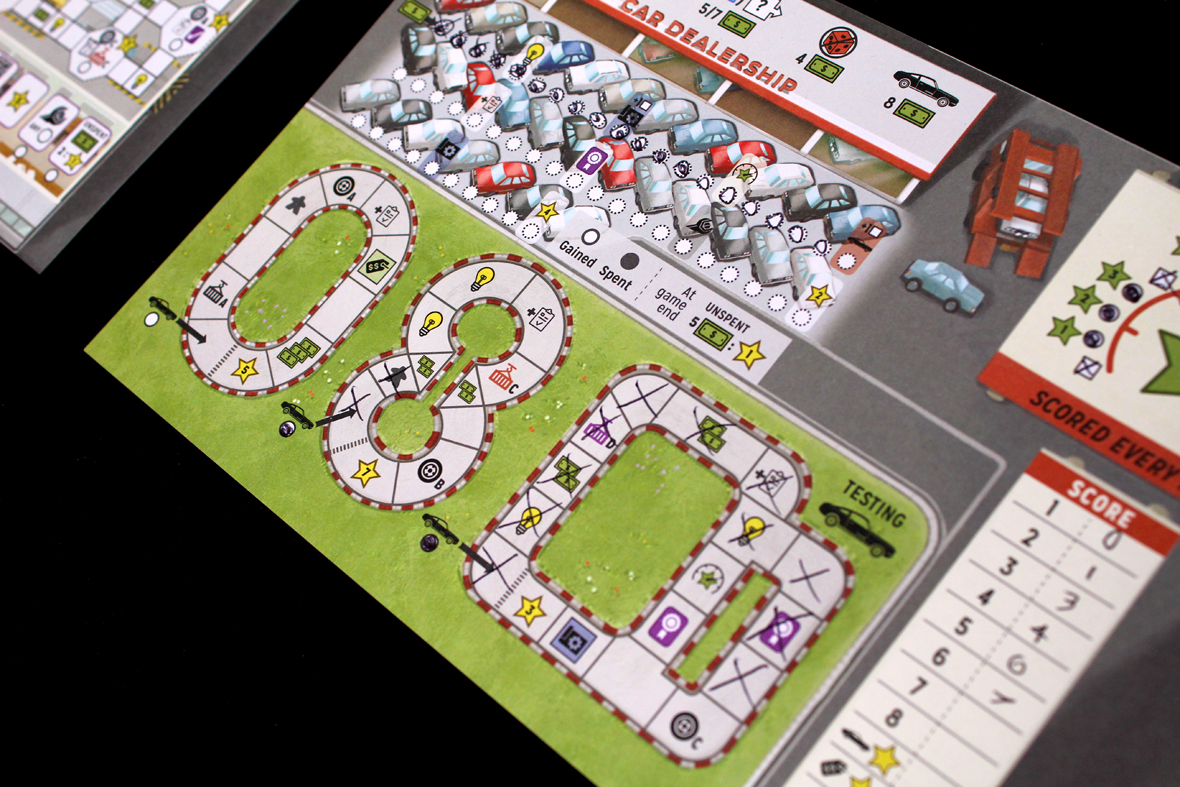
- The Testing Area threw me off the first game since the arrows point counter-clockwise but the cars are supposed to drive clockwise around the track. It’s just a visual thing. Thankfully, there’s an example in the rulebook that mostly covers it, but it still throws me off a bit every time we play. Of course the cars drive clockwise. It’s just confusing how they start.
Cons
- The rulebook … isn’t great. There were some issues when we were first learning how to play the game, and to our great delight, we found out that they’ve already addressed most of them and uploaded a digital 2.0 version that adds more examples and clarifications for various things that we were confused by. Naturally, you prefer a rulebook that’s great from the outset, but honestly, going back and making the changes to make the rulebook make more sense is commendable work, and I respect that. Highly recommend using the 2.0 version if you’re trying to learn how to play.
Overall: 8.5 / 10
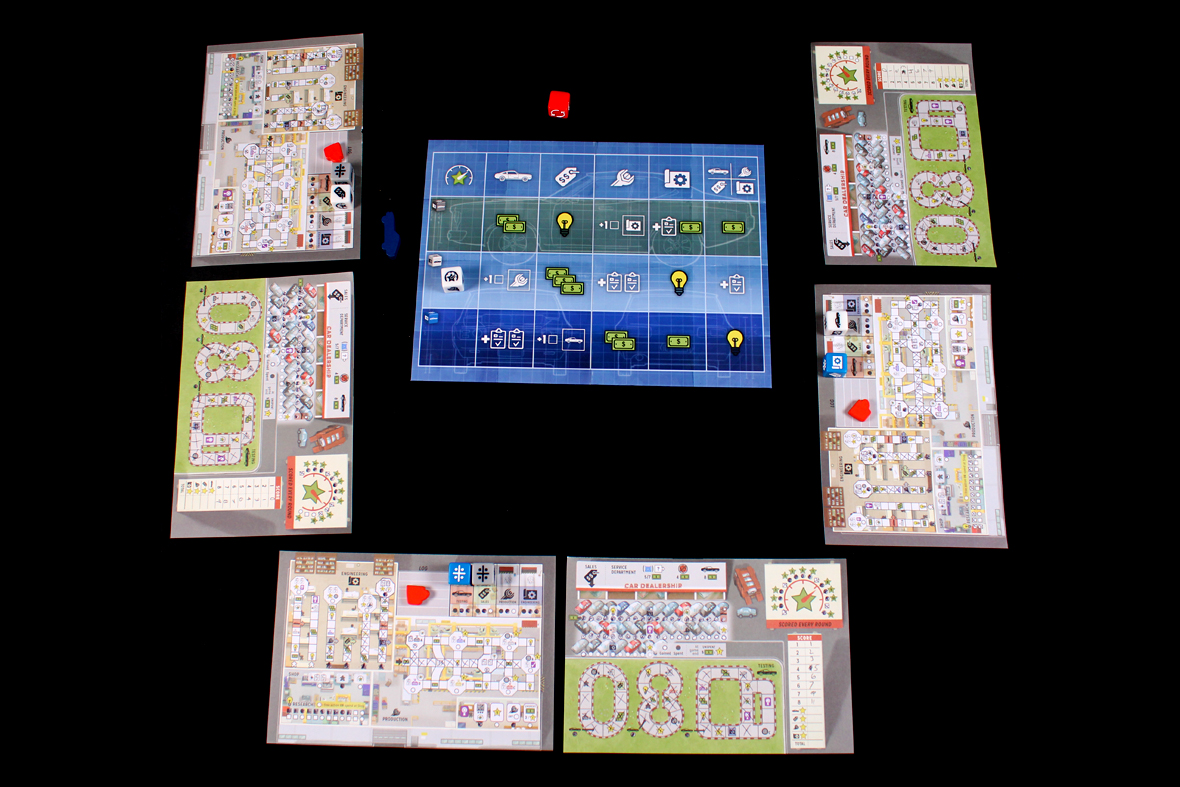
Overall, I think Motor City is great! I get a bit nervous with the heavier roll-and-write games, since I think I was still a bit too junior in terms of my appetite for complexity when I played Fleet: The Dice Game a few years ago (sorry, Suz). I was apprehensive, but frankly, it does not seem to have been a huge issue this time! I think there’s something to how well the game has been streamlined. There’s a lot to do in Motor City, and a lot of ways to go about doing that. I love a game where you can gradually upgrade the strength of your actions, and Motor City lets you go pretty far along that route. You feel significantly more useful and powerful towards the end of the game than you do at the start, and half of the fun is figuring out the pathway to get you to where you need to be. I really like both the drafting and the die color elements, for one thing; the drafting gives you options, and the dice being different colors gives you different outcomes, even if you choose the same options. There’s a lot of variety to it all. Plus, there’s variable paths to accomplishing your goals! You can focus on different things, fill out different tracks, or do pretty much whatever you want. I was going to complain a bit about the rulebook, since the initial run of it is missing a handful of examples that would make things a bit clearer. Thankfully, there’s already a second version of the rulebook on BGG that adds a bunch of things and pretty much addresses all my complaints. Actually, that’s the version I read during my first game; my opponent read the standard rulebook, and that led to some disagreements. Sounds like a him problem (sorry, Antoine). Motor City moves pretty fast for a more strategic roll-and-write game. There’s some downtime, granted, but the game is punchy! I really enjoy it. Love the theme, love building cars; it’s just a bunch of fun. I’m a big fan of how varied the options are within the game, as well. If you enjoy dice drafting, you want a bit more complexity from your roll-and-write options, or you just like cars and car construction, Motor City might be right up your alley! I’ve certainly had a fun time playing it.
If you enjoyed this review and would like to support What’s Eric Playing? in the future, please check out my Patreon. Thanks for reading!
 What's Eric Playing?