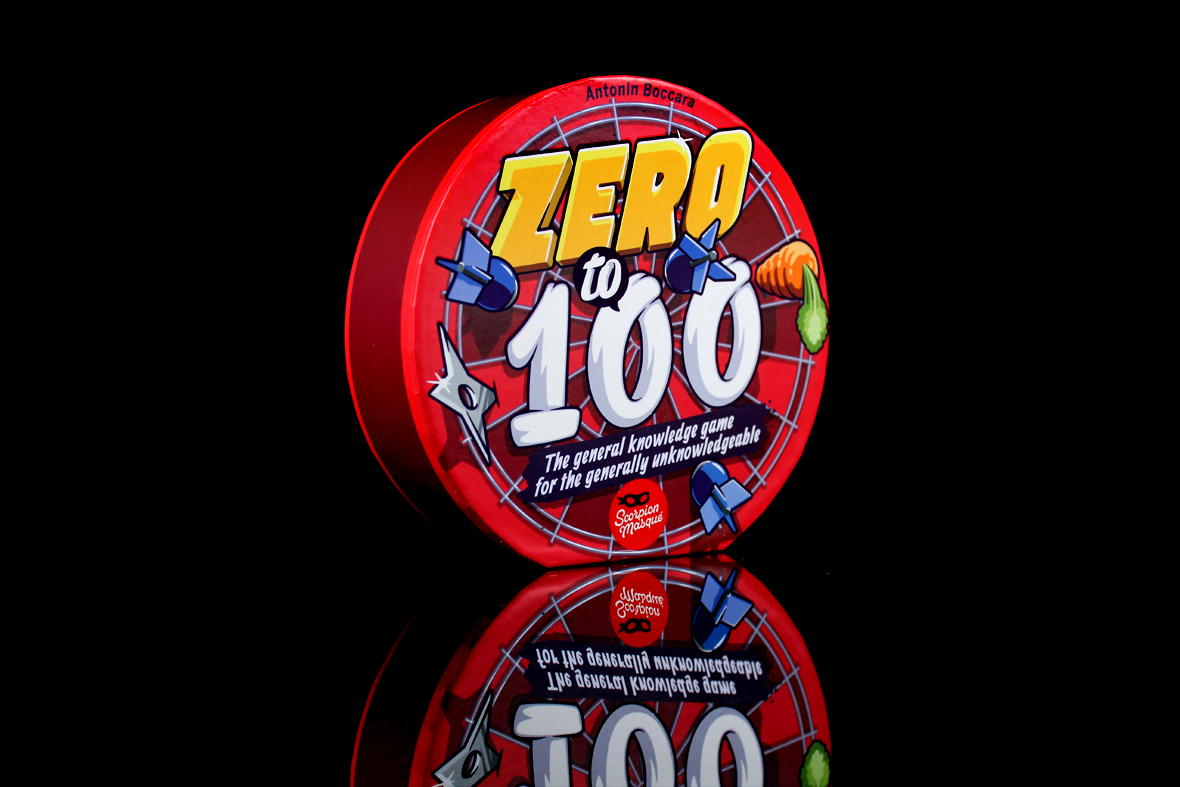
Base price: $15.
2 – 12 players.
Play time: 15 -20 minutes.
BGG | Board Game Atlas
Buy on Amazon (via What’s Eric Playing?)
Logged plays: 2
Full disclosure: A review copy of Zero to 100 was provided by Hachette Boardgames / Scorpion Masqué.
Exciting times! I’m currently packing up my whole life and planning to move out of the Bay Area, so these reviews are the last reviews I’ll probably write around here. It’s exciting and terrifying to move on to something new, but them’s the breaks. I’m trying to get a bunch written now so that I can avoid a break in posting, but it’s a lengthy process of doing things across all fronts. I’ll have more to report on in the near future, I think. I’ve been playing a lot of cool games lately. In the meantime, however, let’s check out the latest! Zero to 100 is a new party game from the Scorpion Masqué folks. Let’s get in there.
In Zero to 100, players are split into three teams and playing against each other in a trivia competition! The challenge here is that the answer’s already apparent; you have questions that you need to match against them if you want to progress. The problem is these questions are … odd. You might know some of them, or at least something close, or maybe nothing at all. But do your best! You just can’t do the worst, or you’ll never make any progress. Can you get relatively close to the mark?
Contents
Setup
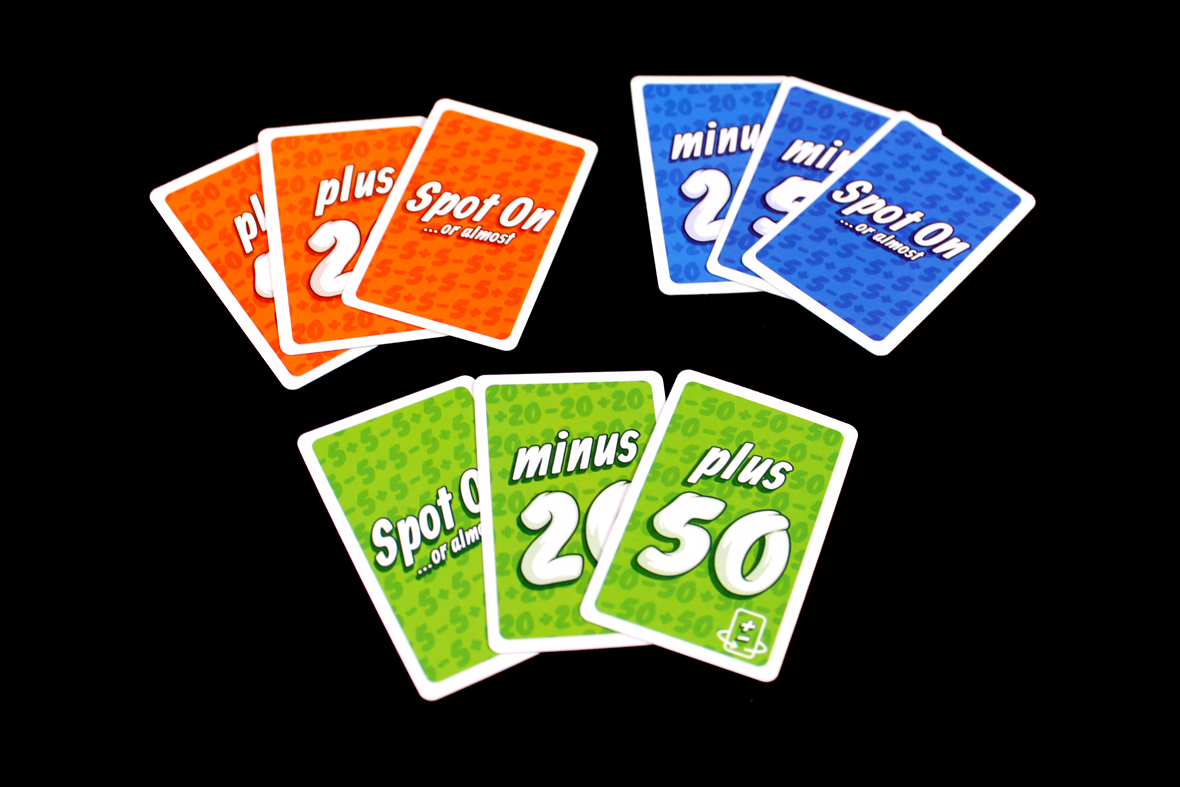
Not a ton. Organize the players into three teams, however you like. Give each team three Power Cards in a given color:
You’ll want to deal each team six question cards:
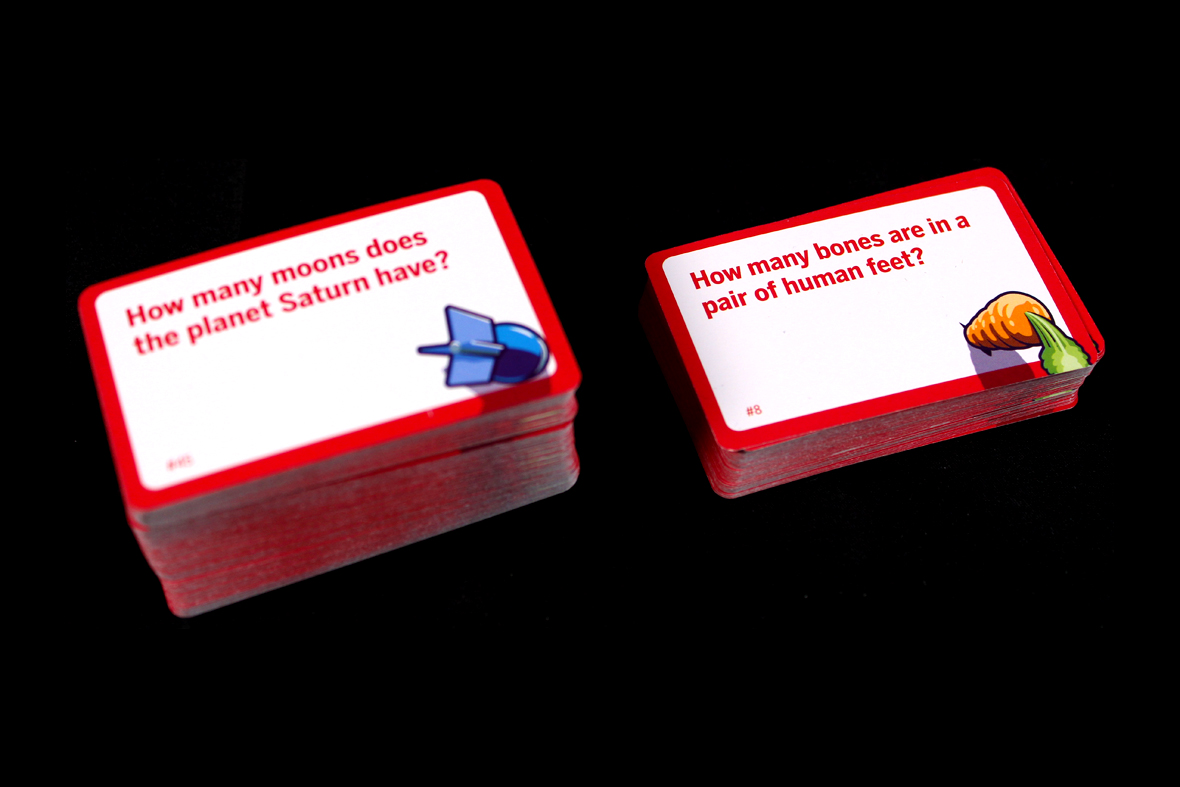
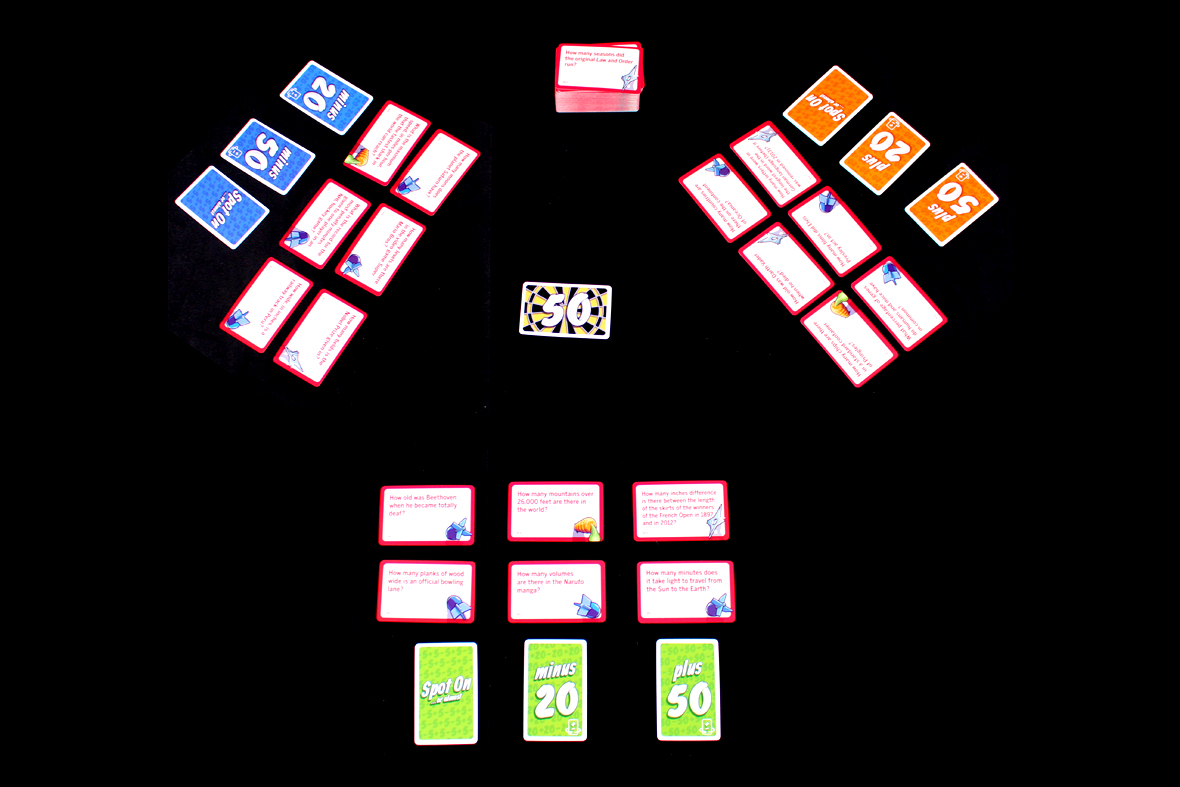
To avoid players remembering the cards, don’t shuffle them in your first go-through the deck; that ensures you’ll always have new ones for at least your first game. Place the “50” in the center of the play area and you should be good to start!
Gameplay
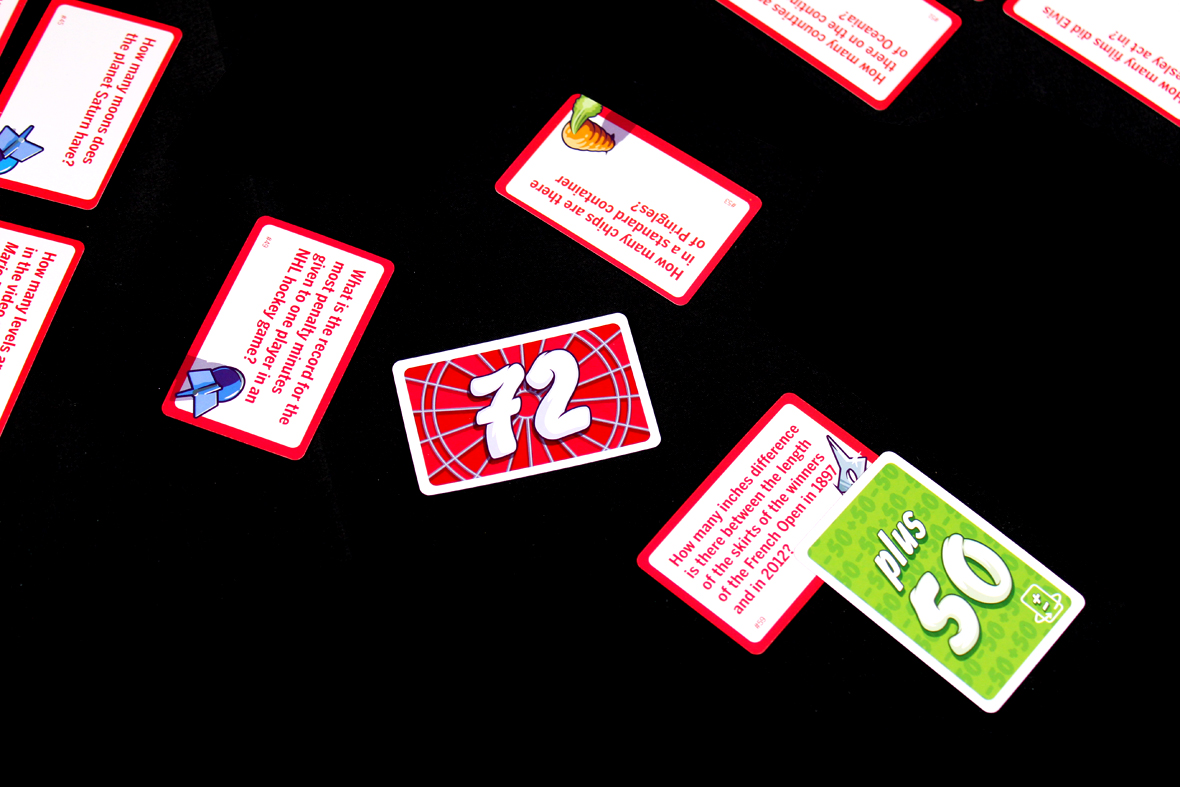
A game of Zero to 100 is played over several rounds! Each round plays mostly the same, so that’s nice. Essentially, your goal is to have your team (which might be just you) decide which of your questions has an answer that’s closest to the target answer (the number in the center. When you’ve got something, push it forward. You may also add one or more of your Power Cards. + / – 20 / 50 either adds or subtracts 20 or 50 from your card’s answer, and Spot On! is a gamble that your number is within 5 (either direction) of the target number. No penalties if you’re wrong; you just can only use each card once per game.
Once everyone has pushed a card forward, each team reads their question, flips it, and reads the numerical answer. The player whose number is furthest from the target number must put their number in the center, replacing the previous number. They must then draw a card to replace the Question Card they just moved to the center (this is bad). If there’s a tie, all tied players draw a new Question Card. All other cards used this round (the target number, other players’ Question Cards and Power Cards) are discarded. If any player correctly used a Spot On!, they may discard another of the Question Cards they have in front of them. Players who weren’t the furthest do not draw a card to replace their Question Card.
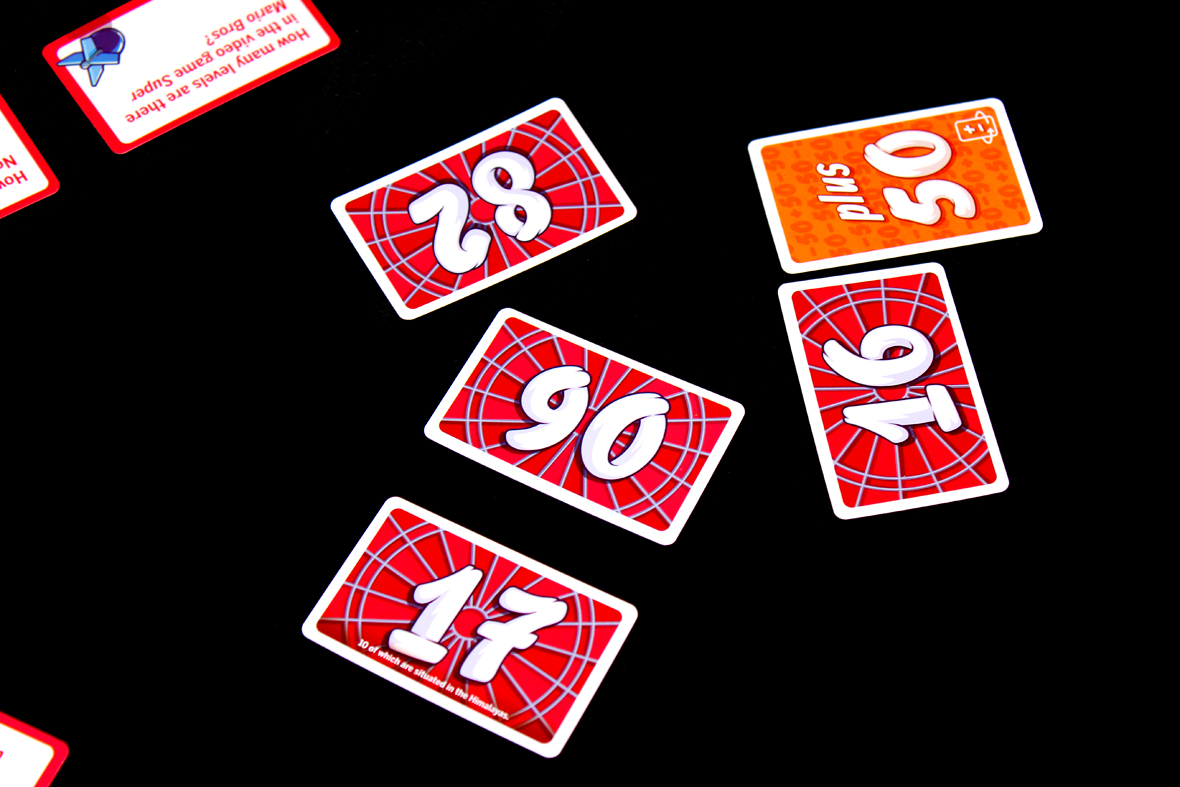
As soon as one team only has one remaining Question Card, they win! If multiple teams reach one Question Card in the same round, they must guess the number on the back of their final Question Card; the closer player wins.
It’s possible to use a Spot On! so that you’re left with zero Question Cards at the end of the round. If that happens, you basically get a Super Victory or something. Pat yourself on the back.
Player Count Differences
Not many, in this case! The only time you’ll really see major player count differences is at two players, since you’ll split into two teams instead of three. With more players, you still split into three teams, and you collectively submit the question for your team. More players might slow down the game a bit, just because larger teams will likely take a bit of time to discuss what question they want to put forward. There’s not a particularly large difference otherwise; that’s kind of the nature of some of these team-based games. Only one answer’s submitted, so beyond having the time for discussion, it kind of remains the same. No major player count recommendation, as a result, but I appreciate that the game supports head-to-head play.
Strategy
- It’s trivia; try to give the best answer possible and think through your options. You should have plenty to think about, given the wide variety of cards at your disposal. Just focus on trying to figure out what the effective range of the Questions you have are (for instance, is it less than or greater than 50? 25? 75?). Try using that line of thinking to segment your cards into “low numbers” and “high numbers”, for instance. You might still be wrong, but it gives you an avenue to at least make an educated guess.
- Note that if you’re not sure, sometimes it can still work out; you just need someone to do worse than you. At the true end of the round, I mean, it’s all about not doing the worst. So if you’re not sure, just bet that someone else has been a worse judge of their questions than you have been. It can work out … sometimes. I do appreciate that this isn’t a game where the goal is to be right; it’s just being the least wrong that matters.
- Spot On gives you an effective range of 5 in each direction; so think about whether or not your number likely falls within that range. That’s a pretty good range for a lot of things! You should at least try to use your Spot On! Card once per game. There’s no major downside beyond “now you can’t use it later”, so unless you’re really concerned about opportunity cost, you’re going to be fine.
- The Plus and Minus Power Cards can do a lot of work for you. The + / – 50 basically covers the entire effective range of the game, so, you can use that to move some of your cards around if they’re not landing in the right spot. Just try to get a sense of the general range of the cards you have so you know when you need to use one.
- You can even combine Power Cards! You can play a + / – 70 and a Spot On!, if you so desire, but I’d probably not recommend it. Or you can turn the + / – cards into an effective + / – 30, I suppose. I don’t quite see why you’d do that, but you can.
- That said, don’t waste your Power Cards! They’re pretty critical. You don’t want to be out all of your number-modifying cards and then get stuck unable to progress or play things. That can very easily cost you the game if you get stuck in one round. Try to use them sparingly or when you don’t have any other options (except for Spot On!; use that as soon as you know you can land it).
Pros, Mehs, and Cons
Pros
- The trivia questions are delightfully silly and unguessable, which I appreciate. A number of them are about how many bones are in something or how long or high something is or how fast a random thing could go, which I appreciate. As I mention elsewhere, I have no way of knowing those things so I just have to rely on my gut, which is about the worst possible thing you can do in a trivia game.
- It’s interesting that you’re not actually trying to be the most correct; you need to just not be the most wrong. It makes it so that almost every player usually progresses a bit closer to the end of the game. That prevents the game from dragging on, and it doesn’t overly reward one player for knowing stuff. That said, it does punish a player with bad instincts, but it’s hard to take it personally just because you don’t know how many eagles were sent to attack Prometheus or something. That’s not a real question. I also appreciate that, though; it’s nice that it’s not a trivia game that just rewards players for knowing things; it’s more of a fun discussion since most players may only have a ballpark estimate of what the right answer could be.
- Getting a Spot On (especially if you land it exactly) feels incredible. So that’s great. Landing the exact right answer is the trivia equivalent of a Grand Slam. You want to do a lap around the table and get high fives from everyone, but nobody wants to high five you because they’re not on your team. So that doesn’t feel as great, but it’s still pretty good.
- Plays pretty quickly! Again, focusing on only holding one player back instead of only advancing one player keeps the game moving quickly, which is nice. Plus, if that player makes a mistake, the other players can catch up pretty quickly, so you’re never too far out of the game.
- There are some laughable moments when a player is way off, though. They usually need to be at least 50 off before you can mildly drag them, but when you can, it’s pretty fun. Props to a player who just plays a legitimately baffling card, though; that takes moxie.
- As with any good party game, it’s pretty easy to teach. You’re essentially just playing Jeopardy with question cards and you’re just trying to be the least wrong. So simple! A good party game shouldn’t require a ton of finessing to get it to the table.
- I appreciate that you can Spot On into a Super Victory (having 0 cards left). It’s an optional victory condition that earns you absolutely nothing but the respect of the other players, so naturally I crave it, now. But I enjoy that it exists; it’s a fun little thing to shoot for if you’ve already gotten decently good at the game.
- Does seem pretty easy to expand. I’m sure there are plenty of obscure questions that have answers between 0 and 100, so, hopefully there will be more where this came from.
Mehs
- Not 100% sure why this is, but everyone tends to use the Plus / Minus 20 and 50 a bit incorrectly (they get confused as to which card it modifies). People just generally use the wrong side; in our games, we had a lot of someone playing the -20 on the target number and then playing a low value of their own, when they should have played a +20 on their own card. We understood what they meant, so we allowed it, but it’s just something that never quite stuck in our players’ heads (mine included).
- I worry a bit about replay value, just by its nature. I think it’s a bit too early to express anything more than a passing concern about it, but I also imagine that shuffling the cards up might help on that front. Plus, even if you know the answer to one of your cards, you may not be able to do much with it. Knowing a 37 doesn’t help you land a 79 if you have no Power Cards left, you know?
Cons
- You can somewhat infer the range of your cards, which can make things frustrating if you know you can’t make the target. This is the challenge as you start getting closer and closer to winning; you now have fewer options. This means you might end up unable to close the deal in the final round because the last number is an 87 and you’re stuck with a 19 or something. It’s genuinely frustrating from a player standpoint, but it is the consequence of burning through your Power Cards prematurely. Always have an exit strategy!
- Strange box shapes continue to be the bane of my existence. I’m genuinely unsure why the box needed to be this shape. It doesn’t lay particularly well, it only has identifying information on the front of the box, and it’s a weird shape so it can’t be stacked vertically with the front out. I understand that that helps it stand out more on store shelves and not everyone is a weirdo with a ton of dedicated board game shelves like me, but, darn it, these weird box shapes vex me. I still have a bunch of cylindrical board games (though I may try to barter my cylinder Junk Orbit for one of the new, reasonable box ones).
Overall: 7.5 / 10
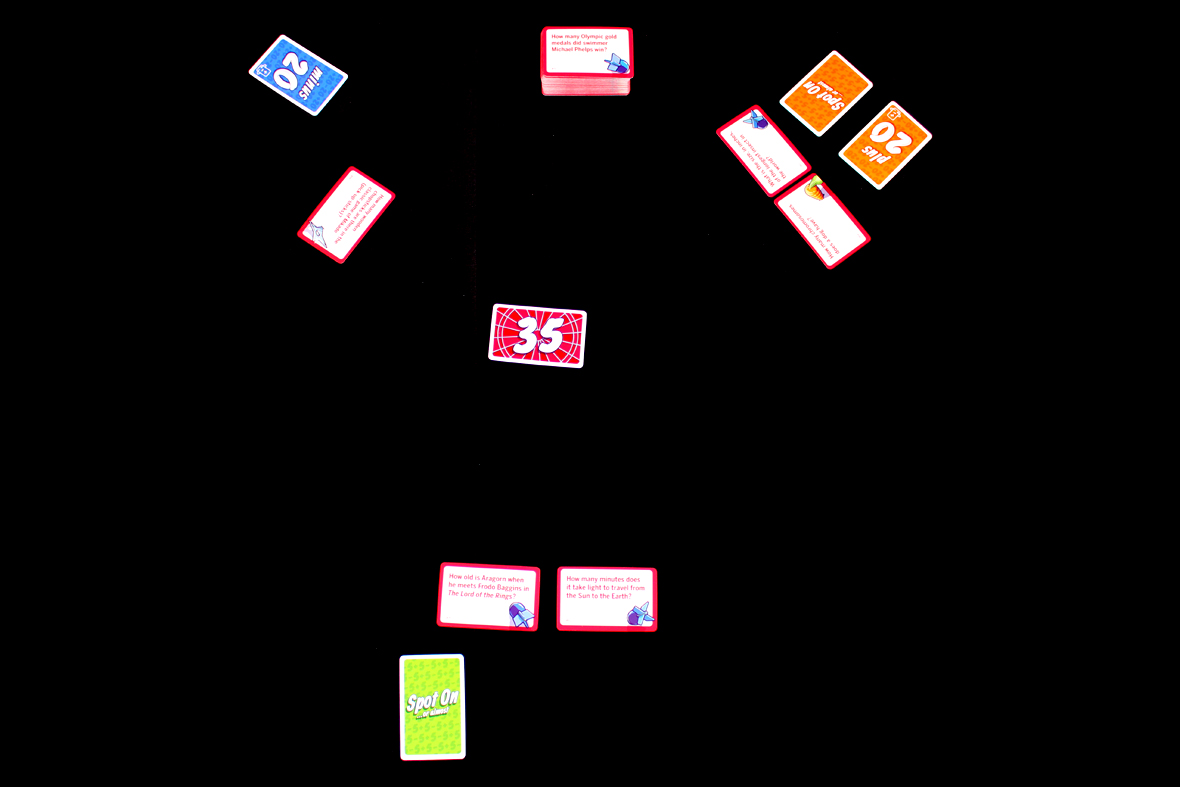
Overall, I think Zero to 100 is pretty fun! It’s a nice, light, middle-of-the-road trivia game, with some deeply weird cards and some deeply fun outcomes. I have no idea how many bones are in random parts of the human body, I do not know how tall some movie characters are, and I don’t know how fast anything goes. It’s great. My dream has always been playing a trivia game that doesn’t actually require me to know things, and instead I get to have an approximate knowledge of many things, like that weird cat from Adventure Time. The one challenge is that you do usually have a sense of scale of these things, so you might end up stuck with a bunch of cards on one end of the scale that leaves you stuck losing each round. I worry that trivia games may run out of steam after several plays, just because you might be able to start getting a sense of what the card values are, but I haven’t seen that issue present itself in the game yet. I wonder how much longevity in particular this has. We will see. That said, I’ve liked how quick and snappy Zero to 100 is! Very easy to pick up and play, simple to teach, and a relatively fast-moving game. I think that’s kind of the ideal for party games, and, to be fair, I’ve been generally impressed by Scorpion Masqué’s party game sense for the last several years. If you’re a fan of trivia but unburdened by knowledge, you are looking for a rapid-fire game, or you’d just like to learn something interesting, you might enjoy Zero to 100! I’ve had fun with it.
If you enjoyed this review and would like to support What’s Eric Playing? in the future, please check out my Patreon. Thanks for reading!
 What's Eric Playing?
Good luck with the big move! I’ll be doing the same thing in about a month, as it turns out; perhaps you can pass on some tips on how best to pack board games so they arrive undamaged.
Zero To 100 sounds like a nice slice of light fun–I’ve added it to my wishlist thanks to your review. And with that distinct shape, it may be one of the few games I’ll be able to FIND after my move…
LikeLiked by 1 person
Ahaha my best advice is to hire movers and hope for the best!
LikeLiked by 1 person