
Base price: $16.
2 – 5 players.
Play time: ~7 minutes.
BGG | Board Game Atlas
Buy on Amazon (via What’s Eric Playing?)
Logged plays: 4
Full disclosure: A review copy of Infernal Wagon was provided by Flat River Games.
I’m genuinely unsure what the last review I’m going to write in Calfiornia is. There are … three contenders right now? Maybe five, depending on how stressed out I get next week. I’m clearly not going to get to all of them, but even the thought of getting to three of them is a lot, especially with the massive Move Checklist I’ve made for myself. But that’s not a problem I’m going to solve at 12:30AM, so instead I’m writing about games. We all have our vices. This next game is a IELLO title coming from Flat River Games to the states; let’s check out Infernal Wagon and see how it plays!
In Infernal Wagon, you’ve struck a bit more than gold, unfortunately. You’re rich, probably, but also the mine’s collapsing, so you better get out as fast as you can! Team up with your friends and play tracks as quickly as you can to keep your mine cart one square ahead of the explosions. Any mistakes might cost you dearly, so you better be communicating and playing together if you all want to survive. Time is not a luxury you have a lot of, however, so play fast! Will you be able to survive this mine’s collapse?
Contents
Setup
This one’s pretty easy. You’re going to shuffle up all the Standard Cards:
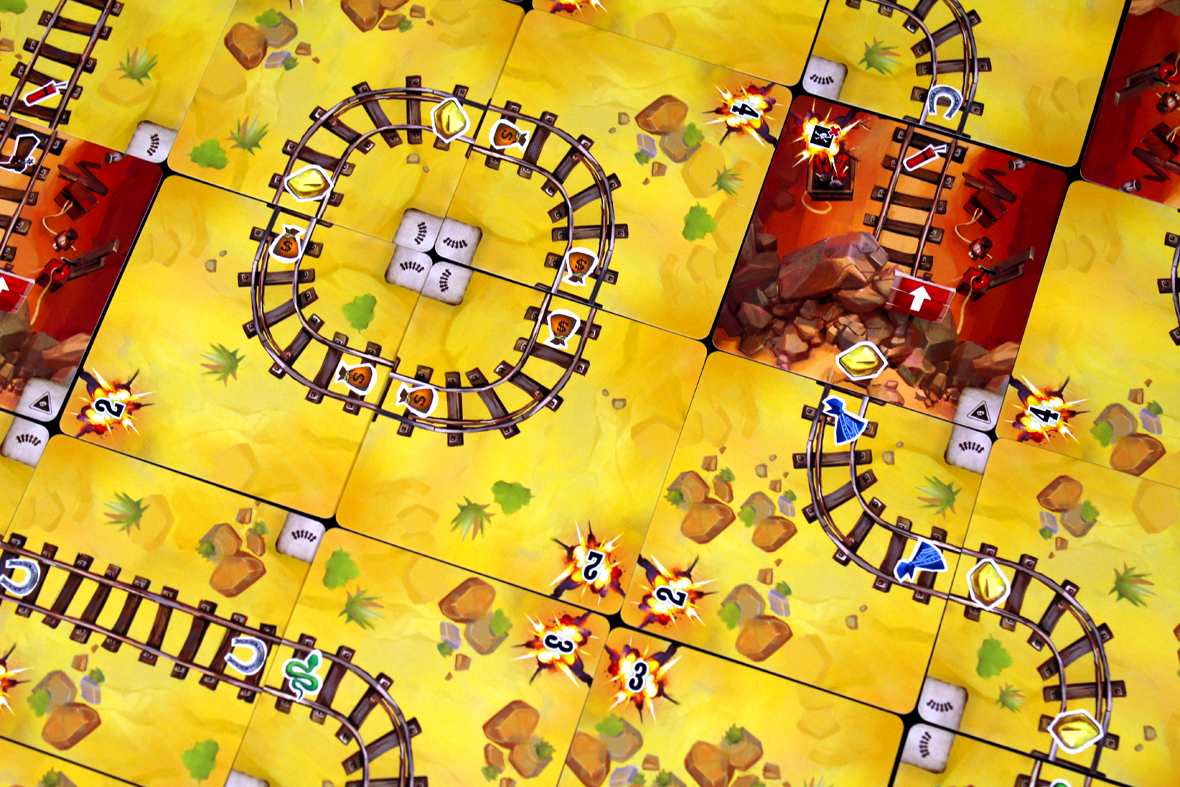
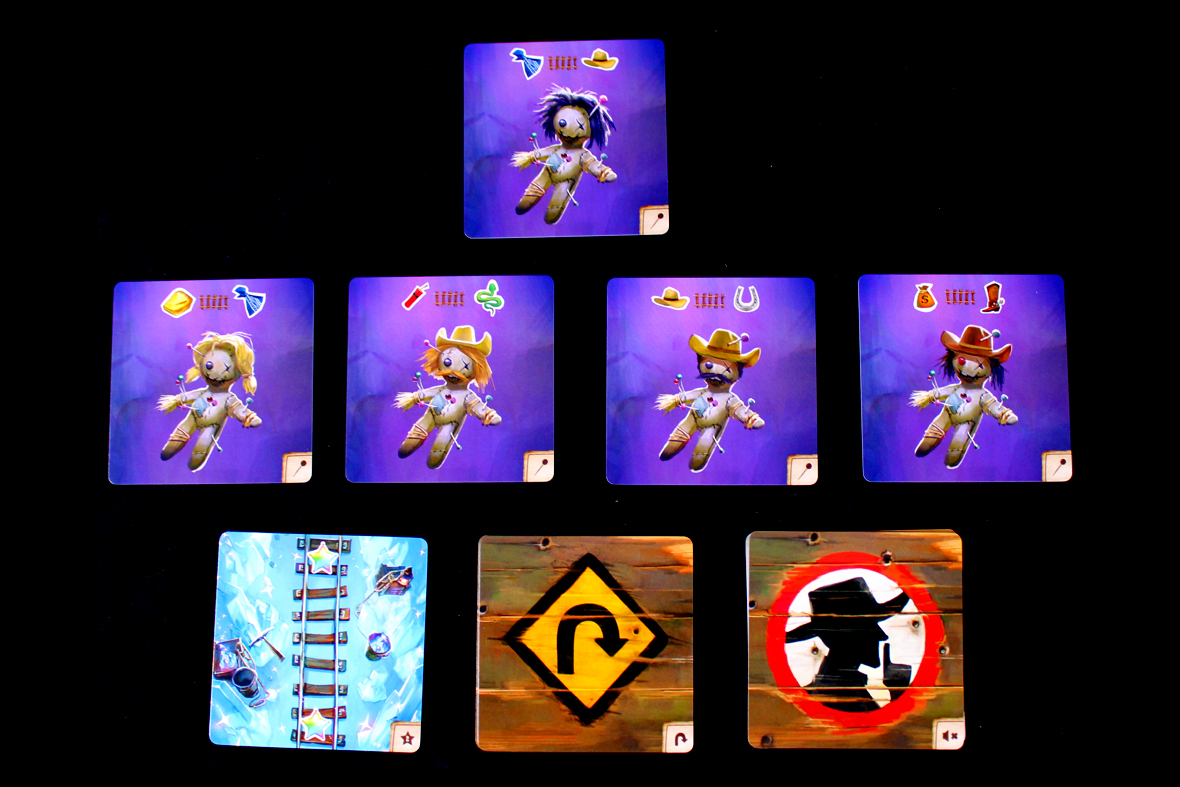
Leave the other modules aside for now; you can add them in later.
Set the three starting cards so that they indicate where the path should begin, like so:

You can place the Wagon Pawn on the card farthest from the explosion. Ideal spot.
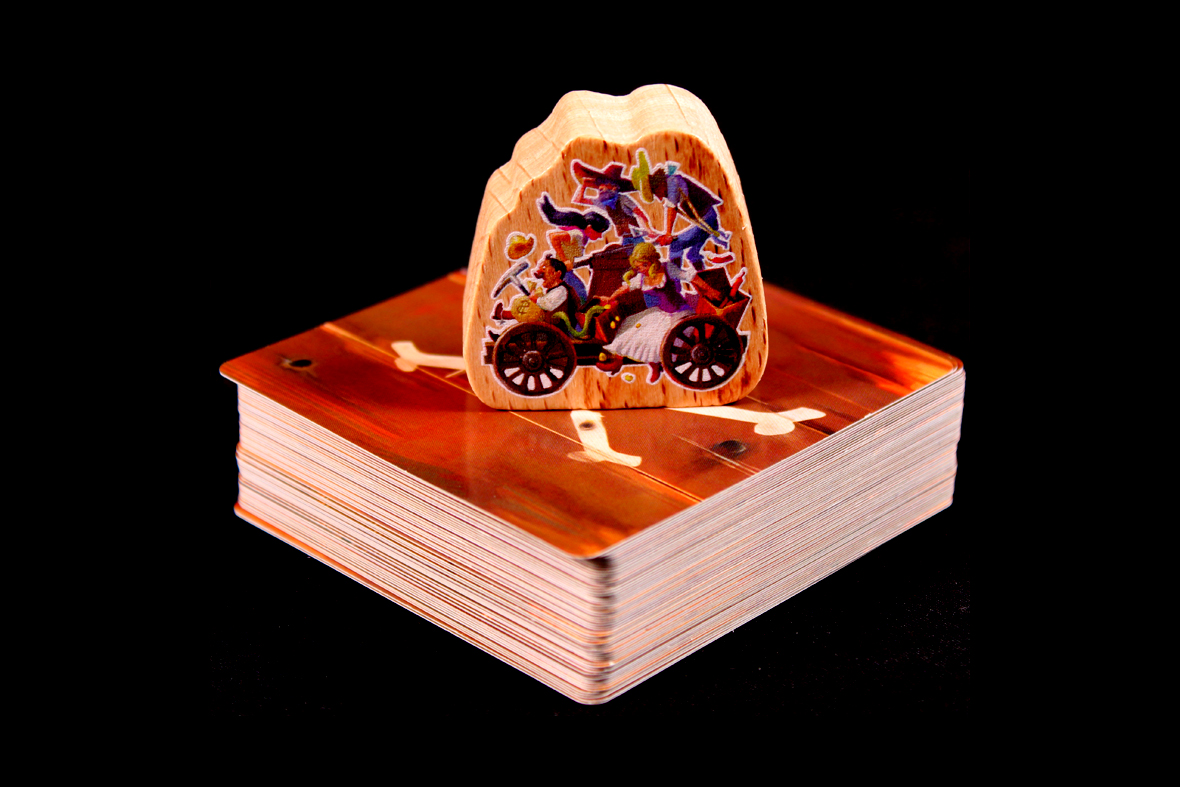
Place the Exit card on the bottom of the deck. You’ll hopefully get there later. Give each player some cards based on the player count:
- 2 players: 4 cards
- 3 players: 3 cards
- 4 players: 2 cards
Then, you’ll need a seven-minute timer! You can use this link, or you can do something less fun. Your call. You should be ready to start!

Gameplay

In Infernal Wagon, you’ve got seven minutes to escape! Place cards and avoid danger if you want to get out alive!
You don’t really take turns in this game; everyone plays cards as they feel like, extending out the track. When you do, move the wagon pawn to the next track card. If the symbol on the card you played matches the symbol on your previous card, you’re good! If not, you must activate the effect on the card you just played. That can range from anything from discarding cards off the end of the path to skipping your next card draw (permanently reducing your hand size). Some cards are Danger Cards, which have an effect every time they’re played! They might add a card to the end of the track or destroy almost all of the cards currently on the track!
After you play a card, draw one card. Note that if you were forced to skip your card draw, again, your hand size is permanently reduced. If that means you’re ever down to 0 cards, you cannot play. You just get to watch!

If you end up destroying the card that the wagon is on, or every player is stuck with 0-card hands, you lose! If a player draws and plays the Exit card successfully, you win!
For additional ease or difficulty, try mixing in some of the Junction Cards! They’ll either make the game easier (wild cards) or make the game significantly harder (cards that require you to play mismatched cards, cards that prevent you from talking, or cards that require you to play from other players’ hands).
Player Count Differences

Not a ton, really. The gameplay is fairly distributed, since players can talk about the cards in their hands and decide who plays what when, so with more players, you just end up with extra players with smaller hand sizes. You might think that that’s optimal, since more cards are in play, but there’s something to watch out for: at a certain point, it’s much easier for players to get de facto eliminated by Danger cards that reduce their hand sizes further. Once that happens, you’re in a bad way. Ideally, you’ll be able to make more useful connections that otherwise reduce that risk, but it’s something to be careful of. I’d contend the game is a bit harder with more players, as a result: more cross-talk and that limited hand size. Beyond that, though, no player count preference. It’s a lot of fun regardless.
Strategy

- Communicate! It’s pretty critical. You really need to be talking with other players at all times. Ask for who has the matching symbol for the card that was just played! Try to play to other players’ strengths so nobody loses too many cards! Just make sure that you’re not talking over the audio too much; you need to be keeping track of time, too.
- Honestly, placing mismatched pieces can be useful, sometimes; it helps clear up the table space. Having too many cards out can be kind of a hassle, and it can visually block where you might otherwise place new cards. Not ideal. Mismatching cards can be a useful way to try and clear out some of the older cards to make way for building new routes, especially if you’ve got a smaller table. Just try to avoid doing that with Danger cards.
- Be careful with Danger cards! Yeah, as mentioned, Danger cards can mess you up pretty significantly, both because they have a pretty intense on-play effect and also because they have a nasty effect if you happen to mismatch them. The worst effect is the one that permanently reduce your hand size if you mismatch them, as that can gradually push you out of the game. It can also put you in a really nasty spot where the only card you can play is a mismatch so it will always activate its effect, which isn’t good.
- Also be mindful of time. You really don’t have that much time. Seven minutes goes by pretty quickly! Might be worth working equally fast.
- If you’re coming up on the end of the deck, it might be worth bum-rushing it. You might want to just damn the consequences and just play as quickly as you can to get straight to the end. Just keep in mind that you pay the penalty for all your mismatching, so try not to run yourself out of cards.
- If you have no good options for cards to play, try to minimize damage depending on what you can play. Sometimes you have to play a card that’s mismatched, so keep an eye on how many cards you’re about to have to discard. You can err on the side of fewer cards discarded at a time, or you can burn it all in one big burst to clear the board and make way for new paths. Just, again, maybe avoid the Danger cards. They’re not what you want to be playing pretty much at all, unless you have to.
- That said, don’t hoard Danger cards. Having a hand full of Danger cards is similarly not ideal. It’s a hand management game, so manage that hand.
Pros, Mehs, and Cons

Pros
- This is a very silly and hectic game; I loved it. That’s my favorite thing about a lot of real-time games; the best ones can really use the real-time element to capture a feeling of high stakes and higher stress, and Infernal Wagon gets that. Everyone is moving and communicating and trying to play the right thing in turns and the game has a great flow as a result, even when you’re behind the power curve. The game creates “good stress”, and I think that’s a lot of the fun.
- I love that it comes with its own soundtrack! Games with their own soundtrack are fantastic, but I also appreciate that this one serves an additional purpose of being a very functional and threatening game timer. It’s better when it’s thematic.
- I also like that it’s a real-space game that’s kind of self-cleaning, so it never gets too out of hand with your table. I think the “Explosion” Danger cards are partially meant to do this; they discard a bunch of the previously-played cards so that you’re never entirely out of options for where you can build next. It’s a clever bit of design baked into the game. Even if you mismatch cards, they discard previously-placed cards, so you can use that to open up blocked paths (and unjunk your hand).
- The extra difficulty modules are a lot of fun! They’re clever; they have wild cards that lower the difficulty, required mismatch cards that make the game much harder, and cards that force players to play from each others’ hands and not talk. They’re all interesting gameplay variants to add as you get good, but there’s also an achievement for any player brave enough to try and win a game using all four of them…
- I also appreciate that there are “these cards make the game easier” cards; it’s nice to shuffle them in to start gradually increasing the difficulty. I usually recommend shuffling in one every time you lose until you find your preferred introductory difficulty level (it’s like Hades’ God Mode, in that way). Also shuffle one in every time you add in a new Junction module. It lets players configure the difficulty to meet their desires and needs, which is my favorite thing a cooperative game can do.
- A nice small-box game. I like this one! It’s portable, easy to teach, and plays quickly. Kind of all the things I’m looking for when I see a small-box game. I haven’t been able to get back to previously-played games a lot lately, but if I can, I want to make sure this ends up in the rotation.
Mehs
- It’s honestly a little difficult to remember to move the pawn; we had to jump it forward a few times every game because we kept getting ahead of ourselves. Not really a problem, just something to try and keep in mind as you play. It’s a bit clunky of an element of play, but I understand why it exists. It serves meaningful narrative and gameplay purpose; it’s just kind of out of the loop of “what you’re doing while you play”, so you will see players neglect to move it. Real-time games tend to force players to prioritize and optimize, so clunkier elements can get knocked out like the pawn does as they frantically try to win.
Cons
- it’s kind of weird that a player can get de facto eliminated from play (their hand size gets stuck at 0, meaning they can’t draw any more cards). It’s a weird facet of how the game works, but it’s definitely the thing I like the least. I’m generally against player elimination in pretty much any context, though, so it’s not surprising. The one comfort a pseudo-eliminated player can find is that the game doesn’t take that long, so they’ll be back in time for the next one.
Overall: 8.25 / 10

Overall, I’ve had a lot of fun with Infernal Wagon! It’s probably one of the “funner” games I’ve played lately. This isn’t to say the other games haven’t been fun, but they’ve largely been strategic and interesting and fun in that way;. Infernal Wagon is first and foremost concerned with being fun and silly and bombastic, which is a nice and welcome change of pace. I haven’t had much time for my usual wheelhouse lately; been too busy for dexterity and too bogged down with the move for large-group party game events. Hopefully that will change around Gen Con time, especially since I’m visiting the Oink Games booth, but this brought me back to a great spot. There’s not much in the way of “deep strategy” here, and there doesn’t need to be! You just need to get out of the mine as fast as possible before it explodes. The entertainment is the stress factor, and Infernal Wagon knows how to offer that as a streamlined and fun experience, from the mechanics of the game to the soundtrack that keeps time before the mine collapses. I particularly respect this game for doing cooperative difficulty extremely well;; there are many different modules that make the game more difficult, and they can be used together or separately or integrated with another module that makes the game easier to allow players to find their preferred challenge level. Want an easy game? Dump all the wild cards in. Want a harder one? Slam a few modules in. You can customize it. I love that, and I’m very impressed to find a small box game that gets difficulty in that way. I think I’ll be playing Infernal Wagon again in the future, and if you’re itching for a fun and silly cooperative experience, you like real-time games, or you’re just interested in the mechanics of making a co-op game scalable in terms of difficulty I’d definitely recommend checking it out!
If you enjoyed this review and would like to support What’s Eric Playing? in the future, please check out my Patreon. Thanks for reading!
 What's Eric Playing?