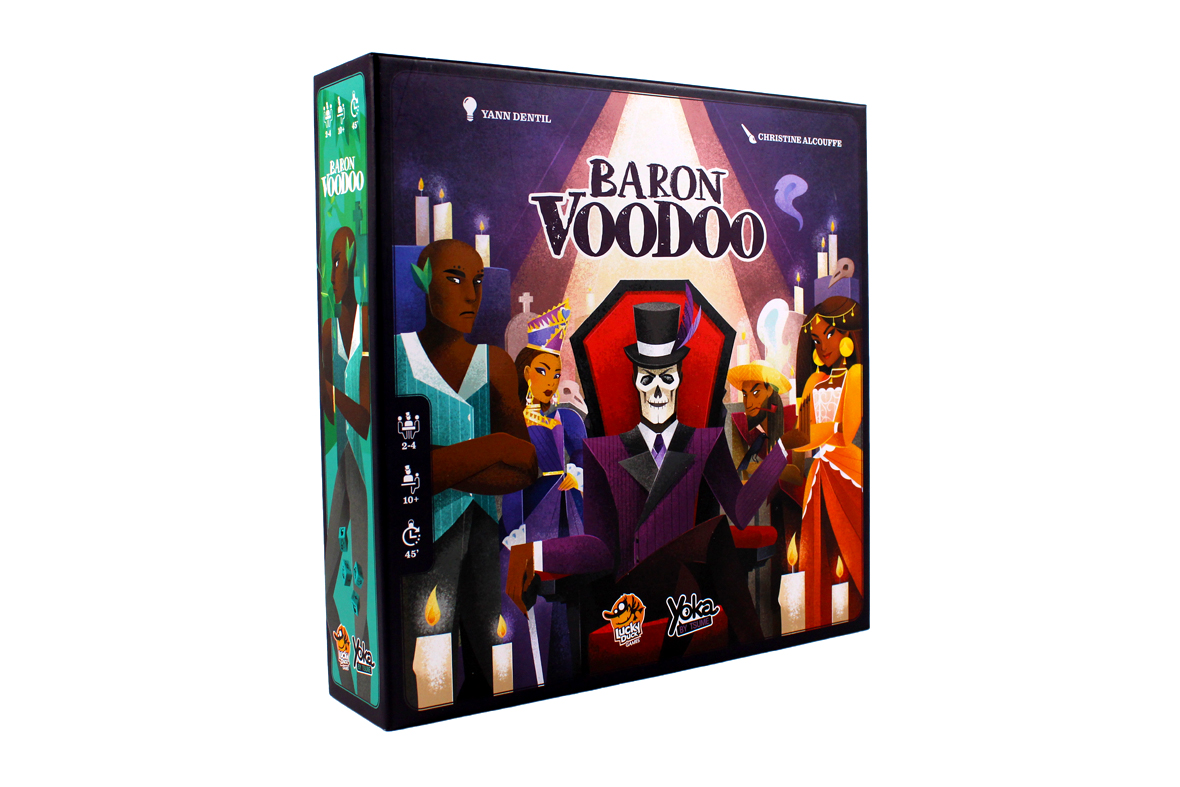
Base price: $40.
2 – 4 players.
Play time: ~45 minutes.
BGG | Board Game Atlas
Buy on Amazon (via What’s Eric Playing?)
Logged plays: 2
Full disclosure: A review copy of Baron Voodoo was provided by Lucky Duck Games.
Alright, another week means another round of reviews! Currently been working through some games in my house before I move, and the next one in the queue is Baron Voodoo! Lucky Duck Games has been having a pretty robust year in terms of production, so let’s see what they’ve got going on with this one! A few of these weeks are going to still be two-review weeks, just as I transition to the new place. So let’s see how Baron Voodoo plays!
In Baron Voodoo, players take on the roles of Loa who seek the throne and powers of Baron Samedi. To get it, they have to guide the most souls to his realm in one night! This may involve some trickery (and occasionally just stealing souls from other players), but you’re pretty sure you can work it out. Baron Voodoo is an abstract strategy game where, on your turn, you must move a die in your player color, skipping over another space and taking the skipped die into your supply. As you do, you can use the skipped die’s ability to gain points, offering tokens, or steal dice from other players. As players gain points, they get closer to the end of the game! Who will end up upon Samedi’s throne?
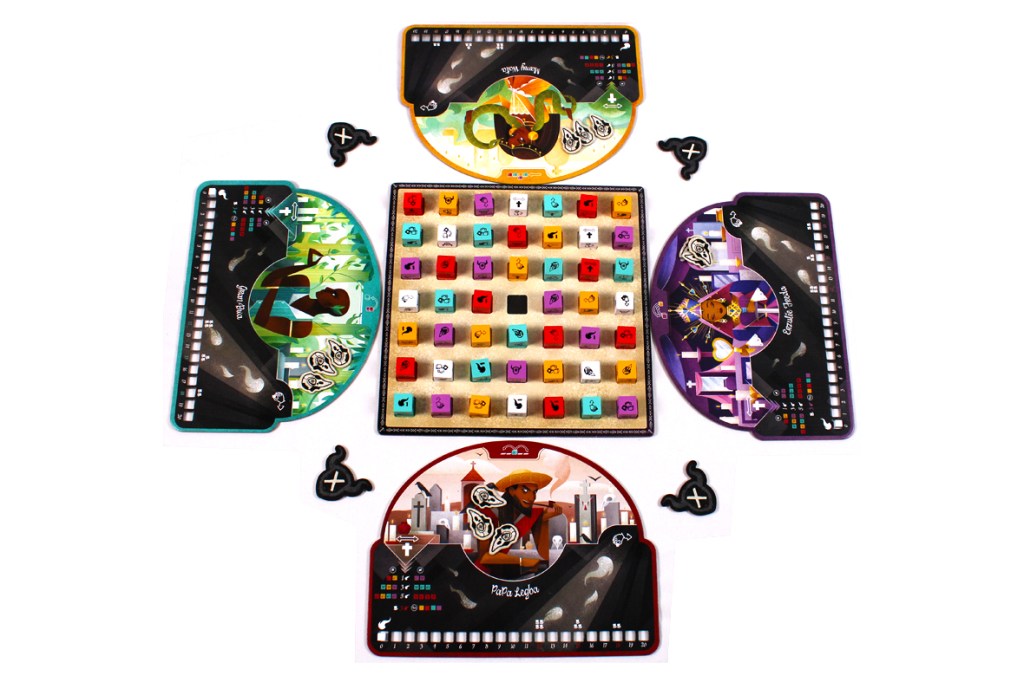
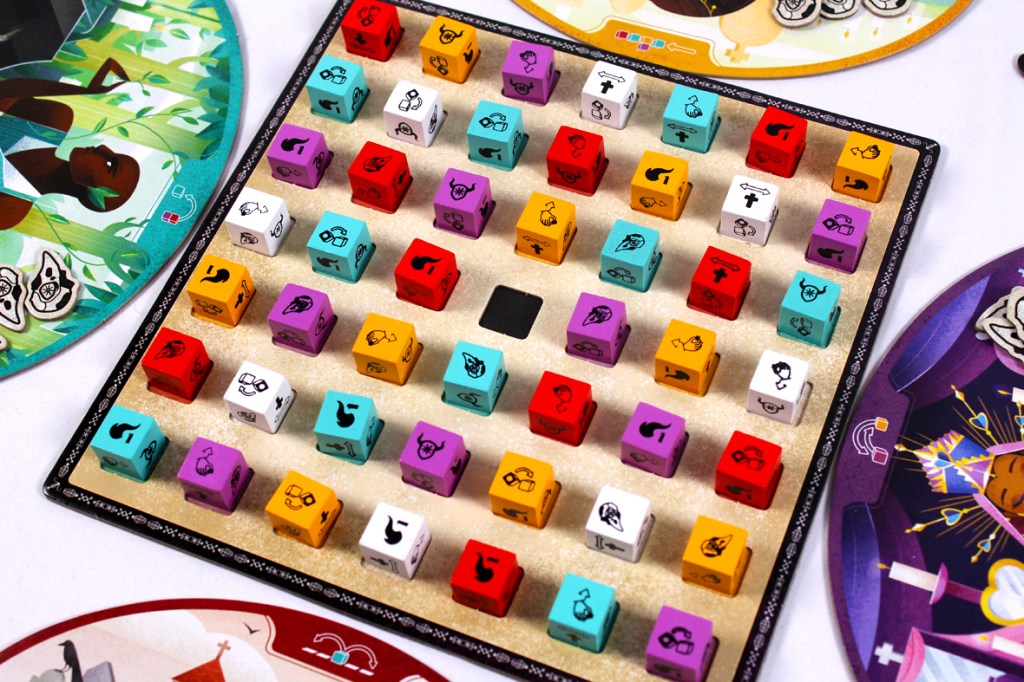
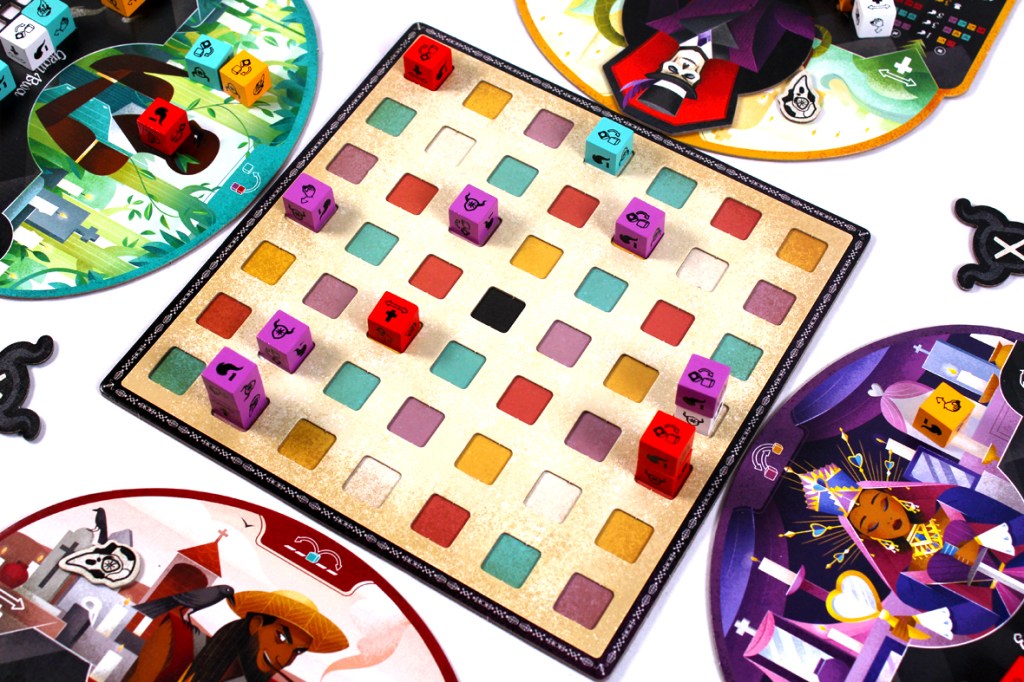
Contents
Player Count Differences
This kind of comes out as a complaint about the rulebook, but I’d probably not recommend this one at two. At two, it’s a bit zero-sum once a player gets Baron Samedi’s abilities, and that puts them in a pretty good position (since you can only get it back from them by having more white dice than they do). This can be tough to do, especially since they can use any Loa’s power for free, whereas you have to pay for the privilege. Plus, the game isn’t precisely clear on whether or not the other Loas are in play (for the purposes of using their powers), which can be frustrating. At four, it’s a bit different, but there’s a lot of chaos happening. Any player that gets Baron Samedi’s power too quickly can be picked apart by the others between theirs turns, so there’s some incentive to maybe not go power-mad too quickly. That said, the game is also over quickly, since you now have four players fighting over a finite number of dice. This convinces me that the sweet spot for this is probably three players; a nice balance of being able to balance out aggressive players without any collective destruction of the shared board space.
Strategy

- You’d really like to have the abilities of Baron Samedi, if you can. It’s pretty handy to be able to use any other player’s ability without having to pay. You can only use one a turn, granted, but you can make a lot work with access to any ability. Keep in mind that this relies on you having the most white dice in your Spirit World, but, you know, make it work.
- Try to have a plan for the dice you take. You should try to take dice that either specifically advance your ability to score large sets, or you should take dice that have abilities you need. Taking arbitrary dice doesn’t necessarily help you out in the long term.
- Saving up dice for a big score is good, but remember that other players can take or swap those dice around if they so choose. Building up a big combo is risky! It’s very easy for players to take your dice on their turn. It’s not a bad idea to dump dice into your Spirit World as quickly as you can, or consider getting a Protection Die to prevent another player messing with your dice before your next turn.
- You’ll want enough Offering tokens that you can take another turn every so often. You need two Offering tokens to take another turn. You can get them from dice or from capturing your own dice, so try to set yourself up so that you can take another turn. It’s a pretty useful way to build combos off of the dice. It’s also nice because you can build up a set of dice and put them into the Spirit World before other players can take them away from you.
- End of the day and fancy dice abilities aside, you’re trying to score points. Don’t lose sight of that just for some interesting combos. You don’t want to keep shuffling around dice every turn while other players are scoring; even Samedi’s abilities can’t make up for a 5+ point deficit over the course of the game. Keep your eyes on the prize, here.
- You can take dice to try and limit other players’ options, but be careful! Doing so might end the game. If a player can’t make a useful move, the game ends (after finishing the round). That said, you can try to take dice to force other players to make less useful moves (or to prevent them taking certain dice that you’d like).
- You always want to stay apprised of how many dice other players have and in what colors. At the end of the game, you get 3 points for having the most dice in each color. As a result, it helps if you know how many dice your opponents have in each color. A swing of 6 – 9 points can really change a game!
Pros, Mehs, and Cons
Pros
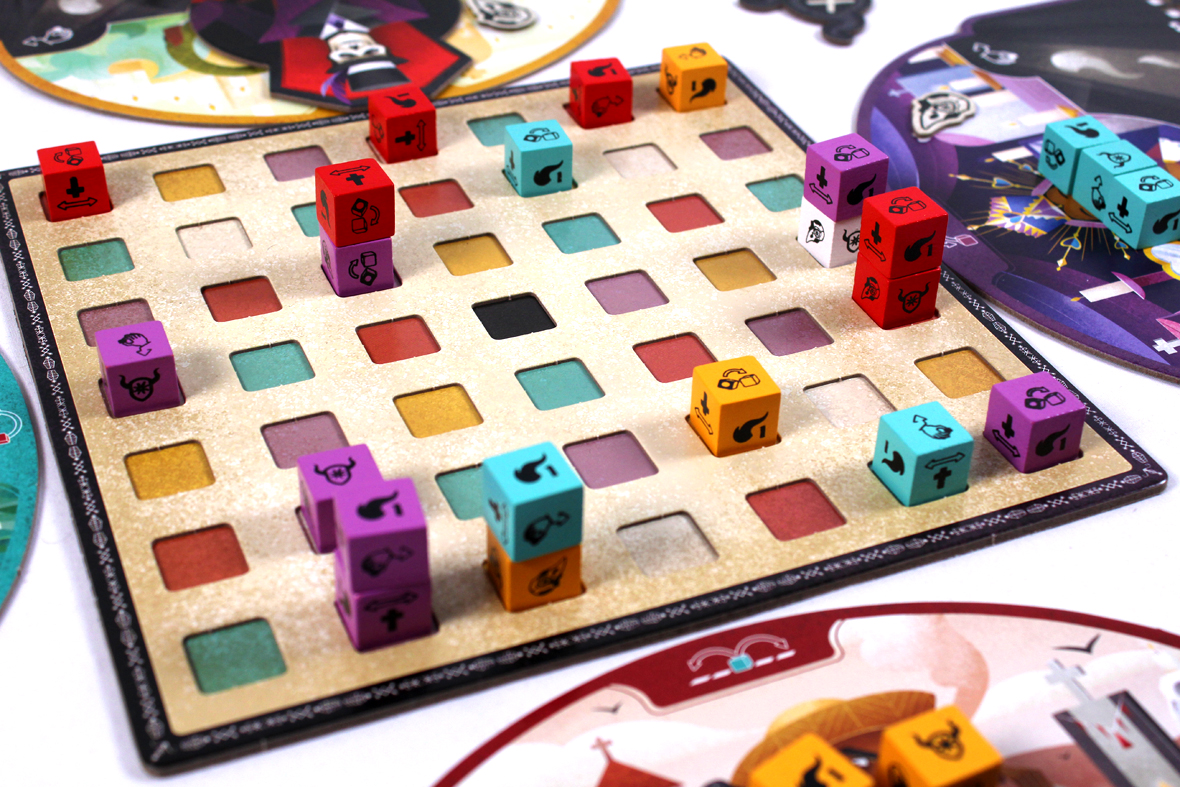
- I like the colors in this game a lot. They’re a nice and distinct set, and the contrast against the heavy use of black is also really good. It’s generally a really pleasant color scheme.
- I’m also happy to see a game where the characters are people of color; it’s a nice change of pace from a lot of what I end up playing. It’s relatively uncommon, so I was very pleasantly surprised. It’s something I look for but not something I get to see that often.
- The theme mostly makes me want to watch Live and Let Die, but I think that’s my two brain cells connecting Baron Samedi. I just really like Live and Let Die; part of that is the very good theme song, but another part of it is just the jazz and New Orleans exploration of it all. This reminds me favorably of that, though it’s not entirely relevant to the game.
- The core game isn’t too difficult to learn. You’re mostly just hopping dice over top of each other. There are some abilities and some set collection to all of it, but it’s not a particularly complex game. The complexity mostly comes in with the rulebook being … not ideal, but if you have a rules video or something, it’s not too bad.
- There’s also a lot of variance caused by the dice at the start of the game, which makes for interesting play. I like rolling the dice to start out and placing them on the board! It changes up the various outcomes of play and of player turns, which is pretty interesting. It gives players a variety of options, which can influence their play style.
- I also like the variants offered for balancing out the dice in the rulebook. If you don’t want that variance, you can balance out the dice with a few variants that basically make all the dice the same. There’s also a very mean variant for players that want to lose friends.
Mehs
- I think nicer dice would have really elevated this game, though I imagine it would have elevated the price quite a bit, as well. It’s a bit of a bummer. Nice dice would have made for a really cool experience. The challenge around that is that many unique dice would have ballooned the price, and, that’s not necessarily going to balance out in the game’s favor.
- Given how much players need to know, player reference cards might have gone a long way, as well. There are a fair number of dice abilities and player abilities; it would have been helpful to have a card to keep track of things. The back of the rulebook does a fine job, but individual player references could have made it a bit smoother.
Cons
- The rulebook is rough. The BGG page gives a pretty good idea, but I think there’s some language work at play, here. Unfortunately, there are a lot of places where additional explanations or examples would help make the game a lot clearer, even as far as setup goes.
Overall: 6 / 10
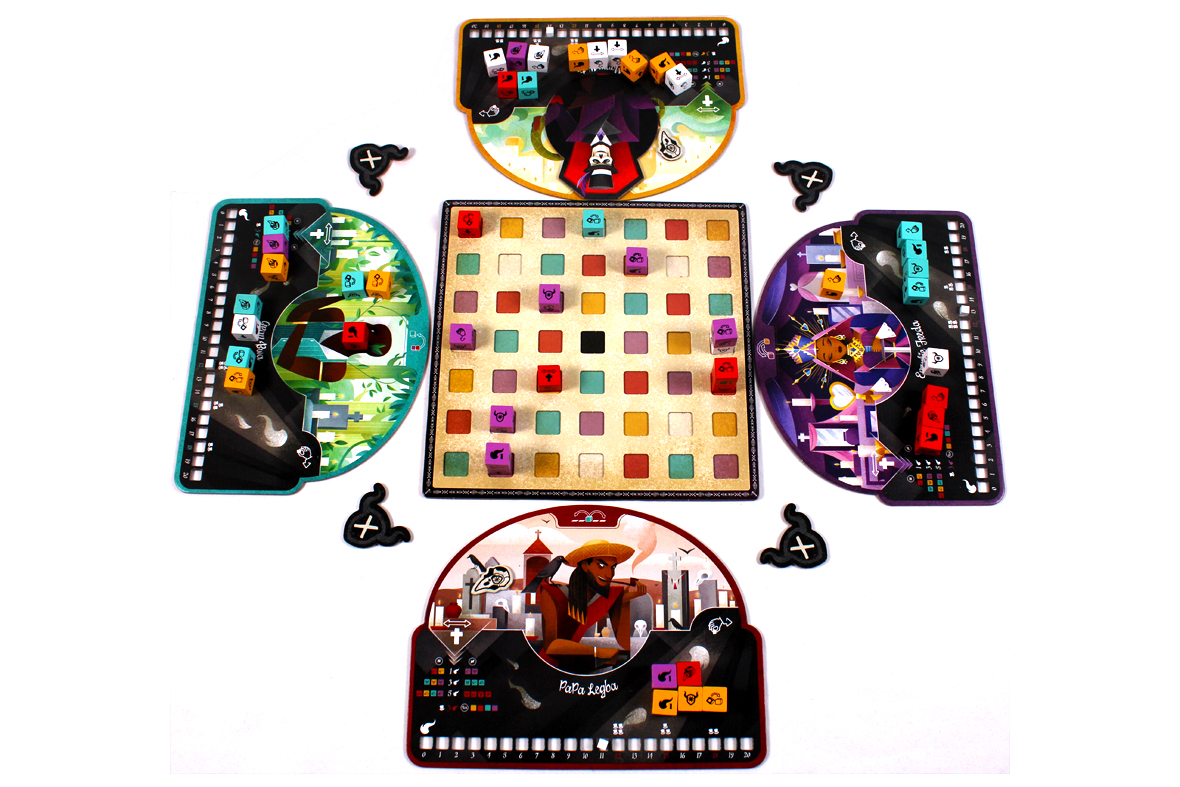
Overall, I thought Baron Voodoo was fine. That’s a pleasant step up from when I first played it; my friend and I did not enjoy it. I’m starting to suspect that we missed a rule or something, which is understandable; the rulebook needs a bit of work. It’s not quite clear, for instance, how a two-player game is different than a four-player game, which is the kind of thing that I’m generally looking for. That makes the game a lot harder to play, which is unfortunate, as Baron Voodoo is a clever abstract with some cool things I haven’t seen before. I enjoy, for instance, how finite the board is; it’s interesting how players essentially pick it apart as they capture dice and use them for various effects. It also means that the game is pretty different every time, since the dice faces allow for all kinds of abilities. Even having players sit in certain orders and use their abilities can really switch up the configuration of the game, which is fun. I do wish the dice were a bit closer to dice and a bit farther away from just being Big Resource Cubes, but that would have ballooned the price. The color scheme is nice, as well, and I’d be lying if I wasn’t delighted by a game full of characters of color. It’s just tough to shake a game with a rough rulebook, and I think more should have been done here to polish things up, especially around key areas like how player abilities work. I think there’s still a good game underneath of it, but it’s a lot of digging through BGG and forums and essentially trying to divine what the correct rules are, and that’s a bit of a hassle. If you’re interested in the theme, you enjoy a dicey abstract game, or you’re cool figuring out a few rules on the fly, you might enjoy Baron Voodoo, as well! I’d be interested to see a second edition or something.
If you enjoyed this review and would like to support What’s Eric Playing? in the future, please check out my Patreon. Thanks for reading!
 What's Eric Playing?