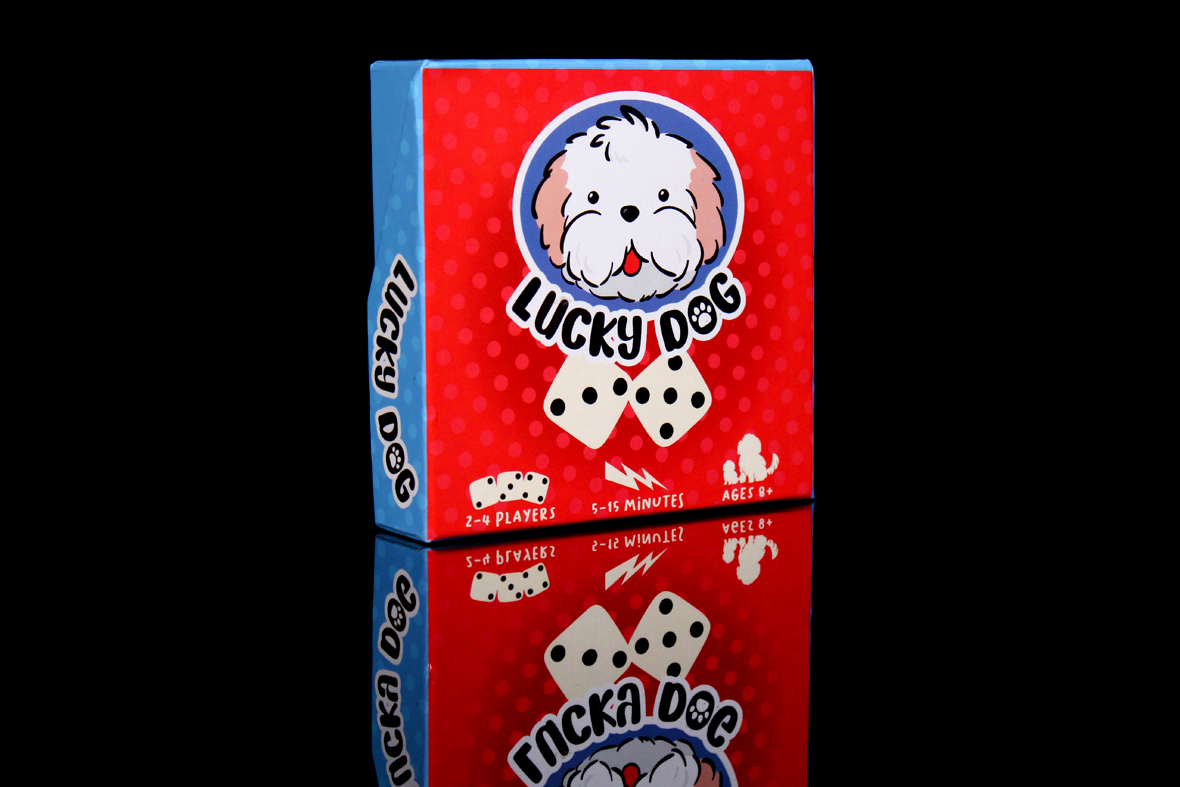
Base price: $15.
2 – 4 players.
Play time: 5 – 15 minutes.
BGG | Board Game Atlas
Check it out on Kickstarter!
Logged plays: 3
Full disclosure: A preview copy of Lucky Dog was provided by Evan’s Games. Some art, gameplay, or other aspects of the game may change between this preview and the fulfillment of the Kickstarter, should it fund, as this is a preview of a currently unreleased game.
I think this is going to be the first wave of reviews I’m writing in my new home. It’s a bit hot in the summer since the sun takes so much longer to set up here, but I’m excited about being in a new place and then immediately leaving that place to go to Gen Con. Some things don’t change, I suppose. But I’ve got a new license, a registered car, and I registered to vote, so I think I’m a Full Adult in a New State, now. I also had to rebuild my entire lighting rig for photos, so there may be some slight changes in coloration while I’m adjusting to a new location. Your patience is appreciated, but at least it’s not my dining room anymore. In the meantime, let’s check out a new game from our buds at Evan’s Games: Lucky Dog!
In Lucky Dog, you’re trying to make sure your dog has the absolute best day possible, as you should be doing every day of your life as a dog owner. If you’re not ready for that, don’t get a dog; I don’t make the rules. Whether it’s treats or cuddles or long walks, you’ve got your work cut out for you, especially as other players endeavor to treat their dogs even better than you treat yours. The insolence. Roll dice to fulfill challenges to love the hell out of your dog. Every dog has his day; when will yours?
Contents
Setup
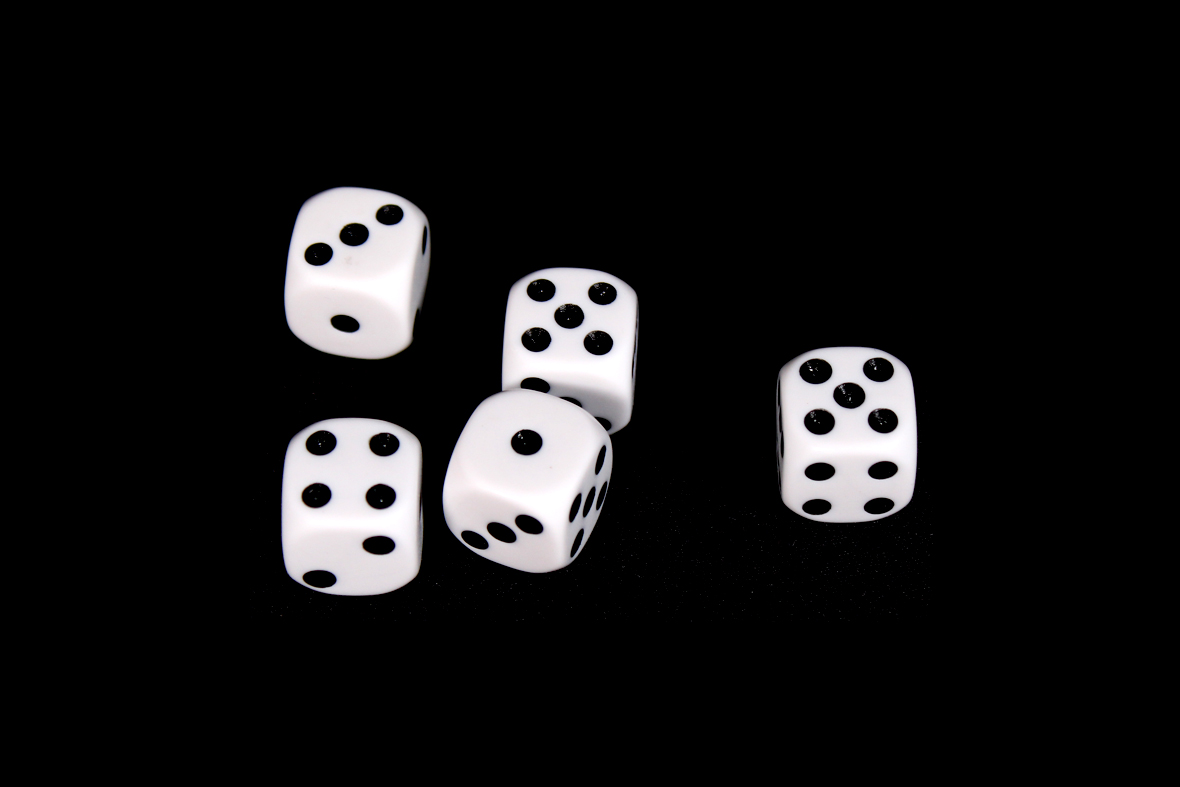
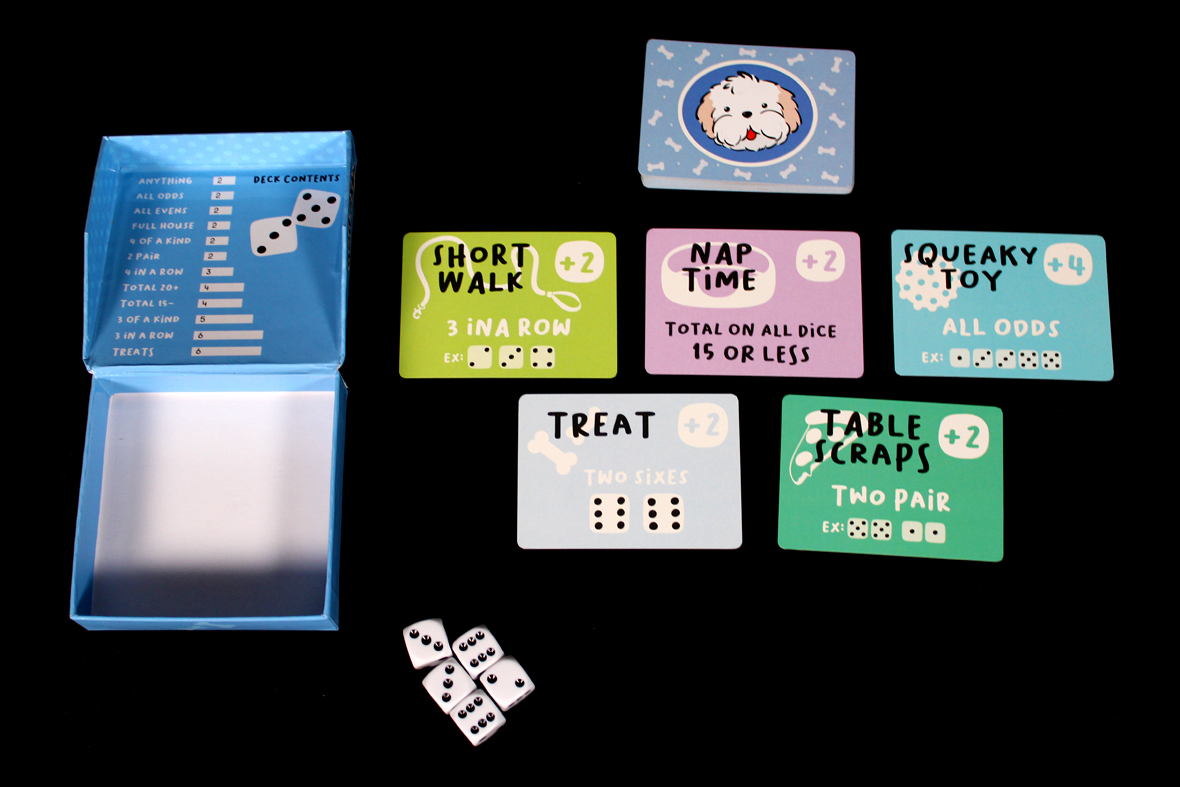
Not a lot, effectively. Give the dice to the first player:
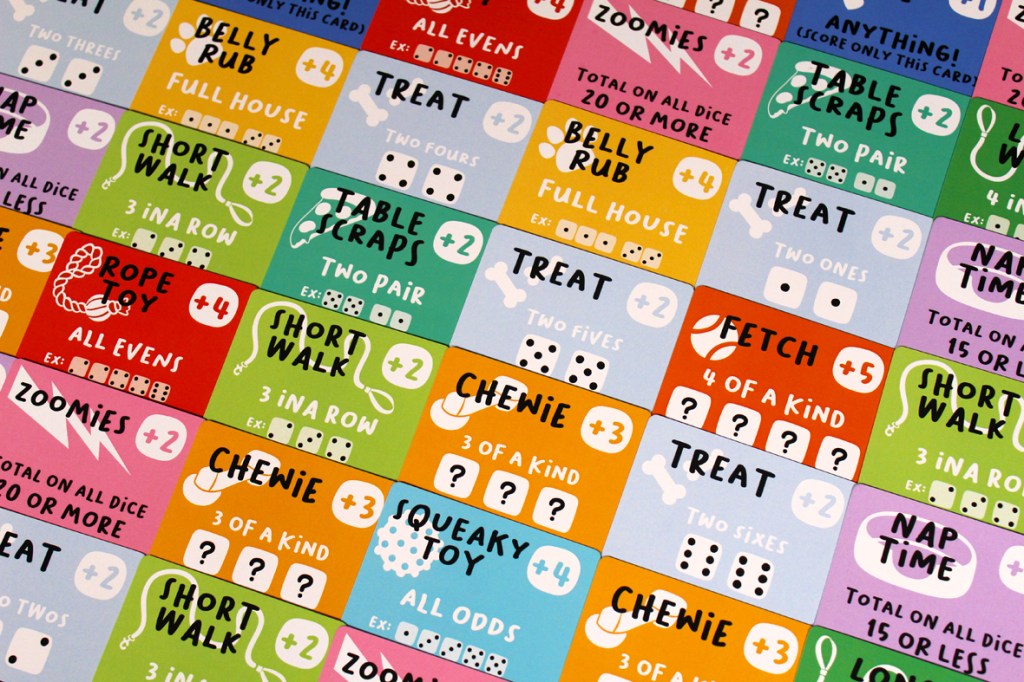
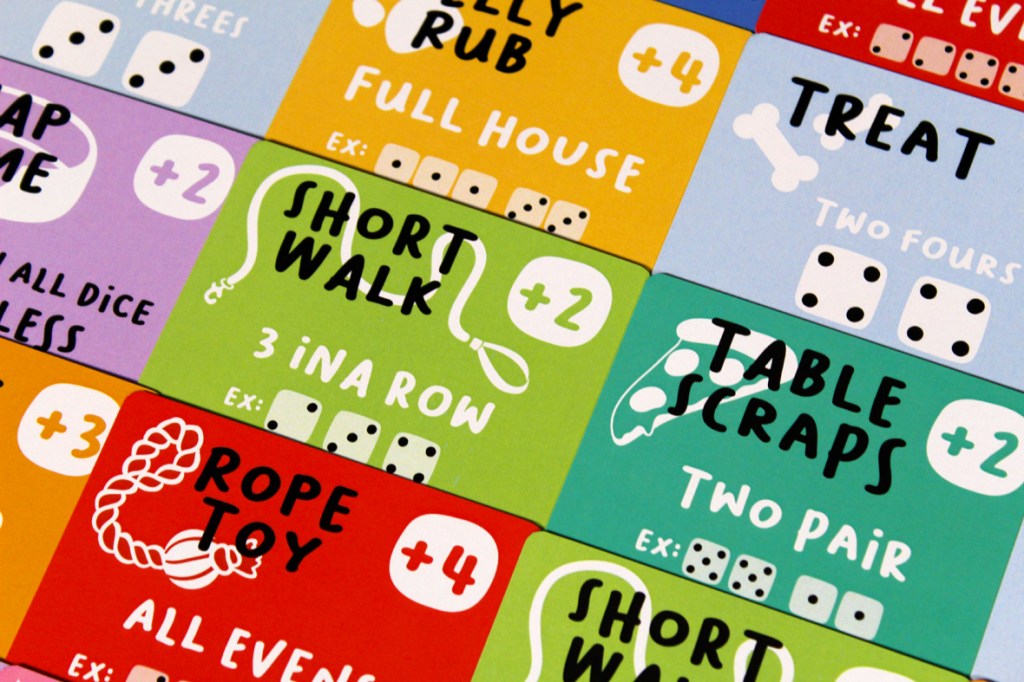
Shuffle the cards and deal five face-up, setting the rest in a face-down deck.

You should be ready to start!
Gameplay
A game of Lucky Dog is relatively straightforward. Let’s dive into it.
Over a series of rounds, players will attempt to be the first one to earn 20 points by treating their dogs like kings and queens. This includes treats, walks; all sorts of things.
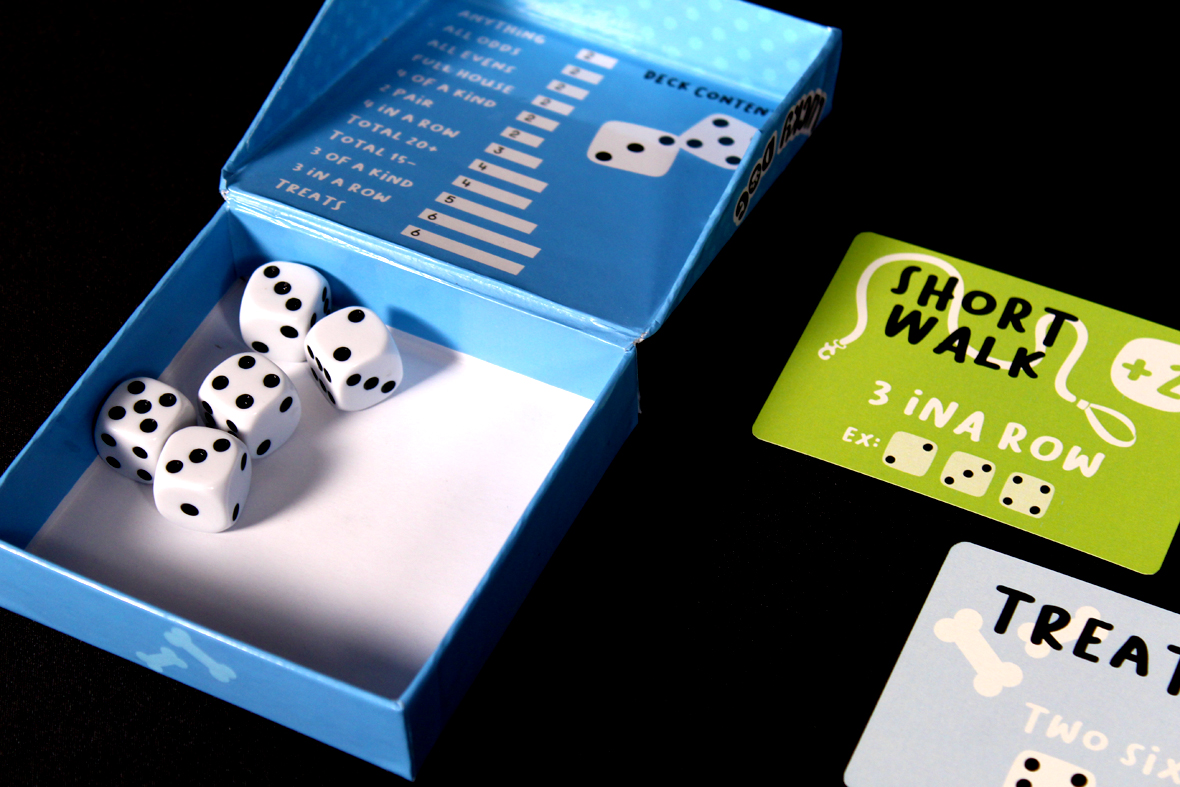
On your turn, you’ll start by rolling the five dice. Once you do, you may discard any of the five cards and replace it with a new one from the deck. After that, you may choose any or all of the dice to reroll twice (note that you don’t have to choose any, and you can choose different dice on your second reroll than the first, if you want).
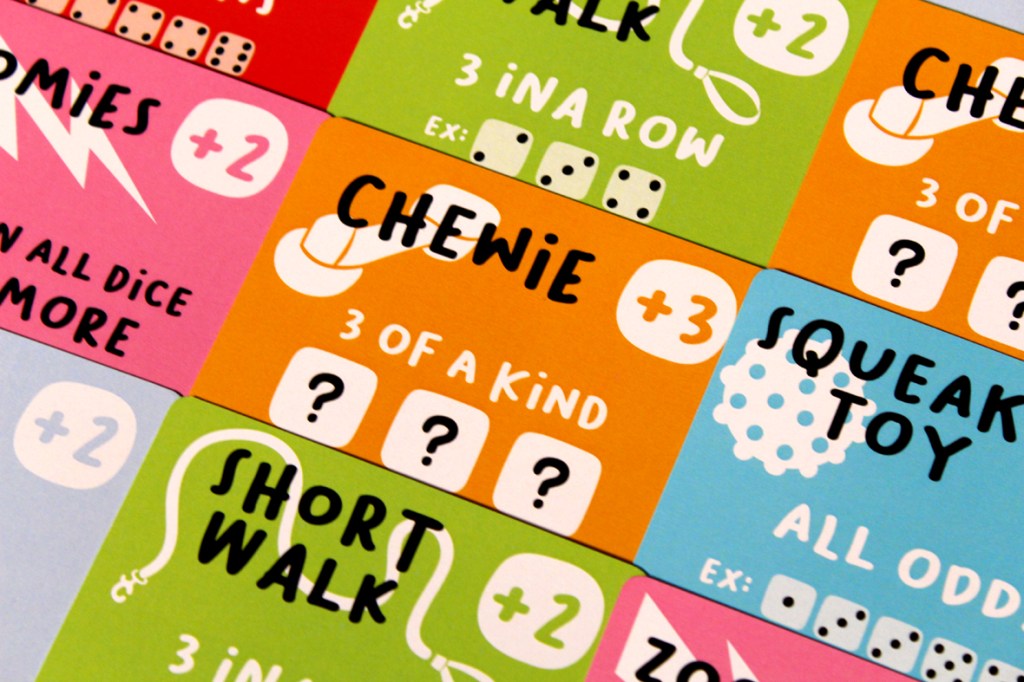
Once you’ve finished your rerolls, you may score as many cards of the five face-up cards as you can. To score a card, your dice must match the criteria on the cards (3-of-a-kind, 4 in a row, pair of 2s, things like that). Note that overlaps are fine; if you would score a 4 in a row, you may also score 3 in a row cards (since you must have a 3 in a row to have a 4 in a row). The cards aren’t mutually exclusive. If the same card appears more than once, you can also score all instances of that card. Take the cards you score and place them in front of you; those are your points.
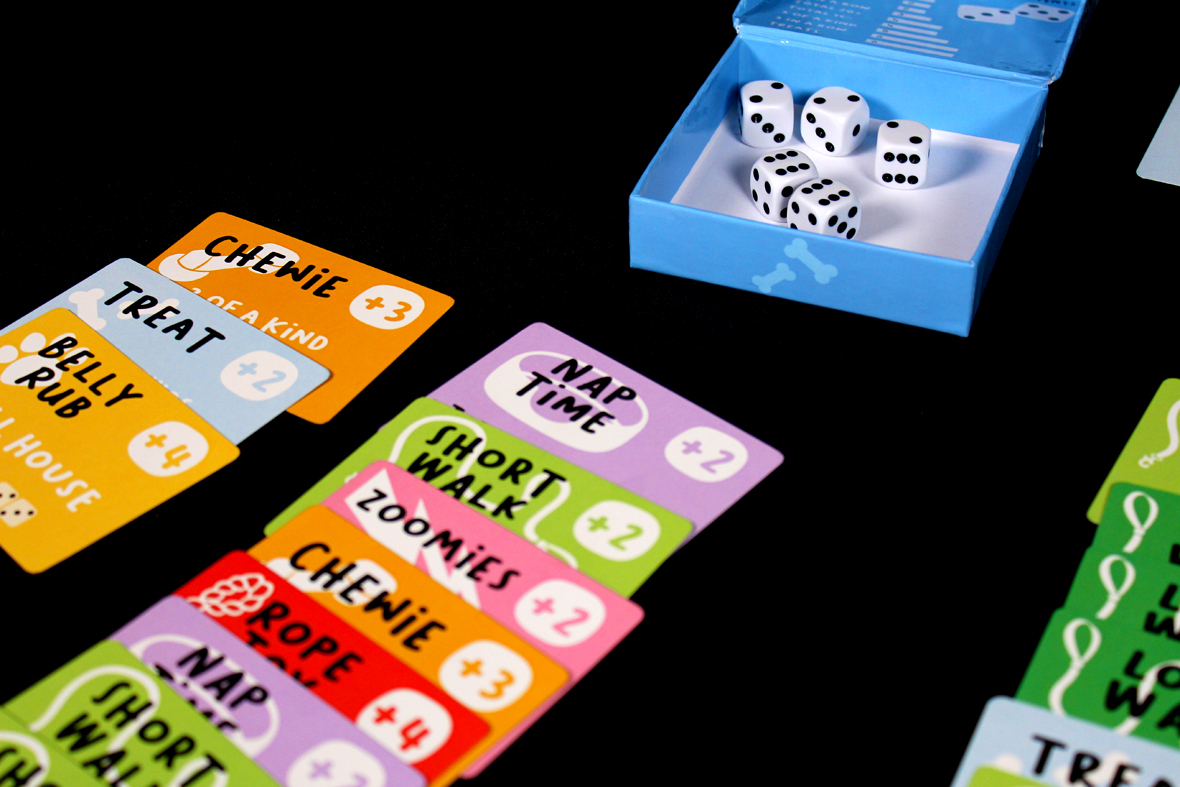
If you hit 20 points, the game enters its final round! The remaining players get a turn (so that every player takes the same number of turns) and then the player with the most points wins!
Player Count Differences
There really aren’t a lot, here, since there’s no player interaction beyond you being able to discard a card of your choice. While you might do that to get rid of a card that you won’t be able to score, you might try to do that strategically to remove a high-value card that’s unattainable for you from play. With more players, that’s a bit less viable since there are just more cards getting drawn between your turns, but what can you do, I suppose. I gently prefer lower player counts as a result, since I feel like the back-and-forth of a two player game makes me feel like I have some effect on my opponent, but higher player counts are totally fine.
Strategy
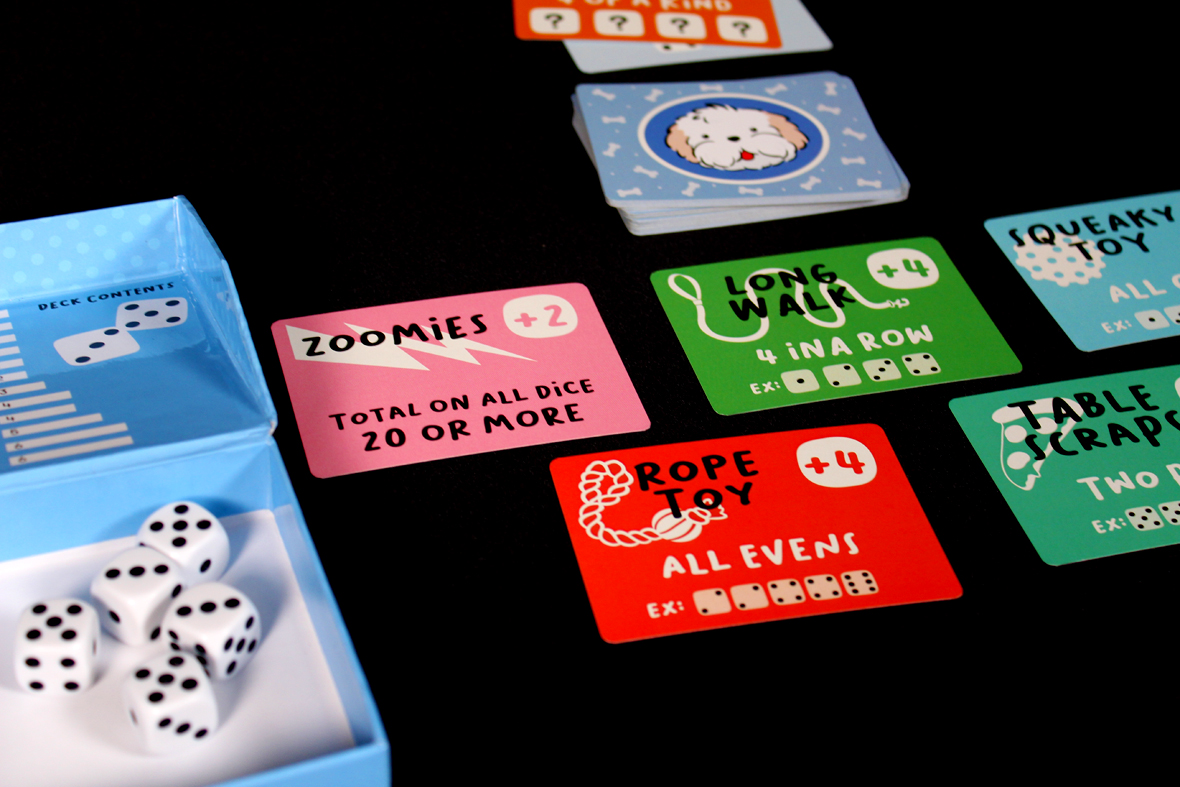
- Your initial roll is going to set the tone for what you can do on your turn, in all likelihood. It’s going to give you a baseline. Granted, you can choose to reroll all of your dice, but after your first roll is the only time you get to discard one of the cards in play, which can help you decide what you want your strategy to be. You can get lucky on subsequent rolls, but your first roll matters a lot.
- Choose your cards carefully. If you have All Events and All Odds in play, well, you can’t score both and they’re worth a lot of points, so it might be worth discarding one of those so that your opponent will potentially get lower-value cards on their turn as options. It’s not really guaranteed, but might as well make it a bit harder for them if you can.
- You might need to swing for the fences at the end of the game to defend your score. If you get 20, the game’s only over at the end of the round. This means that other players might be able to outscore you if they get lucky, so you may want to try and get as many points as you can so that they can’t catch up. Just make sure you don’t get too full of yourself and end up scoring nothing at all!
- Certain cards can overlap, so it may be worth going after overlaps if they appear. You can score pair, full house, three of a kind, and four of a kind if you have five of the same die value (according to the rules; I’m a full house purist but I follow rulebooks). Granted, getting five of the same value is easier said than done, but you can go after similar (and simpler) overlaps if they appear to help boost your score.
- Oh, yeah, probability and variance both can help you here. If you’re going for four in a row, it’s better to start from a 3 – 4 – 5 than a 4 – 5 – 6; the former gives you two possible options (2 – 3 – 4 – 5 and 3 – 4 – 5 – 6, meaning you can roll a 2 or a 6), and the latter only gives you one possible option (3 – 4 – 5 – 6). Consider what your most likely outcomes are and try to plan accordingly, and then throw caution to the wind because it’s dice. Live your best life.
Pros, Mehs, and Cons
Pros
- Very quick little game. One of the fastest! I mean, if you have a particularly lucky turn, you can almost run away with the game in one round! I’d be more impressed than anything if that happened.
- I appreciate that you can pop out the insert and use the game as a dice tray; that’s nice. The dice roll nicely into the box (it’s a relatively small box) and the insert fits nicely inside the box, too. It all works. Another nice thing is that the card distribution is printed on the inside of the box lid, for folks who like that kind of information.
- The variety of card colors are pleasant. It’s not a full pastel rainbow, but it is a nice collection of colors. Gives the game a nice splash of color.
- I like that you can almost always get some useful amount of points on your turn. It’s very rare to be able to get absolutely nothing on your turn, just because you have five dice and five available card possibilities. It can happen, granted, but it’s relatively unlikely.
- Remarkably simple to teach, as well. You just roll dice up to three times and try to match sets on the cards. Very Yahtzee-esque, but with per-turn challenges rather than a sheet to fill out.
- Very portable. You can almost fit the game in your pocket! Depending on your pockets, I suppose. Are people still wearing cargo shorts? Did those ever come back around?
- I appreciate that the extra mode is just a bonus cooperative mode. A lot of crowdfunded games I preview have a lot of extra content, which often can make it tough to review. It’s something about trying to appeal to all possible audiences with as many bells and whistles as possible. It’s crowdfunding. But I appreciate a game that keeps it simple, even more so when the simple is a nice pleasant coop game.
Mehs
- It’s a short game, but it’s also a luck-driven one; make sure you’re appropriately prepared for that. If you don’t like games with major luck components to them, well, you should probably stick to games that aren’t dice-driven games with random card draws. I don’t really know what to tell you.
- For a dog-themed game, there are remarkably few pictures of dogs. There’s a dog on the box, but where are the rest of them? I would like to request additional dogs in the final version so that I know my attempts to give them the best possible day are landing well.
Cons
- The “Cuddle” card (+1 point for any combination of dice, but you can only score that card) doesn’t seem to have much utility in our games unless you get deeply unlucky with rolls. I assume this is to make the game more palatable to players who are newer to this kind of gameplay, but it doesn’t really work in our games; it just ends up being a dead weight card. I’d almost rather it be +1 to any card of your choice or something.
Overall: 7 / 10
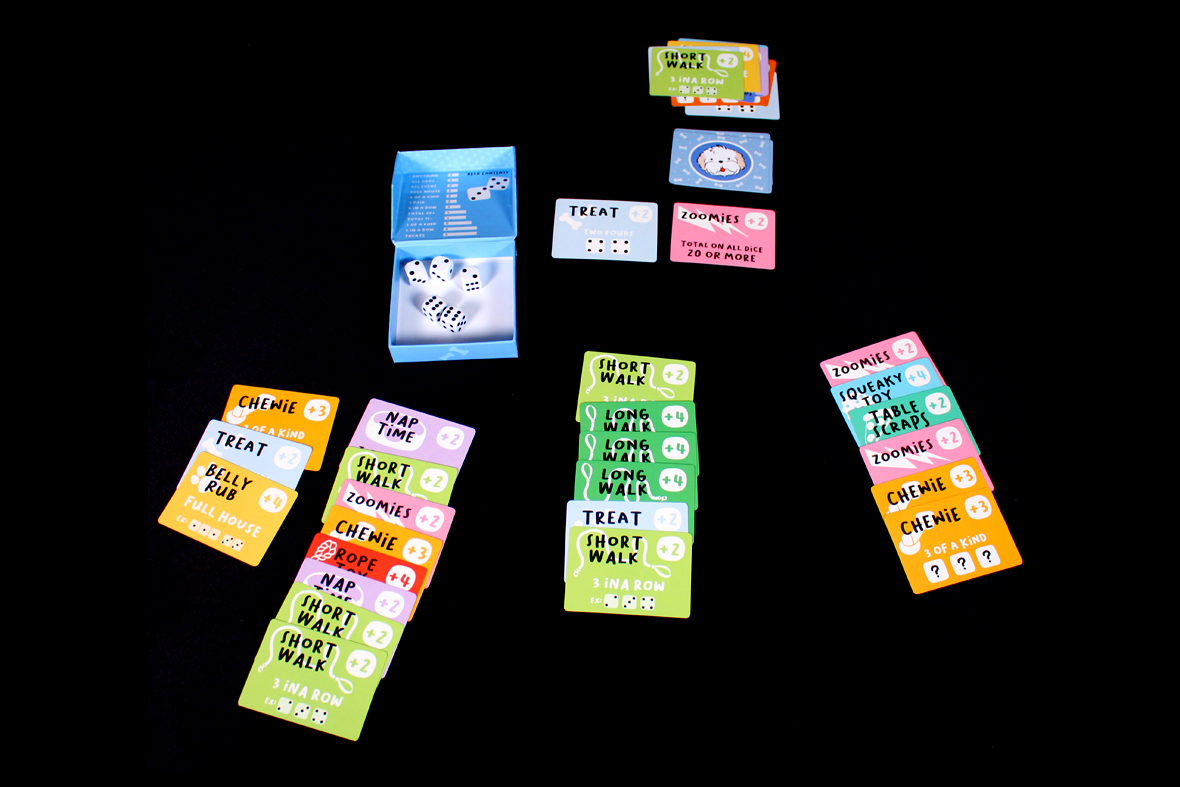
Overall, I think Lucky Dog is a fun game. It’s hard not to be charmed by a game with a cute theme and some pleasantly-colored cards, so I’m just giving in and choosing to let myself be charmed by it. Generally, these kinds of games appeal to me pretty strongly since they’re extremely easy to pick up and play, and Lucky Dog was no exception to that. We got it to the table pretty much immediately, played a couple games, and had a good time. It’s not necessarily going to be a game with the depth that some seasoned veterans are looking for, but it’s also not trying to be. It’s shooting for a game that you have no problem playing when someone asks, and in that regard it does its job impeccably. I’ll be interested if there are more dog elements getting added to the game after crowdfunding, just because I wanted to see more dogs, but that might be my game of Good Puppers a week or two ago still living rent-free in my head. Who’s to say? If you’ve got a low tolerance for luck in your board games, well, this has both random card draws and dice rolls as pretty much the entire core of the game (and is literally called Lucky Dog), so you might want to look elsewhere. If you’re looking for a quick game that you can play with just about anyone, though, Lucky Dog is a nice choice for that slot! I’d happily play it again.
If you enjoyed this review and would like to support What’s Eric Playing? in the future, please check out my Patreon. Thanks for reading!
 What's Eric Playing?