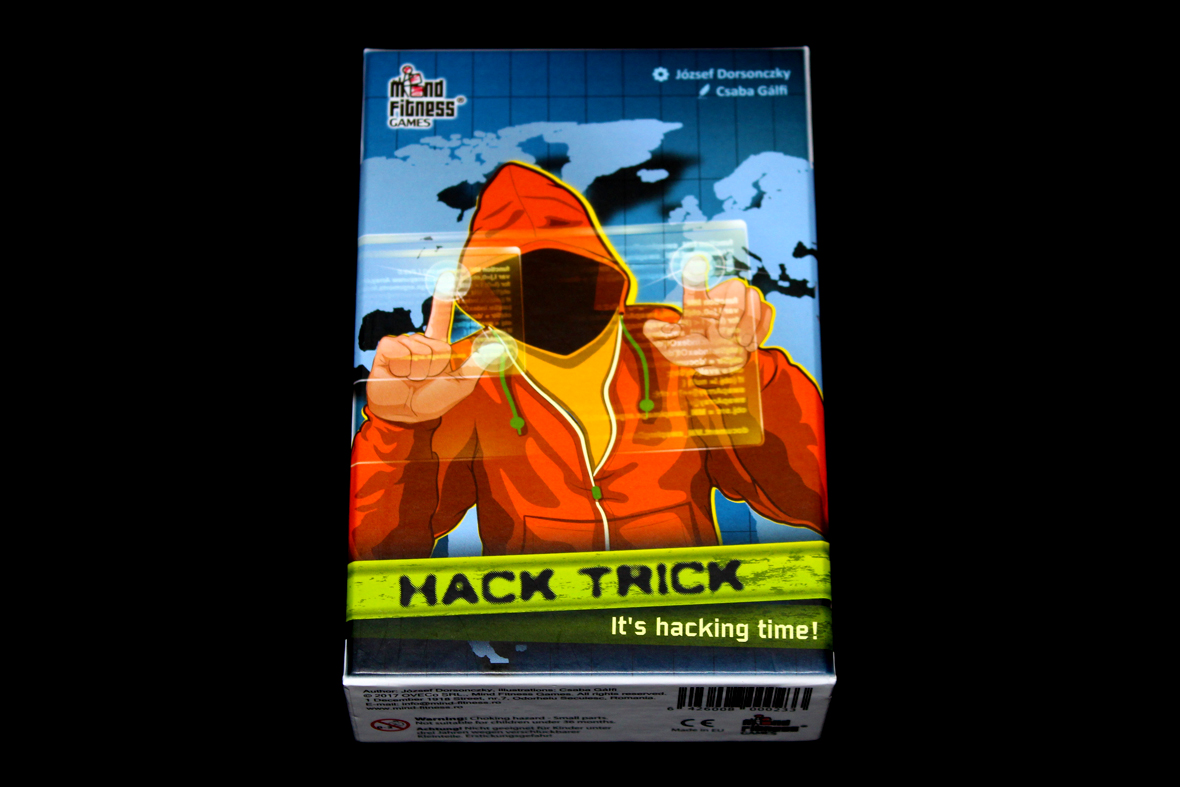
Base price: $15.
2 players.
Play time: ~10 minutes.
BGG Link
Buy …? (I’ll update this if it ever becomes widely available.)
Logged plays: 17
So, having recently successfully moved, I’ve needed a bit of extra time, so I’ve dusted off some fun reviews from the archives! This one’s of a game I tried out at BGG.CON in 2017, so, that’s fun too. Enjoy this review! It’s a vignette of a writing (and photography) style that’s been evolving over time. I will say the game’s inclusion of bitcoin as its primary score-tracking mechanic is even more cringe-inducing than it was when I first wrote this review, so I’ve got that going for me, which is nice.
You play as rival hackers vying for control of the world’s … web infrastructure or something. You need to hack one of the 9 Internet Terminals (there are only 9) so that you can gain control before your opponent does. The first player to own an axis or hack the same place three times uninterrupted wins! Do you have what it takes to become a legendary hacker?
Contents
Setup
First thing to do is to assemble the board:

Give one player the yellow cubes and the other player the purple cubes:

One cube of each color is bigger than the others. Don’t worry about it; it only matters for a specific variant. Shuffle the cards:

Flip two face-up above the board; they’re just out, for this game. Give one player three and the other player four.
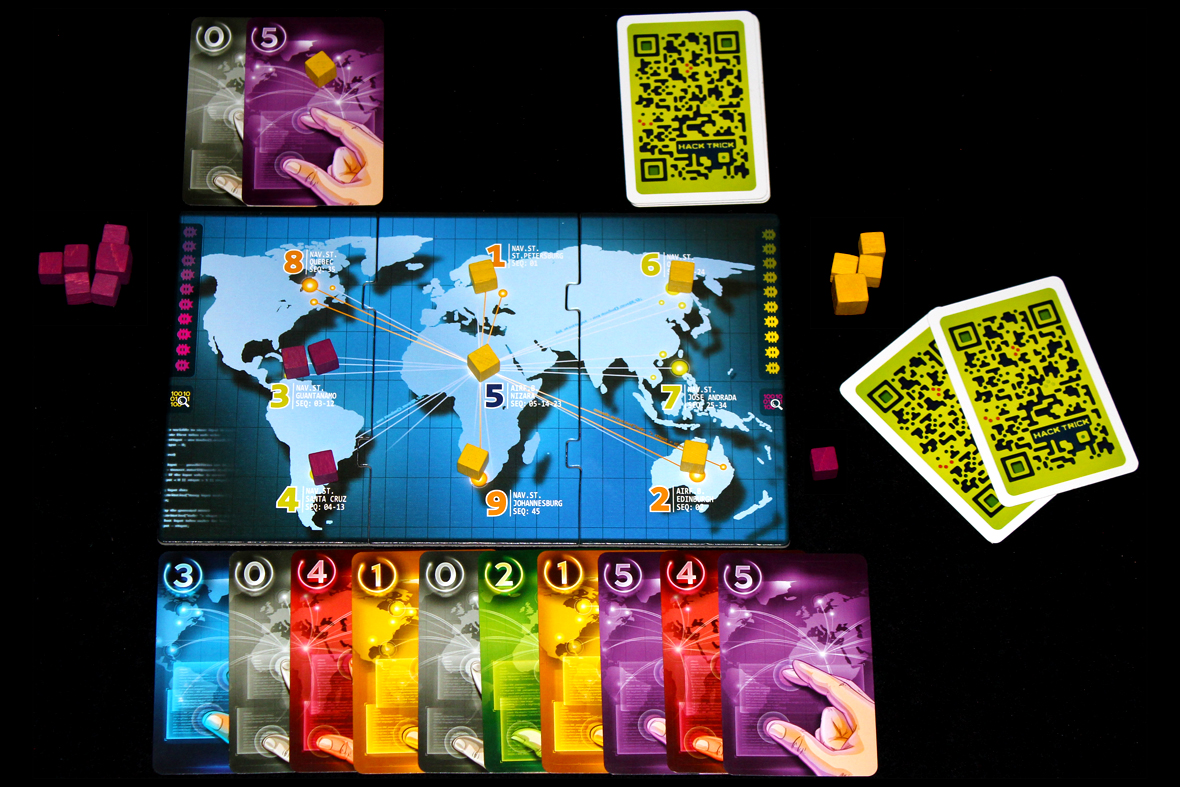
The player with four cards will choose a card and place it face-up below the board, beginning a row. They should then tell the other player the sum of the card values in their hand. The other player will announce the sum of the card values in their hand, and then they will start!

Gameplay

Hack Trick is surprisingly reminiscent of tic-tac-toe, (or naughts and crosses, I guess), the classic game of putting down X’s and O’s until you realize that the game is fundamentally solved and therefore you should almost always be able to force a draw.
Anyways, in Hack Trick, you want to hack some combination of three terminals — either an axis (three terminals that are in a line diagonally, horizontally, or vertically) or the same terminal three times. Seems simple, right?
Well, that’s where the game gets interesting.
Before you take an action on your turn, you may discard one of your opponent’s tokens from your captured side of the board to force your opponent to tell you the sum of the card values in their hand (even if they only have one card!).
On your turn, you may either draw a card or play a card. If you choose to draw a card, you must have 3 or fewer cards in hand. Take a card from the deck and add it to your hand. If there are no more cards in the deck, take every card except the rightmost card in the row below, reshuffle the deck, and then take a new card.
If you choose to play a card, there’s a bit more to do. You may play a card to the row below the board, provided it is different from the rightmost card already in that row. You can’t have two consecutive 5’s or 0’s, for instance.
Once you play a card, add one of your tokens to the space denoted by the sum of the card you just played and the previous card in the row. If any of your opponent’s tokens are there, take them all and add them to your side of the board. You can use these for spying on your opponent, as mentioned earlier.
Now, after playing a card, you may optionally spend an extra one of your tokens to put up a Firewall or Hack your opponent:
- Hack: Your opponent must play a card, if they can, next turn. If they have no cards or all the cards in their hand are unplayable (because they match the rightmost card), they must show you their hand and then draw a new card instead.
- Firewall: Your opponent cannot hack you next turn.

Play continues until one player has gotten three terminals in a row, or three cubes on the same terminal. That player wins! If, at any point, a player runs out of cubes, that player immediately loses, unless they win on that move.
The game also includes some Bitcoin tokens:

That you can use to keep score for multi-round play, but I generally avoid that. You can do whatever you feel like, though. As a variant, one cube is larger than the others — if you win and that cube is part of your victory, you score two Bitcoin, rather than one. First player to three Bitcoin wins!
Player Count Differences
Two-player only!
Strategy
- Try to corner your opponent. Your ideal move is that they set you up for the win inadvertently, or you’ve made too many potential avenues for them to block, similar to tic-tac-toe or Connect Four. Or Santorini, if I’m being completely honest about it.
- Hacking is super useful. Forcing your opponent to play a card instead of drawing a card both makes it easier to figure out what cards they have and determine what cards they’re drawing.
- Keep track of what numbers your opponent has in hand. The more you know, the more that limits their available options. You can choose what you play to minimize their options and potentially have them play into your hands and give you the win.
- Keep your options open. You should be drawing a fair amount of the time unless you’re pretty convinced that you can win on a turn. I’d strongly recommend pretty much always having 2 or more cards in hand. If your opponent can figure out your hand, you’re going to be in a bad way.
- Remember how math works. If you don’t want an opponent to place on a number greater than 5, play a 0. If you don’t want an opponent to place on a number less than 5, play a 5. There’s a useful element of defense you can take here, since they must always place on the sum and the cards must be different. Keep that in mind while you play.
- Your opponent’s hand sum should inform your actions, from time to time. If you know your opponent has three cards in their hand and they sum to 0, you know that they have 3 0’s. If you keep hacking them, you can essentially dictate the game for a bit, provided you can figure out the sum. In the same vein, if they have three cards and a sum of 4, you know that they cannot have a 5. Be mindful of what you know before you play and you can avoid giving your opponent an advantageous move based on a mistake.
Pros, Mehs, and Cons
Pros
- Neat spin on tic-tac-toe. It’s refreshing, honestly. It takes a very simple (and solved) game and builds a neat little two-player experience on top of it. I especially like the forcing other players to play aspect of the game, as there’s a neat strategic element to trying to trap other players into a sequence of forced plays that gives you the win. It’s a lot of fun.
- Easy to learn. It’s about the same weight as The Fox in the Forest, maybe a little lighter.
- Plays very quickly. It’s over and done with in about 5 or 10 minutes. The multi-round game is longer, sure, but in general I abhor those so I just avoid them and play a bunch of single-round games.
- Surprisingly portable. The board is modular, the cards are reasonably sized. The box is also pretty small; you can kinda just pick it up and go.
Mehs
- The cubes are vaguely mediocre. I dunno what I was expecting, but it takes me out of the theme to have just kinda random purple and yellow cubes representing … hacks? Successful hacks? I’m not really sure.
- The art on the cards is kind of just okay, as well. It’s very much a “GENERIC HACKER HACKS THE COMPUTERS HACK HACK HACK” theme and art.
Cons
- The lack of wide availability is a bummer. That’s kind of just the reality of it. That said, companies are bringing more games for a wider US release, so maybe there’s a way to get more games onto their radar? Who knows.
Overall: 8 / 10
Overall, Hack Trick is a great little two-player game! It plays fast and it’s decently strategic, but is just a marked improvement over its tic-tac-toe pedigree. Sure, the theme is kind of whatever, but the mathy and thinky parts of the game are pretty interesting and a lot of light, quick fun. It’d likely make a solid family game (you may need to remove the Hack / Firewall actions for very young players), but if you’re looking to bust something out and play a 1v1 game while you wait, Hack Trick isn’t a bad choice at all. I think some of the Button Shy games have it beat on portability, but it’s still a solid game for what it is. Hopefully, it’ll see a larger release sometime in the near future! If so, and you like quick games with some light math, I’d recommend it!
If you enjoyed this review and would like to support What’s Eric Playing? in the future, please check out my Patreon. Thanks for reading!
 What's Eric Playing?