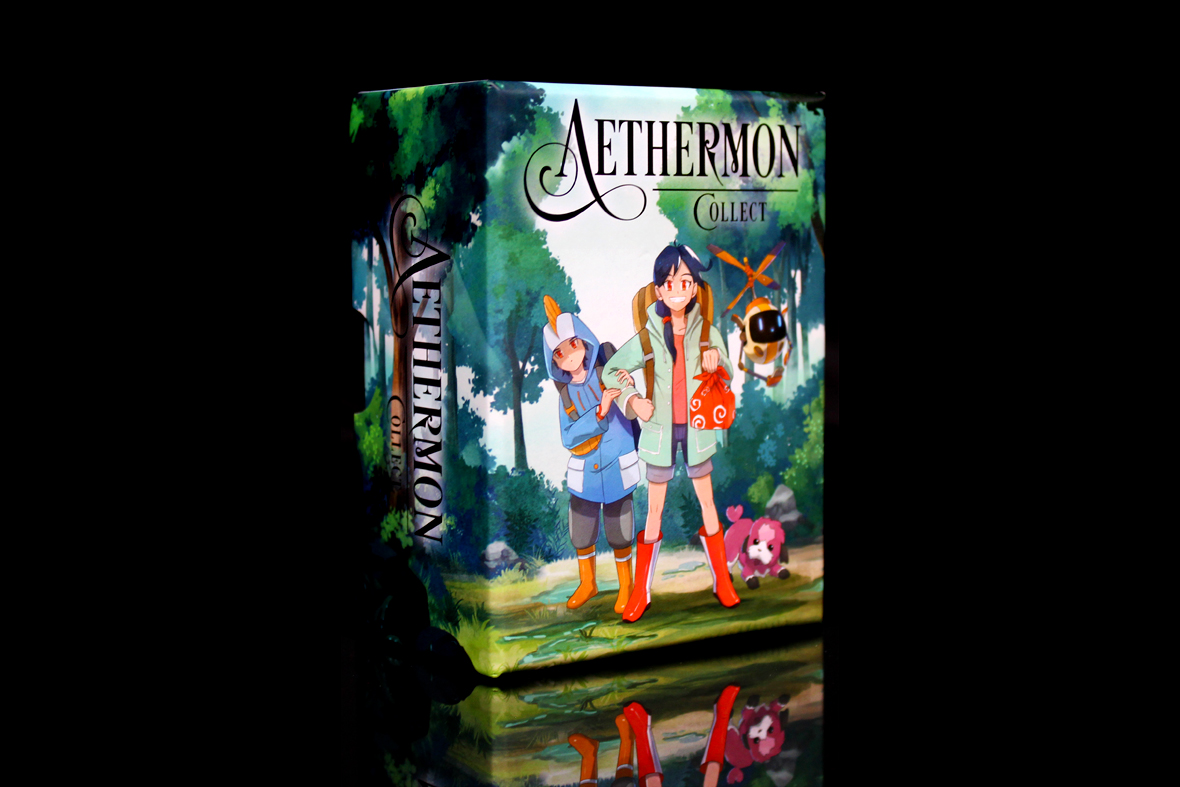
Base price: $30 AUD.
2 – 4 players.
Play time: 10 – 20 minutes.
BGG Link
Check it out on Gamefound!
Logged plays: 2
Full disclosure: A review copy of Aethermon: Collect was provided by Aethermon Studios. I cover the competitive game in this review.
So, unsurprisingly, I love Pokémon. Grew up on it. Watched the show, still have an Ancient Mew card from when I went to see the first movie in theaters, just got some art for my new place, all that stuff. It’s great. I enjoy the simplicity of it (and I like that there’s a deeper layer of strategy that I have exactly zero interest in) and really enjoyed Scarlet and Violet, the latest games. Waiting for new ones and getting a Steam Deck has really fueled my interest in Pokémon-like games, though, so I’m keeping an eye on a few of them. Beastieball, Cassette Beasts; heck, I even tried Pokémon Infinite Fusion, which is almost pure nightmare fuel. Great stuff. Naturally, Aethermon: Collect drew my eye in a similar vein, so I was excited to check it out. Let’s see how it plays!
In Aethermon: Collect, you get to join four folks on a journey through the world of Aethermon! As their group explores, you’ll be able to befriend various Aethermon in various stages of development to try and score points for collections. Plus, there are also powerful artifacts that can help you on your journey, which is always nice. With various elements and cute characters to choose from, who will you befriend on your journey?
Contents
Setup
Not a ton here. Choose a random player to start, and then choose a number of elements to use based on your player count.
- 2 players: Use 4 elements.
- 3 players: Use 6 elements.
- 4 players: Use 8 elements.
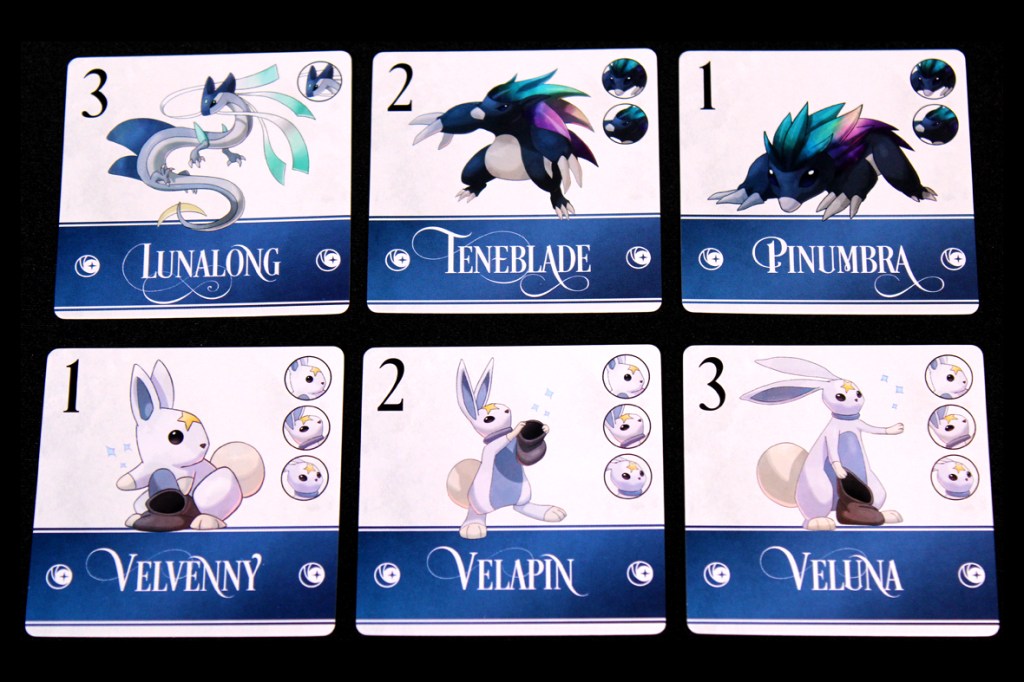
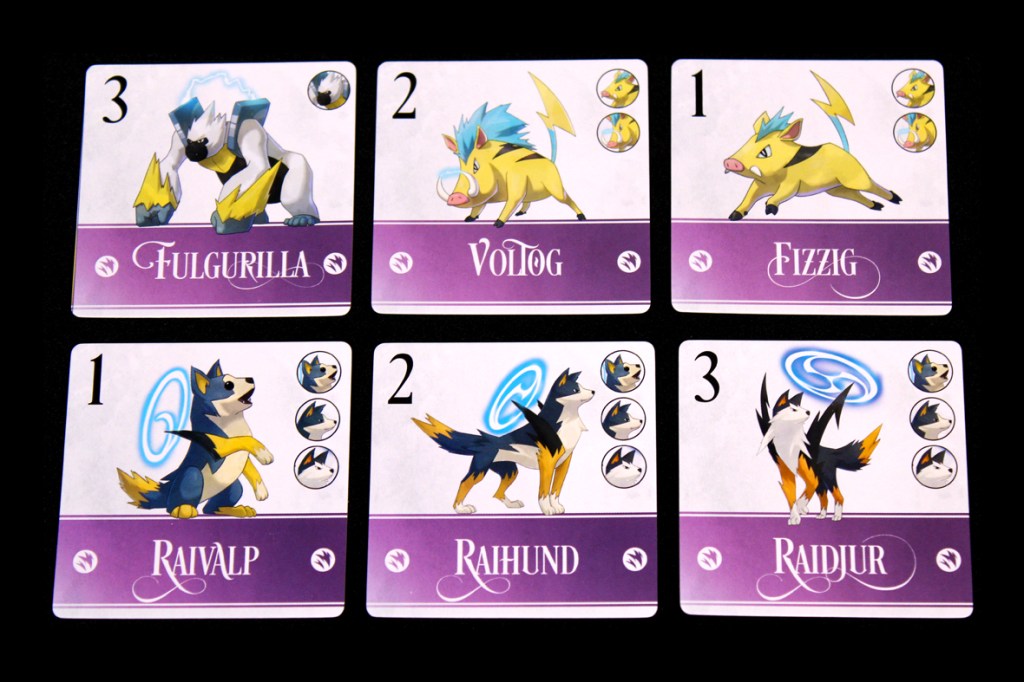
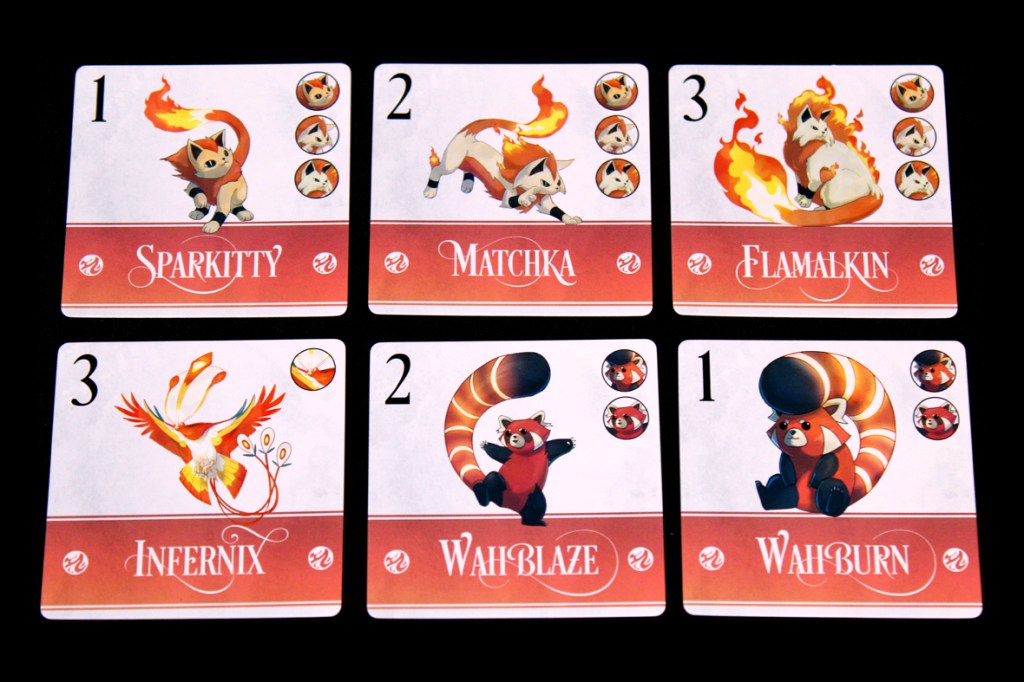
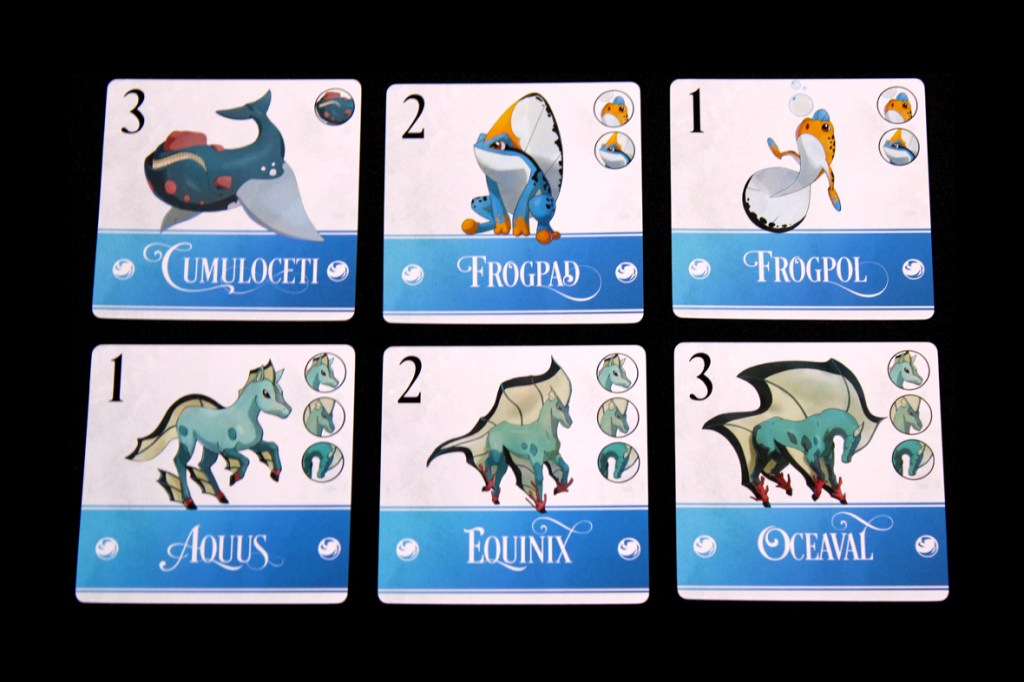
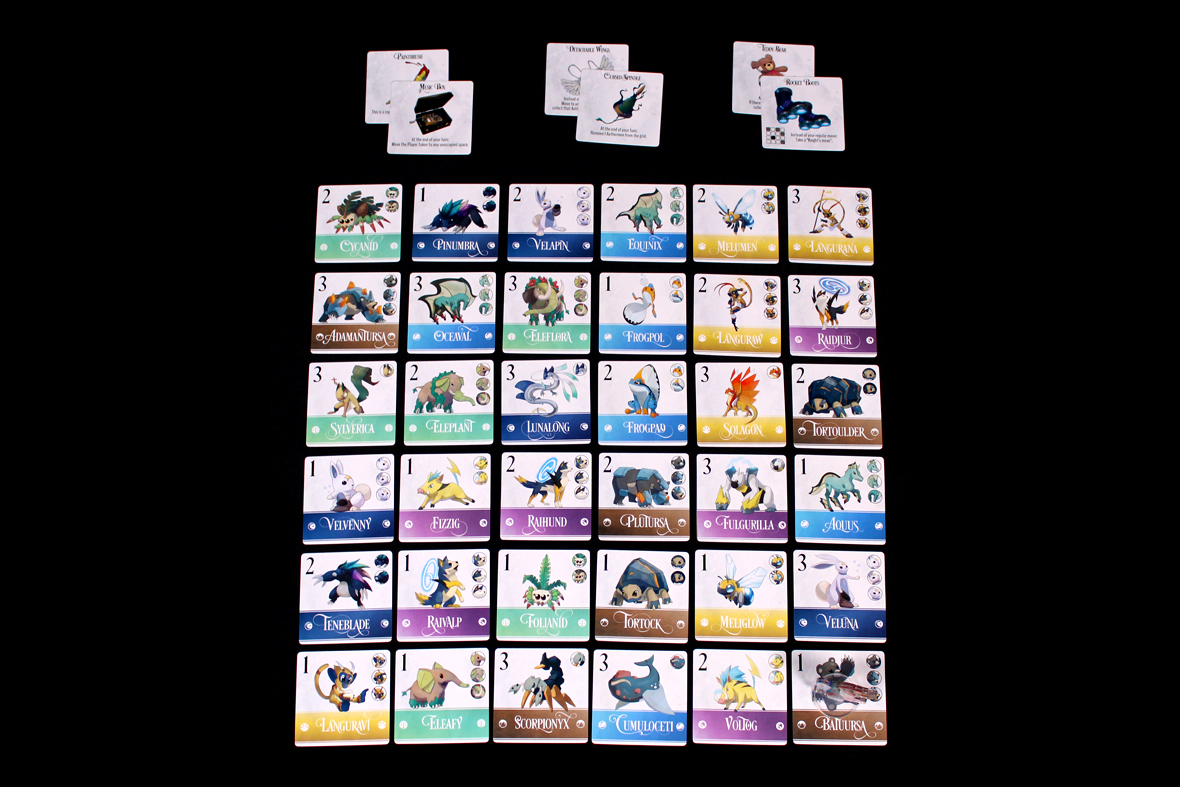
You might be asking, “what are elements?”, and that’s a reasonable question. They are overarching types of the extremely cute Aethermon that you can collect! Choose sets of Aethermon that share the same element (equal to the number of elements for your player count), shuffle them up, and then make a grid!
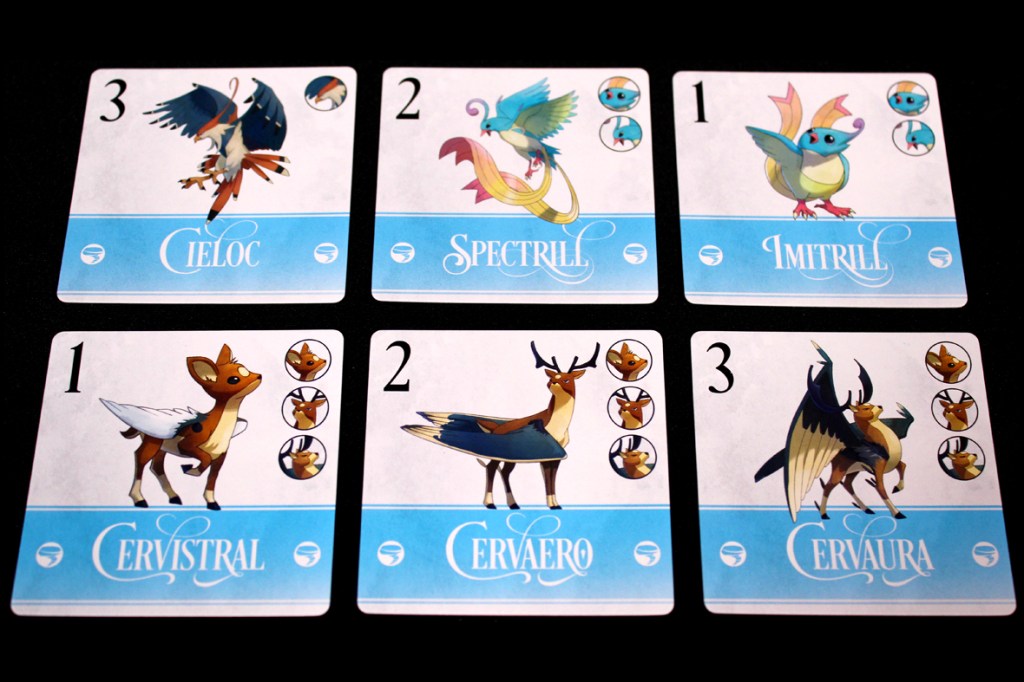
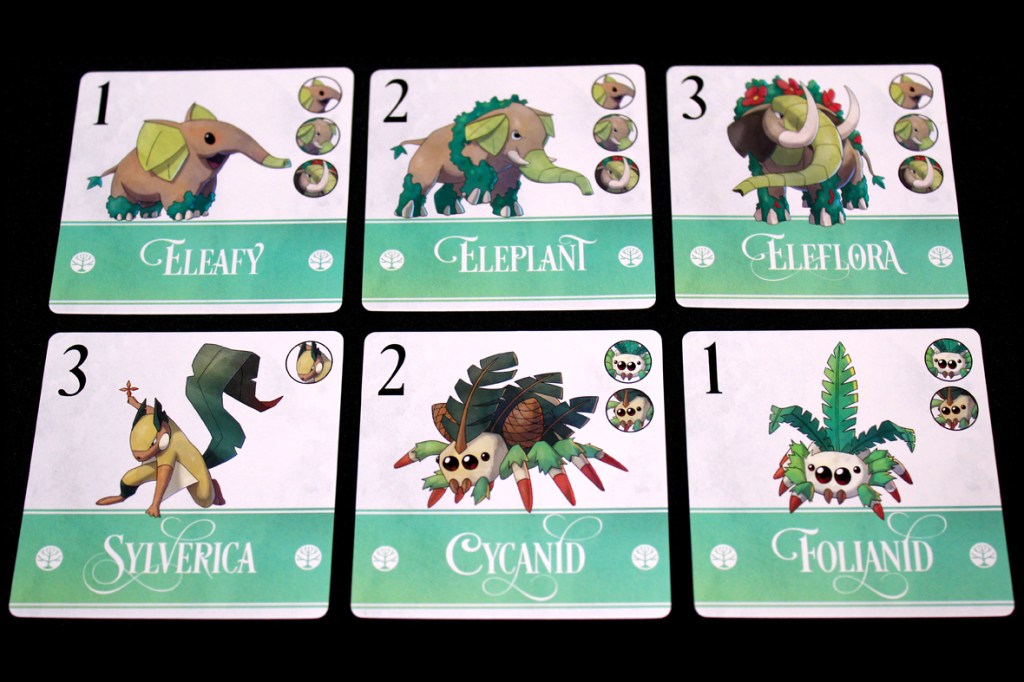
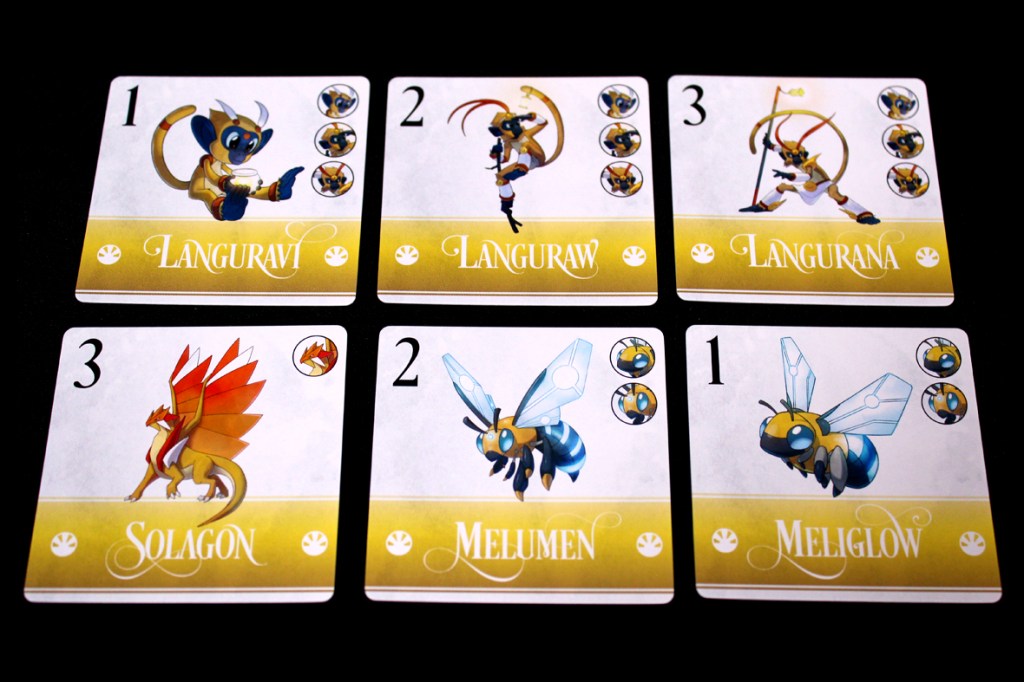
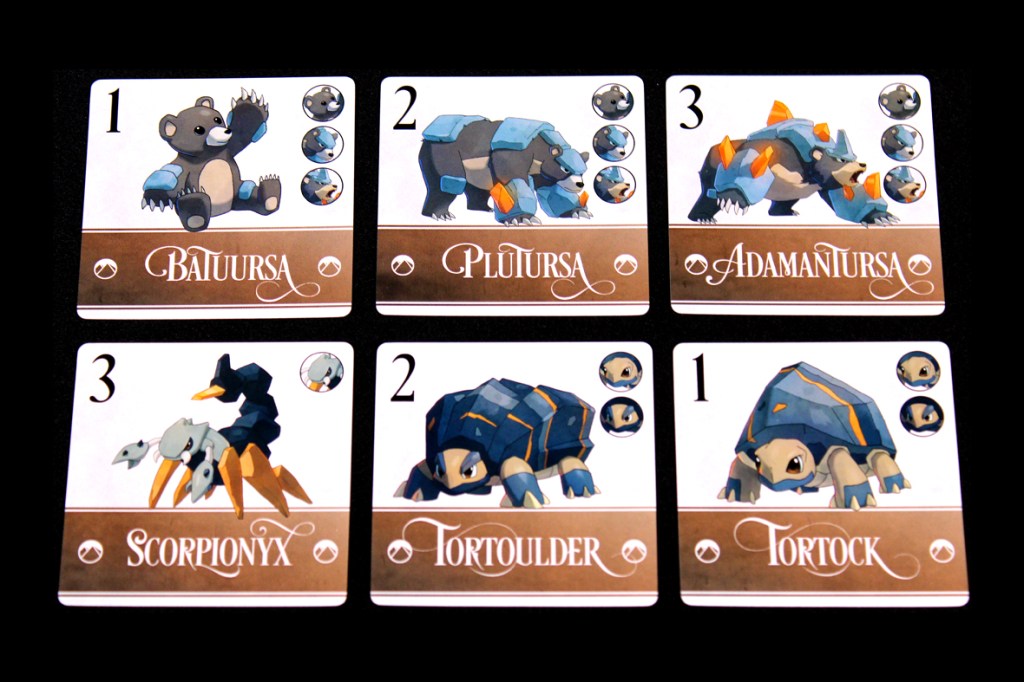
- 2 players: 5×5 grid (center space empty).
- 3 players: 6×6 grid.
- 4 players: 7×7 grid (center space empty).
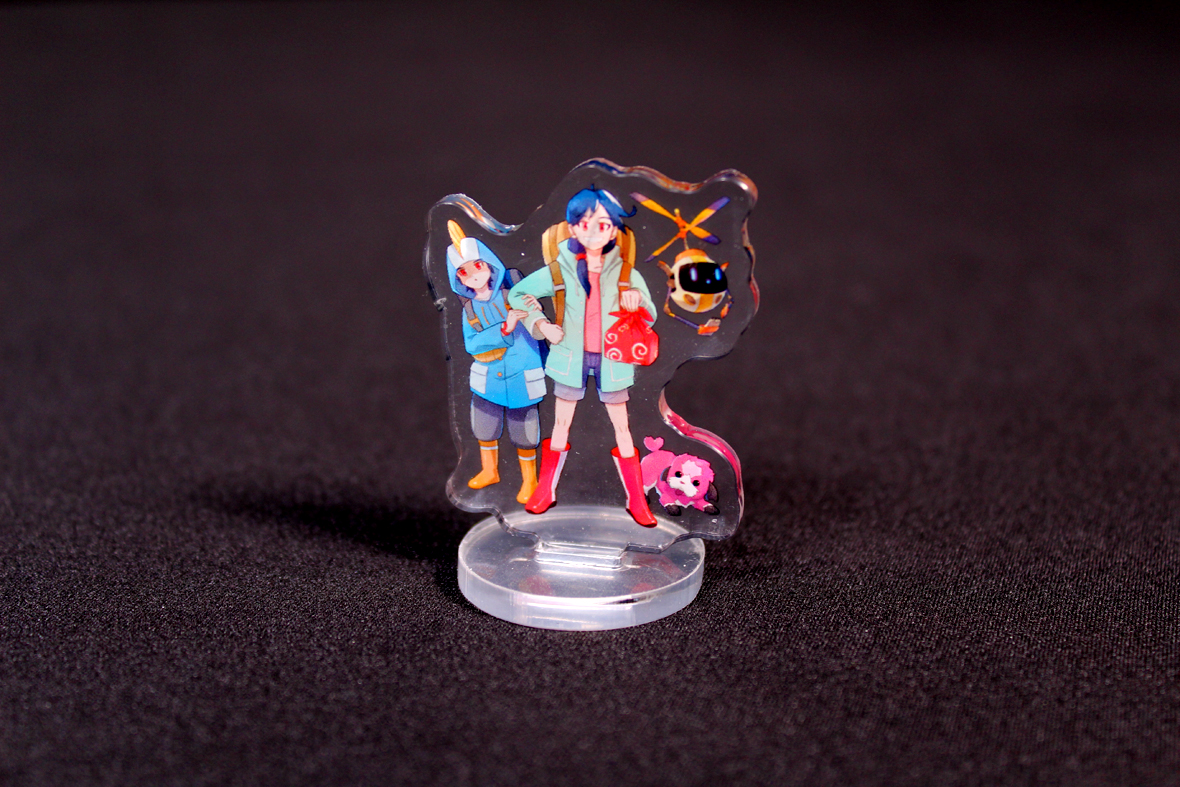
At two or four players, the Group Token goes in the center of the grid. In a three player game, the player to the right of the start player chooses a corner for the Group Token.
Finally, shuffle up the Artefacts, and create one pair per player.
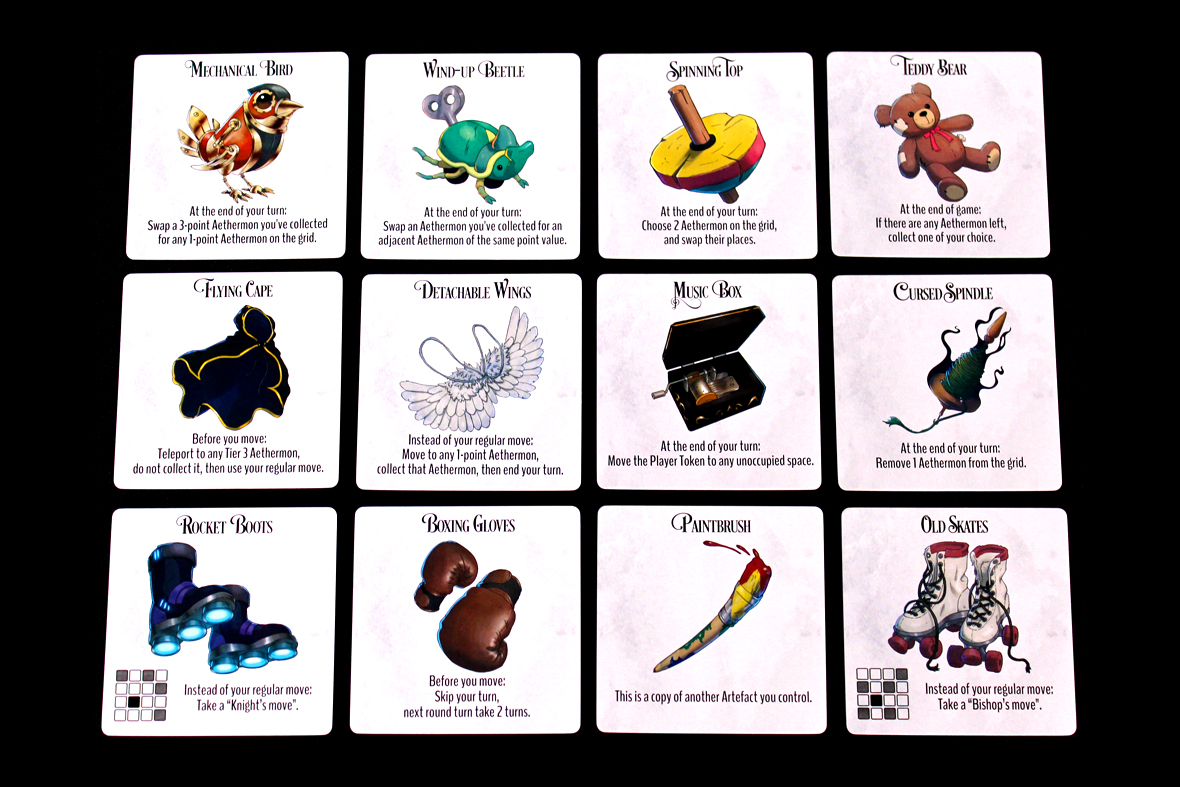
Players will draft these, starting with the player to the right of the start player and going counterclockwise (so the start player takes a pair of Artefacts last). These should be left face-up for the duration of the game (until they’re used). You should be all ready to start!
Gameplay
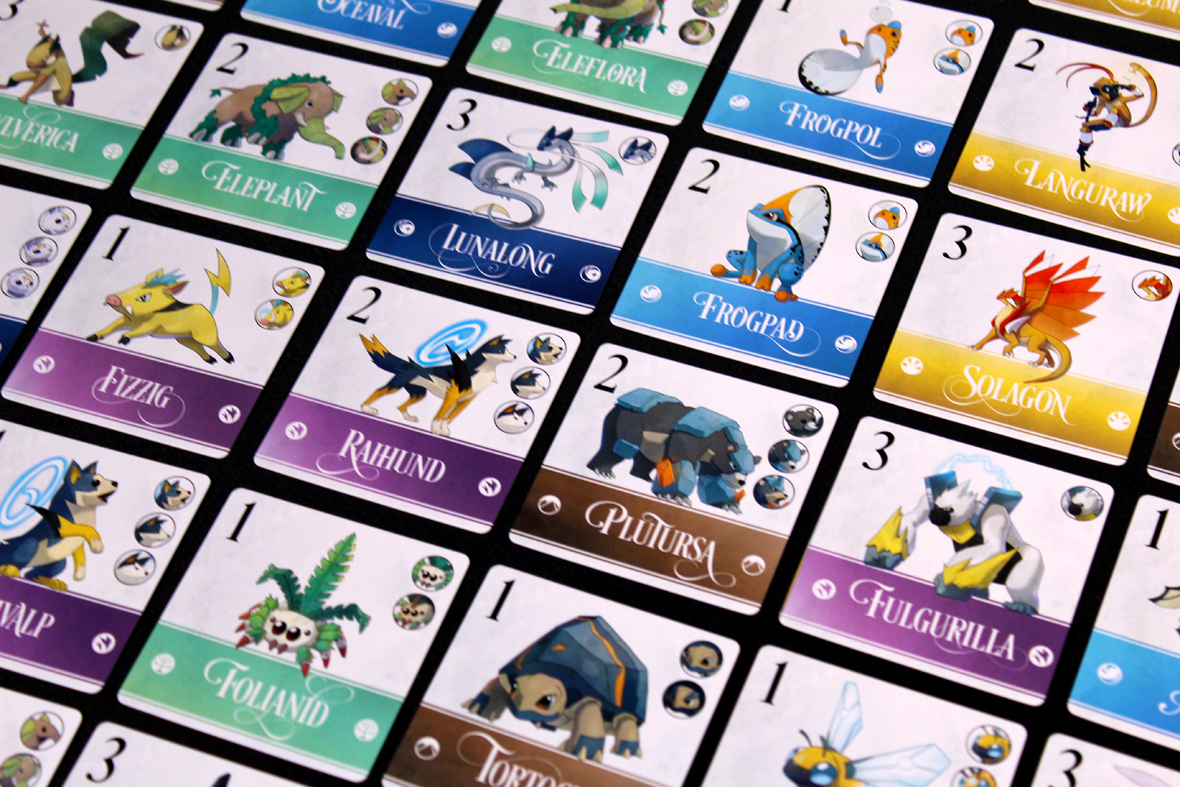
The gameplay for Aethermon isn’t too challenging. Each turn, you’ll move the Group Token, collect an Aethermon, and try to create sets.
On your turn, move the Group Token any number of spaces vertically or horizontally (like a rook in chess). You can move to an empty space if you’d like, but you can’t exit the grid. Should you move onto an Aethermon, you take it and place it in front of you, face-up. After you do this, your turn ends and the next player takes their turn. You may also, on your turn, use Artefacts by following the text on the card and then flipping it face-down. Aethermon is open-information, though, so at any time players may ask which Aethermon you have and look at your sets.
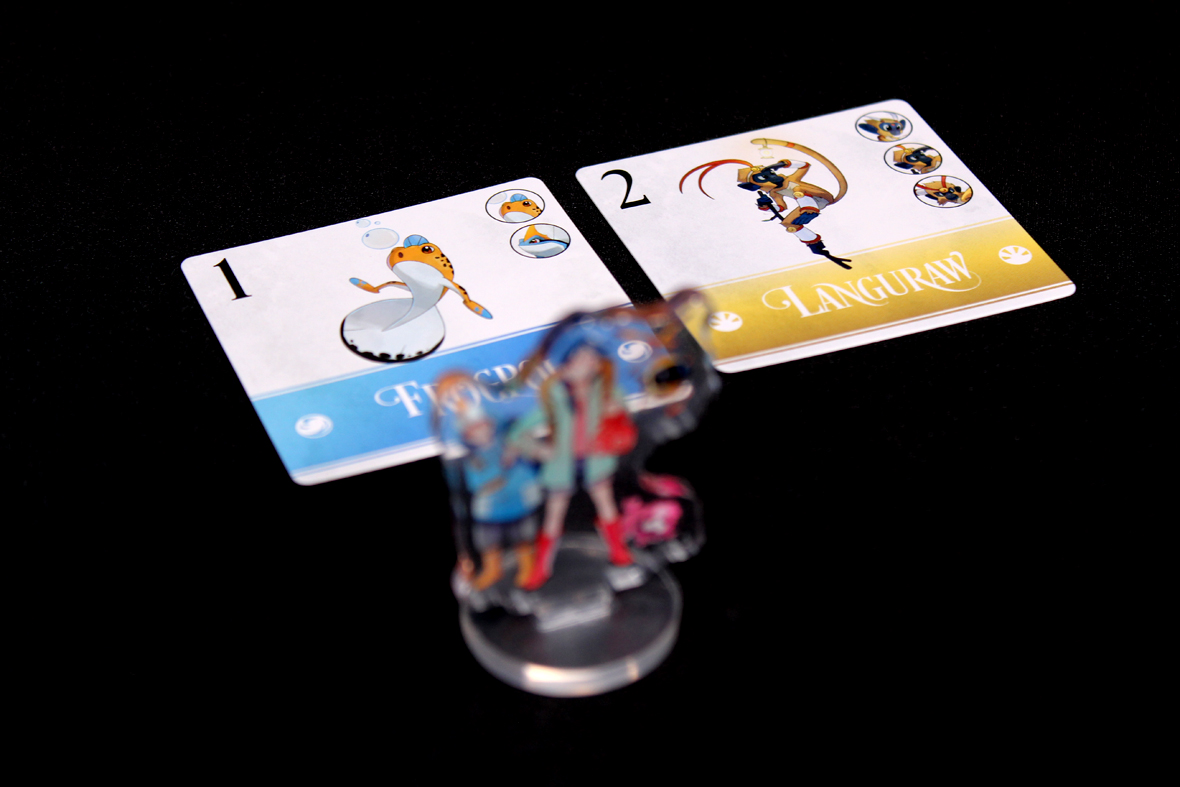
The game ends once every player has taken a consecutive turn without collecting any Aethermon on their turn. When that happens, tally up scores! If you have both or all three Aethermon in a given set (noted by the pictures in the top-right of any Aethermon card), you collect double points for that set! The player with the most points wins!
Player Count Differences
Since the game is pretty much pure drafting, the Aethermon: Collect experience can change pretty significantly at higher player counts. At two players, you’re pretty much trying to decide if you want to take something for yourself or take something to deny your opponent the chance to complete a set. It’s very zero-sum, in that regard, and that’s fine for drafting. With more players, denying a player something is fine, but you might be setting up the next player for something even better (since there are more players than just you and the player to your left). You need to think, to some degree, about the consequences of hate drafting rather than just drafting something that you need. There aren’t too many fine-tuned interactions with the Artefacts, so don’t worry about that. Plus, the grid gets bigger with more players to accommodate the increased player count, so that’s nice, as well. That said, I still enjoy the back-and-forth of a two-player game. It feels almost more like an abstract strategy game with some set collection, and I like that.
Strategy
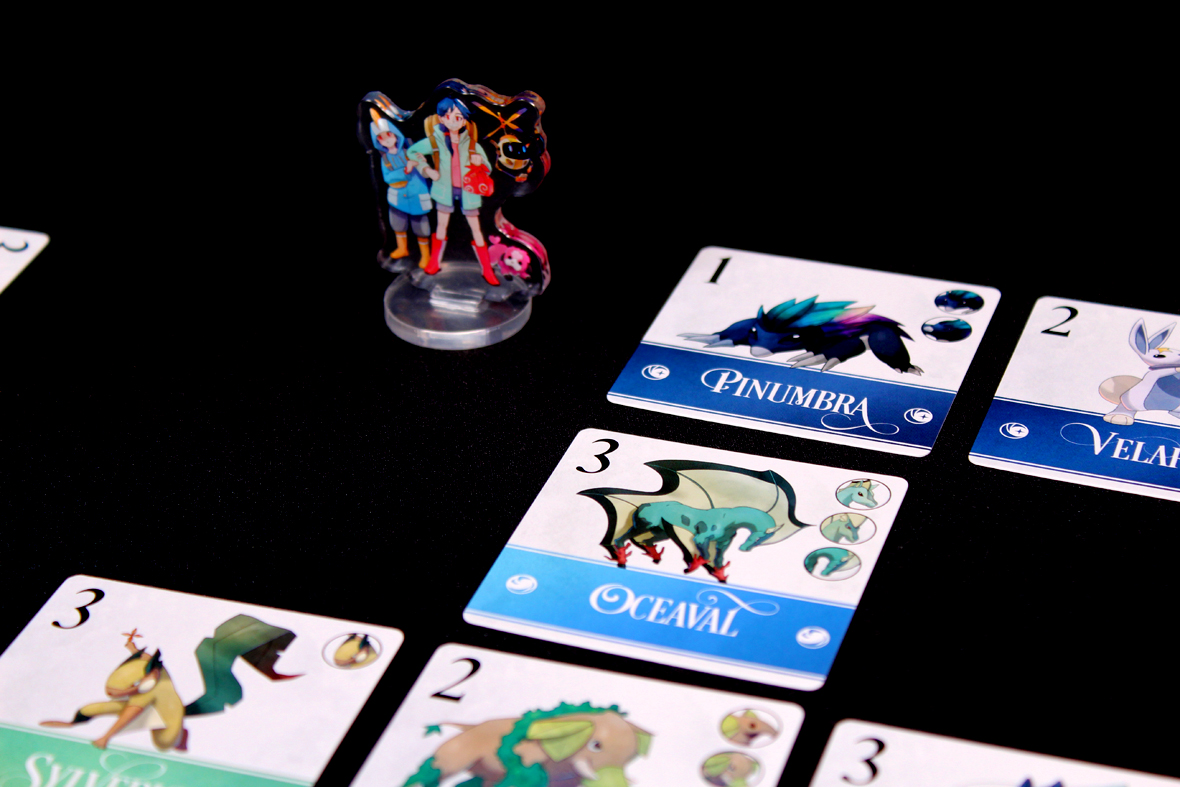
- There’s usually a gold rush at the start of the game for the highest-value Aethermon. In the games I’ve played, players are usually just grabbing as many of the 3s as they can since they have no real guiding principle in any direction. You may be able to force some players to take lower values if you’re smart about which ones you take and where you leave the Group Token. Mean, but fun.
- You can ignore some of the gold rush to grab some of the 1-2 sets, if you’re sneaky. That’s still 6 points, which is more than you’ll get for an incomplete set of three Aethermon. It can be hard to complete a 1-2-3 set in Aethermon: Collect, just because when you’re going for that third card everyone knows that they can just take it and deny you upwards of 7 points. That’s a lot of points! If you grab a 1-2 set of Aethermon, they might not notice that you completed a set already. You might be able to use that against them.
- The Artefacts that you choose can really shake things up! Don’t just choose randomly at the start of the game. You can think a bit about the strategy you want to have or which improve the way you want to play, or you can think about which can give you the most points or the most options, but you should think about it a bit.
- During the game, try to see how the Artefacts can help you get what you need. They’re valuable, yes, but they also need to be used sometime. Don’t just sit on Artefacts until the end of the game! They’re useful and they should be used. Just … use them to complete a 1-2-3 set. That’s the maximum value you can get out of one, so it’s a very easy metric to measure against.
- You can hate-draft, if you want, but I don’t think it makes a ton of sense in a game with more than two players. I just generally don’t think hate-drafting is particularly useful at higher player count games. Taking a card that you don’t want just to block another player getting it is never a particularly ideal move, strategically, but at least with two players it’s zero-sum: you denying them points is roughly equivalent to you scoring points. You may want to consider it if a player is about to complete a 1-2-3 set for 12 points, I suppose, but it probably won’t help you too much.
- That said, using an Artefact to block a player completing a set (while you still get what you want) is fairly optimal. This way you’re not hate drafting, you’re just hating on a player in particular. You’re not here to make friends, probably. Or if you are, this is not the way to do it.
- If you genuinely can’t decide between two Aethermon, just pick whichever you like the look of. It makes things faster. Sometimes there really are just perfectly equivalent choices. You might try to reason that certain sets may be able to complete based on what cards other players need and how the movements will all align, but that’s largely fake divination, so just pick whichever Aethermon you think is cuter and deal with the consequences later. Other players will thank you.
Pros, Mehs, and Cons
Pros
- I love the art style of this game. It’s fun, it’s inviting, and they look like they have an entire universe of backstory for these little creatures. I have strong opinions about which ones I’d collect if I were actually playing a video game about collecting them, for instance, but I’m keeping them to myself because I want you to be able to imagine your own fun friends.
- I also appreciate that there’s lore on the back of the cards. It’s a nice touch! Makes the game feel a bit more lived-in and thought out. It’s clear that they want to do more with this concept, so this is a nice way to get players invested in the world beyond the game.
- I do like the movement system of the game, but I really like the Artefacts that let you move in different ways. They make you highly unpredictable and hard to stop, which is a nice way to bamboozle your opponents. I love that kind of thing.
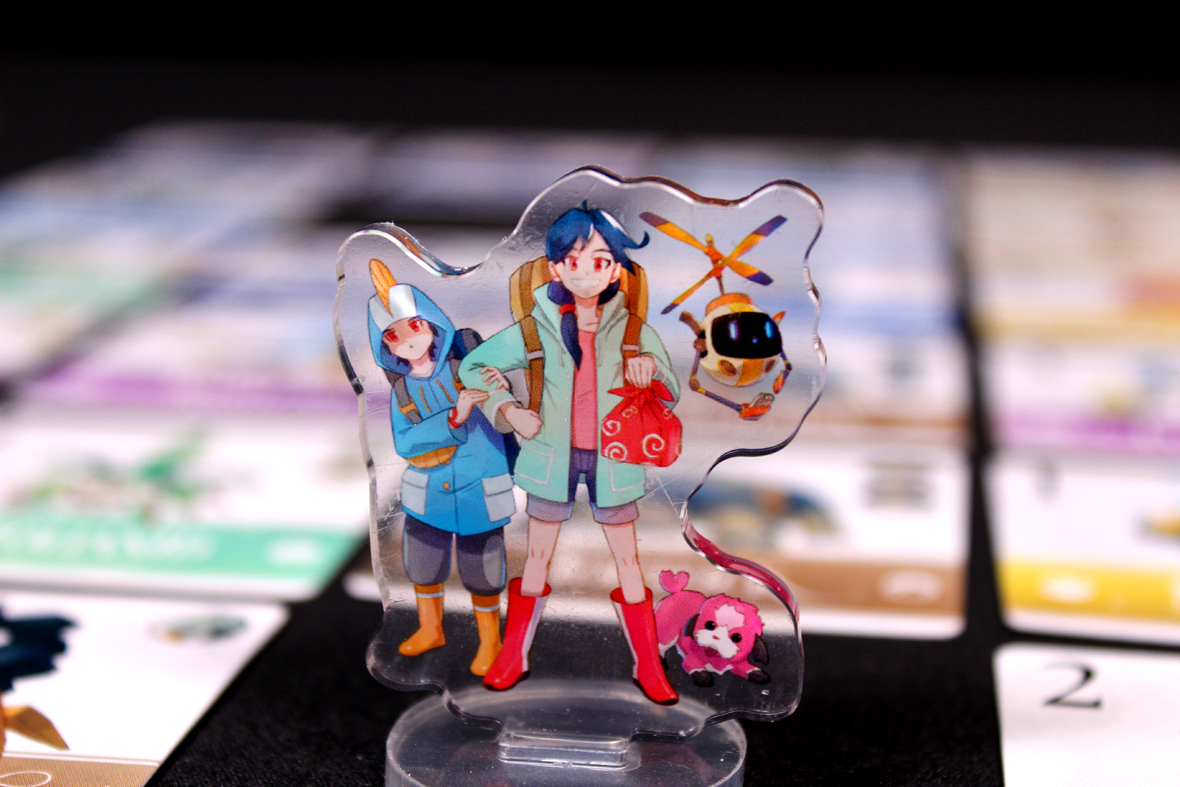
- The acrylic Group Token is surprisingly nice. It’s just a nice piece. Looks good, works well with the game. Big fan.
- A very approachable title. It plays quickly, it’s easy to teach, and the look of the game is, as I mentioned, inviting. They have a pretty good sense of the audience they’re going for with this title, and while that audience is a bit more casual than I am, I appreciate how well they’ve landed on it. There are a few variants that add a bit more complexity, to the game’s credit.
- Very portable, too. Small box games are great in a lot of ways, but portability is high on my list. I love being able to throw a ton of little games in a bag and just be on my way.
Mehs
- A small game with a big footprint, as “make a grid”-style games tend towards. It can take up a pretty good amount of space, so make sure you’ve got the table for it!
Cons
- I do … kind of hate when the rules for a game are printed on cards, rather than in a rulebook. I appreciate that they numbered it so that it’s not entirely out of control, but still, I don’t like that there are 15 distinct cards that collectively form a rulebook. Lose one and you’re suddenly stuck with a gap in the rules.
- I think I’d like to see something that guides players towards certain Aethermon early in the game. Maybe it’s a starting Aethermon or a Partner Aethermon or something, but I do want a bit more complexity from the game. Even something like “different elements have different scoring types” or variable starting powers or something would go a long way towards building my interesting in the game mechanically.
Overall: 6.75 / 10
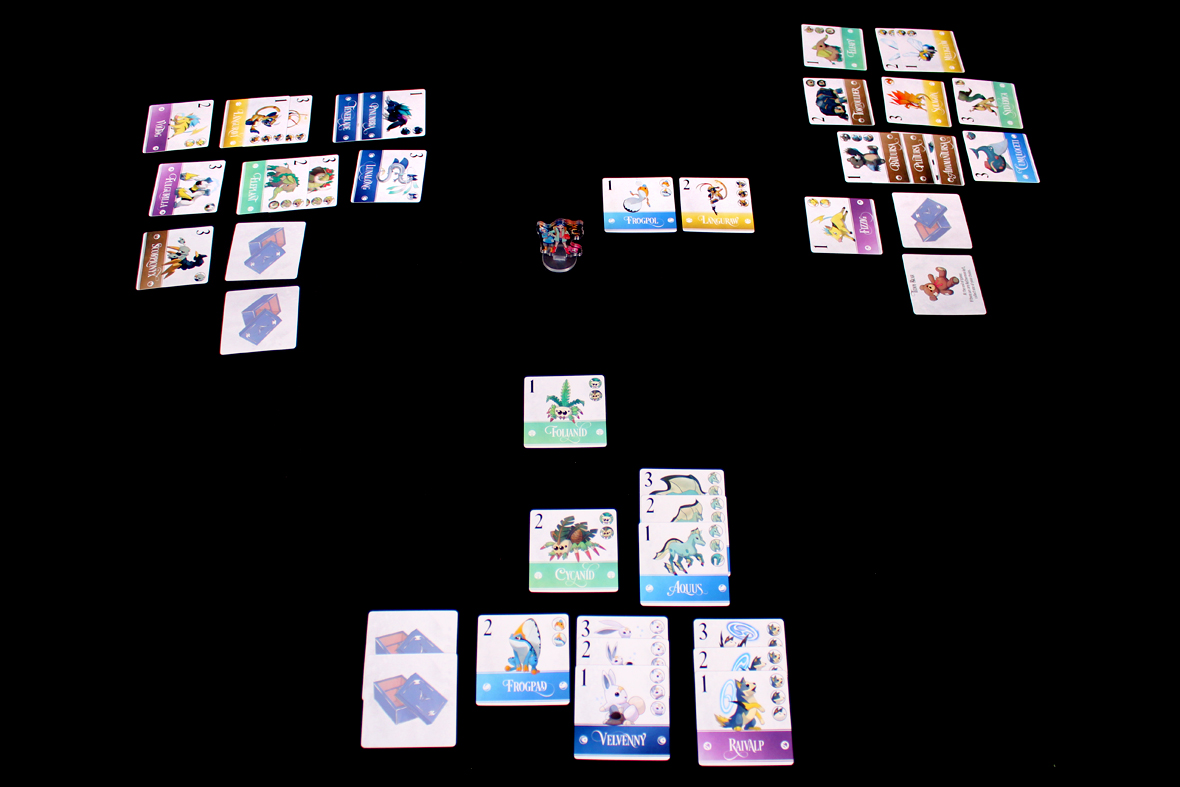
Overall, I think Aethermon: Collect is a cute introduction to the world of Aethermon! For me, the strengths of the game are primarily in the lore and artwork. I really enjoy that each card has a fair amount of information about that particular Aethermon on the back. Gives me something to read if my opponents are taking too long on their turns. Plus, the art is particularly fun! A good number of these look like they could have legitimately been Pokemon in an alternate universe. I like that a lot. As far as gameplay goes, the game’s a bit simple for my tastes; it’s very much a “move a token, take a card” kind of game. Easy to teach, though, to its credit, and it seems like a nice filler game in a larger universe (and that might be where they’re headed; I’m not sure what the overall plan is for this one). The Artefacts elevate the game a bit, which I appreciate, provided you can get some of the more interesting ones (ones that let you move in a different pattern, for instance, or allow you to potentially fill out parts of your sets that you’re missing). I imagine that the game would play very differently with a cutthroat group than it would with a mostly-friendly group, so there may be some more entertainment to have if your group is extremely into hate-drafting. As it stands, though, I did have fun with Aethermon: Collect, though I’d love to see more complex games coming out of this universe. If you’re looking for something straightforward and light, you want a game with some fantastic (and fantastical) art, or you just enjoy drafting, you might enjoy Aethermon: Collect!
If you enjoyed this review and would like to support What’s Eric Playing? in the future, please check out my Patreon. Thanks for reading!
 What's Eric Playing?