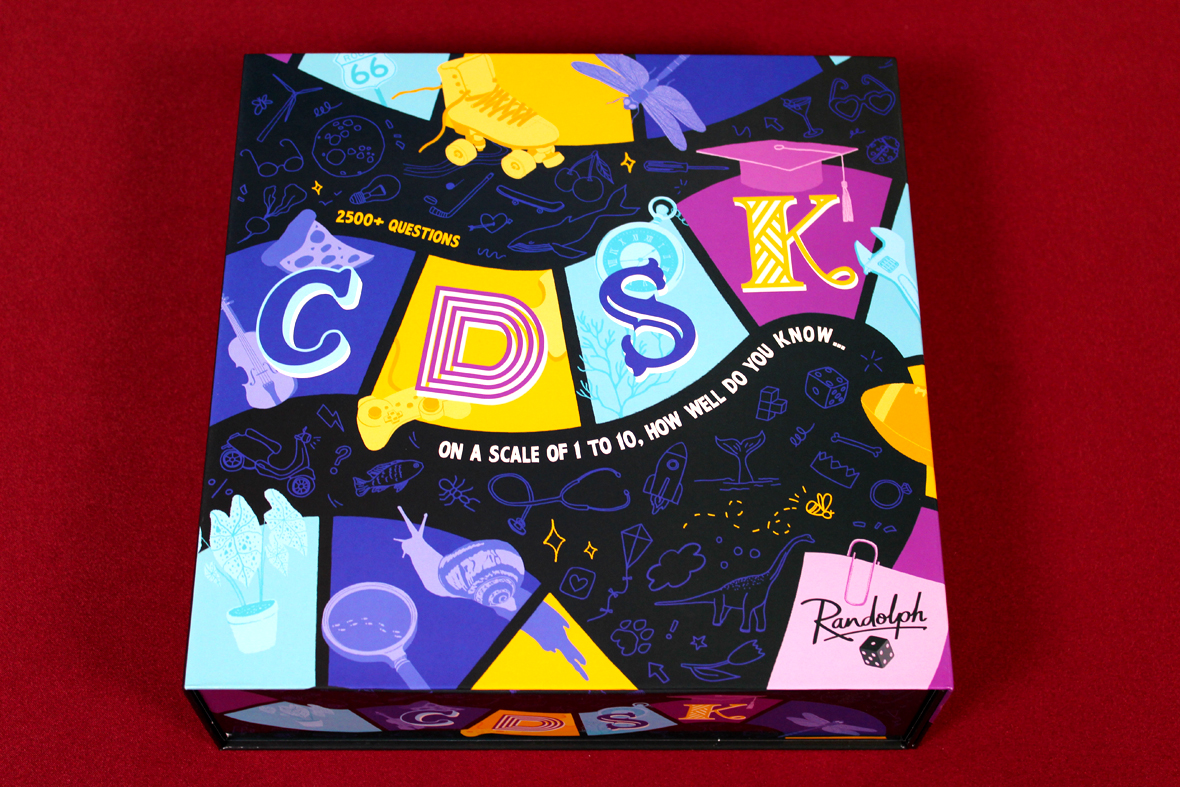
Base price: $35.
2 – 16 players.
Play time: ~45 minutes.
BGG Link
Buy directly!
Logged plays: 3
Full disclosure: A review copy of CDSK was provided by Randolph.
I guess it ended up being trivia week! That happens, sometimes. I’ve been running a bit behind the power curve, lately, since I got sick and then my family visited and then I think I was either out of town or in a fugue state for a bit and then Pokemon GO Fest and then PAX West and now, here we are, on the other side of all that, and I have to go on a work trip next week. It never slows down around here, I suppose. To that end, then, let’s speed things up and check out CDSK, from Randolph!
In CDSK, up to four teams of players compete in a trivia free-for-all. The categories might surprise you! They’re Curious, Delightful, Seasoned, and Knowledge. You know, standard stuff. To make things even stranger, before you get asked a question, you get asked a different one: how well do you know the topic from 1 – 10? Your answer determines both the difficulty of the question you get and how far you go if you’re right. So do your best and figure out the answer so you can be the first across the finish line. Can you beat your friends in trivia?
Contents
Setup
Effectively none. Simply open the box:
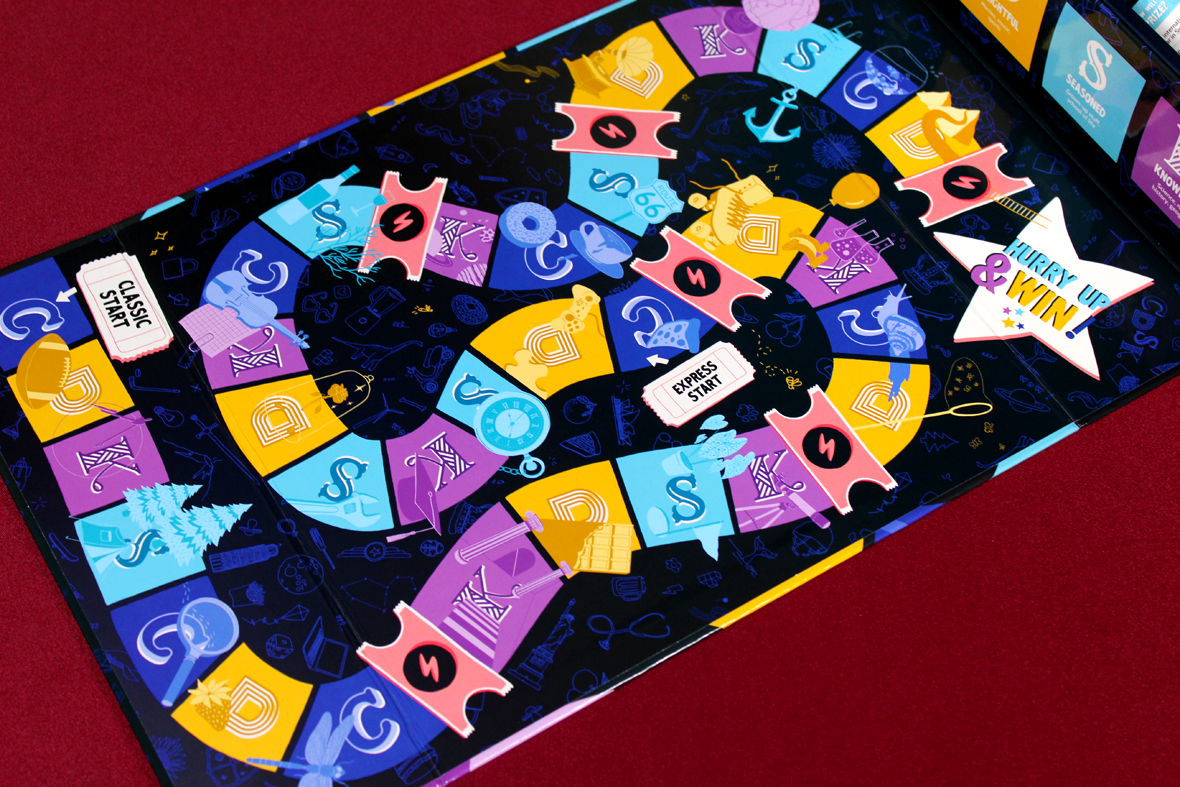
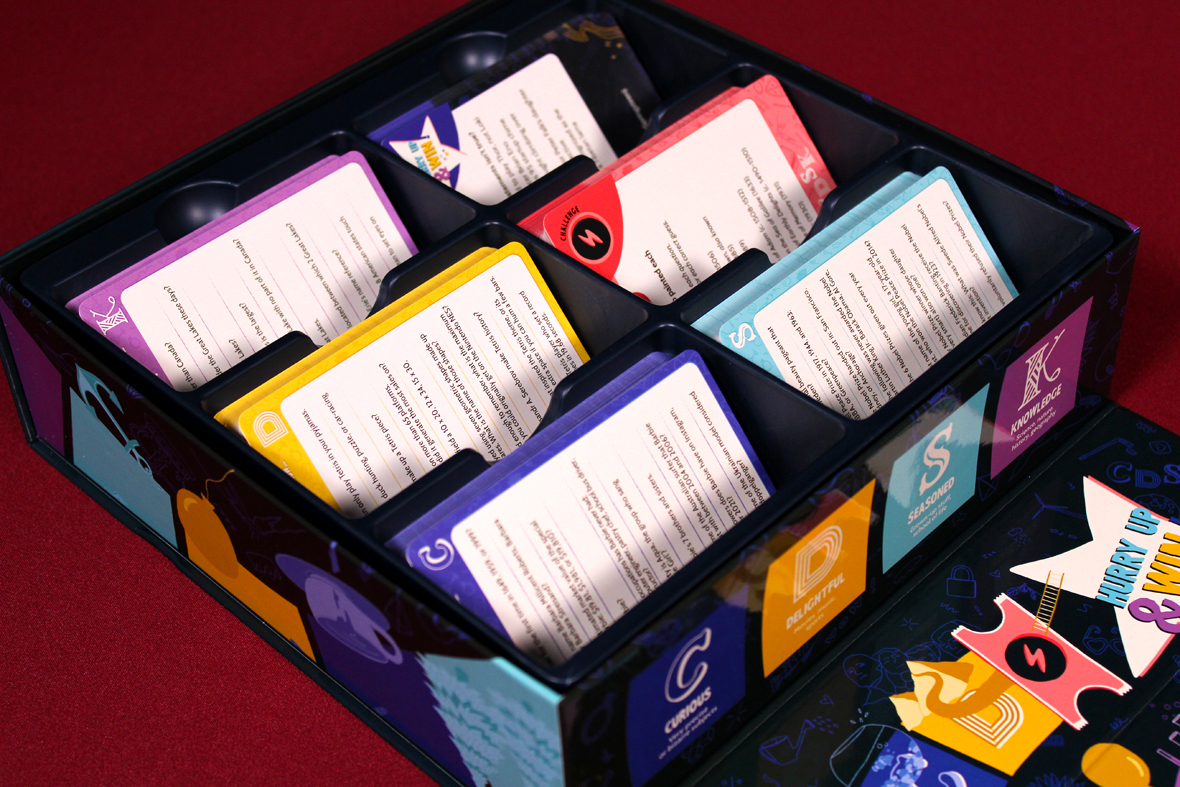
There’s your board. You can shuffle the question cards if you want, or just leave them where they are in the box:
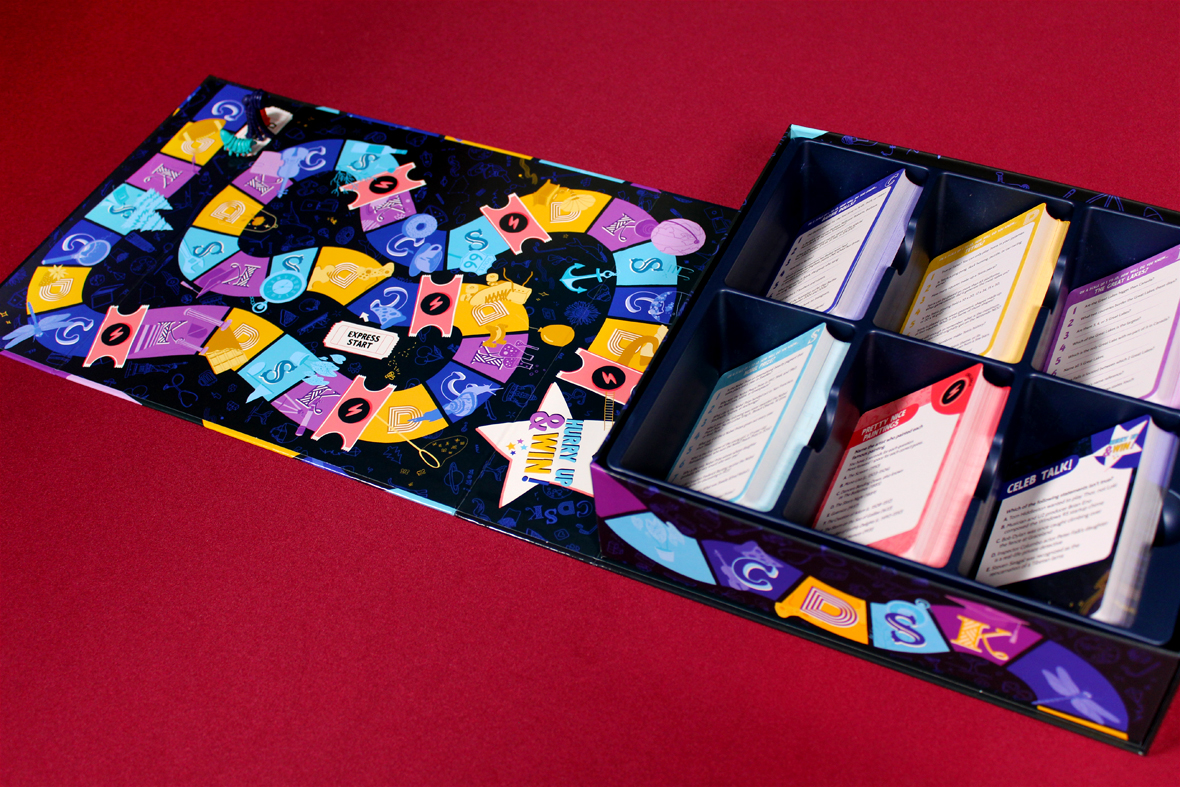
Try to divide into equal teams, as well, though feel free to give newer players more people on their team; it’s never clear if more people help. Then, one thing you do need is team pieces. There are none included for some reason, so just find things that speak to you. As far as team pieces go, buttons, other components, crack open an entirely unrelated game and grab some friends from Unmatched; whatever you feel like. Place them above either the Classic or Express starting points (not on the track, yet). You should be ready to start!
Gameplay

It’s a bit surprising how simple CDSK is. To start the game, your team will choose one of the four categories:
- Curious: These tend to be questions about very specific things. If you know you know.
- Delightful: These are questions about movies, sports, and other “pop culture”-adjacent things.
- Seasoned: These will be questions about things you kind of learn over the process of becoming an adult. The game refers to them as “school of life” things.
- Knowledge: These are your more classic “trivia” categories. History, geography; things like that.
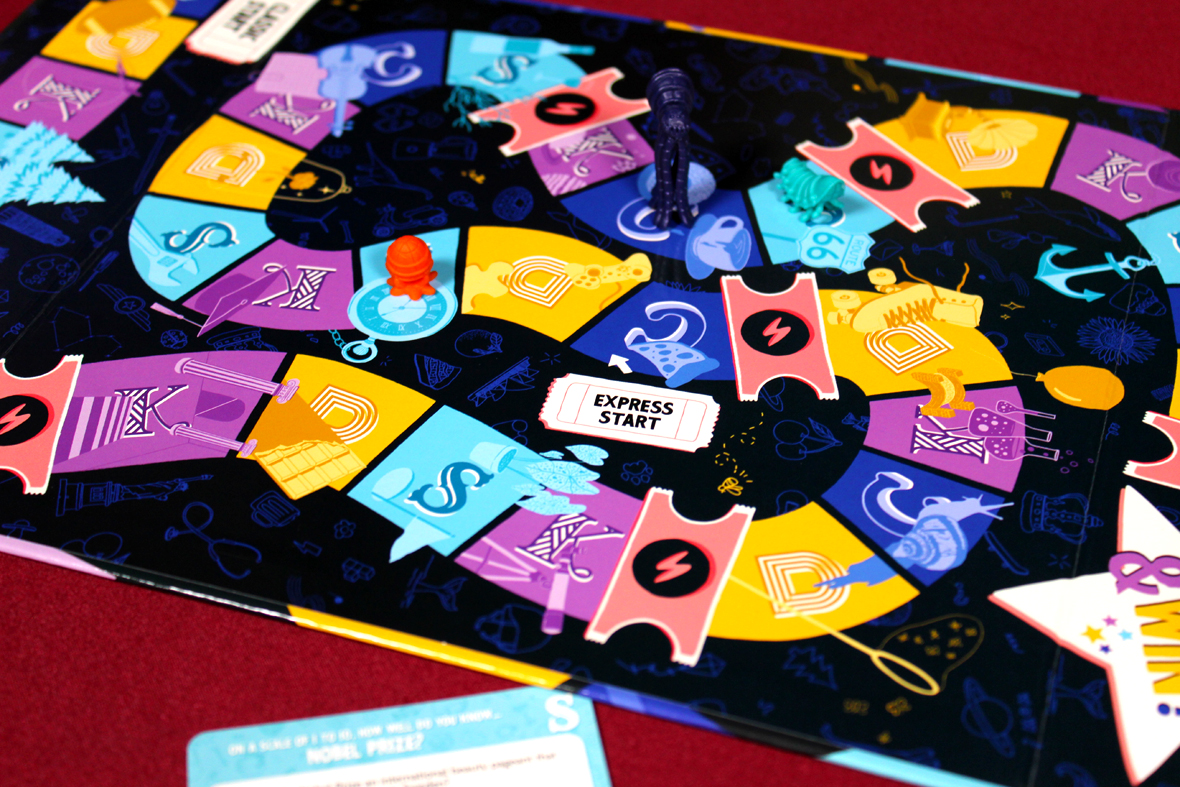
Choose one, and a player on the team to your left will read the prompt. On a scale from 1 – 10, how well do you know … whatever they’re asking about. Now, you choose a number! They’ll read the question corresponding to that number, and you’ll answer as best you can. You can discuss with your team, if you’d like. If you’re right, move forward the number of spaces you said originally. If you’re wrong, stay put! This means on all subsequent turns you’ll be on a space corresponding to one of the four categories (usually), so you’ll use that category in the future. Two exceptions:
- Challenge Spaces: If you land on a red Challenge Space, you use a Challenge Card instead! These tend to be rapid-fire, timed questions, so think on your feet!
- The Hurry Up & Win Space: If you land here, you use a Hurry Up & Win Card. If you’re right, well, you win! Otherwise, you stay where you are and have to try again next turn!
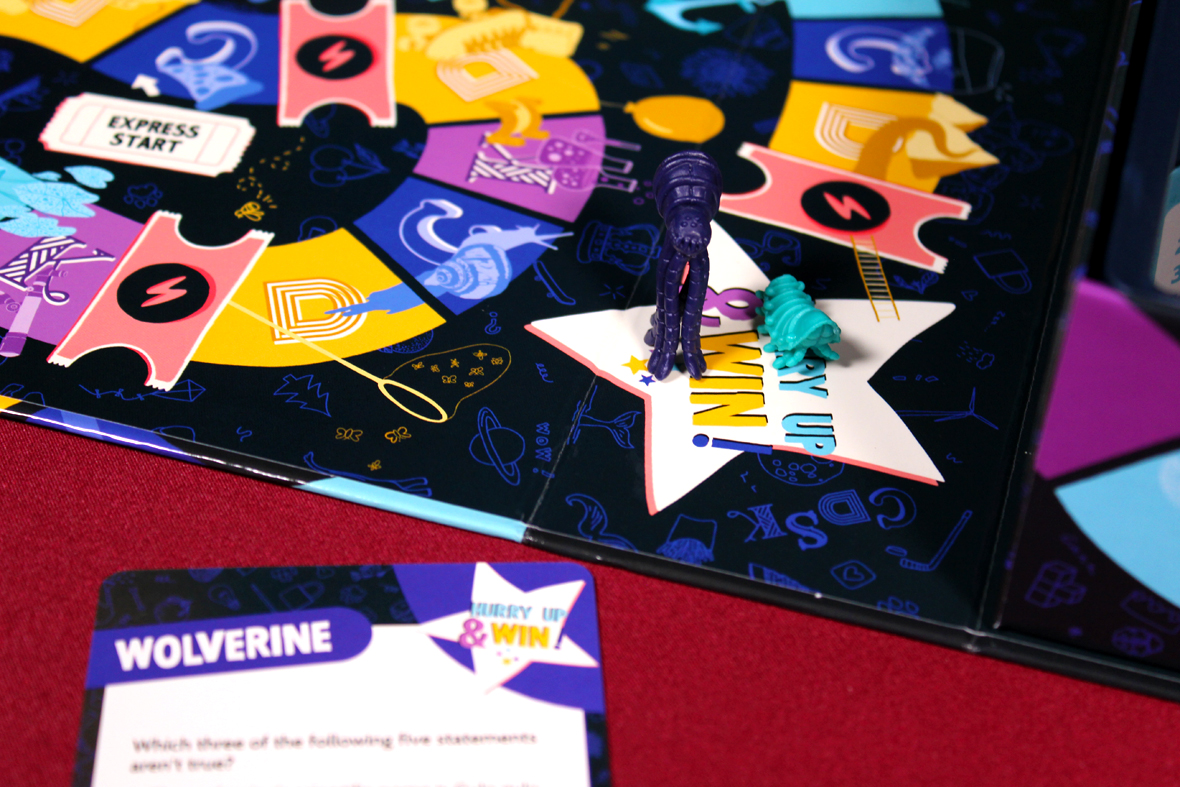
The first team to correctly answer a Hurry Up & Win question wins the game!
Player Count Differences
I’m somewhat inclined to say “very few player count differences”, which is wild, given that the game can technically support sixteen players, but when it comes down to it, you really only have a four-player game; you just have four “teams” that operate as one player each. This lets players discuss amongst themselves for trivia questions but doesn’t fundamentally impact gameplay (beyond slowing it down for discussion). Personally, I find the idea of trying to get sixteen players around a table very stressful, so, not headed that way anytime soon. This also goes back to my major gripe with Codenames, in that it’s really a four-player game, but two of the “players” can be these unwieldy teams that slow the game down. I think there’s more room for personal agency in CDSK, so I don’t mind it as much, but I’d still probably rather play in the 2 – 4 player space.
Strategy
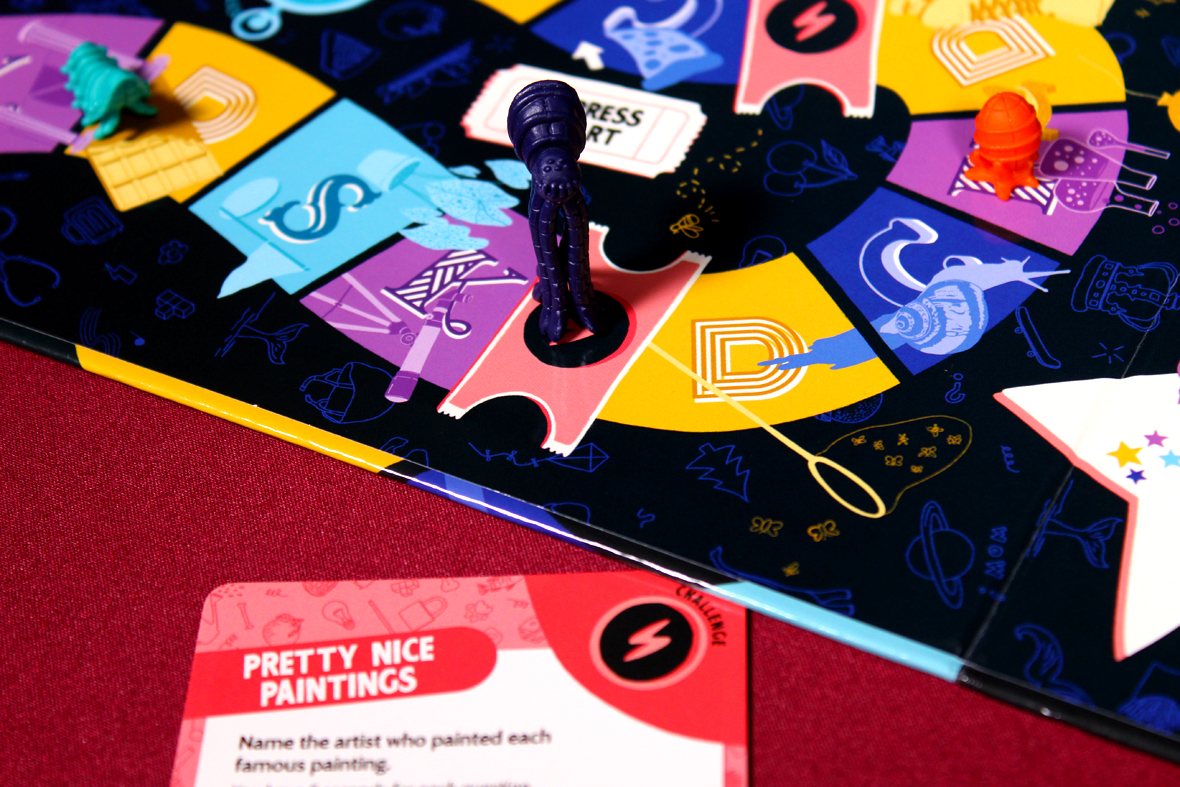
- It helps to know your strengths. This is a trivia game after all; you’re probably going to do better aiming for spaces that you have a higher likelihood of knowing. I mean, if you want to just go for it, go for it; can’t stop you.
- I like going after Challenges! You can really shoot ahead if you do well. They can be anything, but they’re usually rapid-fire enough that I can get a few correct. The nice thing about Challenges is that you usually get to advance per correct answer, rather than an all-or-nothing toss-up. This can be a good way to catch up or surge ahead without having to answer a 10 question.
- Keep in mind that the 1 question is pretty much always a joke. I haven’t read every card, so no guarantees, but getting a 1-difficulty question is usually just a basic “do you know what a person is?” or “how do you eat food?” kind of question. You’ll hopefully breeze by, but it is a useful way to get off of a space if you’re stuck in a set of categories you don’t know that well.
- If you don’t know the Hurry Up & Win question, well, you better hope you know the next one. It’s called Hurry Up & Win for a reason; if you don’t know the answer, another player may get there and beat you to the victory! There’s not really a lot of strategy, here, though; trivia and all that.
- One good move in this game is to gauge what space you want to be on next, and then use that to determine what number you want to give for a question. You can give numbers based solely on which spaces you want to avoid, or, in my case, I try to answer conservatively as I’m advancing and then turn it up a bit to try and land on a Challenge space.
- Related, but you don’t need to overshoot the Hurry Up & Win Space; you can just land on it. Similarly, you don’t need to go for a big, flashy question to get to the Hurry Up & Win Space. You can just pick a 2 or something, if you’re that close. Getting too ambitious is a little bit too Icarian for my tastes.
Pros, Mehs, and Cons
Pros
- A nice, approachable trivia game for everyone. I think what I like most about this one is that you really can just kind of bid based on how well you feel you know the topic. There’s no point to being ambitious if you don’t know it that well; you’ll just mess yourself up. You can slow-and-steady it, or you can shoot ahead with the right topic. It’s all in there.
- I enjoy the kind of whimsical demarcation of the different types of questions. It’s a very distinct framing of categories that’s far from the usual way that people break up high-level trivia categories. I like it a lot! It ends up being really fun.
- It’s always funny in a frustrating way when someone else draws the card that you definitely could have gone for the “10” on. It’s infuriating because they usually pick a 2 or 3 because they barely know it but you, you have a ton of useless and extremely-specific domain knowledge that could have sent you to the moon. And then the next card you draw is about Antipopes or something. That’s trivia!
- I appreciate that the game can support teams. I’m maybe a bit less in favor of playing on teams (see Player Count Differences) but I know a ton of people who are extremely in favor of doing that exact thing, so it’ll include them. Lemme know in the comments if you ever actually play this at 16, though; I’d genuinely love to hear about it.
- I also, strangely, kind of like that the board is part of the box. It’s relatively uncommon these days, so that makes it kind of fun. It lets you open the box with a flourish.
- Everything has a nice place inside the box, as well, which is satisfying. There aren’t a ton of components, to be fair; it’s just cards and the board (which is already mostly the box), but it’s pretty nicely organized.
Mehs
- There’s some argument that the questions will eventually become stale, as is the case with any trivia game, but I usually just recommend that players choose a different number than previously if they get the same card again in a future game. This ends up somewhere in the middle for me. I always fear staleness in games, but, I mean, I played it enough to review it and never saw the same card more than once, and even if you do, well, it’s either a reward for playing it a bunch or an incentive to pick a different number. If you have players that are willing to lie about it, as I usually say, find a different group.
- The Hurry Up & Win cards being double-sided threw me off. Unexpected! But, hey, nice.
- There’s some potential to accidentally read cards in the box. Not great if it happens, but people’s eyes can wander unintentionally. Just mention it and then put the card on the bottom or something.
Cons
- I think I get the idea behind not providing player pieces, but I don’t like it. In theory, this allows players to choose something that fits themselves or their team or their vibe, but in practice, this just means that I, the person hosting the game in their house who doesn’t want people just grabbing random stuff from anywhere, have to pull out a different game and use random pieces that I find in that, which ends up making another mess that I have to eventually clean up. I have yet to be in a scenario where there are just random appropriately-sized things laying around for players to grab.
Overall: 7 / 10
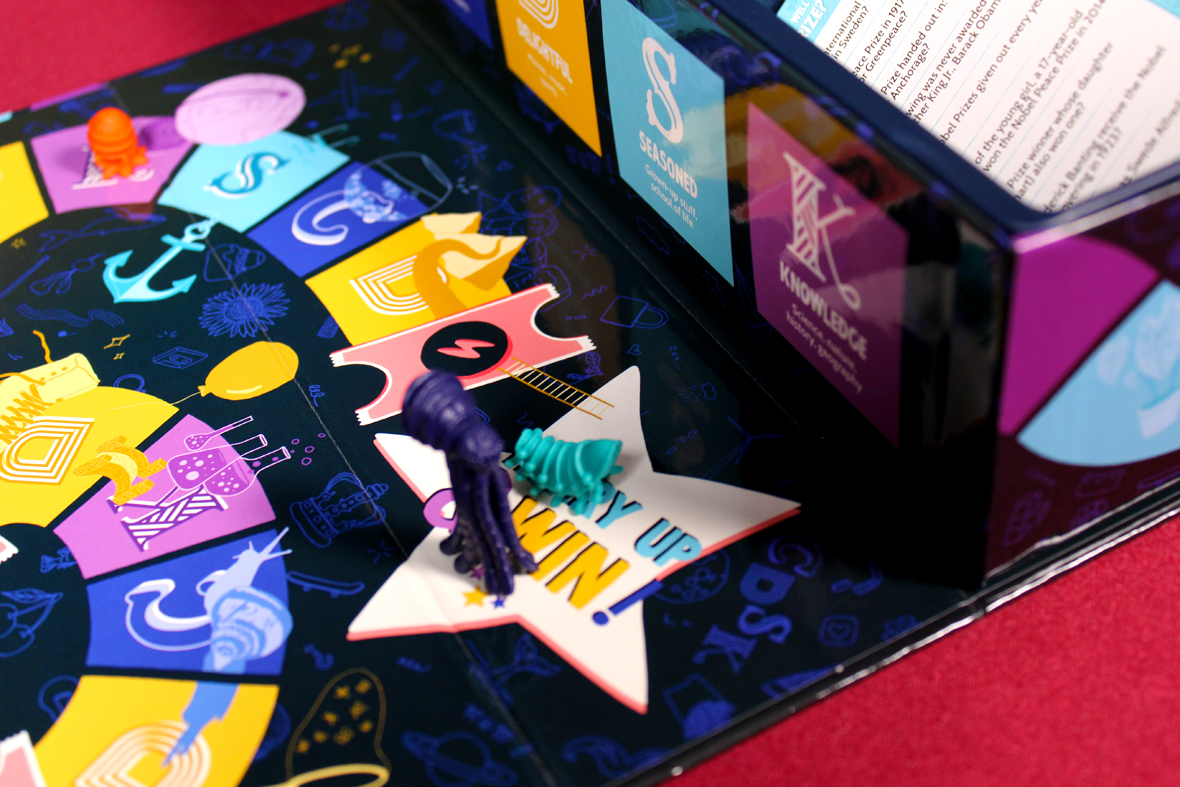
Overall, I think CDSK is fun! I generally like my trivia games to be a bit more fast-paced by nature (see Everything Ever or Anomia), but this was enjoyable, as well! I appreciate how approachable this game is, at its core. I wouldn’t necessarily go for the “Seasoned” question pool if you’re not experienced, but beyond that, there are topics in here for folks with a wide range of interests and knowledge. I appreciate that the CDSK organization of the topics means that you’re never totally sure what you’re going to get, either; it prevents any one player with a ton of specific domain knowledge just camping on geography and smoking the other players. Time-wise, I also really, genuinely appreciate that there’s an “Express Start” option for players who want to play a trivia game but don’t want it to run long. Those kinds of things can be a godsend, depending on your player group. I was surprised that the box just opens up and becomes the board, but pleasantly; it’s kinda kitschy but in a way that I found charming? I can’t say I was as charmed by the lack of player / team tokens, though. As mentioned, I do get, fundamentally, the idea that players should grab things that speak to them, but given that they need to be specifically-sized and I don’t want people rooting through my house for things, it never really lands that way. Oh well. I’m not sure I’d explicitly say that this is a “family” trivia game, though; the questions can be pretty tricky and difficult. Instead, I’d say that this trivia game shoots for approachable enough that you can break it out at a wide variety of game nights for both new and seasoned board gamers. It has that family vibe, even if the questions are challenging, which I like. If you’re looking for a straightforward and approachable trivia game, I’d recommend CDSK! It’s been fun to try.
If you enjoyed this review and would like to support What’s Eric Playing? in the future, please check out my Patreon. Thanks for reading!
 What's Eric Playing?