Base price: $15.
2 players.
Play time: 10 – 20 minutes.
BGG Link
Buy on Amazon (via What’s Eric Playing?)
Logged plays: 2
Full disclosure: A review copy of Sports Dice: Hockey was provided by Foxmind.
Oh yes, Sports Dice is back. After Football, I craved the thrill of other sports, and now here we are. I should probably try Baseball and Soccer at some point, but we’ll see where we are when we get there. In the meantime, I figured, it’s sports season, so, let’s try out a sports game and see where we end up! It was that or a skiing game and that feels very seasonally inappropriate, so here we are. The skiing game is next week. There’s only so much I can do with my schedule. But let’s check out Sports Dice: Hockey!
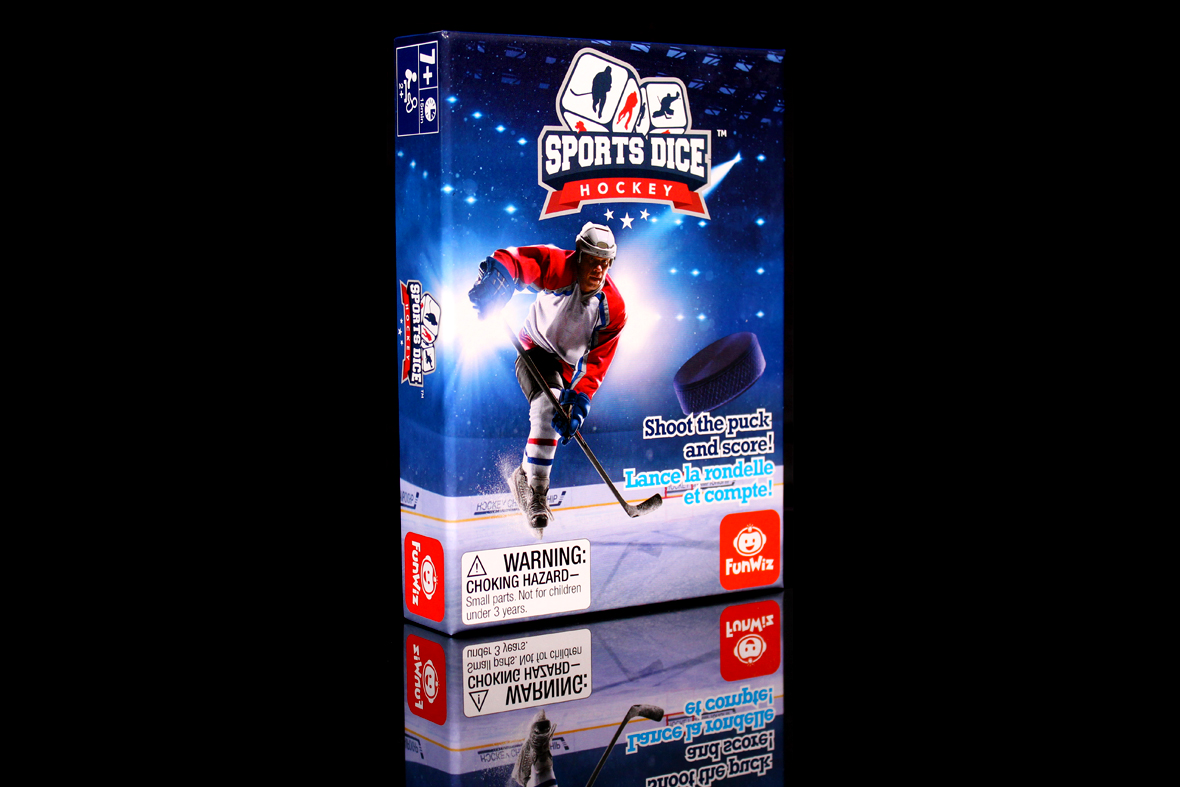
In Sports Dice: Hockey, players are going to hit the ice in a dice-rolling battle to score goals! A quick 15 shots is all you get, so you better make them count! Avoid penalties, try not to get blocked, and take a lucky shot as you get the chance! Anything can happen in hockey, so will you be able to beat your opponent before the third period ends?
Contents
Setup
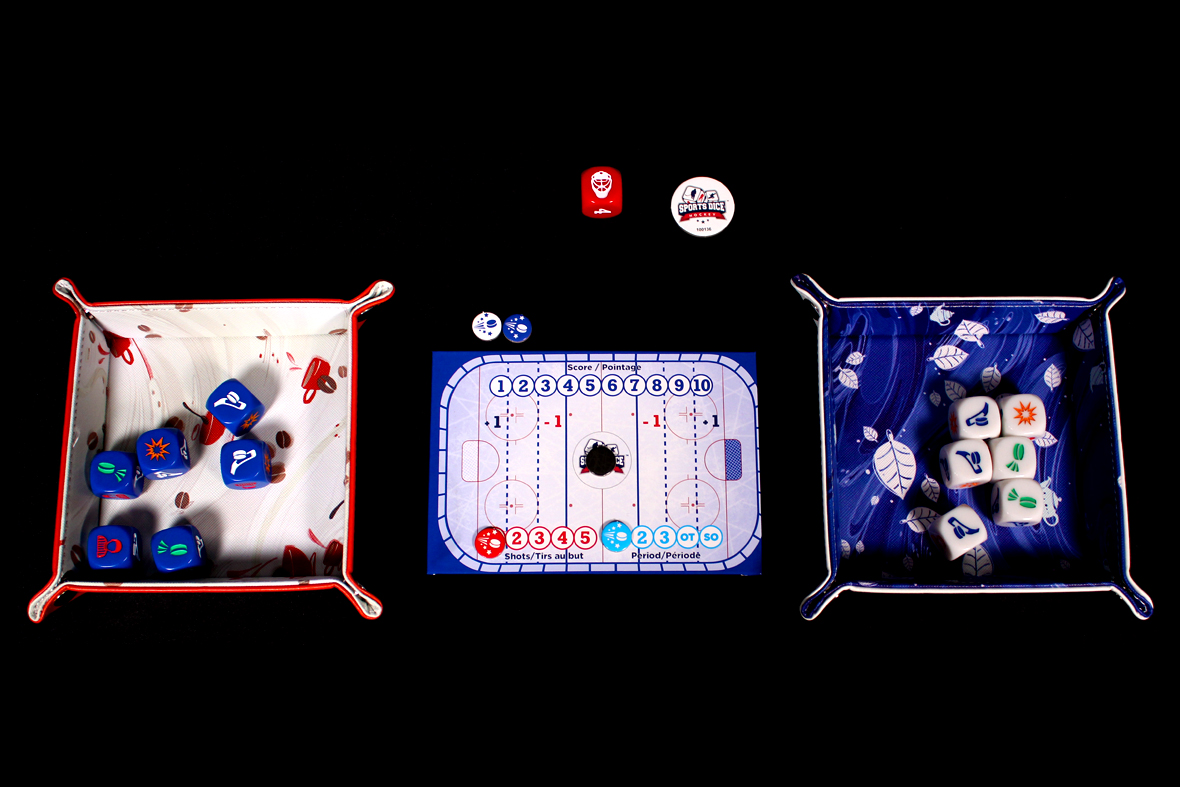
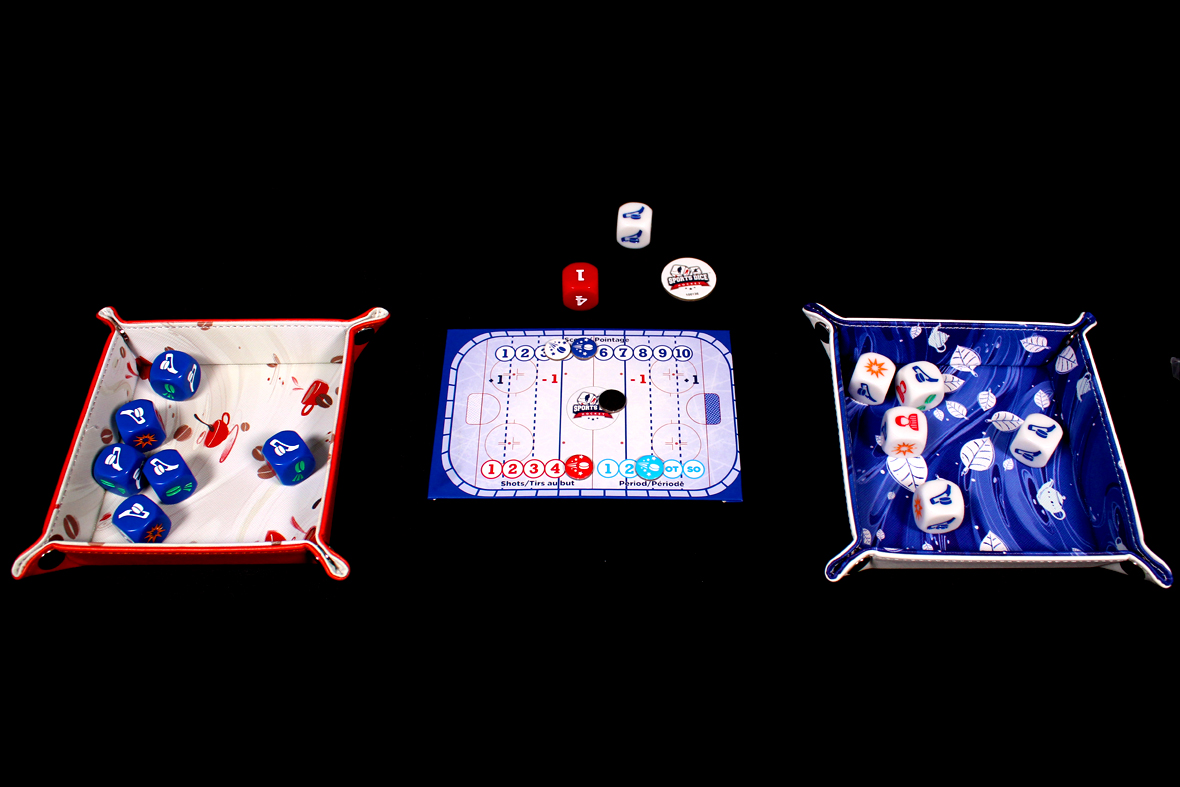
Pretty simple. Give each player a set of dice:
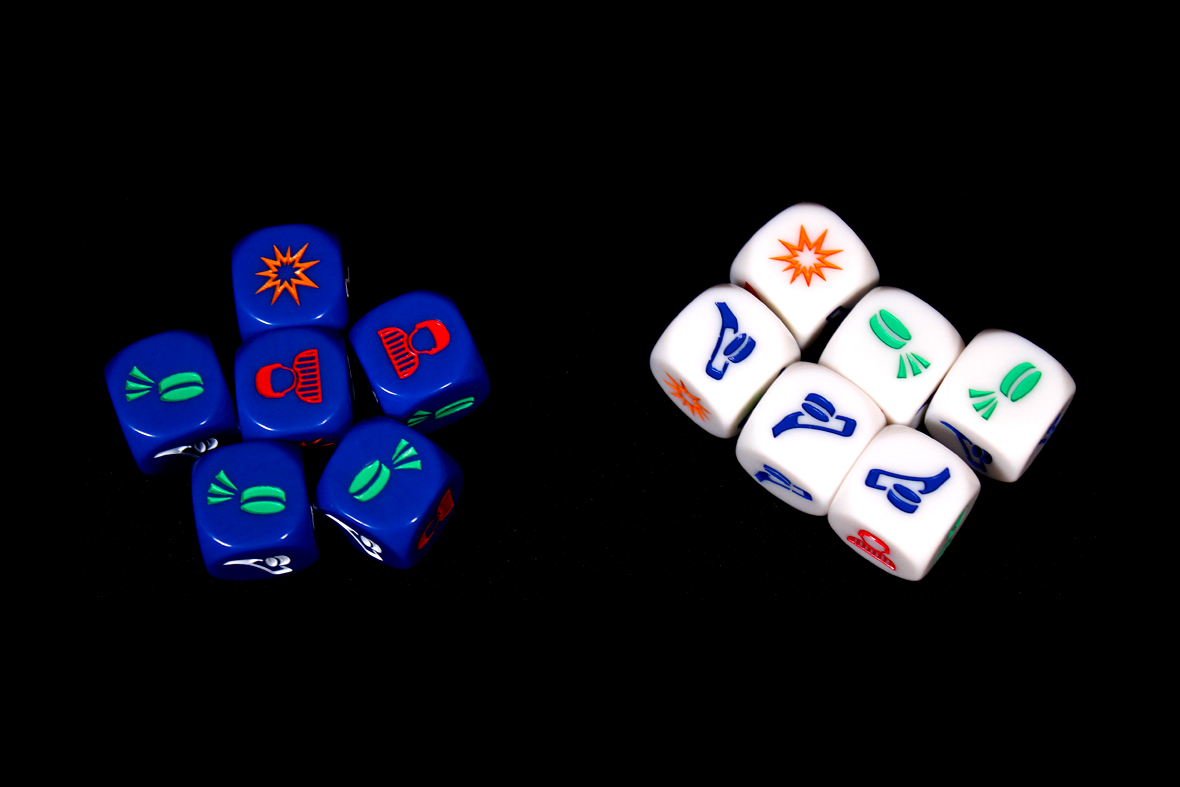
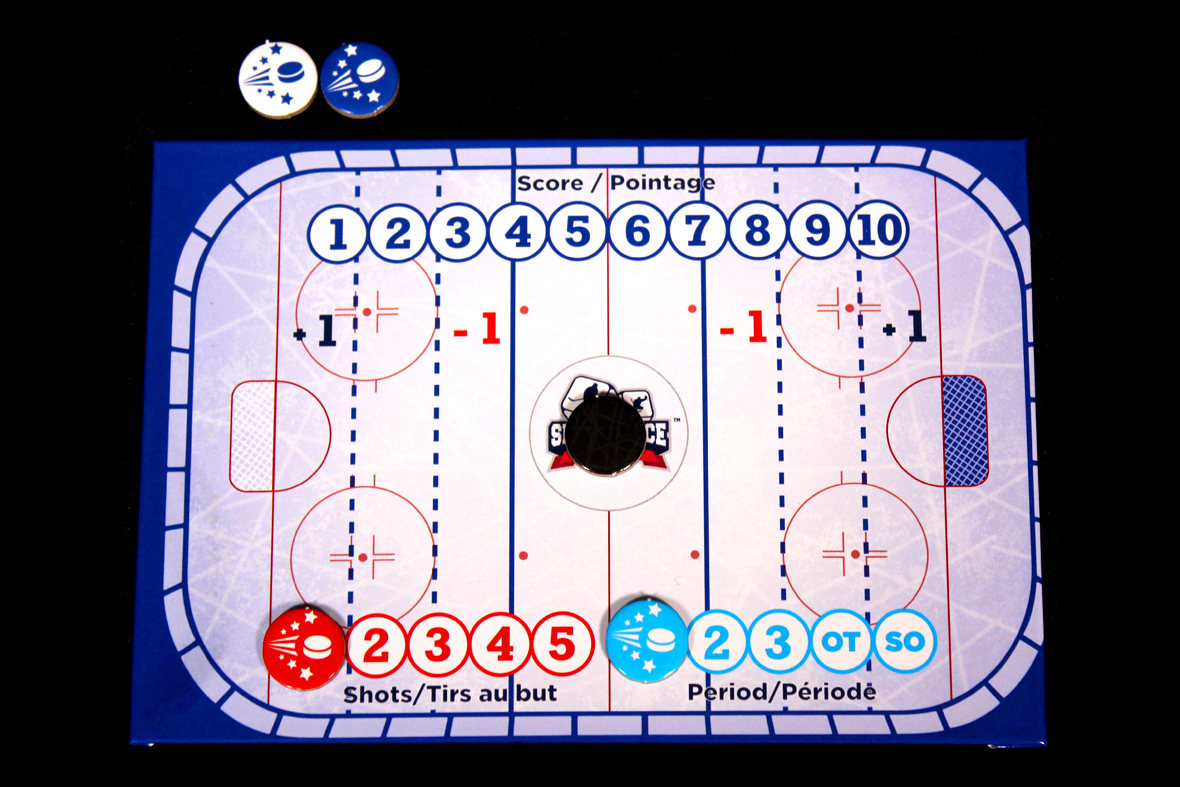
Then, set the board in the middle of the table. There are various scoring tokens and tracking tokens that go on the board as well; place them and the hockey puck.
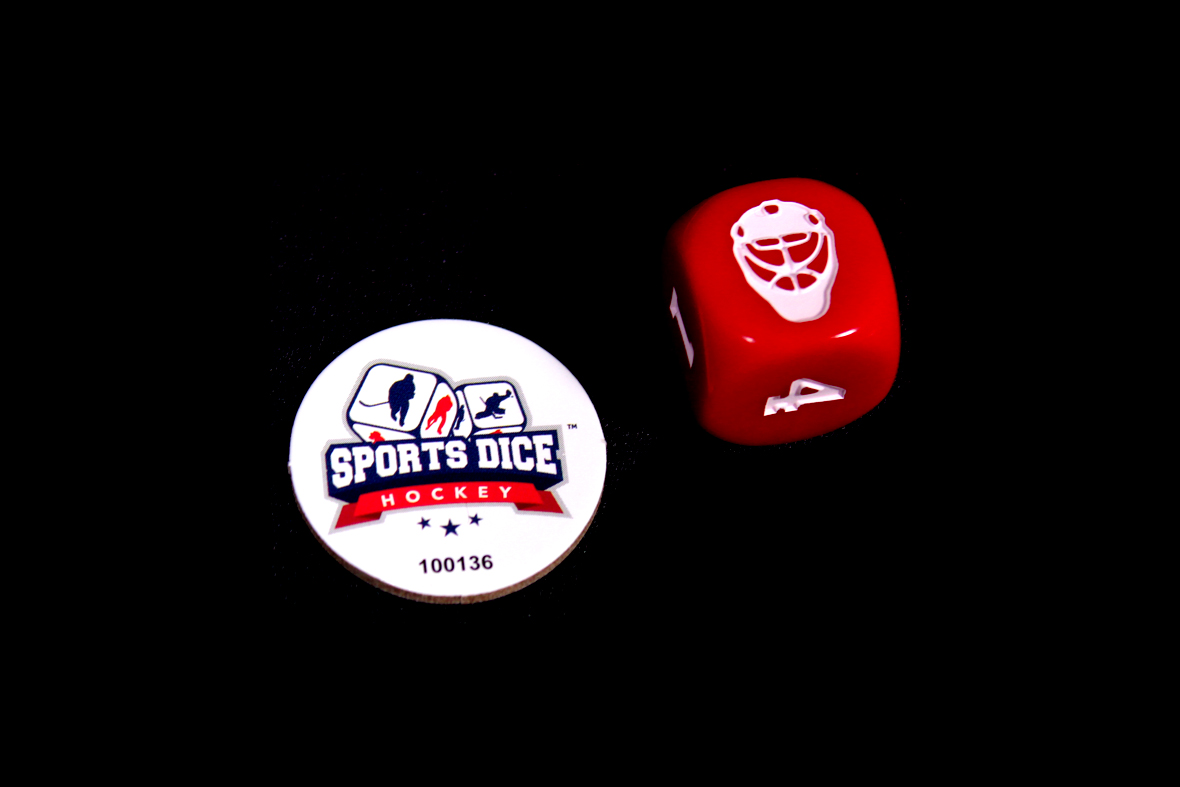
Set aside the Goaltender Die for now, and flip the Power Chip and give it to the player whose dice match the color it landed on.
You should be ready to start!
Gameplay
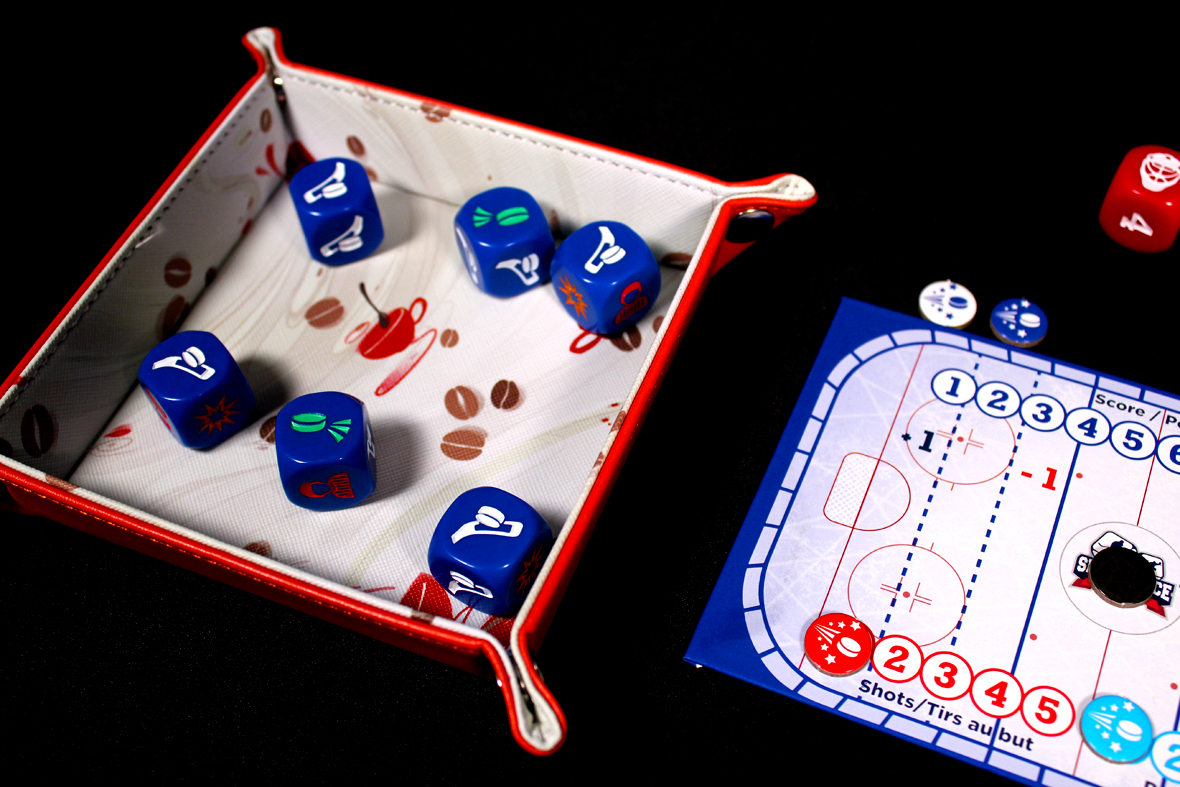
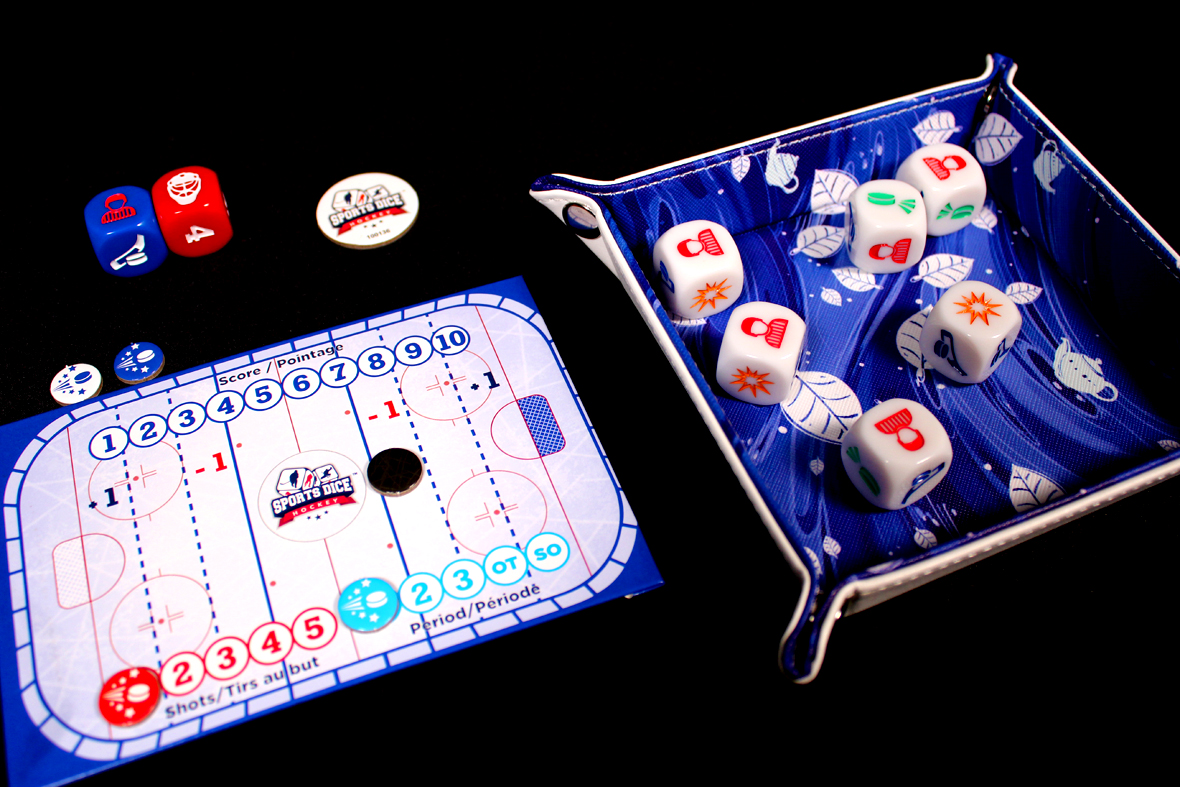
This does help if you know hockey, but I managed to learn most of this on the fly. In a given turn, each player rolls all of their available dice. The symbol that appears the most is their “play”. The player with more dice in their play than the other player wins and executes the effect of their play. In the event of a tie, the player with the Power Chip can either give it to their opponent and win the tie or choose to lose the tie and keep the Power Chip. The various faces of the die have different effects:
- Hockey Stick: Push the hockey puck one section towards your opponent’s goal. If you’re past the solid line on their side, you may also take a Shot on Goal. If you roll six Hockey Sticks, it’s an automatic goal.
- Puck: Push the hockey puck two sections towards your opponent’s goal. If you would reach their goal, you may also take a Shot on Goal.
- Check (Explosion Symbol): Reroll all dice showing the Check symbol. Ignore your opponent’s roll and apply the new result of your dice.
- Referee: Penalty! Remove one of your opponent’s remaining dice from play; they roll one fewer die per penalty until a Shot on Goal is attempted.
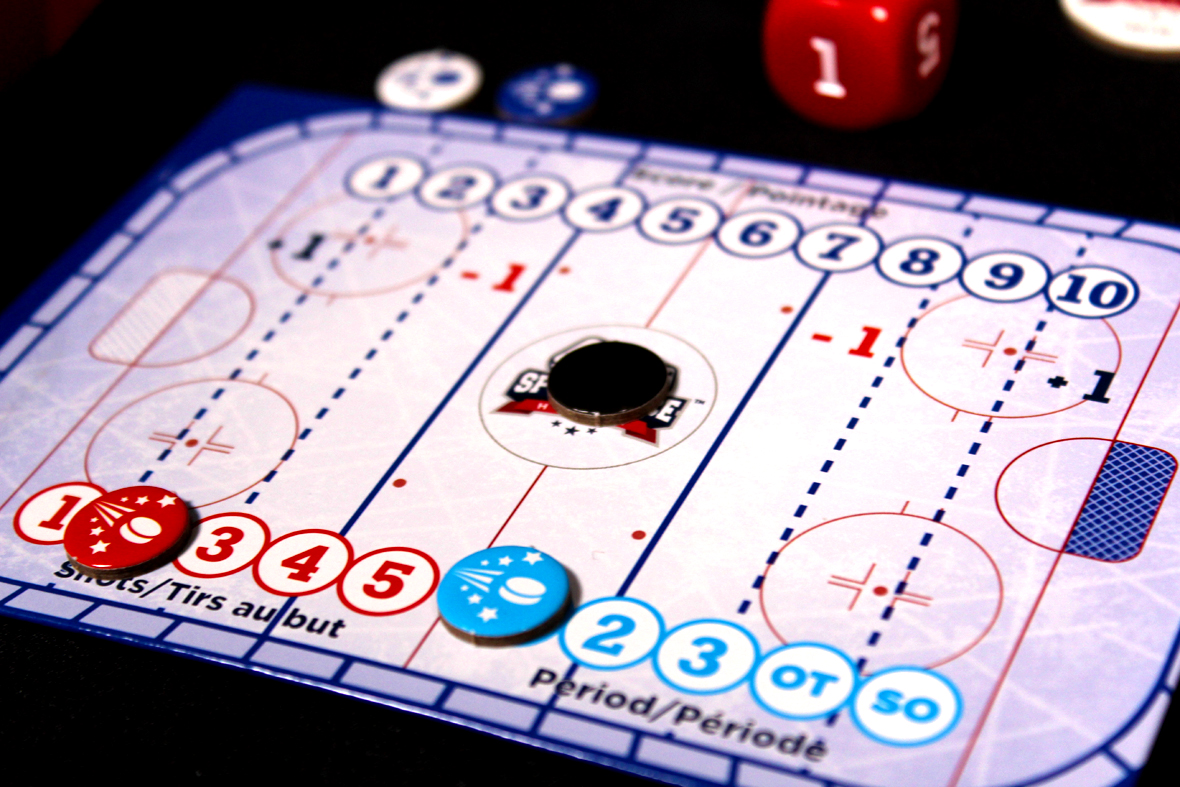
During the game, you’ll hopefully try to take a Shot on Goal. When you do, roll all of your available dice. Count up the number of Hockey Sticks, and then add the number corresponding to the section of your opponent’s side of the rink you’re on. It could be +1, 0, or -1. Your opponent rolls the Goaltender Die. If they roll higher than your number (or the mask), it’s blocked and you don’t score. If they roll lower, you do score. If they roll the same, resolve a tie as normal with the Power Chip. Either way, advance the Shot counter by one; if you take the fifth shot in a period, that period ends. Reset the Shot counter and advance the Period counter.
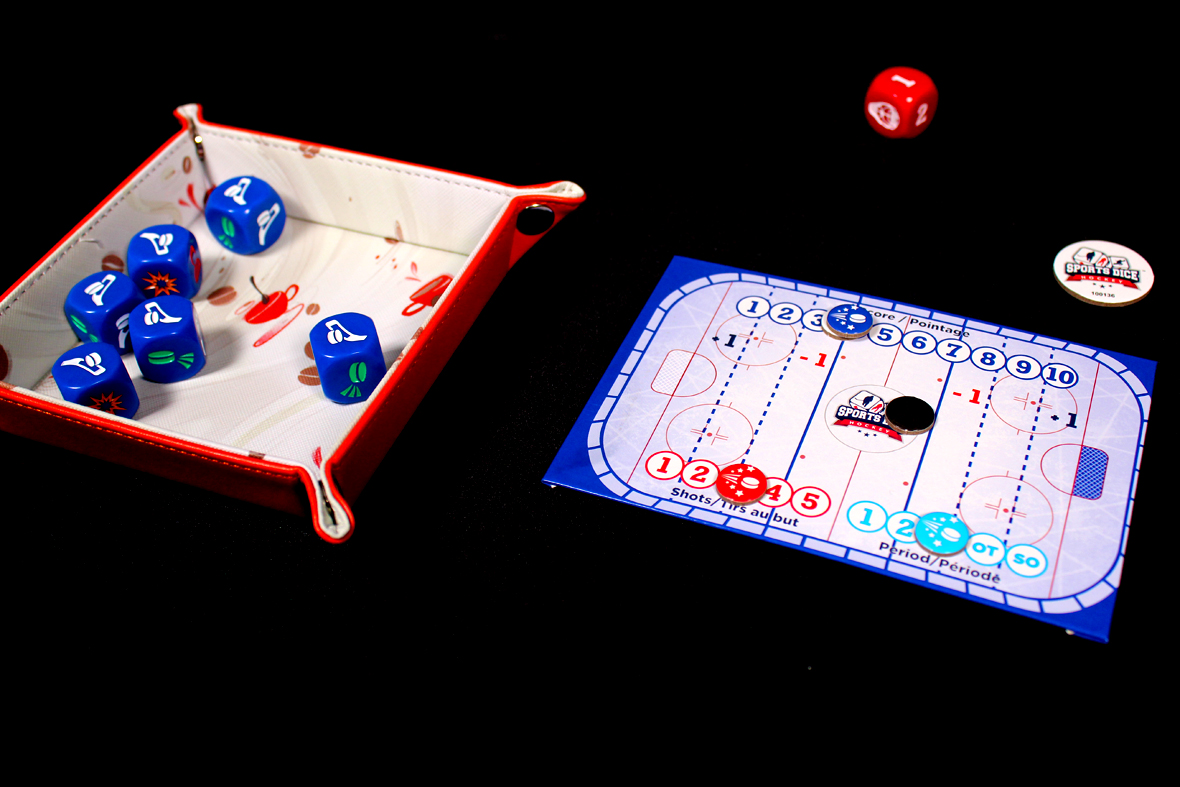
The game ends after the third period; the player with the most points wins! If you’re tied, go to Overtime. In Overtime, the first player to score a goal wins! If no goals are scored, go to a Shoot Out; each player gets three shots, and the player with the most goals wins.
Player Count Differences
None, really; it’s a two-player game at its core. There are four-player rules, apparently, but they’re not included in the rulebook, so… it’s a two-player game, as far as I’m concerned.
Strategy
- Just keep slamming your opponent with penalties, if you can. The more penalties you give them, the fewer dice they have, and the harder it becomes for them to beat you on your turn. This can give you the advantage you need to push into their territory and score. Note that you only get one point per goal, so it’s not really worth like, trying to get rid of all of your opponent’s dice, though I’d be impressed if you did.
- If you’re getting hit with penalties, just take a shot at the goal so that you can get your dice back. Shots reset the Penalties, so if you’re stuck, try to get a shot off as quickly as possible (if you can). Otherwise, you can always let your opponent take a shot and hope that you can block it. Either way, you get all of your dice back, which can definitely be less annoying than rolling with four or fewer.
- Knowing when to keep and when to give up the Power Chip is a solid move. I tend to only give up the Power Chip to stop momentum or to block a big play or a Penalty. The momentum thing doesn’t really make sense since dice rolls are independent of each other, but I have a bit of the ol’ gambler’s fallacy so I like to think it matters. Regardless, giving up the Power Chip to block a Penalty is almost always a good move.
- If you’re ahead by a couple goals, it might make sense to just take wild shots just to advance time and run out the clock. You can run out the clock if you’re ahead! It’s just a little rude. But as soon as you get to the -1 zone, just take a shot! The more you do that, the less game your opponent has to catch up with you. Plus, you might even make a couple of your wild shots and put even more distance between you, if you’re lucky! Just make sure you’re keeping an eye on the score; I wouldn’t do this if your opponent is only a point away from you.
- You’re never completely safe from your opponent scoring; they can just get six Hockey Sticks at any time (unless you’ve locked their dice). Penalties aside, there’s always the threat that your opponent just drops six Hockey Sticks and immediately scores a goal. It’s relatively unlikely, but it can still happen with fairly regular frequency, so keep that in mind, especially if you’re trying to run out the goal. Your luck may change pretty rapidly if that kind of thing happens.
Pros, Mehs, and Cons
Pros
- It’s a fun spin on hockey. I haven’t played a ton of hockey games, so it’s nice to see a few every now and then. Granted, the Sports Dice series is covering a lot of bases, but I’m enjoying them well enough. Can’t wait for Sports Dice: Croquet or whatever.
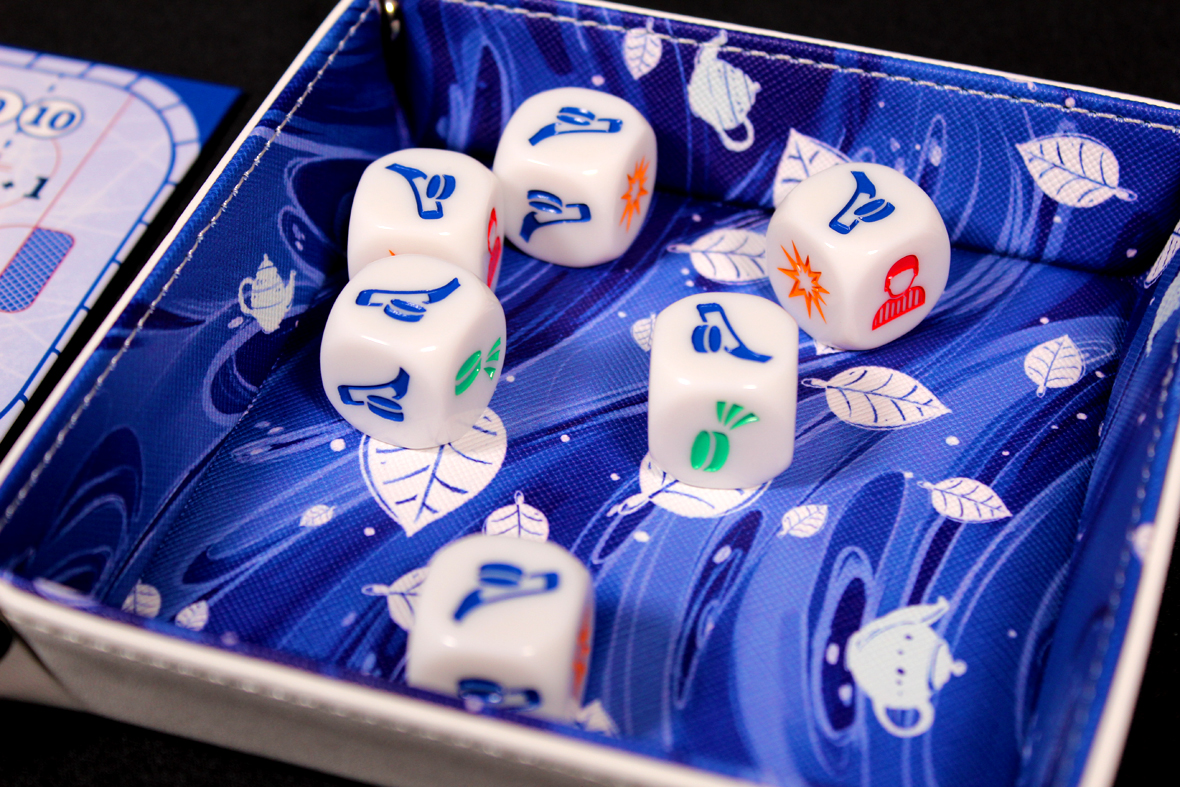
- Small footprint, which I appreciate; you can even roll the dice in the box if you want. It’s its own dice tray! The box is also pretty small, which is always nice for portability.
- I just like how many different sports work in this system. It’s surprising how many things can be adapted to the Sports Dice system, but I respect it! I do actually think Hockey works a bit more interestingly than football, but who knows.
- I like that this one has Penalties, which are a nice way to make it more difficult for your opponent to block your advance without entirely counting them out. The penalty thing is great; you can start whittling away at your opponent’s dice and give yourself a better path to the goal. That said, they can do the same to you, so it’s always funny when you’re both down to four dice and just pathetically rolling against each other. It’s a nice frustrating sensation.
- Big plays can sometimes be random chance, which is still pretty fun. If you’re into random chance, you’re going to have a lot of it here, since you’re rolling huge dice with reckless abandon. Sometimes you just roll six of the hockey stick and you get a goal. It’s definitely going to entertain younger players because there’s a certain level of excitement to it, but if you’ve got players that are down for random chance they’ll love it as well.
- The dice are extremely nice. They’re large, custom dice that come in one color for each team. I can barely fit all of them in two hands, which I appreciate. If you’re going to make a dice game and dice are the whole thing, make them fancy, you know?
- The Power Chip is a nice way to add some player agency to a game that’s mostly just rolling dice and seeing what happens. Giving players the option to pass the ability to win ties to another player to win a tie themselves is great. It cuts right through a lot of the random chance and adds in a bunch of player agency, which I appreciate. You have some choice over what happens, sometimes, but those choices can matter a lot, strategically.
Mehs
- The same issue pops up in Sports Dice: Football, but I’m never entirely satisfied with “if you have something come up, solve it via hockey rules”, since I know next to nothing about hockey. I don’t know hockey rules, so if something comes up that’s not covered I have no idea what to do with that. So, when that happens, I just kind of guess? That’s not ideal, but that’s all the rules give me. I understand that it’s impossible to enumerate over every case, though.
Cons
- A still slightly-unsolved problem is also the unbounded game time; if you keep pushing back and forth without ever going for goals the game can take a lot longer than 10-20 minutes, which can be frustrating (especially since you’re not making progress). This one is a bit funnier, just because there’s always the chance that you and your opponent will just go tit-for-tat and keep pushing each other back and forth for a while, which can push the game length into “unknowable”. That’s just kind of par for the course with Sports Dice, but it would be nice to have some way to break up stalemates beyond just the Power Chip. I suppose the fix is the advanced rules that allow players to spend the Power Chip to reroll dice, but that’s probably the only way.
Overall: 7 / 10
Overall, I think Sports Dice: Hockey is pretty fun! It’s a very simple game, at its core: you roll dice and you see what happens. There are some subtle design choices made that elevate the game, though. I really like the Power Chip in the Sports Dice series, for one: it gives players the ability to choose how a tie breaks, and deciding to use it or squirrel it away for a better occasion is always a fun bit of tension beyond just throwing dice and seeing what happens. Additionally, Penalties are a great change from Sports Dice: Football, just because limiting what your opponent can do is a useful way to allow for players to get long drives of turns towards the goal that their opponents can’t necessarily block. Even if they get there, they still have to deal with the Goalkeeper Die, and they can get blocked on that no matter what. I appreciate how the various random elements do a decent job canceling out each one’s less appealing points. The elephant in the room for the series still remains, unfortunately, and that’s just … there’s no real way to determine how long a game will take. Dice are dice. You can very easily push past twenty minutes if you’re having a heated back-and-forth, which can either be exciting or annoying depending on player temperament. That’s, again, just dice, sometimes. But this is a great game for casual play or if you need something to do while you’re waiting for a hockey game to start. If you’ve got a hockey fan in your life, you enjoy a bit of sports yourself, or you just like chucking big, hefty dice, I’d recommend Sports Dice: Hockey! I was pleasantly surprised.
If you enjoyed this review and would like to support What’s Eric Playing? in the future, please check out my Patreon. Thanks for reading!
 What's Eric Playing?