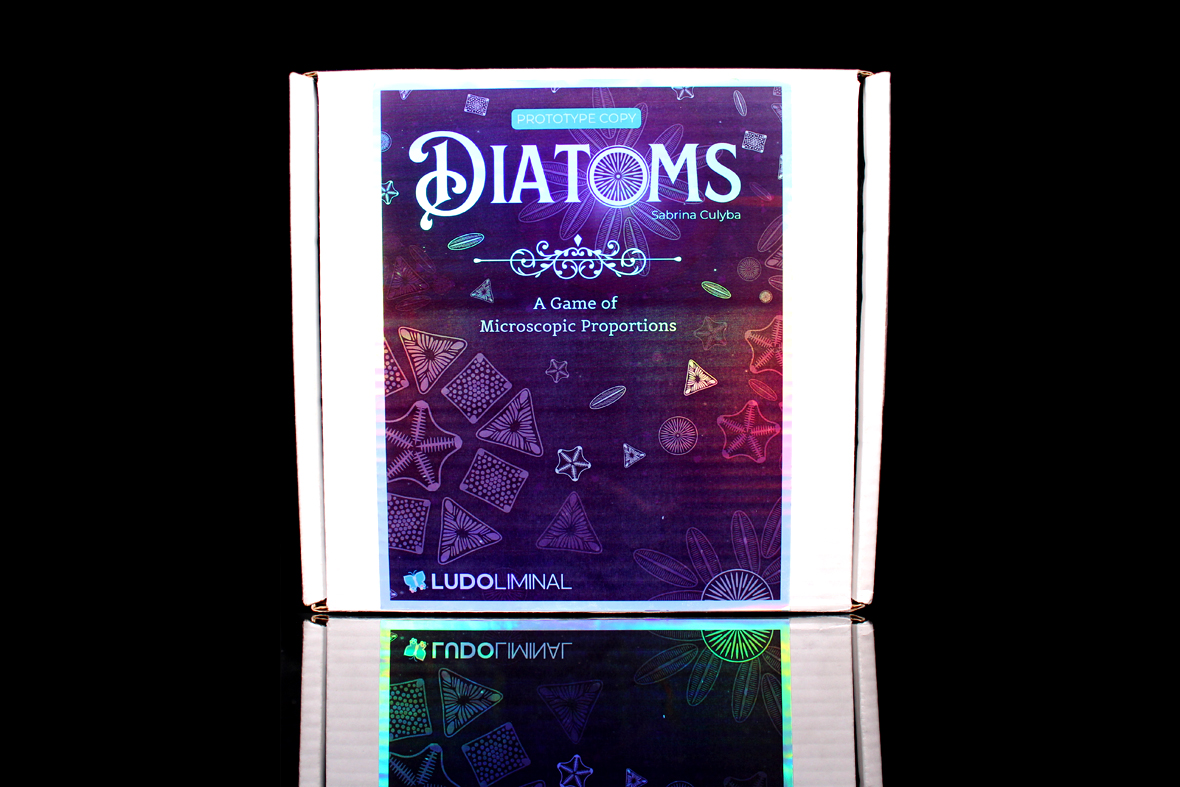
Base price: $XX.
1 – 4 players.
Play time: 30 – 45 minutes.
BGG | Board Game Atlas
Check it out on Kickstarter!
Logged plays: 2
Full disclosure: A preview copy of Diatoms was provided by Ludoliminal. Some art, gameplay, or other aspects of the game may change between this preview and the fulfillment of the Kickstarter, should it fund, as this is a preview of a currently unreleased game.
Alright, we’re very firmly back in the saddle, and nothing proves that more effectively than a crowdfunding preview! Today we’ll be checking out this year’s Cardboard Edison winner, Diatoms! I’m always excited to see what Cardboard Edison recommends for a given year, both because they do a pretty good job capturing a wide variety of themes, but also I just generally like the games that they award. I do help judge, granted, but it’s usually rare for me to get the winner in the pool of games I’m assigned. So now I get to check it out with a different lens, which is fun. Let’s dive in!
In Diatoms, players are attending an Exhibition of Microscopic Mosaics at the Society for the Microscopic Arts. As you know, diatoms during this time period were arranged into tiny mosaics for the entertainment of fancy rich people with microscopes. As one does. Your goal today is to prove yourself as an artist by making a mosaic that will impress all of the judges and enthrall them with your use of color and shape. Will you be able to create a breathtaking mosaic? Or will you just end up with a tiny mess?
Contents
Setup
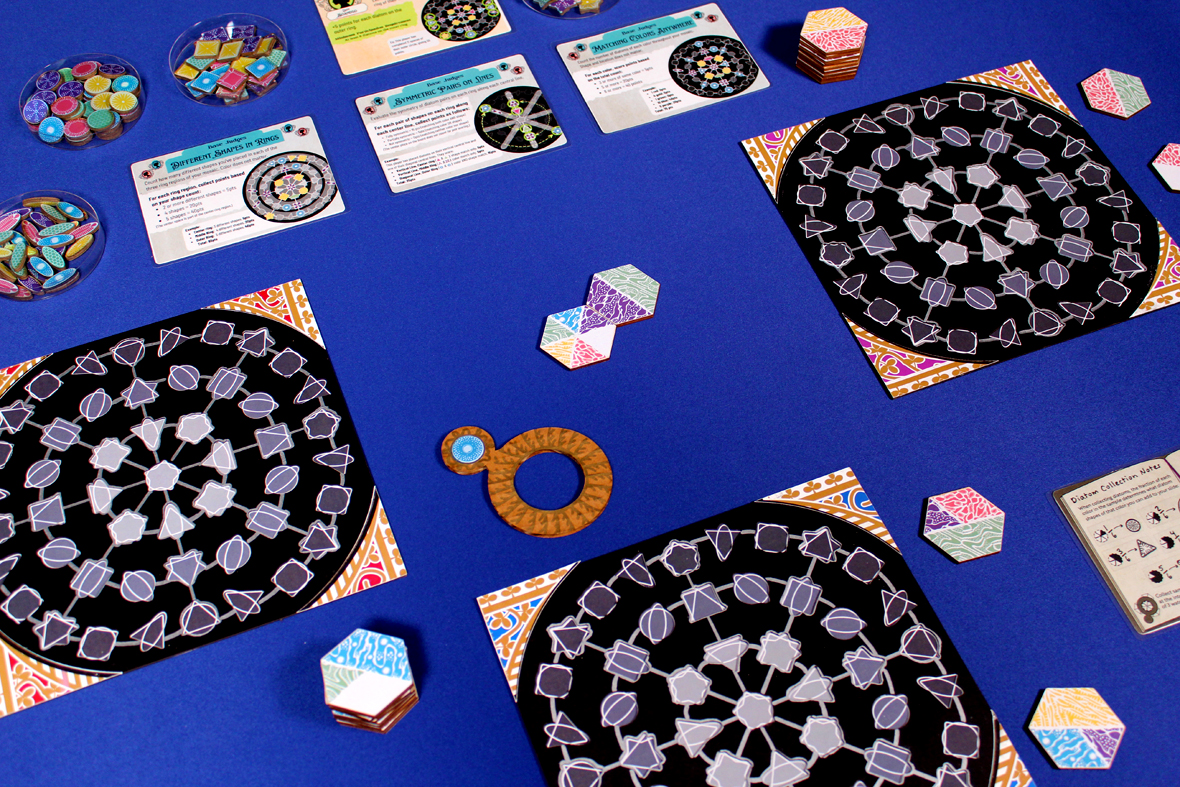
Not a ton of setup, which is always nice. You’re going to place the little Diatom Tiles into their petri dishes, separated by type.
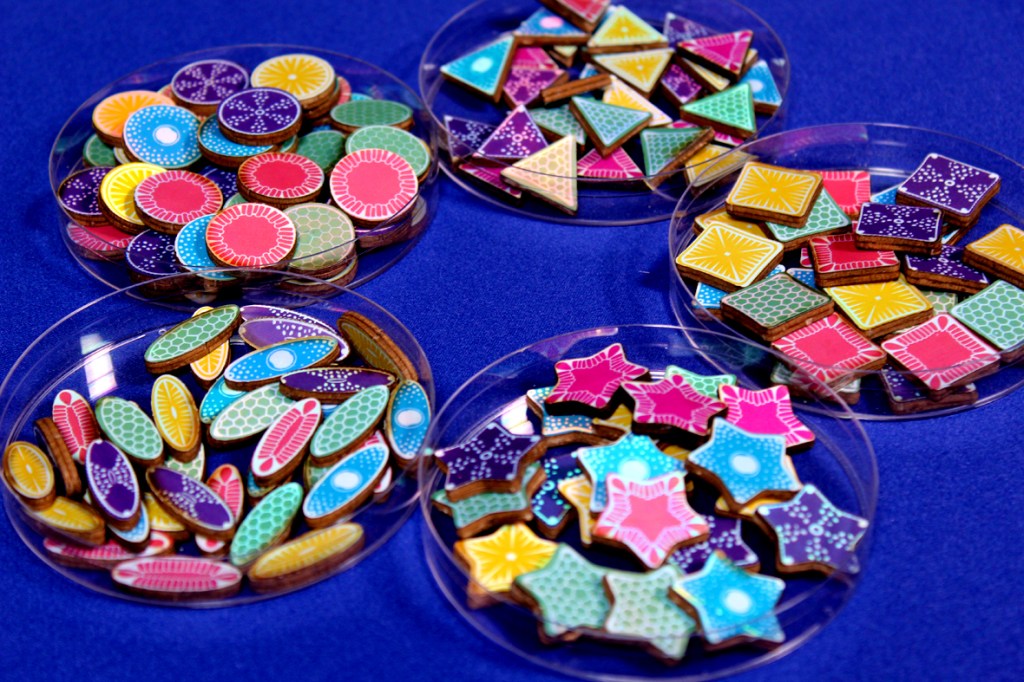
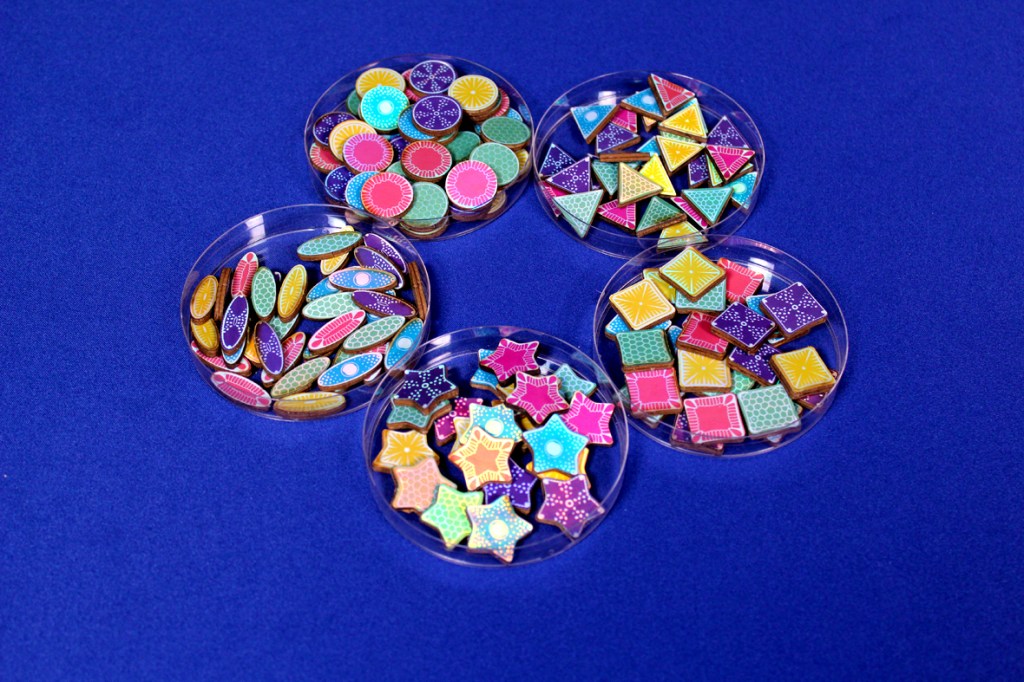
Next, give each player a Slide Board:
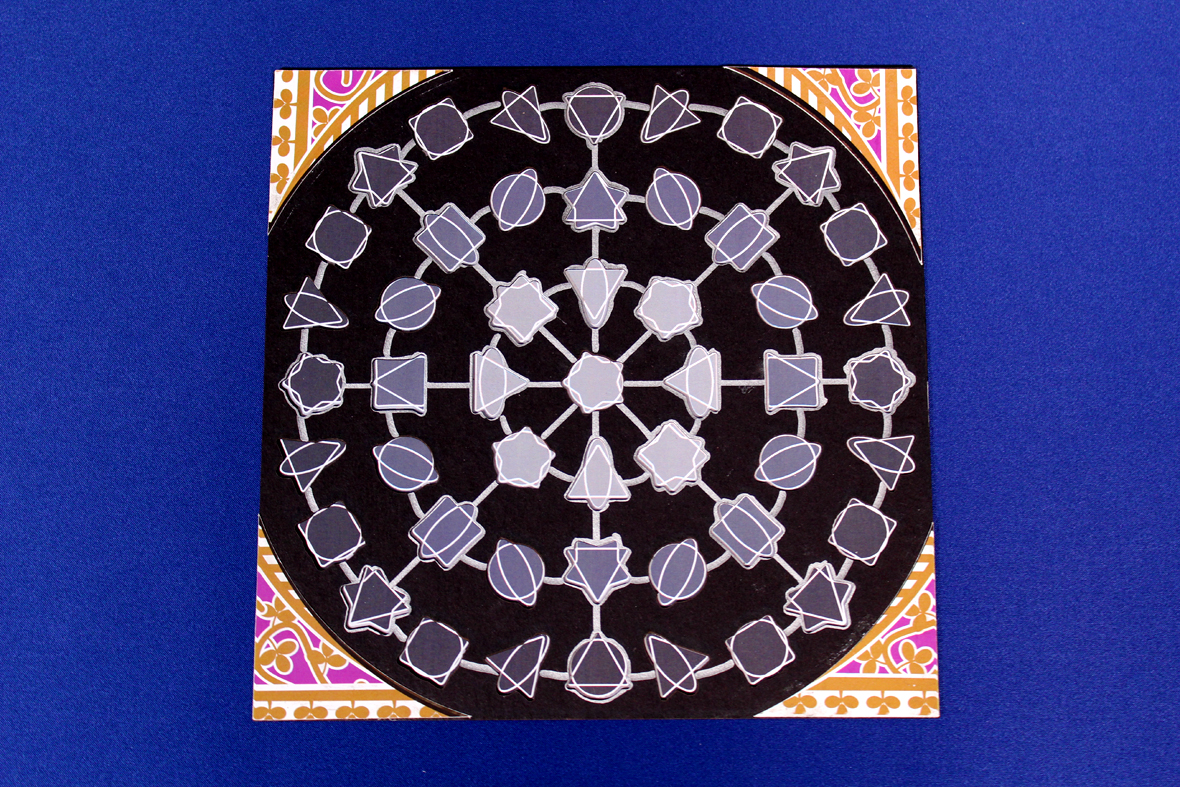
Also, give them a score sheet and a Diatom Collection Notes card. Place the Starting Tile in the center of the table and shuffle up the other tiles:
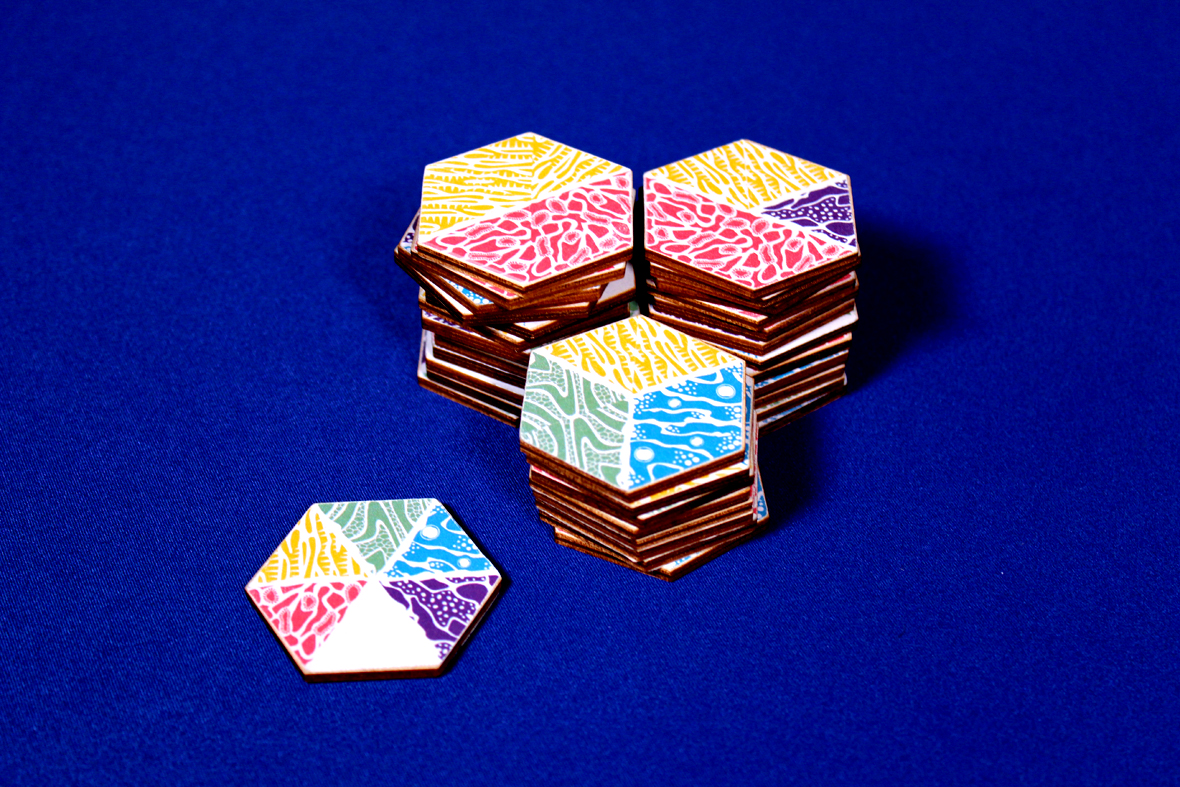
Flip one random tile and place it such that it touches the starting tile with a matching color. Deal each player two tiles, as well. If you’re playing with 2 or 3 players, remove 12 or 8 tiles from the game (respectively), and then make two equal piles from the remainder. Then, set out the three Base Judge Cards:
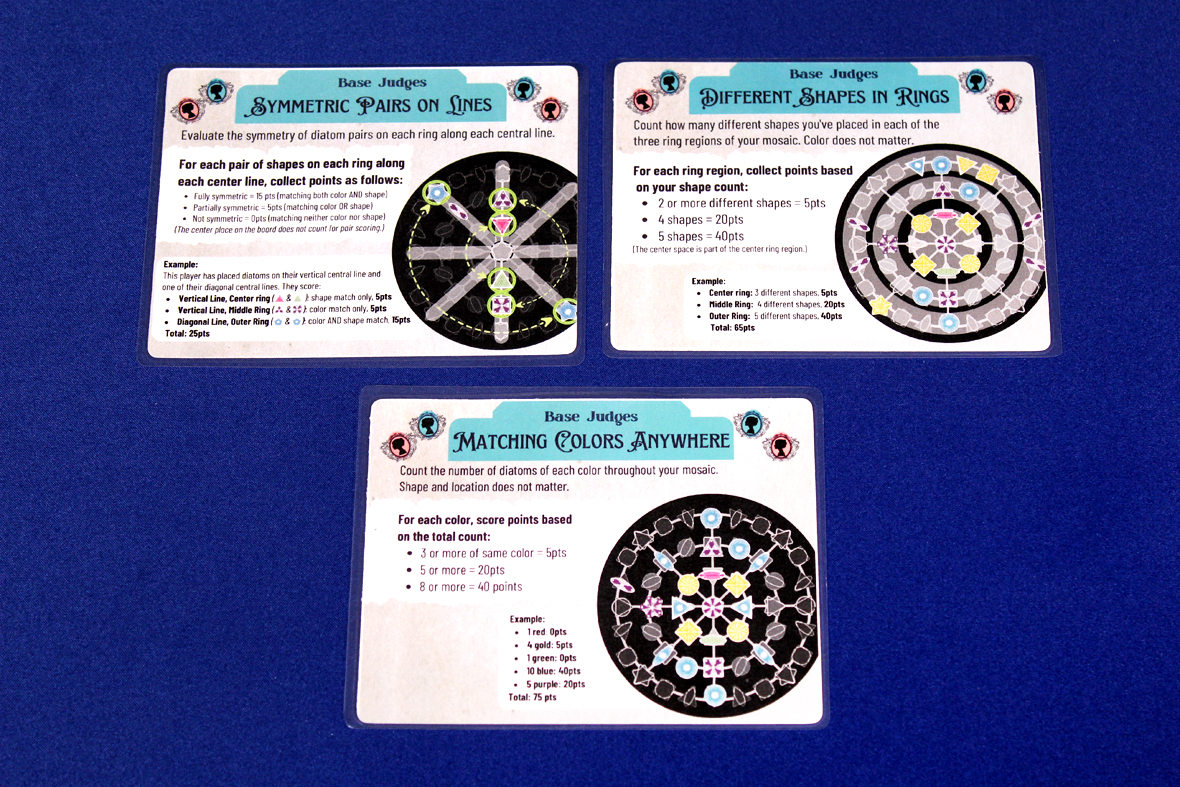
If you want, you can also include the Guest Judge Cards. If you do, choose one and place it either “Easygoing” or “Persnickety” side up.
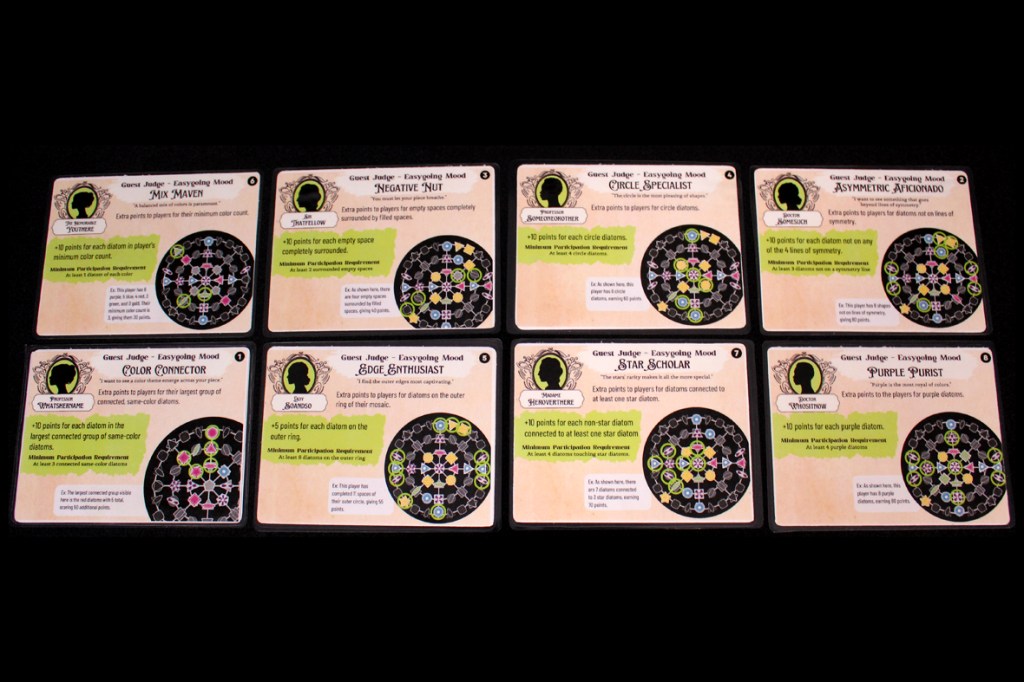
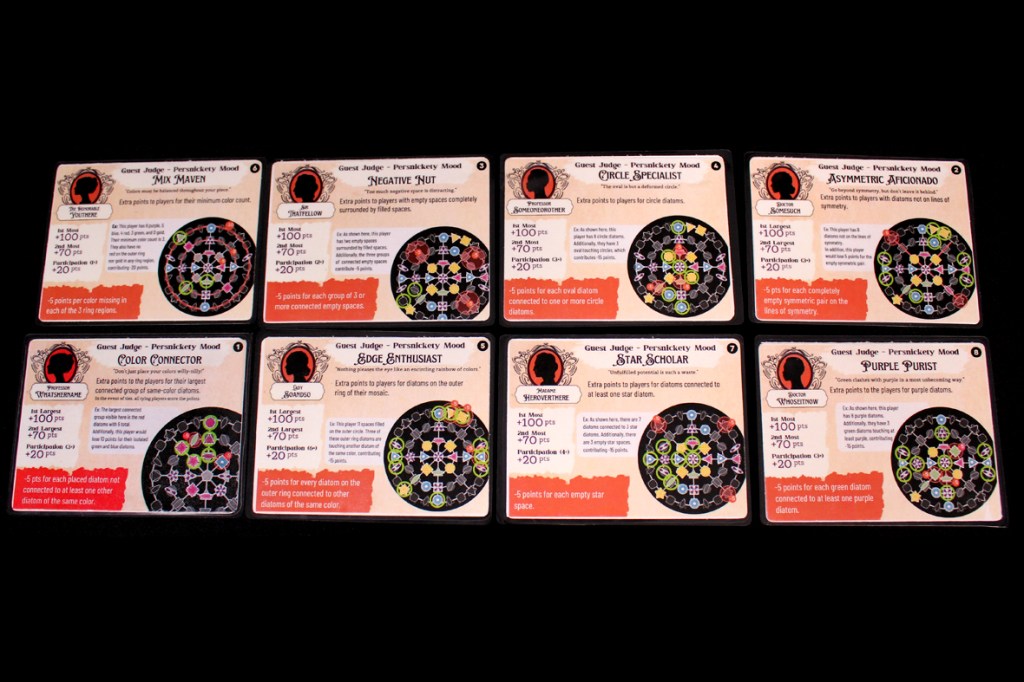
You should be ready to start!
Gameplay
Diatoms is played over a series of turns, as players vie to create the perfect mosaic to appeal to the whims of the judges.
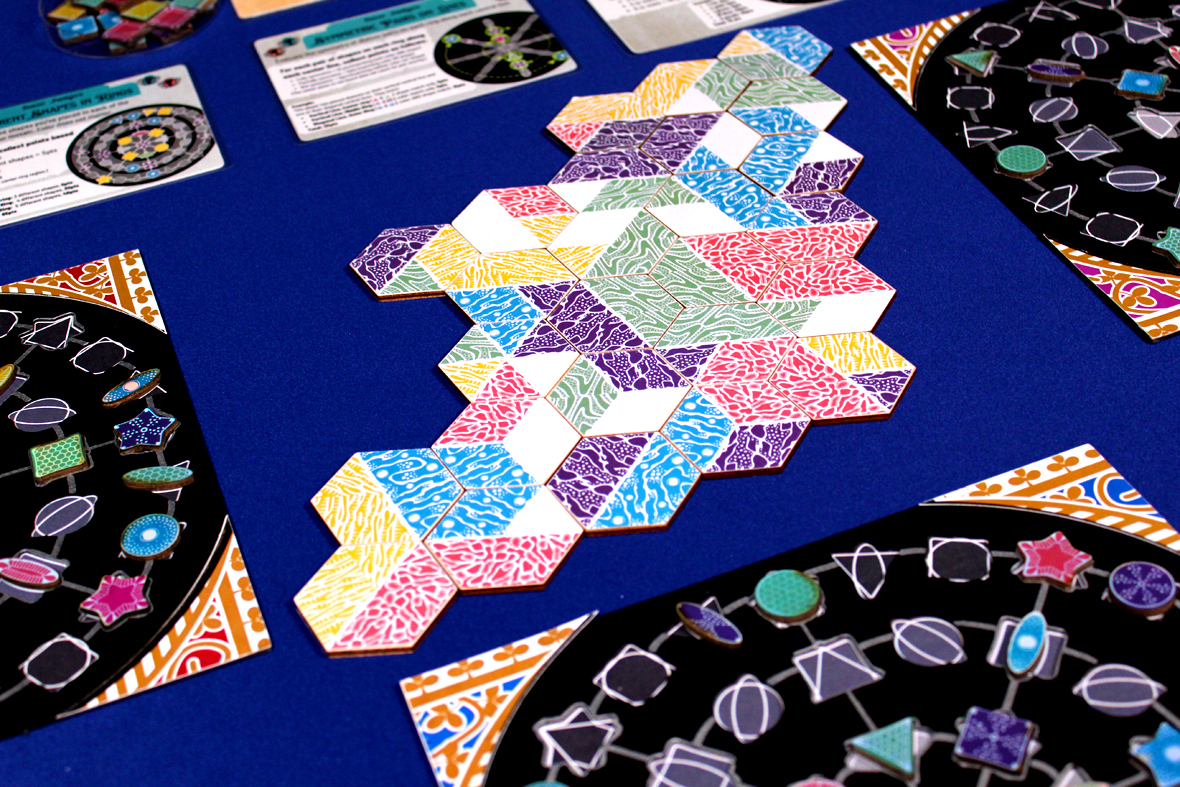
To start a turn, you must take the top Water Tile from either of the two stacks. If one stack is depleted, then you must draw from the other. Then, choose from the now-three Water Tiles you have and place that tile adjacent to another Water Tile in the main area. Note that all sides of the tile that touch tiles in the center must match colors along the edges that they touch. The Water Tiles are mirrored on the opposite side to make your life a bit easier.
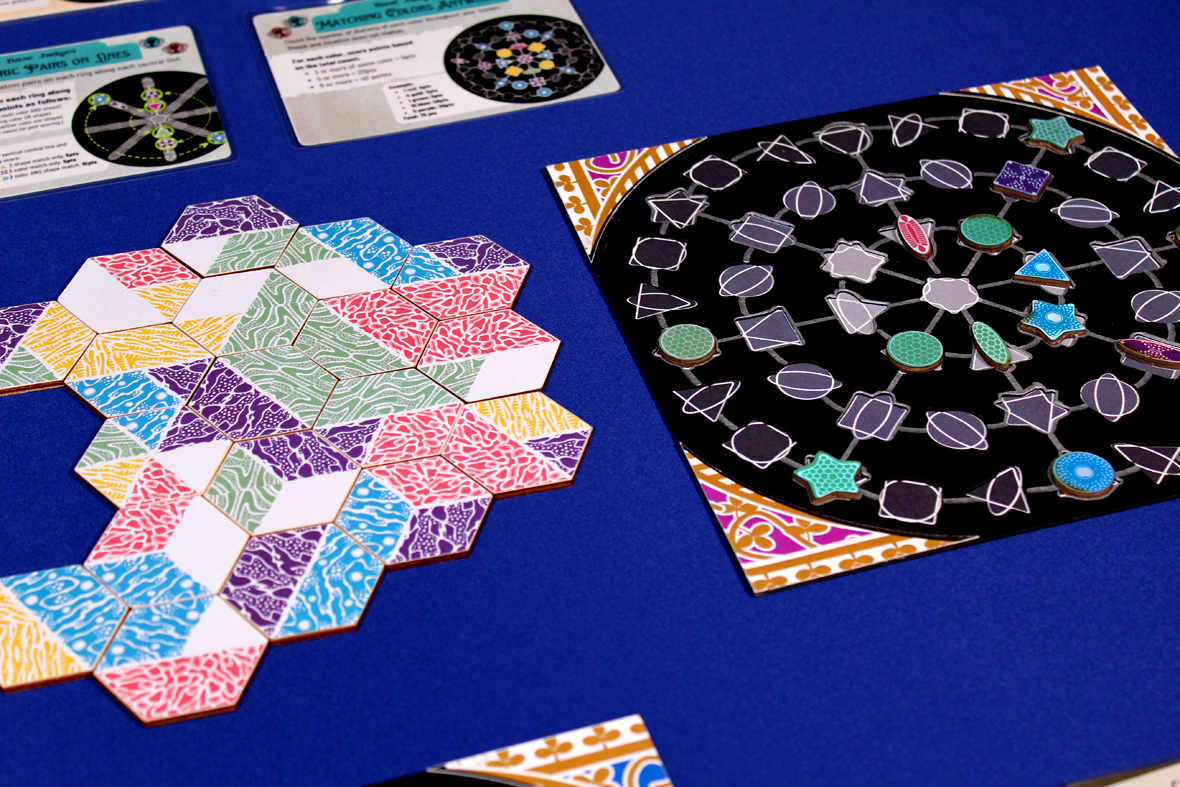
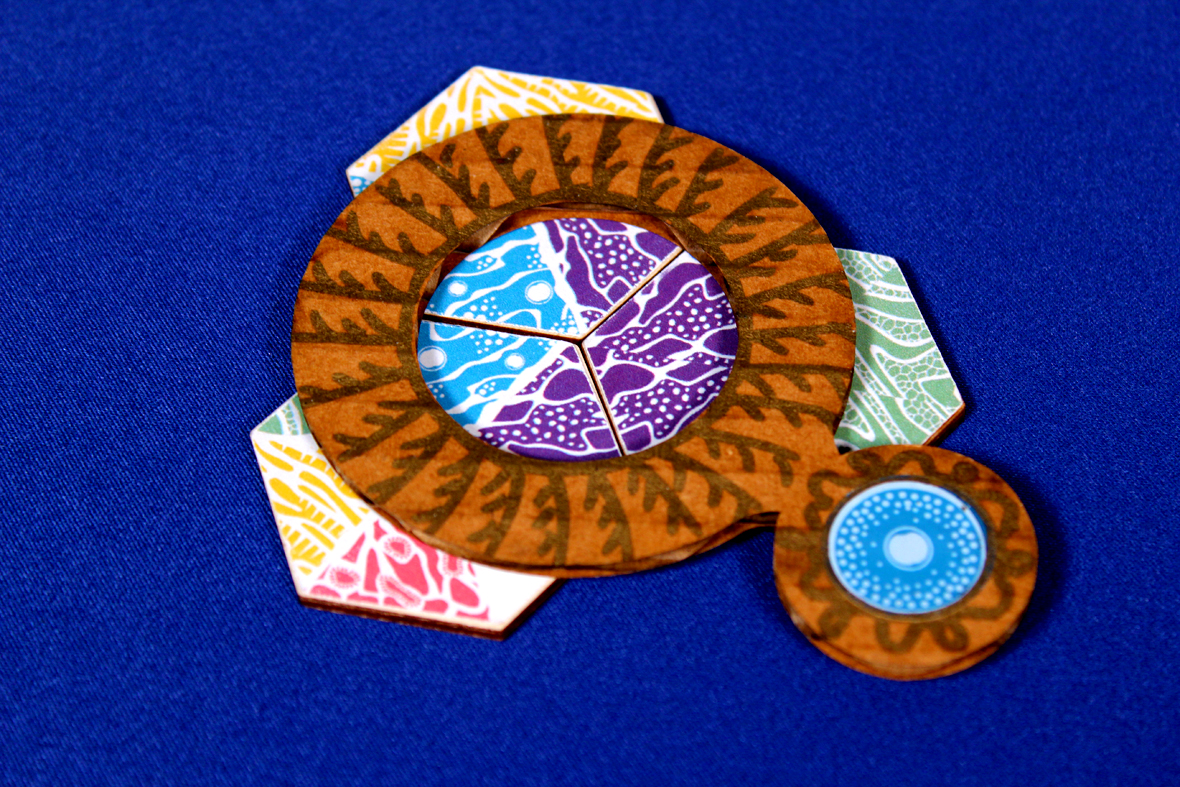
Once you’ve placed a tile, you will likely form one or more hexagons from the intersections of three tiles. For each hexagon you form, you’ll collect diatoms! Here’s how that works.
- First, place the Lens over the intersection. That will show you the six triangles that make up that hexagon.
- Then, collect diatoms based on the contiguous triangles in that hexagon of each color.
- Collect a circle of that color.
- Collect an oval of that color.
- Collect a triangle of that color.
- Collect a square of that color.
- Collect a star of that color.
- Choose any two shapes that collectively add to six (for instance, two triangles or a circle and a star) of that color.
- If there are no more diatoms left in a particular shape and color that you would have gotten, you must split them into any two smaller diatoms that would add up to that value. Note that circles cannot be split; you just don’t get any of that diatom.
- Once you’ve done that, place the diatoms anywhere you’d like on your Slide Board. If you cannot place a diatom, return it to its petri dish. At this point, the next player can start their turn while you fiddle with your board, though they can tell you to hurry it up.
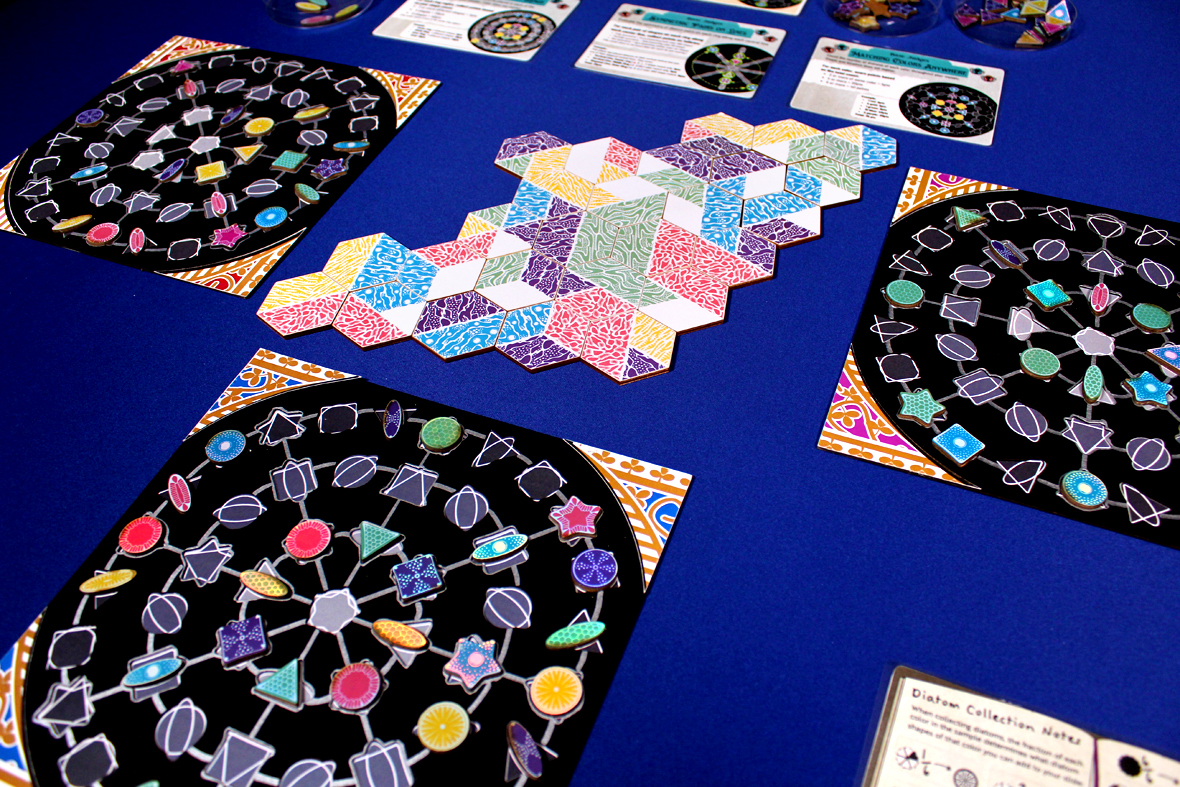
After all the Water Tiles have been placed, judging occurs! There are three base judges:
- One gives you points based on how many diatoms you have in each color. More is better!
- One gives you points based on how many different shapes you have within each of the three rings. Again, more is better.
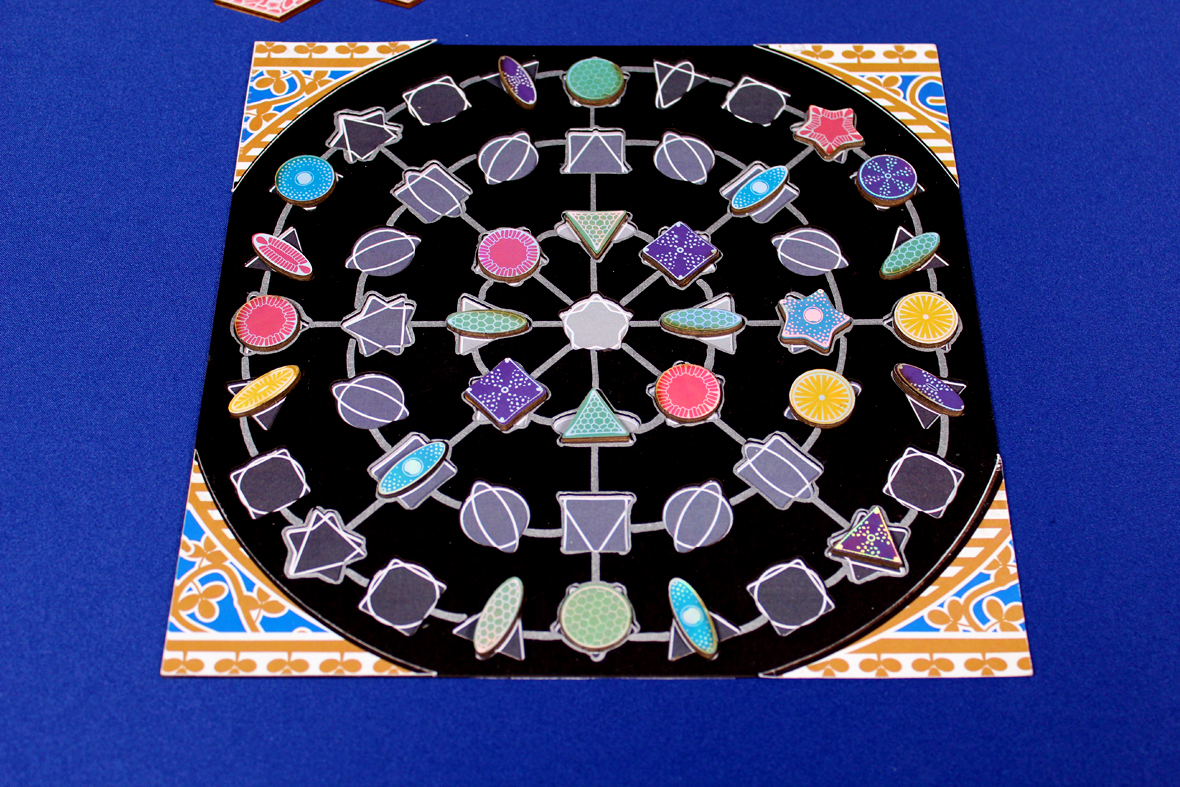
- The third one is a bit complicated. They give you points based on the lines of symmetry on your board. Every time you have a pair of diatoms along the same line of symmetry, you get points! You earn more points if they’re the same shape and color, but you still get points if they only match on one of those things.
- Then, score the Guest Judge’s requirements.
The player with the most points wins!
Player Count Differences
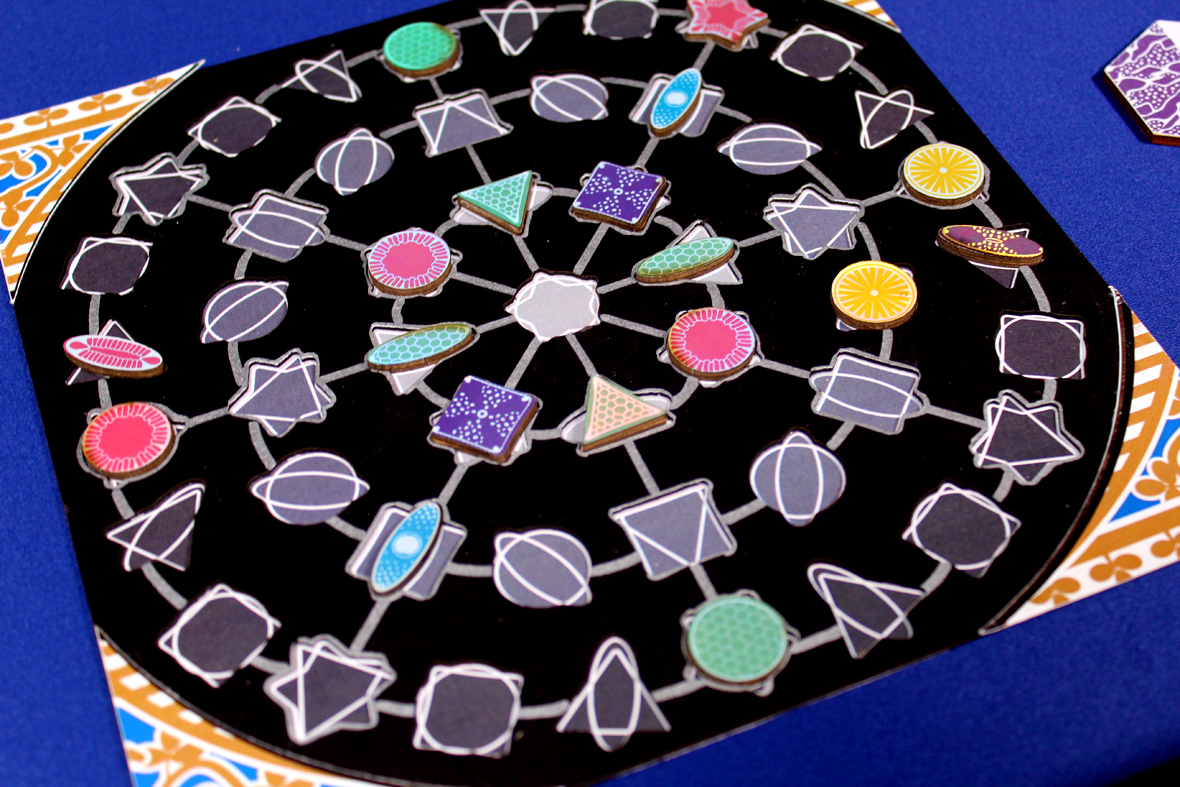
I wouldn’t say there are a ton of player count differences in diatoms, though there is one major one. At higher player counts, you start seeing diatoms disappear. The actual count of diatoms in the petri dishes doesn’t change between player counts, so at two players, you’ll never run out of anything (in all likelihood, unless you get particularly unlucky with the tiles). At four players, you’re a lot more likely to see certain colors and shapes disappear, depending on how things sort out. That can make the game a bit more aggressive at higher player counts, just because players are then vying for limited resources, whereas at two players, it’s a bit cozier and slower-placed because you’re just trying to make the prettiest mosaic. You might get frustrated with a player who takes your optimal tile placement that you were planning your next turn around, but that’s just life in the city. I would say that the pace of the game shifts with player count, so if you’re looking for a more competitive game, try four players! If you want to just take your time and chat while you play, try two players! You can also mix in the Guest Judges to add more or less competitive outcomes to your game.
Strategy
- The Judges give you a pretty clear idea of what you should be doing. You really want a variety of different shapes but the same colors, and if you get the same shapes and same colors, you want to be placing them along the symmetry lines on your board. It also makes your mosaic look better, so, I mean, strategy and aesthetics. It’s nice when they overlap.
- Try not to create a bunch of spots where a player can create more than one hexagon. That can be a huge swing for that player, since they essentially get two turns’ worth of diatoms in one fell swoop. If you keep expanding outwards and avoid creating tile overhangs or things like that, you might be able to mostly prevent it. Not much you can do about other players, though.
- If you get a full six hexagon of one color, think about what you need, shape-wise. It’s not always beneficial to just go for the star and the circle; you might want to go for two triangles and get a guaranteed 15 points from symmetric placement. That said, if you need to fill out a shape type for a ring, do that; it can be worth 40 points if you nail it.
- Don’t necessarily skip blank tiles; they can be helpful for certain placements. Honestly, that was the one thing I took for granted in my first game; I thought they were useless because I didn’t get any diatoms from them. Instead, I realized, they’re super helpful for making sure I can place in spots where I might be able to complete two hexagons, thereby getting me even more than I would otherwise get in one turn.
- Keep an eye on what color tiles your opponent has. It might clue you in to what colors will be harder for you to get, for instance, or what you should avoid creating large areas of. You don’t really want to give them an opportunity to make a full six hexagon of one color, either.
- Remember the magic numbers, here, as far as scoring is concerned. Some of the judges have thresholds where you’ll earn more points for having certain numbers, like eight diatoms of the same color. Once you hit that number, you don’t need to collect any more! You get diminishing returns, at that point. That said, you also don’t want to get stuck with seven, since you’ll miss out on 20 extra points. That’s not nothing.
- If you’re playing with the Persnickety Judge, remember to avoid their negative point condition. That just straight-up loses you points for doing something, which is never ideal.
Pros, Mehs, and Cons
Pros
- The theme here is pretty amazing. I like to think of myself as a worldly kind of guy, and I’ve literally never heard of this in my entire life. I love that. I got to learn about a weird new thing and play an entire game about it. What a fun treat.
- I appreciate that they went for “extremely holographic and shiny” as an art style. It’s fun, and I appreciate it. It’s not quite full Lisa Frank, but it has some of the same energy, and I can do nothing but respect it.
- I really appreciate how chill the two-player game is. You’re competing, yes, but you’re mostly adding to a shared space and collecting tokens that there are plenty of, so it ends up being a nice game to have a chat over rather than a white-knuckle strategy experience. No guarantees at four players.
- Mechanically, pretty approachable as well. This was one of the faster Gameplay sections I’ve written recently, especially for a game of its size. I think I could teach a fair number of people this pretty quickly. It’s just slightly too long to be a “lunch game”, but it’s not so heavy that it would need to be the focal point of a game day, which I appreciate. Seems like a game I could play with my family.
- I like the whole fractions thing a lot. Deciding what diatom you get based on what proportion of the hexagon is that color is really neat! Again, not something I see that much, but it’s very satisfying from a math standpoint. Haven’t had this much fun with fractions since Fraction Poker. Even getting to use the lens to determine the fractions is fun.
- I like that you build up a shared play area with the Water Tiles. It’s a nice bit of collaboration, even though you’re competing.
- Oh, I appreciate that the Water Tiles are mirrored on the other side, as well. That saves us all so much pain.
- The diatoms being in petri dishes is fun, too. It was fun in the Pandemic board game, and it’s also fun here.
- The Score Sheet is very helpfully laid out. I actually found several of the Judge criteria complicated, but the Score Sheet makes it very easy to score them quickly and effectively, which I really appreciate. That’s some good design right there.
Mehs
- It’s somewhat easy to miss making multiple hexagons and your opponent isn’t exactly incentivized to remind you. Granted, if they’re going to play like that, you’re probably better off finding a new person to play with, but it would be nice to have some sort of visual guide or better highlighting around the edges of each hexagon so that you can easily notice that you’ve completed more than one, especially for players that are relatively new to these types of games.
- What is the center for? It doesn’t really seem that beneficial. It’s not its own ring and it doesn’t have a symmetry partner, so there’s almost never a benefit to placing in the center as opposed to other places. It vexes me. EDITOR’S NOTE: It’s been brought to my attention that the center is part of the central ring, whoops! That makes the center more useful. We apologize for the misunderstanding.
Cons
- Some liberties were taken with font size on some of the Judge Cards and in the rulebook, and that wasn’t great. Making the font smaller to fit more text on a thing didn’t work out for me when I was writing college essays and it doesn’t work great here, either. It gives the impression that the Judge is more complicated than it ends up being (increasing player stress) and it makes the rulebook a bit harder to get through since the font size changes between pages. I’m hoping they go over this before the final version releases.
Overall: 8.5 / 10
Overall, I think Diatoms is a really cool game! I’m kind of always seeking out themes that are novel and compelling, to some degree, and you’ve got to agree that a board game about forming diatom mosaics for rich Victorians is something that you don’t see a lot in the tabletop gaming space. Even the mechanics are fairly novel, in that you’re forming hexagons and using the fraction of the hexagon that ends up being each color to determine which shapes and colors of diatoms you get for your mosaic. It’s a nice and challenging bit of puzzly play with a lot of interesting choices. There’s definitely a bit of a learning curve, so be careful when introducing it to new players. They may not necessarily see how to link together multiple hexagons in one turn, for instance. Makes me think that Diatoms slightly benefits players who have experience with either the game itself or spatial puzzle games more generally, but, I find that to be somewhat generally true, within the genre. I do appreciate the game’s approachability, though; it’s a surprisingly straightforward game to learn, though I do think there were choices made around the cards and rulebook that I hope are changed before the final fulfillment. To fit more information in a limited space, the text was made smaller, which makes some scoring cards pretty difficult to read from any distance. Not ideal at a shared table. Hopefully that’s just some prototype shenanigans, though. I did appreciate the additional scoring options, both just for their presence and also in that they have a “nice” and a “competitive” scoring option, allowing players to mix things up for what best benefits their game group. It has the nice additional extras that you’ve come to know and love from crowdfunded games without the overwhelming amount of extras that you’ve come to know and hate from crowdfunded games. If you’d like to take a journey into the world of microscopic mosaics, you enjoy a spatial puzzle game, or you just like shiny and sparkly game components, I’d definitely recommend Diatoms! I think it’s a great game.
If you enjoyed this review and would like to support What’s Eric Playing? in the future, please check out my Patreon. Thanks for reading!
 What's Eric Playing?