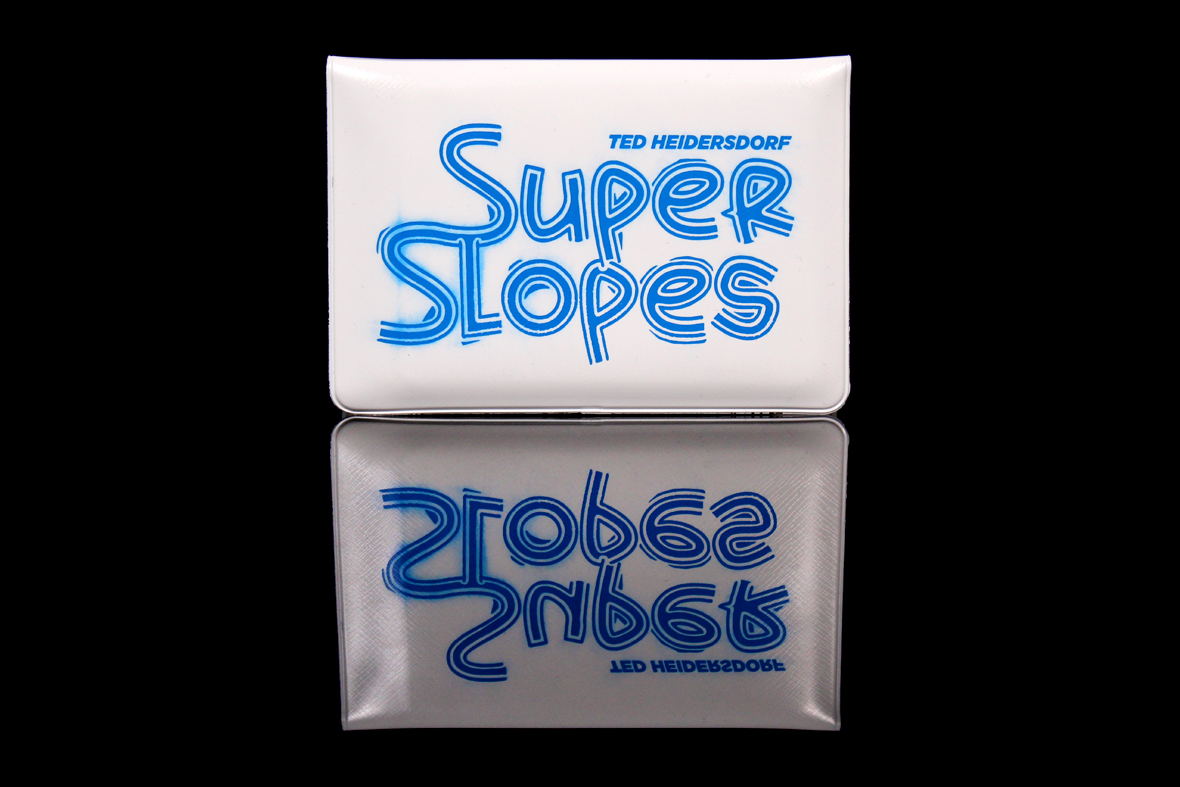
Base price: $12.
1 – 3 players.
Play time: 10 – 15 minutes.
BGG Link
Buy directly!
Logged plays: 2
Full disclosure: A review copy of Super Slopes was provided by Button Shy.
Is it the right time for a skiing game? No idea. I live in the Pacific Northwest, now; I figure people go skiing all the time. Hitting the slopes and all that. Fresh powder. French fries and pizza. Other ski terms. Is this working? I hope so. Either way, we’ve got a new Button Shy game dropping, so, as your resident Huge Button Shy Fan, I’m covering it! So let’s check out Super Slopes and see what’s happening there.
In Super Slopes, players are working not just to make the ultimate ski run, but also to pull off a perfect run on it, scoring points and avoiding danger as they do. Draft cards, place carefully, but also try to make something fun and wild if you want to score the most points! Will you be able to create the greatest ski run? Or will you end up wiping out?
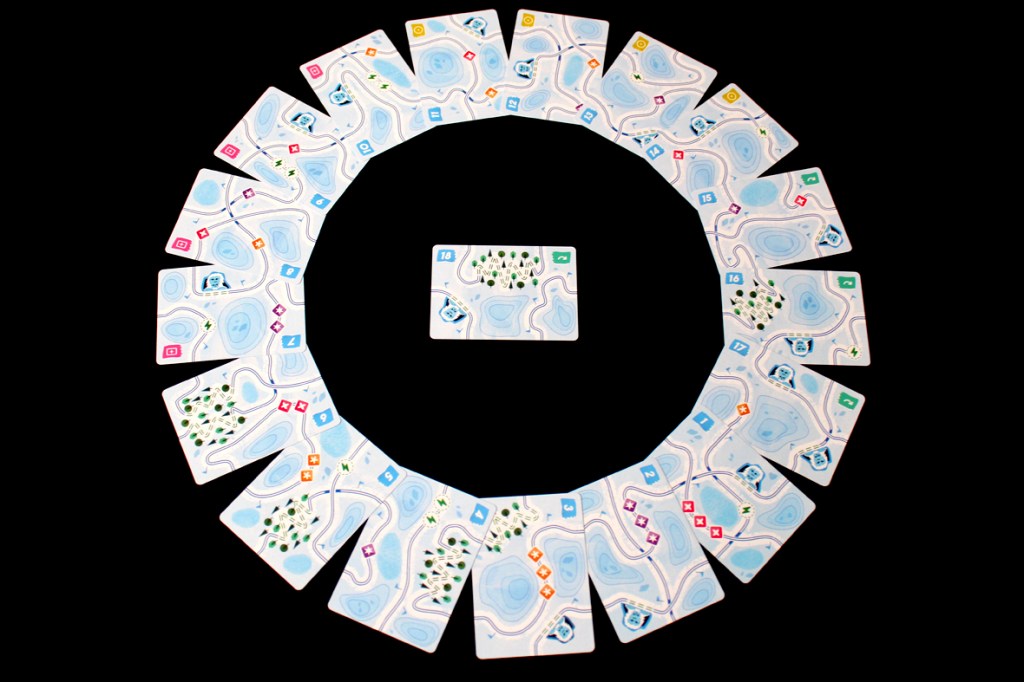
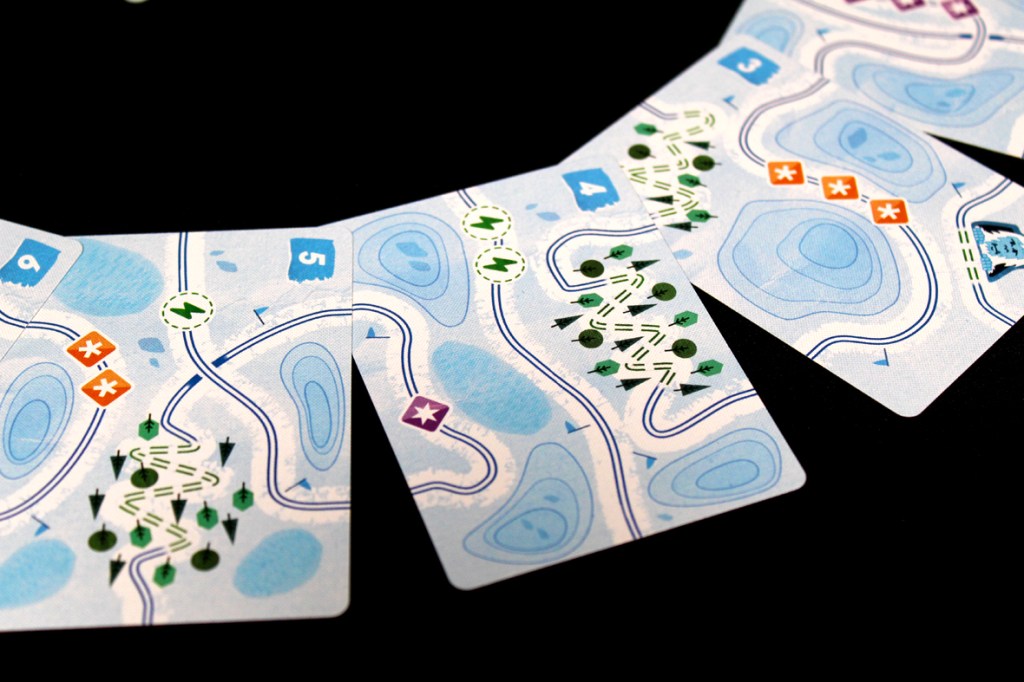
Contents
Setup
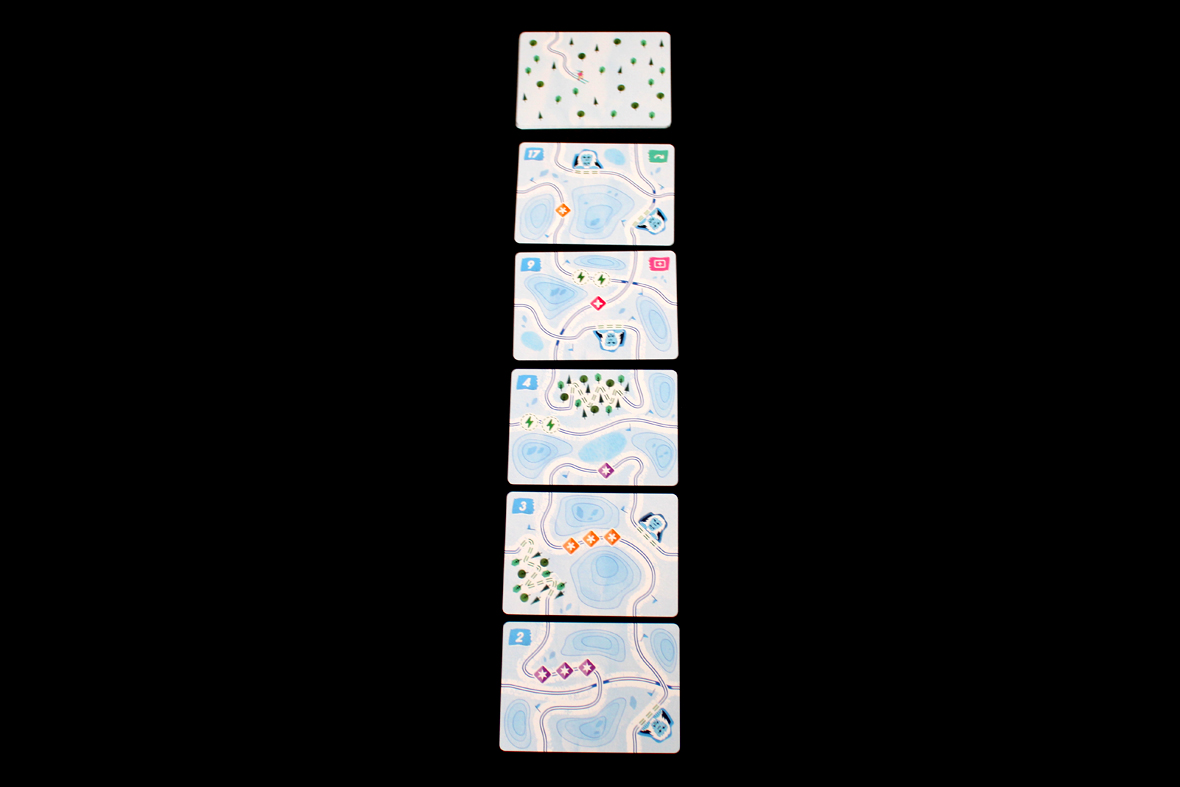
This one’s pretty easy. Shuffle the cards and draw five:
Order them from highest to lowest (highest at the top) and then place them in a column. You should be ready to start!
Gameplay
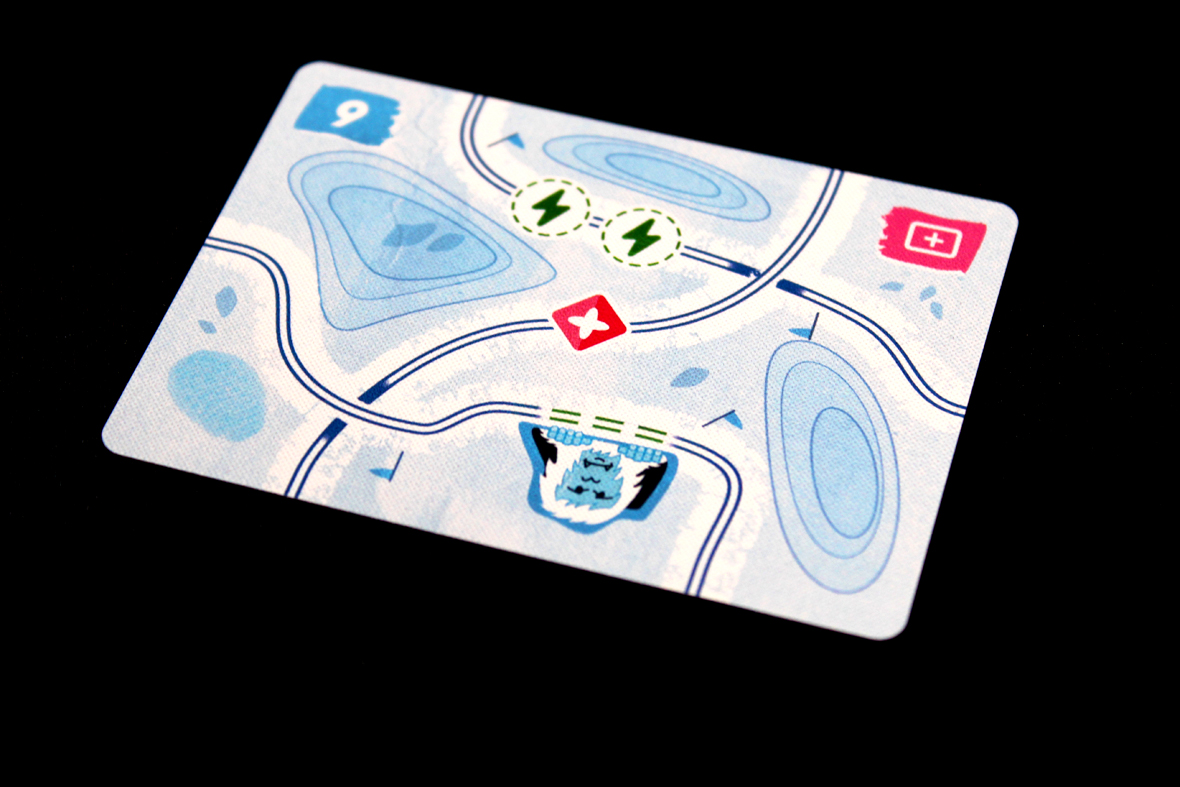
Your goal in Super Slopes is to make an incredible downhill run and then execute it!
Each turn, you’ll start by picking a card. To do so, choose one of the ski runs that starts on the topmost card (they can run in either direction). Follow it to the end, and you may choose any card that one of those ski runs ends on. Certain cards in your play area can give you special abilities, as well, provided you have at least two of their symbol.
- Plan: The pink symbol lets you add a sixth card to the column in the usual fashion. However, you don’t refill back up to six cards on your turn; you just leave it at five.
- Jump: You can skip over one card to the card below it, as though the two cards were connected.
- Stop: In addition to choosing one of the cards the ski run ends on, you can also choose any card the ski run passes through.
Then, place your card! You must place a card adjacent to another card in your ski area (the first card can be placed anywhere), but you have to stagger them so that cards above and below each other are offset by half a card width. You may also rotate the cards 180 degrees. Then, refill the column!
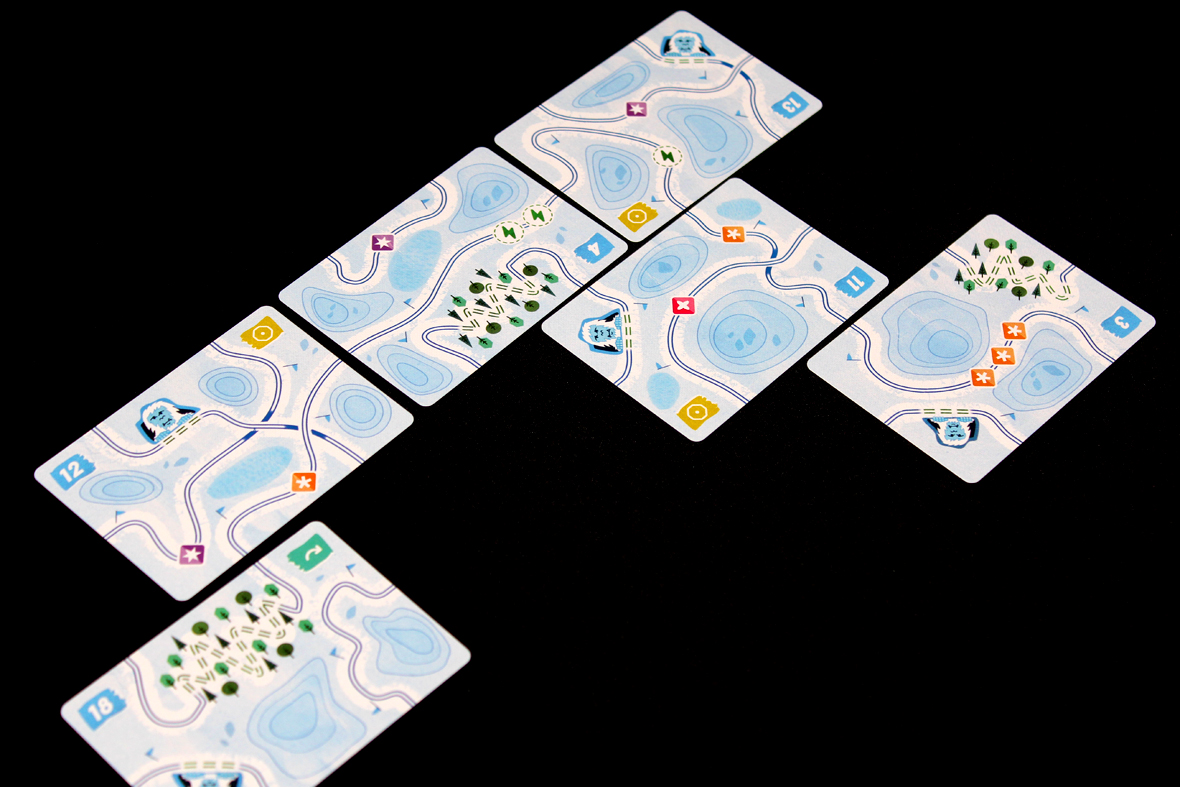
The game ends as soon as you’ve added a certain number of cards to your map, depending on your player count:
- 1 player: 8 cards
- 2 players: 8 cards
- 3 players: 6 cards
Now the challenge! Choose a run on your map that starts and ends at open edges of the board. Follow the run, gaining points for various features. Just be careful! You need Energy icons to get through Forests and to avoid taking negative points from the Yeti. Extra points if your ski run manages to cross over itself!
The player with the most points wins!
Player Count Differences
My general vibe is probably keeping this in the one- or two-player space. What I like about Super Slopes is building a big route and scoring a ton of points while trying to navigate placing what I need to place where. With more players, you have access to more cards over the course of the game, which naturally leads to more interesting paths and higher scores. At three, you only get six cards each, which, while fun, tends to keep scores pretty low. If there were more cards I probably wouldn’t have an issue with three players at all, otherwise. One nice thing that three players does is mix up who is taking what from the central column, giving you a wider array of options on your turn. I like that a lot. The solo game, on the other hand, has the “AI” just choose the lowest-numbered available card and total up points based on available symbols and energy. Still fun, but a distinct challenge (and you can give the AI extra turns to make things harder). No big preference otherwise, I just wish there were more cards for higher player counts.
Strategy
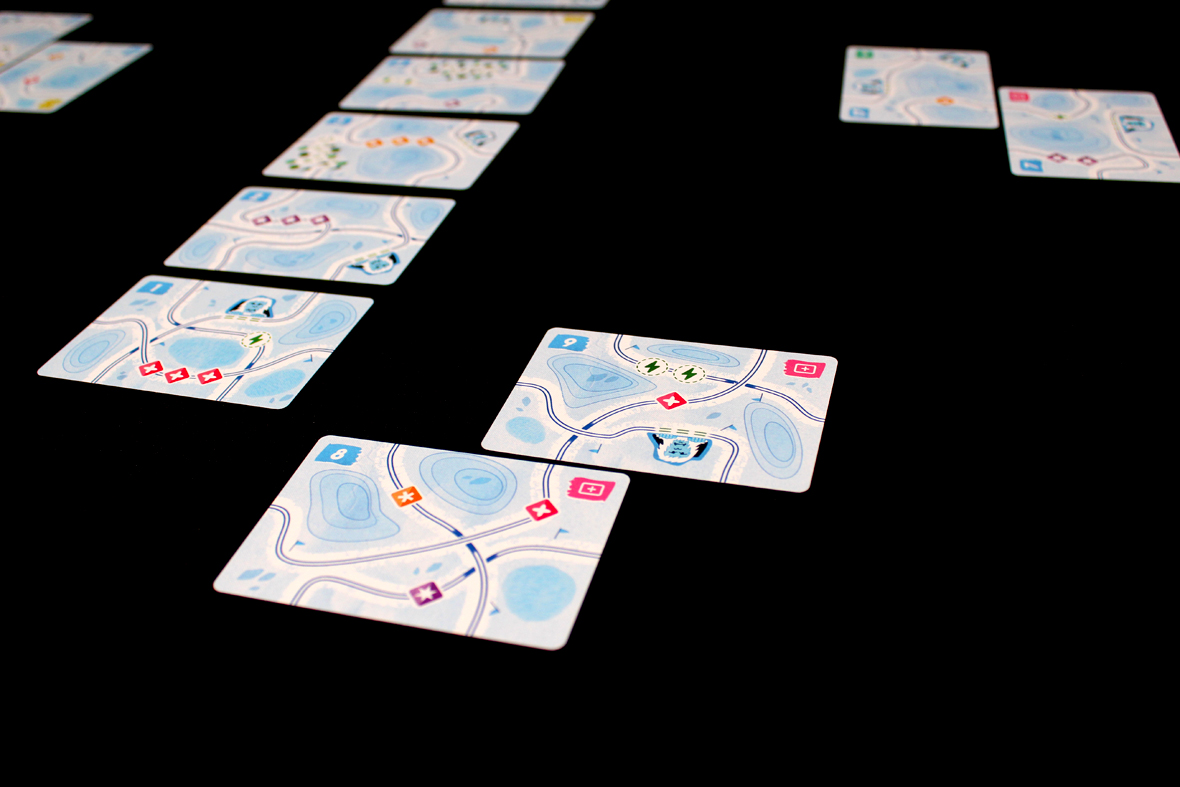
- Keep an eye out for various ability symbols. They give you three useful upgrades. I particularly like Stop, as certain configurations of the column can limit your options and force you to take cards you’d otherwise not go for. Jump, similarly, can also help with that since you can skip a card. Interestingly, you might want to watch out for Plan, as adding a sixth card isn’t always helpful. Sometimes it ends up limiting your options!
- Don’t forget you can flip the cards over! Not to the other side, but you can rotate them around get a few new options, potentially. This can change up your avenues and such.
- Spatial reasoning helps a lot; remember that the cards have to be staggered half a length above and below each other. This is something that keeps goofing me when I play, but alas. Just because a card is almost perfect, doesn’t mean that it’s actually going to work for your ski run! It will be moved half a card to the left or right when it’s placed, so keep that in mind when you pick it!
- Try to place cards so that they’re consistently decreasing. Every time you go from a card to a lower-numbered card you’re going to gain 2 points, so getting a bunch in a row is going to be pretty ideal for you. That said, you only have so much control over which cards are available, so don’t get bent out of shape trying to land it.
- When you place a Forest or a Yeti, keep in mind that you need an Energy to get through that. Forests will stop you dead in your tracks with no Energy, and that’s not great. Yetis will just cause you to lose a point every time you pass by them. It’s also not ideal. Energy isn’t worth a ton if you don’t use it, but you’d generally like to have some.
- Once you’ve committed to a symbol type, while you probably want to keep that symbol, you may also want to take other cards to block your opponent(s). There’s something to be said for taking cards that have the symbols that your opponents want, but at higher player counts that may not be that useful (except for taking cards 1, 2, and 3, which each have three symbols of the same type). When you’re taking cards for yourself, you can only count one type of symbol on your run, so by the same principle, you want to try to get all of the same type.
Pros, Mehs, and Cons
Pros
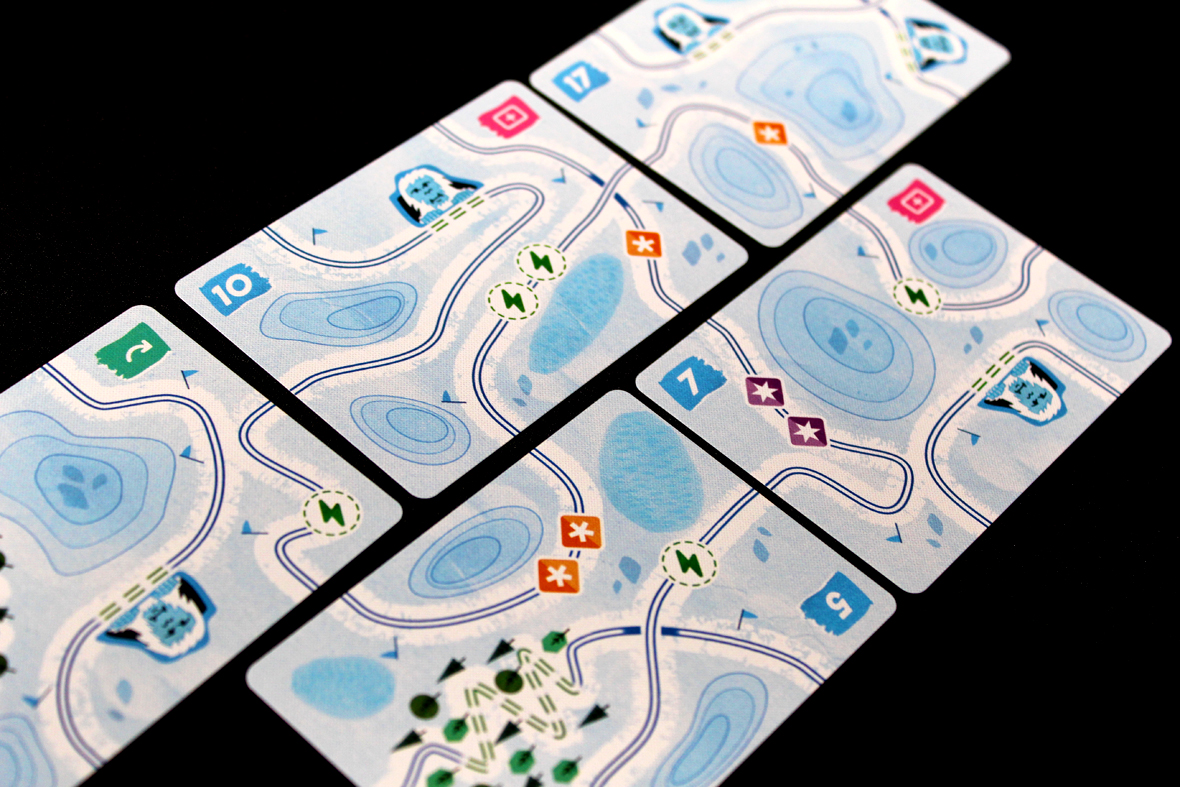
- I really like how dynamic the path-building in this game is. There’s a lot of cool stuff to it since you’re not necessarily starting the path at one end or the other. You can literally start in the middle of two separate paths, build them both, and then eventually connect them for a bunch of points! Or you can just kind of move in a straight line.
- Very portable. It’s a Button Shy game; it comes with the territory.
- I like how the card options are presented to players! It’s very smart. I have seen a lot of different “draft cards from a row” style games, and I haven’t seen one like this where the path the cards take matters. It’s extremely cool! Unless you’re the player that gets unlucky and can only take one card on their turn. It does happen, sometimes.
- Thematically very entertaining! It reminds me of SkiFree. I miss SkiFree. Skiing games are fun! This one even has a yeti!
- The game moves pretty quickly, which is nice. There’s not a lot of downtime between turns because players are just taking and placing a card. Heck, once a player has taken a card you can usually start the next turn (as long as they don’t look at the column and plan accordingly).
- The art style is pleasant. It’s a nice light blue! Not a whole lot to it other than that, but I like it.
- Scoring is interesting! Lots of moving parts, there. There are a myriad of ways to score, which I always like! Means you can specialize or try a little bit of everything and still come out on top. More importantly, it means that if you goof, you’re not necessarily stuck in the long-term.
- I also like how simple the AI is. It just takes the lowest-numbered card it can reach and then scores all symbols and energy symbols. It’s nice and straightforward.
- The abilities are simple and they add a lot to the game. You can jump, you can stop, and you can look at an extra card. They all are handy in their own ways, but not perfect, which is nice. No single “best” ability.
Mehs
- I wish there were more cards in play for the three-player game. Six cards just doesn’t feel like a lot! I want to plan a big and elaborate ski run! You also have more opportunities to connect and make cool loops. Maybe there’s an expansion or something that will add a few more cards.
Cons
- The spatial aspect of this game even throws me off sometimes. I sometimes just struggle to get the right sense of where cards should go and how they line up with other cards, and that can be particularly frustrating, especially when it affects my plans and strategy. There’s not a whole lot for that, though; I think my brain just doesn’t do a good job with rotations and half-card translations.
Overall: 8.5 / 10
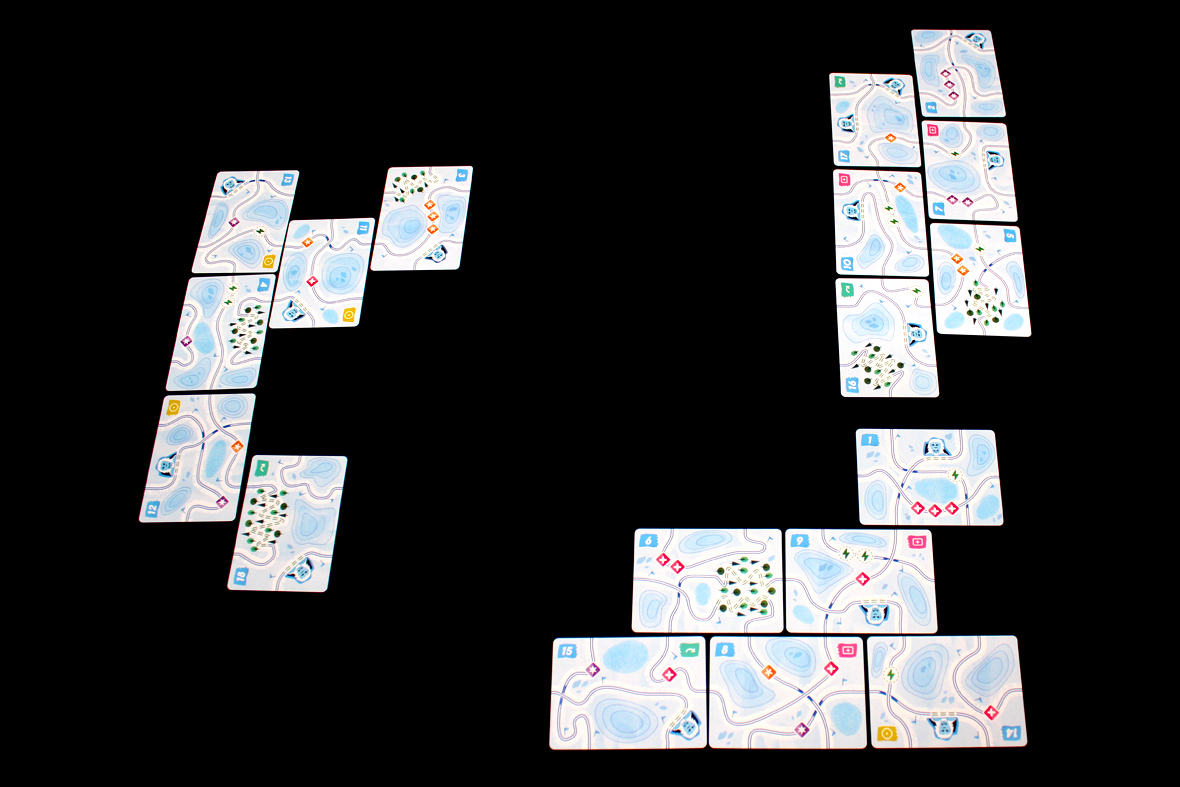
Overall, I really enjoyed Super Slopes! I have played a number of Button Shy titles and while they all play with various aspects of space and spatial reasoning. I like them a lot! This one does route-building / path-building, one of my all-time favorite mechanics, so of course I’m going to have a soft spot for it. My only major gripe is that similar to River Wild, the half-card offsetting messes with my ability to plan and organize, for some reason, so I throw myself off every game. I figure I’ll get better the more that I play, and I want to! The solo mode is simple, the two- and three-player game is pretty straightforward as well, and there’s all sorts of interesting paths and combinations to make based on what cards are available in the column, what you’ve already played, and what you can actually take! I find the whole thing pretty engaging. It’s quick, and light, and nobody gets eaten by a yeti, so that’s all well and good, as well. I also like the player abilities. Again, pretty straightforward, but still interesting. If you want to hit the slopes, you enjoy path-building, or you just want to keep your Button Shy collection growing, I’d recommend Super Slopes pretty solidly! It’s right up my alley.
If you enjoyed this review and would like to support What’s Eric Playing? in the future, please check out my Patreon. Thanks for reading!
 What's Eric Playing?