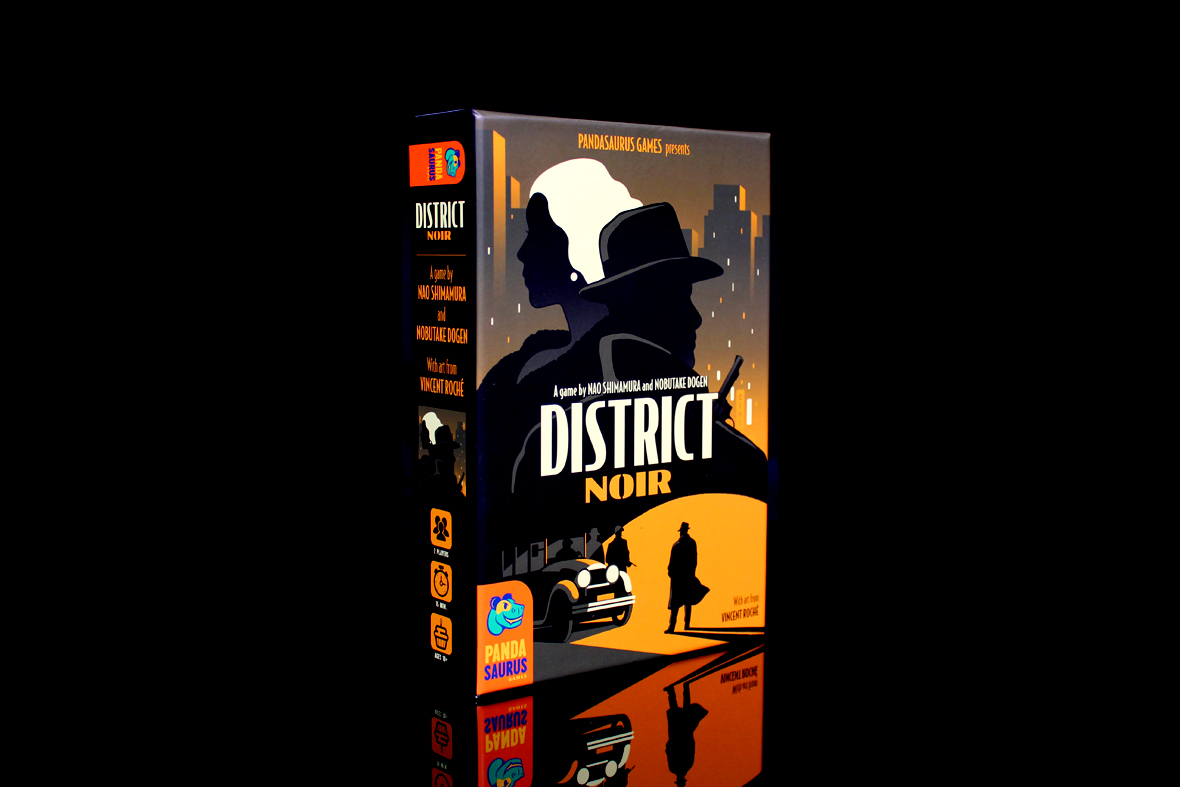
Base price: $15.
2 players.
Play time: 10 – 20 minutes.
BGG Link
Buy on Amazon (via What’s Eric Playing?)
Logged plays: 5
Full disclosure: A review copy of District Noir was provided by Pandasaurus Games.
Back in the swing of things with another pair of reviews! This week is all two-player games, continuing a now multi-week streak of “accidentally coordinating themes”. I’d like to think that I was subconsciously smart enough to pull that off on purpose, but … I’m relatively unconvinced that that was the case. I think it was all on accident based on what I got reviewed when. But we abide. In the meantime, though, we’re covering another Pandasaurus title, District Noir!
In District Noir, you’re waged in all-out war for control! You can do so by winning over the various supporters of town or by controlling the three locations at the heart of the city. The challenge is, folks are fickle, and winning their support can often come with benefits or at a high cost. Alliances and betrayals are pretty common across the District; you can imagine. The back-and-forth balance is going to be challenging to manage, as any mistakes you make your opponent can leap on. Will you be able to win control of District Noir?
Contents
Setup
Setup is pretty straightforward. You’re going to shuffle the deck of cards:
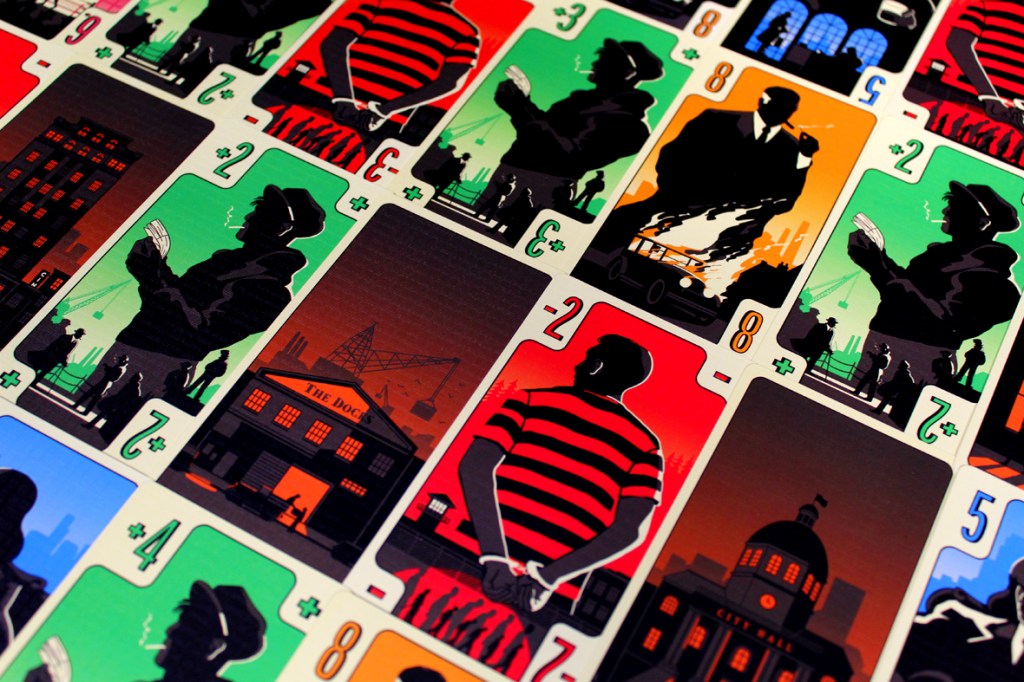
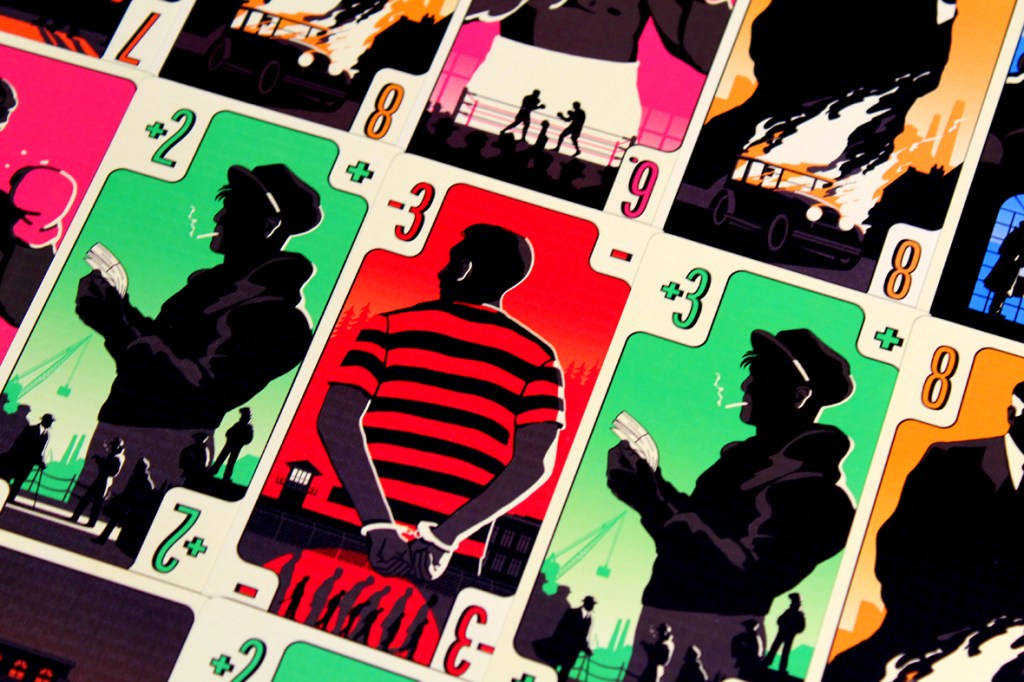

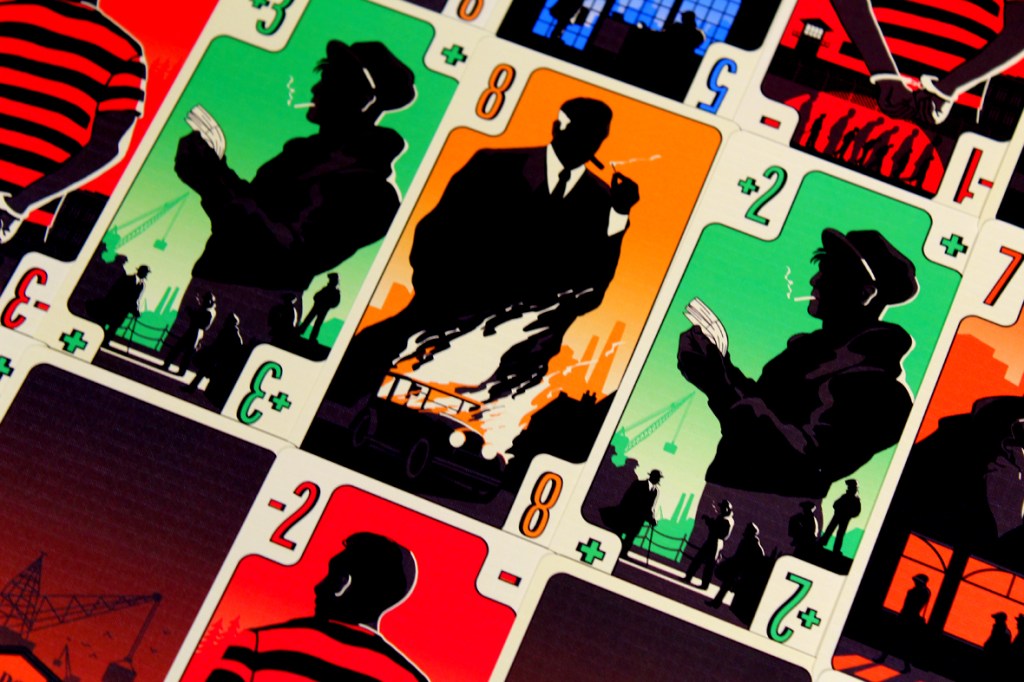
Remove three of these cards without looking and return them to the box. Deal each player five cards face-down to form their starting hand. From the deck, reveal two cards face-up, placing them in a line. Then, give each player a reference card and flip the coin to determine which player goes first:
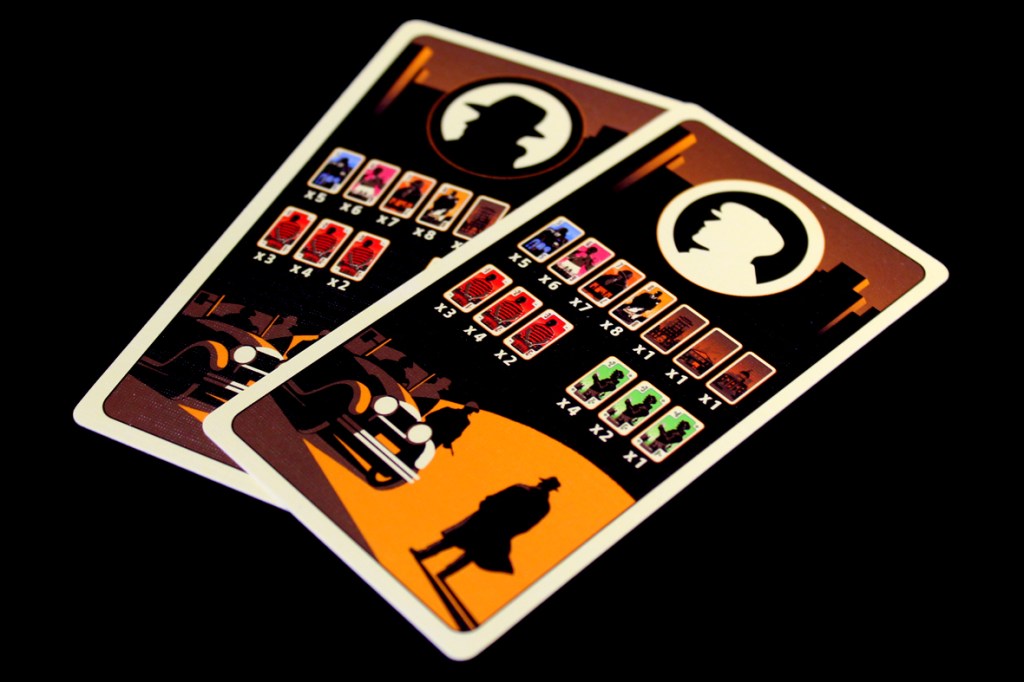

You should be ready to start!
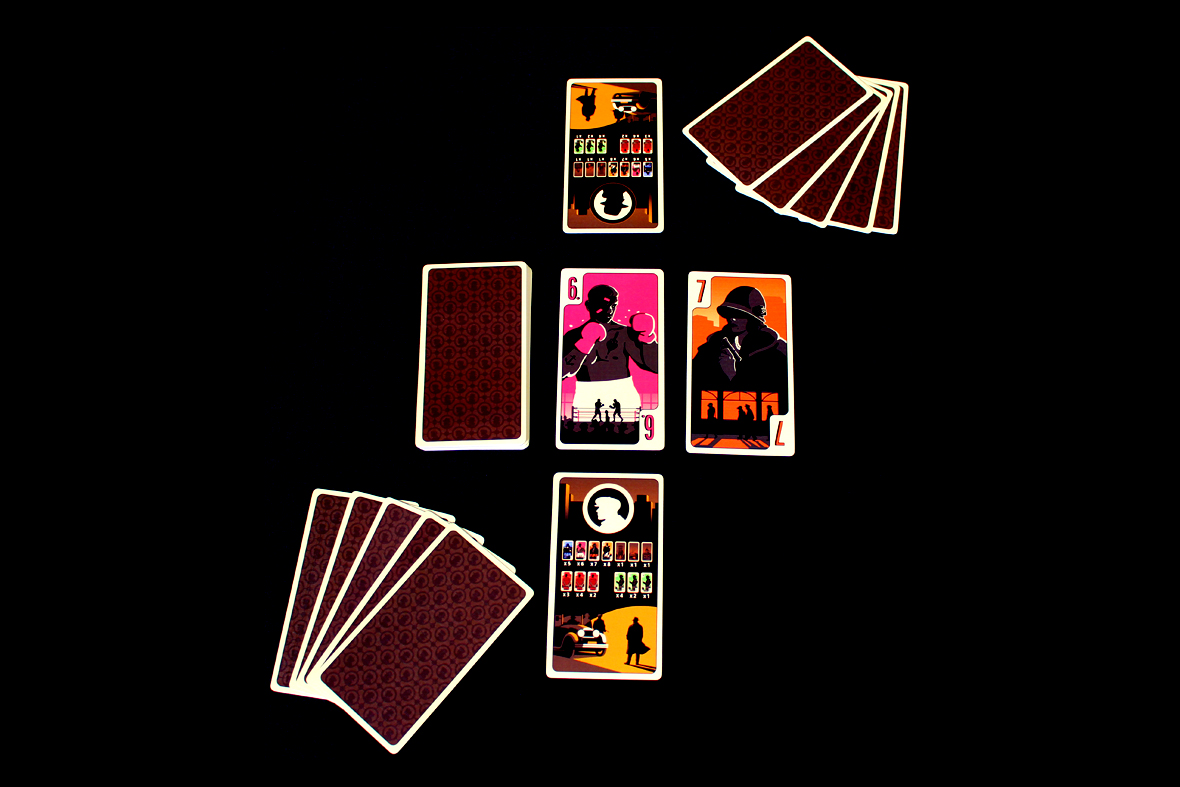
Gameplay
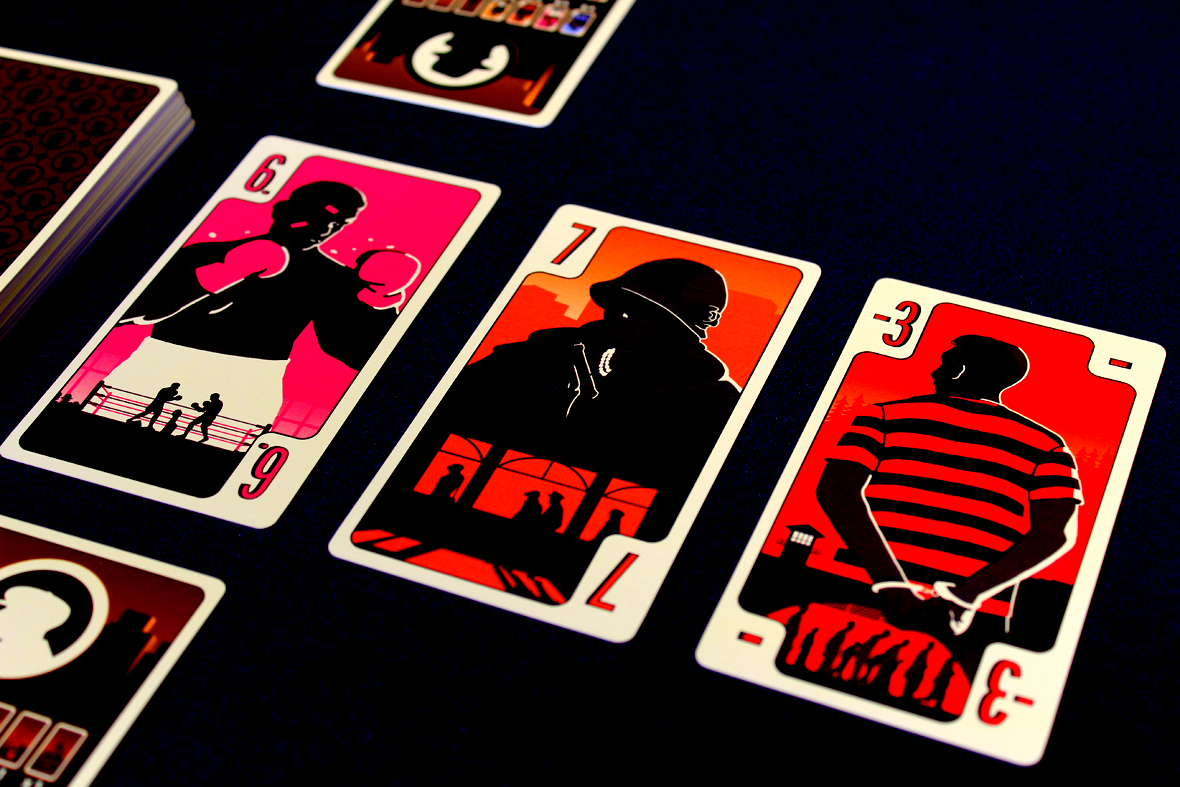
District Noir plays pretty quickly, so this section will be a breeze. Each round, you’re going to take turns playing cards and ultimately take cards from the center. That’s pretty much it.
To play a card, just choose a card from your hand and place it at the end of the row. If you’re out of cards, you must take cards from the center.
To take cards from the center, take the five most recently-played cards (starting with the card at the end of the line) and add them in front of you. Sorting them is helpful, so also do that. If there are fewer than five cards in the center, you take what’s available. You cannot take this action if there aren’t cards in the center currently.
This means, at the end of the round, both players will have played five cards and taken cards from the center. There will usually be some cards left in the center, and that’s fine. If the deck’s empty, the game ends, otherwise, deal each player five cards and start a new round, where the person who went first in the previous round goes second in this one.
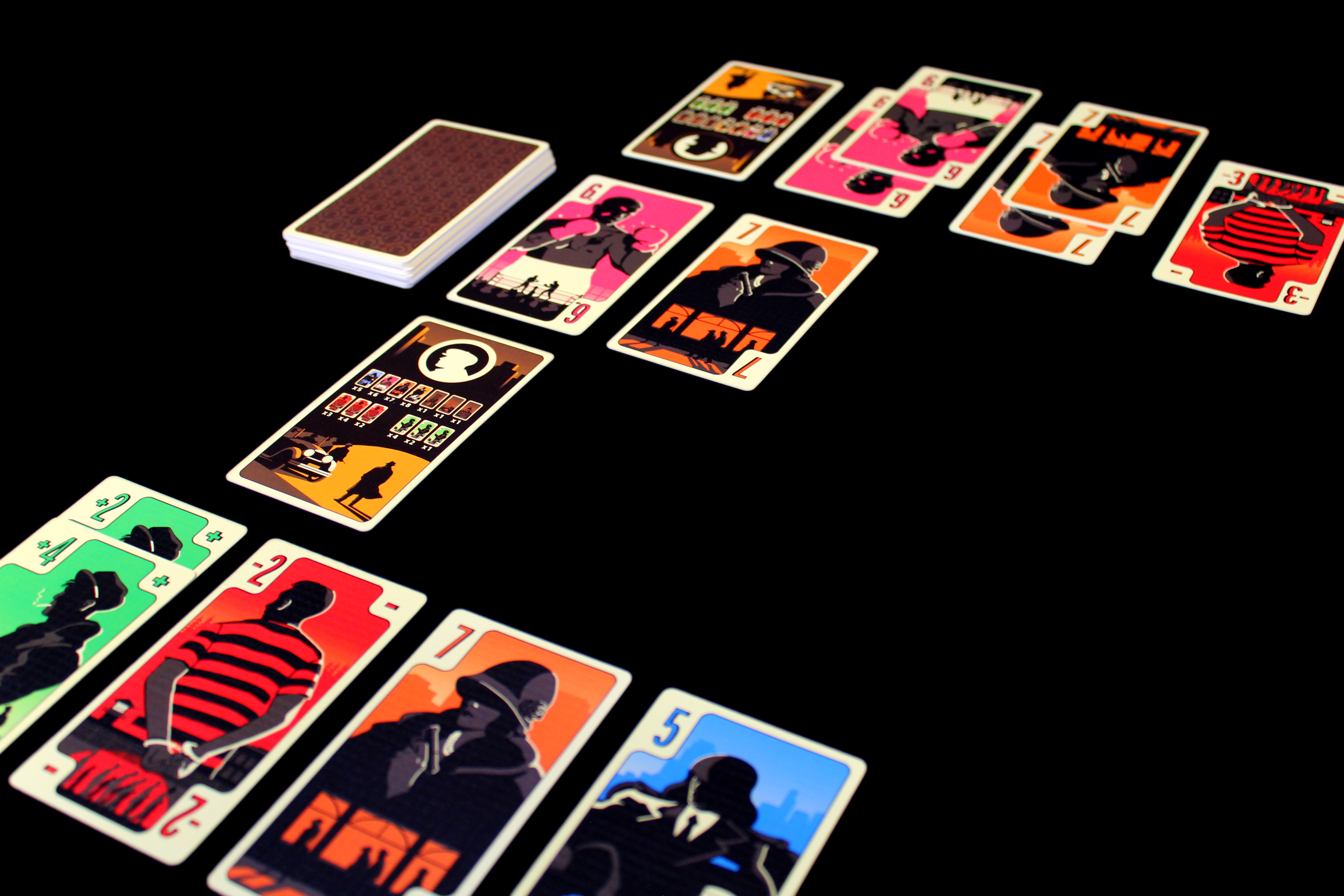
The game ends once the deck’s empty at the end of the round. To score do the following:
- Supporters: Each type of supporters (5 / 6 / 7 / 8) awards points to the player who has the most of that type of card. That player earns 5 / 6 / 7 / 8 points, respectively. If there’s a tie, nobody scores.
- Supporter Sets: Each set of four different supporter types earns the player who has them 5 points.
- Alliance and Betrayal Cards: Each card is worth its printed value.
Add up your points and the player with the most points wins! Now, you might be wondering about City cards. They’re not worth anything! Instead, during the game, if at any point, one player has collected all three City cards, they win instantly. So keep an eye out for that.
Player Count Differences
None! This game is two-player only.
Strategy
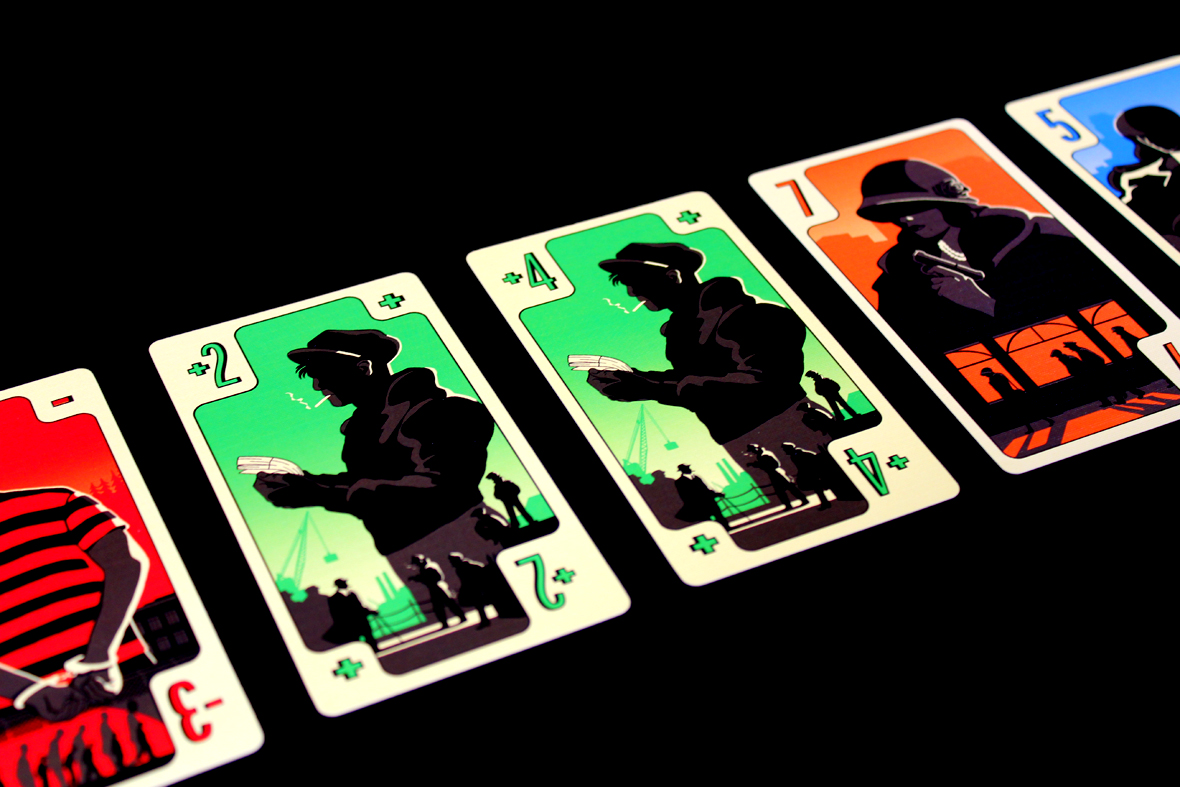
- This is a game of give and take. Plan accordingly. You’re going to be placing cards out that you want, as you must, and your opponent will be forced to do the same. Try thinking about why they’re placing a specific card at a specific time and try to deduce why they’re playing that. Are they trying to bait you into taking cards so that they can play their better ones?
- Try not to take cards too early. You can lose the game doing that! Once you’ve taken cards, your opponent can take at their leisure, knowing that the most you can do is throw cards into the center that you hope won’t be that helpful for them.
- There’s a bit of a press-your-luck element to taking cards, really. Is it better to take the guaranteed points now or hold out for potentially even more points later? That’s the dilemma. You also may not want to take cards if you’re holding on to a City card, because then your opponent may just wait for you to take it.
- Turn order matters here as well. If your opponent has two City cards, you draw the third one, and they go second, you’re in a bad way. There’s almost no reason for them to take cards until they see that last City card (unless you manage to convince them to take cards early, somehow, or you convince them that it’s out of play). Either way, you’re usually either giving them the game or giving them a sweet enough deal that, by taking it, they win the game anyways. Neither option is good!
- Try to get a couple of every Supporter so that you can get the bonus points from having sets of one of each. It adds up! Ten points can be a lot in this game, especially if it’s close! Plus, getting more Supporters can potentially earn you more points from getting majorities! It’s always worth it.
- I tend to throw Betrayal cards in and around City cards. You gotta make your opponent work for it, you know? Can’t just give them the City card for nothing.
Pros, Mehs, and Cons
Pros
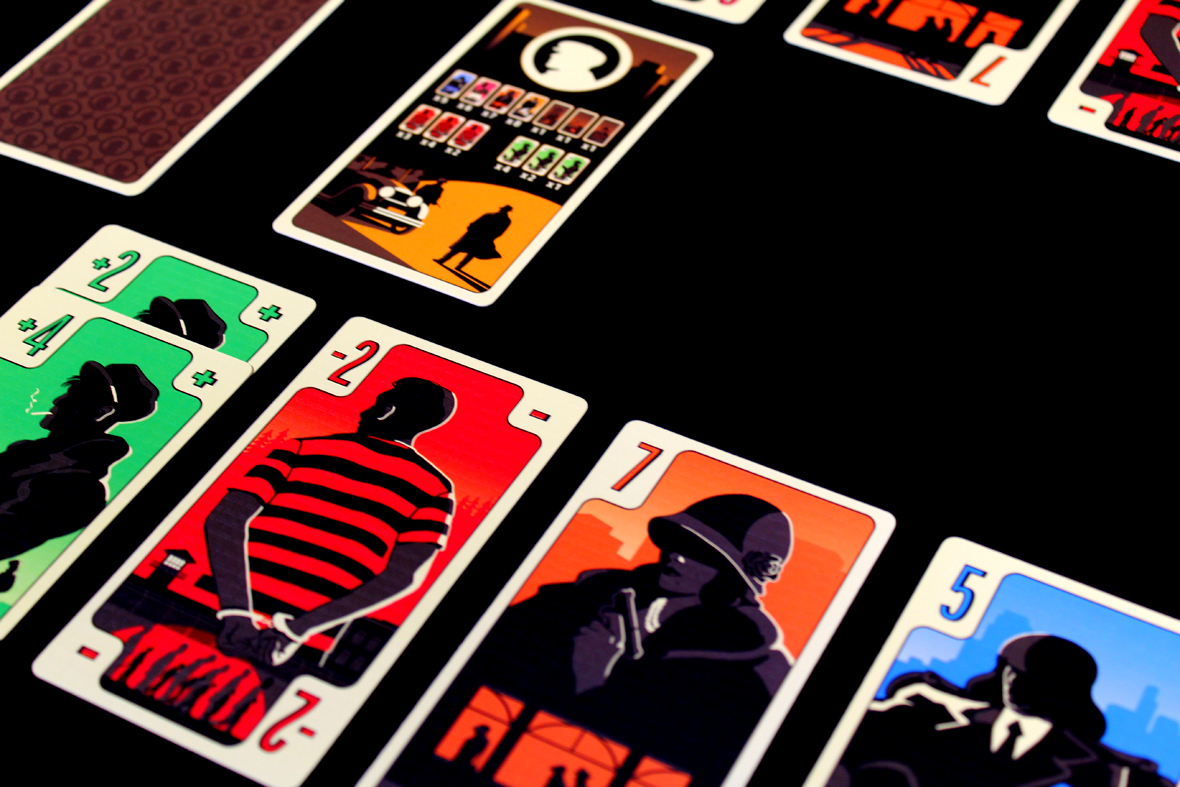
- I like the art style a bunch! It’s seedy and mysterious but also bold and colorful; it’s a nice bit of contrast and it really pops on the table.
- Plays very quickly. It’s just play a card or take cards and that’s basically the entire game; it moves fast.
- I enjoy that there’s a good tension around what cards your opponent may or may not play. The back-and-forth is great, but also the thrill of getting exactly the card you want and then trying to decide if it’s worth taking what you have or waiting in the hopes for something better is pretty solid, too. For a quick game, it’s got a lot of great thinky points to it.
- Pretty portable. Small box and not many cards, so if you’re a Quiver guy, it fits right in there. I play it mostly on BGA, so it fits even better there because it can just live on my phone.
- I appreciate how simple and approachable the game is and how that allows for some clever play. The game is tight and challenging, even for being so few cards and so few actions. It’s great! There’s lots of depth to it, as playing with the same player multiple times will start leading to you changing up your strategy and your style to throw them off.
Mehs
- I kind of wish they had named the Factions and the Supporters. I just wanted to know what was going on! Give me a bit of that extra lore and all that. It’s fine that they’re faceless, but having names of rival gangs or groups would have been entertaining.
Cons
- Losing to a bad draw doesn’t feel amazing. That said, it’s a lot like blaming the kicker for missing the game-winning field goal. Sure, it would have won you the game if he had made it, but also if the offense had scored more points it wouldn’t have been a problem. So a bit of both, really. Don’t give your opponent all the City cards.
Overall: 7.75 / 10
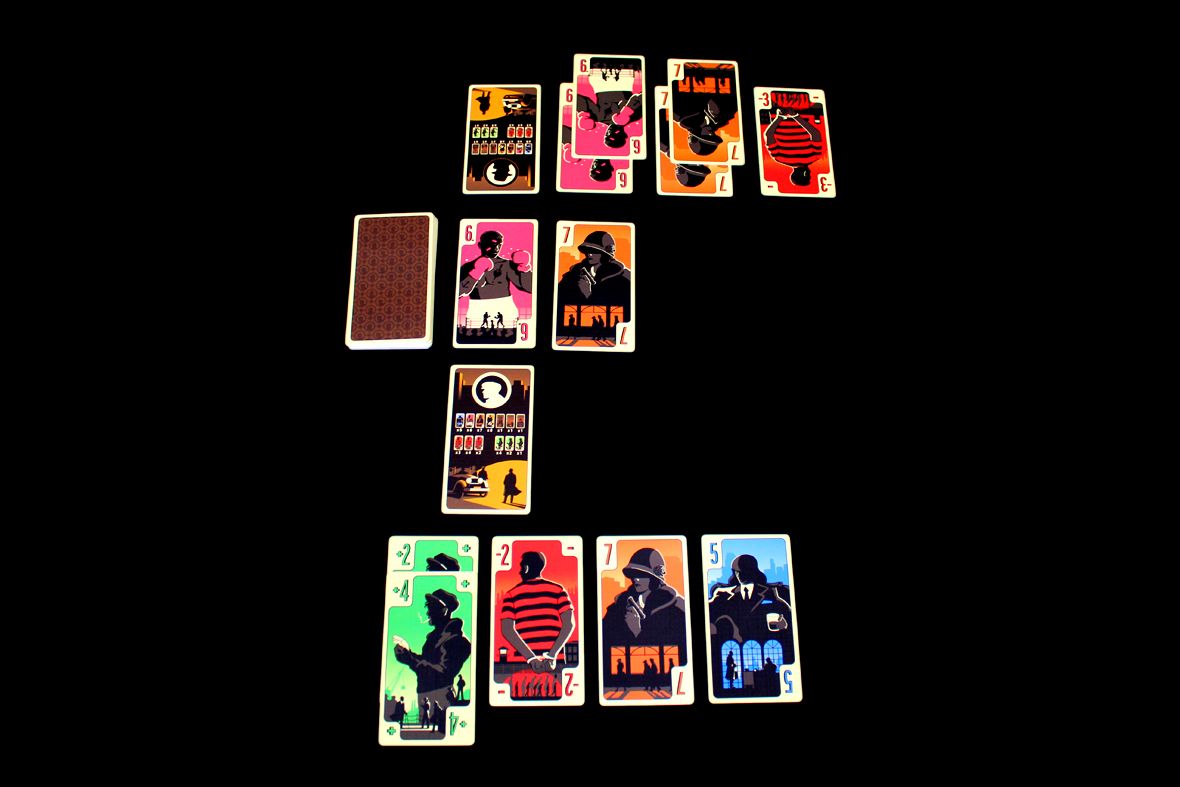
Overall, I think District Noir is fun! It’s been a nice, quick, and interesting game to play when I’m looking for a quick head-to-head card game or I just want a tense experience with a bit of bluffing and some deduction. I don’t bluff often, mostly because I’ve been playing online (and even in person it doesn’t totally work), but if you can sell your opponent on taking cards early, it might be a better game for you than if you can’t. I will say, I think they did an excellent job on the art on this, though! It’s seedy and mysterious and all the figures are appropriately shrouded. I just wish we had names for the factions or the various Supporter groups so that I could get more invested (or, realistically, be sillier about it as I play). It’s not an enormous deal; it’s just a way for me to get more invested in play. Beyond that, though, I find the game approachable and pleasant. There’s a scenario that you can get into that is almost an instant loss, but it’s decently hard to stumble into without making some bad calls earlier in the game, and the game is quick enough that, frankly, just take the L and play again. I’d be interested to see more games in the series or a more complex version of this, but in the meantime if you’re looking for a quick two-player game, you enjoy noir-themed games, or you just like cards, I’d recommend District Noir! It’s been fun.
If you enjoyed this review and would like to support What’s Eric Playing? in the future, please check out my Patreon. Thanks for reading!
 What's Eric Playing?
Wow, your photography is just top notch. Great work.
LikeLiked by 1 person
Ah! Thank you so much. I really appreciate it.
LikeLike