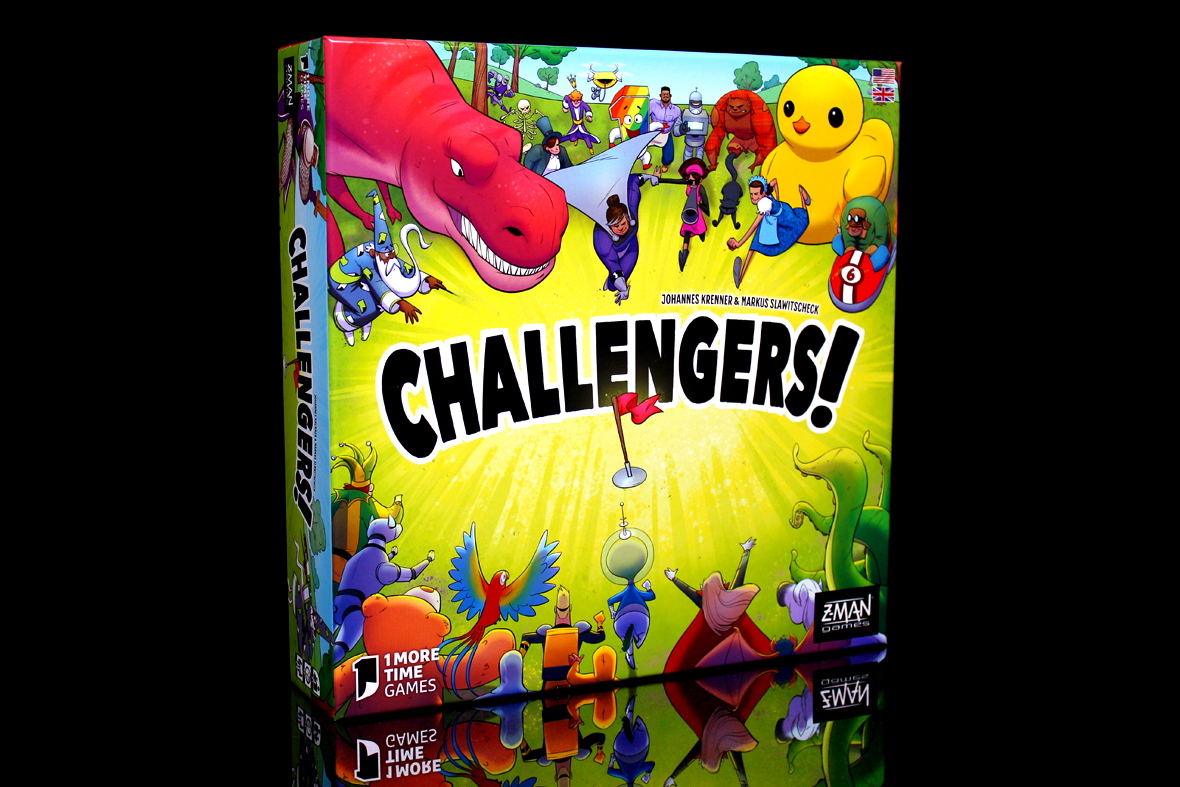
Base price: $40.
1 – 8 players.
Play time: ~45 minutes.
BGG Link
Buy on Amazon (via What’s Eric Playing?)
Logged plays: 22
Full disclosure: A review copy of Challengers was provided by Z-Man Games.
And, of course, I got food poisoning at BGG.CON so I’m behind on reviews again. No big deal, just have to get back ahead on reviews while it’s still Thanksgiving Week and I’m leaving for PAX Unplugged next week. It’s the lifestyle, but boy howdy, these holidays all come at once, you know? It’s ongoing and we’re making it work. How about we check out a game that I’ve been excited about in the meantime, then? I’ve been playing a ton of Challengers on Board Game Arena, so I’ve been looking forward to talking more about it in a review. Let’s dive in!
In Challengers, it’s time to capture the flag! You need to get your team together and overpower the other guys so that you can get the flag out of their hands and into yours. That said, your team is looking a little strange this time around. You probably shouldn’t have put out the ad for players on Craigslist. But you’ll be able to pick more people in this deckbuilding battle royale game! Each round, players are matched up and play cards from their deck until their total strength exceeds their opponent’s; then they capture the flag and their opponent’s players are sent to their Bench. Then their opponent does the same, with a fun twist: though you may have many attackers, only the top card defends! Also, you can only hold six types of cards on your bench, so if you want to place a seventh type, you lose the match! After playing seven matches and mixing up who plays who, the player with the most fans (points) wins! Are you ready to throw down?
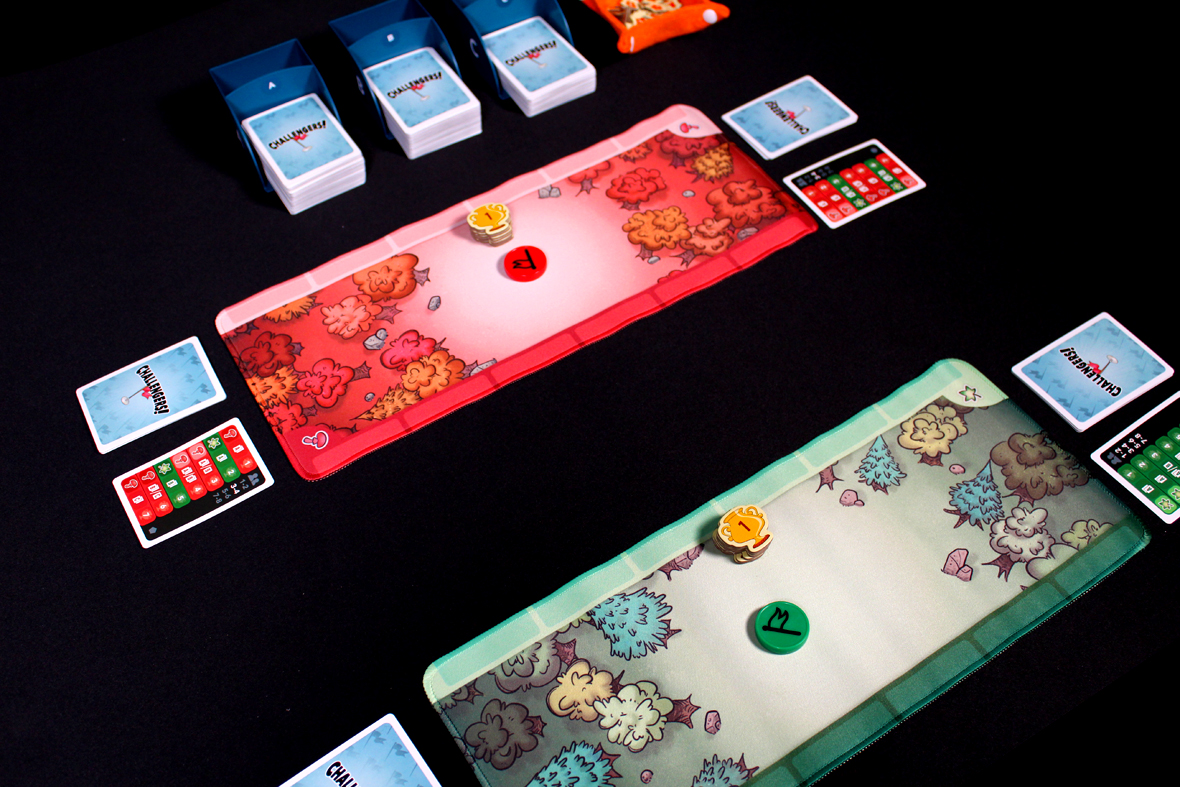
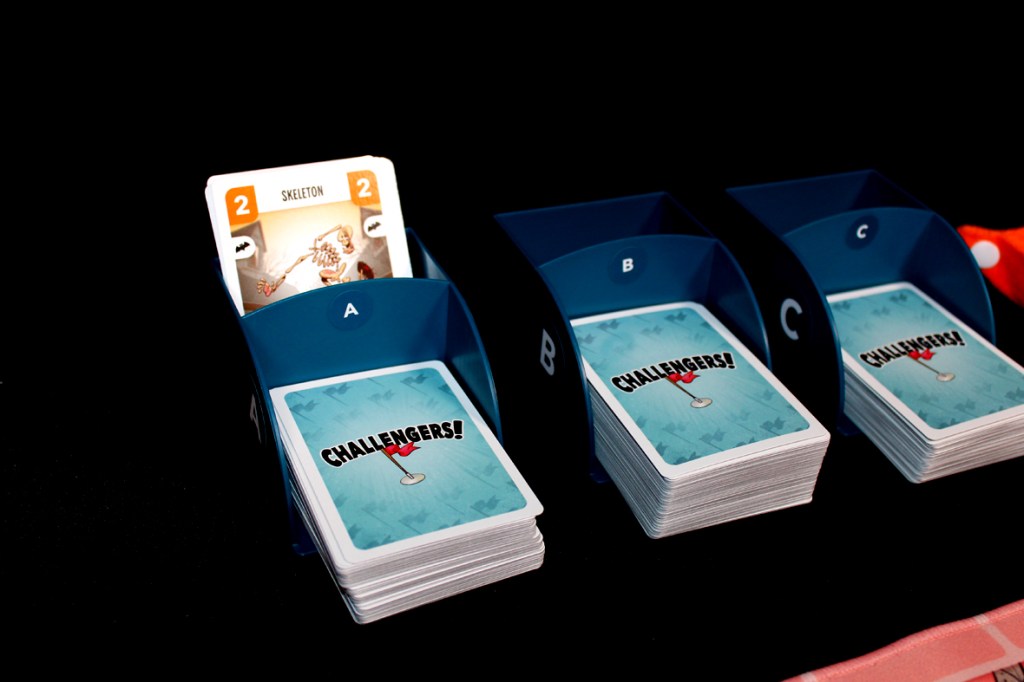
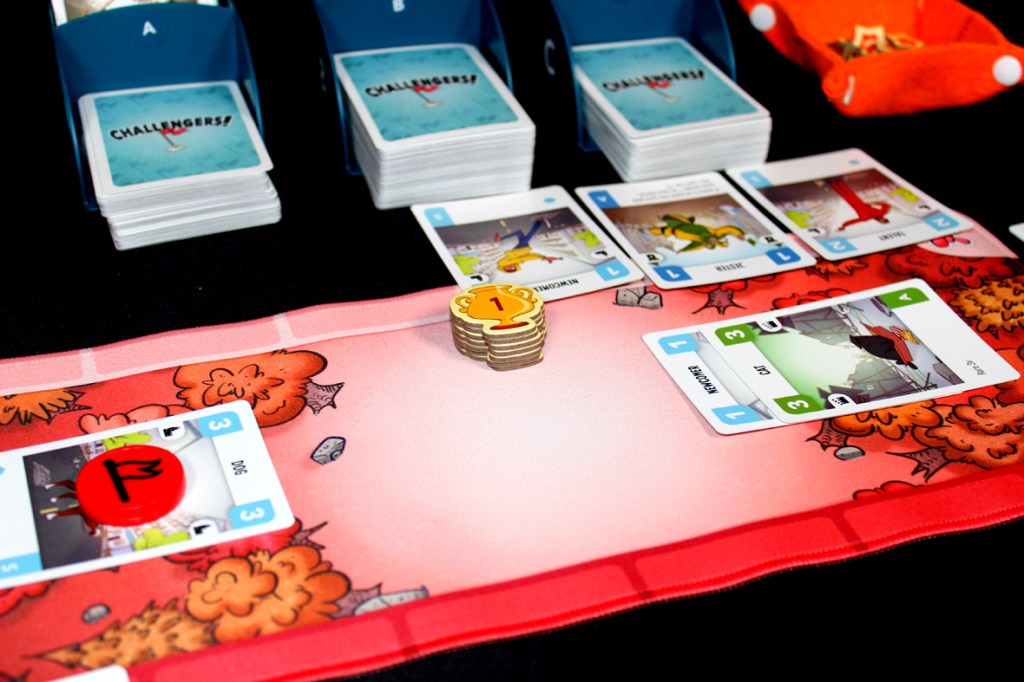
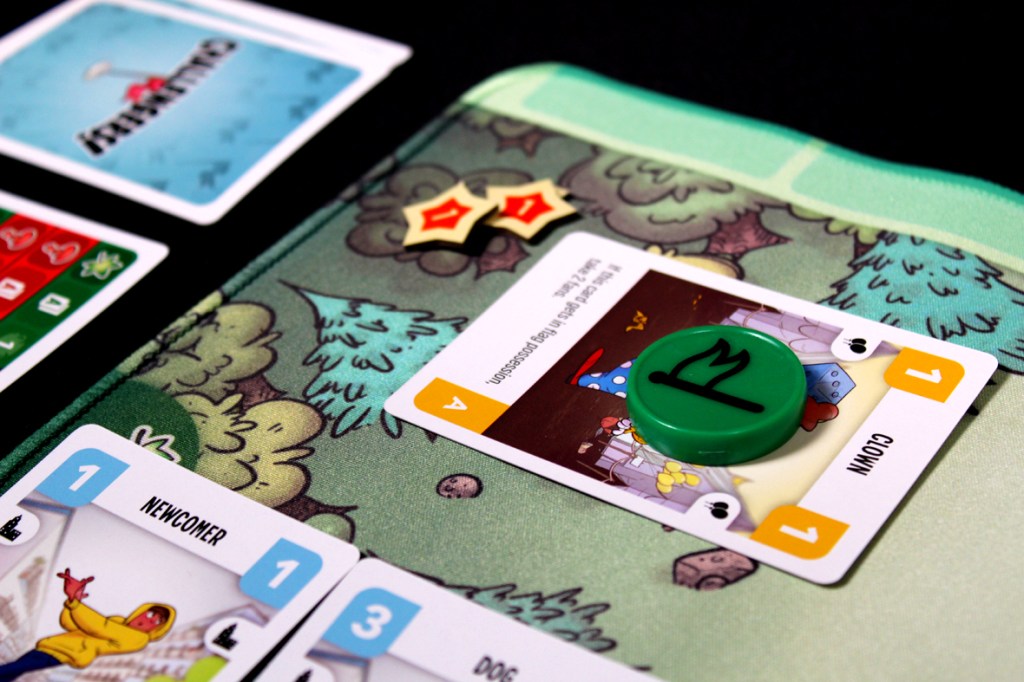
Contents
Player Count Differences
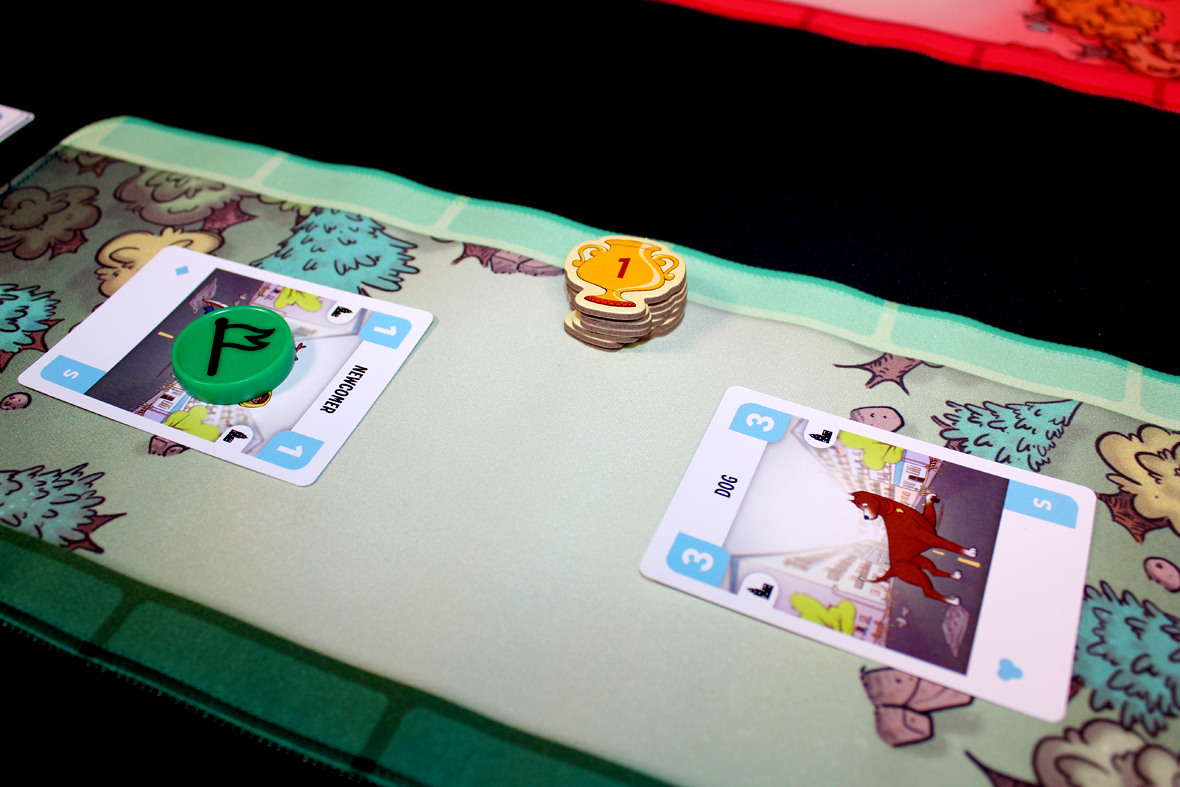
Yeah, this is another one of those games that generally just plays better with more people. At two, you’re pretty much going back-and-forth in a standard tit-for-tat deckbuilder. Nothing wrong with that! I still enjoy it, actually, and that’s my regular player count. With more players, though, you get the enjoyment (and a bit of the swing) of Challengers where you get to play other players in a sort of round-robin deckbuilding extravaganza. That’s really the experience Challengers was designed around, and while it works at lower player counts, that shine is definitely worth experiencing at least once or twice. Interestingly, with odd numbers of players, the game throws a robot into the mix who also fights against other players with its own deck. It actually works pretty well, in practice (I’ve lost to the robot a few times, to my great irritation). The zany frenzy of it all is at the core of Challengers, and it’s just not quite as silly or zany with two players. The actual core strategy and gameplay remain unchanged, though, and the back-and-forth against one rival can be pretty fun. Plus, the game short-circuits and ends early if any player wins their fourth tournament at two players, which can be a nice mercy rule sort of situation. I’d highly recommend you try Challengers with more players at least once to get the full experience, but otherwise, I’ve enjoyed it at every player count I’ve tried.
Strategy
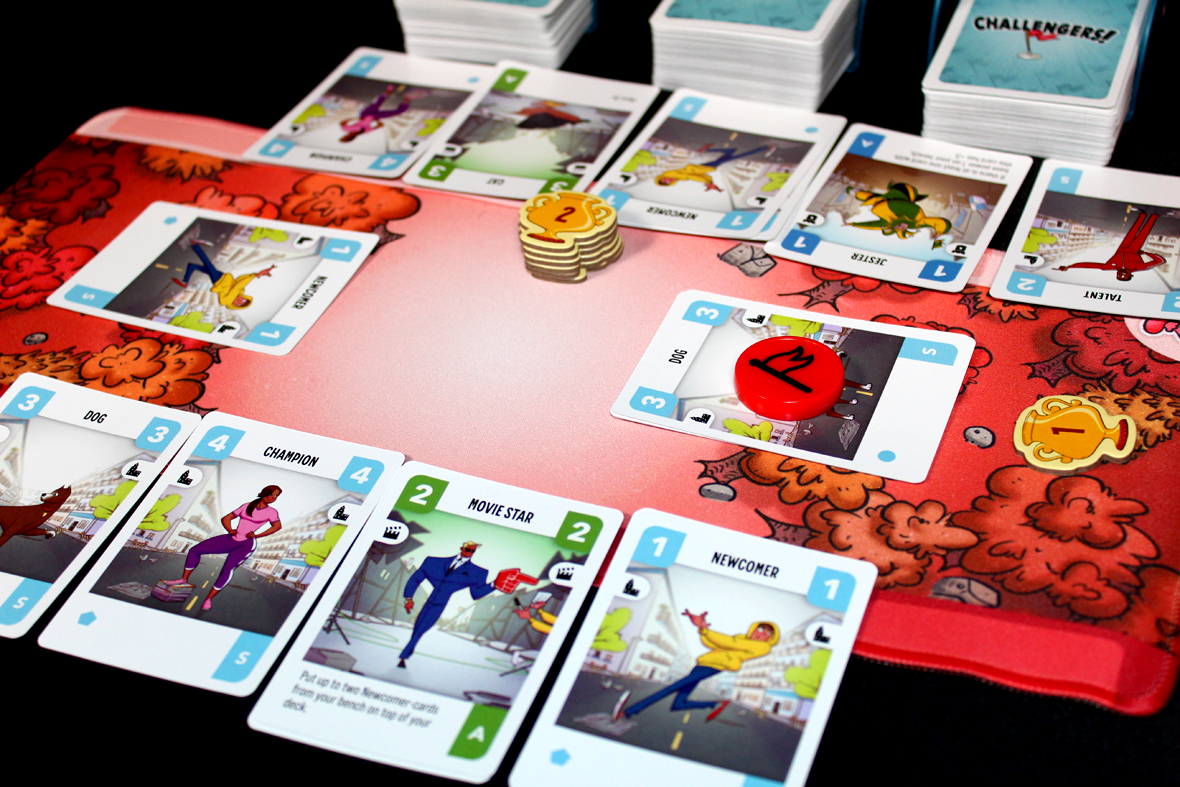
- Depth, not breadth, here. You really want multiple cards of the same type, rather than a variety of single cards. The key is that each slot on your bench is limited to one type of card, rather than an instance. So three Necromancers all take up one spot on your bench, but a Necromancer / Skeleton / Champion set takes up three spots. If you go too wide, you’ll only ever be able to play seven cards before you’re spent.
- Clear your bench when you can. There are multiple cards that let you dump cards from your bench, freeing up additional spots for subsequent cards. That’s an okay way to go for breadth if you want to go that route.
- Keep an eye on synergies. There are a lot of cards that synergize well together; look for those combos as they emerge and build your deck around them, if you can. Just remember that the cards often have to be played in a specific order, so you may not actually hit a synergy if you’re not careful.
- Cards that let you sift through your deck are clutch. There are a number of cards that let you mess with the ordering. Put cards that benefit from more cards on your bench at the bottom of your deck. Play cards that power up subsequent cards earlier. These are very simple synergies but they’re very dependent on you threading the needle appropriately and getting the right cards out at the right time.
- Don’t be afraid of change. Just because a synergy worked previously doesn’t mean it will work for the entire game. Sometimes you have to dump some cards and start over with a new strategy. It might take a couple rounds to pay off, even, and that’s okay!
- It’s not necessarily bad to take a card that you might not want. A few cards have effects that activate when they’re added to your deck. They might not be the best cards for your strategy, but they might be okay! At the very least, they’re usually better than their equivalent-value cards in your starter deck.
- Effects can compound; remember that. If you take a card that makes your 1-value cards worth +1 while it’s on your bench, if you have three of those cards, then suddenly all your 1-value cards are +3. You can do a lot more with a bunch of 4s than you can with a bunch of 1s.
Pros, Mehs, and Cons
Pros
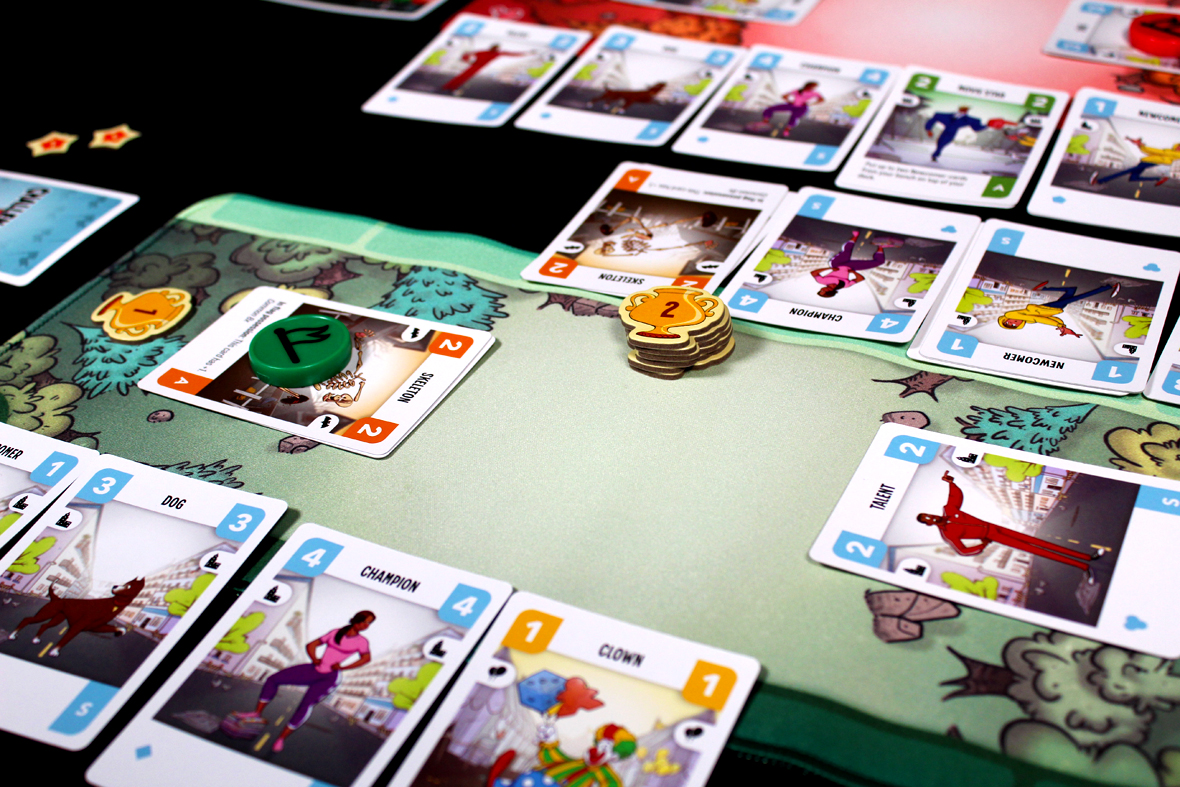
- I think the art style and the gameplay mesh really nicely here. The art makes the game seem bouncy and excited and chaotic, and that’s pretty much exactly what the game is. You’re running around deckbuilding and fighting other players for fans and trophies as you attempt to capture the flag in a bunch of brawls. It’s a hoot!
- It’s already got a sequel, so that’s fun. Challengers: Beach Cup! I was going to say this is so modular that it seems easy to expand, and then they explicitly did that. Good on them, I suppose. I’m excited to eventually try the next one!
- I like this approach to battle royale deckbuilding. It never feels like you’re truly out of it. You get to go around and fight everyone you’re playing with 1:1! It’s super fun. You also can physically get up and move around the table if you want to make it more fun and a bit sillier.
- I also appreciate the sense of progression and the redraw feature. You gradually pull from more intense decks over the course of the game and their cards get stronger and stronger, so your deck gets stronger too. This is how you grow the deck towards the endgame. You also get to see cards and then choose if you want to discard all of these and draw new ones. It’s a bit of risk / reward: you get to see new cards, but you’re stuck if none of them are better than what you have. I usually take one and then redraw, but your tolerance will be your tolerance.
- I like that the individual sets each have their own themes and things going on.
- Plays pretty quickly since you’re not doing the deckbuilding thing of constant reshuffling all the time. You really only shuffle between rounds, which is great! Once your deck is empty, you’re essentially done with the round, which is also nice. It lowers some of the mechanical complexity of the game.
- I also appreciate the lack of a market or money or things like that. I’m starting to realize that money markets aren’t my favorite feature in deckbuilders, just because they add so much additional complexity around “value” and another thing to keep track of (explicit money). Just being able to grab a card or two and move on with your life is pretty nice.
- This is probably the deckbuilder I’d teach to someone new to deckbuilding, provided they have experience with some light strategy games. There are a lot of different strategies for success, here, and those might be fairly opaque to players without much experience in the area. One thing I like about Challengers, though, is that it’s pretty easy to note what the strategies are and pick them up in the next game. It’s a nice game to grow your skills and still have fun with!
Mehs
- There’s not always a way to get the cards that help you catch up, since the decks can be pretty random. There are a number of cards that are great for players who are behind (one becomes stronger the more Trophies your opponent has from winning rounds, for instance), but you may just never see them? Would be nice if there were a way to help players out a bit more explicitly.
Cons
- Similarly, it can be hard to build up a particularly cohesive strategy when you’re just getting a random smattering of cards each round. I’m not entirely bothered by this given that the game seems to be aiming more towards a hectic and chaotic good time, to be fair. If you’re aiming for chaos, you can’t be entirely mad that the chaos doesn’t produce a perfectly-aligned outcome for you. You just need to try and make the best of what you have over your opponent.
- It’s definitely a “feels bad” when your perfectly-synergized cards come out in a bad order so you lose. Get cards that help you organize your deck! It’s a little on you, but still frustrating.
Overall: 8.5 / 10
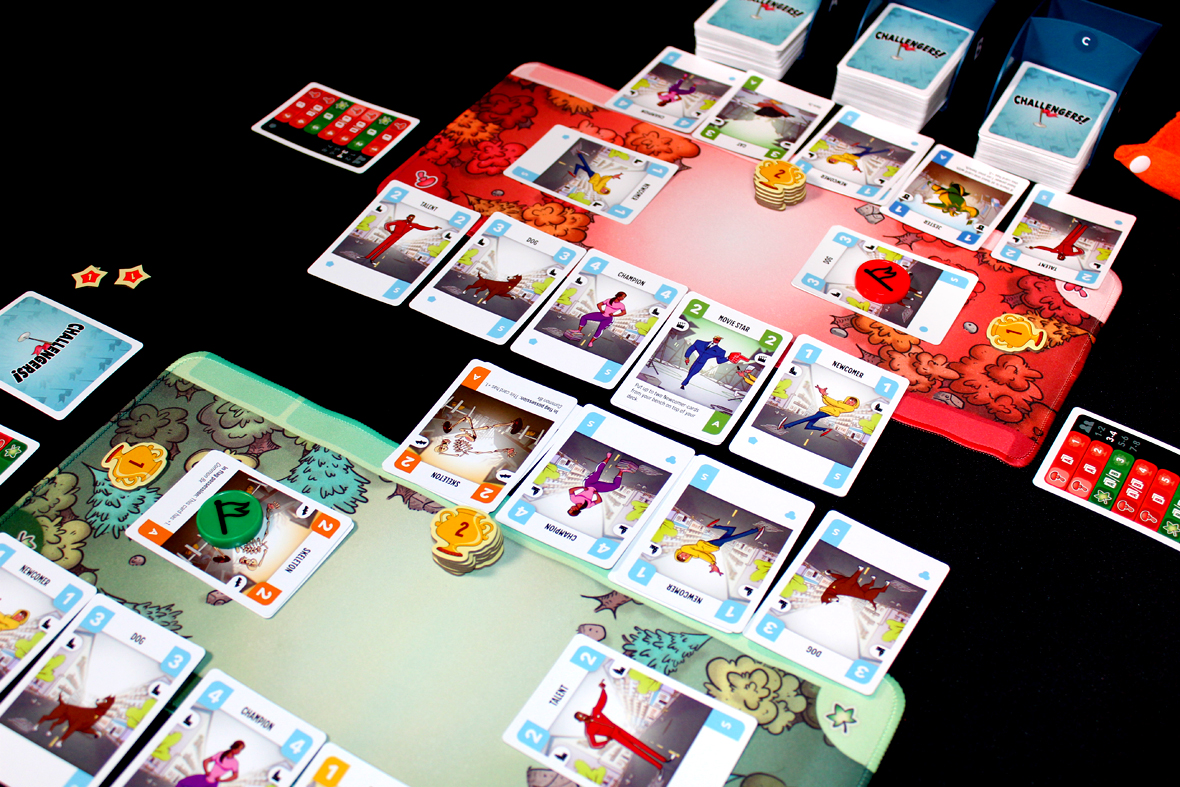
Overall, I think Challengers is a ton of fun! It’s part of an ongoing set of games that I had been excited about getting to before a bunch of life happened, and now that I’m through that I’m excited to tell you more about it! I’ve always had a fondness for deckbuilding games, to be fair: it was one of the first genres I really got into, and even now, my favorite game (Millennium Blades) is a particularly intense deckbuilder. I like the mix of luck and strategy and planning that they impose on players, and Challengers is no different. Here, you’re trying to make a quick synergy in a nice, lean deck, though: more cards will not always help you (unless they’re more of the same type). Small decks do mean that the game can be a little more dependent on luck than some of your other deckbuilders, since order will matter a lot to whether or not your strategy executes perfectly or fizzles. Them’s the breaks with a small deck, I suppose. But if you’re enjoying digging into the strategies you’ll find a lot of different options and ways to play which will let you change things up each game (and you’ll have to; you’re not going to get the same cards to take each time). I’d be interested to try this more with players who are developing their experience in deckbuilding and see how they respond to the cards and the various synergies. I love watching players learn new strategies and learn how to play games, and this seems like a super fun way to do that. In the meantime, though, I’ll keep enjoying Challengers quite a bit. If you’re looking for a bright and fun deckbuilder, you like building tiny combos, or you just want to have games with more weird cards, I’d definitely recommend checking it out!
If you enjoyed this review and would like to support What’s Eric Playing? in the future, please check out my Patreon. Thanks for reading!
 What's Eric Playing?