Base price: $12.
2 players.
Play time: ~30 minutes.
BGG Link
Buy directly!
Logged plays: 2
Full disclosure: A review copy of Arcane Bakery Clash was provided by Button Shy.
It’s my personal favorite time of the year. Fresh off of PAX Unplugged, I finally have enough space and time to just power through a ton of Button Shy Games reviews, and I’m super excited to try them all! Solo games, party games, spatial games, a civilization game, some Tussie Mussie expansions; the whole world of wallet games is my oyster, so you’ll be hearing about them over the next few weeks. To kick off this wonderful season, let’s check out Arcane Bakery Clash!
In Arcane Bakery Clash, you’ve finally agreed to throw down with your coworker at the magical bakery; winner takes all. Is that a good idea? No. Will it make an enormous mess? Probably. Do you care? Also no. Summon hand-baked creations to defeat your opponent in a duel of wits and walnuts (thankfully, no allergies here). Will you be able to reign supreme over the bakery?
Contents
Setup
Not much in the way of setup for this one. Give each player a character card and place a coin under the 10 on their Health Track.

Shuffle the other cards, and then deal each player two:
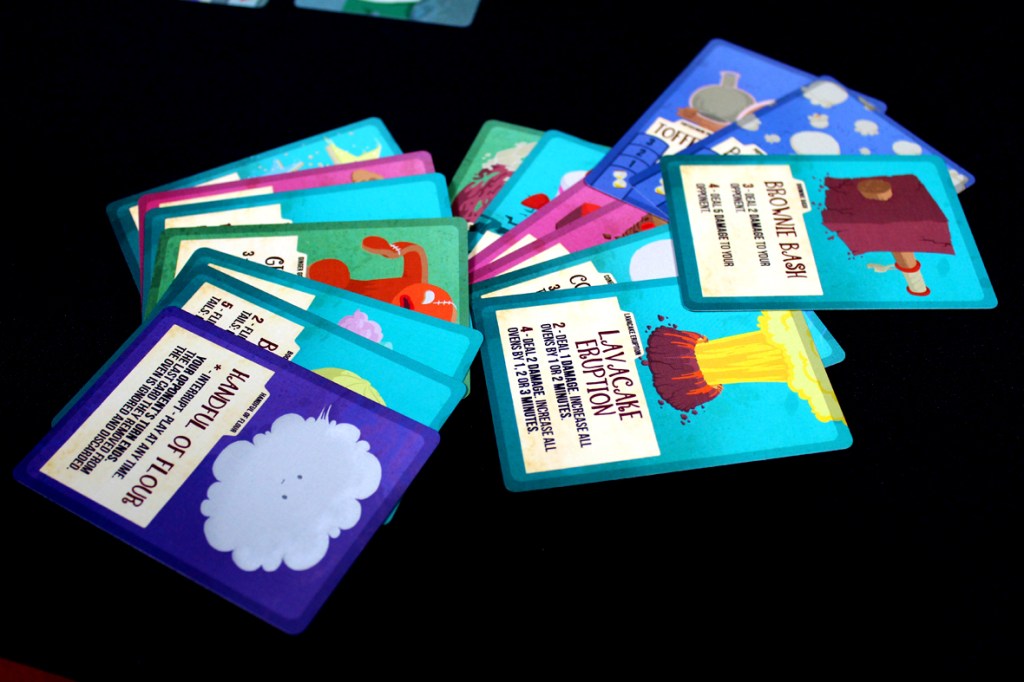
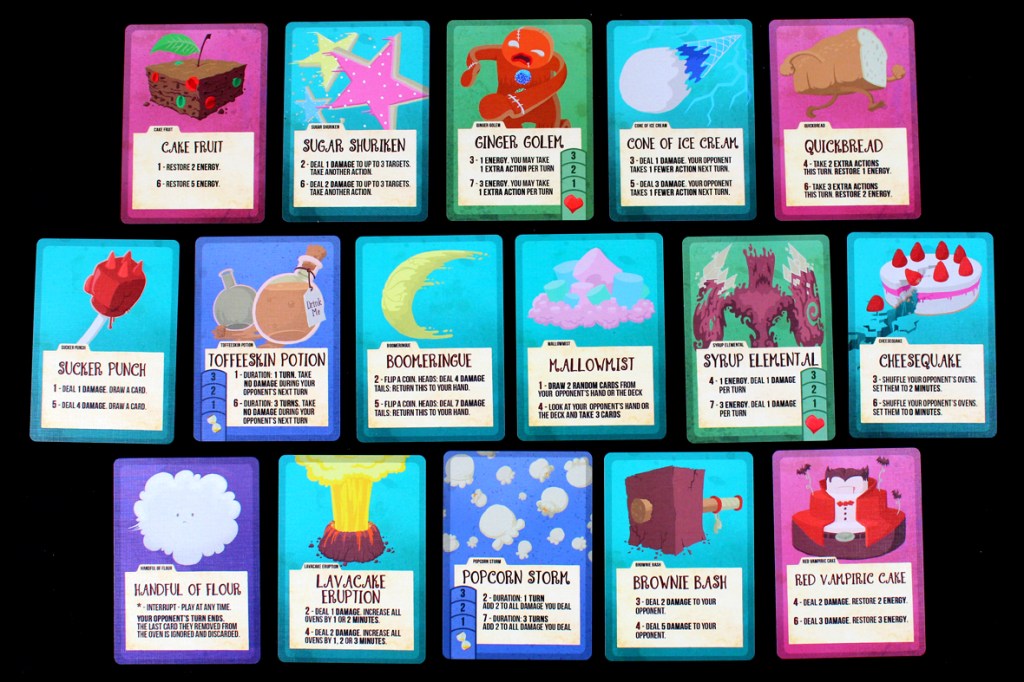
Choose a player to go first! They’ll only take one action on their first turn.

Gameplay
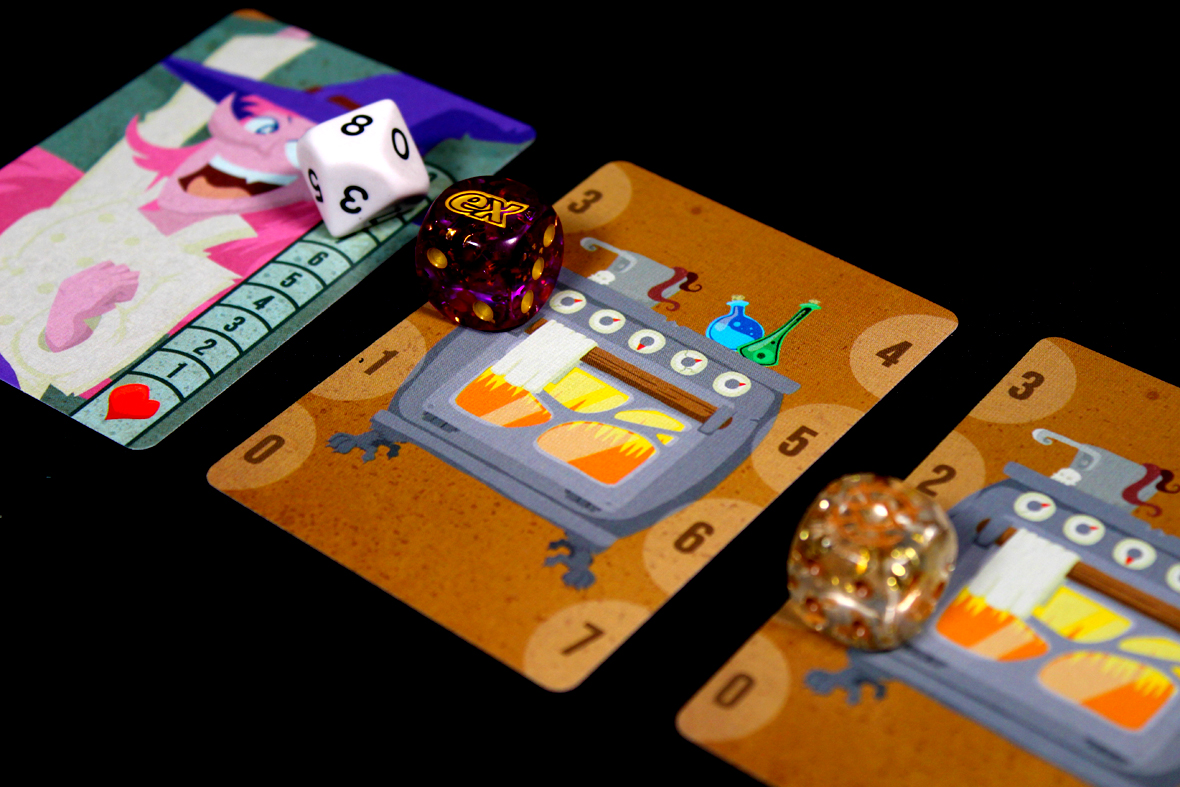
Each turn, you’ll take two actions until one player is defeated! You’ve got five options.
Draw Recipe Card
This one’s the easiest. Draw a recipe card into your hand. If you take the last card, shuffle the discard pile to make a new deck.
Put a Recipe into the Oven
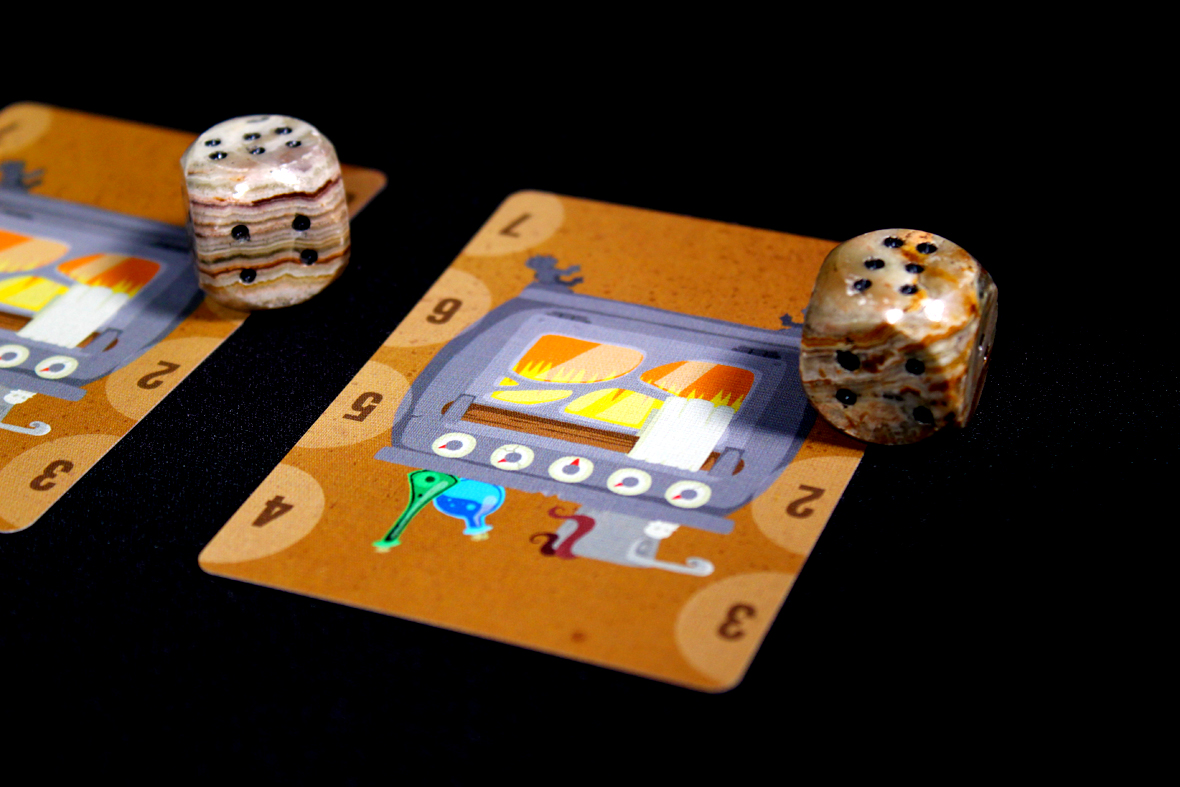
Place a card face-down in front of you, provided you have fewer than three cards in the oven. Place a coin on “0”; that’s where all recipes start.
Peek at an Oven
If you forget something about one of your cards in the oven, you can look at it, but it’ll cost you an action.
Turn Up the Heat
Pick any recipe in the oven; advance the coin by one.
Take Out a Recipe
And this one’s the hardest. Flip over a card in the oven and note where the coin was. If that number matches a number on the front, take the corresponding action. Otherwise, take a damage and discard the card. Try not to do that.
Some cards have their own energy or time track! Do what the game indicates to do for that one.
At the end of your turn, advance all the recipes on your side of the board by one. If this moves any past the 7, it explodes in the oven! Discard the card and take two damage. Extremely try to not do that.
End of Game
If either player’s health drops to 0, their opponent wins!
Player Count Differences
None! This is a two-player game.
Strategy
- Remember what you’ve placed in your ovens. If you forget, you really do end up having to waste a bunch of time and energy, or worse you’ll end up exploding whatever you have. That wastes time and hurts you. That’s pretty much the worst possible outcome, so try and avoid it.
- You’ll need to attack and defend in equal measure if you want to win. If you’re only on offense, you’ll need to successfully beat your opponent before they get a couple good shots in. You can’t really be on defense forever without healing; they’ll eventually wear you down a little bit.
- Similarly, alternating between long bakes and short bakes might help you pull it off. If everything in your ovens is a long cook, you’ll have a bunch of turns where you can’t do much beyond pumping up the heat and hoping one of your bakes will finish up. A short bake can throw off your opponent enough to buy you some time or give you a mildly useful benefit.
- If you get the card that lets you interrupt another player’s action, I’d probably hold on to it; there’s only one, so it means your opponent can’t do that to you. It’s particularly useful if your opponent is about to start their turn with a big play: the handful of flour cancels that big play AND ends their turn. It’s a great way to absolutely shut someone down and completely stop their momentum, so saving up for that is usually worth it.
- Cards that let you mess with your opponent’s ovens are great; you can mix them up or even, occasionally, manually force the timers up or down. Sometimes you can even trigger an explosion! This is where the memory element can be particularly nasty or tricky. If you mess with things your opponent is trying to remember, you might be able to trick them into a particularly nasty mistake. That’s another pretty solid way to mess up their momentum if you can pull it off.
- If you’re genuinely unsure what you have, consider looking at at least one of your ovens. It sucks to waste the action, but better than making a mistake. It’s a lot better to waste an action looking at one of your ovens than it is to lose a recipe that’s baking or, worse, to have it explode in your face and take out a ton of your health. Neither option is particularly good.
Pros, Mehs, and Cons
Pros
- As always, a Button Shy game is a win for portability. We love a tiny wallet game, and this is another 18-card wonder from the going experts. I’m a fan of the entire enterprise, but I really like how many games I can carry in a backpack or a suitcase.
- This is a fun theme! A lot going on there. There aren’t enough bakery games, to be frank. It’s always nice to see more.
- The nice thing about a two-player duel game is that there’s pretty much zero downtime. This is the kind of game where you can imagine it taking much longer with more players. Just a lot to think about, a lot to plan, and a lot to do. Keeping it to two players is pretty solid, as a result.
- I like that you can summon little guys who can also be attacked and provide benefits. They’re just little guys! But they have pretty useful abilities, so you can keep them around until your opponent decides to attack them instead of you. But even then, better that they take damage and die in your service than you taking the hit, I suppose.
Mehs
- I do get a little whiny when Button Shy games require a lot of extra components, like all the coins and trackers this one needs. You do kind of need a lot of coins or dice or whatever to keep track of how much you have going on; I’m almost surprised the game didn’t come with a tiny cardboard sheet of them or something. This kind of thing is often distracting (for instance, I didn’t love when CDSK did it either), since I have to then find random components to use.
- The memory element is nicely designed for its intended purpose, but it does give players with better memories an advantage since it burns an entire action to check just one card. It just creates an inherent imbalance of sorts; there’s not really any particular way to get better at that element, I think. It just ends up making players who aren’t great at memory elements more frustrated.
Cons
- I absolutely hate interrupt cards, and I think the interrupt card here actively makes the game … worse. It’s a pretty sure-fire way to piss me off, and a major element of the game can hinge on whether or not you draw this card, since it lets you effectively dump an opponent’s entire turn. I generally don’t like interrupts anyways, since they mess with the flow of the game, but having an interrupt that discards a player’s planned-to-be-played card is just frustrating.
Overall: 5 / 10

Overall, there are some things I like about Arcane Bakery Clash, and one thing I absolutely hate. I’m a big fan of the theme; it’s right in the Button Shy family wheelhouse of pleasantly whimsical, and summoning all manner of cooked creations to do battle is pretty funny. I especially like that you can summon additional targets to provide benefits for as long as they survive your opponent’s attacks. It’s pretty clever, in that sense. Plus, at two players, there’s not really any ability to dogpile another player; you just kind of attack, defend, and bake. I also appreciate that you can mess with your opponent’s ovens by increasing or resetting their timers, which can occasionally cause their best-laid plans to explode. Very fun. I’m not entirely sold on the memory aspect of the game, unfortunately. I think that a lot of games that have some memory element to their gameplay can often introduce a frustrating imbalance between players, and that’s especially true here. It feels like the memory aspect exists solely to make the “shuffle your opponent’s cards” card work, and while that does work well, I don’t think that having to waste actions looking at your own cards just because your memory is so-so makes for a fun player experience (unless you’re playing against a player with an equally bad memory). The thing that particularly sours my experience, though, is the Handful of Flour card. This card allows you to just effectively cancel any player’s card, ending their turn. I’m already not a fan of interrupt cards, just because they add some weird problems to most games’ core gameplay loop, but this one is particularly vexing, as a player who drops an 8-time card can just get “Nope”’d, effectively canceling several turns of work in one fell swoop. While strategically great, it feels super bad and often leads to player frustration. It feels like it would have been better served as another, similar card that allows you to reduce or reset the time on your opponent’s cards (or if it required its own time in the oven to cook). Either way, it’s a frustrating card that won both of the games I played for my review, so, not a fan. I think without it I’d likely enjoy the game experience significantly more, though I concede there will be players that love that kind of thing. If that’s you, or you’re looking for a quick dueling game, or you love memory elements, you might enjoy Arcane Bakery Clash!
If you enjoyed this review and would like to support What’s Eric Playing? in the future, please check out my Patreon. Thanks for reading!
 What's Eric Playing?