
Base price: $50.
1 – 5 players.
Play time: 1 – 2 hours.
BGG Link
Buy on Amazon (via What’s Eric Playing?)
Logged plays: 2
Full disclosure: A review copy of Rebuilding Seattle was provided by WizKids.
Do we take breaks around here? Sometimes! I’ve been winding my reviews down a bit lately because I’ve been busy with moving across states and trying a whole new life in a new place, and that’s been pretty cool. Two reviews a week is plenty of content for y’all and it still means that I can go do other things. I’ve got a whole new city and state to explore! In the interest of building up those experiences, let’s talk about Seattle in a different context, with Rebuilding Seattle, from WizKids!
In Rebuilding Seattle, a huge tragedy has just occurred! That’s right, it’s 1889, which is a bummer. Also most of Seattle’s downtown burned down. Unrelated, but you are in charge of rebuilding it. Pick a neighborhood and start there, but your opponents are going to try and outbuild you. Also, be careful! You don’t want there to be more people than the amenities you can offer, otherwise everything will be crowded and annoying. Who will revitalize their part of Seattle the best?
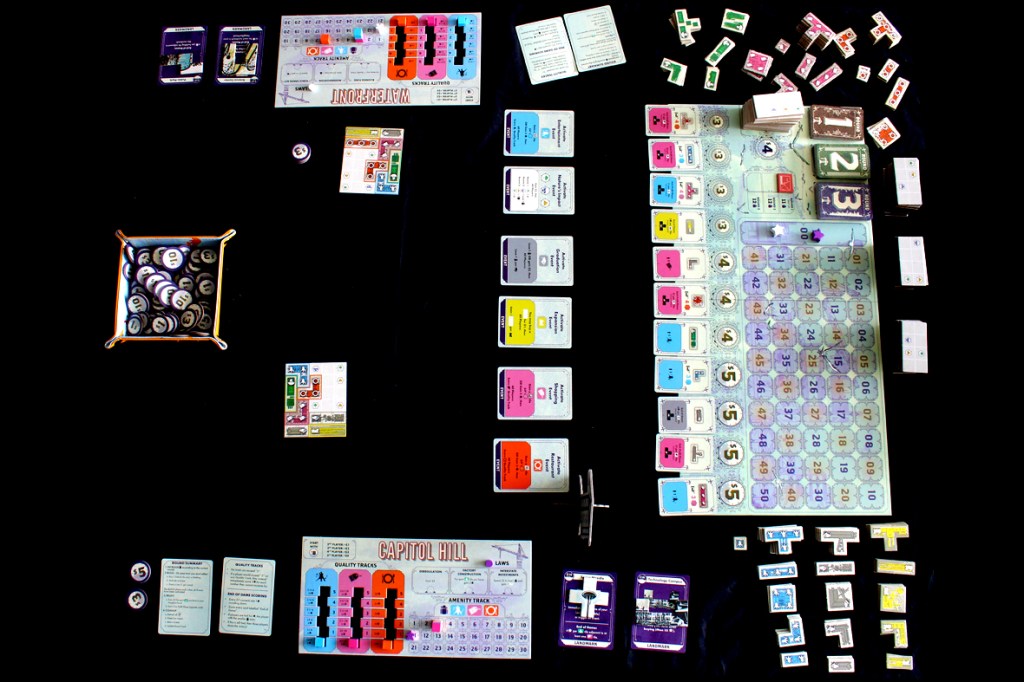


Contents
Player Count Differences
I think the game does a good job of scaling up with player count; at higher player counts, I never felt like there were too few tiles or cards available, even if a player took the exact card that I wanted. There’s usually something else you can go for. The one issue that I have with higher player counts is that more players increases a particularly nasty incentive to activate events that take the Amenity Track into account. That’s not terrible, but it’s fundamentally very “screw other players by activating the event before they can make use of it”, rather than the more fun “do something that benefits you more than other players”. In some games, that can throw off an entire player’s strategy and there aren’t that many rounds, which feels … bad. Again, we try to avoid the whole “feels bad” thing in games. You won’t see this quite as much in lower player count games, since at two, for instance, it’s fairly zero-sum: messing with another player and benefiting yourself are kind of equivalent. As you might guess if you read the site a lot, I tend to prefer more of the zero-sum situation. All that said, I tend to prefer the lower end of the player count spectrum. I like being able to build up without worrying about collateral damage, rather than having to account for another player trying to play to spite me on the Amenity Track.
Strategy

- Your Landmarks provide some starting strategy; lean into that. They might tell you to build up Neighborhood Tiles or to pair certain types of buildings together spatially. If you’re not sure what to do, lean into that! Landmarks can be pretty potent sources of points or other benefits, especially in the late game. They seem unaffordable in Round 1, but usually by Round 3 you’re swimming in money, so it’s a bit easier to swing.
- Think of ways to reduce your Population early in the game and figure out how to raise your Amenities in the late game. In the late game, you’ll usually find it difficult to lower your Population to the point that you can score multiple Quality Tracks, but hopefully over the course of the game you’ve had more success either raising your Quality Tracks or you’ve been able to build places that give you additional Amenities. Early in the game, though, reducing your Population essentially gives you an Amenity of each type as soon as you do.
- You can kind of expand your Neighborhood in whatever weird ways you want, but try to avoid covering up symbols; you’ll score them later. The symbols are pretty useful for earning money, earning points, or reducing Population, and the events that you can activate will factor into that differently each round. You may need to cover up some of the symbols for late-game or other bonuses, but it’s a good idea not to cover too many of them.
- That said, once you get the Population decrease from the waves, you can start covering those up. They’re not as critical in Round 3. After the Event is activated then, yes, there’s not really much of a need to keep the others around. The exception is Trees; they score in Rounds 1 and 3, so you would do well to keep track of them through the end of the game.
- Trying to go hard on all three Quality Tracks isn’t particularly wise or doable; your best bet is just going for one or two so that you can try and get full rewards on both. You’re just spreading yourself too thin if you go after all three; if you do well with two, you can get a lot of points or a lot of money (or a good amount of both). If it’s your first game, even focusing on just one track can be pretty helpful while you’re getting a sense of how the game’s systems interact.
- Generally speaking, finding ways to earn money is good; that lets you buy tiles. Like real life, sometimes, having money is good. It will let you buy increasingly more tiles over the course of the game and play your humongous Landmarks, both of which are pretty critical. I mean this mostly to say, don’t ignore profit tiles; you can certainly make money other ways, but those are a good primary method.
- Buying the pre-printed buildings is just okay; it’s more about needing the shape than getting a particularly useful benefit. Sometimes you just need exactly the shape that’s provided by the tile, and even though you’d rather have additional benefits or increase your Quality Track or something, you just don’t have any of those tiles available. This is pretty much the only time you should take a pre-printed building. They’re a bit on the cheaper side, but they don’t do much else for you beyond increasing your Amenities.
Pros, Mehs, and Cons

Pros
- Love a city-building game. It’s one of my favorite things to do in a game, and there’s just so many different ways to go about it in Rebuilding Seattle. It’s pretty expansive and I kind of love that. You can focus on different things, try things out in different neighborhoods, that whole thing. There’s a lot of variability, which is nice.
- There’s also a fun historical context! It’s based on real events and real parts of Seattle, so since I was just moving up here it was a very fun game to play to get hyped and also learn a little about the history of the city I’m choosing to live … near.
- I appreciate that every player gets a neighborhood that can enact slightly different laws. I get that that’s just variable player powers, but I appreciate that it ties into the theme of the game a bit, too.
- The color scheme is pretty fun too. It pops in a fun way, which is nice. The whole game ends up looking striking on the table.
- A surprisingly approachable complex title. I did worry that this was going to be a much bigger headache than it ended up being; it’s right at my personal complexity comfort level. I wouldn’t say it’s much more challenging than, say, Lost Ruins of Arnak or games in that complexity band, honestly. I feel like I could teach this to anyone interested in a city-building game and it would land.
- As someone who lives near Seattle, I also like that the Landmarks are all based off of cool places and come in fun unique shapes. Similar to variable player powers, but they are closer to variable player goals. They help you hone your strategy, find things to do, and turn those into big swings of points when you have the opportunity to execute on them. It’s all generally good.
Mehs
- There’s not a particularly great organizational scheme for this game; you just kind of end up throwing all the tiles into a bag. One thing that almost every game with lots of tiny tiles needs is a good insert or organizer scheme so that they don’t just end up in one giant bag. Rebuilding Seattle doesn’t have that, so the tiles end up in one giant bag. It’s not ideal.
Cons
- Because of the lack of a good insert and the additional cards and Neighborhood Tiles, setup is kind of a pain. Since everything ends up in a large bag, every game, you have to reset the whole play area and sort everything out again, which isn’t great either. It would be more ideal to have an insert that doubles as a storage solution both during and after the game, so you can just pull tiles from where they live.
- I don’t love the incentive players have to activate Events that nobody can really score, but I appreciate that it’s not entirely all-or-nothing. It’s kind of a “feels bad” for players and plays a bit spitefully, but if you’ve raised your Quality Track high enough, even with a high Population and low Amenities you should still be getting something out of the deal. I’d hate it a lot more if you just straight-up got nothing.
Overall: 7.5 / 10
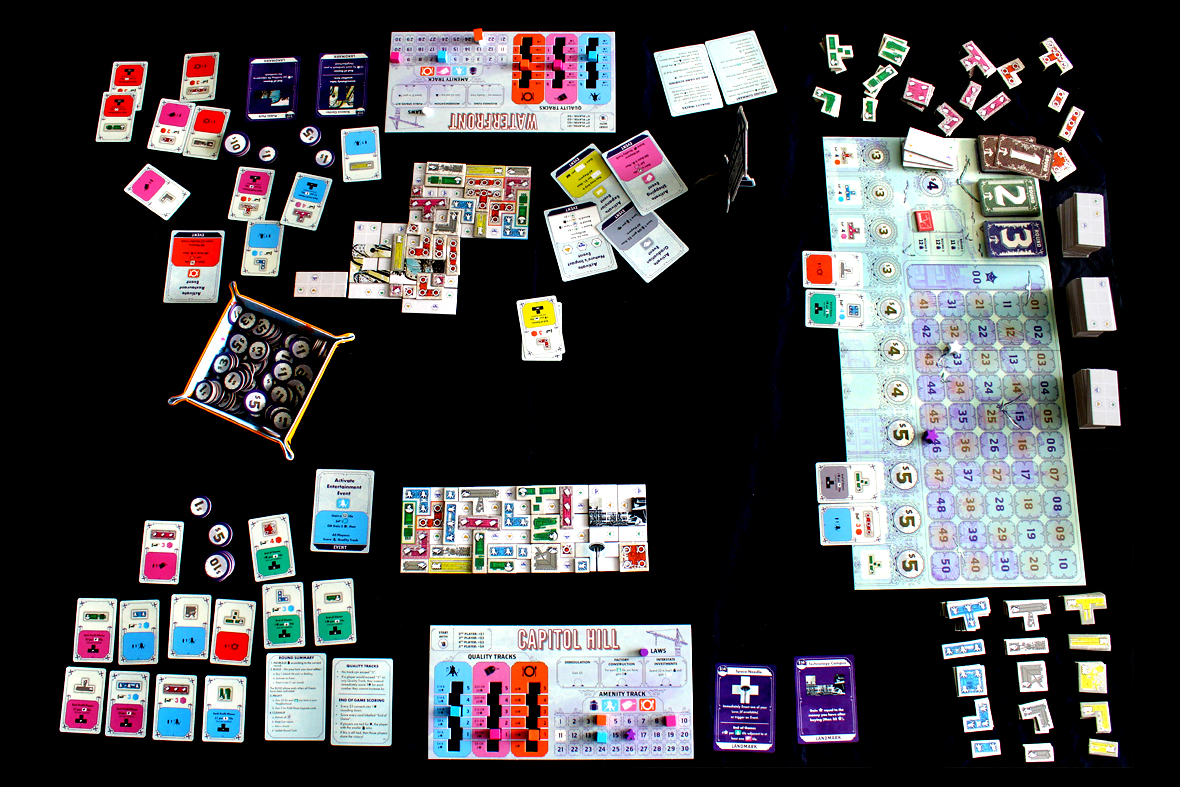
Overall, I ended up being a big fan of Rebuilding Seattle! I do love a bit of complexity from time to time, and I think Rebuilding Seattle did a great job packaging that complexity inside of an approachable and thematically interesting package! I appreciate that there’s a lot to do every game and really, every turn. It’s quite pleasant. Granted, players can mildly conspire to make it less pleasant by activating events and depriving players of the ability to make big gains based on their population, but, you know, that’s about the only thing that I find mildly annoying about it. That and the mess that is loading it and unloading it from the box. Seriously, a good insert would have gone an extremely long way, here. There are just a ton of little tiles, you know? But beyond that, I think it’s a lot of fun! Rebuilding Seattle presents a few complex puzzles to manage. If you enjoy the spatial management of building up a city and creating some cool patterns, they’ve got it. If you want to do more of the economic side of building an engine to create money and score points, well, there’s plenty of that, too! If you want interactive play where you can engage your opponents and try to deny them points and opportunities by activating events that they want, there’s plenty of that. There’s just a good amount of different things layered into a complex game, but the cognitive load of actually learning and playing it is surprisingly low. I was impressed! In a similar manner to Warsaw, which I played forever ago, I’d almost like to see how this system could be applied to other cities that were once destroyed and rebuilt to see if that would shake the game up a bit in new and interesting ways. But who knows. Rebuilding Seattle has become one of the more interesting complex titles I’ve played this year! If you’re looking for something complex, you enjoy city-building as a concept, or you’re just pro-Seattle, like me, I’d definitely recommend trying out Rebuilding Seattle! I’ve quite enjoyed it.
If you enjoyed this review and would like to support What’s Eric Playing? in the future, please check out my Patreon. Thanks for reading!
 What's Eric Playing?