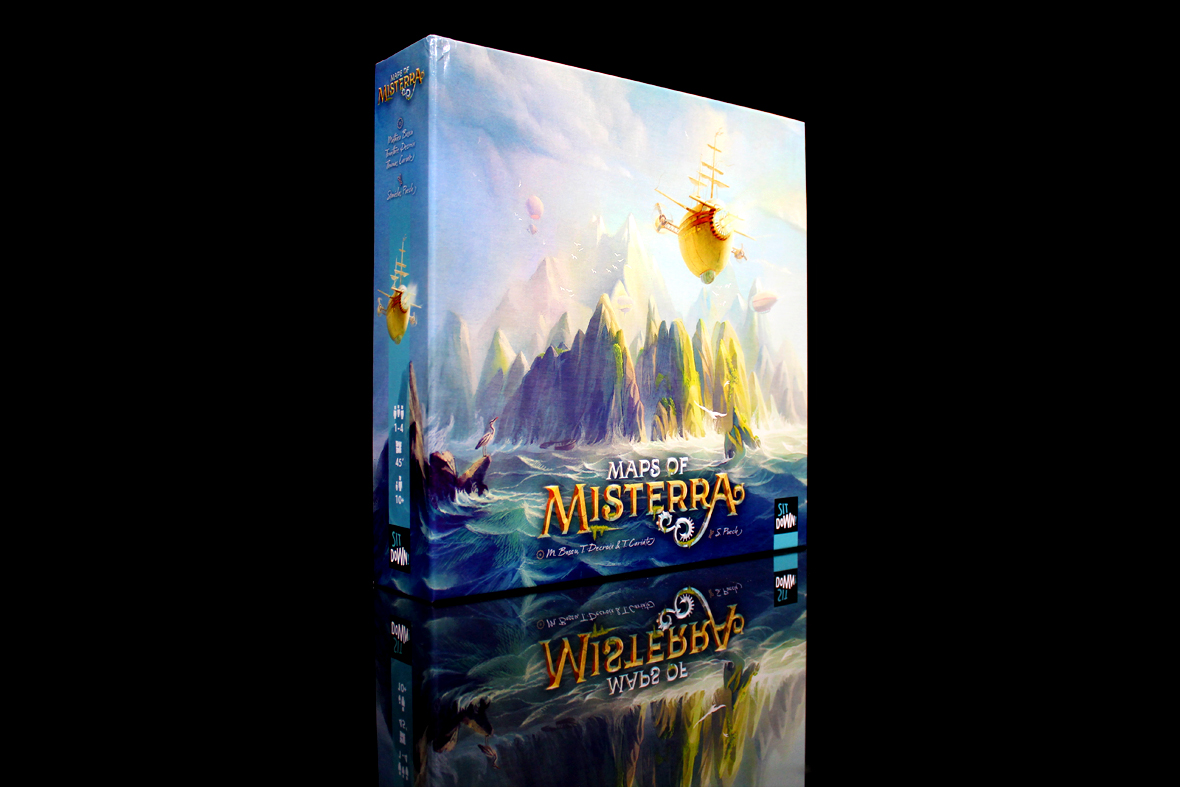
Base price: $35.
1 – 4 players.
Play time: 45 – 60 minutes.
BGG Link
Buy on Amazon (via What’s Eric Playing?)
Logged plays: 9
Full disclosure: A review copy of Maps of Misterra was provided by Flat River Games / Sit Down!.
This is another one of those times that a game I’ve been playing on Board Game Arena finally hits the review table, which is always nice. BGA does a great job letting me see the mechanics and test out different strategies, but for the tactile experience, you’re going to be hard-pressed to beat playing a game in person. Except for setup. That always sucks. But BGA handles that for the most part! Oh well, before I think too much about that, let’s get into Maps of Misterra!
In Maps of Misterra, players take on the role of explorers who have just found an uncharted island. That said, they’re very disagreeable. Nobody can entirely decide what terrain is where, so they’ve instituted a system by which as long as two people agree on a terrain type, that’s what it is. That said, you’ve got your own people to report to, so it’s probably fine if your map doesn’t 100% reflect reality. Not like they’re ever going to come here. Will you be able to make a name for yourself as a grand cartographer? Or will you end up directionless?
Contents
Setup
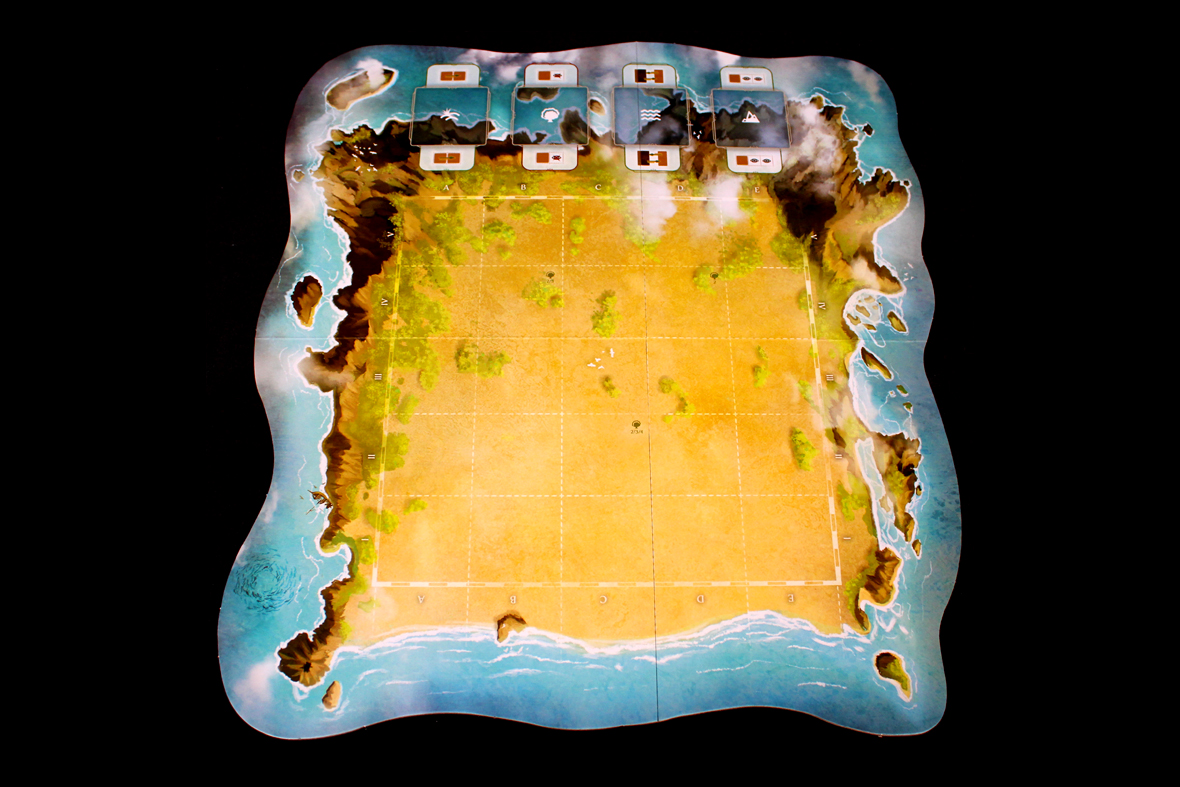
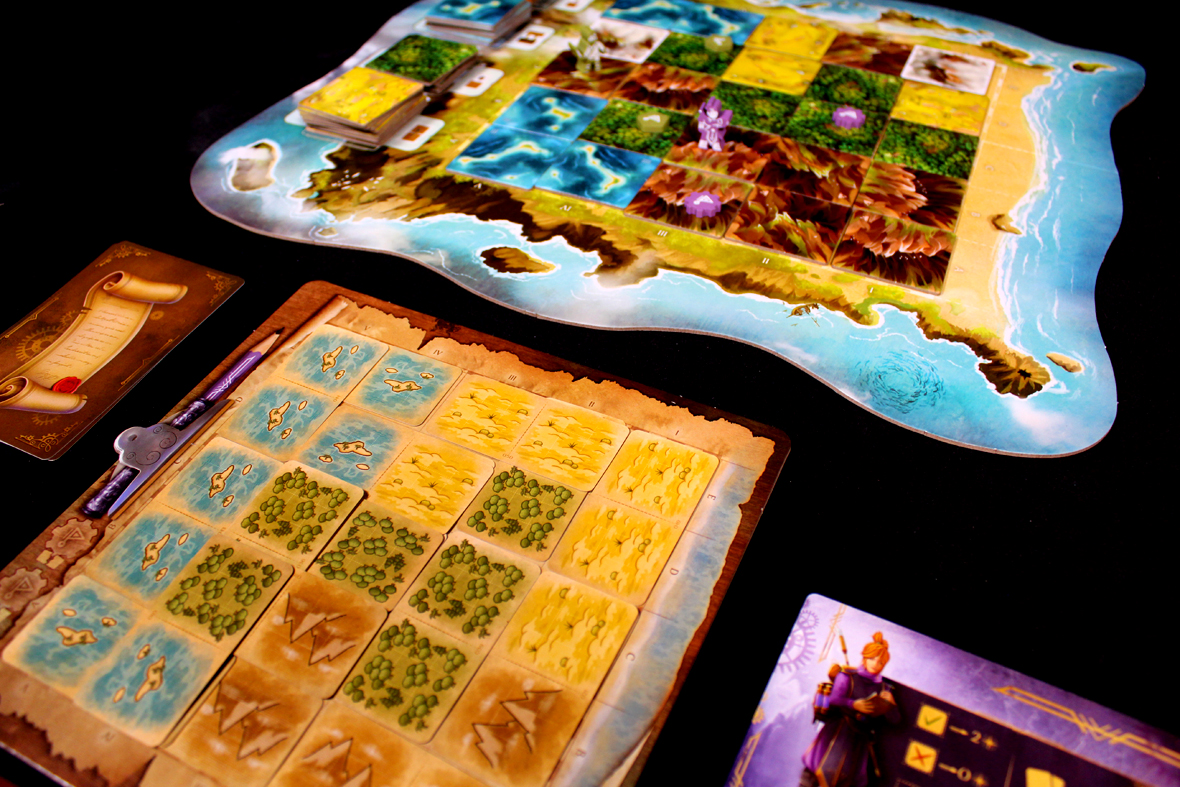
Not too tough to set up. Lay the Island Board in the center of the table:
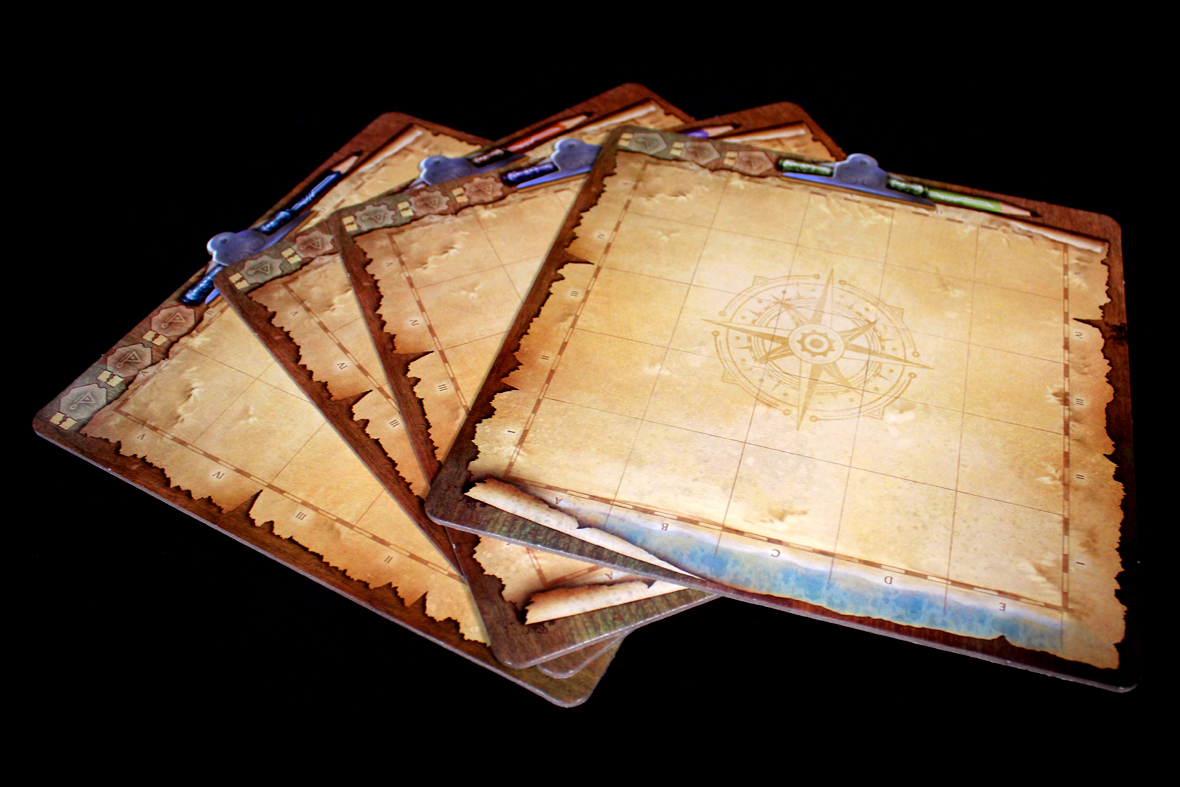
Give each player a player board aligned with the island board (the beach should be facing the same way on everyone’s board).
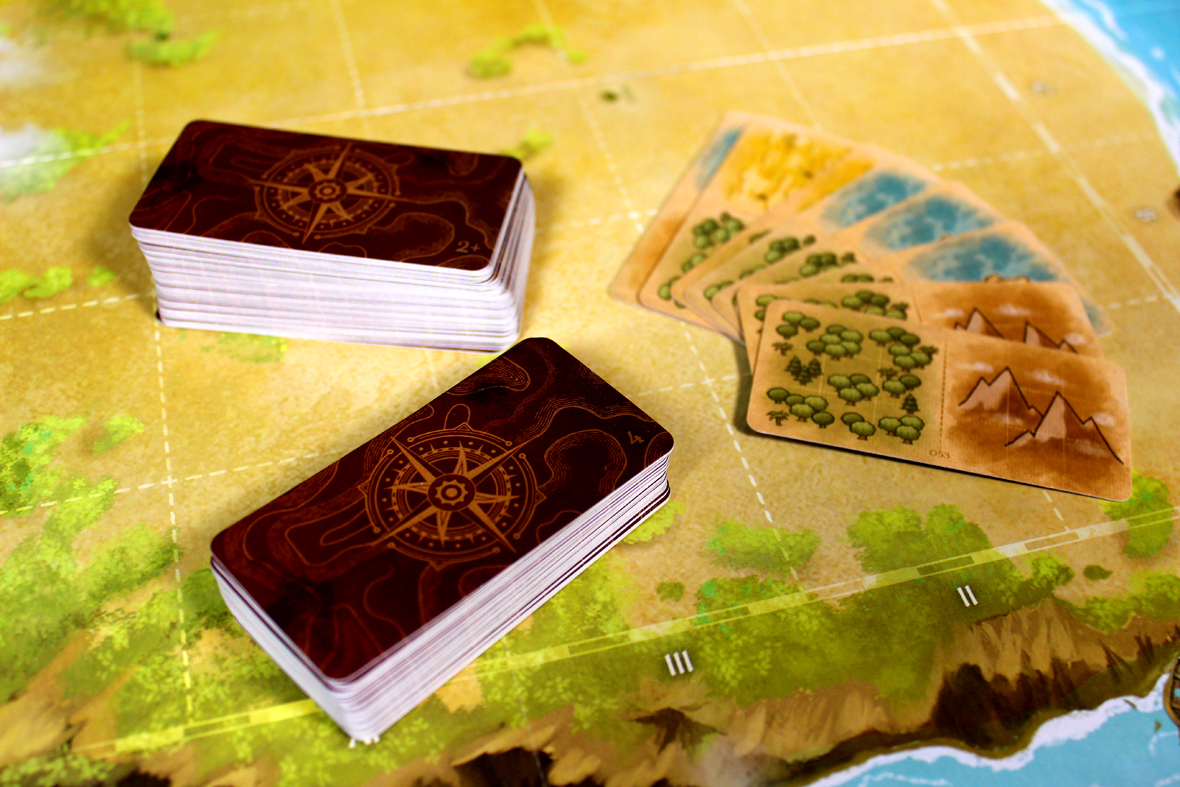
Shuffle the Presumption Cards and deal each player four. They should keep two and return the other two to the box. Remove some Sketch Cards based on player count; shuffle the rest and deal five face-up to form the supply.
Place the Terrain Tiles on their spot on the board.
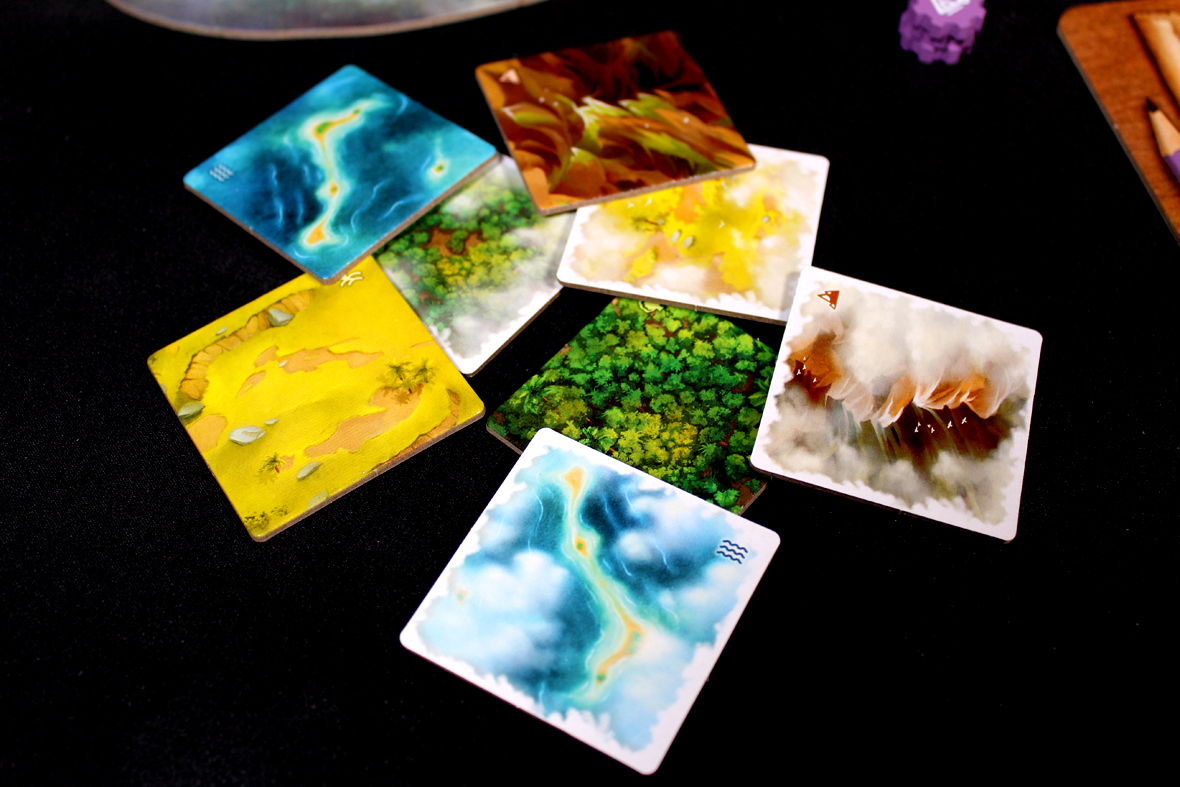
There should be 1 – 3 Forest Tiles on the board, based on player count; place them. Give each player their Cartographer meeples and their Claim tokens:
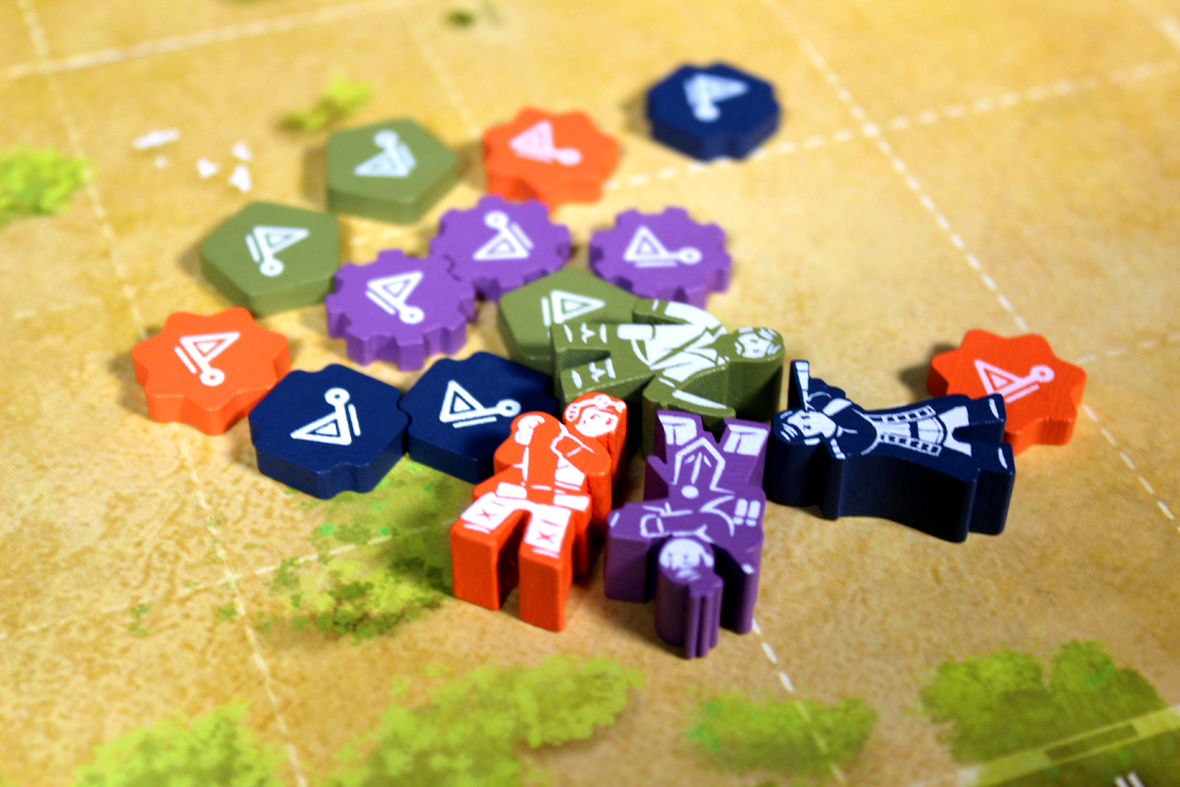
You should be ready to start!

Gameplay
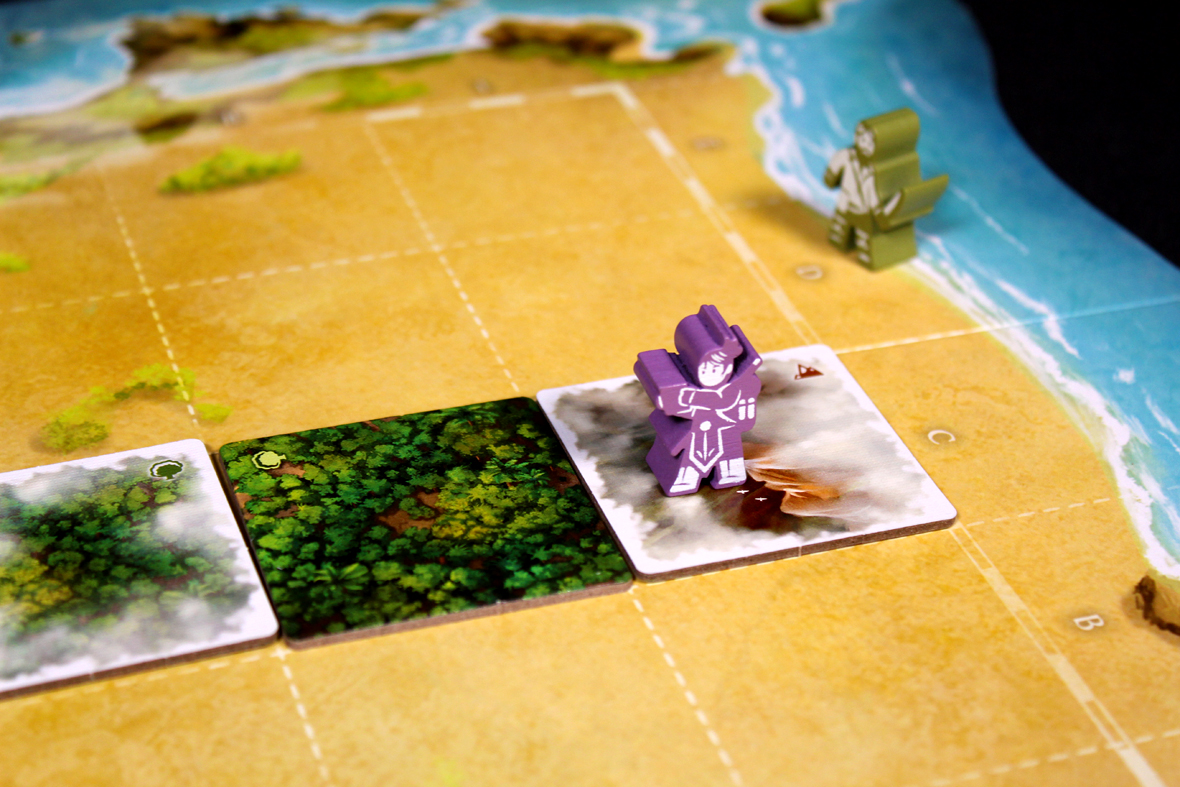
A game of Maps of Misterra takes place over several rounds, as players explore and map and plan on this recently-discovered island. Each player gets two turns per round, one right after the other. They go like this:
Move
You may move your Cartographer meeple one space in any direction. If you move onto a Steppe (even a hazy one!), its special ability allows you to move again. For your first turn, you must place your Cartographer meeple on any beach space. After that, moving becomes optional.
Map or Claim
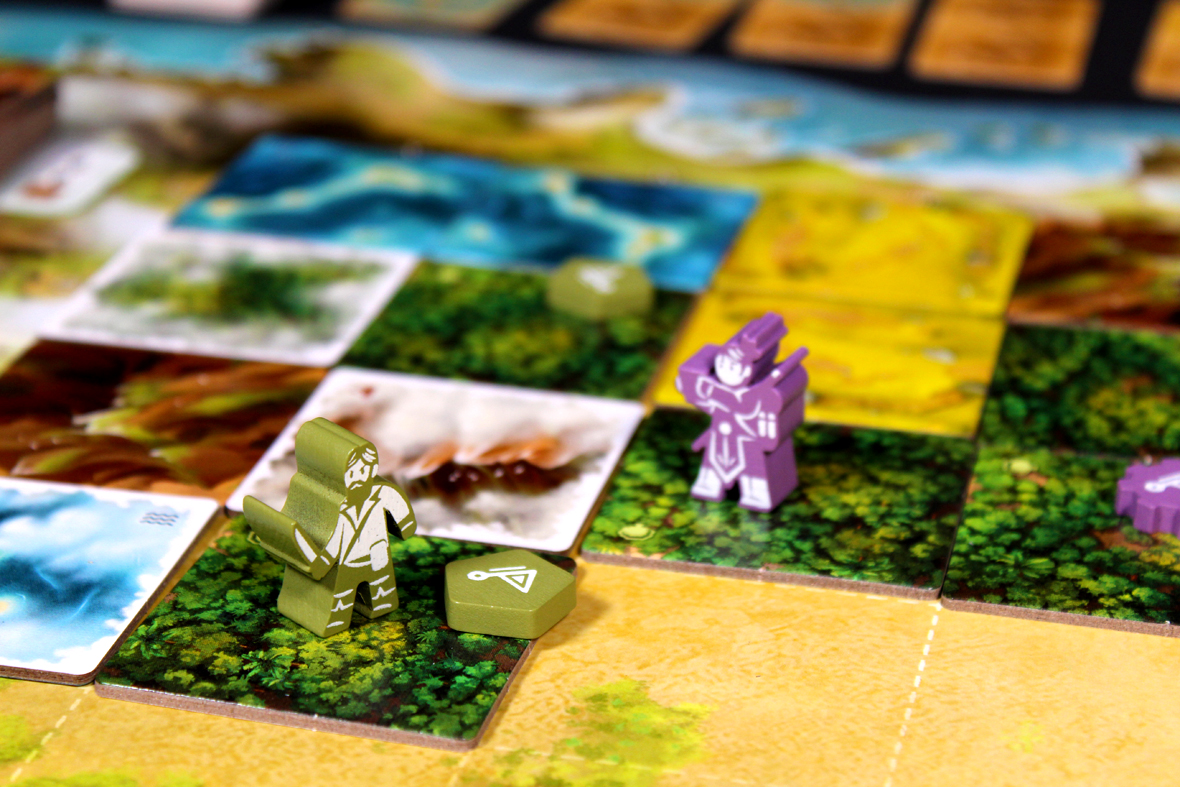
Next, you may either place one of the five cards in the display on your player board to Map, or Claim a territory as long as you’re on a confirmed (not hazy) space. If you’re on a Lagoon space, you can discard one of the cards in the display and replace it with a new one first. If you are on a Jungle space, you must Claim. If you Map, you must place one of the cards so that one of the spaces is either the space you’re on or the space adjacent to you. If you’re on a Mountain space, that distance is extended by one.
When you Map, any spaces on the board that are empty or hazy are replaced by the spaces on the card you placed. Any hazy spaces that match the card you placed become Confirmed, flipping to their non-hazy side. So that’s fun.
When you Claim, you discard one of the cards from the supply and place your Claim Token on your current space. You can get points for that later! Your space must be Confirmed, first. You also can’t claim the same type of location twice!
End of Turn
Once your turn ends, refill the display to five cards.
End of Game
If, at the end of your turn, your board is covered, the entire island is Confirmed, or the deck is out of Sketch Cards, the game ends! Finish the round so that everyone has the same number of turns, and then score!
Each player scores their Presumption Cards, as well as 2 points for every space on their boards that match a Confirmed space on the island (all Hazy spaces are removed). For each region you’ve claimed, you get 2 points per Confirmed space in that region. For every empty space on your board, you lose 1 point. The player with the most points wins!
Player Count Differences
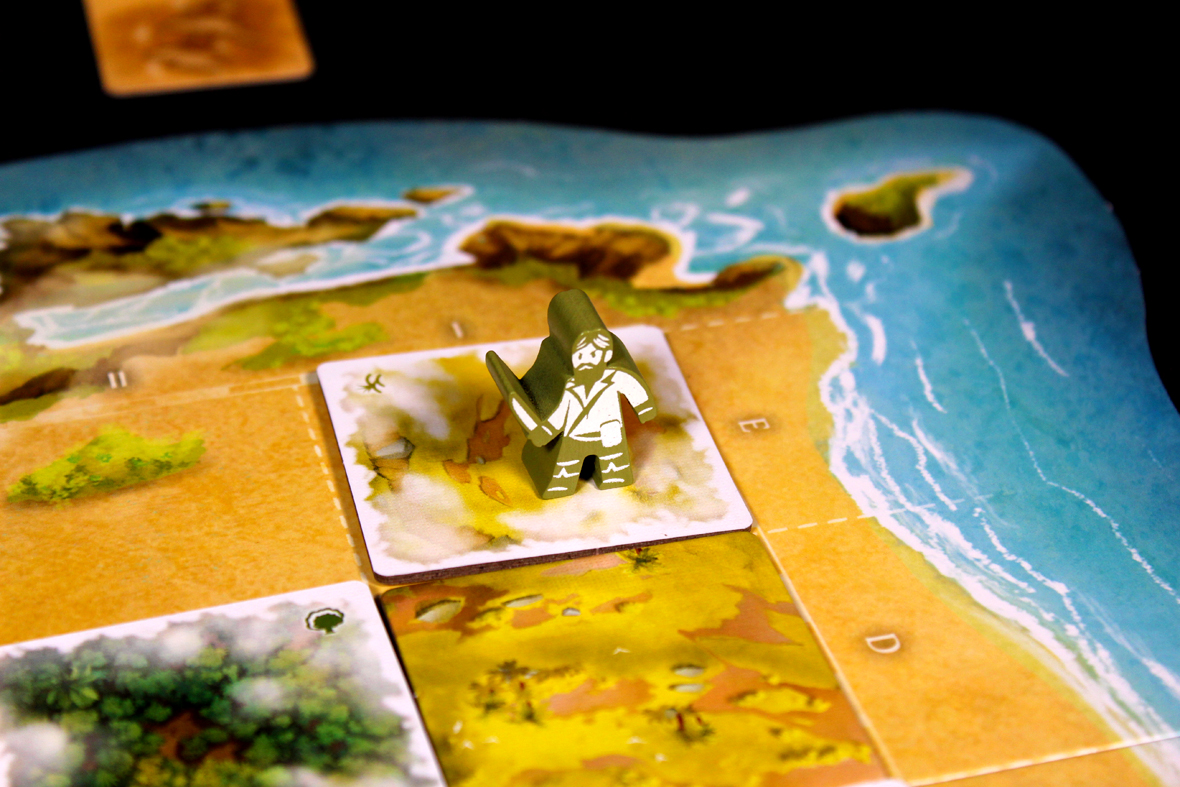
There are a few! The core one is largely that with different player counts you start with different numbers of “fixed” Jungle tiles on the board to start. I assume these are largely to inhibit movement at lower player counts, whereas at higher player counts you’ll have the other players playing whatever tiles they want to help with that. With more players comes a bit faster rotation of the cards in the display, which may influence what you can and can’t place on your turn, but there are also more cards (and duplicate cards), so ideally, that will kind of even out based on player count. The one thing you do have to deal with is that the game can still run a bit long as players try to set up their map, so there may be a noted slowdown as player count increases. That’s less my thing, but I do enjoy that, at higher player counts, spots on the map can get confirmed basically without your input at all, so you need to be careful about the very ground under your feet changing, as well. Not a ton of strong preference, here, though I’d probably stick to two or three players.
Strategy
- Your Presumption Cards should drive a lot of your strategy. They shouldn’t be the only thing you’re thinking about, but they are going to be the primary way that you differentiate your game from your opponent’s game. So try to make sure you’re making gradual progress on that throughout the game, and try to pick some useful ones at the start of the game.
- The tough thing you need to remember is that the Presumption Cards only apply to your board, not the actual map. This kind of threw me off the first few times I played, but your Presumption Cards are your board only. The way you score off of the confirmed spaces is by matching your board up with them.
- You can occasionally mess with your opponents by breaking up spots they’re building, if you want. This can either make it more difficult for them to lay out the spaces that they need for their own Presumption Cards or you can split off some tiles from one of their Claims, if they’re trying to expand one.
- Also watch out for large contiguous areas! You’re going to want to claim those. While you might be breaking up your opponents’ Claims, try and claim big ones of your own? A little easier said than done, given … you know, the whole thing. As soon as you start blocking some players, they’re going to do the same thing to you.
- I like Steppe spaces for the extra movement bonus and Mountains for the extra placement bonus. I just think they do a lot for enhancing your general mobility and placement. They make it easier to place what you want on the board, as opposed to Jungle spaces, which just make everything more difficult.
- You do, ideally, want your map to match the actual map; you can get a ton of bonus points that way. Whether or not you can make it all work is another thing entirely, but the more spaces you can make work with both your Presumption Cards and the map, the more points you’ll get. This is where I kind of recommend going for Presumption Cards that are easier to land, just because it’s easier to make them work with the actual map.
- Try not to put Jungle tiles in places that you want to go; they can make spaces that can’t be mapped if you’re not careful. They can junk up the map almost entirely, which is a bit frustrating? Not fun. Just be careful with your placement, though you can always try to use them to make things harder for your opponents, if you can land it right.
Pros, Mehs, and Cons
Pros
- Cartography games are pretty great! This makes me miss The Guild of Merchant Explorers. I just like maps, I think. Building out landscapes and such is a lot of fun. I started replaying Cartographers recently and I’ve really been enjoying making maps and such. I just like the theme and such.
- I really like, thematically, that you don’t necessarily need your map to be legitimate. You’re really just hired to sketch out the place and you’re playing a bit towards your presumptions. You really can just be like “yes, the map is ‘mostly accurate'” and mostly get away with it, both from a narrative standpoint and a gameplay standpoint. It’s fun.
- The various powers from being on certain terrain is nice. It gives you an incentive to choose certain Presumption Cards and set up the board a certain way. Plus they interact in interesting ways, like long corridors of Steppe tiles so that you can quickly move around the board, or huge, unnavigable Jungles.
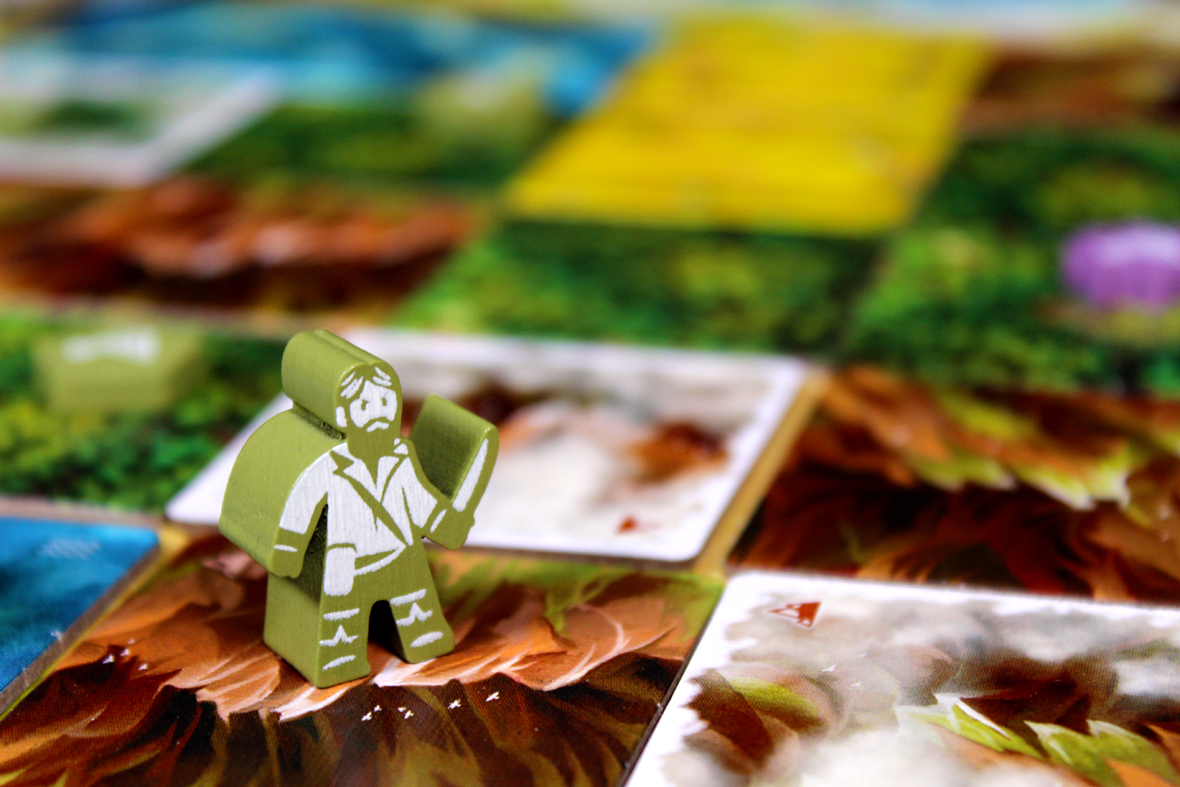
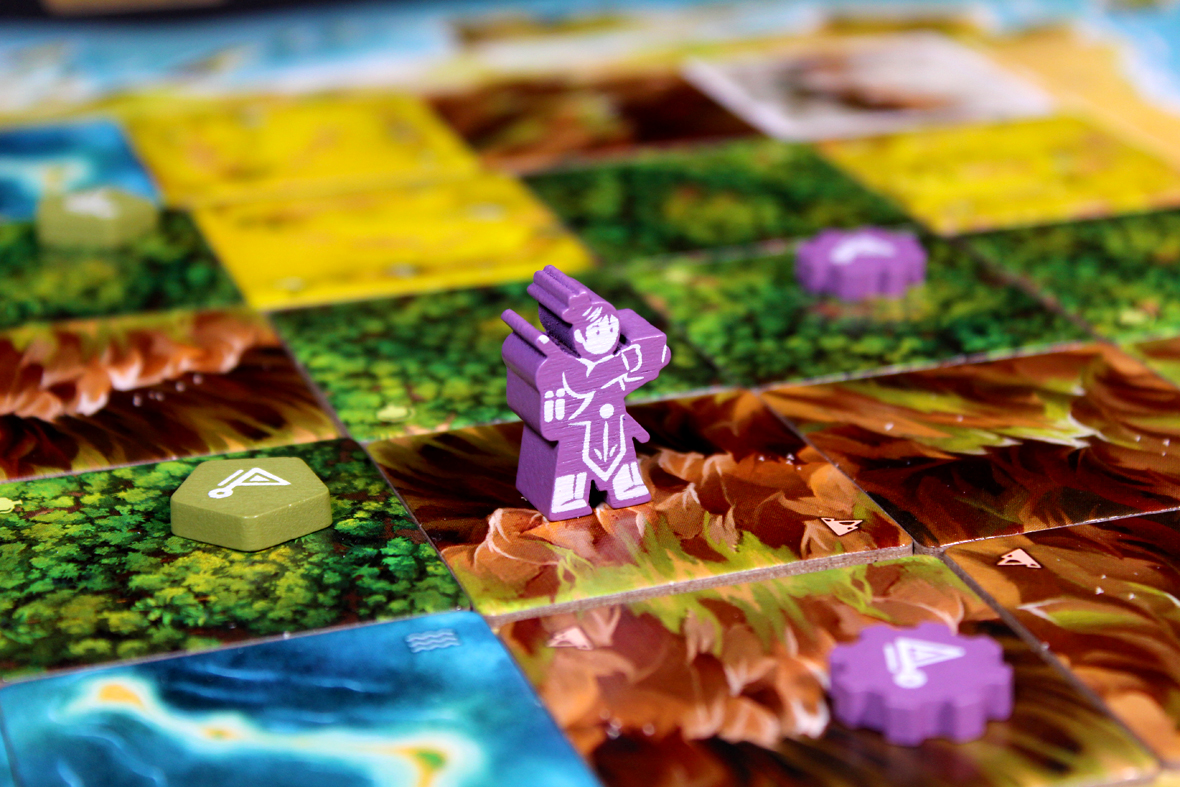
- The component quality is pretty good, too! I like the Cartographer meeples a lot, and the tiles are a nice size and shape. Nice insert, too!
- I especially like the little map clipboards that serve as your player board. It’s a nice bit that almost makes you feel like you’ve got your own little map that you’re doing.
- Games with shared player spaces are always kind of interesting; it’s neat to see how the map turns out over the course of the game as players confirm each others’ tile placements. I haven’t played a ton of games where you’re all participating in the same board lately, but it’s nice! There’s a lot of competition and cooperation happening at almost the same time, which is pretty cool. It does make the game a bit more interesting at higher player counts, just because there’s more happening and more things being mixed up.
- This game does a good job of giving you, the player, a sense of accomplishment when you look out over the tableau and you see everything everyone’s done. You have a pretty expansive set of maps when you’re finished, even if they’re not totally aligned! You could tell a little story about it if you wanted.
Mehs
- I wish there were a bit more space between the tile spots on the actual board, since you’re going to be flipping them and changing them out every so often. It’s a tiny bit frustrating, just if you’re shifting things around, you can bump a lot of the tiles because there’s not enough of a gap between them to get a grip. A bit farther apart would be nice.
Cons
- The game can get slowed down immensely if there are a bunch of jungle spaces that players have to navigate through. Jungle tiles are basically no fun to navigate unless you’re going to Claim, since you can’t Map when you’re on one. This also means that there might even be spots on the board that can’t be mapped if you place Jungle tiles in a silly way. If the entire center is Jungle tiles, you’re just going to have to slog through it to get from one part to another. I wish the Jungle tile ability had been different, since it just kind of slows the game down.
- Some Presumption Cards are just much easier to hit than others, especially if you’re trying to align with the board. It’s a bit of a mixed bag. Getting the ones where you can just place tiles around the edges of the board is much nicer than the ones where you need an explicit pattern of tiles that are going to get messed up by your opponents as soon as they notice what you’re doing.
Overall: 7.75 / 10
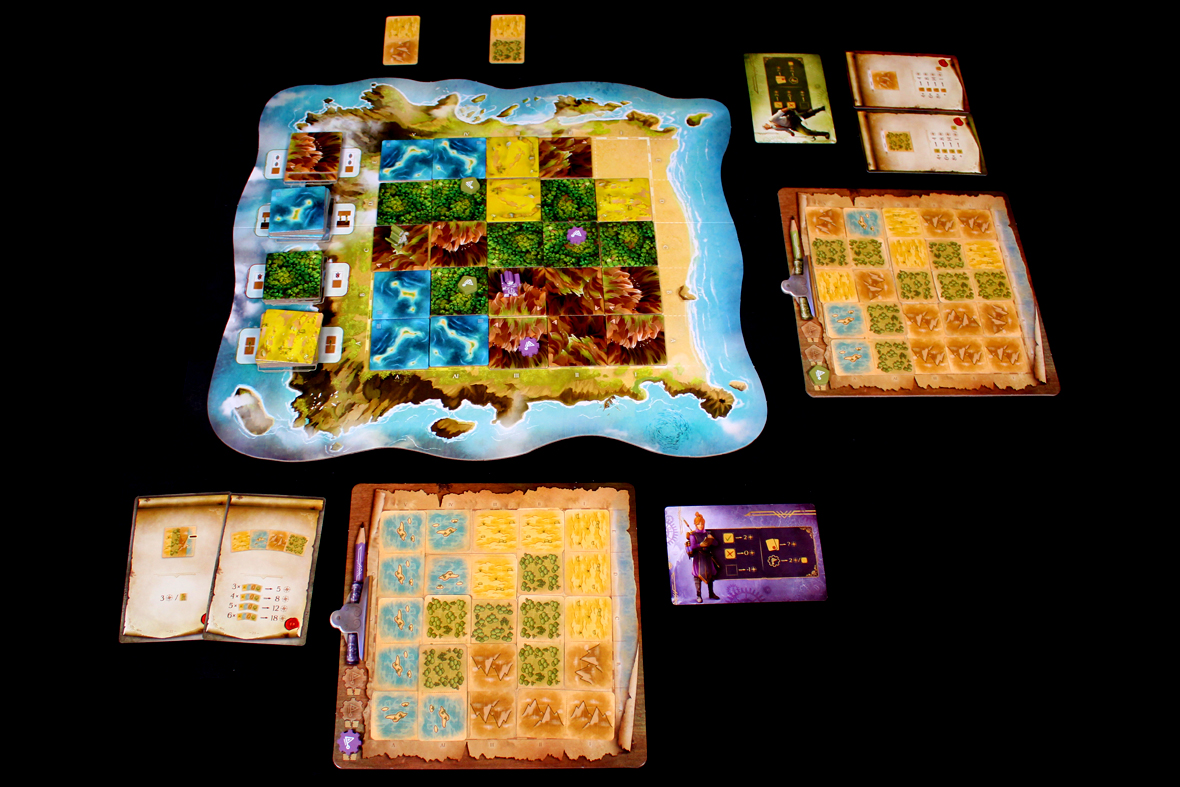
Overall, I’ve enjoyed my plays of Maps of Misterra! I’ve been a bit fascinated just because everyone else I’ve played it with has liked it less than I have, and I’m not entirely sure why that is. I think that, going into it, we all kind of thought it was going to be a bit more deduction-based (with “discovering” the terrain types), so that might have had something to do with it, but at the end of the day I’ve liked it a fair amount. The one thing I do find annoying is that not all of the Presumption Cards are created equal, so having easier ones definitely lays a simpler path for you than others. Also, while I generally like the Terrain abilities, the Jungle ability just making everything more difficult to do and slower seems a bit baffling. It might be correct from a balance standpoint, but it feels bad from a “fun for players” standpoint. Not quite ideal. That said, there’s a lot to like about the game. There’s high quality components and a very consistent and appealing art style that makes you feel like you are a fantasy cartographer, which is charming. Just a huge fan of the general vibe. Plus placing the cards like dominoes leads to some fun stacking effects and an interesting board state throughout the game. I really feel like I accomplished something at the end, which is always good. I just wish the tiles on the board were a bit farther apart so that they were easier to flip. Alas. If you want to cut your teeth at fantasy cartography, you enjoy games with shared player boards, or you just like tile-laying and exploration, you’ll likely enjoy Maps of Misterra! I had fun with it.
If you enjoyed this review and would like to support What’s Eric Playing? in the future, please check out my Patreon. Thanks for reading!
 What's Eric Playing?