
1 – 4 players.
Play time: 20 – 30 minutes.
BGG Link
Buy on Amazon (via What’s Eric Playing?)
Logged plays: 2
Full disclosure: A review copy of Codis Naturalis was provided by Pandasaurus Games.
I guess Pandasaurus has an ongoing relationship with Bombyx, now, which is fine. I love Bombyx’s games, generally speaking, and I’m glad they’re coming across the pond to the States-based audience. I have more questions about why this is Codis Naturalis rather than Codex Naturalis, the game’s original name, but that seems like a question for another time or another life or something; I’m just going to be confused in the now. And that’s fine by me; sometimes things aren’t meant for me to know. Either way, card games, more reviews; let’s get to it.
In Codis Naturalis, you’re making a book! Specifically, you’re trying to list out the various species that live around. Flora, fauna, fungi, and more await you as you add pages to your book and try to meet specific conditions that come up. Naturally, your opponents are trying to make an even better book, but you’re not going to give them the satisfaction. Your book will be the best. So draw, place, and plan to score points and complete placement goals to be the best at reference literature! Will you be able to make all the write moves?
Contents
Setup
Pretty easy, though you have to shuffle a few times. Set the score track in the center:
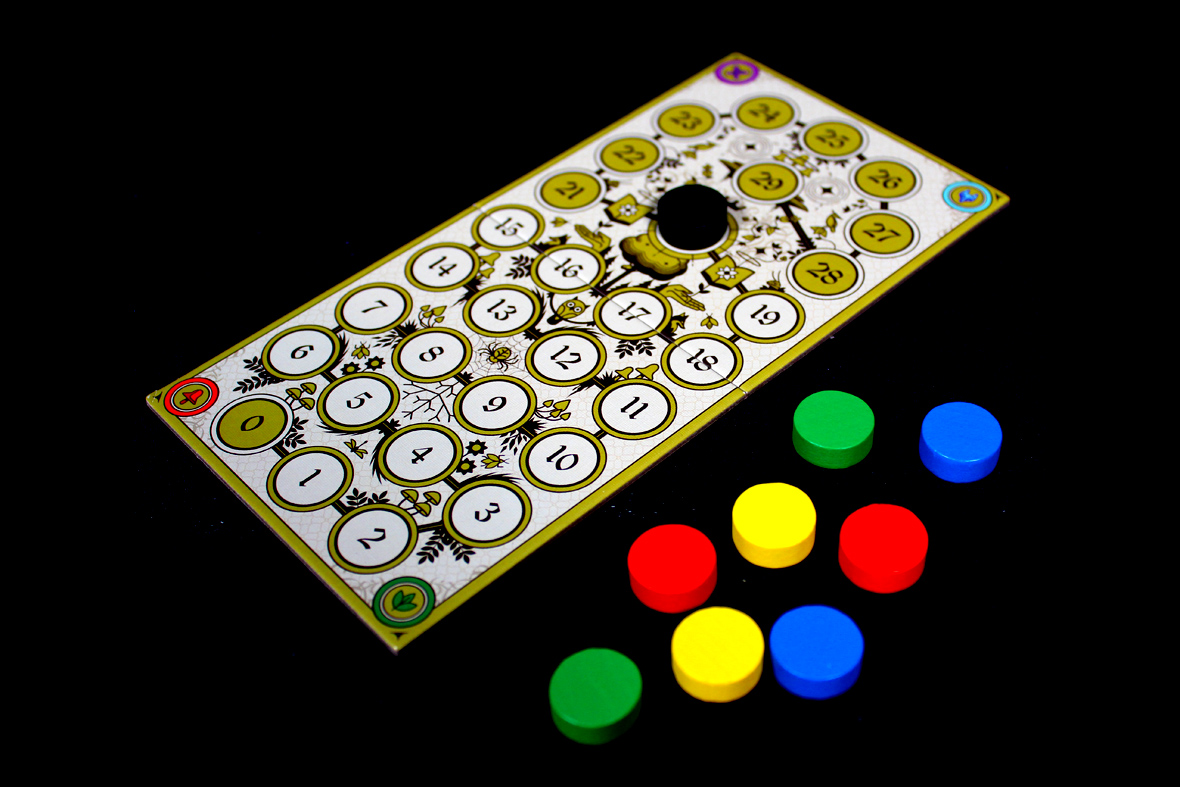
Each player is going to get a pair of tokens in their color of choice; place one on the 0. Next, shuffle the Starter Cards and deal each player one. They’ll decide which side to place face-up and then place their other token on the Starter Card.
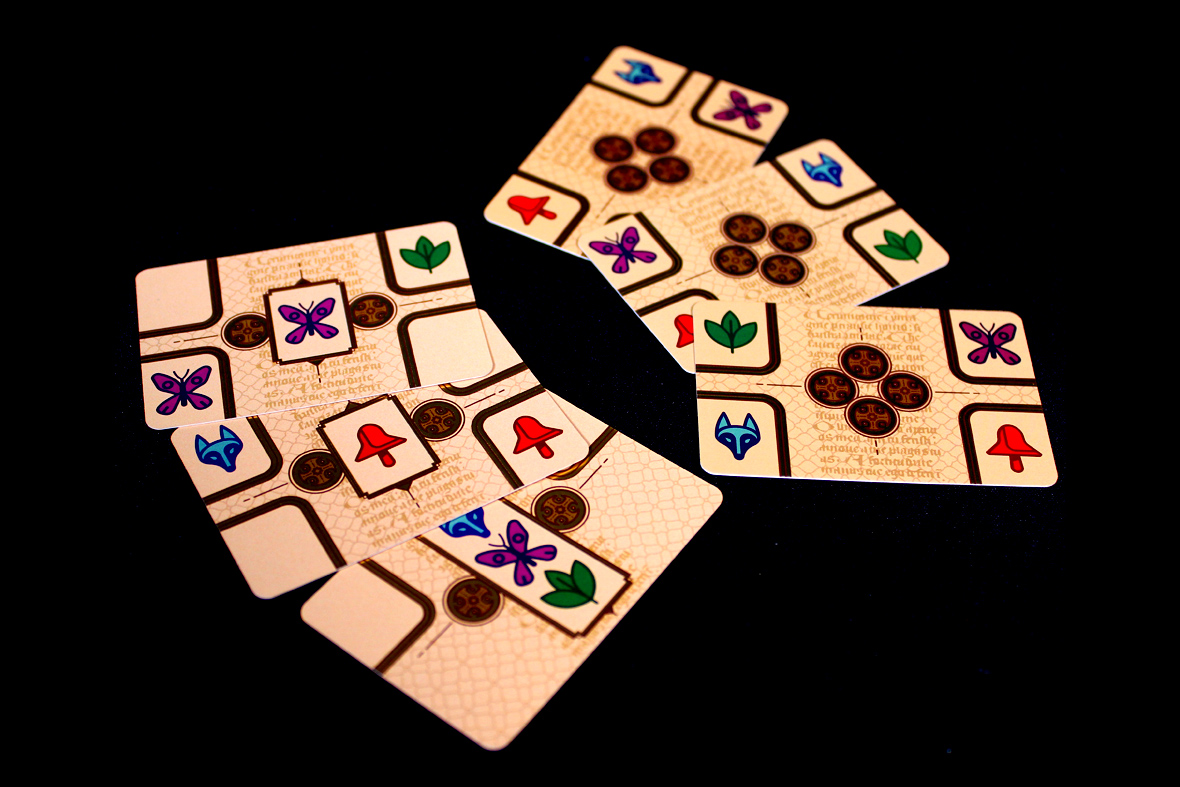
Shuffle the standard cards:
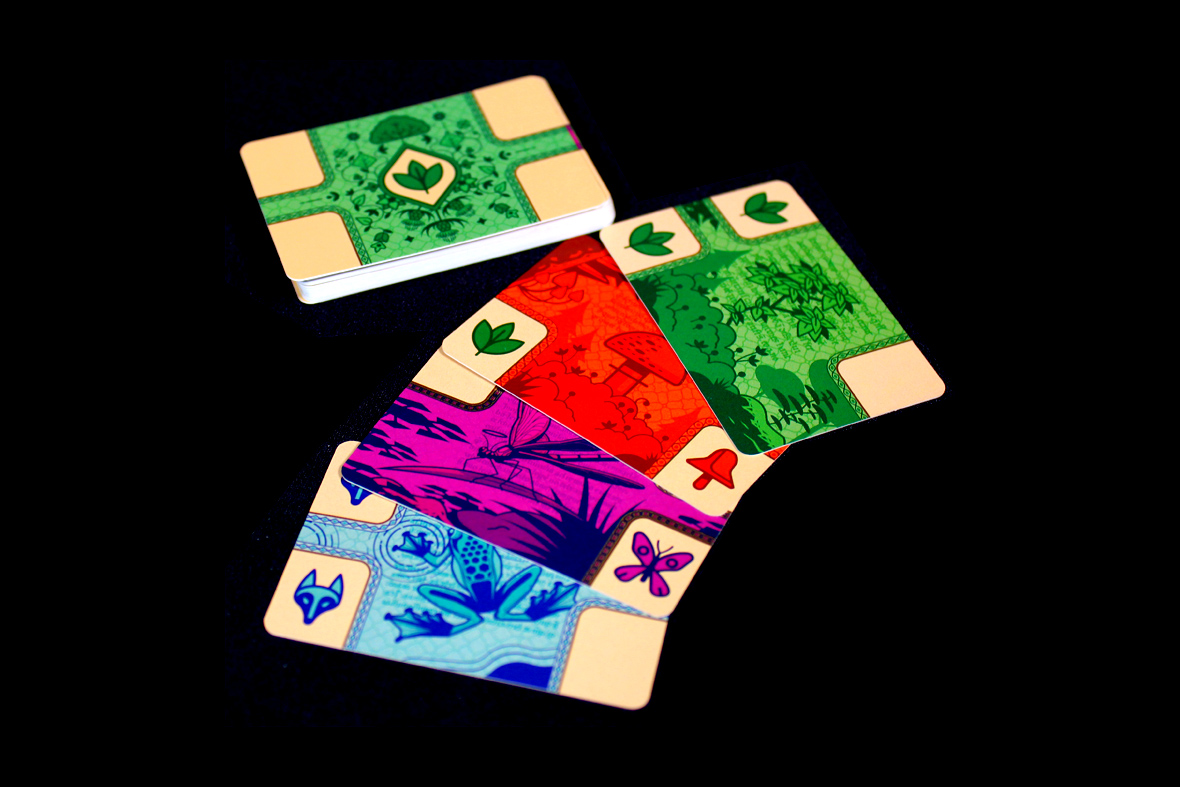
Shuffle the Gold Cards:
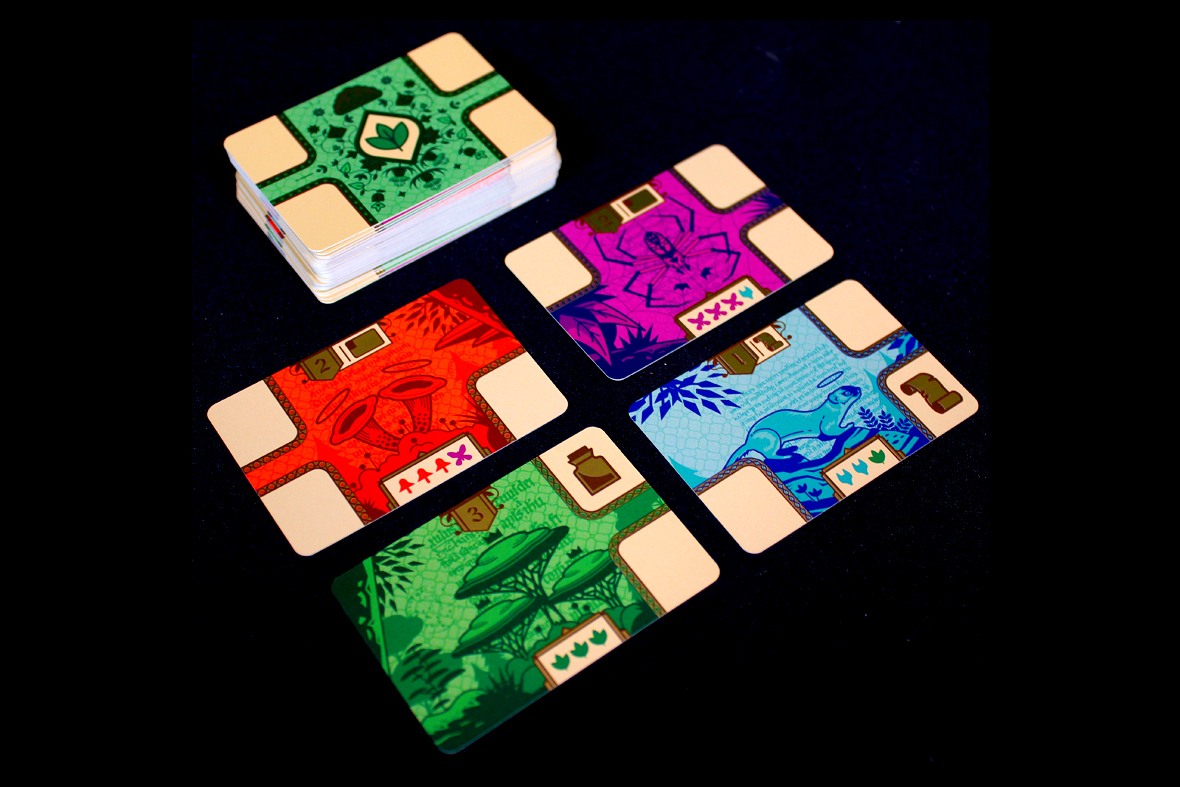
And shuffle the Objective Cards:
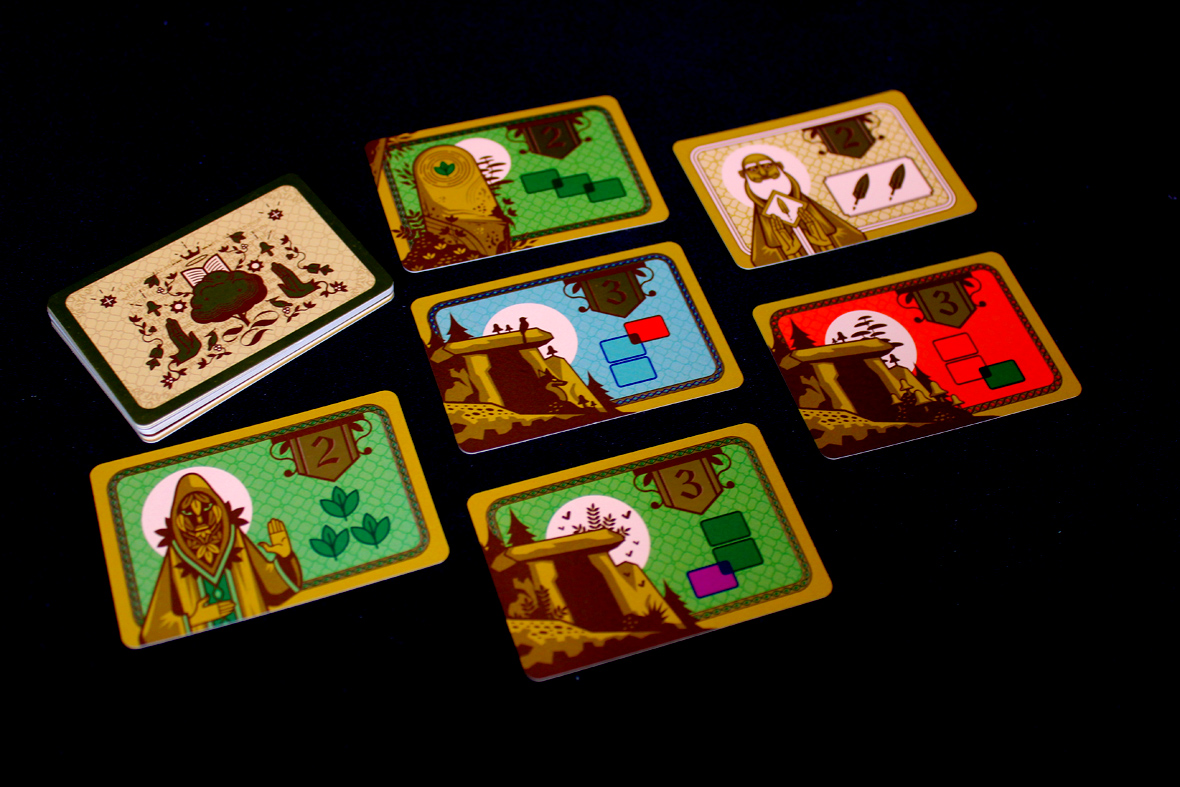
Deal each player two Standard Cards, one Gold Card, and two Objective Cards. They choose one Objective Card to keep, placing the other on the bottom of the deck. For the remaining sets, place the Standard Card deck near the scoreboard and reveal two cards, setting them face-up next to the deck. Do the same for the Gold Cards and the Objective Cards (though you don’t need the Objective Deck after this). You’re ready to start!
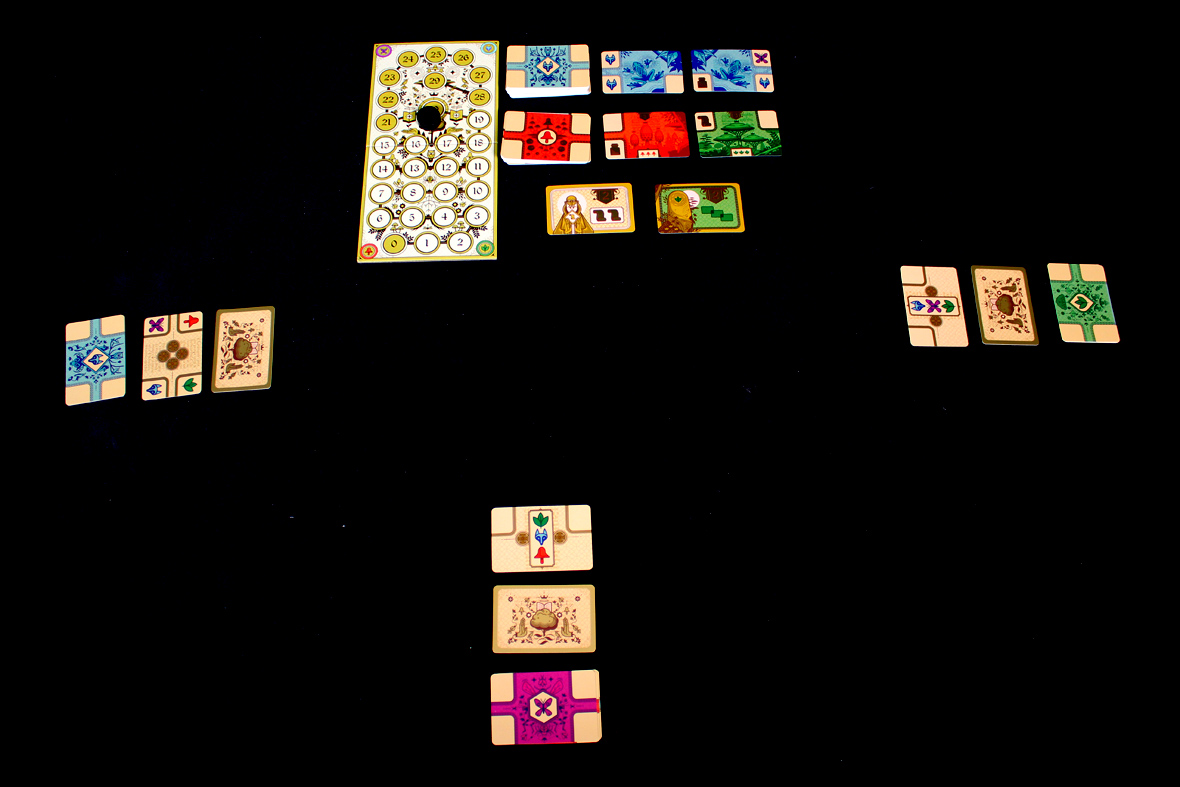
Gameplay
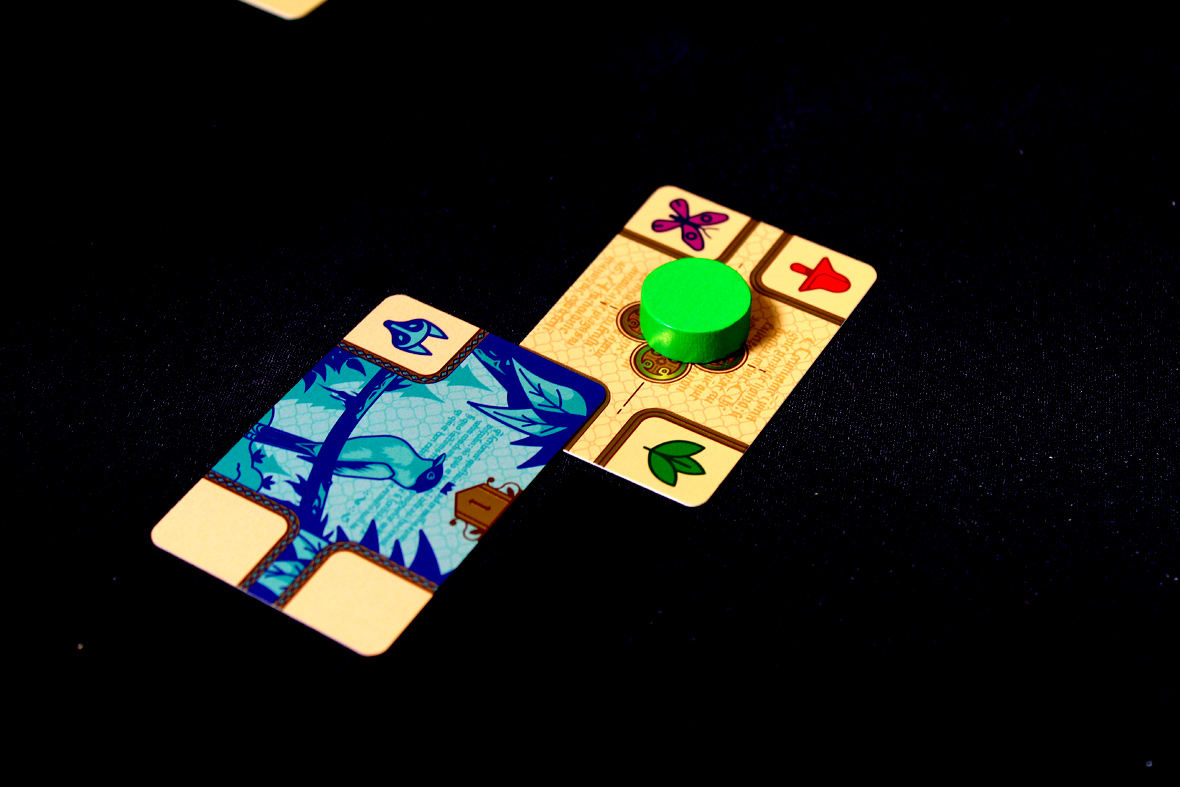
This one’s alarmingly straightforward, which is great. Over the course of several turns, you’ll place cards and then draw cards. That’s about it.
On your turn, if you want to place a card, you can! It has to go on any visible and empty corner on any card, with some caveats:
- You can’t cover more than one corner on a card.
- You can’t cover a corner that isn’t visible. Some cards don’t have the clearly-marked cutout corner; you can’t use those.
- If there are symbols on the bottom of the card, you must have all of those visible in order to play the card. You can cover one or more in the process of placing the card, though.
- If you don’t like the front of the card, you can flip it and play it face-down.
That’s about it. Once you do, the card may award you points. You immediately score those points, and even if you add or cover icons indicated on the card in the future, you don’t gain or lose points.
Then, draw a card! You can choose any Standard or Gold Card that’s face-up or the top card of either deck.
Once both the Standard and Gold Card decks are depleted (somehow) or any player has scored at least 20 points, the game ends! Continue play until it gets back to the first player, and then do final scoring by checking your Private Objective and the two Public Objectives. The player with the most points wins!
Player Count Differences
This one, I prefer at two. With more players, you’d kind of expect the card market to expand a bit so that there are more options, but it … does not. There are always two cards face-up at any given time. This usually means that you cannot rely at all on cards being available on your next turn if you’re playing with four players. Yes, they might take the Gold Cards instead or draw from the top of the deck, but you have explicitly far fewer guarantees than you do at two. The one nice thing is that usually / hopefully, players pick enough different Private Objectives that they’re all pulling different cards, so the market churn can actually work in your favor, in that regard. If everyone wants the same color (red, for instance), the game can be frustrating at high player counts, though: you just will have to rely on luck to determine who will get the cards that they need for certain objectives. It’s still like that, to some degree, with two, but fewer players means more cards per player. I recommend two, for this one.
Strategy

- If you can get into a flow state, that’s usually ideal. You’d, ideally, be at a place where you can cycle through playing cards that score you points every turn with increasing frequency, all while working on building out patterns that will score you points on Objectives. That’s the ideal state! But at least try to get to a point where you can play cards without too many interruptions, if you can.
- Don’t draw too many Gold Cards too quickly. If you do, you’ll be playing them face-down if you don’t have a way to actually get the resources required to play them. Sure, they’re worth points, but you need a sufficiently filled-out tableau for that to work.
- Keep in mind that playing face-down is sometimes worth it for expanding out placement. Sometimes your cards (especially if you’re drawing face-down) won’t necessarily have the best corners that you need to expand out your tableau the way that you’d like. In that case, take the single resource and play it face-down so that you can get the benefits of a completely open card whose resource will always be available. Plus, sometimes that’s exactly what you need.
- Plan ahead with your cards, especially if you’re going for certain card configurations. You need to be able to build out certain patterns for points, depending on what Objective Cards there are, so don’t waste your cards of a required color on patterns that won’t score for you!
- You can try to take cards other players need or likely want, but unless you need them yourself, it’s not usually super useful. Hate-drafting is always an option, I suppose! I just don’t think it’s a particularly good one, especially since each player has their own Private Objective that you know nothing about. Play to your strengths, not necessarily to the detriment of someone else. That said, if the Public Objectives require red cards, hog all of them.
- Playing to your Private Objective is good, but don’t neglect the Public ones! You’re pretty clearly going to want to score as many points as possible, but playing to add some competition for the Public Objectives can still earn you points and potentially let you score points your opponents might have otherwise been able to score. That’s always a good outcome.
- Don’t clutch your pearls where your resources are concerned; by the end of the game, covering them for points is usually the right move. If it’s between ending the game and not, as long as it doesn’t cost you points from an Objective, cover resources! Some cards even reward you for covering more corners with them.
Pros, Mehs, and Cons
Pros
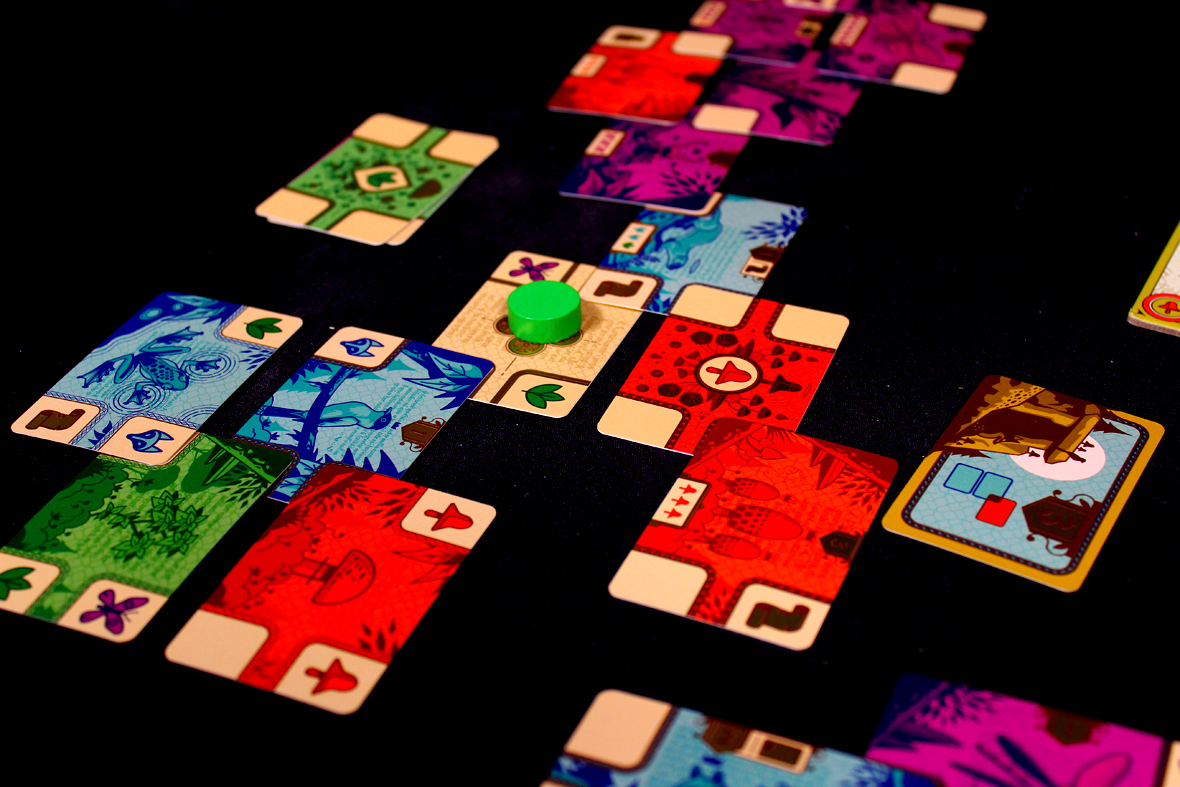
- The art style is very fun! Looks like it’s based on medieval literature sort of vibes. I think that’s neat. Also, the color work is great! If I had to nitpick, I’d love to have seen more art on the cards, but that’s mostly because I like the art a lot and the art style a lot, too.
- I particularly like the gold accents on cards, even though they’re annoying to photograph. I did my best; I have no regrets, beyond wishing I had done an overall better job. But it really pops when you play! It’s such a classy accent on a game, which is why I assume it’s relatively common.
- This is a very easy to set up and play game, which I always appreciate. You just kind of need to shuffle a few decks and you’re ready to go. Even pulling apart the various cards isn’t too hard; the Gold Cards have gold and the Standard cards don’t. Simple to pick up and tear down.
- Also, remarkably portable! It’s a smaller-box week, here; I promise I’ve got a couple big ones coming soon. I’ve been busy. But it’s easy to pack up a game and go, which is always appreciated.
- The spatial puzzle of it all is pretty fun. It’s a spatial puzzle that doesn’t necessarily require you to be good at spatial reasoning; you just need to be able to assess how many of something you have and be able to make space for things that you need. Both aren’t too heavy of lifts, so this has a nice approachability to it.
- I like that you can flip over cards to at least give yourself some breathing room; it’s a nice way to make up for a mediocre turn. I always appreciate alternate player options, just because not everyone is going to have a perfect turn every time. Other things you can do tend to reduce player frustration, reducing overall group friction and making for a more fun overall experience.
Mehs
- The actual scoring icons are teeny. I sometimes miss them, and your first few games you might get a few of them confused because they’re just … very small. The cards aren’t huge, granted, but these are extremely tiny. Almost bafflingly so.
- It’s a little unclear to me why you keep the deck of Objective Cards nearby in the rules when you don’t use them again. I guess it’s for visual consistency? It does make players feel like once they’ve accomplished an objective they get to “complete” it and reveal or draw another one, which would make for a very different (and more luck-based) game, but that’s not the case, unfortunately.
- Codis? Codex? I know what the box says and I know what BGG and BGA say and they’re not the same thing. I went with the title on the box I was sent, so, forgive me if I’m incorrect. I assume I’ll be informed later.
Cons
- Since it tends to expand horizontally, it can be challenging to find appropriate play spaces for this game. It can just be weird with your table! Just make sure that you give every player a fair amount of room.
Overall: 8 / 10
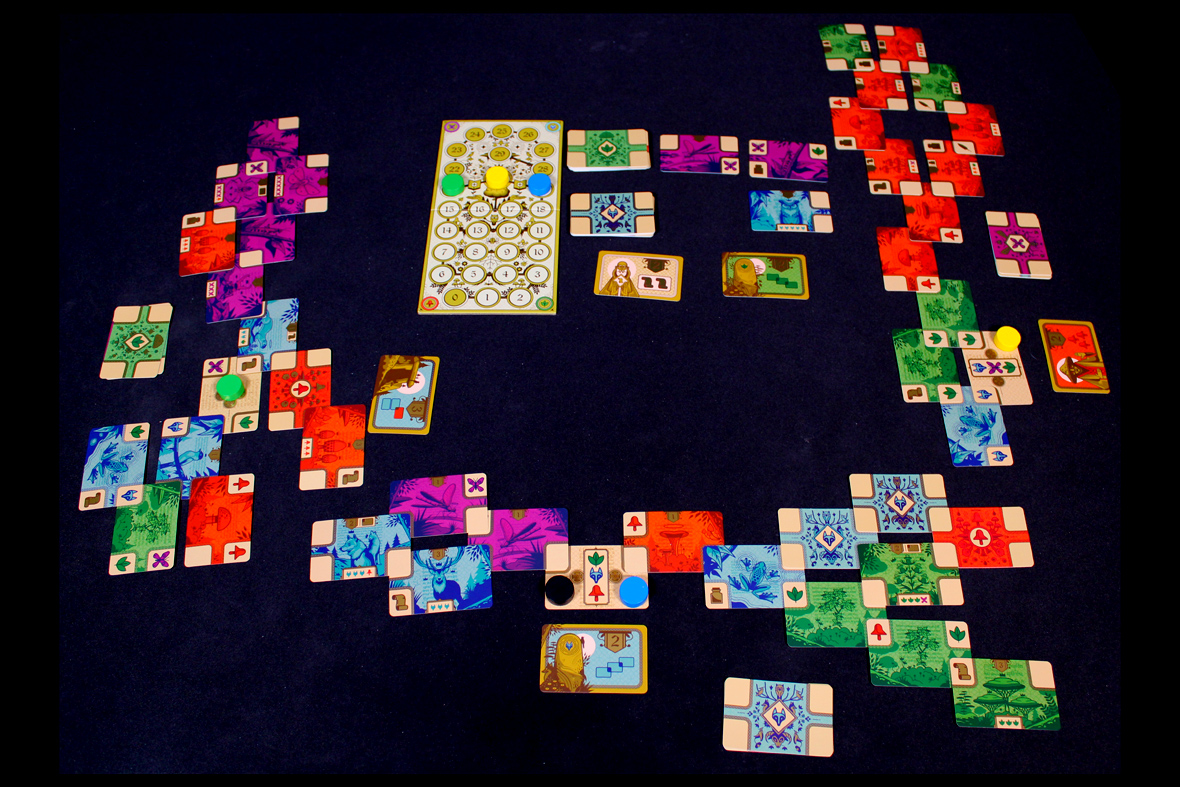
Overall, I think Codis Naturalis is a great little game! I really enjoy quick and simple games with great art, and it checks all of those boxes quite nicely. I’m already getting games set up on Board Game Arena to work this into my regular rotation, so expect to see more plays of this in my imminent future. Maybe not a hundred, like some other games, but at least a good few. We will see. In the meantime, I’ll remain maybe a bit vexed by the name change from the original, but without any real documentation to that effect on why that happened, everything I have for y’all is pure speculation, so that’s not really here or there. I do kind of laugh, at times, when player codices start spilling into each other and there has to be an incredibly arduous moving task, but that’s often the case for games with a lot of horizontal placement; tables just aren’t really designed for that kind of thing. It doesn’t usually spill off the edge of the table, but it certainly can get in other players’ ways. Part of the fun, I suppose. But Codis Naturalis does something that’s kind of difficult to do well, which is a fairly simple spatially-oriented game that isn’t designed to give folks who aren’t good at spatial reasoning a headache. There’s some placement, but with a little bit of planning and luck, you can usually lock those down pretty well. And I appreciate that! If you’re looking for a quick spatial game, you enjoy some fun art, or you just like placing cards and seeing what happens, I’d recommend Codis Naturalis! I think it’s fun.
If you enjoyed this review and would like to support What’s Eric Playing? in the future, please check out my Patreon. Thanks for reading!
 What's Eric Playing?