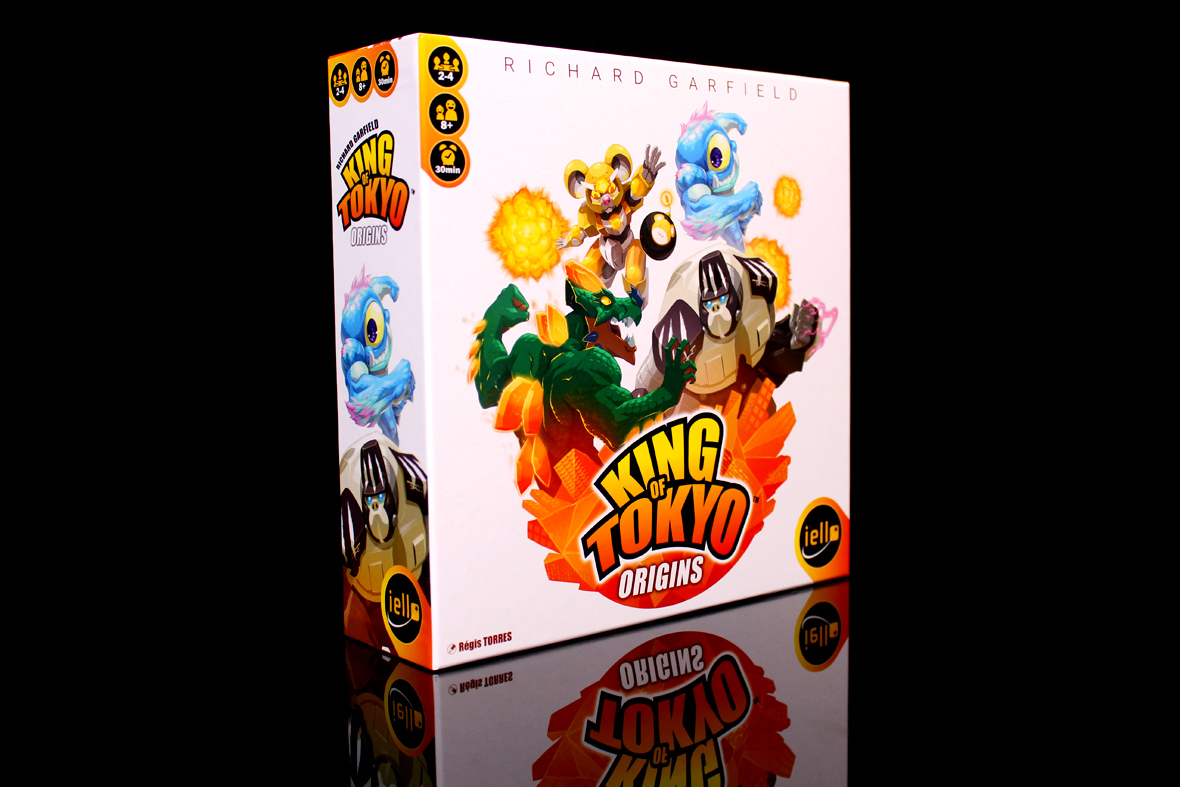
Base price: $30.
2 – 4 players.
Play time: ~30 minutes.
BGG Link
Buy from Target!
Logged plays: 3
Full disclosure: A review copy of King of Tokyo: Origins was provided by IELLO / Flat River Games.
I actually haven’t played that much King of Tokyo! This seemed like as good of an entry point as any, given that this is probably going to be a major entry point for a lot of folks. It’s not that King of Tokyo is old, or anything like that: it’s just, this is the Target version, and as much as I love my FLGSs (shout-out to Blue Highway and Mox), a nontrivial portion of folks are still getting their games from Target. It’s the nature of the big-box store. It’s kind of interesting, economically, but that’s a writeup for a very another time. I’m digressing, as usual, so rather than do that, let’s just check out King of Tokyo: Origins!
In King of Tokyo: Origins, four monsters have a beef to settle and taking over Tokyo is the only way to solve it. As you do; poor Tokyo. Players take on the role of one of these monsters, each, fighting and brawling and occasionally wisely retreating so that they can take their place as the eponymous ruler of a city they’re mostly busting up. It’s a complex process. Each turn, players can roll six dice up to three times, with the goal of getting symbols that allow them to attack, heal, or gain points. Nature (and Tokyo) abhor a vacuum, so if at the end of your turn, Tokyo is unoccupied, you go! Unfortunately, you can’t heal while you’re there, and all of your opponents can just wail on you until you go home with your tail between your legs. Collecting energy will allow you to power up with various cards and abilities to tilt the fight in your favor, too! It’s a quick and frenetic game, but will you be able to become the King of Tokyo?
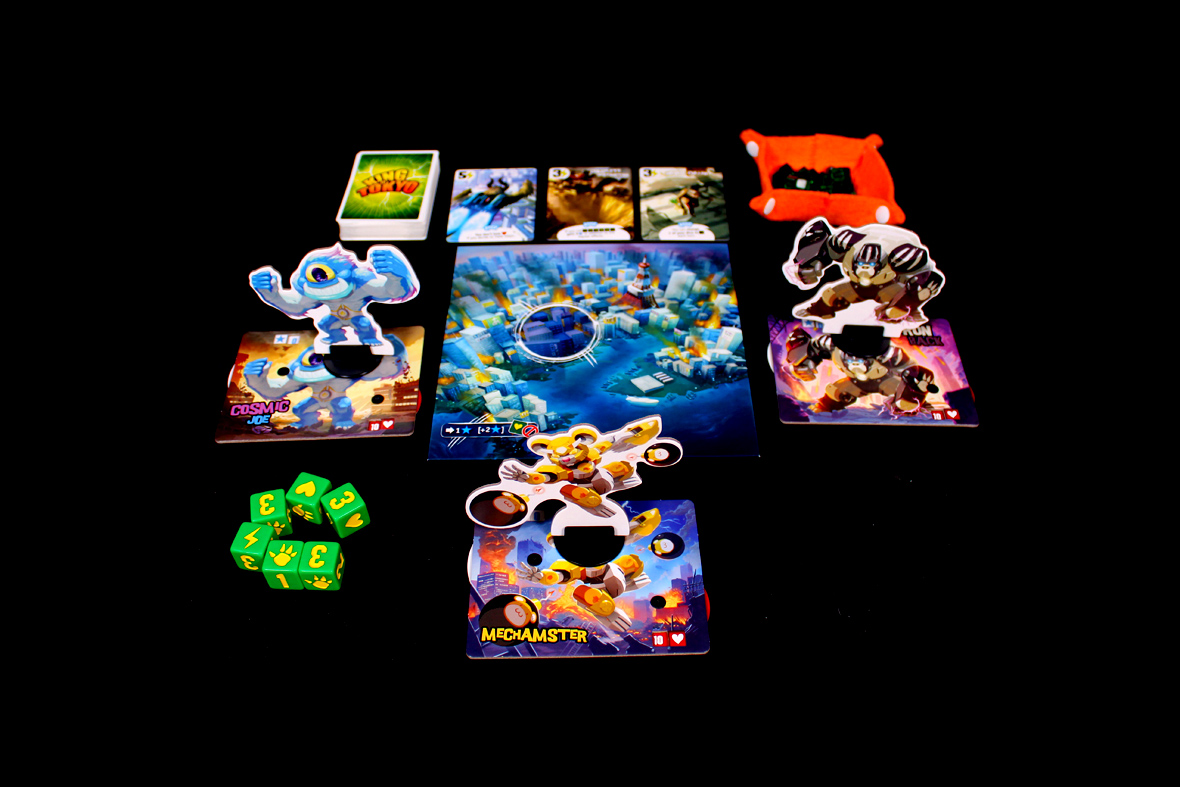
Contents
Player Count Differences
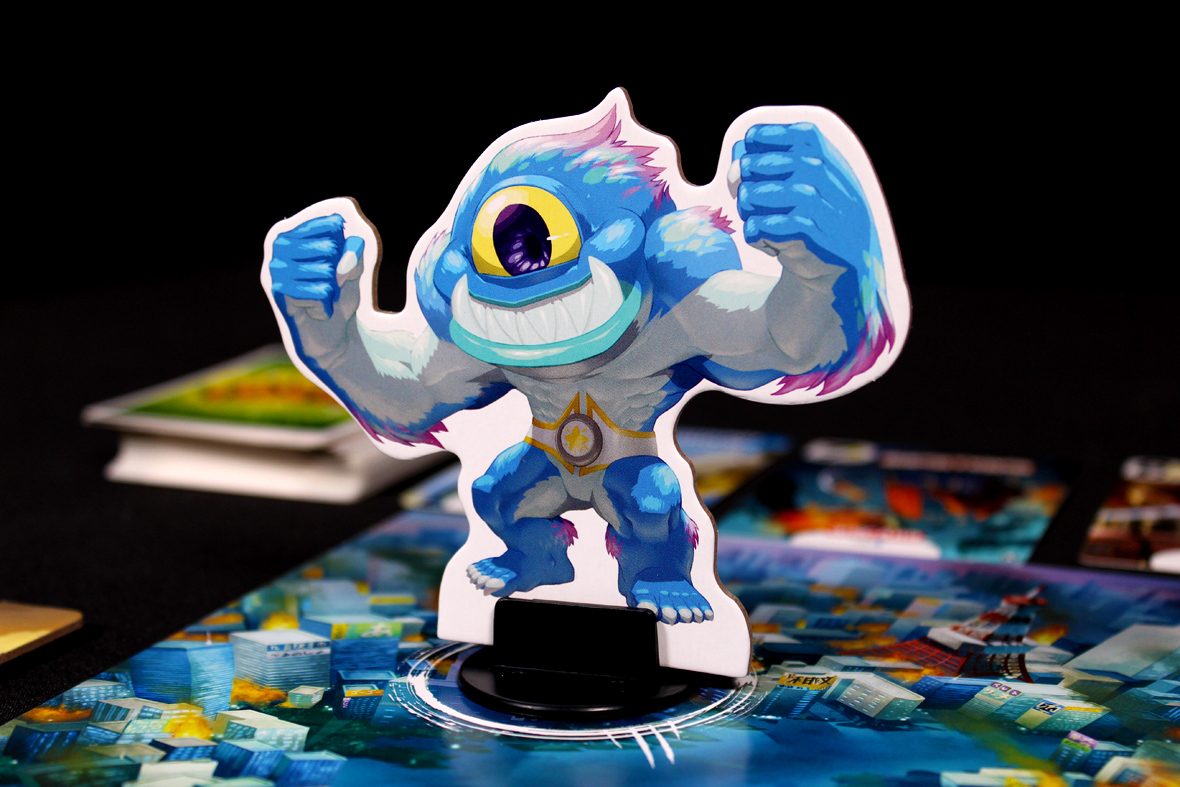
Oh, this one can be a doozy at various player counts. At lower player counts, you’re really going head-to-head; either they’re in Tokyo, or you are, so you’re always attacking. Some benefit to the player who’s not in Tokyo, since they’re the only one who can heal. At two, they recommend letting players gain energy for entering / keeping Tokyo, rather than points, just to keep the game moving. With more players, there’s almost more of an advantage for the Tokyo dweller, if they can keep their foothold until their turn; when they attack, they attack all non-Tokyo players (so, everyone else), which can do a lot of damage at once if they roll well. There aren’t a ton of ways to reduce damage in this game, and you have to get pretty lucky to heal big, so, suffice it to say, you can get pretty messed up. If you enjoy high-energy play, though, you’ll probably like King of Tokyo at any player count. There’s always a bunch to do or watch, and turns are relatively short and quick.
Strategy
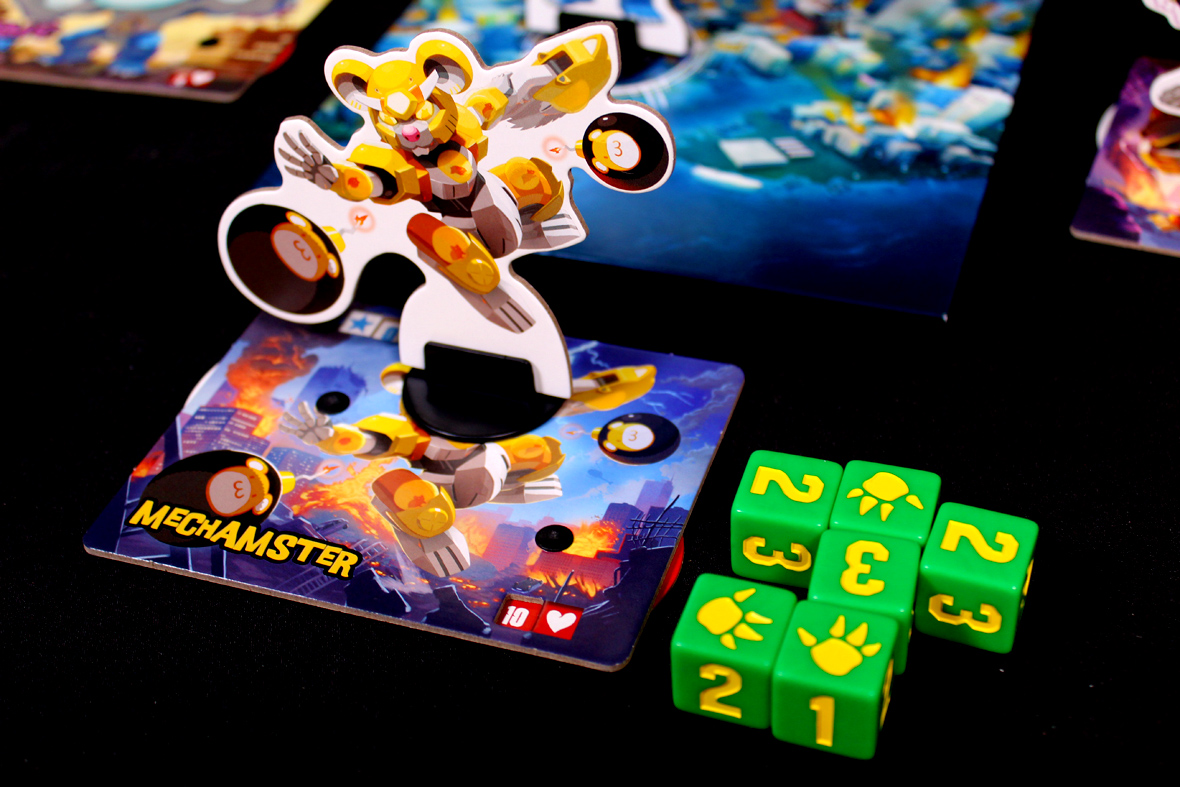
- Don’t stay in Tokyo too long. The longer you are in Tokyo, the more you’ll be taking hits from literally every other player in the game. Yes, you get points each turn you stay there, but if you’re playing with the aggressive sorts, you might find that your health is dwindling fast. Plus, you can’t heal while you’re there (usually), so you might end up getting knocked out of Tokyo and the game. Try to avoid that.
- Get some Power Cards to boost your skills! There are so many! You can use them for so many things, too. Some of them might improve your attacking skills, your defensive abilities, or things like that. If you’re just going vanilla, then you’d better hope your dice always do what you want. Otherwise you’re going to have trouble.
- You’re pretty likely to get dogpiled if you’re not careful and you start getting too many points. The other players notice when one player starts to pull ahead. I think it’s called the crab bucket theory or something. Either way, this is even more likely when you’re in Tokyo since every player is literally going for you. If you don’t want to get attacked, stay out of the center.
- Going for points early on can avoid you making any player particularly angry and drawing aggro, though. Players are more impressed than irritated if you’re stringing together scoring combos, in my experience, and there’s not always a way for someone to actually get rid of points you’ve earned short of knocking you out. So some players might not necessarily go after you if you’re pursuing a points route to play.
- Power Cards are going to start pointing you, strategically, in a specific direction. Lean into that. If you’re getting a bunch of cards that make it easier for you to get sets of 2s, for instance, maybe that’s your path to winning! 5 points a turn gets you to 20 in four turns, anyways, and thats pretty good. If it’s helping with your attack, try to hit more and hit harder. Defense? Try figuring out ways to hunker down and game points passively. These strategies will change as the player count changes, but, still worth a shot considering.
- Hail Maries are always cool, even if you lose catastrophically. That’s half the fun, in my opinion. You take a big swing and just completely miss and lose. But you might win, and that’s almost worth a completely boneheaded failure.
Pros, Mehs, and Cons
Pros
- I like that you can win by getting sufficient points or by defeating all of your opponents; it lets the game keep moving even with players fighting and healing and fighting again. You can’t really cause players to lose points (outside of the occasional Power Card), so every player gets progressively closer to the goal whether you want to fight each other or not. I like that there are non-combat paths to victory (though you almost always need to be at least a little good at combat).
- The tension between “do I attack” or “do I heal” is always fun. You can’t get much if you’re just balancing the two constantly; you need to fight and manage offense and defense. Too little defense and you’re dead. Too little offense and someone will likely get to 20 faster or defeat everyone else.
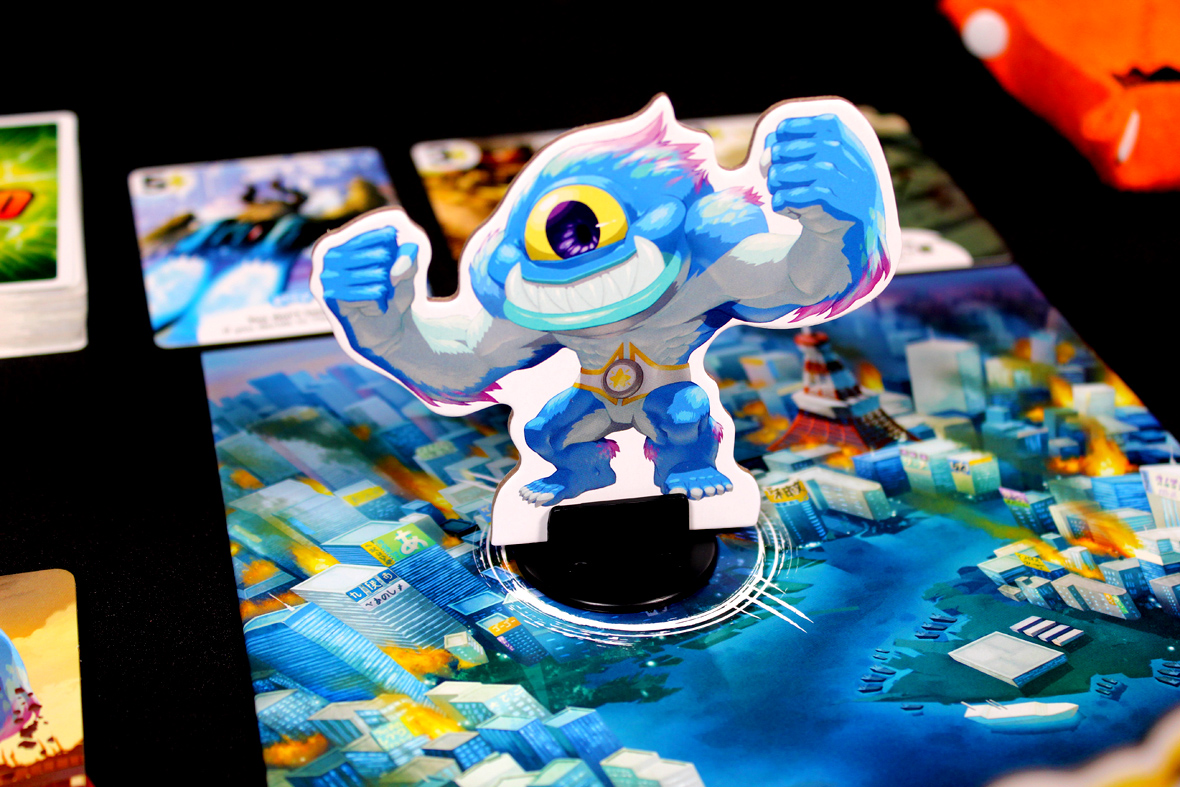
- The art and the theme are super fun! The game just looks great. I really like monster fights, ever since I grew up playing Rampage in the arcade back in my hometown (or at my friend’s place? I’m tired.). Either way. Big monsters duking it out with their weird superpowers has always been appealing to me, so it’s nice that more games are exploring that.
- It’s pretty nice to have the game essentially recommend paths for you based on the Power Cards. Having trouble figuring out a strategy? No worries! Just get a few Power Cards and start trying to glean it from there. You might end up leaning into certain point numbers like 1 or 3, you may gain some useful defenses, or you might just get some weird ability to score 9 points as long as you roll one of every face on your dice. Who’s to say?
- I like that this can hook into the other games pretty easily! You can just take out and use the new Power Cards or all the cards, and pleasantly, it doesn’t seem like there are any monster-specific things you need to worry about. You can kind of just mix and match your ideal set, if that’s what you want to do.
- You can also use this box as a “small storage” way to take just your favorites when you don’t want to schlep the whole thing, I suppose. There are bigger boxes that you can use to hold more things, but this is a nice and compact four-player set that might be a good travelish box.
- Special dice are always fun. It’s just a rule. I just really love custom dice! They’re charming. These in particular have a good weight to them and they throw and roll well. It’s a nice end-to-end package.
Mehs
- I wish there were ways to refresh the Power Card row; sometimes it can get a little stale and nobody wants what’s in there, so nothing really happens on that front. That’s the nature of random markets, at times, but given that you want players to engage with the Power Cards from a design standpoint, being able to easily refresh them for low-cost, it doesn’t quite land or work. Market staleness is almost always a problem in games like this, though. (EDITOR’S NOTE: Whoops! This totally exists; you can spend 2 Energy to refresh the Power Card row. Not sure why I forgot.)
- It can be a bit annoying when you get a little dogpiled. It is, fundamentally, how the game works, but if you’re not okay with that, stay out of Tokyo and focus on points, or … play something else.
Cons
- The game moves pretty quickly, but player elimination can be frustrating with more players. It’s a fast game, but sitting and watching it is obviously not the funnest part. I tend to prefer more of the points-scoring methods so that nobody gets kicked out prematurely, but you can’t alwys optimize for that. Sometimes a player is just going to take a big hit that they can’t heal from and that’ll be the end of that. There’s no D&D-style saving throw; you’re just knocked out.
Overall: 7.5 / 10
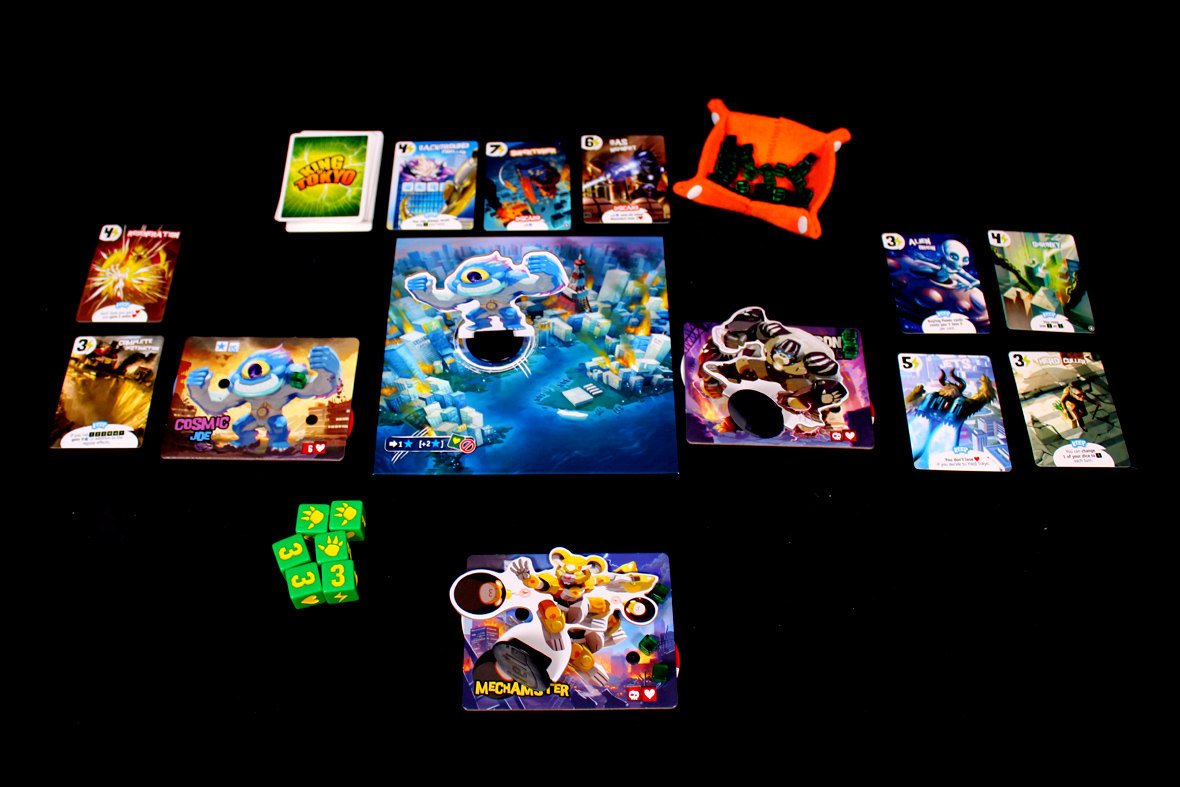
Overall, King of Tokyo is a classic for a reason, and I think King of Tokyo: Origins does a nice job of distilling all the funnest parts down to a quick and compact little game. You’re obviously getting a slimmed-down version for Target (partially to keep prices lower, I presume), but the monsters you get are their own guys, so there’s no real reason to not get more King of Tokyo if you play this and it ends up being your favorite game. There’s even a number of ways to combine the Power Cards with the standard game in the rulebook, as well as a truly disturbing number of additional monsters available through other packs and means and blood rituals that are beyond both my scope and this review’s scope. The game itself hearkens back to old-timey (or, I guess, new-timey, given the recent success of the Godzilla franchise) Godzilla movies, and I kind of love that, but this family-friendly Yahtzee-esque spin on that is very approachable. I mean, the game could be boiled down to “fight Yahtzee”, or a simpler version of Dice Throne, and both of those games are very successful for a wide variety of audiences. I personally like the colors, the art, and the variety of the cards and the strategies they start to create for players. I’m not as much for the inherently necessary take-that and the dogpiling, but the game is, as is common for these types of games, quick enough that it’s hard to get too mad. Sometimes they get a lucky roll and you’re just out of the game. The player elimination is what I’m really not sold on, but I despite player elimination by and large, so I might just be a grump about this specific mechanic. That said, it’s a nice entry point into the modern board game space, and I think you can get a pretty good group excited about this (especially when paired with a movie or the old video game Rampage or something). If you think that’ll spice up your game night, you enjoy a bit of fight and friend, or you just want a quick game with some big dice to throw around, King of Tokyo: Origins is probably going to be up your alley! I had fun with it.
If you enjoyed this review and would like to support What’s Eric Playing? in the future, please check out my Patreon. Thanks for reading!
 What's Eric Playing?
In normal king of Tokyo, you can spend 2 energy to wipe the market. Does this version not have that?
LikeLiked by 1 person
Whoops! Missed that. I’ll update. 🙂
LikeLike