
Base price: $64.
1 – 4 players.
Play time: 30 – 90 minutes.
BGG Link
Buy directly! | Buy via Board Game Bliss (CA)
Logged plays: 5
Full disclosure: A review copy of Obsession was provided by Board Game Bliss.
This seems like the appropriate time to review this game. I just watched Bridgerton with some friends for the first time, and while it’s not my favorite show of all time, I can see that societally we’re really in a time for these kinds of shows. I think The Courtship was a few-years-old dating show with a similar vibe. Some folks just want to spend their days learning needlepoint or fancy dances or corsetry and that’s their business. So this brings us to Obsession, a game all about Victorian England vibes and you managing your estate. Let’s get to it.
In Obsession, players take on the role of a well-to-do family getting established in a new area in Victorian England times. Sure, you’ve got your house staff, but you don’t have all the rooms built onto your new estate yet and you don’t quite have a standing coterie of admirers and locals that spend all your time at your fancy parties. And that simply won’t do. Over several rounds, you’ll use the various rooms in your house to conduct events with the help of your staff and the local gentry (and the family). These events will earn you money, boost your Reputation, and also attract more locals to your estate for future events. The money you earn can improve your estate with new rooms and activities, and these various things you do might eventually attract the attention of the Fairchilds (Fairchildren?), the local brother and sister who are the ton’s most eligible bachelor and bachelorette. Courting them can really boost your whole thing, locally. Your opponents are rival families who wish to be even more beloved and popular, which I get. It’s kind of all there was to do at the time. So gather your family, put the staff to work, and get ready to dance in circles with other people over a lengthy period of time. Will you be able to prove that your family is the classiest?
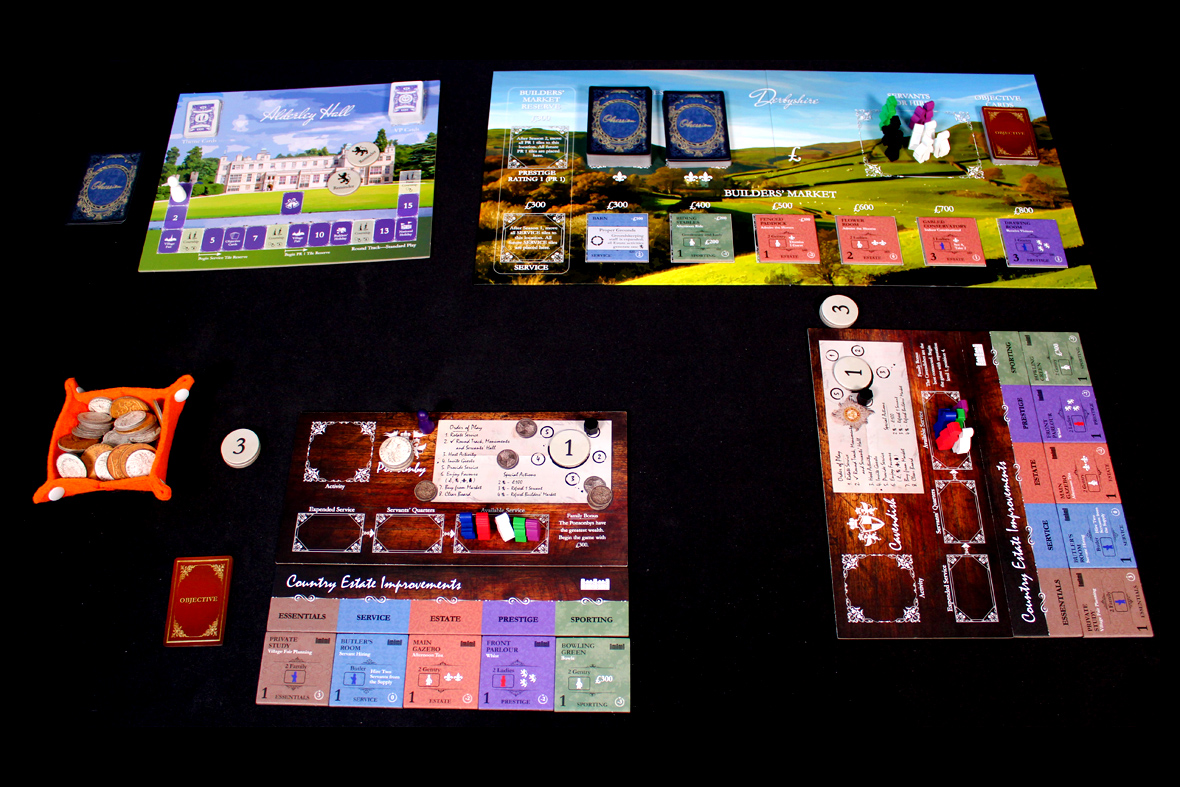
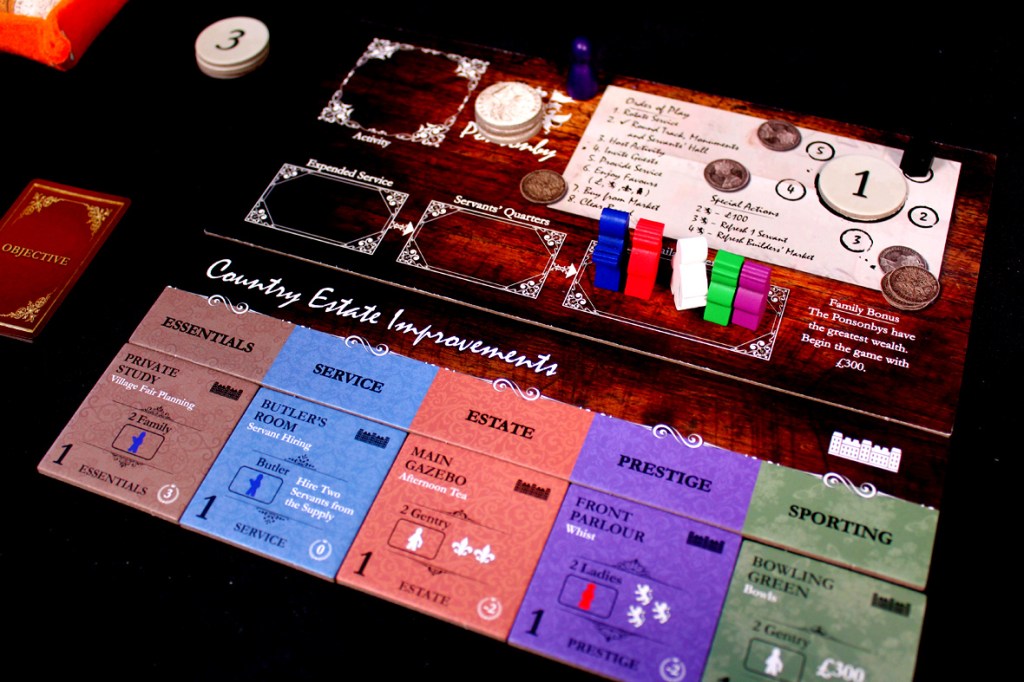
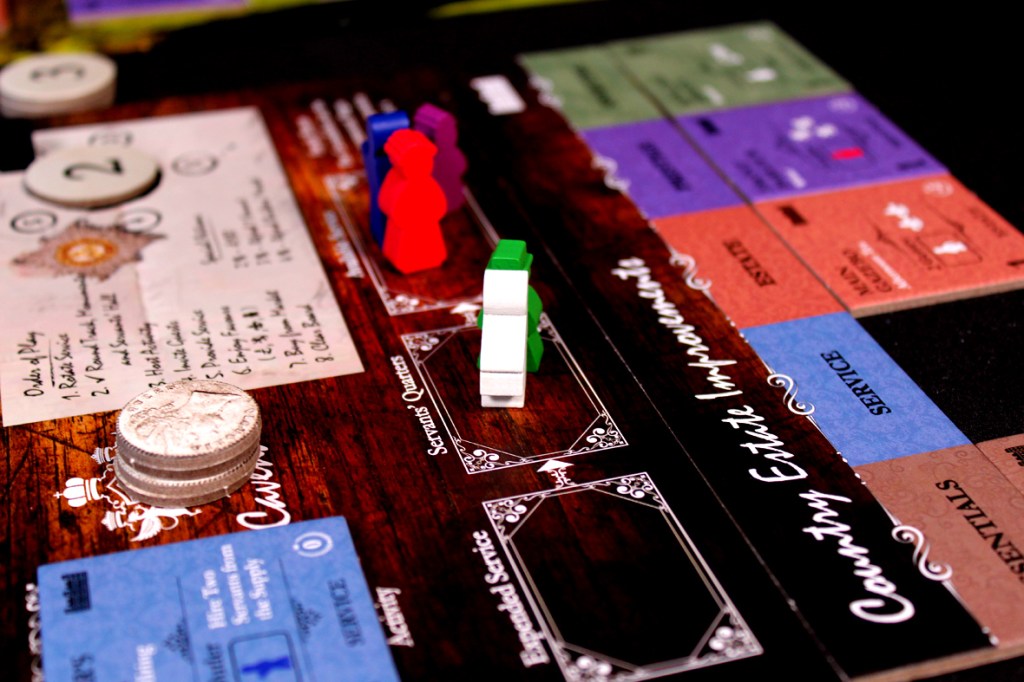

Contents
Player Count Differences

At various player counts, you’re going to find some things easier and some things more difficult. There are some balancing choices made by the game, for instance, making sure that there are sufficient staff at each player count so that you’re not running out of Valets or Lady’s Maids. But other things stay constant, like the size of the Building Market or the number of tiles of each type. This means if you’re looking for a specific tile, you might be out of luck, and if the specific point type sought by the Fairchilds is different every time, player specialization may make it difficult for you to successfully court one multiple rounds in a row. While one could make the argument that this makes higher player counts more interesting, I think it’s easy to keep two-player games plenty engaging, especially with some of the available variants (refreshing the Builder’s Market more regularly or changing up Courtship at the last second) available in the rulebook. From a space constraints perspective, it’s a bit easier to play on a standard table with two players, granted, but you can still do your posh accents or roleplay if you want with more folks; you’ll just need a bigger table. I wouldn’t say I have a huge player count preference, as a result. If you play with the more aggressive / take-that cards, though, then I tend to prefer two-player games.
Strategy

- Keep an eye on Courtship requirements. These can really slide under the radar if you’re not paying attention! It’s not just about buying tiles of those types; it’s also about using them so that they flip over to their more valuable side. You want the Fairchilds to come by your estate; they’re extremely valuable.
- Your Objectives should push you toward certain tiles or combinations of things. You just want to buy the tiles on your Objectives or level up your Reputation or hire a certain number and type of staff. If you’re not sure what to do on your turn, try moving towards one of those requirements!
- If you don’t have much to do, it’s not necessarily a bad idea to use some of your unused tiles to gain more points. It’ll help for Courtship, and also, a bunch of your tiles are initially worth negative points, and that sucks. You really don’t want to leave them around, and using them early means that when you have sufficient Reputation to do more interesting late-game moves, you’re not wasting them on moves that only get you one Casual Guest or something.
- Certain Guests are valuable during the game, but they’re worth negative points, so dump them before the end. They might have useful effects, but anyone in your deck worth negative points is bringing you down. Use your various tile and family effects to get them off of the property.
- You’ll want to be constantly building up Reputation both for more useful tiles and also for higher-value Prestige Guests. Low Reputation households won’t prosper, and the most useful tiles and guests are locked behind pretty high Reputation requirements (5+, usually). It’s pretty critical to at least get up to 5 before the end of the game, but 6 usually has more interesting and lucrative Prestige Guests.
- Don’t forget about your staff, either! You can have all the Reputation in the world, but it won’t matter if you have insufficient staff to attend to your guests! You probably want at least another Valet and Lady’s Maid, but getting an Underbutler is extremely handy, if you can get the tile for that. The Servant’s Quarters are also pretty useful: they let you recruit one staff member from the Servant’s Quarters each round (instead of having to wait until the next round for them to move back into the Available box).
- If you’re pretty far ahead on one value of Courtship requirements, you can always try to refresh the Builder’s Market if there are a lot of tiles of that type in there. It’s rude but effective. You don’t benefit from other players getting tiles of the same theme as the Courtship requirements, so why not burn those tiles and hope nothing else useful comes out? That’s not always particularly feasible, but it’s still a good idea.
Pros, Mehs, and Cons

Pros
- This is the perfect game to play if you want to roleplay having posh accents and gossiping about scoundrels. Who wouldn’t want to spend 90 minutes doing that? I certainly would! But in all seriousness, if you enjoy having a bit of metagame theme or having a themed game night, this game has a great theme to build a game night around.
- The component quality is pretty nice, too! The tiles are a good thickness, the various boards are good quality, and the tokens are nice as well! One of my Housekeepers seems to have been split in half, but honestly that’s just funny more than anything else.
- I appreciate that there are multiple styles that you can play the game in, depending on player space. The player boards can be configured, and I love that kind of forward thinking. Different spaces have different constraints.
- I enjoy that the developer’s cat is a playable card, even if you do need the expansion for it. She’s a full-on duchess; I hope she’s doing well.
- This seems like a game you could very easily re-theme for your Bridgerton-themed events if you wanted to diversify the cast a bit. The cast could use it, and everyone is super into Bridgerton lately, even my Dad. Baffling.
- The game has a very lovely consistency between its theme and gameplay. You really are just moving your guests around between various rooms in your lavish estate and gradually adding on and trying to throw new events and fancy parties to help your family marry another rich and powerful family. It’s so posh. But the way they lace that ludonarrative through the actual mechanics of recruiting guests and needing Reputation to play them and Staff to attend to them is really something. It feels the way the game is supposed to feel, and I think that’s high praise.
- I appreciate the game’s storage solution. Little boxes for everything! Having little boxes for each player’s family is particularly helpful, since you can just put a clean copy of everything in there and that cuts down setup time pretty majorly.
- Having a way to sort tiles in the Builder’s Market when you’re adding more than one at a time is good, and I appreciate the simplicity of their solution. Each tile has a sorting number so, for initial draw and in cases where multiple tiles are bought at once, the new tiles are added and then sorted by number. It’s dead simple.
Mehs
- The VP and Theme cards are almost hatefully small. They’re awful to shuffle and I have reasonably-sized hands. I don’t know why they did this. More problematically, the Theme Cards being so small does kind of make them less noticeable, so you’ll occasionally have players forget about the Courtship requirements. That’s not great.
- I’m not mad at the deckbuilding, but there’s only slightly more deckbuilding than The Lost Ruins of Arnak, if you’re looking towards this as a medium-weight “deckbuilding” game. I’d almost call it worker placement, though there’s no blocking, since you’re really discarding your Guests and then passing to redraw all of them to your hand (like a worker placement game’s Recall action). That’s mostly taxonomical, so I don’t care that much, though. I’d just say there’s not a ton of deckbuilding in this one, but if you’ve played Arnak, there is more deckbuilding here. It’s just not a full-on deckbuilder like a Dale of Merchants or something.
Cons
- The rulebook isn’t always the fastest way to find specific information you need. Kickstarter games, man. They have a lot of variants and a lot of edge cases, and that often means the rulebook can be a bit challenging. This one has an additional Glossary, which means that you may be looking at two different books to try and find the answer you need. It’s not my favorite solution, though the rulebooks themselves aren’t poorly written; they’re just dense.
Overall: 9 / 10

Overall, I think Obsession is awesome. As I mentioned elsewhere, I think I’d love it more if it had a little bit more vanilla deckbuilding (or there was a shorter version of it that was all deckbuilding), but the deckbuilding / worker-placement thing it’s got going on is amazing. I really like the flow of managing both what staff you have available and the who’s who of the locals you’ve been able to get excited about coming to your events. It feels like a game about Victorian England times should feel. You’re all about reputation, constantly putting on parties, and trying to make an impossibly difficult-to-manage house. I love it. There are enough moving parts that the rulebook can be a bit confusing, at times (as any rulebook with a separate Glossary tends to be), so keep an eye on that as you might stress some players out when you pull out a rules tome. Thankfully, the actual core of the game isn’t too challenging; there are just a number of edge cases that come up during a game. This and Dinosaur Tea Party would really hit at either spectrum of game weight for a posh board game night, and I can see even fans of less heavy board games being intrigued by the theme alone. Plus, you can roleplay a bit and gossip incessantly about the gentry as you send them to the parlor or the Cabinet of Curiosities or whatever you’re doing on your turn. It’s fun. As with any good Kickstarter game, I’m pleased that there are a good number of variants and solid component quality, even if the former does lead to some of those rulebook challenges I mentioned. It’s a balancing act of making the game a streamlined and cohesive experience versus adding all the fun stuff you’ve thought of to the game, and I find that Kickstarter / crowdfunded productions tend towards doing the latter. But it works for Obsession; a game so engrossed in a period’s largesse should be big and occasionally a bit messy but with a lot of ambition. I think they landed it quite well, and I’ve been playing it pretty regularly on Board Game Arena. Excited to get back to my games, actually. If you’re looking to add a bit more gaming weight to your Bridgerton nights, you really enjoy those Regency / Victorian vibes, or you just want to fake being insufferably posh for an hour, you’ll probably like Obsession a lot! I’ve really enjoyed getting to play it.
If you enjoyed this review and would like to support What’s Eric Playing? in the future, please check out my Patreon. Thanks for reading!
 What's Eric Playing?