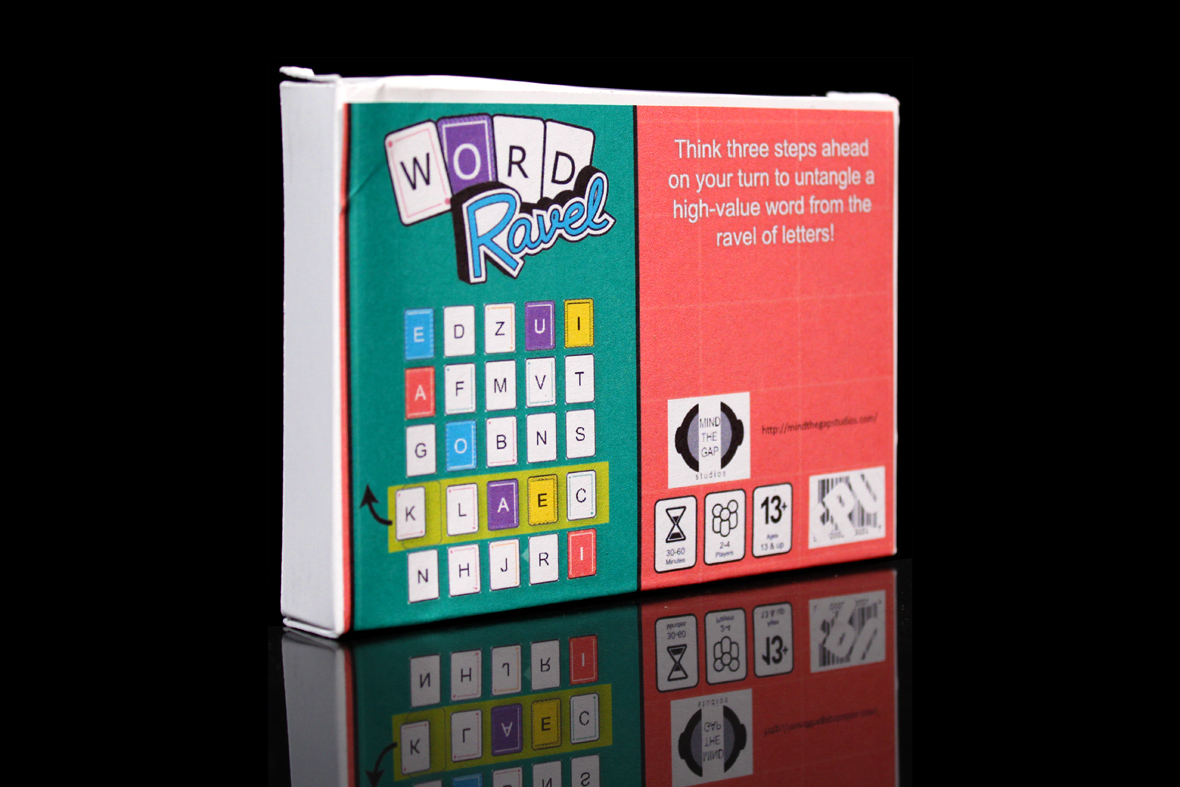
Base price: $15.
2 players.
Play time: 30 – 60 minutes.
BGG Link
Check it out on Kickstarter!
Logged plays: 2
Full disclosure: A preview copy of Word Ravel was provided by Mind the Gap Studios. Some art, gameplay, or other aspects of the game may change between this preview and the fulfillment of the Kickstarter, should it fund, as this is a preview of a currently unreleased game.
It’s PAX West season! We go from one con to another around here, and that’s exciting. I think PAX West is getting progressively larger as more and more people have been coming to town (or, in my case, moving to town), but that’s neither here nor there. I’m excited to attend! I love PAX Unplugged, and even though West is more video game-oriented, I think it’s a lot of fun. I’m hoping to try the new Zelda demo and buy a bunch of tchotchkes. Expect to hear more on this in the future. In the meantime, we’ve got a game Kickstarting soon from a local designer: Word Ravel! Let’s check it out.
In Word Ravel, your goal is simple. You want the highest-value word! Unfortunately the letters are all jumbled, so slide things around to get what you need while your opponents do the same! The board refills every time, anyways, so it’s all good. Do you have what it takes to unscramble the highest point words?
Contents
Setup
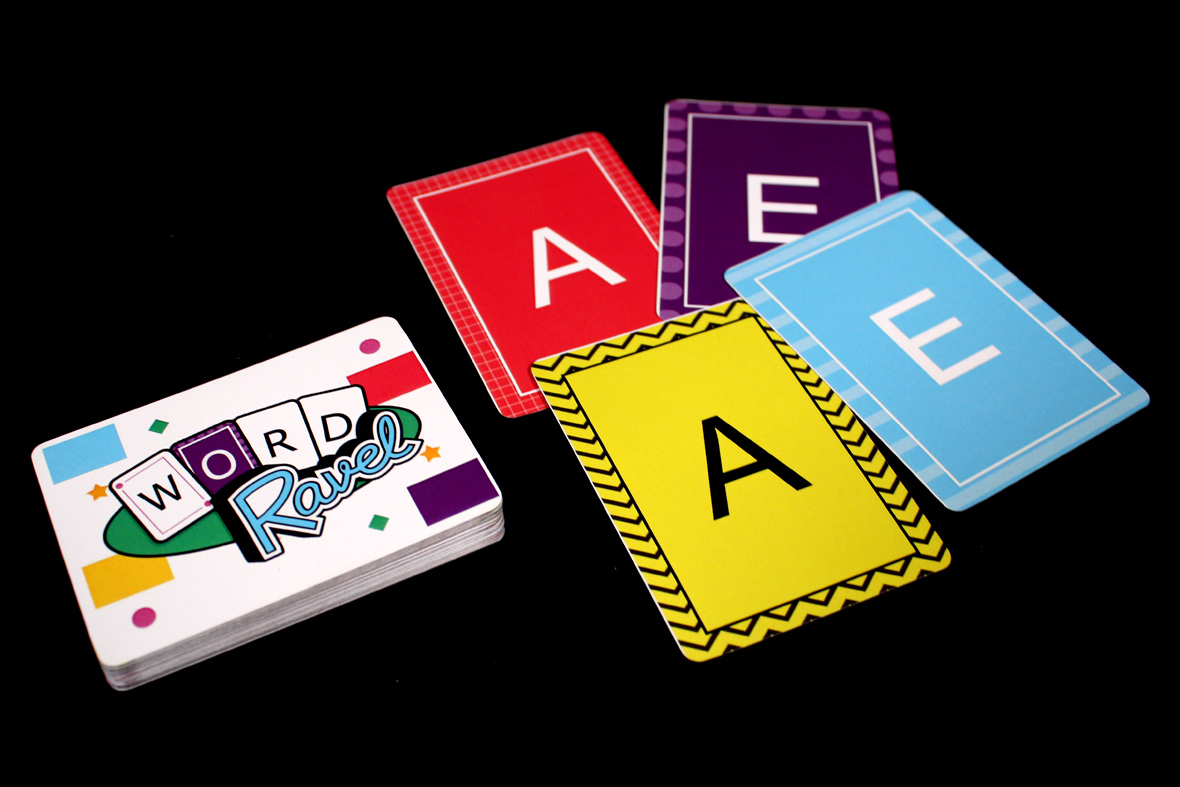
A little bit here, but not much. Each player gets their own set of Vowel Cards in a color:
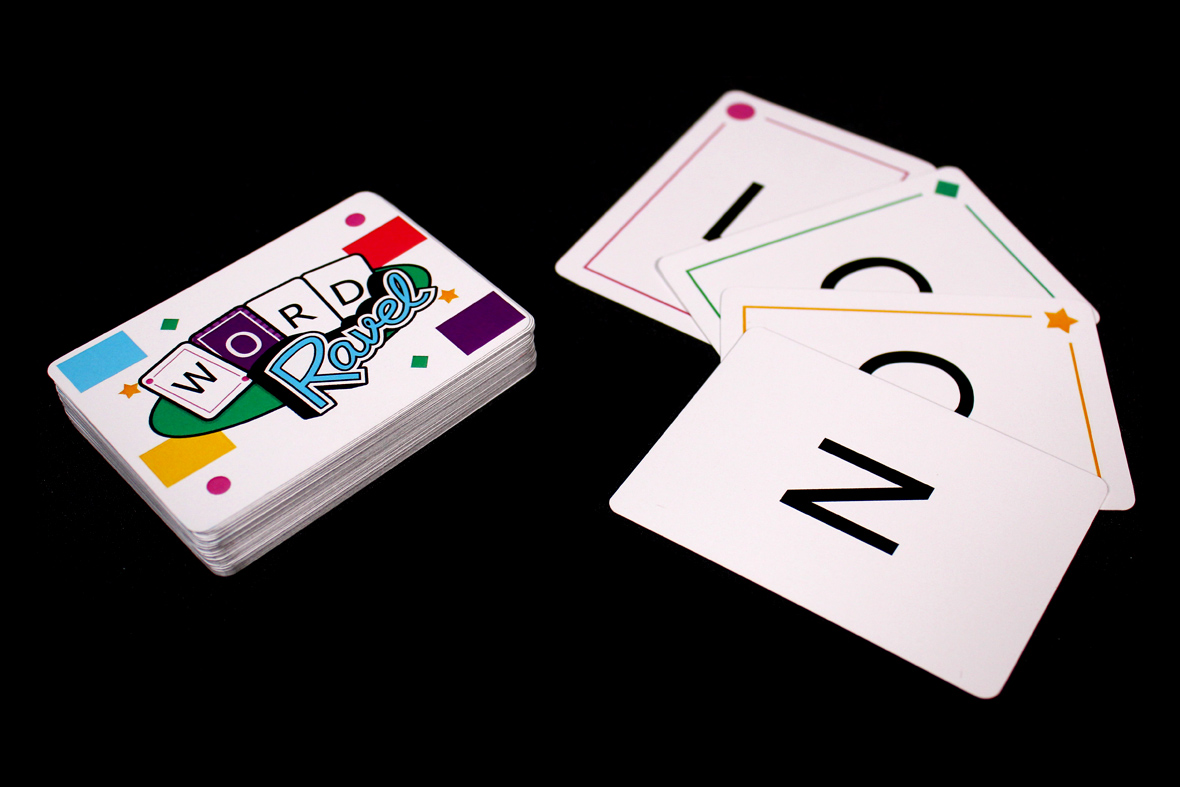
Then, shuffle the standard cards:
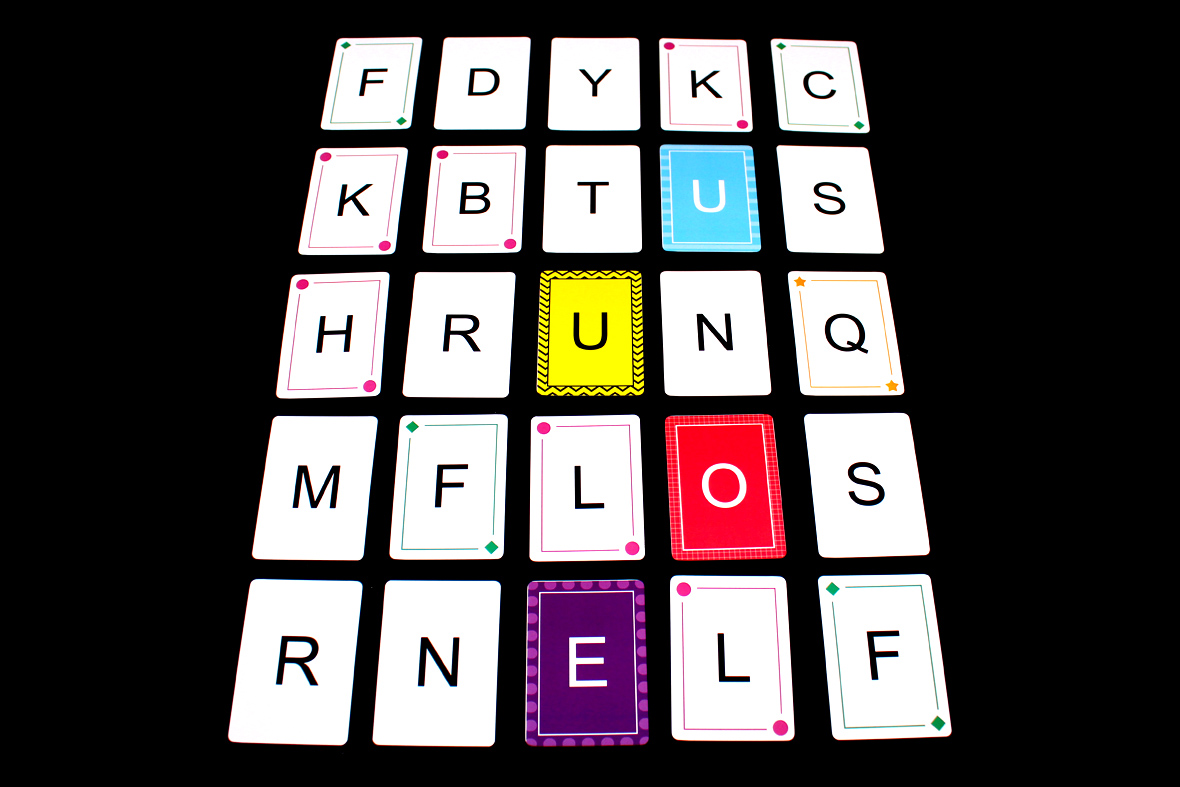
Each player shuffles their vowels, draws two, and chooses one to contribute to the center, face-down. If there are fewer than four players, shuffle the extra vowel decks together and add one face-down until there are four vowels in the stack. Add twenty-one standard cards to bring the total to 25, and then shuffle those again, dealing them face-up into a 5×5 grid. You’re good to start!
Gameplay
This one’s pretty conceptually easy. Each turn, your goal is to spell one really good word out of the grid. But grids aren’t particularly known for being forgiving, so you might have to get a bit flexible on that front.
On your turn, before making a word, you can shift any row or column up to three times total (it doesn’t have to be the same row or column with each shift). Shifting just means moving all the cards in the same direction and taking the card you pushed out of the grid and placing it into the now-empty space.
Once you have a 3 – 5 letter word, you remove all the cards! Words can be formed orthogonally or diagonally or even backwards, which is nice. You set the cards aside to be scored later. Then, refill the board. Players each draw two vowels, like in Setup; if you already have a vowel in the grid, you can swap it out for one of the ones you drew. Otherwise, add it (and replacement vowels from the out-of-play vowel deck) to a pile. Draw enough standard cards to, with the vowels, refill the grid, and then shuffle those cards and refill the grid.

Play continues until the end of three rounds. Score your cards!
- Standard and Vowels are worth 1 point each. If you use another player’s Vowels, they get 1 point too!
- Circles are worth 2 points.
- Diamonds are worth 3 points.
- Stars are worth 4 points.
The player with the most points wins!
Player Count Differences
The major one is just around time between turns. This is a game with a lot of spatial manipulation and word planning, so with more players, turns just take … a while. There’s not a ton of ability to play around what the board option are, since you’ll likely be losing a bunch of vowels and getting a huge hit taken out of your plans, so you’re kind of just loosely waiting for it to be your turn again so you can get a sense of the board state. That’s not the most engaging; it makes me wish you had X distinct boards so that each player was always solving for the board in front of them or something, but that’s a different game entirely. I think this game would probably shine most as a solo app or game, partially because then you could even play it cooperatively, but the preview version I played didn’t have explicit solo rules, so can’t speak to that. In the interim, I’d be most likely to play it with two.
Strategy
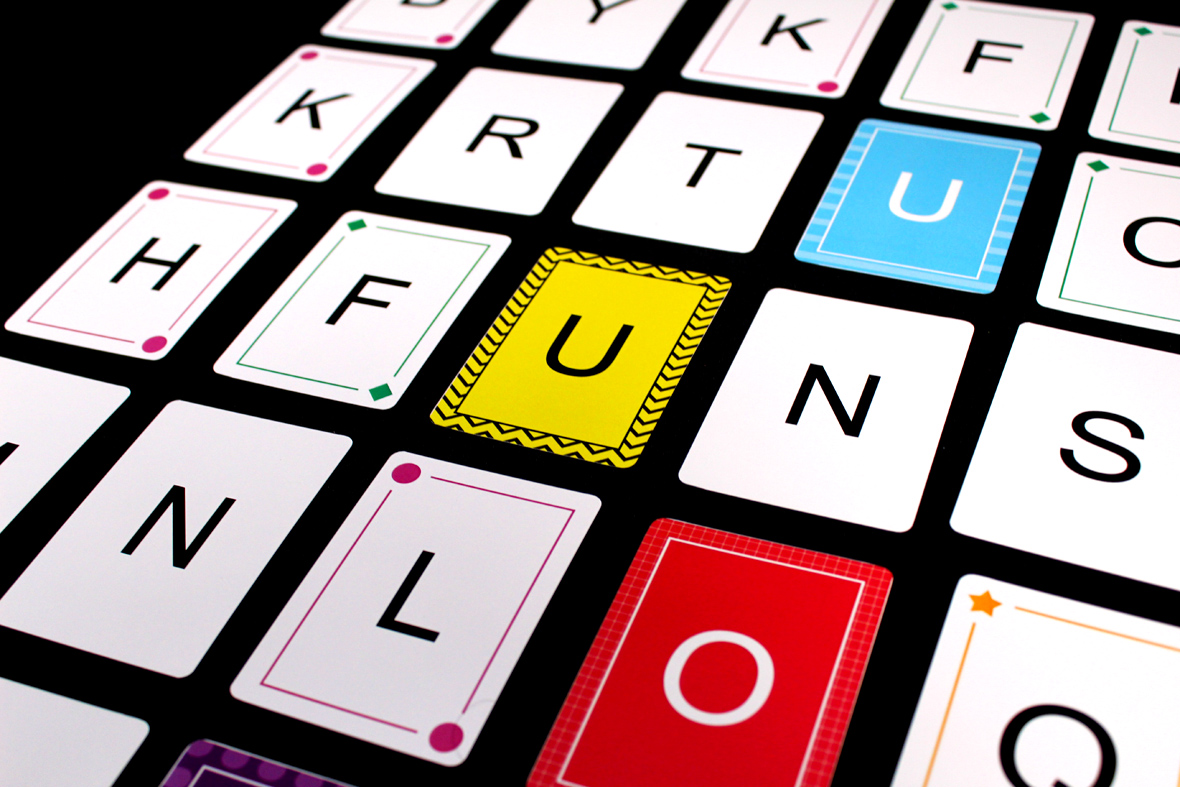
- Maximize points. You really want the highest-point word you can spell since you only get one per round, so focus on that. Where are the star letters? How many can you get in your word? Too tough? Compromise! Just don’t go for a word because it’s easy.
- When it’s not your turn, don’t use useful vowels! Give your opponents that U or that O; they’re difficult to get good words for.
- There’s not necessarily a lot of planning ahead that you can do, so save some brainpower. Things are going to be moving around a lot, especially with more players.
Pros, Mehs, and Cons
Pros
- I appreciate that the 3 – 5 letter limit at least somewhat limits player agonizing. Plus, I mean, it’s hard to make a longer word in a 5×5 grid, so, there’s also that, but it’s still a smart limiter.
- I do love a word game. It’s an ongoing favorite genre for me.
- I think this would be awesome as a cooperative experience! It’s still kind of tempting to help other players out if they want on their turns, so there’s a cooperative temptation there; it would be interesting to see how different things would make the experience more engaging.
- High portability. It’s just a double tuckbox at the moment (though I imagine Kickstarter stretch goals could change that up), so it’s pretty easy to take anywhere.
- I appreciate that there’s some level of interactivity. Being able to throw in less-useful vowels to trip other players up is kind of fun.
Mehs
- I do kind of wish the cards were a bit more aesthetically engaging. I think that’s just the breaks for a Kickstarter, sometimes, but it would be nice to have cards with a more intense or colorful look to them. It would be fun.
- A once-over through the rulebook would be great. We got a little tripped up over a usage of “the word” versus “a word” or “the one word per turn” or something. It seemed like, briefly, you could find multiple words in the grid, which would lead to a very different game. Still interesting, though.
Cons
- The core gameplay loop is a bit simple for my tastes. I wish there were other ways to manipulate the grid beyond shifting, though, problematically, that would just make the game take longer if there were more things to do.
- There’s a fair bit of downtime when it’s not your turn, since you’re kind of just watching other players think about and plan out words. This is a place where I feel like the game could be more engaging for players between turns. There’s very little jockeying or conversation happening, even if players are taking some time to rib each other between picking words. You’re just kind of watching the board, and I think that Word Ravel could stand some more adjustments to prevent downtime, especially since player turns can take a while.
- It would be nice to mark the shifts you’ve made for undoing, though I worry that would make a turn take longer. Sometimes you forget which columns you’ve already touched. It happens, but marking it would be nice. I’m a bit opposed to undo actions, since that would nontrivially extend the playtime of the game.
Overall: 6 / 10
Overall, I think Word Ravel was fine. I’m not sure if I just felt like I was missing something, or if there was something I wanted from the game I didn’t get. Inherently, no major problems beyond the time it might take players to plan out words, but I think I wanted something more challenging and complex in my word game space. I might just be a bit spoiled by games like Ponkotsu Factory or A Message from the Stars that have been adding a lot of complexity to things (Illiterati, too), but while I can appreciate the simplicity of this, Word Ravel ended up feeling more like the kind of game I’d be playing via the New York Times App. That’s not a dig, by the way; I love my NYT Games and religiously do the Wordle, Mini, and Connections, but I wouldn’t inherently enjoy them as much competitively. I think that’s where I see Word Ravel doing the best, for me, is via enhanced solo play or cooperative play. I enjoy the idea of working with other players to find the best three shifts to get the highest-scoring word, rather than waiting on them to come up with an okay word or trying to thwart them by dropping a less-useful vowel. Even looking for more words would be kind of cool, though I do worry that would slow down gameplay for optimizers even more. I think the core system is just a bit simple, so I’d like to see more development and more complexity emerge between now and the final release. I wonder if it’ll happen! If you’re interested in a nice simple word game or you like searching for words, though, you’ll likely enjoy Word Ravel! I enjoyed it; I’d just like to see what else it can do.
If you enjoyed this review and would like to support What’s Eric Playing? in the future, please check out my Patreon. Thanks for reading!
 What's Eric Playing?