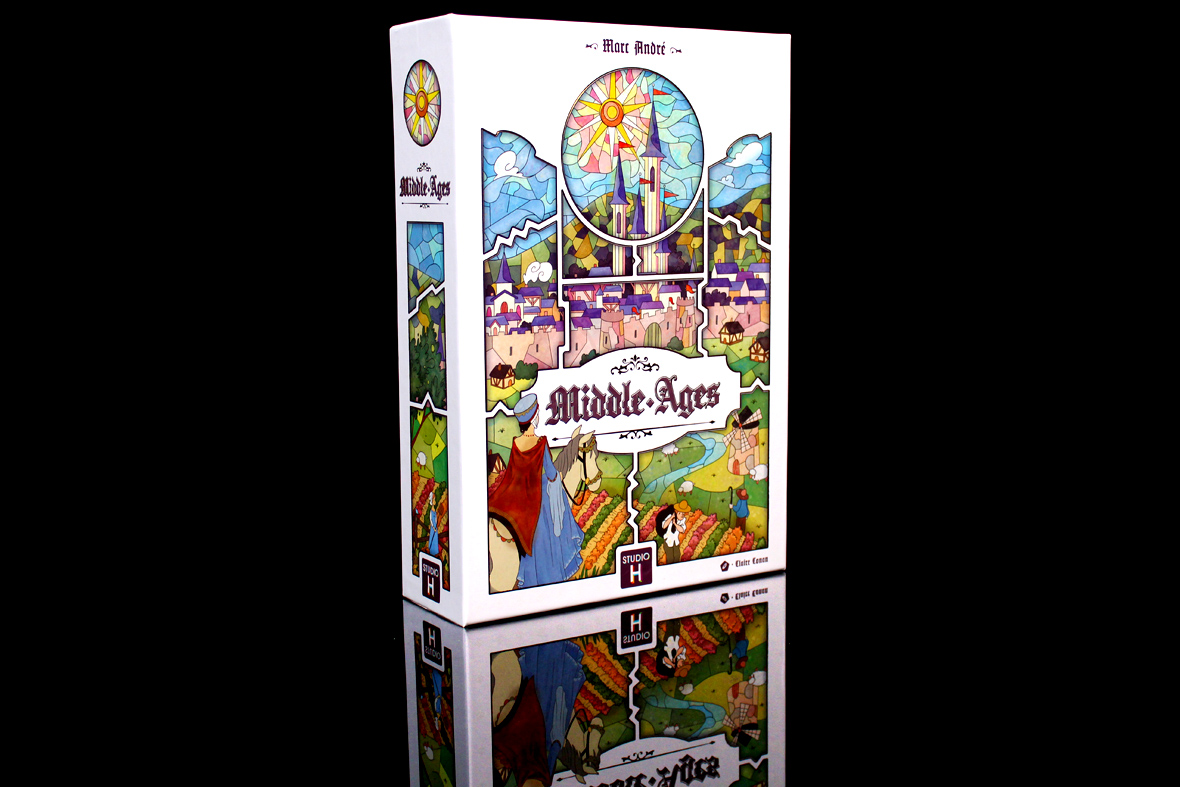
Base price: $35.
2 – 5 players.
Play time: ~30 minutes.
BGG Link
Buy on Amazon (via What’s Eric Playing?)
Logged plays: 5
Full disclosure: A review copy of Middle Ages was provided by Studio H / Hachette Boardgames.
Too busy of a weekend means I’m running right up against my deadlines, again, which is always fun and exciting. It’s the Tokyo Drift of review writing, or, more aptly, me looking at my Steam Deck thoughtfully while I’m writing reviews. At some point I’ll get a bit more responsible or a bit farther ahead, but it’s not looking like it’s going to be this week. If anything, it’ll be before the end of next month so that I can go on a work trip. Or I’ll dig a bit deeper into the vaults. Could go either way. In the meantime, though, we’ve got Middle Ages to check out! Let’s do that.
In Middle Ages, players take on the role of Lords developing up their fiefdoms by adding different tiles and their various effects. The best part of being a Lord is that you barely have to work and the money keeps rolling in! Serfdom is really paying dividends for you. Try not to think about it too much. However, other local fiefdoms may cause problems for you. They may use up too much water for their mills or declare war on your undefended property or who knows what. You’ll have to play offense and defense if you want to be the most successful Lord. Are you up to the challenge?
Contents
Setup
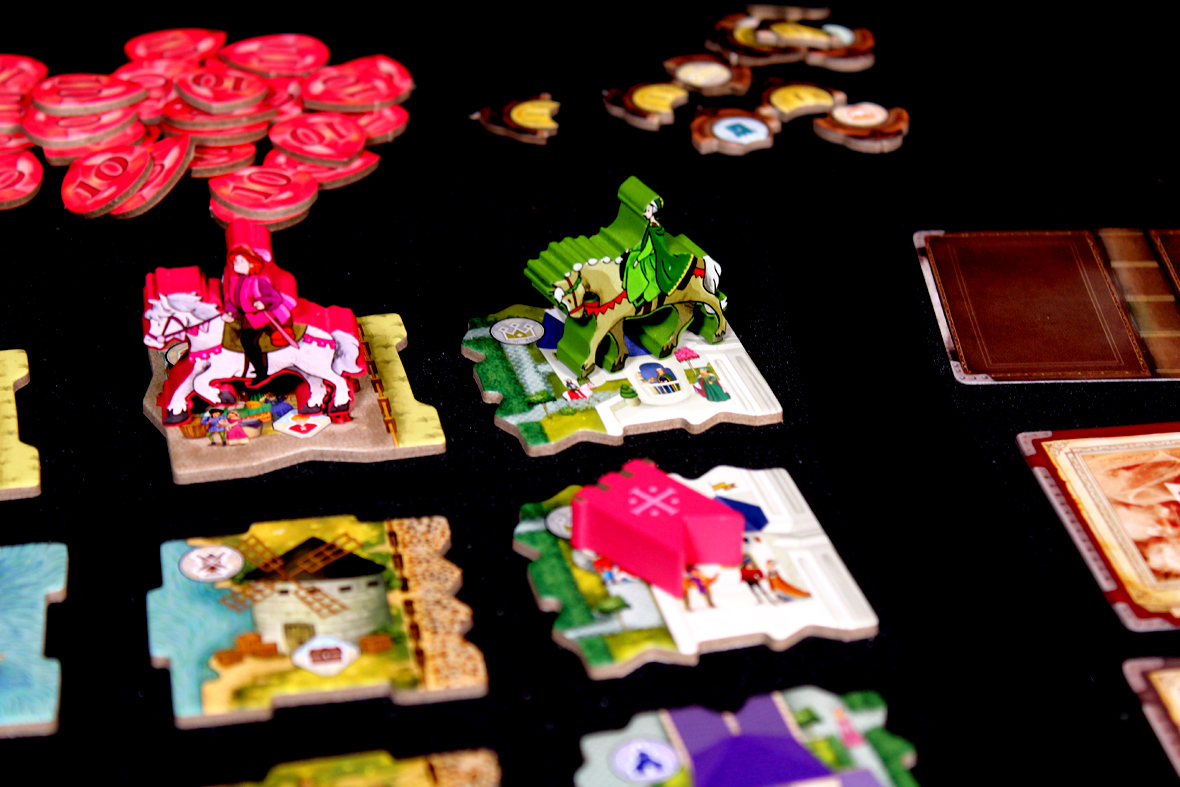
This one’s pretty easy! Shuffle up the blue-backed tiles. If you’re playing with four or more players. shuffle up the orange-backed tiles as well and set them aside. Draw one more tile than the number of players and make a row organized from lowest to highest number, then flip them over. Make three more rows after that. Shuffle the Event Cards and reveal four below or to the side of the tile area:
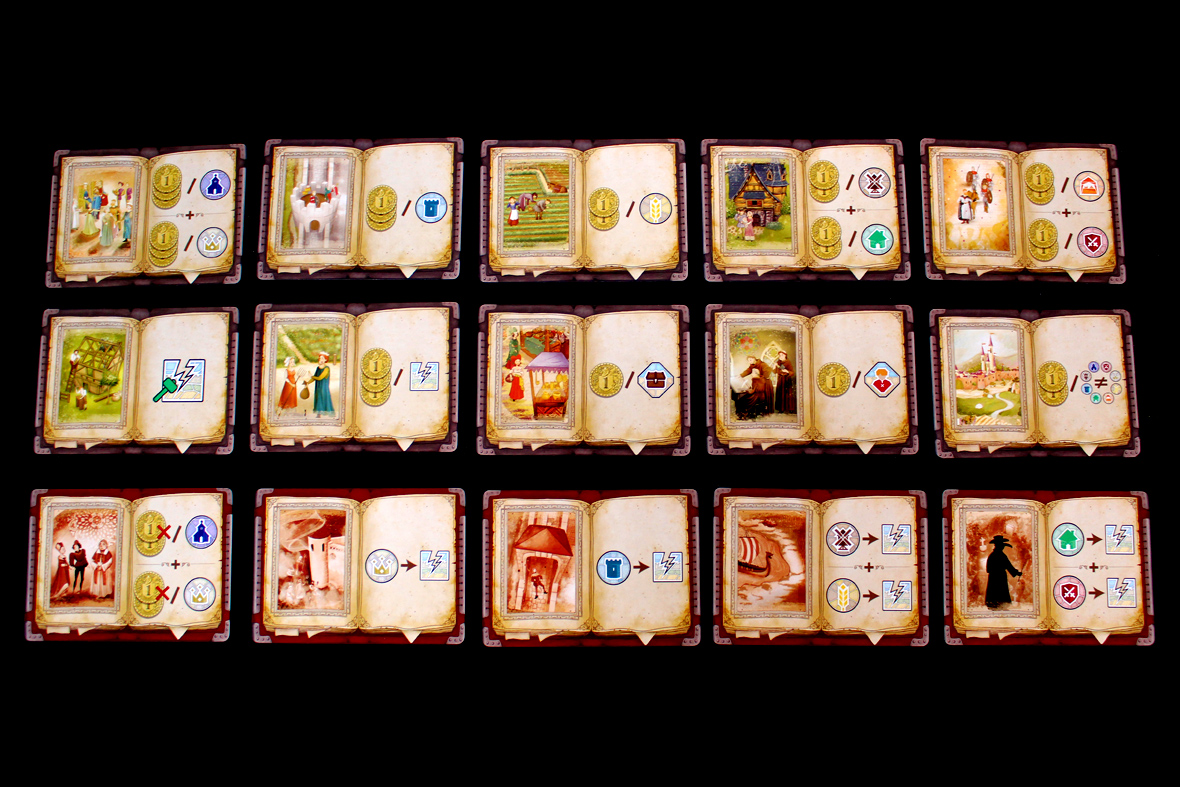
Each player gets a player board:
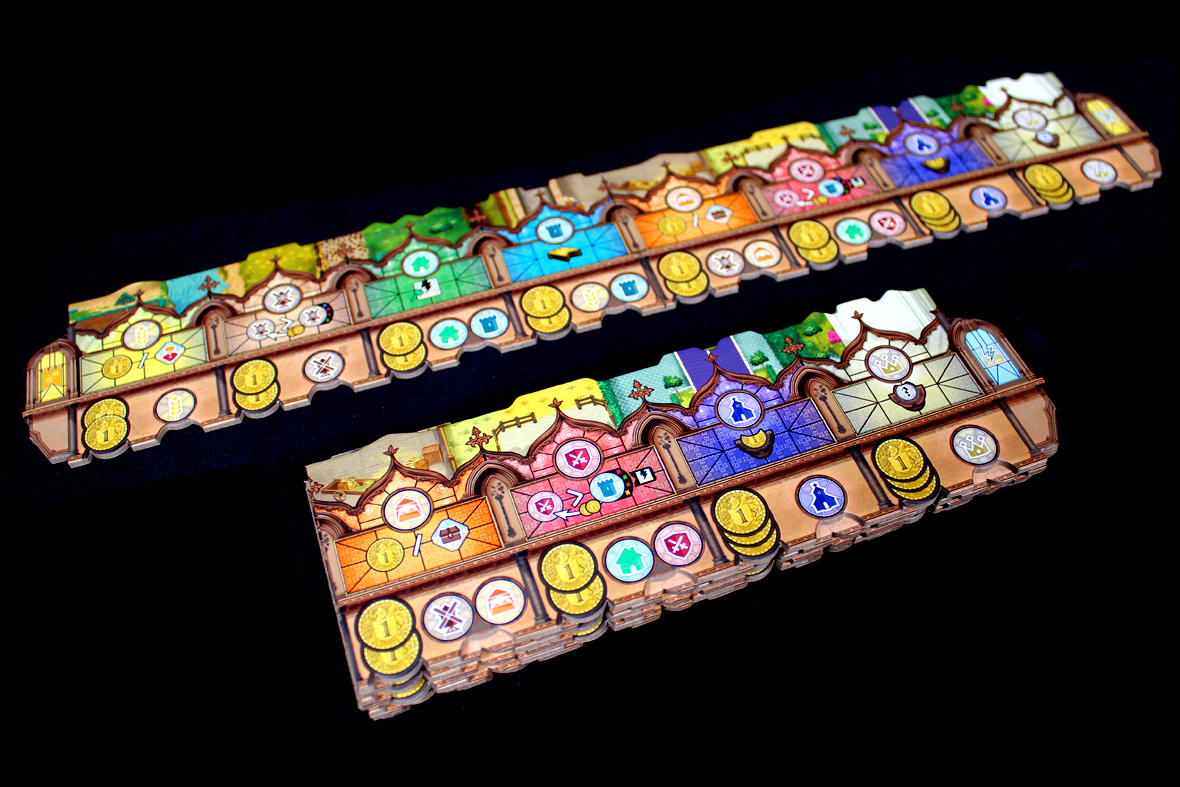
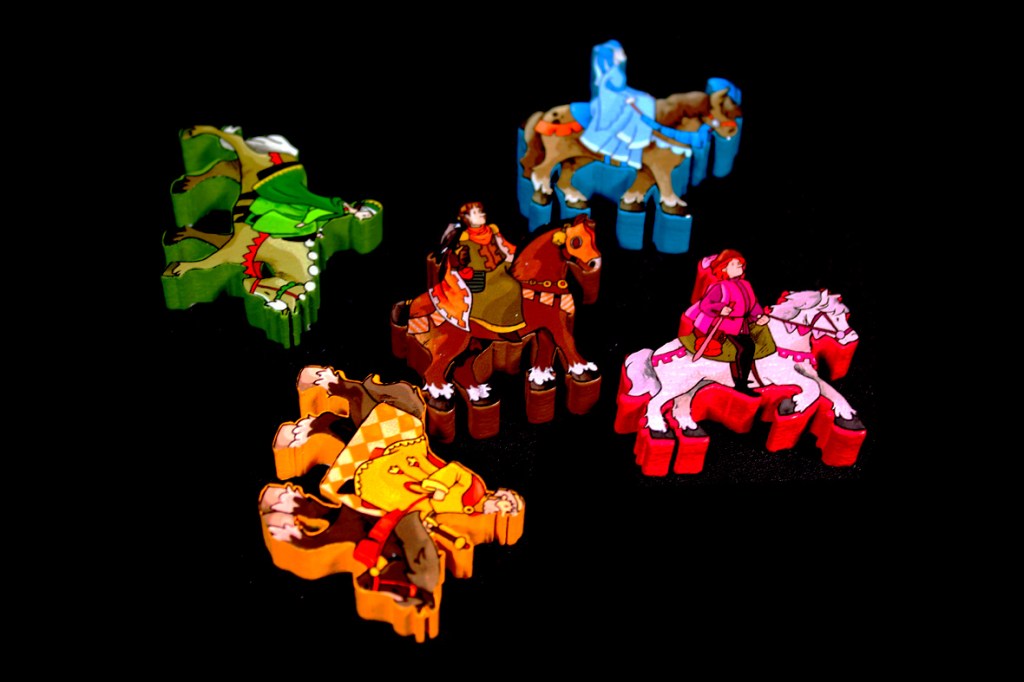
They also get a matching Lord and Scout token. It’s not immediately noticeable which color player board matches, so, try to keep track of that.
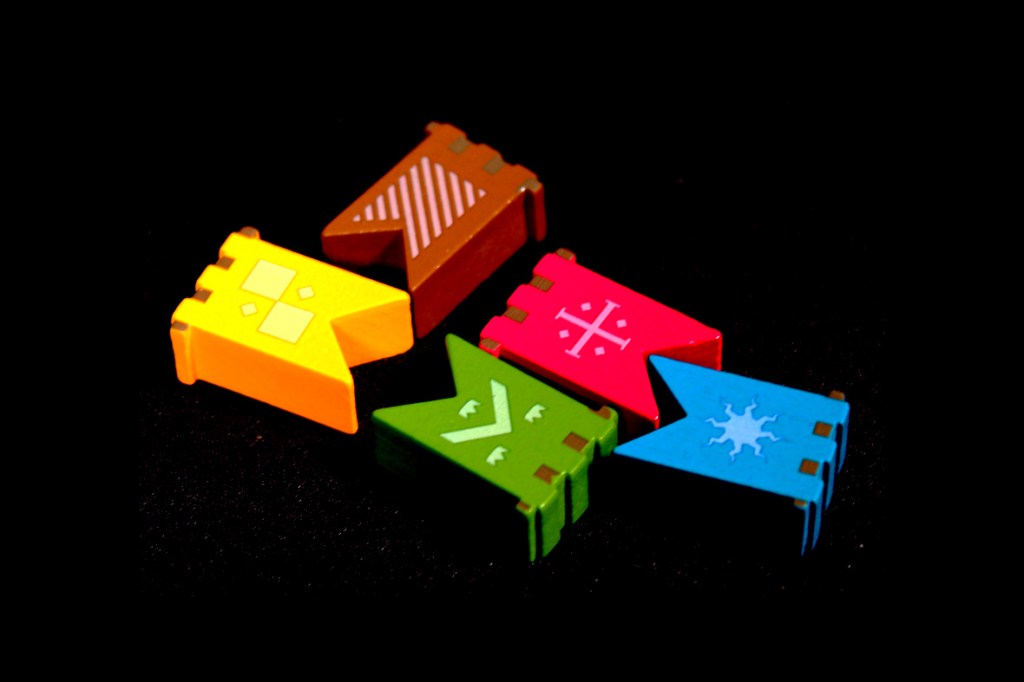
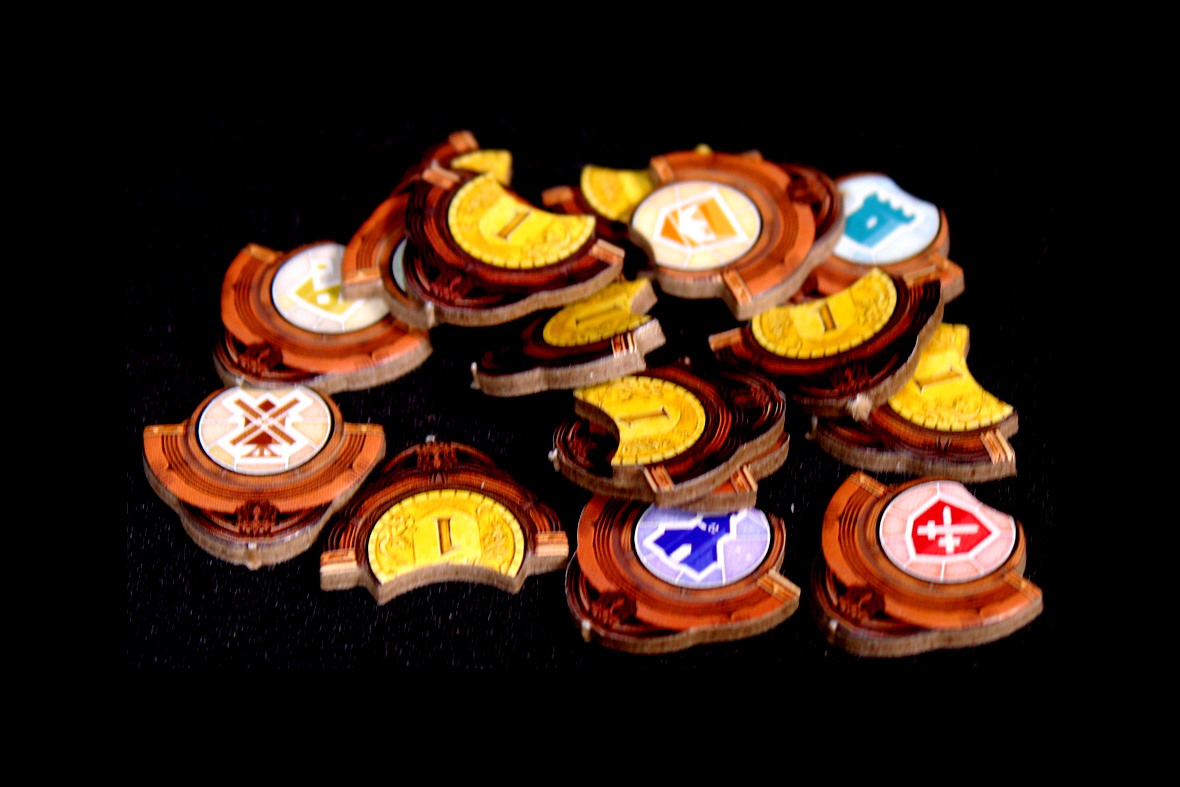
Set aside the other tokens:
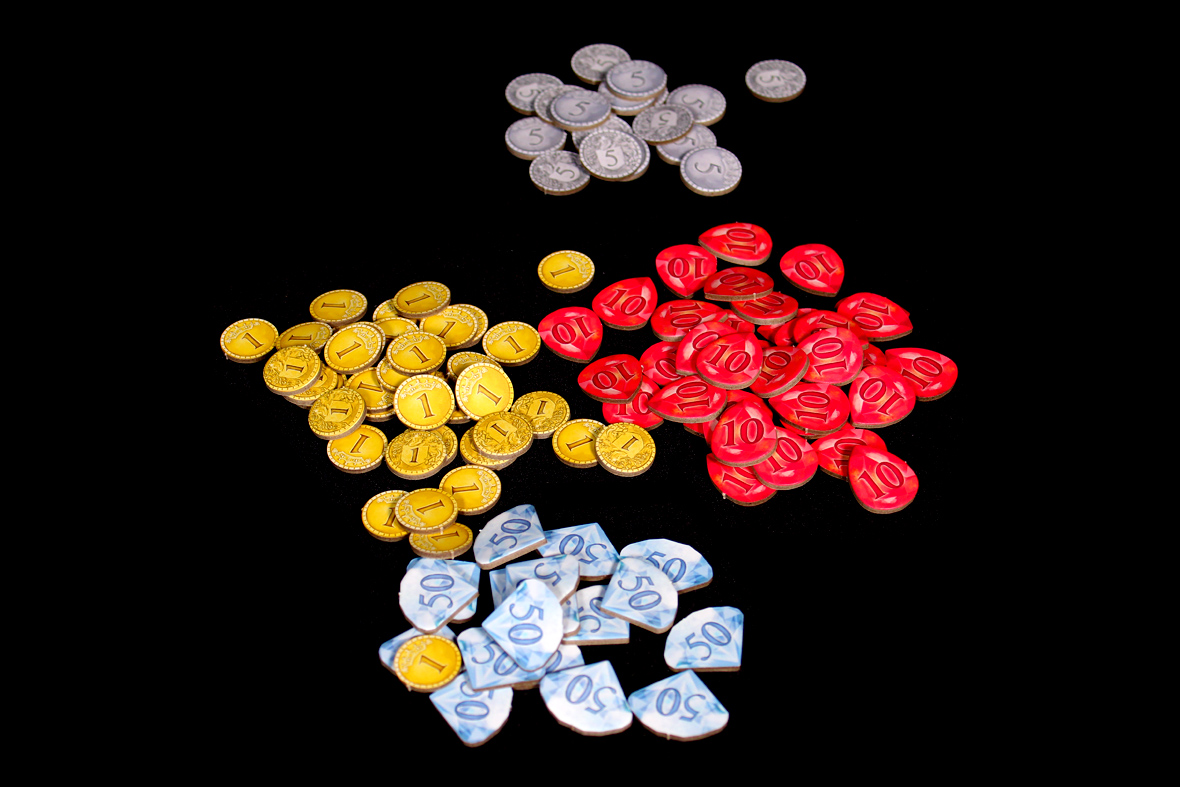
And the coins:
You should be ready to start! Choose a player to go first.

Gameplay
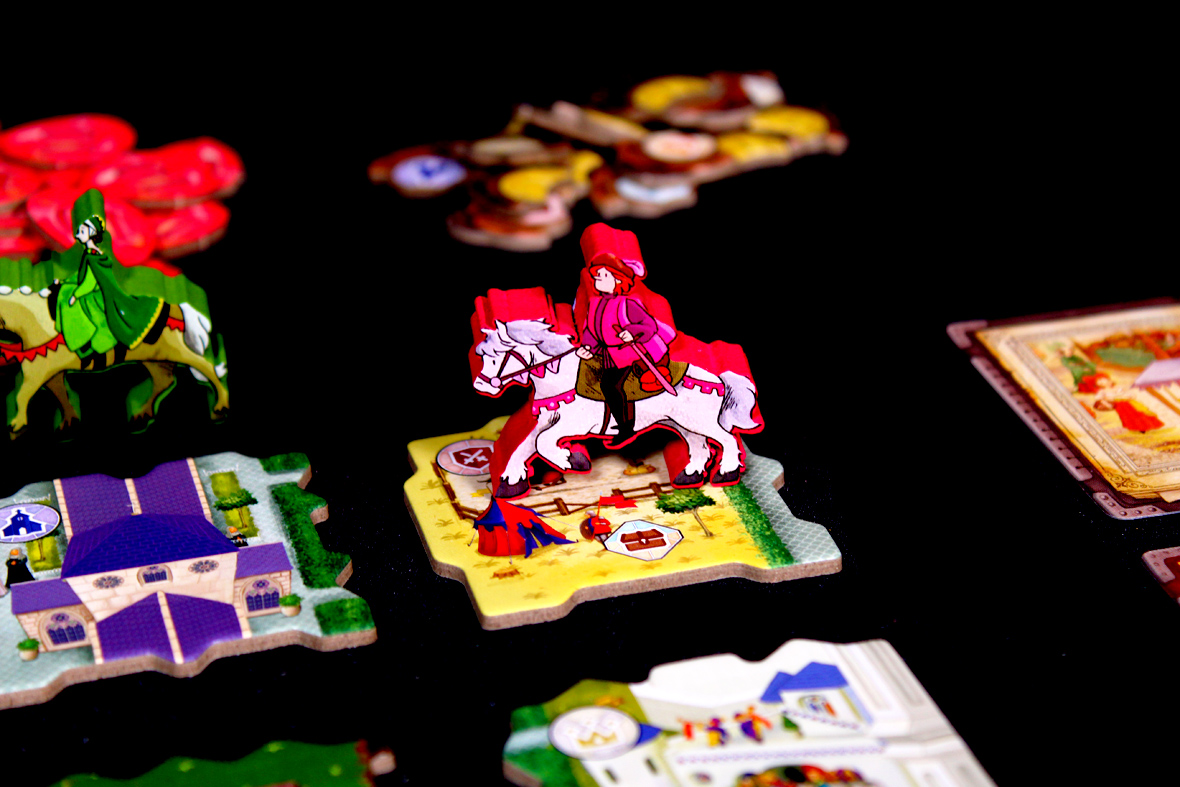
This one’s very straightforward. Over sixteen rounds, you’ll draft tiles, place them in your fiefdom, resolve their effects, and every fourth round, resolve an event.
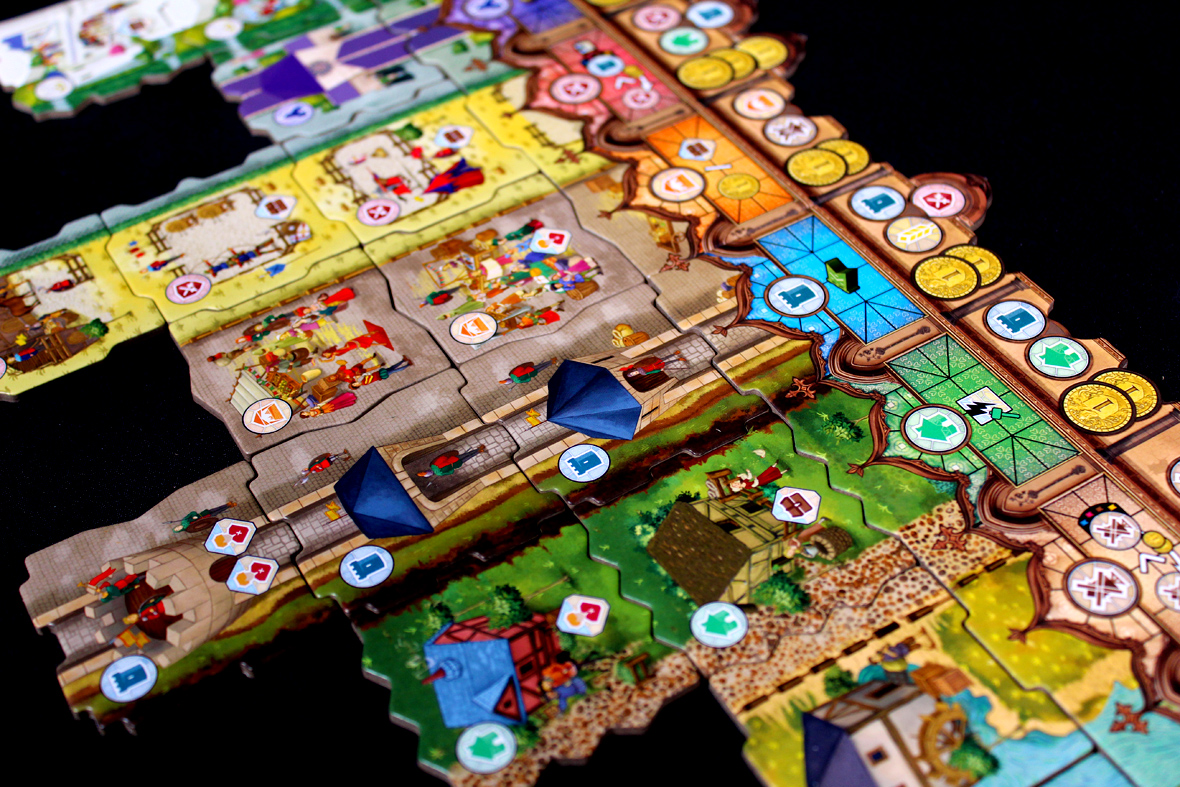
On your turn, you move your Lord Token from the tile it’s currently on to a tile in the next row below it. If you’re at the bottom, move your Lord to the top row. Take the tile you just vacated and place it in your fiefdom; its effect will activate. Usually that’s some sort of tile-specific effect, and then income, which earns you 2 – 3 coins per pictured tile below it. Once everyone has moved their Lord Token, discard the remaining tile in that row and refill it with new tiles in numerical order, then flip them over.
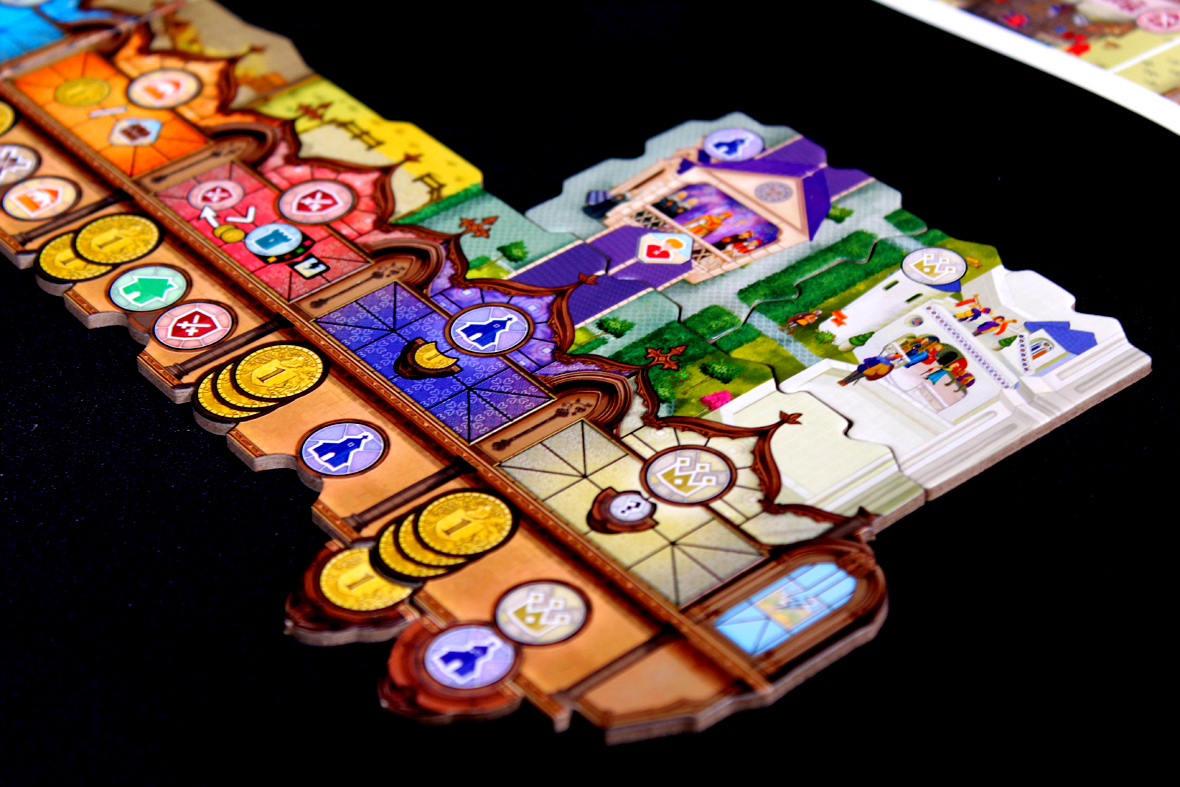
After every fourth round (when moving Lords to the top row), an Event Card activates with its own effects.
Once you’ve finished the sixteenth round, that’s it! Tally up coins and then each player loses ten coins for every empty tile type on their player board. Ouch. The player with the most coins wins!

Player Count Differences
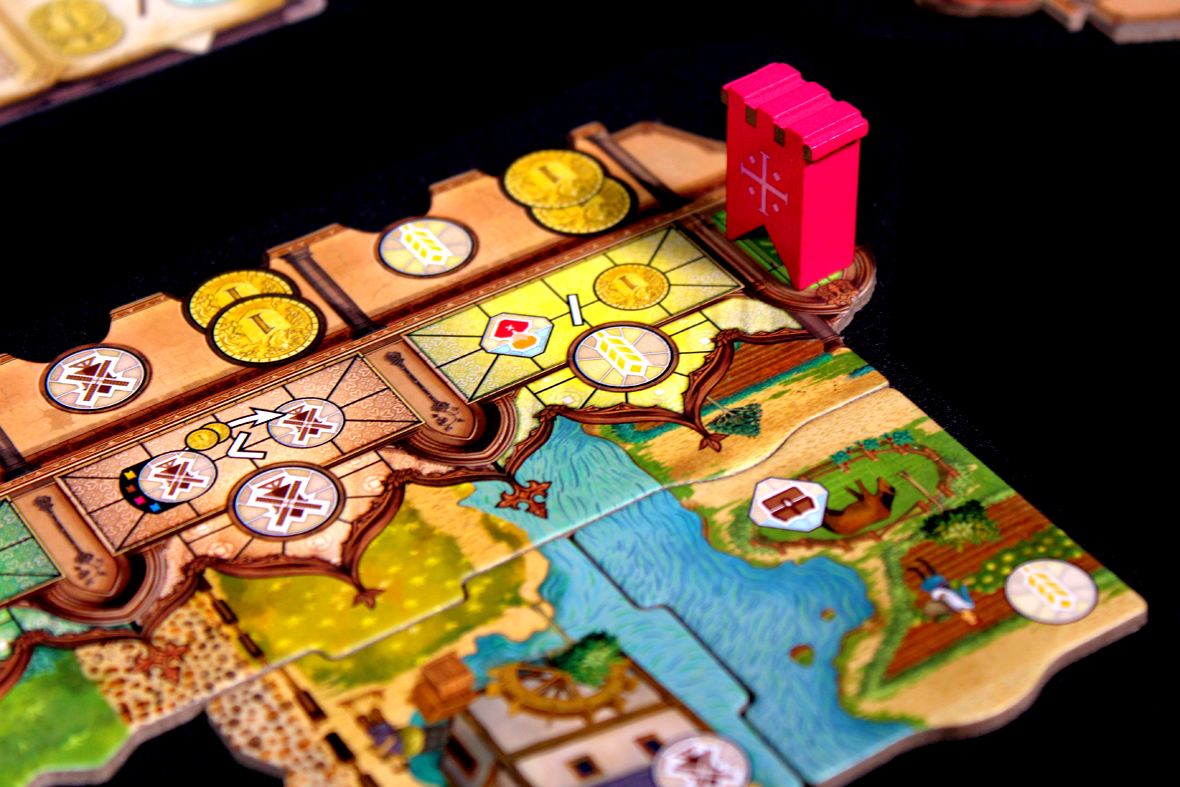
Not too many here! The game targets “opponents” for tile effects kind of writ large, so while you might get more coins taken away or tiles discarded at higher player counts, odds are, so will the other players (and you’ll likely have more shots to protect yourself; nobody’s going to let the player who’s been picking on everyone get a third Mill or Barracks). It makes the whole thing feel a bit more “first past the post” than zero-sum. As I’ve mentioned elsewhere, the player interaction, while it skews negative, doesn’t feel personal or targeted, which helps a lot. More players inherently adds more chaos, but it also means you can have much stranger fiefdoms (overindexing on a few types of tiles, for instance), though remember that you lose 10 coins for each tile type you don’t have, at the end of the game. Beyond that, though, I don’t have a strong player count preference! I’ve tried a few different ones and enjoyed the game the same.
Strategy
- Try to get at least one of each tile type. You lose 10 coins per tile type you don’t get, which is pretty extreme on purpose. That said, you can usually sabotage other players pretty badly with a late-game Barracks if it eats their only tile of one type, so that’s funny too.
- If you’re going deep on one tile type, getting a Church and a Palace can help you really maximize coins. Churches give you a coin that you can place on a tile so that when you collect income for building that tile you get an extra coin per type. Palaces do the same thing but give you an extra tile type, instead. This means if you place both you can get a lot of coins for each tile you place of that type, which is great.
- Having some defensive tiles helps a lot. You want some Mills and some Ramparts to block other players messing you up with Mills and Barrackses. Getting those early will pay dividends in that you won’t have to pay dividends.
- Plan a bit around the Event Cards. You should at least know what’s coming up! If you’re going to have to discard a Barracks tile you may want to take something else; if you’re later going to get three coins per discarded tile, you may want to not take something else. It’s up to you.
- Going hard on Barracks tiles makes you a tyrant but it’s also quite effective. All the tiles are worth more the more tiles you have of that type, but Barracks tiles in particular destroy your opponent’s leftmost tile and can potentially push them to a penalty or reduce the money they get from subsequent tiles. Either way, not a bad plan. That said, if you do this too often, they’re going to Rampart up and make this a significantly less-valuable endeavor.
- Don’t let an opponent get all the Church and Palace tiles. They’re worth 3 coins per Church or Palace you have, which can really add up fast.
Pros, Mehs, and Cons
Pros
- Love the art style! I particularly like the box art, but the tiles themselves are nice, too! I appreciate that they’re not entirely the same art on each tile type; that would get a bit boring.
- The insert is nice; mostly holds everything well. It gets a bit weird when you try to put the coins away, but if you move one of the player boards to the other side of the box it all ends up working out.
- The tiles are great quality. They even have different edge styles so only adjacent tiles can fit together! I love that. They’re also very thick tiles, which is always good.
- The game moves pretty fast. 30 minutes is a high estimate, in my opinion, unless you have five players or something. Once you know what you’re doing, it’s a quick game.
- The tile organization during the game is smart, as well. I appreciate that you sort them low to high like Kingdomino, and similarly that the more “beneficial” tiles tend to be higher numbers to incentivize players moving around.
- I like the penalty for not getting at least one of every tile. It prevents players going too deep and forces them to focus on how to make them work. It can be a bit of a bummer if you win a game and don’t feel like you got to experience all of it.
- I enjoy the different tile effects! There are a lot of different ways of getting to a high score. You can play aggressive and go for Mills and Barracks (though you’ll likely get blocked on that front eventually) or you can try other economic tricks like doubling down on Chest Icons and the Market Tiles or some combination of a ton of other ideas. There’s a fairly limited tile set, but they all play fairly well together (or can be made to, via the Palace tile), so you can customize the game for what you want to do.
Mehs
- You’ll be making and breaking a lot of change over the course of the game. There’s just a lot of coinage that isn’t exactly 1 / 5 / 10 / 50, and so you’re going to want to keep the 1s and 5s in a central location so that you can quickly do that math.
Cons
- The iconography on the Event Cards can be tough for your first game. It’d also be nice if there were more of them? It takes some getting used to. I was kind of hoping, since you use four Event Cards per game, to see a few more of them? Particularly ones that are a bit more advanced or complex, just as options. The ones we have are good, just basic, and I’d be interested to see how much more complexity we could get in the game.
Overall: 8.75 / 10
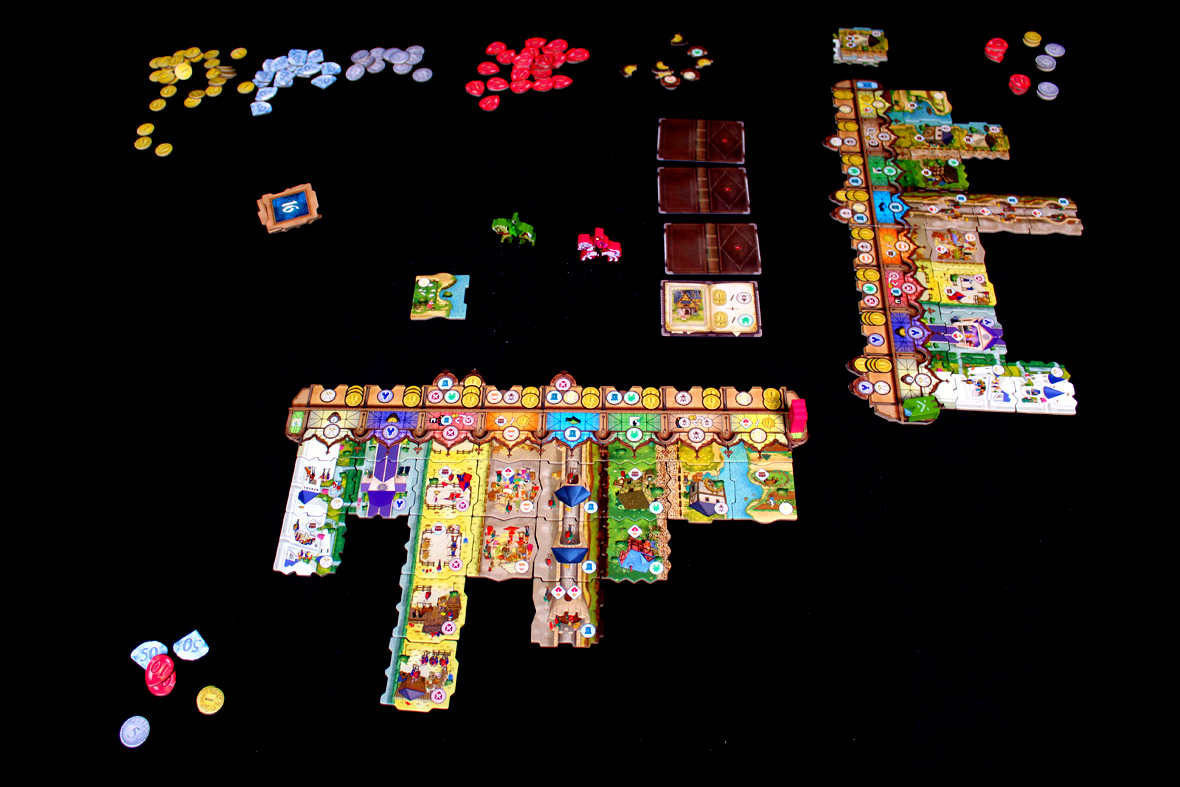
Oh, Middle Ages is one of my favorite games I’ve played this year! It hits on a number of great fronts. Art is fantastic! It has that nice stained glass look on the box, and then the tiles look like a nice modernized version of tapestry or something. They lack those truly horrendous medieval cats, but we can’t have everything that we want, I suppose. Middle Ages also does a nice job of hitting in that sweet spot of casual but strategic, for me. It’s easy to pick up and play, but there’s a lot of interesting things you can do and interesting ways to play, so I feel like I’m changing my strategy from game to game. More Event Cards would probably do a bit to jazz that up, further, but I’m fundamentally a bit impatient, so it scans. Could be fun! From a tactile sense, the game works rather well, since the tiles are a great size and thickness and fit great together. I originally was a little worried since the game has some decently “mean” elements to them, but I didn’t find them all too aggressive. It’s mostly just that you’re either burning down other players’ tiles or you’re stealing coins from your opponents, but again, you don’t get to pick who you’re picking on. You just take from everyone with less than you (either fewer Rampart tiles for the Barracks or fewer Mill tiles for the Mill). There’s good configurability, too; you have a lot of different ways that you can improve or change your fiefdom depending on what’s available and how you go about it. Quick, simple, and still a good depth of strategy. I like Middle Ages a ton, and if you’re looking for a fast game, you want something that’s not too challenging to pick up, or you just like tile drafting, I’d definitely recommend checking it out!
If you enjoyed this review and would like to support What’s Eric Playing? in the future, please check out my Patreon. Thanks for reading!
 What's Eric Playing?