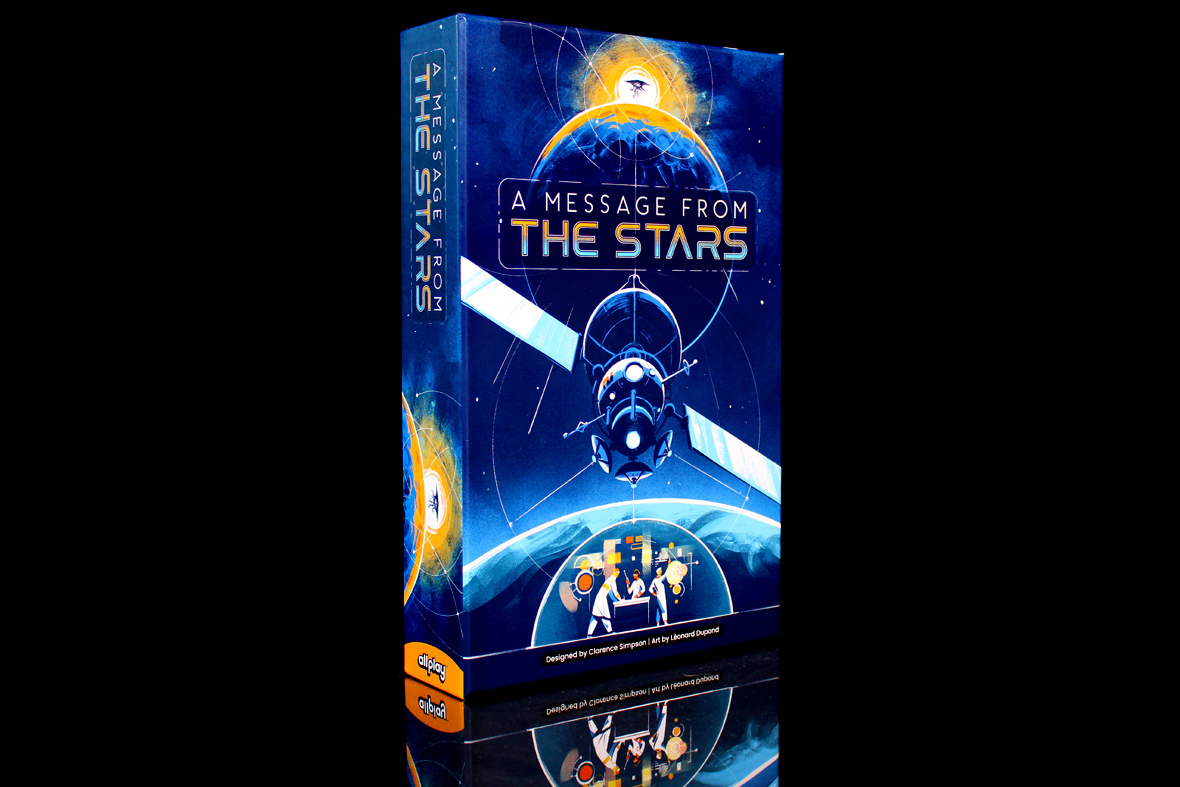
Base price: $40.
2+ players.
Play time: ~45 minutes.
BGG Link
Buy on Amazon (via What’s Eric Playing?)
Logged plays: 3
Full disclosure: A review copy of A Message from the Stars was provided by Allplay. Some of the components pictured are Deluxe components; the standard game does not come with six dice and a stand for the cards, for instance.
I probably could have gotten more done this week but the allure of sleeping until 3PM over the weekend was too great. Gotta say, though, if you’ve never done it, try it. You’ll feel like garbage until the grogginess wears off. And maybe it will wear off for you! In the meantime, I’ve just been checking out new and old games. Got some very exciting stuff coming down the pipe for y’all, and a Zelda game that’s going to completely consume my next weekend. Not reviewing that (video game reviewing; not happening), but I will happily talk about it here in a few weeks. Gotta love an intro paragraph for a brief snapshot of my life. Anyways, let’s dive into the game itself.
In A Message from the Stars, it’s aliens! You’ve always expected this day would come, and you’re not sure if it’s going to be an Arrival thing or a Close Encounters thing or an Aliens thing or a Star Trek thing or a War of the Worlds thing or that one movie where they kiss the aliens, so you’re opting to be prepared. How will you prepare? Communication! The problem is, their message is encoded in a way you didn’t expect, so you’re not quite sure what they want. Maybe you can crack it, but it’ll take a couple tries! Will you be able to cross the bounds of interspecies conversation?
Contents
Setup
There’s an involved bit but the rest is pretty quick. The Alien gets a player screen, and both teams get their Message Cards:
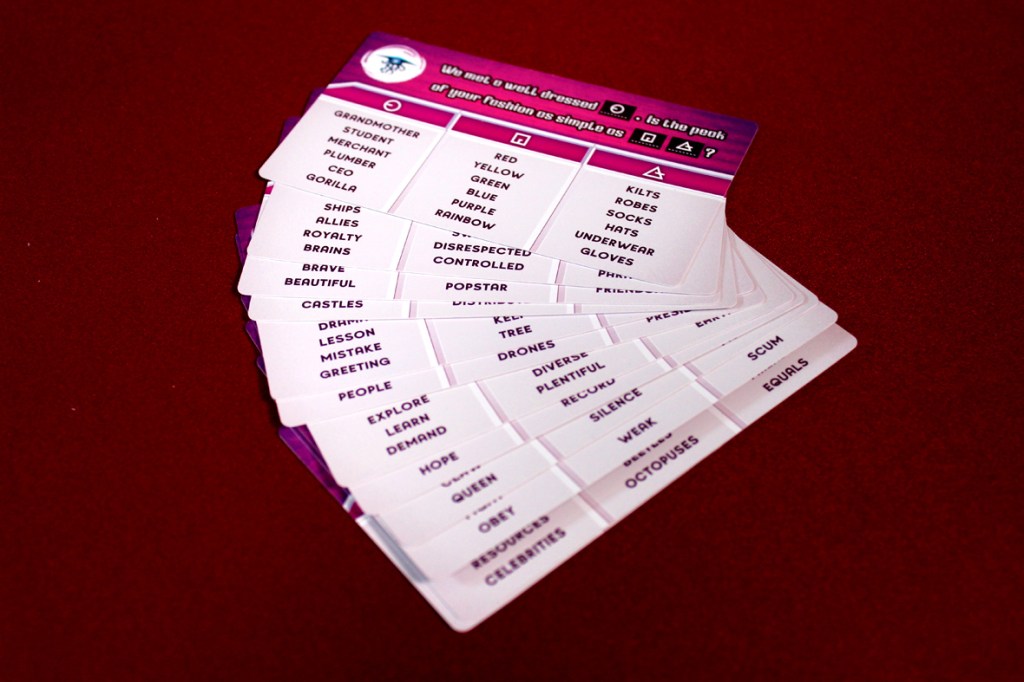
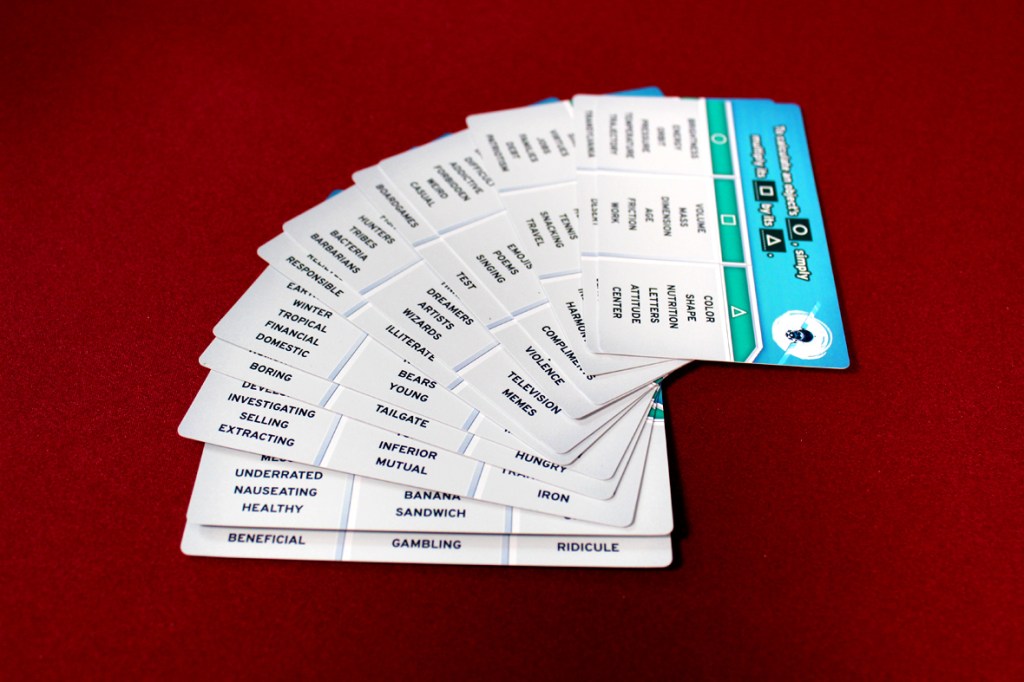
Both teams get their Transmission Cards:
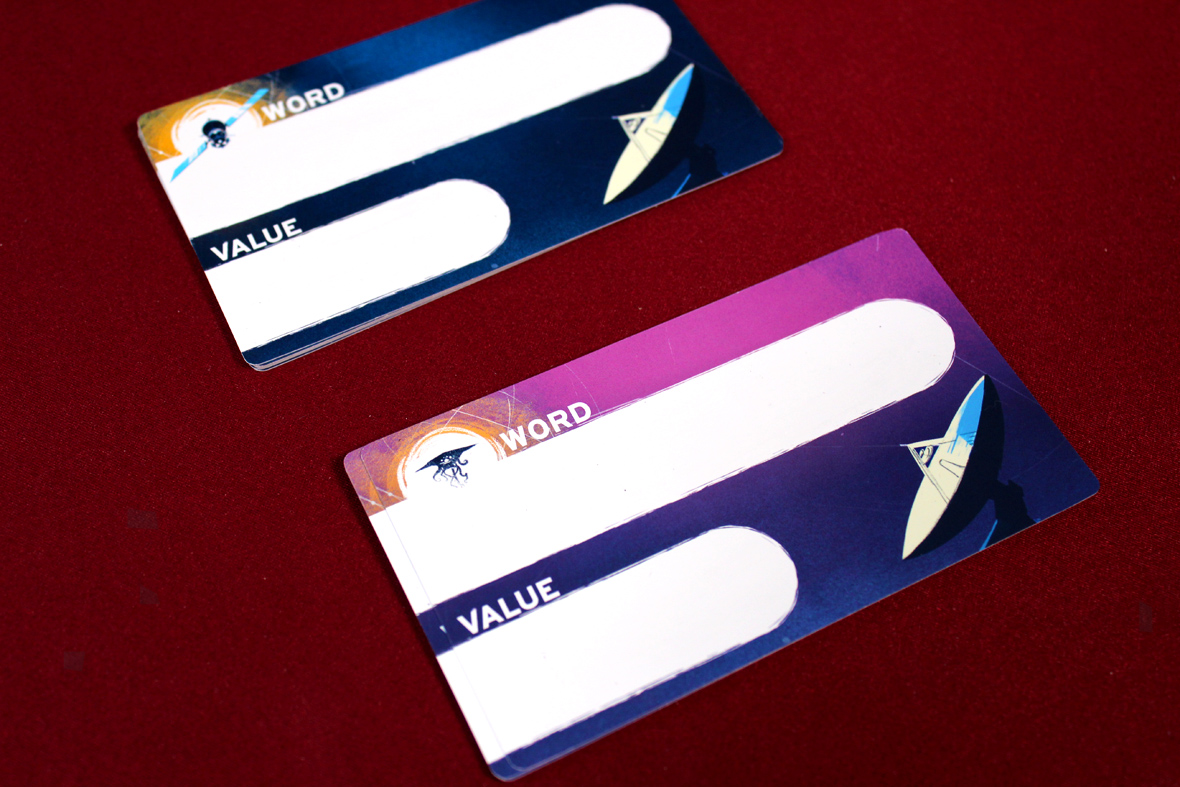
Everyone chooses a message card randomly, and then rolls the dice to indicate what their secret message (and the three words they need the other team to guess) will be:

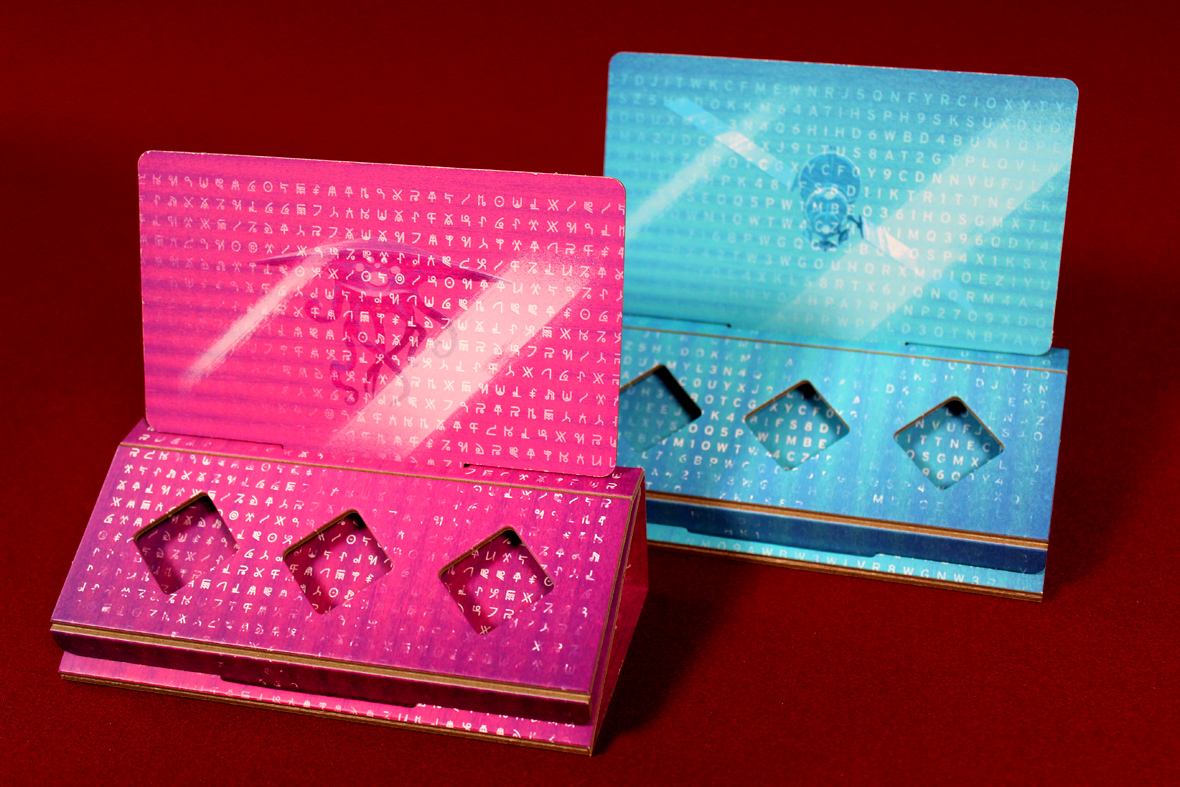
Keep the numbers secret and place the dice and your team’s Message Card on the stand.
Now, for the challenging part. Shuffle up the Letter Cards and give them to the Alien player:
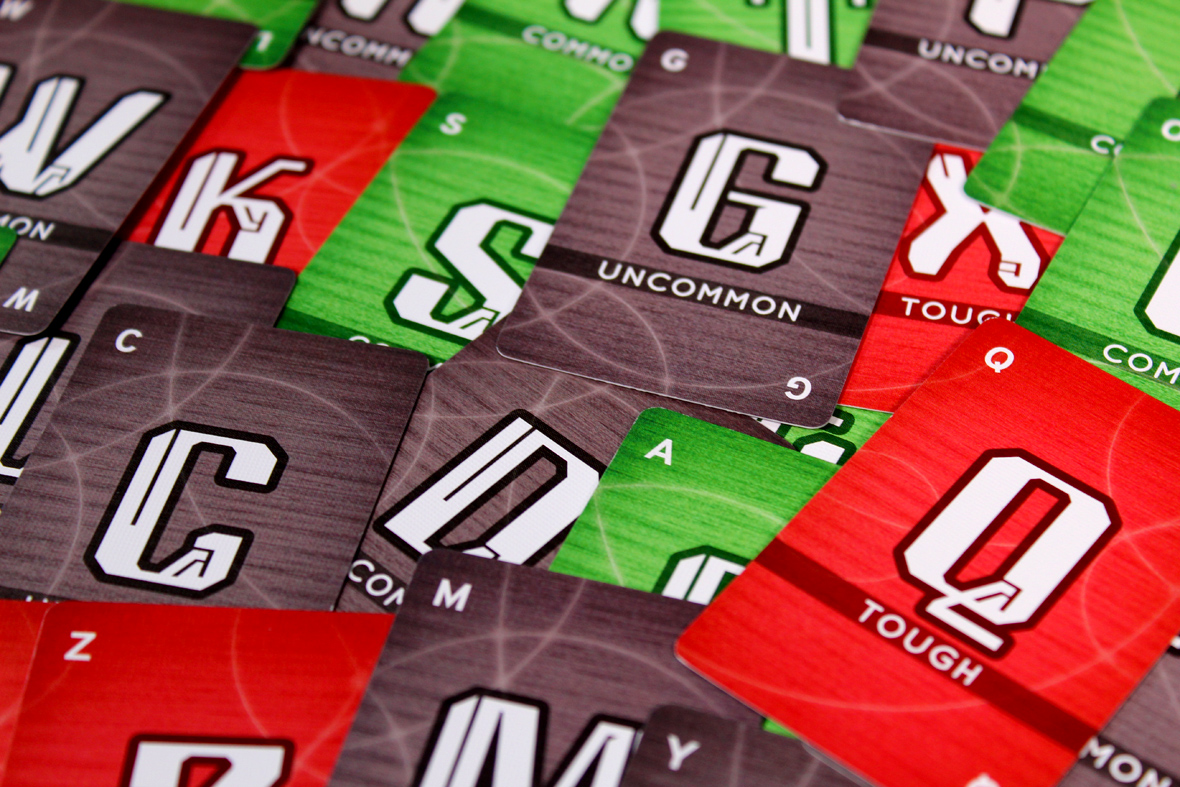
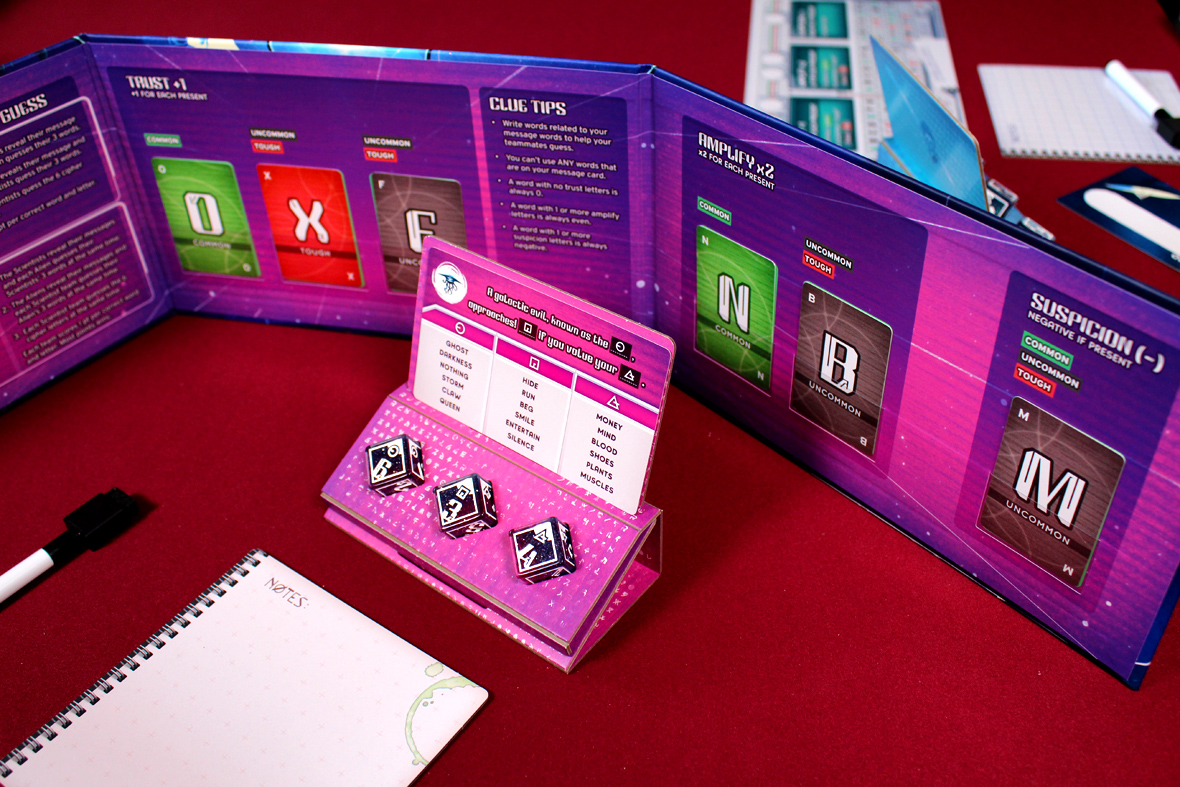
The Alien now creates the cipher! Start drawing one card at a time and placing them inside of your player screen, with the following rules:
- Across all six of your selected letters, only one can be Red.
- Trust must include 1 Green Letter, 1 Black Letter, and either 1 Black or 1 Red Letter.
- Amplify must include 1 Green Letter and either 1 Black or 1 Red Letter.
- Suspicion can be any color.
If you draw letters you can’t place, just put them on the bottom of the deck. You should be ready to start!
Gameplay
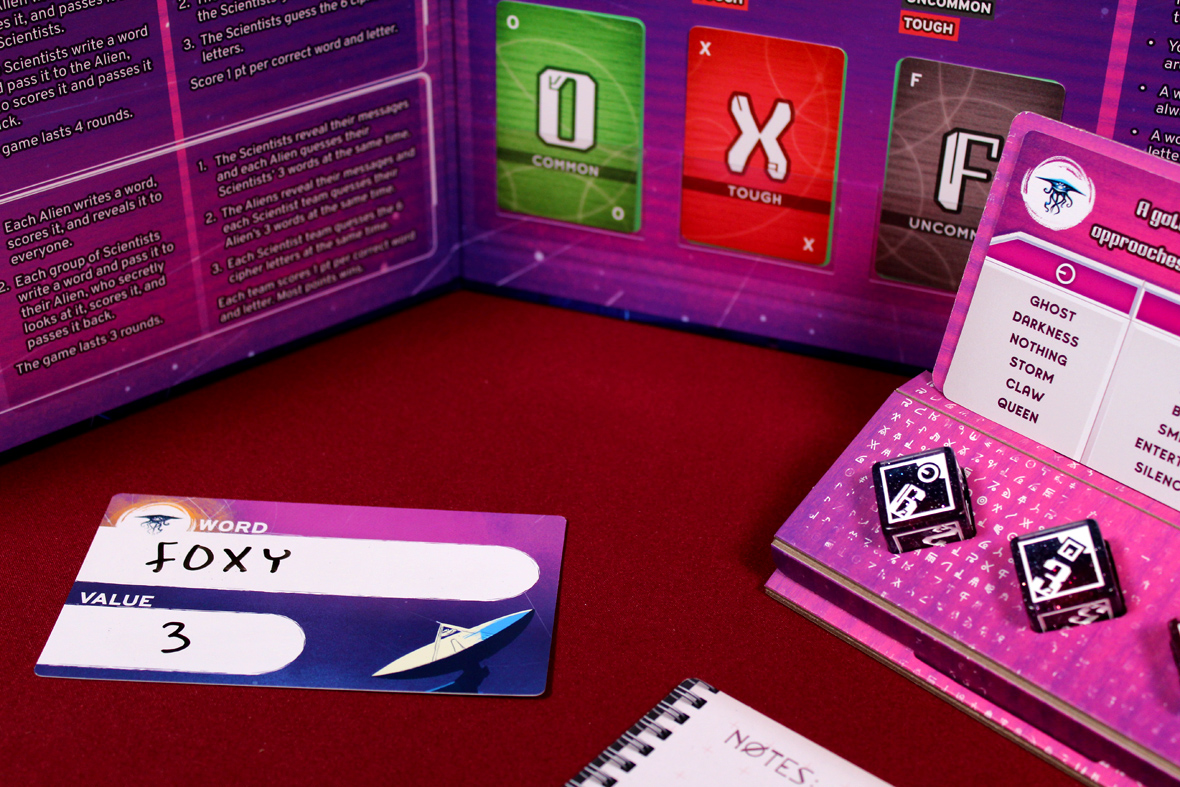
The actual game is pretty easy! The goal of both teams is to guess the three words in the other team’s message. The Scientist’s team has one more goal: correctly guess the six letters of the Alien team’s cipher!
Each round, the Alien starts by writing one word of their choice on their Transmission Card and scoring it based on the Cipher. A few rules:
- You cannot use any words related to or present on your Message Cards.
- Each Trust Letter in your word adds +1 point to its score.
- Each Amplify Letter in your word multiplies its score by 2.
- If one or more Suspicion Letters are present in the word, the score is negative. One exception: if the score would be zero, it says zero. Negative zero isn’t a thing.
Then the Scientist sends a message back and the Alien scores it! The Scientist should use the information they get to figure out what the cipher letters might be. Keep in mind that any word with 0 Trust Letters in it must be 0 points. Math!
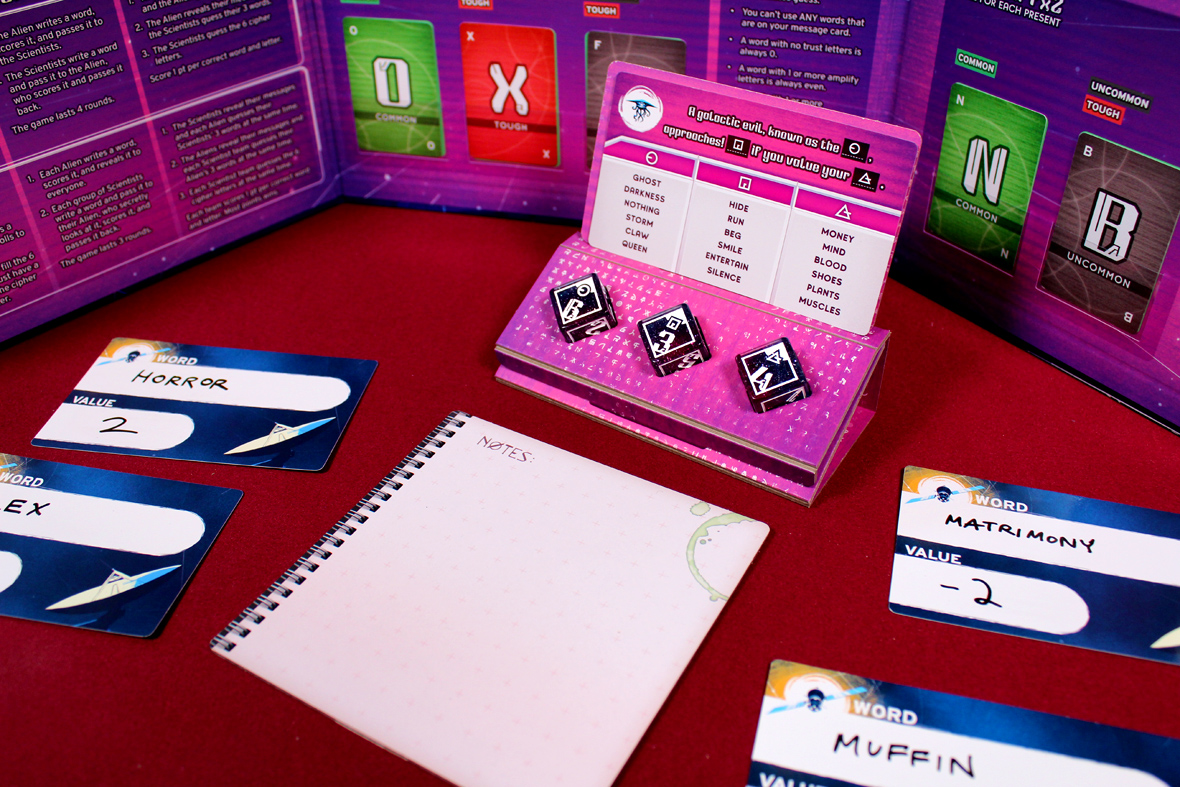
After four rounds, the game ends! The Scientists show their Message Card and the Alien team tries to guess the three words. One point each for the ones they get right! The Alien team goes next. One point for each word the Scientists get right! And then, the Scientists guess the Cipher letters! One point for each one they get right. Max score is 12!
Player Count Differences
This is one of those games where more players usually means you end up being on one team or another. I call it multi-headed play. You still only have one Scientist team and one Alien team, but now … more people are also playing! Hooray. It’s largely fine, though I don’t like that kind of play for a variety of reasons. Information gets leaked, not everyone gets to touch everything, you have to pass committee review to get anything done. Sometimes it’s really fun with the right group, or you can outsource things to younger players so that they get to be included. In those circumstances, of course! Let’s go for it. In the interim, though, this is definitely a game I prefer with two. There’s a team vs. team competitive variant, where you have two teams of Aliens and Scientists using the same cipher but different messages, and the higher-scoring team wins. That works if you want more players. Either way, I tend to recommend keeping the player count low.
Strategy

- I generally clue my words in order, but you can’t always rely on that. I think that’s not great from a metagame perspective, but it kind of is what it is. Sometimes there’s something more pressing, like getting a lock on your Trust letters, that might preclude this, so you can’t always assume that’s what the Alien player is doing (but it usually should be).
- For the Alien, you should try to clue your Trust letters as quickly as possible; it’ll help prevent the Scientist getting 0s on their turn. 0s aren’t inherently bad (they rule out all letters in the word as being Trust Letters), but they don’t give you any information about Amplify (and can occasionally misinform about Suspicion, since negative zero is still … zero).
- Generally speaking, look for patterns. Some things are pretty easy, but others are less helpful. If you get a score of 2, did you have two Trust Letters, or one Trust and one Amplify? It’s difficult to be certain. A 3 is much easier to lock down (no Amplify). Negative numbers are also always simple, since that means the Suspicion Letter is among them, so long words with a positive score are a great way to weed out a lot of Suspicion options.
- If you find the Tough (red) letter, you can cross all red letters out on every other spot. So that’s nice. There’s only one Tough letter across all six options in the game. Finding it really knocks your other options out, and similarly, if you find that five of your six letters aren’t Tough, the sixth must be. That can be helpful too!
- Sometimes going for the shortest possible starting word with all three of your Trust Letters can be superb. You can lock that down straight out of the gate and then just keep going. Good luck if your vowel options are O or I, though; those make some words much more annoying.
- Don’t forget to clue your Message words, though! You can … sometimes get too into the Cipher cracking and forget to actually give words that help your coplayer guess the message you’re trying to send. I say this with some experience.
- Scientists: take notes, but talk out loud about your thought process! It can help the Alien figure out what you’re still confused about. Don’t do that thing where you try to lead the Alien, of course, but talking can really clear up where you’re not sure. Should the Alien focus more on Trust or Amplify? Are you getting a sense of what kind of words you’re trying to send and what scores you expect?
Pros, Mehs, and Cons
Pros
- The Companion App is a must-have, and I really appreciate that it exists. This is one of those deduction games (like Cryptid, for instance) where messing up at all can make the entire game invalid (Loot of Lima, too, for a more Allplay-aligned one, but that one impressed me less). Having the Companion App to double-check the values can sometimes be the difference between a good game and a scrapped one (as someone who can occasionally be a bit clumsy).
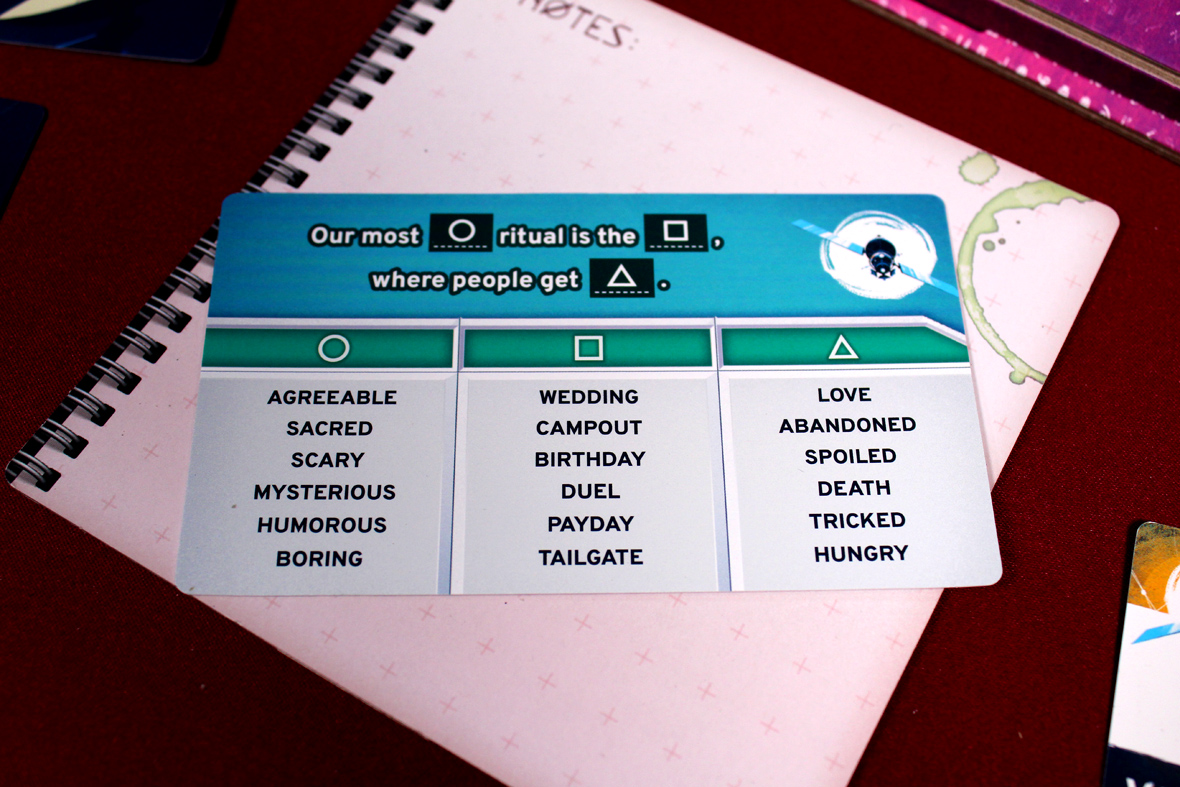
- I appreciate how silly some of the messages can be. I was once forced to let the Alien team know that I was the only person on my ship who could read, for instance. It’s goofy.
- It’s not quite a cipher-solving game, but the deduction around how the words work is pretty fun. I wish there were more types of ciphers you could use, for instance, just to mix up the deduction every now and then (a Turing Machine-style game where you picked three cipher types at random would be really cool, though I understand there are reasons why, mechanically, these three were chosen). That said, I enjoy getting to work backwards and try to figure out what’s possible based on the rules of the game. For mathy-deduction folks, this game is a great pick.
- It seems like you could expand this game in multiple directions. More cards, easily, but like I said, alternate cipher options or a more elaborate victory condition for cooperative play would be nice.
- Having a competitive mode for players who like that sort of thing is nice. You do need at least four people (though, reading it now, you could play it with one Alien that’s on a team with each Scientist without much trouble). I tend more cooperative, but this is largely the same game just split into two teams. Doesn’t say how to resolve ties, but what can you do.
- I do love Allplay’s consistent box sizes. It’s nice to always know what to expect.
- The back and forth can be pretty fun. I enjoy playing as both teams. Deduction on one side, planning on the other. It’s got a similar feeling to Codenames, at times, but with more meat to it from a math standpoint.
- There’s a nice level of approachability for various facets of the game. I was playing this with my friend and her son and while, say, he wasn’t as hyped about all the math, I could ask him “hey, can you give me a word that has this letter and this letter and is related to this?” and he’d do pretty well! So, that was a nice way to let younger players feel included.
Mehs
- I wish there were a more exciting endgame goal than just “try to get 12 points”. It feels a bit arbitrary, which is a bummer. Even one of those tiered scoring things (which I find a little boring) would at least give me a sense of how it all comes together. Or different difficulty modes with their own scoring would be nice.
Cons
- This one’s a mathy one, so it might not be for everyone. It’s not a particularly aggressively mathy game, but your only avenue of deduction is largely math-based (since you’re working back from the various cipher values). If that sounds fun, great! If not, no hard feelings..
- I’ve found that players struggle a bit to pick this game up from just the rulebook. I’d be loathe to say the rulebook is “poorly written” or anything; I just think the game can be a bit abstract and that it doesn’t necessarily make sense to new players that I’ve introduced the game to. It might make sense to try and introduce how the rounds work, and then introduce the cipher score once you’ve gotten that locked down.
- There’s a weird metagame-y pattern implication that seems a bit odd. You need to clue three words and you have four chances to do it. Seems to me that the strongest move would be to make your first three words correspond to the strongest clue for word one, word two, and word three, and then use your fourth word to indicate an overall vibe (or, for the alien, make it clear what letters in the cipher still haven’t been guessed). That’s not a particularly fun bit of metagaming that you can do, though, so it disappoints me a bit. It’s not always explicitly the best thing to do, but since there’s no real victory condition, it feels like it’s generally the right decision.
Overall: 8.5 / 10
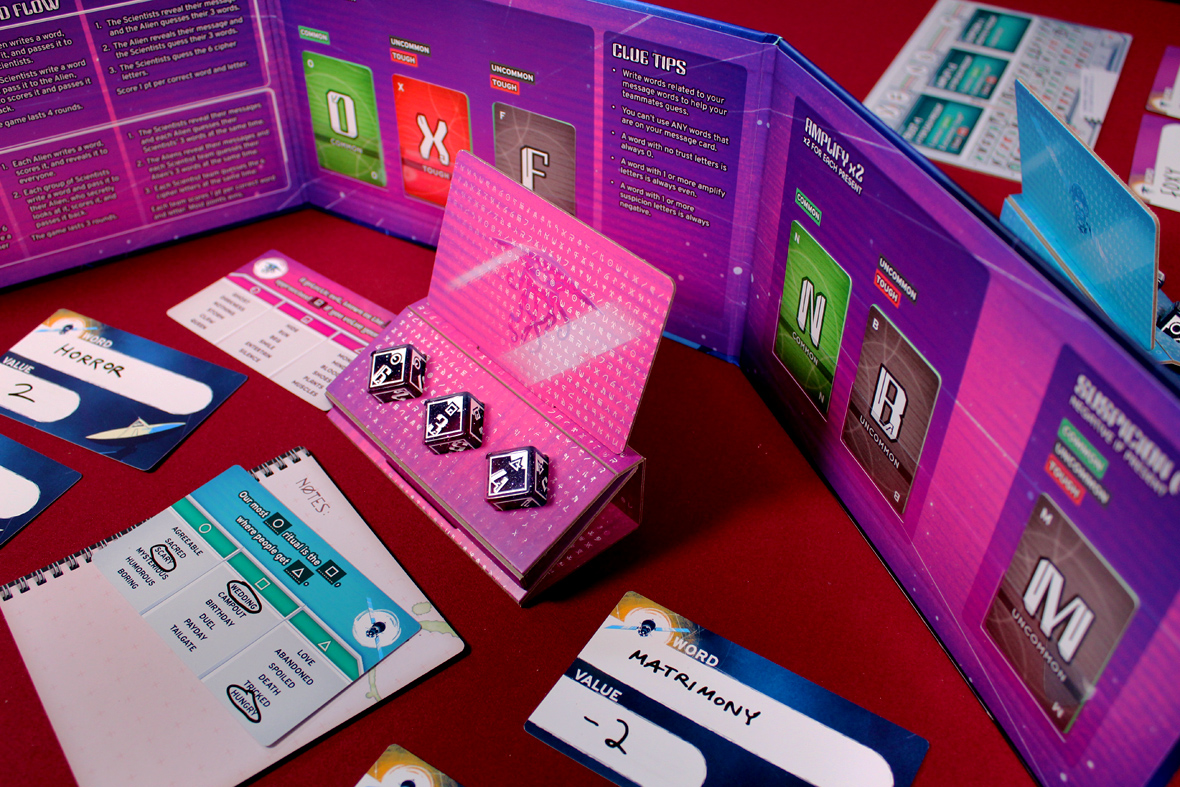
Overall, I enjoy A Message from the Stars! It’s a game that I wish had a bit more complexity to it, but that’s because the core play loop is really what I’m looking for in a game. It has that same deductive entertaining factor as Turing Machine, as I’ve mentioned elsewhere, but it’s more word-focused than passcode-focused, allowing for different styles and combinations. Yes, I think it’s probably best with two so that everyone kind of gets to do their own thing, unless you’re doing the competitive mode, but I find a lot of deduction games better with two players. They all lead to a lot of thinking, which can slow the game down as you add progressively more people, and here, you’re often searching for one very specific word. It’s satisfying when you find it, and the cipher mechanic makes the word fun to score (or surprising, for the Scientist), but you’re really doing more of a generative task as the Alien and a deductive task as the Scientist. Whichever you prefer is up to you. I’d love to see more from this game because I think it is a lot of fun, but also, some parts feel a little unfinished. The whole “12 points” thing feels a bit abstract for an otherwise very thematic game, and I’d love to see if there’s some way that the game’s end can be made more exciting or more engaging to complement the fun parts of the rest of it. But in the meantime, I think this is a game I’ll come back to every now and then; I’ve had a lot of fun playing it. And if you enjoy deciphering messages, deduction, or incomprehensible conversations with the aliens beyond, you’ll likely enjoy A Message from the Stars, too! I’d recommend it.
If you enjoyed this review and would like to support What’s Eric Playing? in the future, please check out my Patreon. Thanks for reading!
 What's Eric Playing?