
Base price: $25.
1 – 4 players.
Play time: 20 – 40 minutes.
BGG Link
Buy on Amazon (via What’s Eric Playing?)
Logged plays: 2
Full disclosure: A review copy of Parks: Roll & Hike was provided by Keymaster Games.
Ah, one of the great delights of my time is having a friend over who is playing Hades for the first time. Fun to play, fun to watch; just a big fan of the game overall. I haven’t played Hades II since the Early Access launch, and I think it might stay that way until the full release. I love that game, so I’m excited to get to play it in full in a while. We’ll see. Love a rougelike, which is also why I kind of enjoy playing roll-and-write games! It’s a similar experience from jump every time, and sometimes there’s ways to spice it up! Let’s dive into a new one: PARKS: Roll & Hike, from Keymaster Games!
In Parks: Roll & Hike, players take on a casual walk through one of six different National Parks of the United States! Each has their own quirks, but your fellow hikers and you have a wager in place: who will have the nicest time? So break out your journals, fill up your canteens, and get ready for a nice trip! Can you successfully have the nicest time?
Contents
Setup
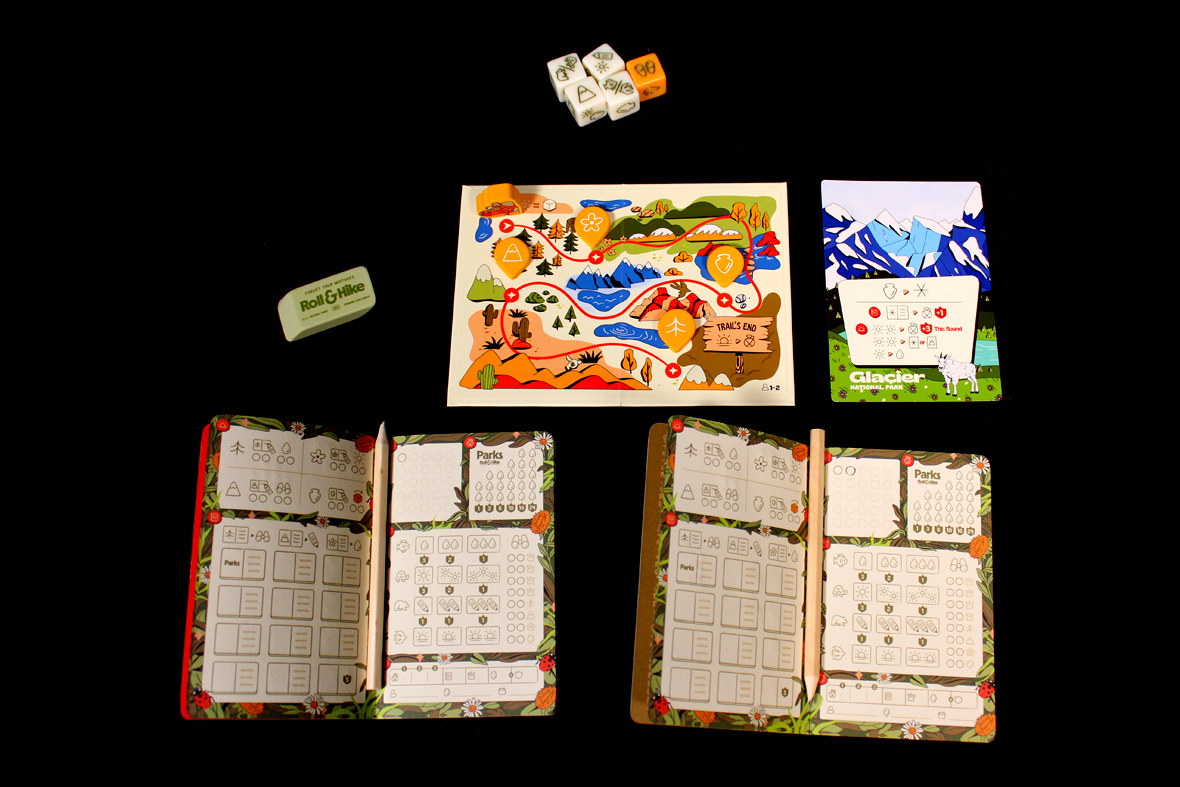
Give every player a logbook, to start!

Each player gets a pencil, as well, but you can place the eraser nearby; it’s everyone’s eraser.

Set the board out to the correct player side, and then shuffle the Trail Tokens and set one above each of the trail markers on the path on the board. If you’re playing with two players, you don’t need the binoculars. (You can set the foot marker / Group Token on the first space.)

Choose a Park and place it action-side up. That’s the Park you’re using this game! Each has their own effects and symbol to use later.

Roll the dice and place them near the board:
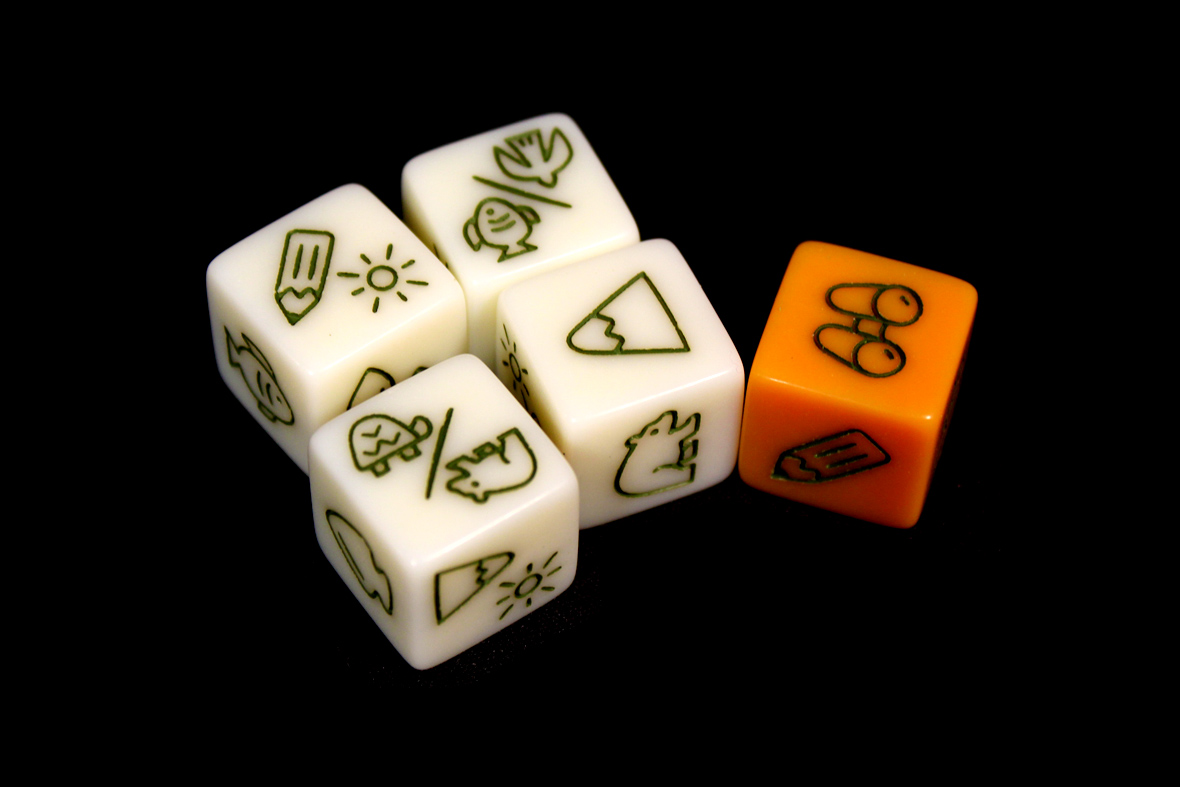
And you’re about ready to start! The second player gets a bonus Sun icon, the third player gets bonus Sun and Water icons, and the fourth player gets two Suns and a Water.
Gameplay

Your goal is to have the nicest trip over three days! Each day is divided into the Hiking Phase and the Sunset Phase. Each turn of the Hiking Phase, you’ll take a standard die or the Lead Hiker die from the dice pool and use its ability. If you want, you can take the Lead Hiker die, but that’ll cost you one Sun icon for each standard die remaining.
When you use a die ability, you can make a mark in your logbook for the specific action. Usually that lets you gain something for later, or lets you draw a symbol in your journal corresponding to the die face. Some get you immediate points, like Water; some give you additional abilities, like Binocular or Wildlife rolls; and some let you scribble lines next to already-filled-in journal pages, like the Pencil. If you take a die and can’t use it, you just gain a Sun.

When you take the Lead Hiker die, you gain the action on the die and the symbol on the next space of the board, moving the Group Token forward. All other players get to add a line to their journals for the corresponding symbol (for Binoculars, they can just choose). When the Group Token reaches the end of the trail, the day ends and the Sunset Phase happens.
During the Sunset Phase, players get all their Sunset Bonuses, score their Canteen, and take any additional actions from the Park Card.
Play continues until the end of the third day. Total your points (including one point for each line written on journal pages), and the player with the most points wins!
Player Count Differences

It’s going to be a lower-scoring game with more players, since the end of the game will come around (relatively) faster. Here, you’re looking at the Group Token advancing every time someone claims the yellow die. That could happen at any pace at any player count, though it’s less likely to happen straight out the gate any given round (because it costs more Suns the more standard dice are still unclaimed). When it does happen, however, you’re a little bit closer to the end of the current day (and the end of the game). There are always five dice in play regardless of player count, so you’ll get fewer turns per player at higher player counts (even than two, despite there being one fewer space on the board). It’s not a bad thing at all; the game is still pretty snappy and very fun. You just need to be careful about what you’re optimizing for, given that you’ll have fewer turn-specific chances to do it. I really enjoyed the game at two players and three, however, so I wouldn’t say I have a super-specific preference for player count for this one.
Strategy
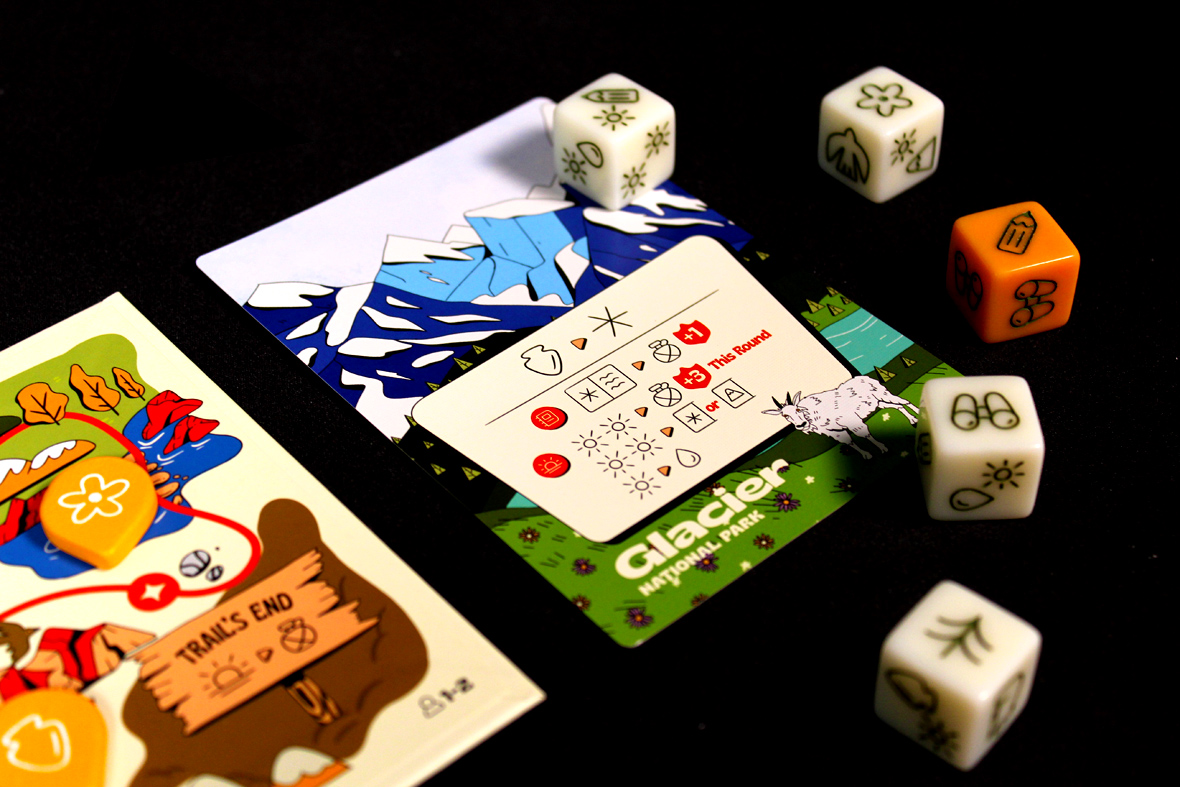
- The Canteen route isn’t a bad play. You get progressively more points every time you fill up a canteen with water icons, so there’s something to the idea of getting as many as possible early on to try and accumulate as many points over the course of the game (since you re-score it each day). That’s similar to, say, Cartographers, where a coin in the first round is technically worth 4 points for the same reasons. I’m generally pro-doing this, but it might be hard to pull off logistically because, again, you just aren’t going to likely be able to get that many of the same die face or token.
- I usually go after at least one Sunset spot to get some more Sun icons. It’s a bad idea to run out of Sun icons, just because they give you a lot of flexibility. Usually they can be used for special end-of-round (Sunset) actions for your specific park, and they also let you take the Lead Hiker die earlier and potentially get some bonuses that way. You don’t want to be in a position where you don’t get those because you have zero available Sun icons.
- You don’t want to waste actions, especially bonus ones. There are a lot of bonus actions that can go potentially wasted. If you don’t have journal pages to write in for specific icons? Wasted. If your journal gets too full too quickly along with the icon-specific sunset spots? Wasted. If you use up the Wildlife actions too quickly? Wasted. There’s an optimization curve to all of this that’s not particularly trivial to place and learn, but that’s part of the fun of the game. Try to enjoy it rather than stressing, but also try not to waste actions.
- Wildlife actions are pretty useful, especially if you go deep on them. They give you progressively more stuff each time you activate one, and you can get a bonus for getting Wildlife actions adjacent to other Wildlife actions in your logbook. Seems pretty valuable to me.
- Getting to the last page in your journal is also generally a good idea. You get a bonus 5 points and you have a ton of spaces to add lines (which give you an extra point each at the end of the game).
- Keep an eye on the Park-specific actions and bonuses you can go for. There are six and they generally synergize with the theme of the Park you’re on, but you should lean into those if you can. After all, they’re Park-specific; if you ignore them, you’re not really playing the whole game.
- I still think that at higher player counts, hate-drafting makes progressively less sense. Hate-drafting, here, meaning taking a die that you don’t particularly want to keep someone else from getting it. There are examples you can likely come up with where it is still the best move, but in general I think you should act a bit more selfishly with more players, especially since you get fewer overall actions per game.
Pros, Mehs, and Cons

Pros
- Keymaster is probably one of the best companies in the industry when it comes to branding, end-to-end. It’s the consistency of the experience, from the little logbooks to the pencils to the “Forget your mistakes” branding on the eraser. There’s an aesthetic pursuit of, I don’t know, the superlative at Keymaster, and that’s why they’re consistently top of the industry? It really shines through in pretty much every game that they make.
- I do like the art style in this a lot. There’s a consistency across what feels like color temperature so that even the bold colors are relaxing and easy on the eyes as you play and it makes the entire game feel significantly more cohesive again, as an experience. I don’t see a lot of other places putting this much attention to detail, and it really shows at every step.
- Having six very different parks to play around in is nice. There’s a thoughtfulness to that kind of design that I like, but it also demonstrates that this is a compact experience that you can still vary a good bit.
- I find the game itself fairly relaxing. It’s a surprisingly chill game for its depth, which is something that’s pretty consistent across the Keymaster portfolio, to be fair.
- Pretty portable. It’s a little box! I like that sort of thing, and have actually carried it with me to a number of things, including OrcaCon.
- The logbooks are a lot of fun. I like getting to scribble in them and draw icons and stuff; that’s really the best part of the roll-and-write experience. I also appreciate that they went for icons that are largely easy to recreate but distinct enough that you can vary it a bit if you want your logbook to be more aesthetic.
Mehs
- Like PARKS before it, the lovely exterior can hide a surprising amount of complexity. It’s not a particularly complex game, to be fair, but there’s enough to it that even I found myself frequently looking back at the rulebook. I’d put it just on the high end of casual play, complexity-wise, as a result, and mostly put this here to set expectations. It still fits in nicely with the PARKS family, though I’d put it firmly between PARKS and Trails. Though, now that I’m looking at the BGG page, it looks like they’re going with Parks for the second edition, rather than PARKS. Something to think about in the future, I guess.
- This is always a stupid concern of mine, but I get that anxious panic of finality about the little logbooks. “What if I run out??”, my silly smooth brain suggests, despite the fact that as a reviewer playing a game more than five times that isn’t on BGA is an absolute luxury. It’s going in the Mehs because I whine about it but it’s not a real concern. Granted, if this is your favorite game and you play it every night with your family, it might be, but they sell more logbooks and have a PDF of just the player sheet. They’ve anticipated all of my fears and preempted them; that’s just good business.
Cons
- It’s not bad in the slightest, but I do miss the Fifty-Nine Parks Project art from the original PARKS game. I really liked those and while I imagine there’s branding considerations and just, honestly, scalability and contracts, I’ll always miss those a bit. That said, I did mention as a Pro that the art looks great, so, you know, I can contain multitudes on this.
Overall: 8 / 10

Overall, I think Parks: Roll and Hike is great! Probably a must-try, if you’re already deep in the Keymaster portfolio, but I think this entire game family is designed to appeal to the weirdos up here in Seattle that actually go outside. Yes, I need a vitamin D supplement; I’m still not going hiking. I wouldn’t necessarily call this a “cozy” game in the same way that I’d talk about a Flamecraft or a Verdant; I’d instead go with a “chill” game. You’ve got a good amount of strategy to it, but most of the thematic thrill is in the gentle joy of exploration and discovery and the trip. It’s about the journey, not the destination, I guess? I think there’s still a growing population of folks who really like those kinds of games and this game is definitely up that alley. As I mentioned, it hits nicely between Trails and the original PARKS, in terms of depth and complexity, and it keeps pretty consistently to that thirty-minute playtime, so it’s a great game to break out among friends for a quick and thoughtful experience. It helps that I can harp on that word experience, though, because Keymaster has bent over backwards to make sure that the Roll and Hike experience is curated. Everything is consistent and intentional, from the branded pencils to the art to the just, overall vibe of the game. It’s a look at not just a game as a piece of art, but a game as a product as a piece of art. That’s pretty interesting because it’s inextricably linked to the product itself, but I can’t say I mind it. If every game was working this hard to provide an end-to-end experience, we’d really be in a good spot. As for the game, it’s a lot of fun. Good strategic variability, lots of options for how to play and what to do, and a nice narrative through-line that takes players from the start to the finish with a lot of ownership of their plan and strategy. Like a good trail or a secret spot, Parks: Roll and Hike provides the kind of experience you could see yourself returning to again and again with new groups of friends, and if you’re looking for that or you’re delighted by the kind of chill outdoorsy vibes that Keymaster is trying to cultivate, I think you’ll have a lot of fun with this one!
If you enjoyed this review and would like to support What’s Eric Playing? in the future, please check out my Patreon. Thanks for reading!
 What's Eric Playing?