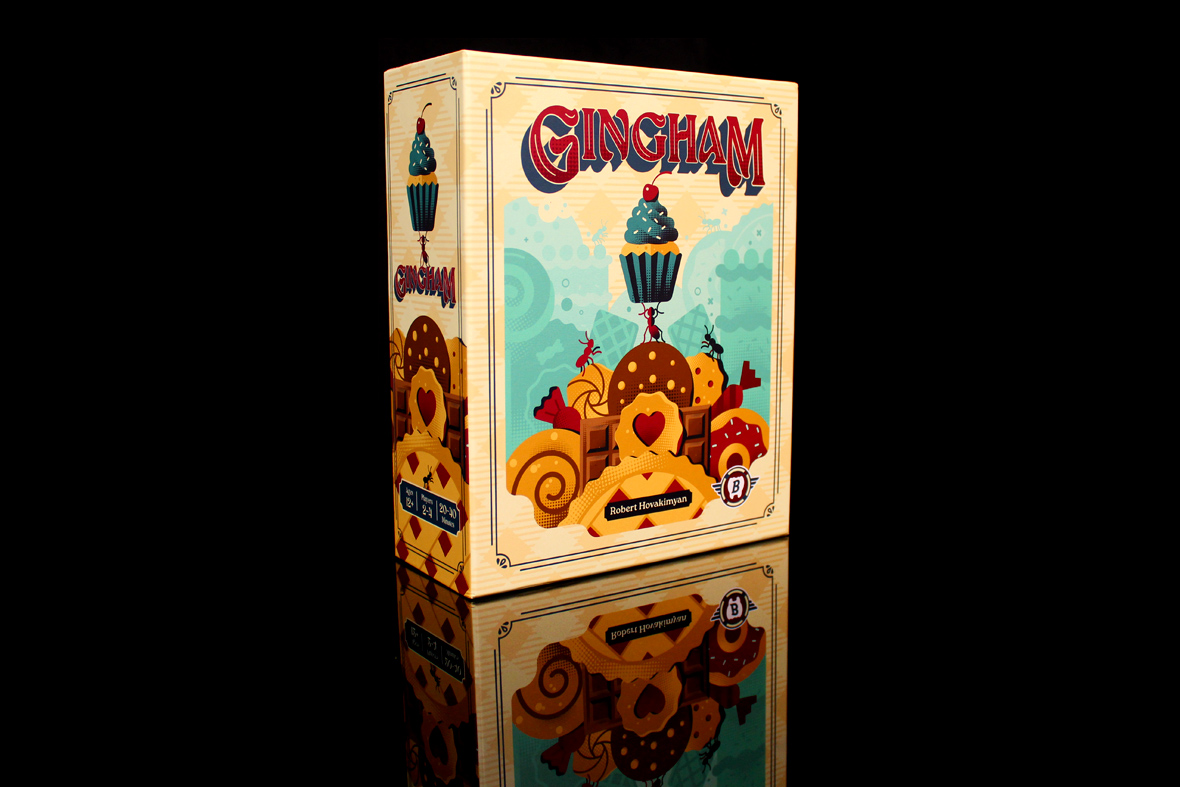
Base price: $XX.
2 – 4 players.
Play time: 20 – 40 minutes.
BGG Link
Check it out on Kickstarter! (Will update link when Kickstarter is live.)
Logged plays: 1
Full disclosure: A preview copy of Gingham was provided by Bitewing Games. Some art, gameplay, or other aspects of the game may change between this preview and the fulfillment of the Kickstarter, should it fund, as this is a preview of a currently unreleased game.
I’m at least somewhat soothed by the fact that this week doesn’t look like it’s going to be as catastrophically busy as the last one. I had some major launches at work, the American Tabletop Awards announcement stuff, and my normal job and reviews on top of everything else, so I spent a large chunk of this weekend just conked out, asleep. Not my favorite way to spend a weekend, but, hey, it needs done sometimes. So here I am, 11PM, again, writing writing writing. This time it’s a Kickstarter preview, but it’s a bit of a ways off. Watch this space next week for my thoughts on Gazebo, this game’s sister game. Let’s talk about Gingham!
In Gingham, you and your fellow ants have scored big! There’s an entire abandoned picnic blanket absolutely covered with snacks. But you aren’t the only ones who’ve made it to the feast! Opposing ants with their own queens and colonies have arrived, and they have their sights set on what’s clearly your food! So stake your claim and build lines to transport the sweets you most rightfully want back to your fellow ants to score big! Can you successfully eat the most at this ruined picnic?
Contents
Setup
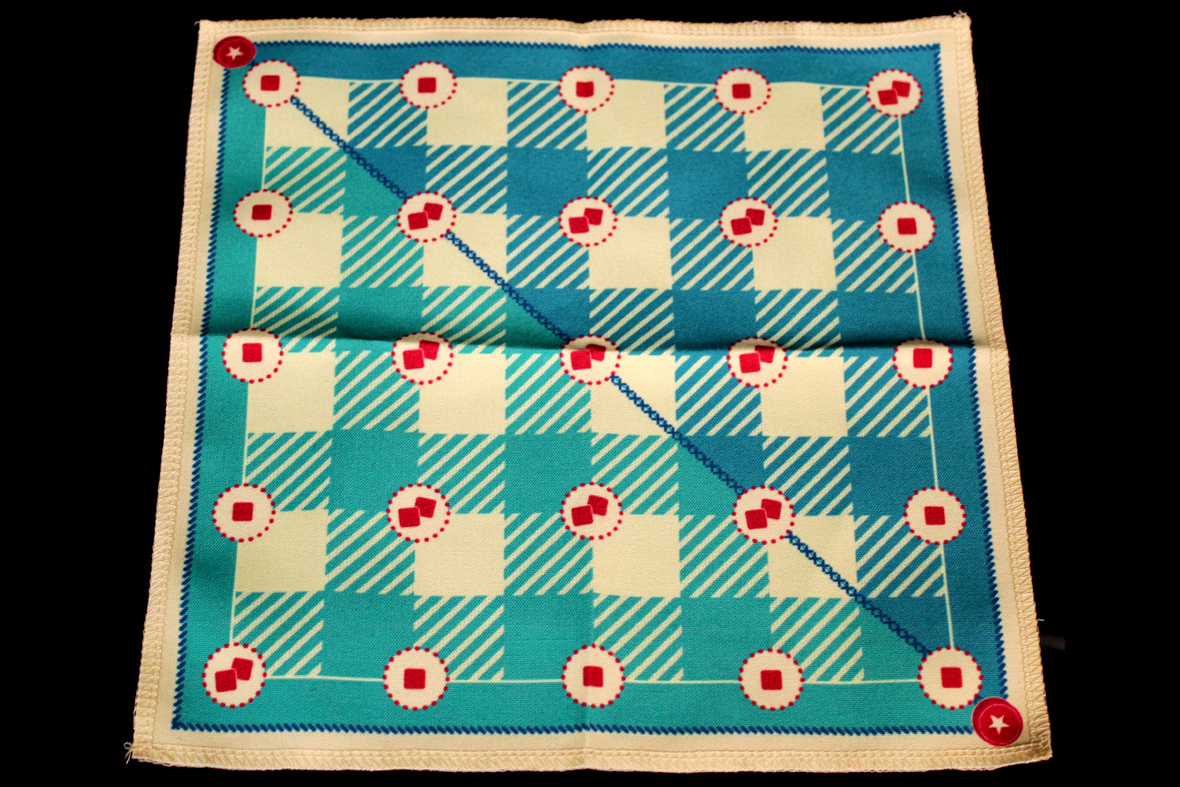
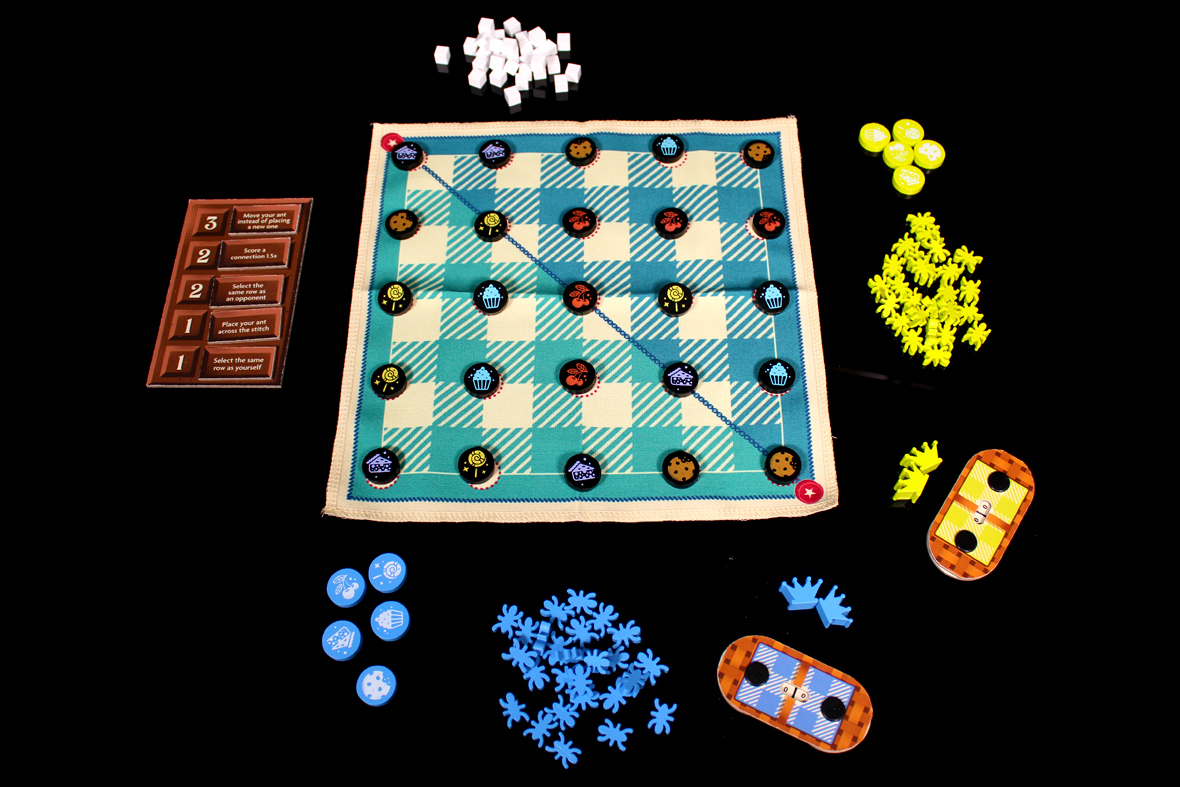
Not a ton of setup here. You’re going to place the board in the center. Big board for 3 – 4 players; small board for 2 players.
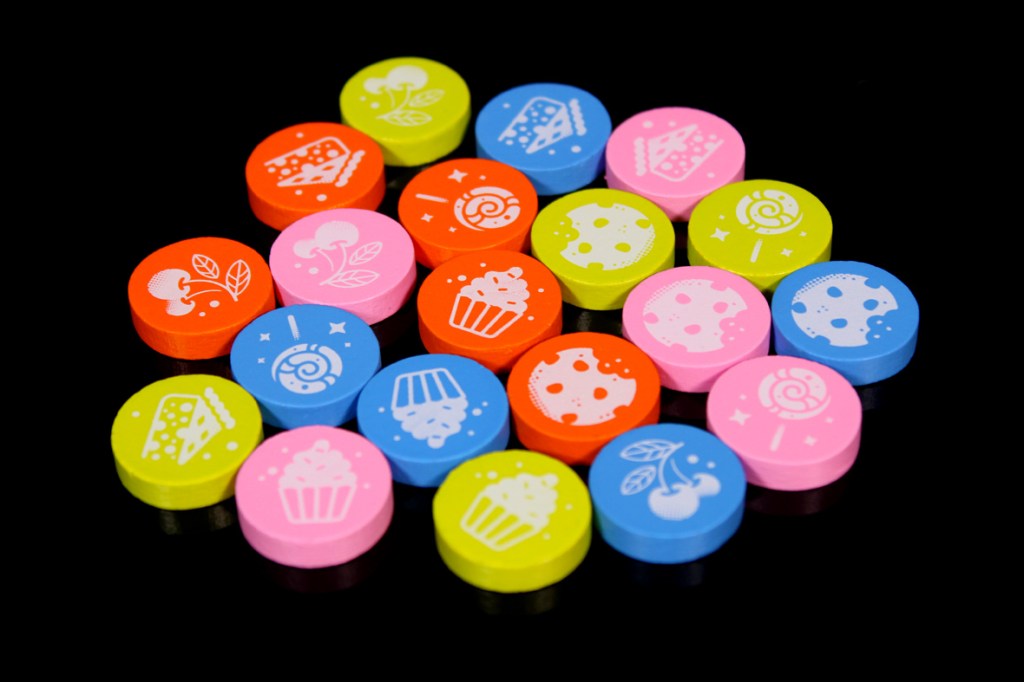
Then, shuffle the sweets:
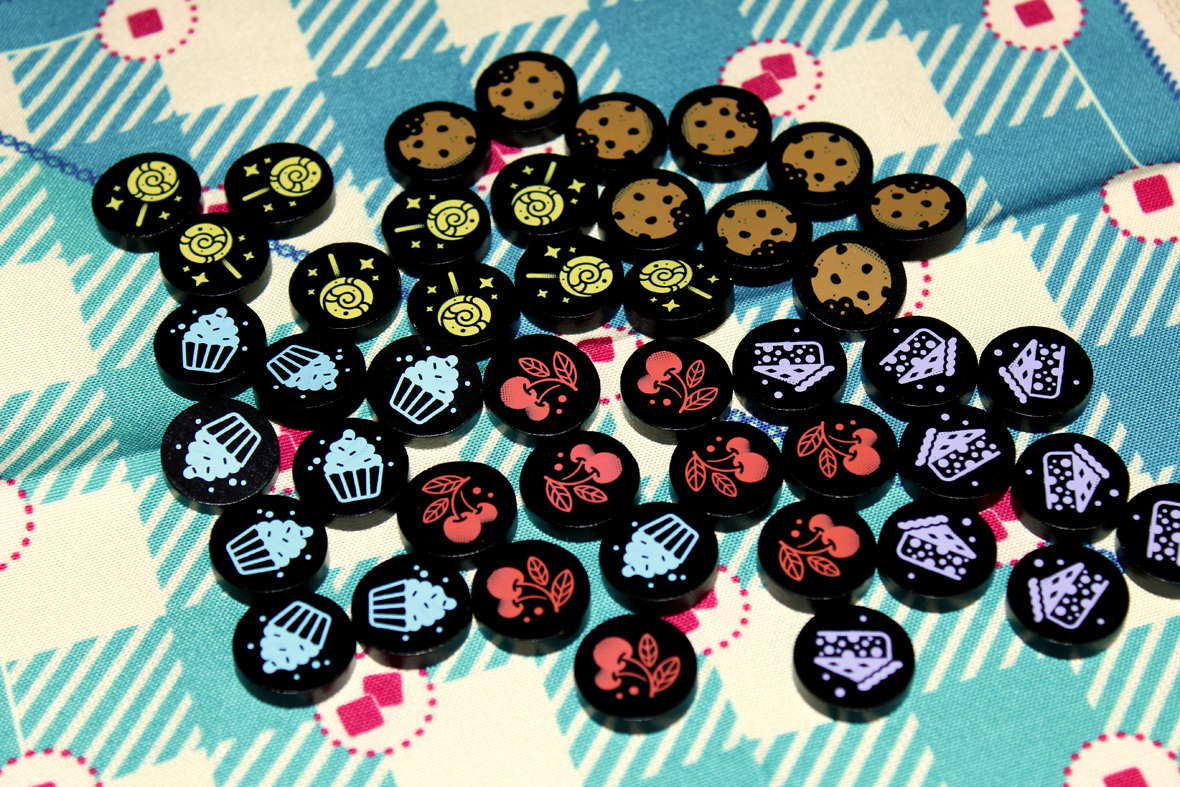
Don’t use the lollipops in 3 / 4 player games. Use 9 tokens each for 3 – 4 players and 5 tokens each for 2 players. Shuffle them and place one face-up on each circle space on the board (the intersections of the squares). Place the ability board next to the central board (shuffling up the abilities and placing them on the board).
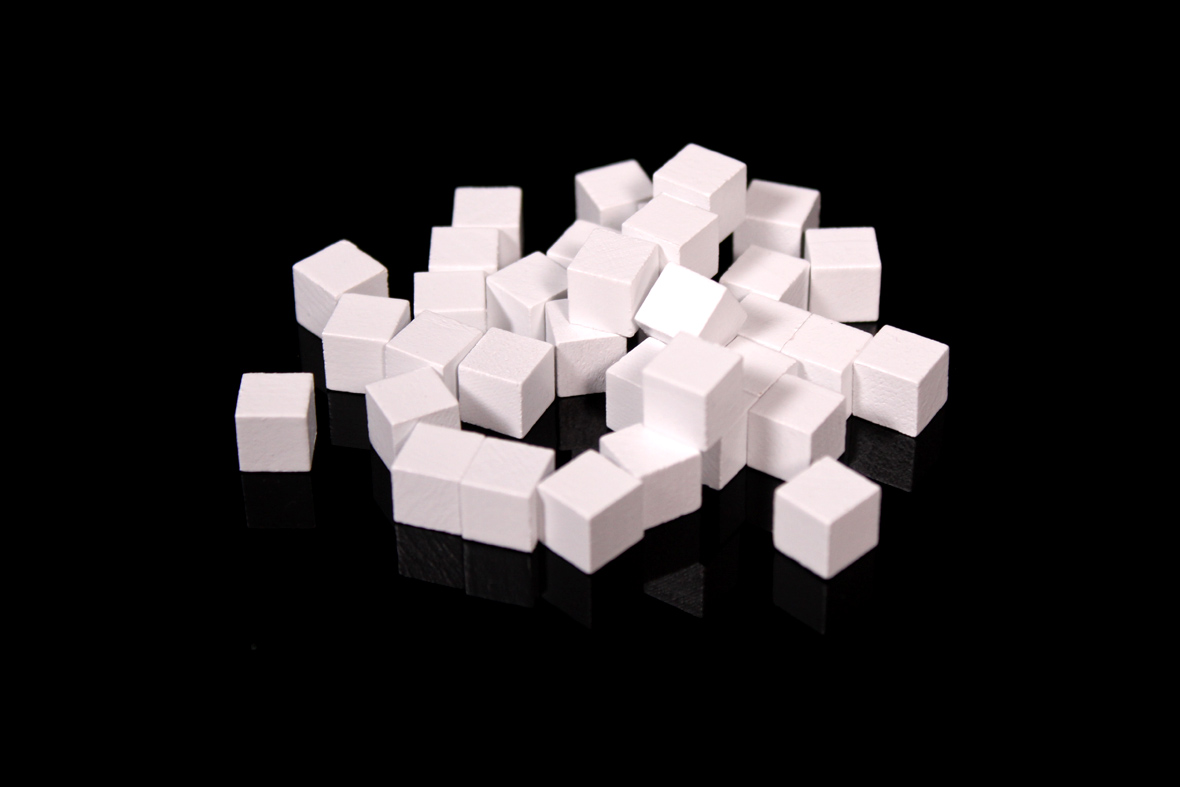
Place the sugar cubes nearby:
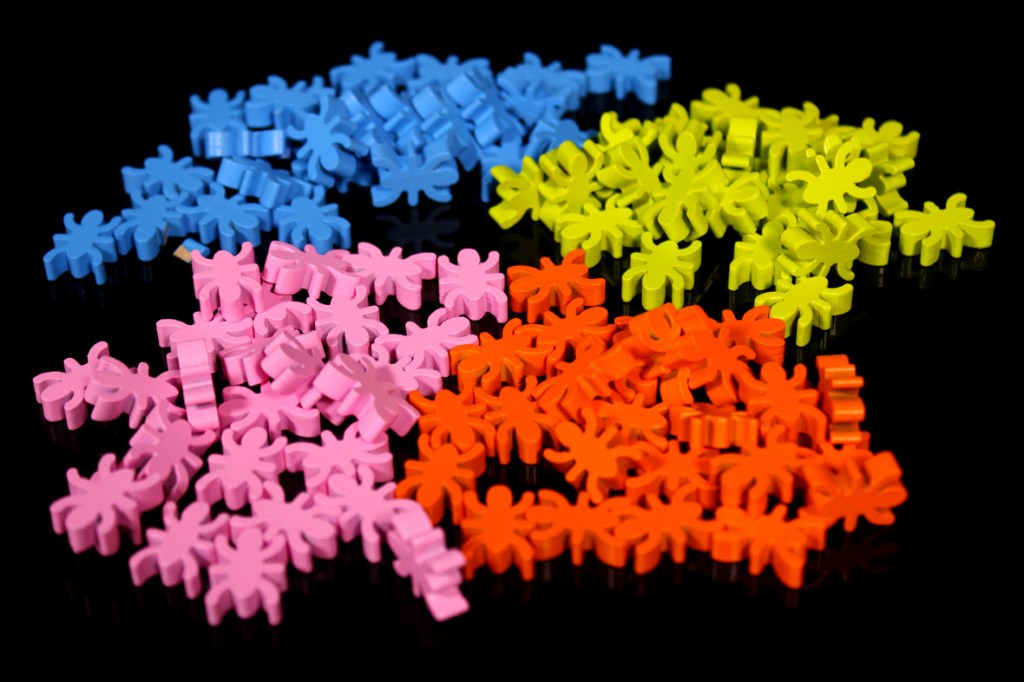
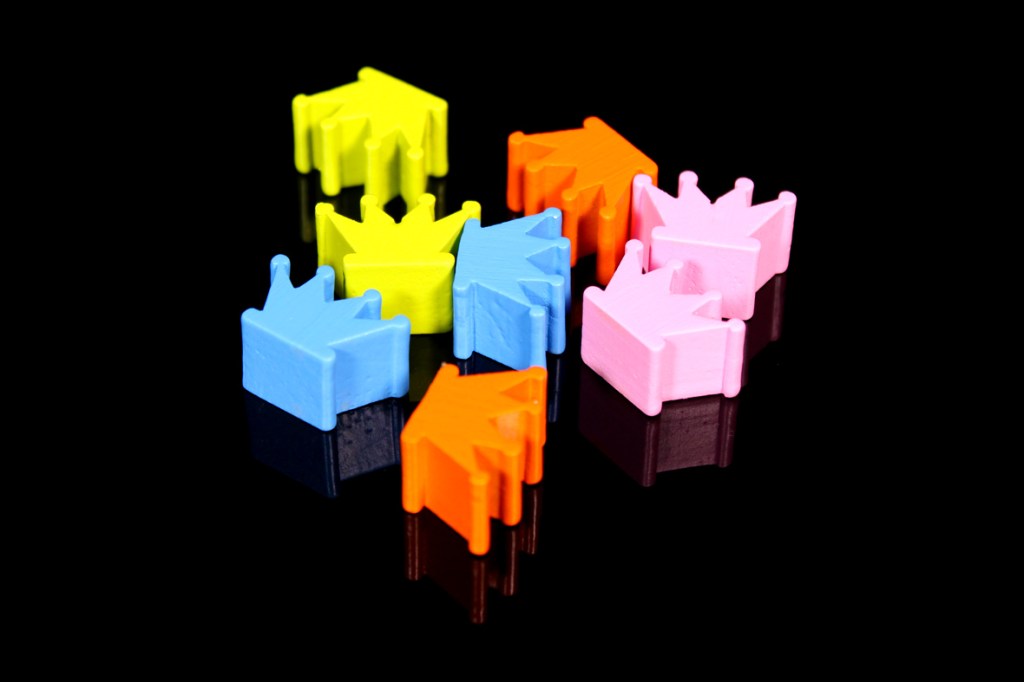
Each player then gets their stuff. They get the ants, two queens in the same color, and the claim tokens:
You should be ready to start!
Gameplay
Not a ton to report, here, which is nice. Your goal is to get points! So let’s talk about how to do that.
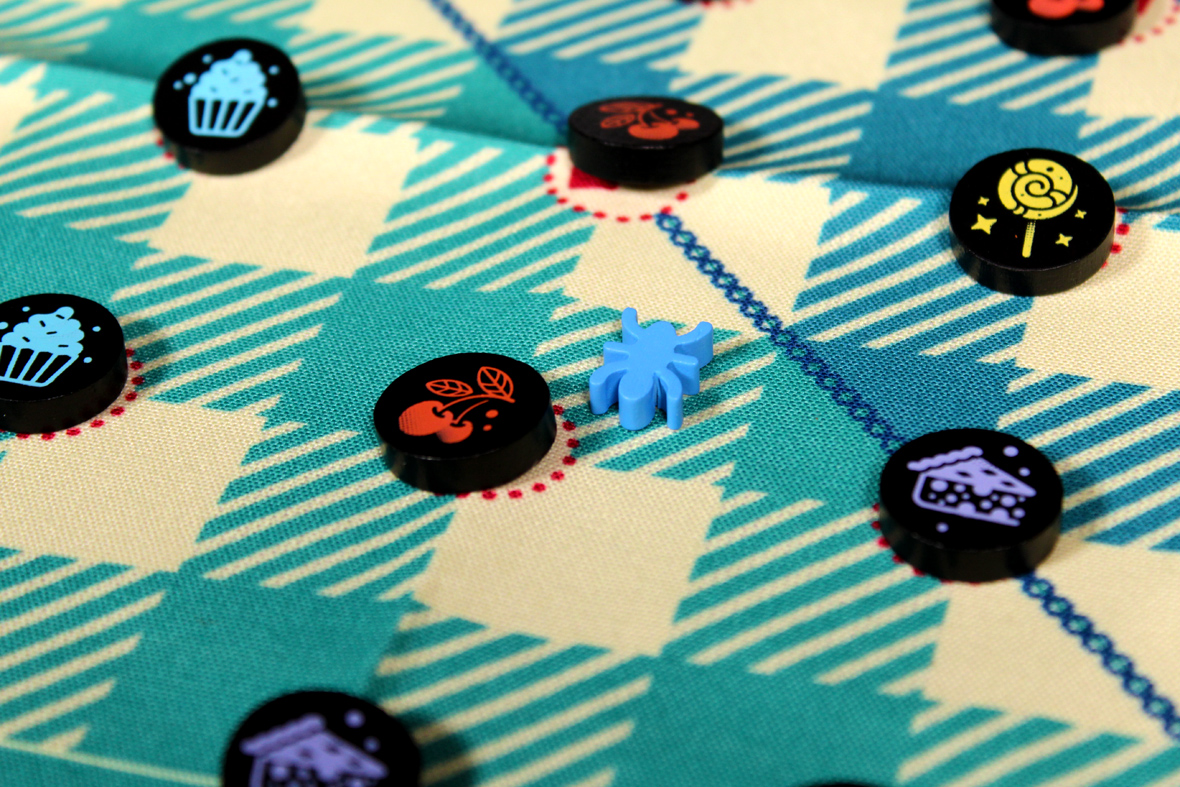
Each turn, you’ll place in player order determined by the previous round. For the first round, just go clockwise twice. On your turn, place your queen at the end of any one space along the chosen edge of the board (the first player of a round chooses the edge that everyone uses). Then, place one of your ants on any space up to and including the space that’s split in two in that row. We use rows and columns interchangeably here because, well, you can rotate the board. If another player’s ant is on your chosen space, you bump them and they’ll place on any unoccupied space at the end of your turn. You cannot bump your own ants. If you place next to a Sugar Cube(s) icon, you gain that many Sugar Cubes.
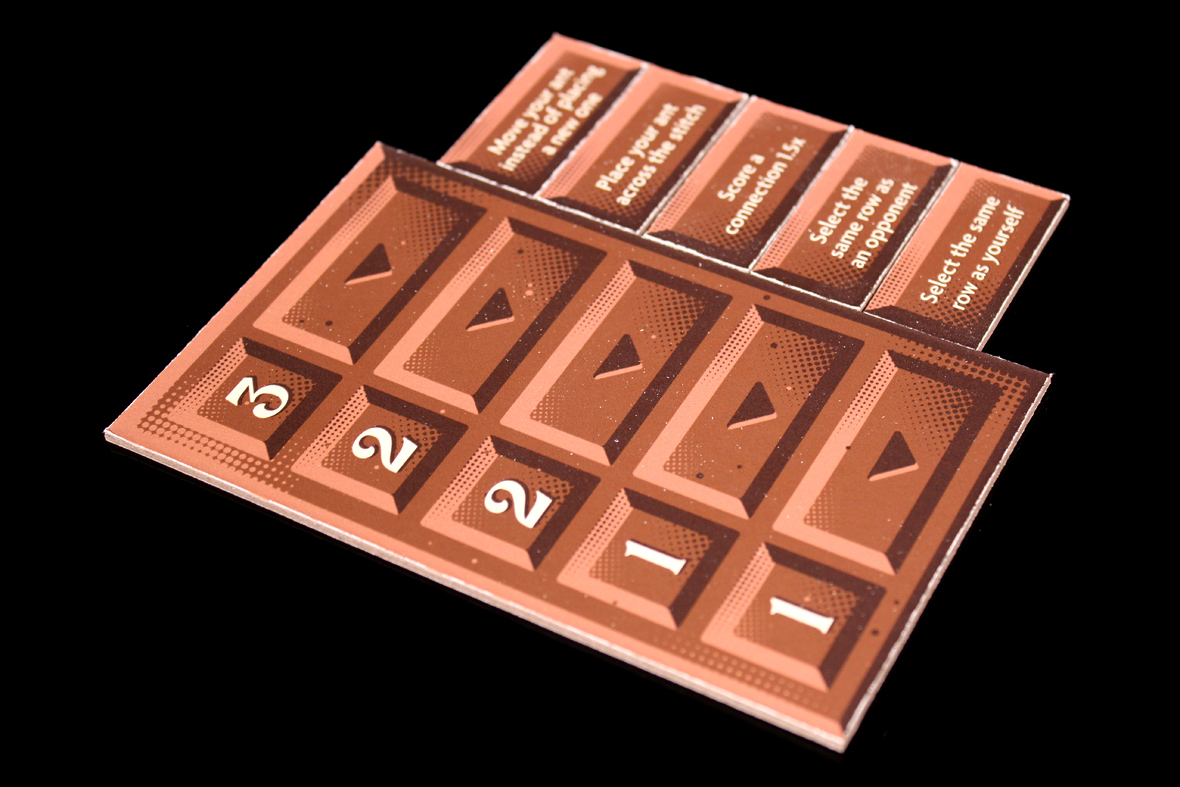
If you want, you can spend Sugar Cubes to use an Ability. Pay the cost, then move it to the top of the Ability Board and bump the rest down. Now it’s more expensive!
Once you’ve placed an ant, if you’re now making a connection (orthogonally) of ants of your color between two of the same sweet, you score 1 point per ant in the shortest path between the two. Then, move all the tokens on one of those spaces to the other space; your choice. If you’re completely surrounding a stack of sweets, you can choose to claim it! Count the number of tokens in the stack (including an opponent’s Claim token), score that many points, then remove any opponent’s Claim token and add yours instead. This does mean that your claims are never safe, so be careful!
After all Queens have been placed, the next round begins starting with the player whose Queen is closest to the Star of your given row. They choose the new side, and play continues. Once any player has 35 points (40 in a two-player game), they announce that and reveal at the end of the round and the game ends.
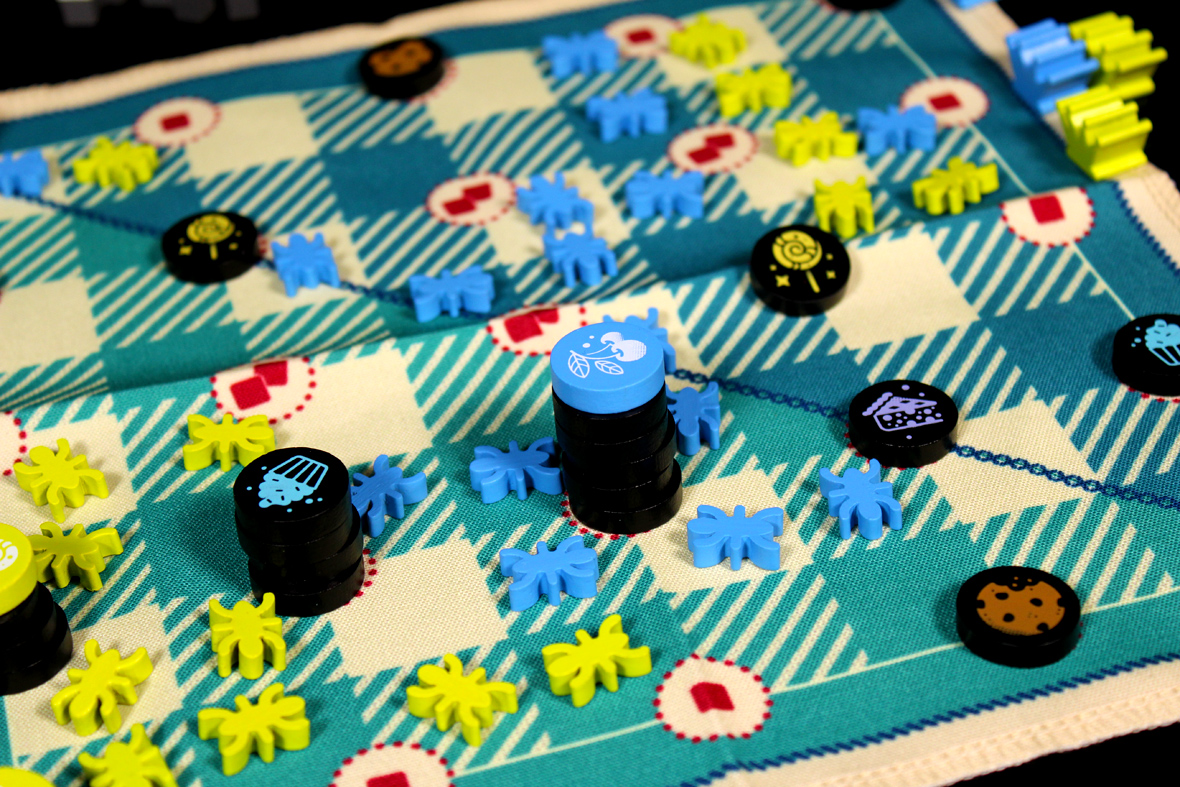
At the end of the game, there are extra points given out. Each player scores their Claim stacks again (one point per token in stack, including their Claim token) and then the player(s) with the highest stack of each type score 5 points for that type. Ties are friendly; all tied players would get 5 points.
The player with the most points wins!
Player Count Differences
Well, more players completely changes this game. Now you’ve got an entirely new, bigger board; you’ve got more players competing for more (but fewer types of) tokens; and you’ve got more blocking and bumping and stealing. Which lets us go back to a What’s Eric Playing? staple (sing along if you know the words): higher-player games tend to lean into more chaotic play. That’s neither good nor bad; it’s a function of preference. As usual, if you want your games to be more hectic, play with more people! You’ll see people scoring a little bit less frequently and lower overall (hence the reduced score threshold to end the game) but much more will be happening. You’ll have to figure out when you need to prioritize yourself instead of messing with others. With two, it’s much more clearly zero-sum; every point I keep you from getting is functionally the same as me earning one. I think I may be more interested in the chaotic play of higher player counts, but I enjoyed the strategic movements of a two-player game.
Strategy

- Long-line connectivity serves you well. The longer the line, the more points you get. The only challenge here is that the longer the line you’re trying to make, the easier it is to get bumped at any point in that lengthy connection by another player. They’re not just going to kick back and let you score 15 points, after all.
- Adding a bunch of tokens to your growing stockpile isn’t a bad choice. It depends on when you decide to claim it, after all, but if you make your stockpile more and more appealing you’ll find that other players may be fighting to take it from you. You can, of course, take it back, but that also takes time. Having the biggest stockpile in each type also earns you end-of-game points, which is useful.
- Building a stockpile in a corner is an interesting choice. It only takes one ant to kick you out and claim it, but if you don’t build up that stockpile it’s almost worthless by the end of the game. It might end up changing hands a bunch, or players might realize there are more lucrative fronts. Who knows.
- Where you move a piece after you connect it is almost as important as connecting it. If you beat another player to a spot, you might actually want to consider moving the token away from that spot so that they can’t make their own connection to that. You can live the dream of throwing another player’s strategy off without needing to sacrifice points. It’s the take-that having your cake and eating it too.
- It’s often worth thinking about player order, especially since the first player gets to choose the side of the board you’ll be playing on. This can be critical if you’re trying to pull off a big combo or try to win the game, since if you’re stuck on the wrong side of the board you may not even be able to place the piece you need where it needs to go (without spending sugar cubes).
- A healthy supply of sugar cubes is useful. It’s just one of those things where you need them for abilities, so you might as well have a few so you can use one when you need. Just keep in mind that they’re worth points at the end of the game.
Pros, Mehs, and Cons
Pros
- The strong little ant on the cover is working so hard. It makes me laugh. I generally like the art style of this game, though, so there’s a lot to like.
- I appreciate that the little cubes are actually in-universe sugar cubes. Too often, it feels like people use the generic cubes to be something else because they didn’t want to pay for something else. I always appreciate when the generic cube tokens are supposed to be actual cubes of some sort. It feels gratifying.
- I like the balance between connectivity and surrounding for points. There’s two different ways to score and while they have some synergy, they’re not wholly related, which is fun.
- It’s also nice that claims aren’t permanent. That keeps things moving and makes it so that you have no real avenues for full defense. If you focus on expansion, another player might just snatch your whole claim out from underneath of you. I like that! Live in fear.
- The focus on portability is really interesting. It’s nice to see more games that are portability-first rather than just small boxes, and I think the travel cases are going to appeal to a lot of folks who want to take things on the go. No idea how consumer tendencies are going to shift in the face of looming tariffs and such, but that’s a fun thing that we’ll explore when I’m talking about new games in three months or so, I suppose!
- The ability economy is super fun! It’s a least-recently-used cache, which we use sometimes in computer science, but I like that the least-popular ability also stays cheap! It incentives players to try thinking outside the box and mixing things up.
Mehs
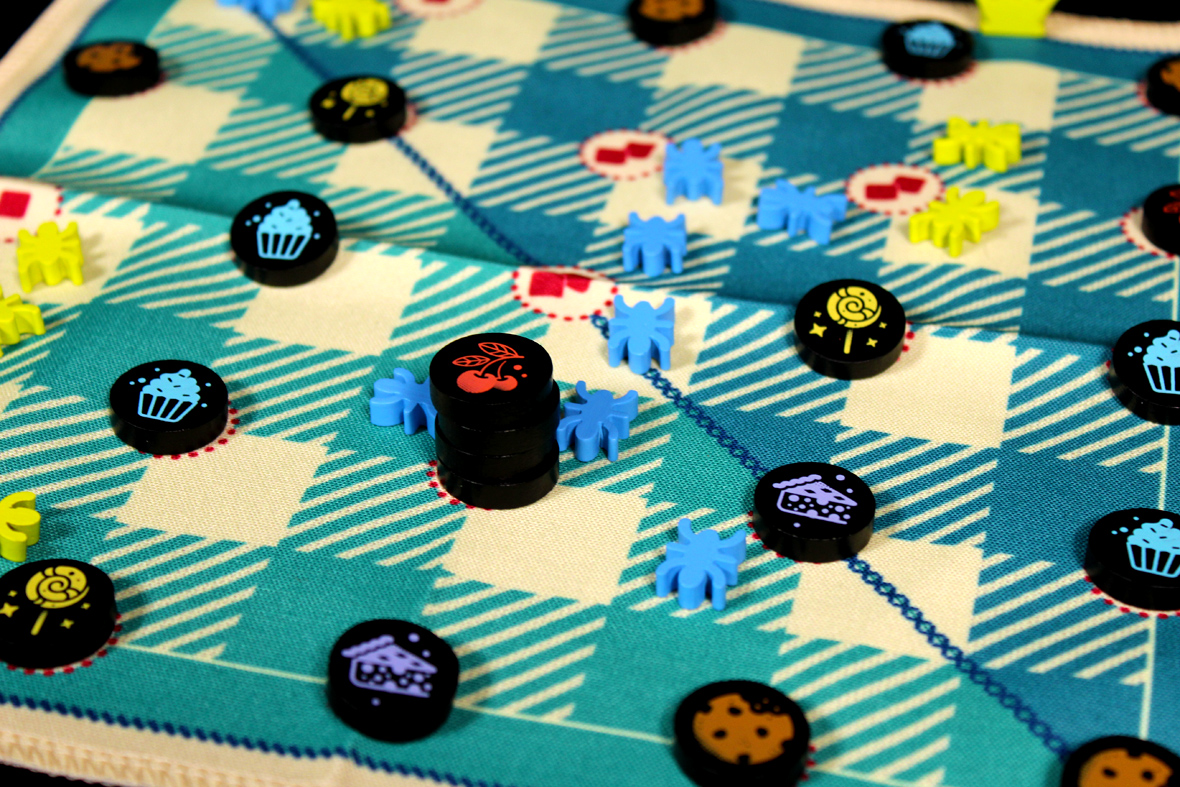
- This is the classic cloth board problem: the board doesn’t immediately lay flat, which makes the pieces lay a little weird. If the pieces were heavier this wouldn’t be an issue, but since they’re not, they kind of slide a little bit. You could probably iron the mat and fix that, but I don’t own an iron. I steam my clothes the way God intended, by keeping them in the same room as the shower.
- Be careful with the ant meeples! One of the legs already snapped off one of mine. They’re a bit flimsy, which is a little sad.
Cons
- Hopefully will be fixed in the full version, but there’s a lot of extra … stuff? Everything came in its own bag, essentially, meaning there were maybe nine or so extra bags? There are also extra unnecessary lollipop tokens. There are enough for a four-player game, but the rules specifically state lollipops aren’t used in a four-player game, so you’d only need five. I suppose this means you can just use whichever types of candies you want? I’m a bit more concerned about the bags, though; I’d love to see that desire for portability not come at a cost of a bunch of plastic waste.
Overall: 7 / 10
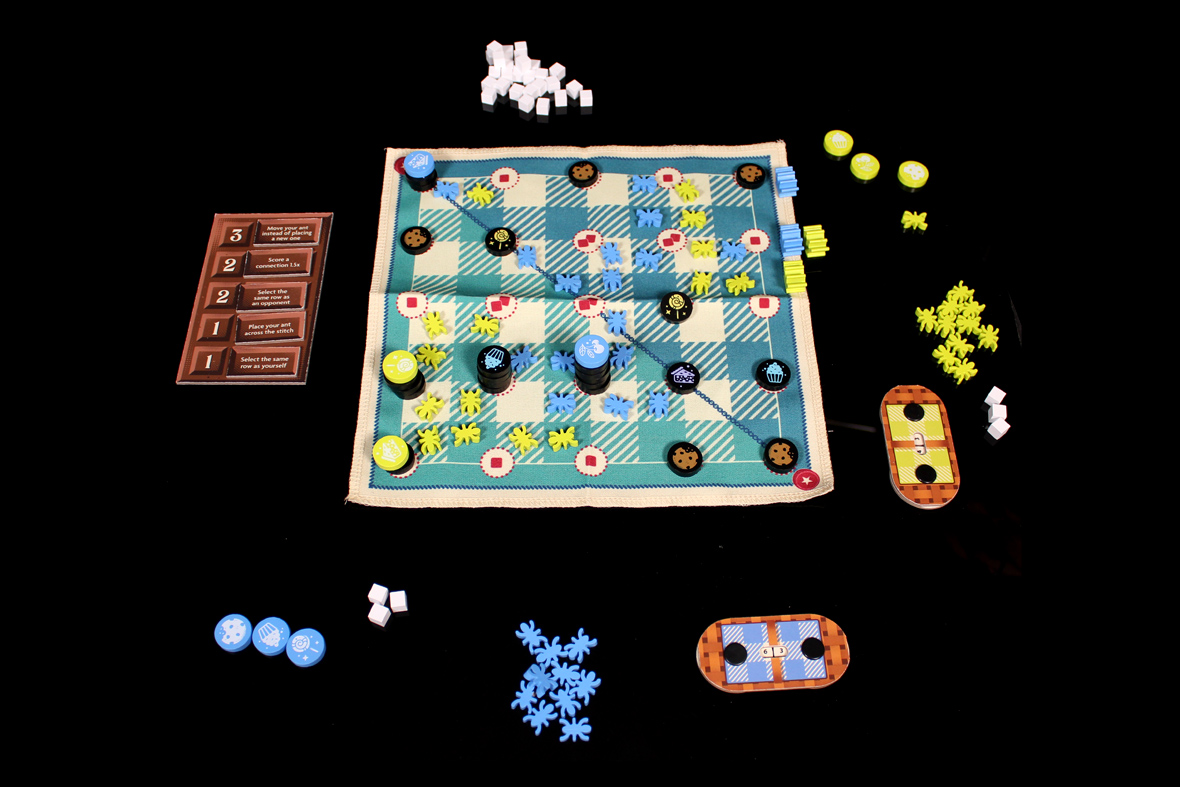
Overall, Gingham is a cute little game! Area control isn’t always one of my favorite genres, but this one does some neat stuff to almost make it feel a bit more like an abstract strategy game than some sort of hardcore warring ants title. And it’s really not. You’re at a picnic, trying to make lines of ants to connect sweets to your various stockpiles. It should be a bit whimsical, and I think the art style and the colors capture that quite nicely, even if one of my little ant meeples is down a leg. Designing pieces for shipping is hard. The production quality is still very high, as is generally the case with Bitewing, though their manufacturer sure loves tiny plastic bags for everything. I assume this does something helpful like keep painted elements apart but it also starts to feel excessive at some point. But I digress. I think the major strengths of this game are letting you always have something to do. You’re constantly analyzing the board from new directions (since you have to play from multiple different sides), to the point that I almost feel like this would be fun on a lazy susan, just to get to spin the board a bit. That kind of rotational thinking vexes some players, which is also fun. But making a big play still feels amazing, and Gingham gets that. If you’re a fan of ants ruining a picnic, you enjoy a bit of strategy, or you just like portable games, then, you might enjoy Gingham as well!
If you enjoyed this review and would like to support What’s Eric Playing? in the future, please check out my Patreon. Thanks for reading!
 What's Eric Playing?