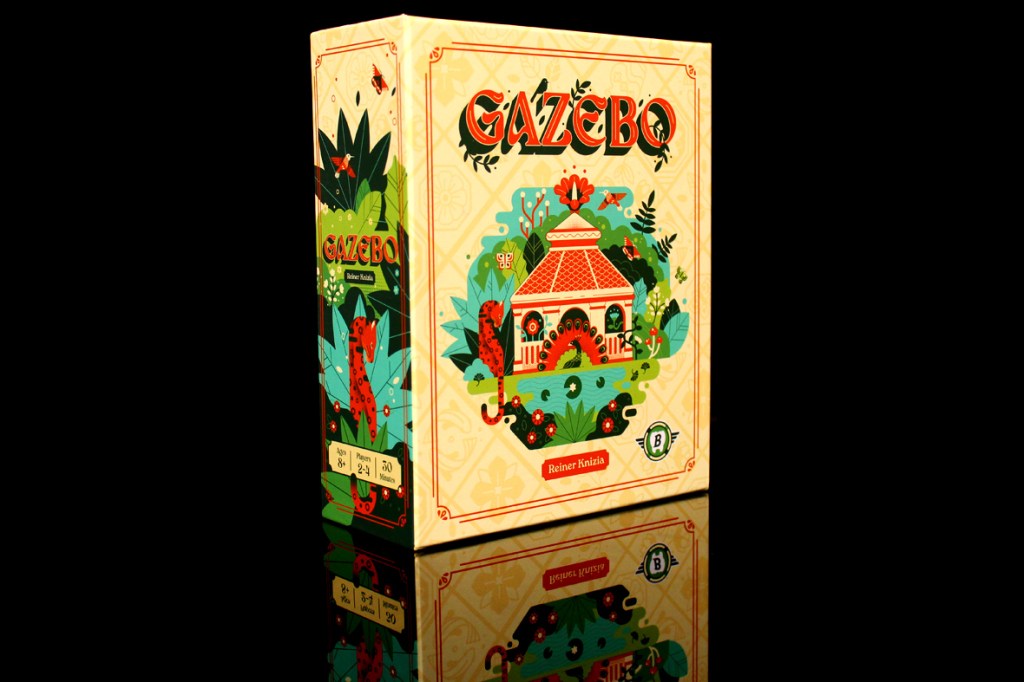

Base price: $XX.
2 – 4 players.
Play time: ~30 minutes.
BGG Link
Check it out on Kickstarter! (Will update link when Kickstarter is live.)
Logged plays: 2
Full disclosure: A preview copy of Gazebo was provided by Bitewing Games. Some art, gameplay, or other aspects of the game may change between this preview and the fulfillment of the Kickstarter, should it fund, as this is a preview of a currently unreleased game.
One of my good friends and I have wildly different schedules, which means that it’s very challenging to line up time to play board games. We’ve enjoyed some limited success, but we actually played five games last night between 1 and 4 AM. Wild time to try and learn anything with strategy, but we worked it out. I practice an affirmative consent model of board gaming, which is we only play board games if all players are a solid “yes”. If anyone’s a “eh” or a “maybe”, we don’t play it. May take longer to find a game but, honestly, it’s made game nights so much better since I started doing this this way. We played a bunch of fun games, so I’ll be talking about them over the next few weeks. Let’s start with a new one hitting Kickstarter soon, Gazebo!
In Gazebo, your greatest dream is to be both inside and outside simultaneously. For generations, you have wandered this planet with nothing to sate you save for the occasional sunroom or patio, and it’s started to wear on your mind. At the edge of your sanity and with an immortal lifetime left to go, you discover: the gazebo. It’s a perfect construction and devoting the remainder of your forever to building gazebos is more than your passion: it’s your calling. There are other immortals who seek to build their own gazebos, however, and there can be only one. I’m like, a solid 20% sure that’s what the game is about, anyways. I don’t dig too deep into the lore. So will you be able to fill the world with your gazebos?
Contents
Setup
Pretty light. There are two types of dominoes: single-color (dark) and double-color (light):
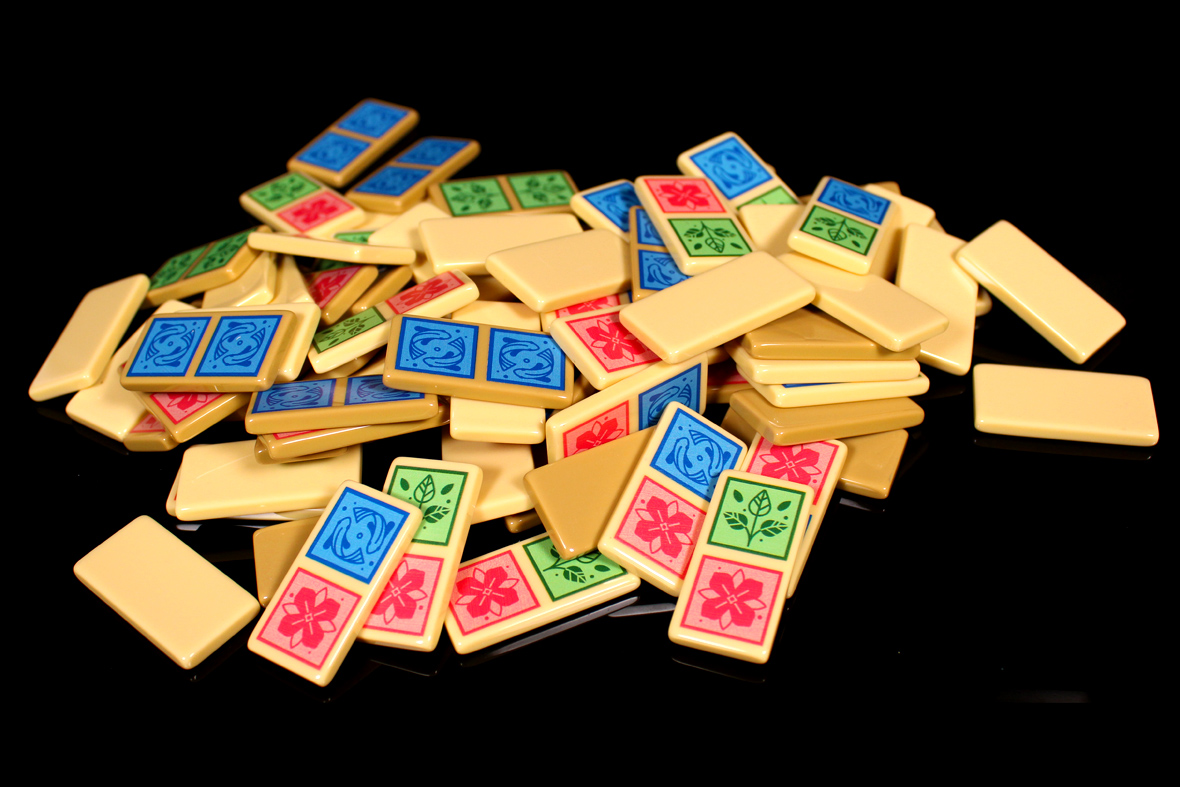
Separate and shuffle them, then give each player five face-down single-color dominoes and three double-color dominoes. The latter will form their starting hand, while the former forms a reserve. More on that later. Choose a board to play on and unfurl it:
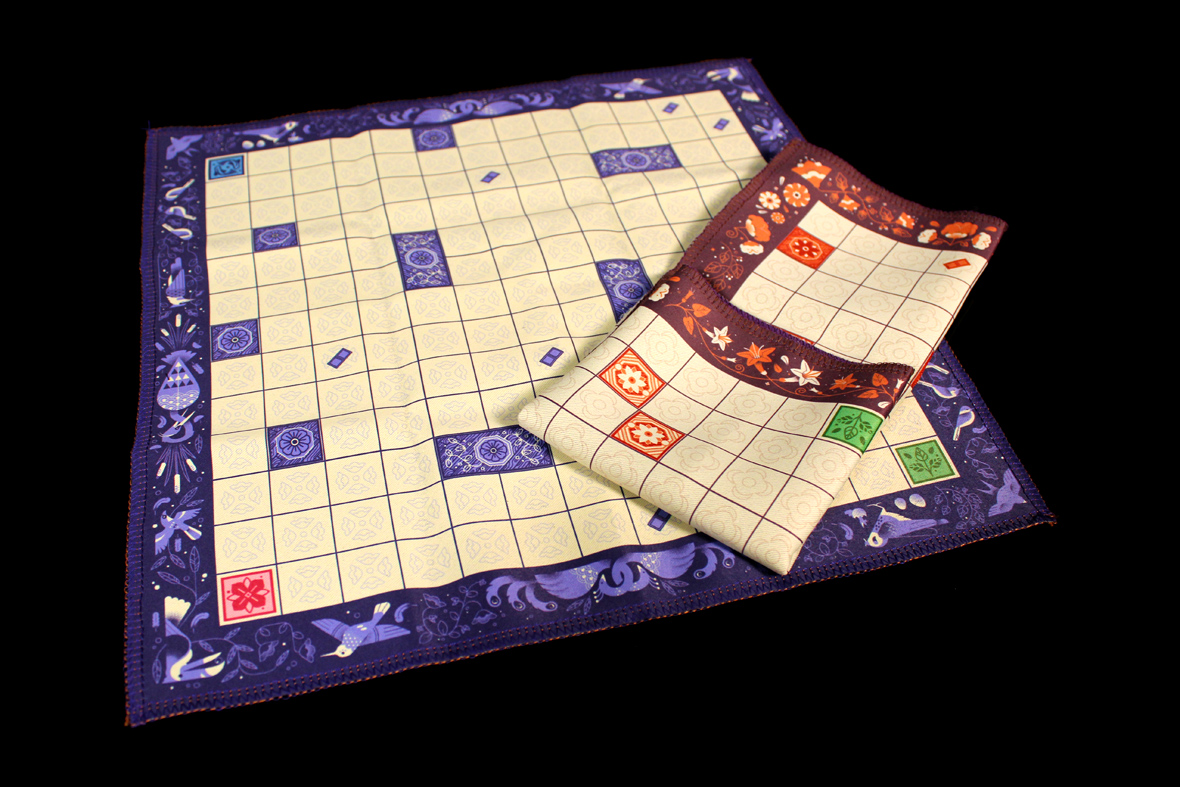
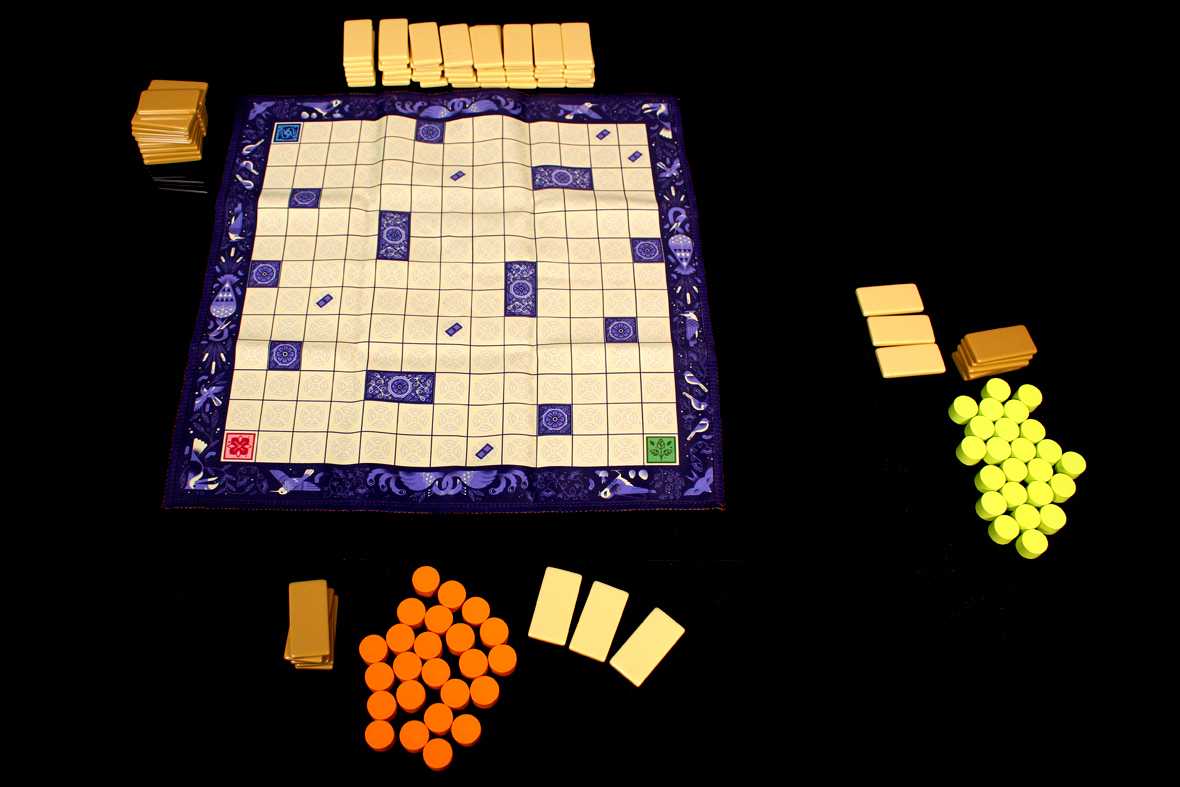
Then give every player gazebos in their color of choice:

- 2 players: 24 gazebos each (green and orange)
- 3 players: 19 gazebos each (add in blue)
- 4 players: 15 gazebos each (add in purple)
Everyone should be ready to start!
Gameplay

This one’s actually pretty easy! On your turn, you’ll play a domino and then draw a new one from either the light-colored pile or your private dark-colored reserve. If you play a domino on a zen space (with a domino on it), you can also draw from the remaining dark-colored tiles. Easy enough.
When you place a tile, a few things can happen.
- Create a nook: If you, after placement, have two or more of the same color tile contiguous without a gazebo on it, place one of your gazebos on it.
- Create a big nook: If you expand your nook such that any one of them is now five spaces of the same color contiguously, add a second gazebo token to make this space a “Big Nook”.
- Claim a patio: If your nook is orthogonally adjacent to a patio space, claim it with a gazebo (if it’s already unclaimed). If it’s claimed, you can steal it if the total number of gazebos on your connected nooks exceeds your opponent’s. Some patios are double-sized, so you’d place two gazebos on them.
- Absorb a nook: If your nook (before placing a tile) is larger than your opponent’s nook, their nook is not a big nook, and you place a tile to connect the two nooks, you can remove their gazebo and return it to them. This will likely make your new combined nook now a big nook.
You can place a tile anywhere so long as it’s adjacent to at least one of the starting spaces (not Zen or Patio spaces) or tile.

Play continues until one player is out of gazebos. That player wins immediately! If there are no dominoes left or no dominoes can be placed, the player(s) who have placed the most gazebos win!
Player Count Differences
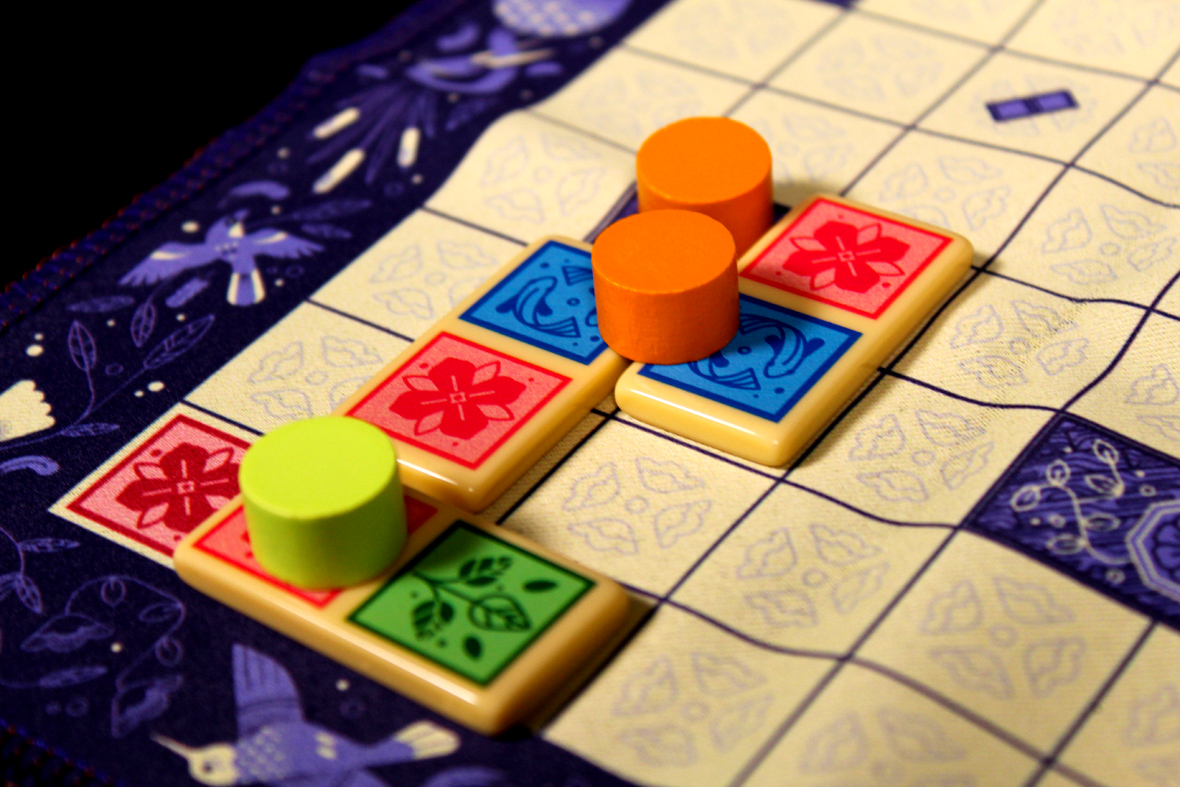
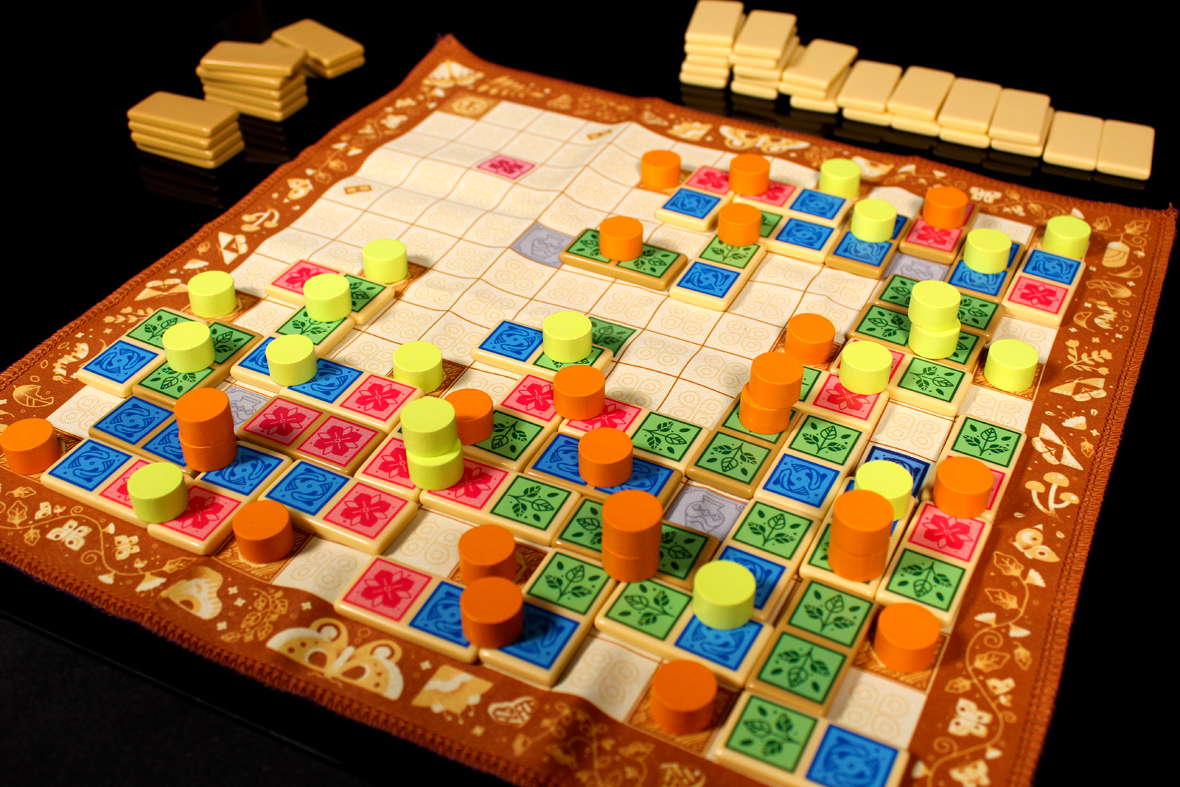
I was actually surprised how little of the board we ended up filling out in our two-player games. We stayed pretty close to each other to build off of extra tiles that were left hanging out, but we played, on the whole, pretty friendly. Not a whole lot of stealing. That can happen at low player counts; it’s zero-sum, effectively, so stealing from someone else or scoring points for yourself can be roughly equivalent depending on how well you’re doing. At higher player counts, I’d expect to see a lot more collisions, just because everyone’s on the board jockeying for position and placement. There, stealing may be a decent idea, but you also risk drawing the ire of the rest of the players and having them team up on you. Not really ideal. There may also be just territorialism where players stick to their starting areas and don’t much expand. I doubt that to some degree, but it’s a possibility. Either way, though, I’ve quite enjoyed Gazebo with two! I doubt I’d mind playing with more.
Strategy
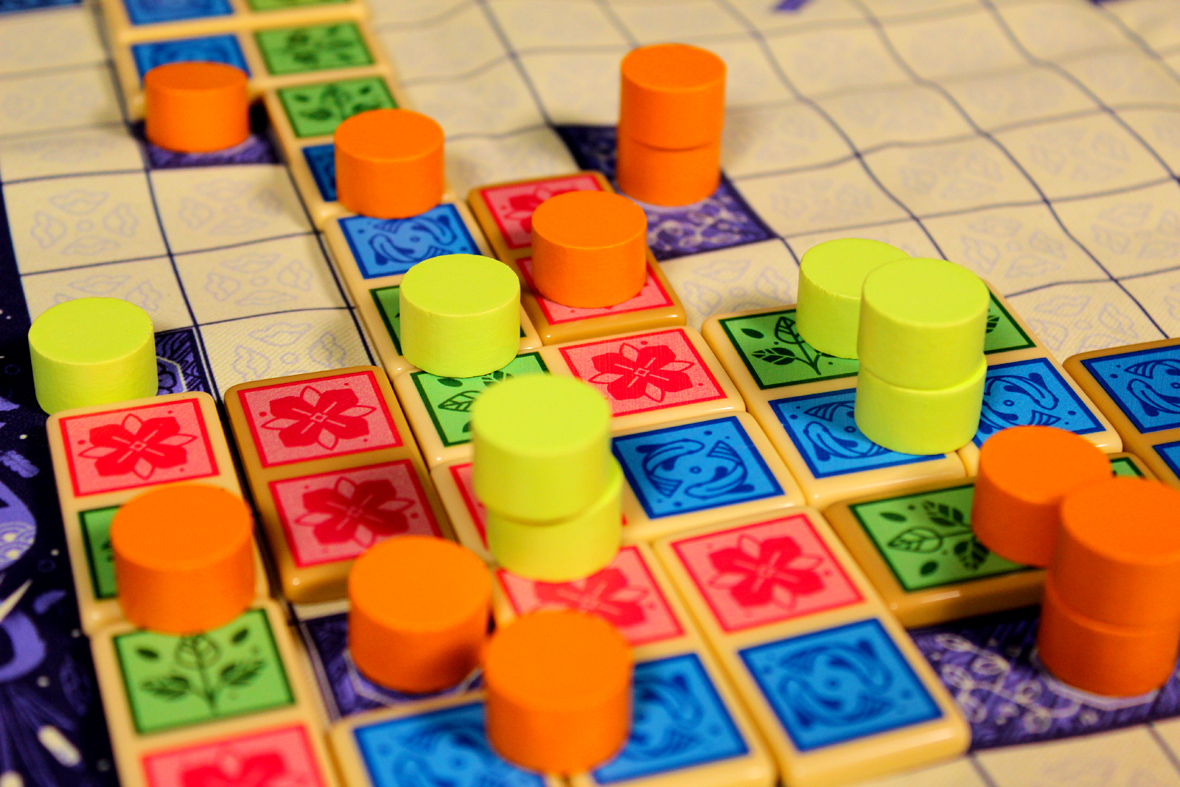
- A lot of little nooks can go a long way, but they can also leave you fairly vulnerable to getting your nook taken over by an opponent. Your opponent can just absorb little nooks of matching colors at any time if they connect them, so be careful! Wall them off or make them into big nooks, which can’t be absorbed.
- Claiming patios is a nice way to spend extra gazebo tokens. Especially for the first board, there are double patios where you can place two tokens. Either way, getting to place an extra token on a patio is another token you don’t have to worry about.
- In general, you’ll want to take advantage of the board-specific features to maximize your chances of winning. This is generally true. The board-specific features are there for a reason, so if they’re giving you extra turns or letting you place two gazebos or whatever, understanding them and incorporating them into your strategy will give you a fairly definitive edge over a player who’s not doing that.
- Pace yourself on drawing single-color dominoes! You only get so many per game, though I’ll frequently spend one to place on a Zen space and draw another, especially if I’m not getting the color I want.
- It’s not usually advantageous to you to extend your opponent’s stuff. It’s not always disadvantageous, but you don’t want to help them get a big nook or connect to a patio or vase or something. They have their turn to benefit them; they don’t need your help.
- You can, however, very effectively block your opponents if you’d like. Limiting them to a four-tile nook or keeping them away from your stuff can be really useful, especially since you only need to place a domino or two to cut them off. I usually like to do this by building a nook of a different color as a buffer between their stuff and mine.
- Big nooks are an aspirational goal and an effective deterrent. Big nooks can’t be absorbed by opponents, so you can use them as a buffer as well. Plus, you get two gazebos for your trouble, which is also great.
Pros, Mehs, and Cons
Pros
- Bitewing is, as a company, a bunch of pros. Even the preview rulebook feels luxe. It’s a surprisingly nice paper texture! But the dominoes are also extremely nice and the carrying case is great, too.
- I think domino games as a genre are generally a lot of fun; I point to Kingdomino as the (uh) king of the genre, but there’s plenty of room for more. I think players understand something intuitively about dominoes, perhaps? They fit a certain way and color matching makes sense, but it’s hard to visualize how to fill in a set area with dominoes without making some mistakes, which makes things fun. I used to mess this up all the time in Kingdomino’s 7×7 mode. Gazebo has similar thrills, here.
- The art style on this is immaculate. It’s very garden party, but with some nice subdued color work. It’s a very stylistic game, which definitely grabbed my attention.
- I really like the variety of boards and special abilities! It seems like a nice way to add more content and let players find their preferred complexity within the game’s rules. Having a simple core ruleset and letting players build up more with having certain boards is great. It also seems like having additional expansions with even more boards would be a good way to extend the lifecycle of the game.
- The game just plays so easy. You just play a domino each turn and then some things happen; it’s great.
- I’m very excited to see how the actual gazebos look with the rest of the game. Preview copy life means that sometimes the actual gazebos don’t make the cut, but I’ll be as excited as you all to see how the final game looks. It seems like they’ll be really great.
- A solid pick for portability. I like that both this and Gingham have these super-slick travel cases. They’re a bit beefier than I expected, but honestly, you could still throw one or both of these into a big bag if you’re going somewhere for the day; you don’t have to worry about components or cards blowing anywhere unless it’s really windy.
- I appreciate the work they did to give players flexibility around drawing single-color dominoes. I was reading through the designer notes (which I always enjoy) and I saw that the original game had single- and double-color dominoes in one big pile. I can see how that would add an element of sometimes-frustrating luck, whereas here you have a supply that you can ration or go all-in on from the beginning, leaning more into player choice. I like that design iteration.
- The heavier dominoes do a better job weighing down the cloth boards. This is something I worried about with Gingham and thankfully, the dominoes here are a bit weightier so the cloth board flattens out more over the course of the game.
- I also like the end condition! Games without actual scoring are very hot right now. This is a real trend I’ve noticed by sampling data such as: I’m tired and sometimes counting is hard. But while it’s a fairly abrupt end to the game, it’s not unexpected; you can see your opponent slowly gathering and placing their gazebos so that when they go out and end the game, it was a decently long time coming.
Mehs
- Having a bag for drawing dominoes from could be pretty useful. It’s not bad as is, but having a little bag with the patterns on it would look really nice and be a cool extra thing that shows off more of the game’s art. I’m a big fan of it, though, so I wouldn’t mind seeing more.
Cons
- It may be worth checking with your group about how aggressively you want to play this; you can be fairly aggressive if you’d like. I usually recommend just checking in so there’s no mismatch on player expectations. You can steal nooks and patios with reckless abandon if you want or you can play a fairly chill game apart from each other. Up to you, but worth making sure everyone’s on the same page.
- I’m not sure this will be included in the final version, but I don’t love that the rulebook has rules for expansion-only content. It feels a little like an ad in your rulebook, which I don’t particularly like. I get the desire to have everything in one place, but if players don’t have the expansion content I worry there’s going to be some frustration, there.
Overall: 8.25 / 10
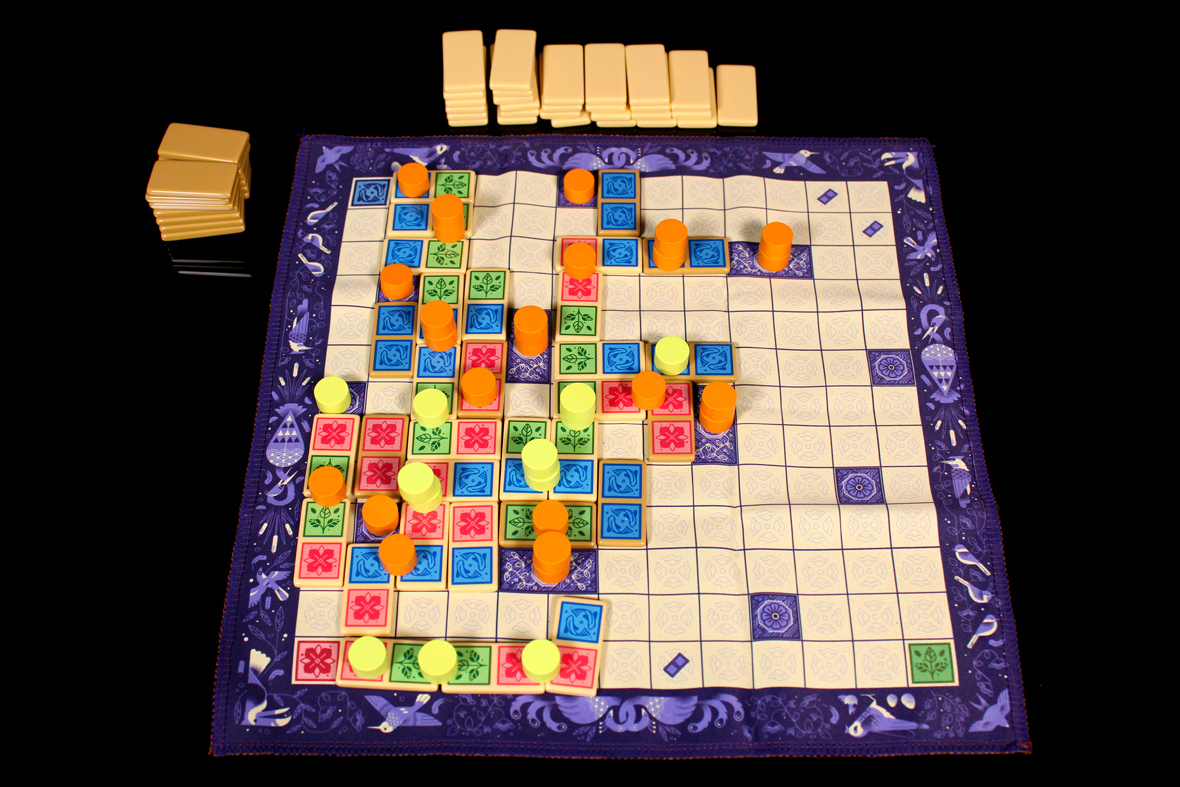
Overall, I ended up being a big fan of Gazebo! I don’t normally love area control games, but the pleasant art and quick-paced gameplay won me over pretty quickly. I think, inherently, part of it is that element of simplicity. There are only three colors, so there aren’t a ton of things you can necessarily do on your turn. Not that there are no interesting choices (and, frankly, the decision space expands as the game goes on), but that the strategic options aren’t endless or stressful. You can balance a nice mix of strategic and tactical play. Plus, they did a smart thing that I quite enjoy: offering other board options lets you find the right fit across game groups to really get your money’s worth from the game. I’ll be interested to see how the different boards land, though I don’t love that the standard rulebook explains the rules for the expansion content. It’s clearly labeled but it still would frustrate me as a consumer. Additionally, as a contrast to Gingham, the dominoes are heavy enough that they flatten the cloth board as you play, so you’re not seeing as many of those wrinkles as play goes on. I don’t own an iron. As with all area control games, this can get a little aggressive, as well, so make sure you have a good read on how aggressively your group wants to play. You can play this fairly not-aggressively, as well; I’d almost be interested to see options for separated play or a solo mode or something. I do love the spatial element of play and I think the art is perfectly suited to the game; it’s classy while still being vibrant. Big fan. If you enjoy the thrill of the gazebo, you like domino games, or you want to try your luck at area control, I’d recommend Gazebo! It’s been a lot of fun to play.
If you enjoyed this review and would like to support What’s Eric Playing? in the future, please check out my Patreon. Thanks for reading!
 What's Eric Playing?