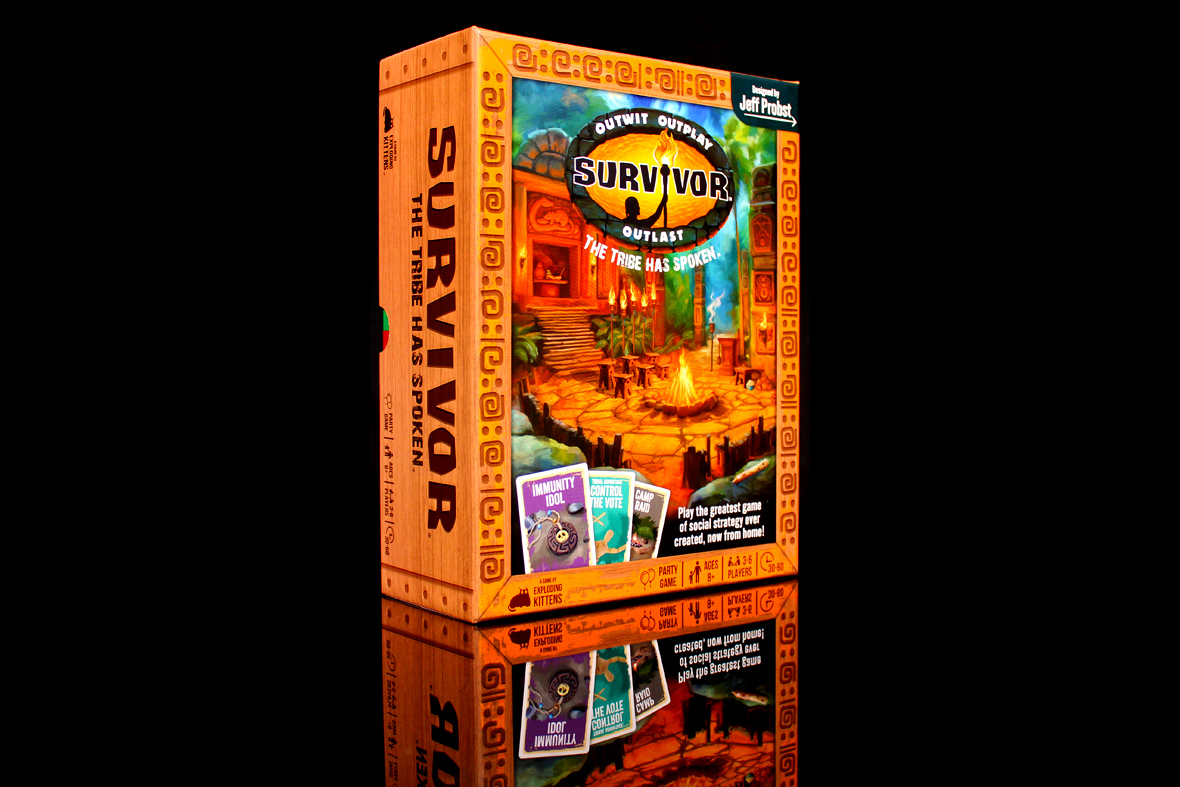
Base price: $25.
3 – 6 players.
Play time: 30 – 60 minutes.
BGG Link
Buy on Amazon (via What’s Eric Playing?)
Logged plays: 1
Full disclosure: My friend bought this game and I borrowed it so I could review it. Yeehaw.
Look, it’s not that I have to review every game I play; I just like writing down my thoughts about games, so getting a new game to the table is every bit as much of an opportunity as a challenge. My friend, an enormous Survivor fan, has been interested in this game since she read about it online (probably one of you other content creators / reviewers, so, congratulations; you got a sale). We happened to be at a game store in Seattleish, and so she grabbed a copy. I had promised her a while ago we would play it, and now here we are, fresh off the presses. Let’s check out Survivor: The Tribe Has Spoken!
In Survivor: The Tribe Has Spoken, players take on the role of two characters on a team determined to win at all costs. There is nobody you won’t betray, nothing you won’t do, and no rock-paper-scissors you won’t try to win to earn a coveted Immunity Idol or convince players to eliminate your enemies. The problem is, the only thing more unpredictable than you is literally everyone else at the same time. So seek influence, steal cards, and work your way towards the Final Tribal Council to be named the ultimate Survivor. Do you have what it takes?
Contents
Setup
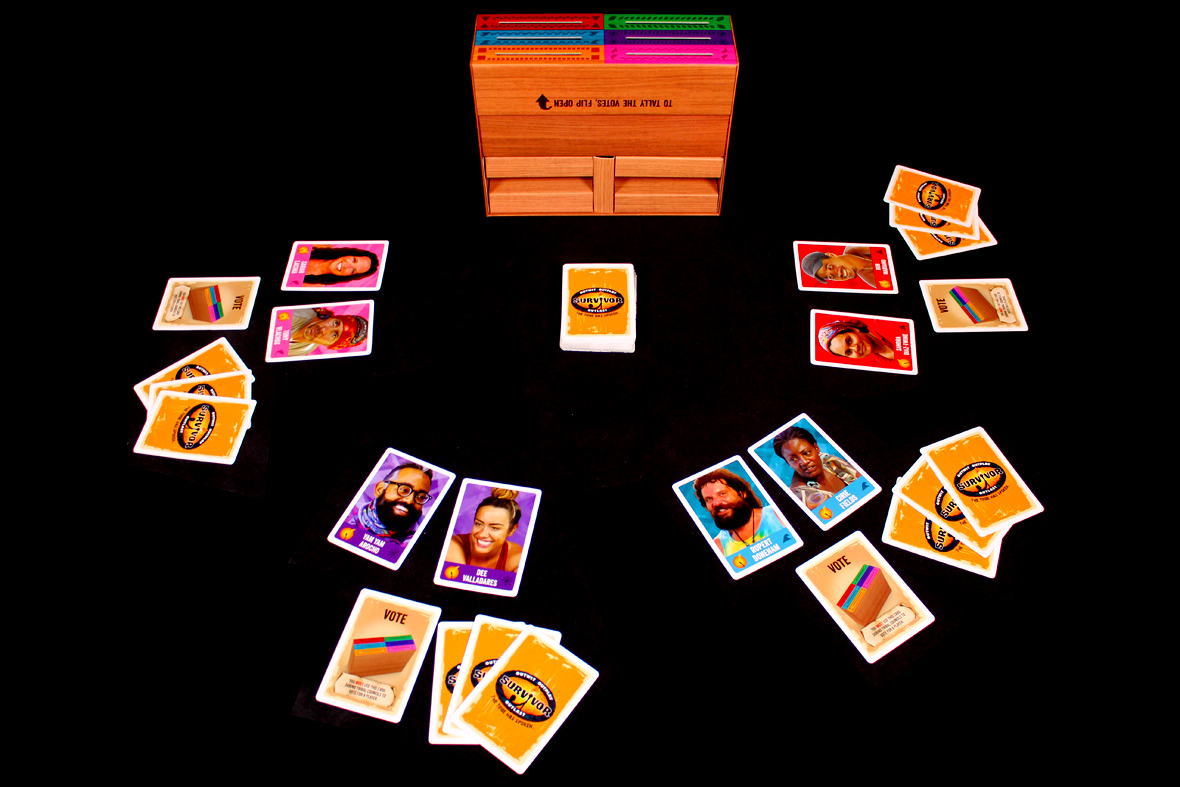
Not a ton. Have each player choose a team and take the corresponding two characters:

Each player gets a Vote Card (that’ll come in handy later):

Shuffle the deck and deal each player three cards:
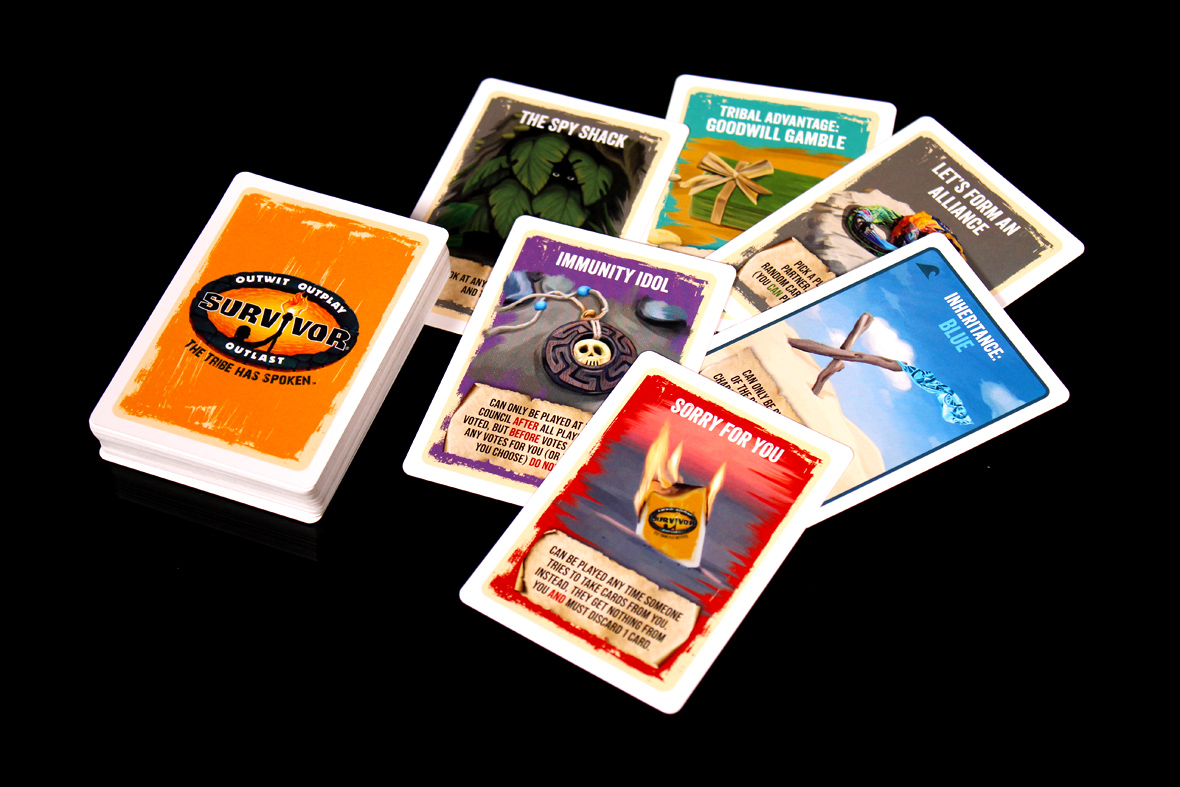
Then, prepare the deck. Shuffle a number of Tribal Council Cards based on your player count:
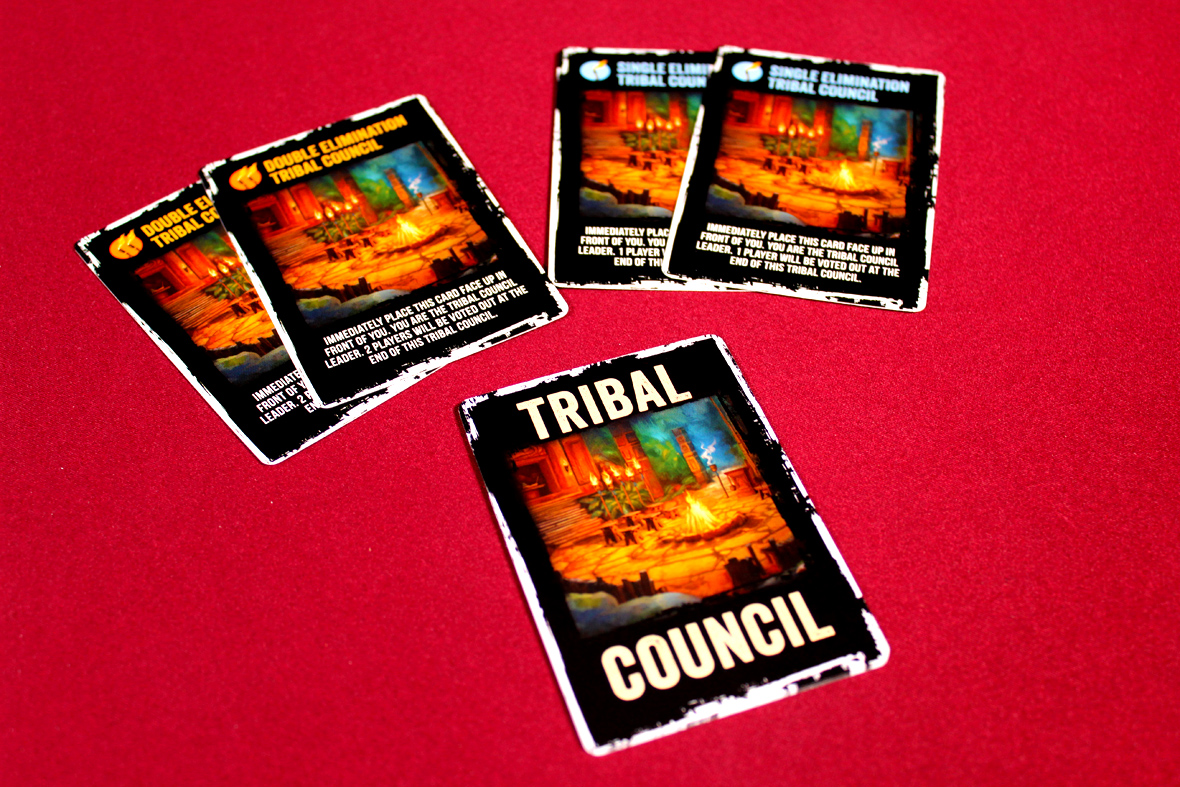
- 3 players: Four Single Elimination Cards
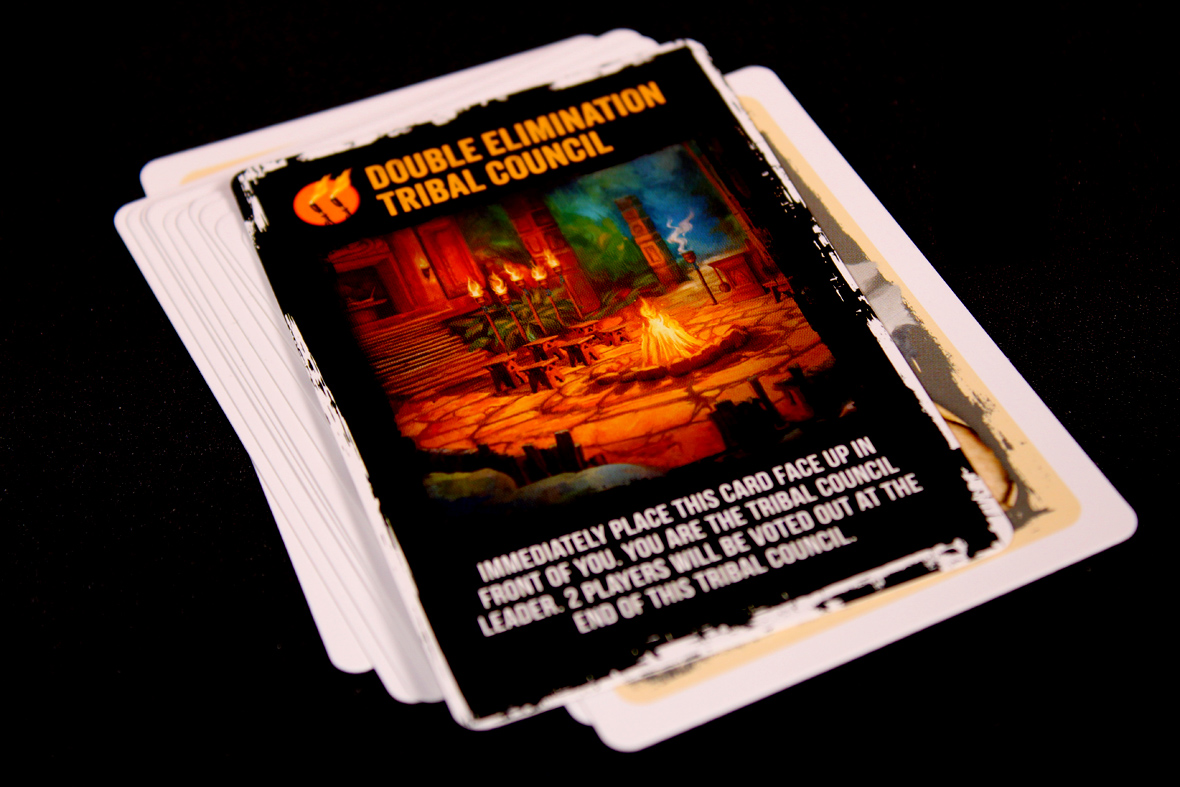
- 4 players: Two Single Elimination Cards and two Double Elimination Cards
- 5 players: Two Single Elimination Cards and three Double Elimination Cards
- 6 players: Five Double Elimination Cards
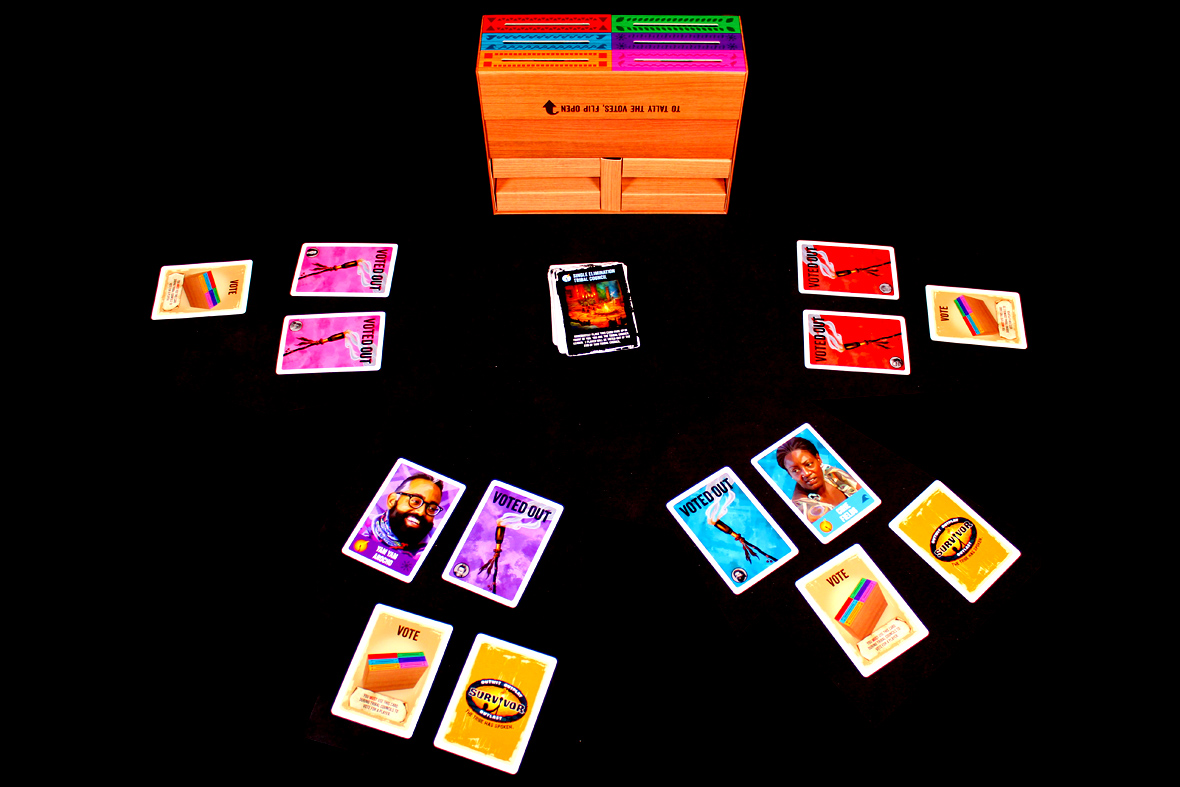
Split the deck into even piles based on the number of cards, and then place them so that a Tribal Council Card alternates with a stack (Tribal Council should be on the bottom). The Tribal Council cards are larger so you know when they’re coming. Finally, set the box on its side so that the voting slots are pointing up; more on that later.

Pick a player to go first! You should be ready to start.
Gameplay
This one’s pretty easy, generally speaking. Each turn has the same format until a Tribal Council.
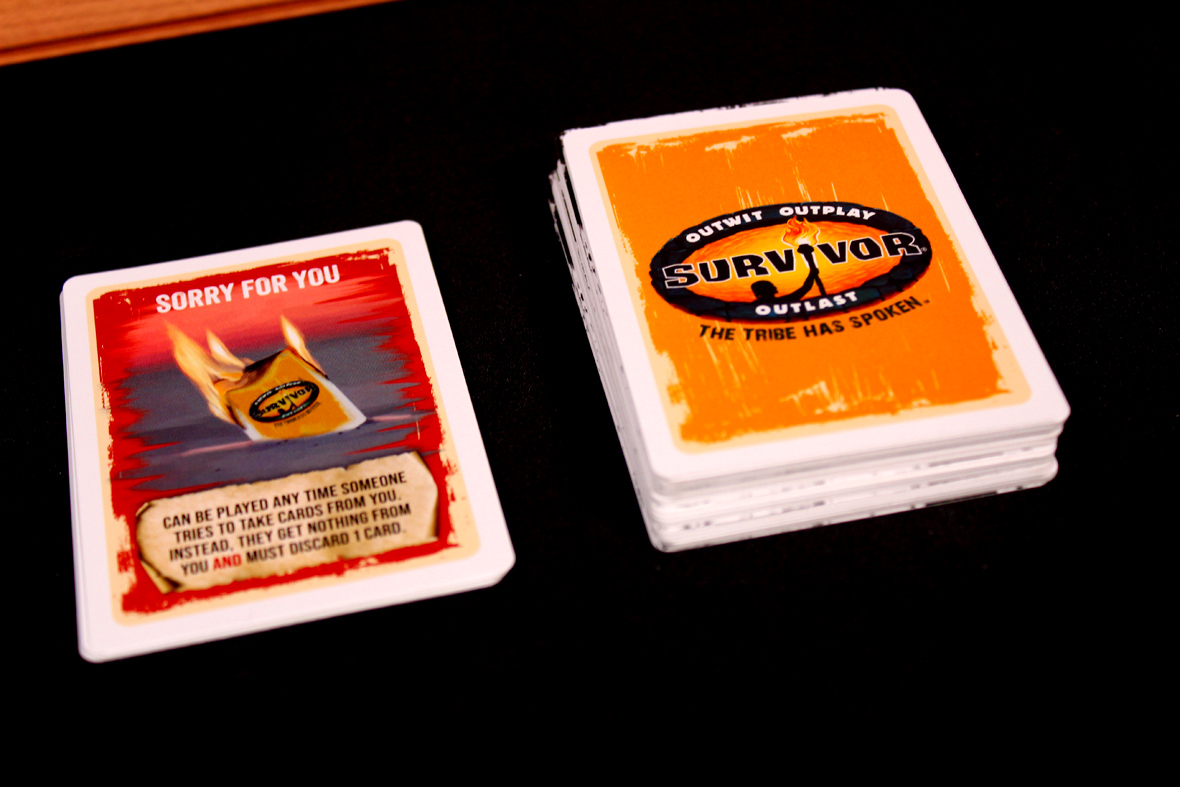
To start, you’re going to steal a card from any other player. You can’t avoid it; Survivor isn’t about making friends. Choose wisely. Then, you can optionally play a card from your hand. Some give you more cards or let you steal more or force everyone to play a game. Once you’ve done that, you draw a card and your turn ends.
The real intrigue starts when a Tribal Council begins. When a player would draw a card that’s the Tribal Council card, they play it and become the Tribal Council Leader. Once that happens, you can play Tribal Advantage Cards to change things up and make alliances and secret promises, all up until there’s a vote. You can either do eyes-closed, knocking on the table to hide sounds-style, or you can place the voting box in another room and let players vote privately. Almost anything goes until the vote, though: you can even have secret conversations away from the other players!
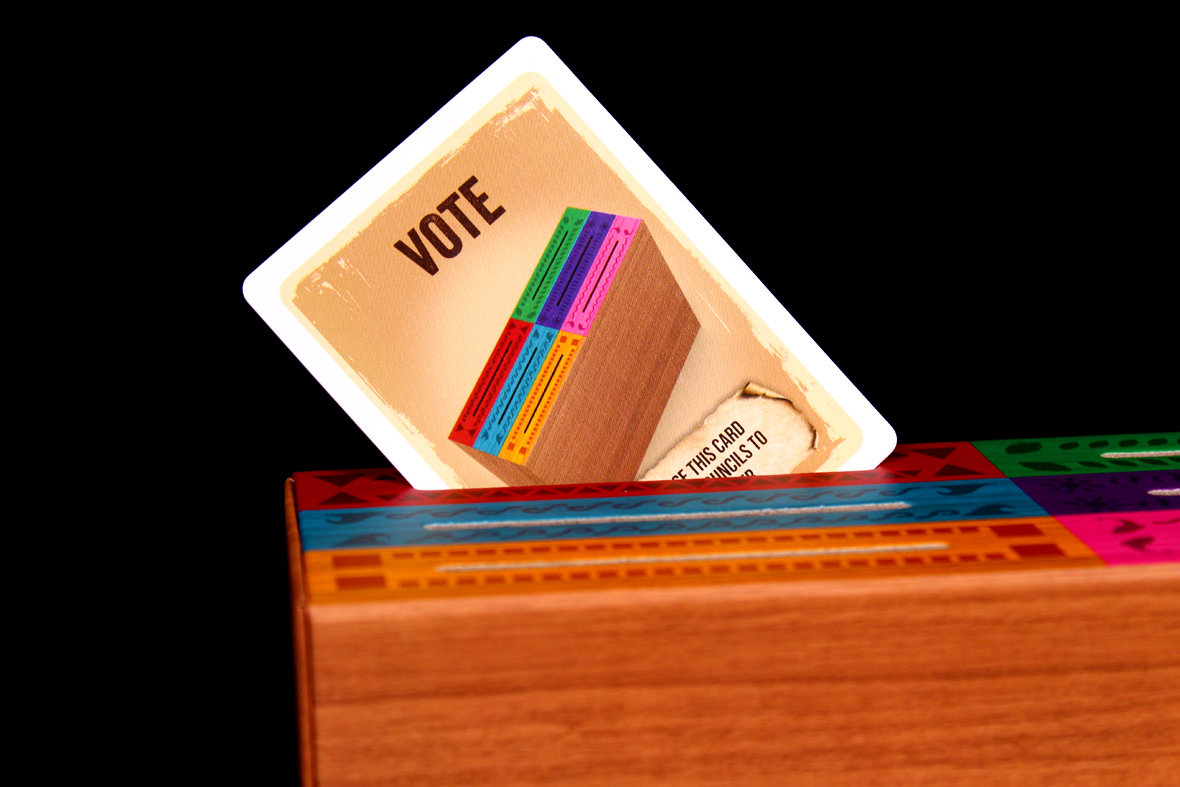
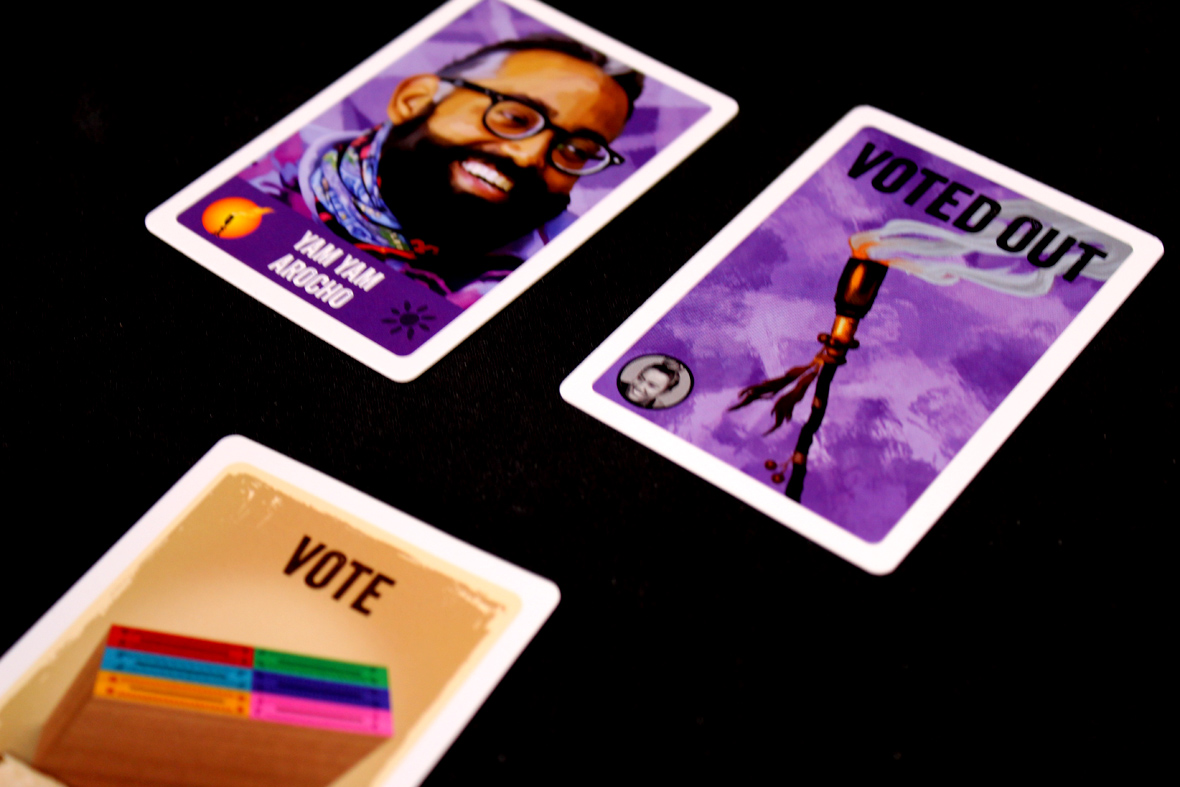
Once the votes are cast, any player may play an Immunity Idol. If they do, votes against them don’t count! Otherwise, either one player is eliminated during a Single Elimination or two players during a Double Elimination. When you’re eliminated, flip one of your two characters over. If your second character gets flipped, you’re out of the game! In the event of a tie, the Tribal Council Leader chooses who among the tied players is eliminated.
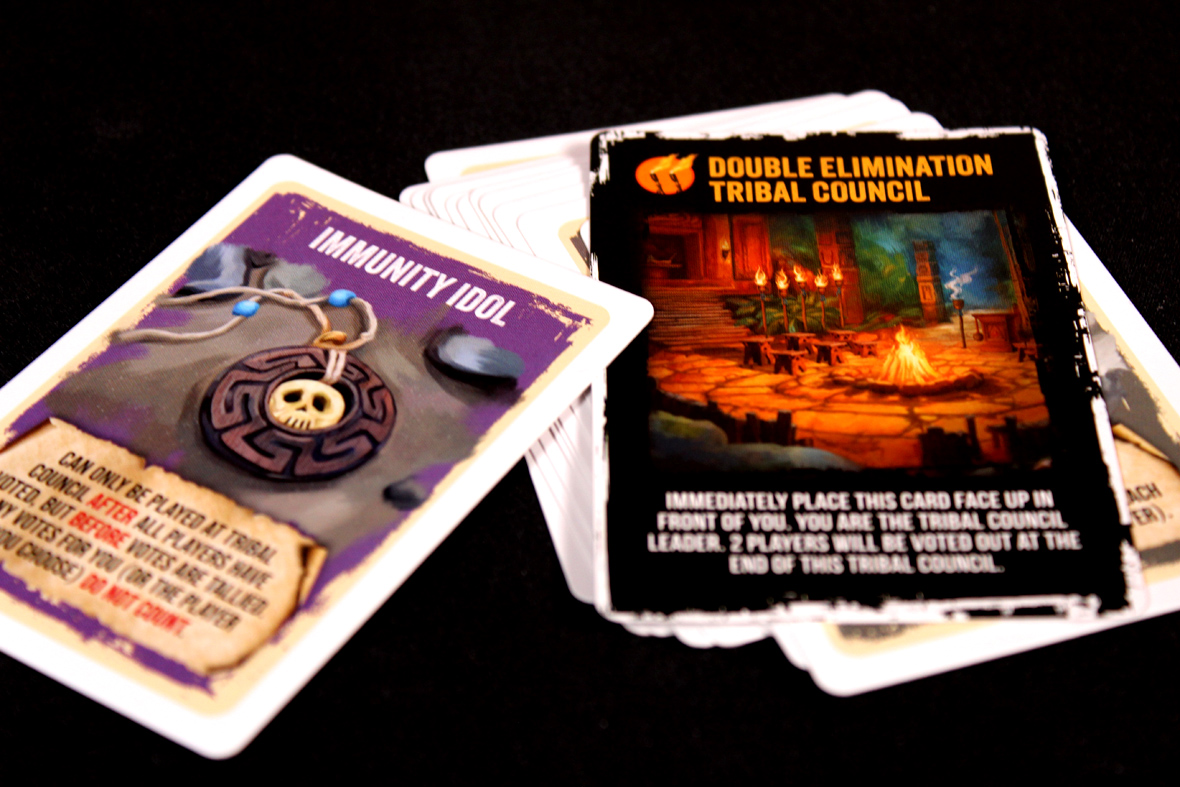
Play continues like that with the player after the Tribal Council Leader until only two players remain. Then it’s the Final Tribal Council! The most-recently eliminated player becomes Tribal Council Leader and all eliminated players return to discuss who did the best and who should be the Final Survivor. Votes are taken simultaneously (Tribal Council Leader breaks the tie but can change their vote if there’s a tie) and the player chosen by the others wins!
Player Count Differences
I think mostly that the game succeeds best with more people, and unfortunately, more people stretches out the length of the game because it takes longer for the necessary number of players to be eliminated and end things. A player can’t get out in the first round, as they have two characters each that form their team. So any one player getting eliminated, even with the group’s focus, usually takes at least two rounds (given the prevalence of Immunity Idols). I think that’s good to some degree, because it lets the game get into what it should be doing best: mind games and alliances and lies and secrets. Too few players, and you only need to take one out and then you’re done. Sure, there are fewer Tribal Councils, but that means there’s less intrigue and backstabbing. I think the game thrives in that meridian of trust, so, I want to see more of it. It just comes with the unfortunate consequence of increasing playtime, which matters. Once you’re eliminated, you don’t have anything to do until the Final Tribal Council, when you come back to name the player who won. I ended up playing my Steam Deck for a chunk of it while I watched the rest of the game. Still interesting, but I imagine I’d be a bit more frustrated if there were two extra people who had to go. I guess the out players could play something else while they wait? Some consolation. But I still think more players is the way to go.
Strategy
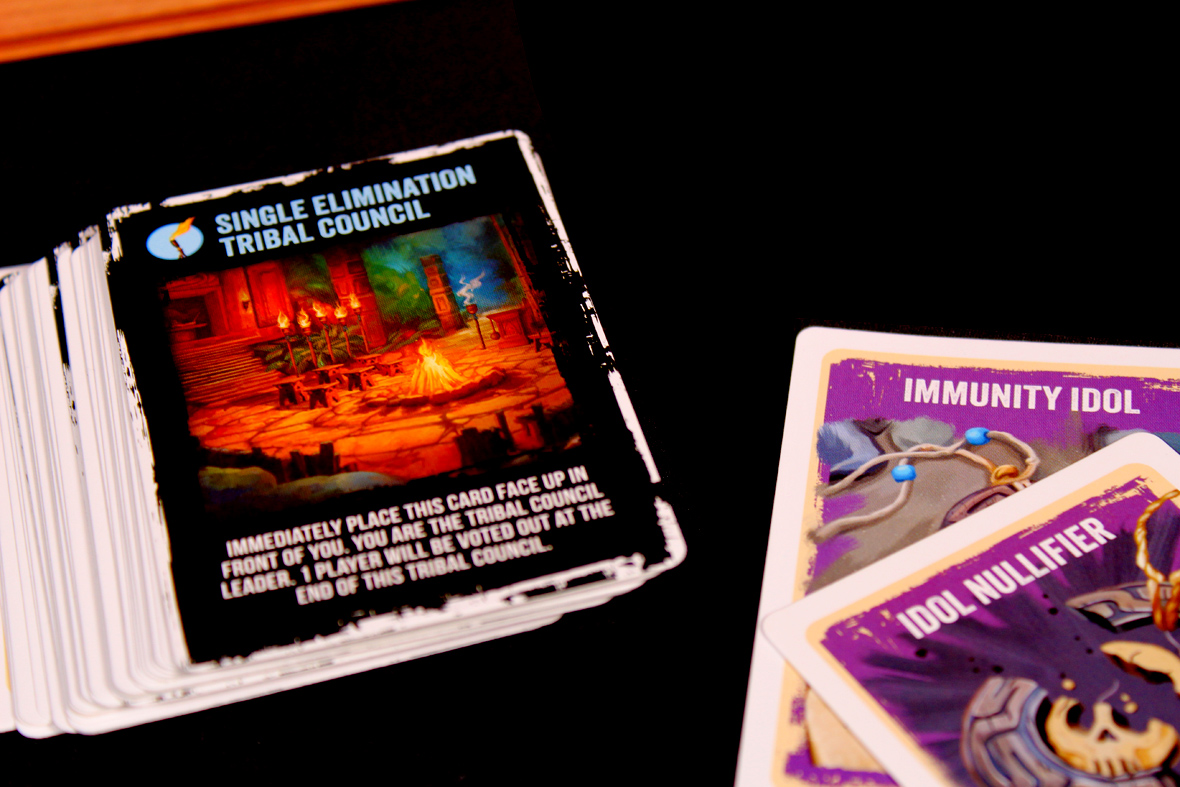
- There’s a lot of power in saying you’ll do something in order to dissuade other players. If you tell other players you’ll just use your Immunity Idol so they might as well not vote for you, some of them might be convinced. Not a great argument, since you then get to not have to use it and you keep it for later, but that’s the name of the game at times. I found that it works decently well with the card that blocks stealing cards. Let someone else fall on that sword, right?
- Playing nice does generally work in your favor. Players tend to hold grudges, and those grudges come out at final voting. Worth having people on your side.
- Lying by omission is morally okay. Probably. I’m not an authority on the matter, but you don’t have to tell other players you have an Extra Vote card that you’re planning to use on them. Plus, when you do, you can pretend to be outraged. Can you put an Extra Vote in your own box? Sure, if you’re confident and a little crazy. If you’ve got cards that other players don’t know about and they assume you don’t have them, just don’t feel the explicit need to correct their assumptions.
- Keep in mind how Immunity Idols work. This got us badly. Immunity Idols negate all votes cast for that player. This does not mean fewer eliminations happen! It just means all those votes are thrown out and zeroed out. This means you can get hit by a few strays if the person who got voted for the most plays an Idol.
- Watch player reactions; they can give you information. Did someone draw a really good card? Worth stealing from them on your next turn, probably. Does someone seems shifty about where certain cards came from? Worth interrogating.
- Tribal Advantage Cards can be huge. If you take over as leader or steal another player’s Vote Card, that’s suddenly a lot of power that you’ve consolidated. Use it wisely; other players will take notice.
- Use the card list. It tells you what the cards are and what they do. At least one of the cards lets you request a specific other card from a player; it’s helpful if you know what the options are.
Pros, Mehs, and Cons
Pros
- There are some fun surprises. Can’t go into one specific one, but I think eagle-eyed players are going to enjoy this game a lot, especially if they’re able to figure out some of its puzzles. It’s like any other treasure map, yeah? X marks the spot and all that.
- I think, based on my limited understanding of Survivor, that this is pretty close to as close as you can get on the whole experience. My friend who is a huge survivor fan loved several things, like the specific choices of which players made up which teams, the organization of the Tribal Council stuff, and the light betrayal / elimination process. Everything I know about Survivor I learned from her and Game Changer, so I kept calling Immunity Idols “loop de loops”, but that’s neither here nor there.
- The actual turn progression is incredibly simple. It’s really just draw a card / play a card / draw a card, given that the first card you draw is from another player’s hand. You don’t get much less complicated than that; even Fluxx has more complex configurations (at times).
- I love that the voting boxes are part of the physical box. That’s fun and silly. I think it’s a nice way to make the experience feel more authentic while playing with player expectations and general box construction. Plus, it lets you vote secretly.
- I really like the mind games. They’re all things like “rock paper scissors” or “show the lowest number that nobody else shows” and those are all things that lend themselves very well to “I’m going to throw rock; throw rock as well so we can swap cards” or other mind gamey things. Big fan of that.
- Giving each player two characters is smart. It helps disconnect the player from the eliminations to some degree and makes sure that you can’t get knocked out immediately even by the most vindictive group.
Mehs
- Player elimination is always a bummer, but at least you get to come back. You come back just to decide who actually wins the game, though, so that may or may not particularly excite you?
- I think it’s silly that you leave in Inheritance Cards for players that aren’t in the game anymore. It seems wise to just remove those from play, or maybe the intention is to have useless cards in your hand so that you can get robbed? Either way, it’s a bit silly.
Cons
- By the nature of things, the game will run longer with more players (and likely mean more time out of play for those eliminated), but it also plays better with more players. In order for there to be more players, you, by math, have to do more eliminations. That means that some players may get out earlier and play less of the game, but them’s the breaks. There’s some temptation to just try and gradually wear down players before you start eliminating anyone, but you don’t always get the option to make that work. There will also be more side discussions and private chats with more players; you just have to make the best of it. I told my friend playing that I think that this will make the game a lot more fun for players who are invested and doing well, and significantly less fun for players who either aren’t as interested or are doing poorly, and I think that still holds true.
- It can be challenging to make the case to players you’ve betrayed that you should still win. They do it on the show the whole time, but there are higher stakes and longer periods of time there. I was unimpressed by either player’s arguments when I played, but we ended up picking the person who had screwed over other players the least.
Overall: 6 / 10
Overall, I think that Survivor: The Tribe Has Spoken is fine. I really don’t love social deduction games (as I mentioned in my Lovestruck review last week), but this is, to be fair, more of a pure social game than anything else. You’re not figuring out hidden identities; you’re playing the numbers, wining and dining players, and then cutting them loose as soon as they no longer serve you. The betrayal elements are, yes, a turnoff for me, but they’re also necessary for the authenticity of the experience. And, to be fair, it’s a very authentic Survivor experience! You’re really getting into the heads of other players and manipulating, promising, betraying, and lying your way to the Final Tribal Council. If you do that too much, the eliminated players will come back with vengeance on their minds. If you play a good game, though, even a player you betrayed may begrudgingly hand it to you. And that’s pretty interesting! A lot of moving parts, but a great add for any Survivor fan (and there are many of y’all; aren’t there like 50 seasons, more or less?). I think where the game went best for me was around the little mind games that would let you steal cards. I think those are fun, they’re great ways to play around with alliances or play to your strengths, and they’re fundamentally silly. I will say, cryptically, there was one very fun surprise that I did not expect in the game, and I believe that that was a stroke of genius on the design team’s part. I love that kind of thing. If you figure it out, you’ll likely have a solid guess of what I mean. But I do have to say that this is a lovingly-crafted tribute to one of the most popular reality shows of all time, and it works along those lines pretty well. I just know I’d never make it on an actual season of Survivor now, either. If you’re looking to live your best life, betray your way to the top, or get outfoxed by an Immunity Idol, Survivor: The Tribe Has Spoken might be right up your alley!
If you enjoyed this review and would like to support What’s Eric Playing? in the future, please check out my Patreon. Thanks for reading!
 What's Eric Playing?