
Base price: $12.
1 player.
Play time: 20 – 60 minutes.
BGG Link
Buy directly!
Logged plays: 4
Full disclosure: A review copy of Ancient Realm was provided by Button Shy.
We did it, boys: I’m on the other end of wedding season, I think. I got a new suit! That was fun, at least. It gives “stage magician” vibes. It’s exactly what I wanted. But now, still traveling, I’m writing directly to you, readers, to tell you about more games. I’m still rebuilding the infrastructure required to play larger and more complex games outside of cons, but we’re getting increasingly close. In the meantime, though, there’s a lot to do with travel games, and what better company to travel with than Button Shy? Let’s check out another.
In Ancient Realm, you have one goal: build a civilization that stands the test of time and also doesn’t frustrate its users as much as Civ 7. I don’t get it, personally; I like Civ 7, but it seems to be having a real one in reviews, right now. I digress. Here, your goals are simpler: get resources! Hire folks inside of town! Build some Wonders! The basics. That said, you don’t have many cards, so you’ll need to be pretty crafty to pull it off. Will you be able to be remembered as a great leader?
Contents
Setup
Pretty simple. Shuffle the District Cards:

And shuffle the Wonder Cards:

Flip two cards from each deck and place them next to each other in a row. Set the Storage Cards below them and set the cards to 3 Gold and 1 of each other resource:

You’re essentially ready to start! Leave room for a row above the Market row for cards that you play.

Gameplay

Not too much, here, which is nice. On your turn you’ll add a card from the Market to your building row. If it’s a Wonder, you have to pay its cost first; otherwise you can place it. You can cover up parts of cards in your building row if you’d like, but they are then (optionally) activated and removed from your realm. If you choose to activate them, you’ll pay a cost (usually 1 gold; Mines are free) and then gain the listed benefit before covering that section. At the end of your turn, refill the Market by drawing a card from either deck and adding it face-up.
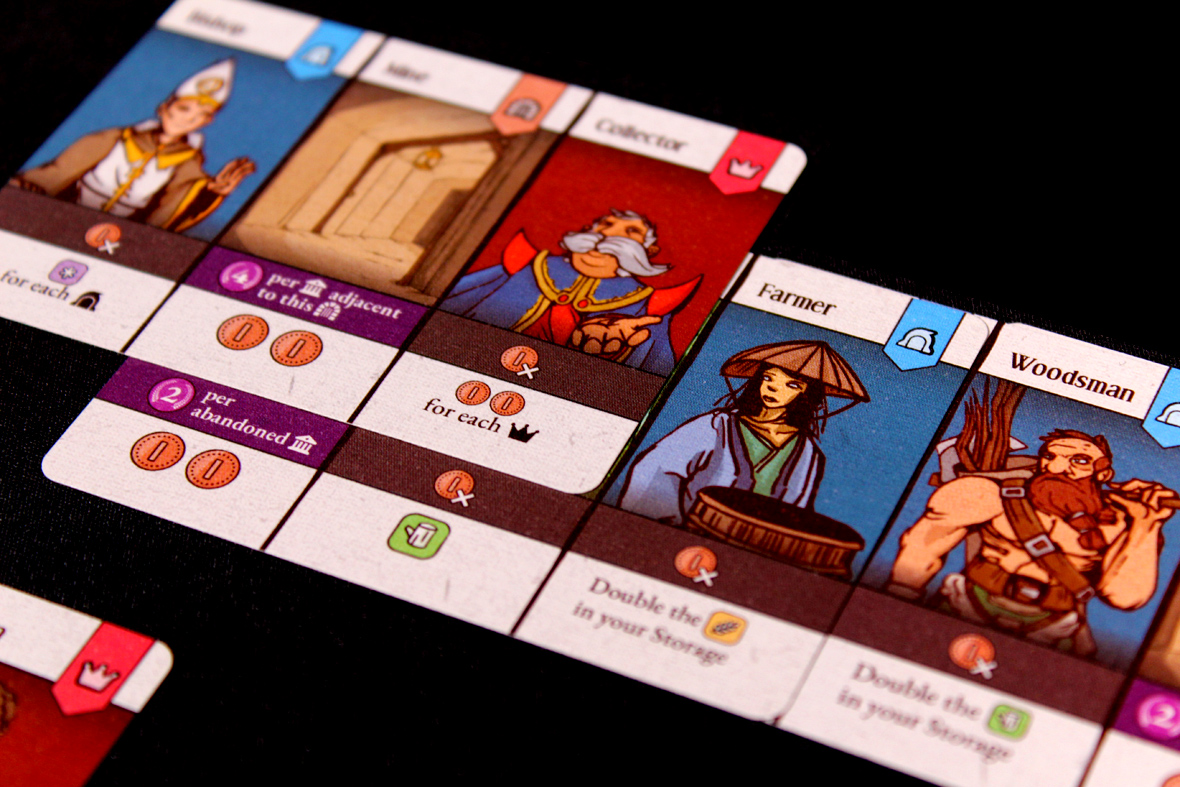
You can, at any point, discard a Wonder Card from the row and gain 2 gold or any one resource; at the end of your turn after taking your action, you refill the Market back to four. Note again that you don’t have to keep the Market at two Districts and two Wonders; you can draw from either deck.
Additional things you can do during your turn: for one, you can always swap two gold for any one resource. Just keep in mind resources max at 7. You can also make use of the Event on the back of the top card on the District Deck. See what you can do with those.

The game ends when either the Market is empty or you can’t place any cards. Total up your score and see how you did!
Player Count Differences
None; solo game.
Strategy

- Manage your resources wisely. You need those for Wonder construction! This means efficiency is key, but also you want to have plenty of something when you get the citizens that double that resource type. Just keep in mind that there’s an upper limit, so going to see them with more than four is challenging and wasteful.
- Building all the Wonders is tough! Don’t worry if you need to burn a few for resources. It’s tough to have it all. Do what you can and see if you can optimize during the next game.
- It’s not just about what you can play; you also need to factor in where to play it and when. That card activation can be tricky because you may not want to cover certain cards or parts of cards for various reasons. And that’s fair! Even choosing left or right may have sweeping consequences depending on how the card is laid out. Choose wisely!
- Make use of the Event Cards when you can. They are essentially free benefits (or at least modifications to the standard rules); that can usually work in your favor.
- You do need to build some Wonders, though. They have a wide variety of benefits and are worth a lot of points. That can be pretty useful.
- Tweak the Market balance. Got too many resources? Refill from the Wonder Deck. Too few? Refill from District. That’s a bit too simple of a heuristic, but it’ll be good enough for your first game.
Pros, Mehs, and Cons

Pros
- It’s a very tiny civilization game! I really like seeing Button Shy experiment with the games it publishes. They can’t all be absolute bangers, but this was a pleasant surprise that I quite enjoyed. That said, I tend to like Steven Aramini’s games quite a lot, so this isn’t a huge surprise to me.
- Every card is doing double duty (or more). It’s a very packed crowd, to the game’s benefit. Some cards have essentially four different uses: three on the front and a fourth Event on the back. There’s a lot, and figuring out how to balance all that and where to place certain elements must have been a doozy.
- I like the resource management aspect. I think it’s always fun to be able to use cards as simple resource trackers, and Button Shy excels at this. How you manage the resources is also interesting, here, as you use them to trade and primarily build Wonders for their various effects.
- Interesting decisions, too. Certain cards are set up specifically to force the occasional tough call. Do you want to cover a Mine that might be getting you points down the line? Or is it worth it now so that you can earn something instead of the nothing that Mine would have gotten you? How you place cards and when you draw them does a lot to shape your strategy game-to-game, which is interesting for a game with only 14 Market Cards.
- The Events are a nice way to engage the unused cards. Again, it makes when you do something or have something matter, which is neat.
- High portability. The Button Shy advantage, folks.
- I like that you can impact the split of the Market. It doesn’t always have to be two and two; you can add more District Cards after each turn to try and tilt it in one direction, if you need.
Mehs
- The spatial element may throw you off a bit. There aren’t a ton of spatial civilization games, so I like the novelty of this one, but I can see how having to decide left or right in advance and that affecting subsequent activations may be tricky for some.
Cons
- The delayed activation is going to throw you off during your first game. For non-Wonder Cards, they’re not activated when the card is played; instead, they’re activated when a card is played above them and then covers their spot on the card as you overlap the two. That can be pretty confusing the first time you play. Mines, similarly, are also unaffected. You can still cover them, though!
Overall: 7.5 / 10

Overall, Ancient Realm is a lot of fun! I was surprised that Button Shy could publish a little civ game and now, here we are. Makes sense that Steven Aramini could do it; he’s always got something interesting cooking (more on that later!). I enjoy the art style and that you can have a tiny civ in under 30 minutes. It speaks to the Button Shy ethos while it tries to also break the mold of what you can do with 18 cards, and it’s a fun attempt. You also still reap all the rewards: it’s very portable, it’s pretty easy to pick up, and, again, experienced designer with experienced publisher. It tends to work out. You may find yourself perplexed by the spatial and timing elements, but they do start to gel together better in your brain the more that you play. All that remains at that point is to get resources and build a legacy. If you’re interested in civilization on a budget and a bound, you like Steven Aramini’s games, or you’re just a long-time Button Shy die-hard like me, I’d definitely recommend Ancient Realm! It’s been neat to try out.
If you enjoyed this review and would like to support What’s Eric Playing? in the future, please check out my Patreon. Thanks for reading!
 What's Eric Playing?