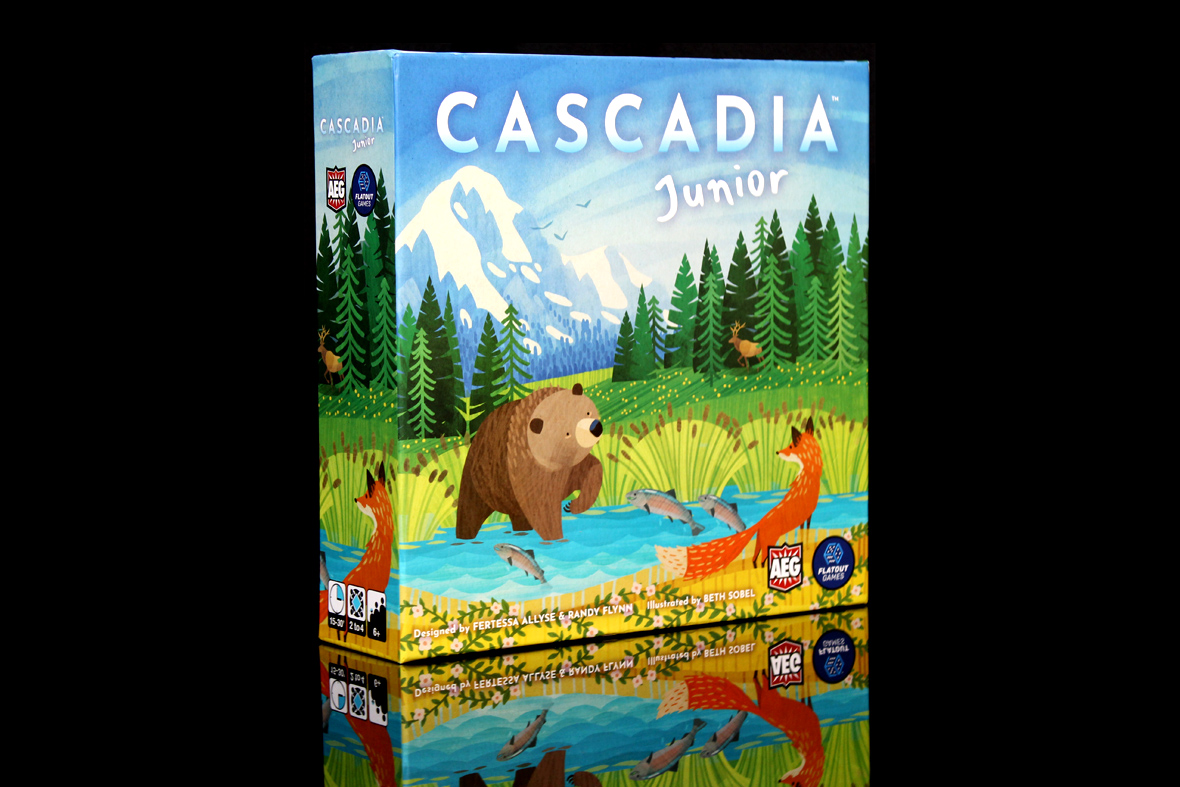
Base price: $32.
2 – 4 players.
Play time: 15 – 30 minutes.
BGG Link
Buy on Amazon (via What’s Eric Playing?)
Logged plays: 1
Full disclosure: A review copy of Cascadia Junior was provided by AEG / Flatout Games.
Some part of me genuinely tried to get this published before midnight this time; I think I wanted to go to bed early but I got distracted playing Hades II. Unfortunately, I once again got distracted playing Hades II, so here we are. The good news is that I finished to the point that I’m now pretty sure I just need to play the game again when it hits 1.0; there are plot things I need to resolve but otherwise I think I’m ready … to play the new Donkey Kong game when it comes out Friday. We all contain multitudes, but in the meantime I think I’m going to try to get ahead on reviews before Gen Con wrecks me again. Can you believe it’s only two weeks away? I certainly can’t! And that’s causing me some stress! Oh well. Cascadia Junior, folks: let’s see what’s what.
In Cascadia Junior, you’re headed to the Pacific Northwest to see the sights and the friendly animals! I actually have no idea if salmon are friendly or not; I don’t really think that much about the emotional directionality of fish. Maybe I should! Maybe salmon are actually huge jerks. That would be huge for pescatarians, I think. Either way, you’re going to be building your own Cascadian ecosystem with sightings of wildlife and their habitats, recording them on your own Panorama Board to memorialize your trip! What will you find on your adventure?
Contents
Setup
Each player gets a cool Panorama Board. Shuffle the tiles and remove some based on your player count:
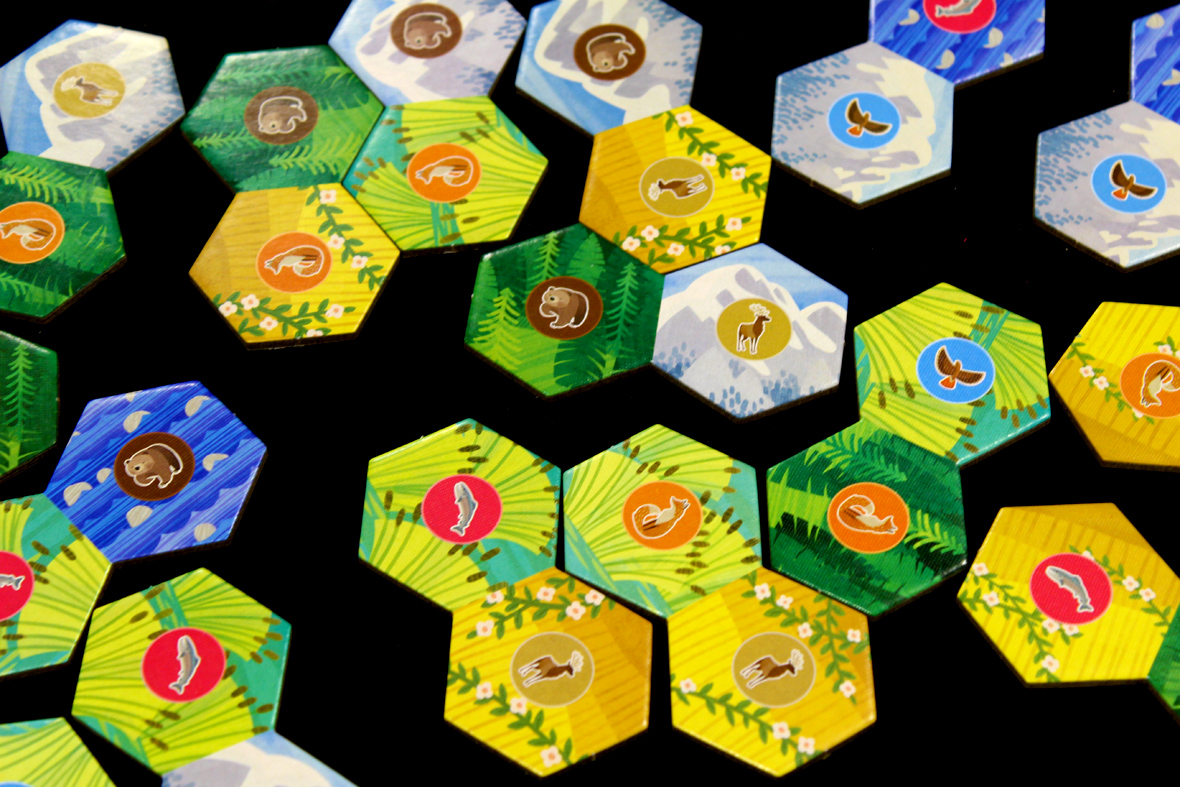
- 2 players: Use 23 tiles.
- 3 players: Use 34 tiles.
- 4 players: Use 45 tiles.
Each player gets one and places it face-up in what will become their Environment. More on that later. Two more get flipped up into the center to form the Market. Now, place the Wildlife Cards face-up on the A side; for advanced play, use the B side. You can place the Wildlife Markers nearby:
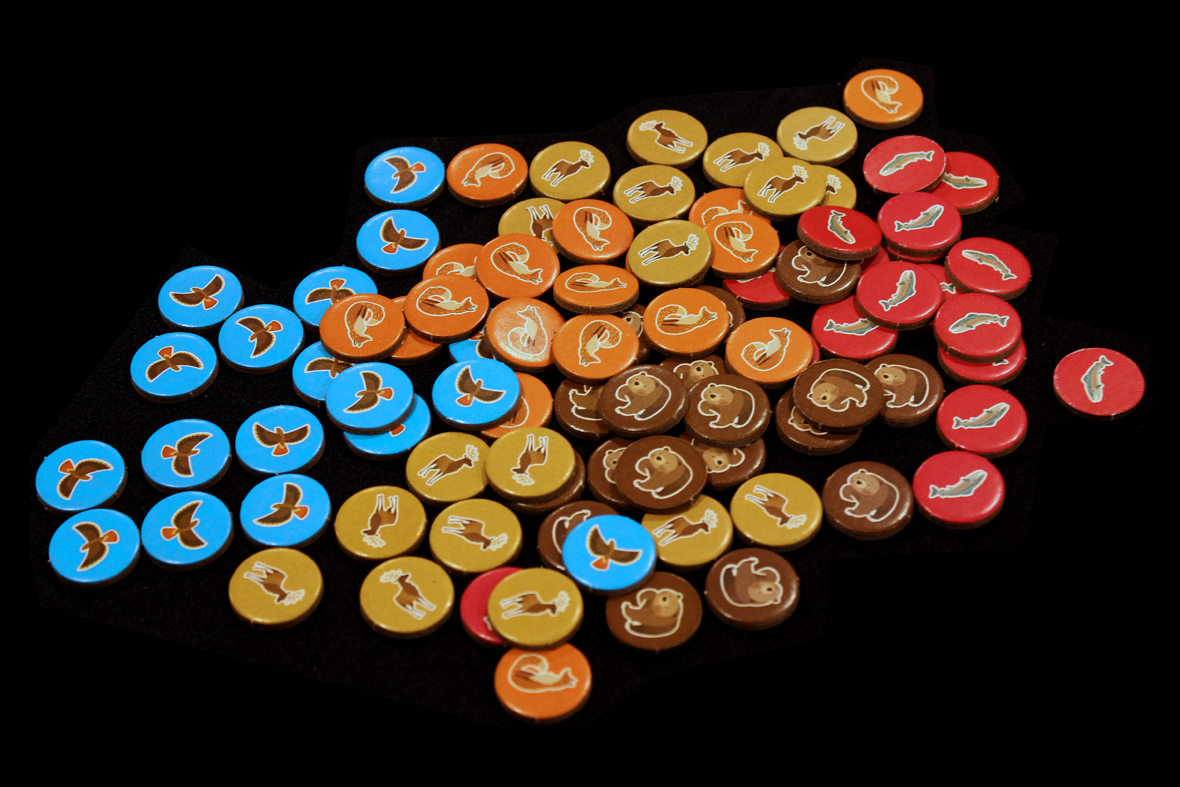
Shuffle the Wildlife Sighting Tokens and Habitat Tokens as well, keeping them pinecone-side down. You’re ready to start!

Gameplay
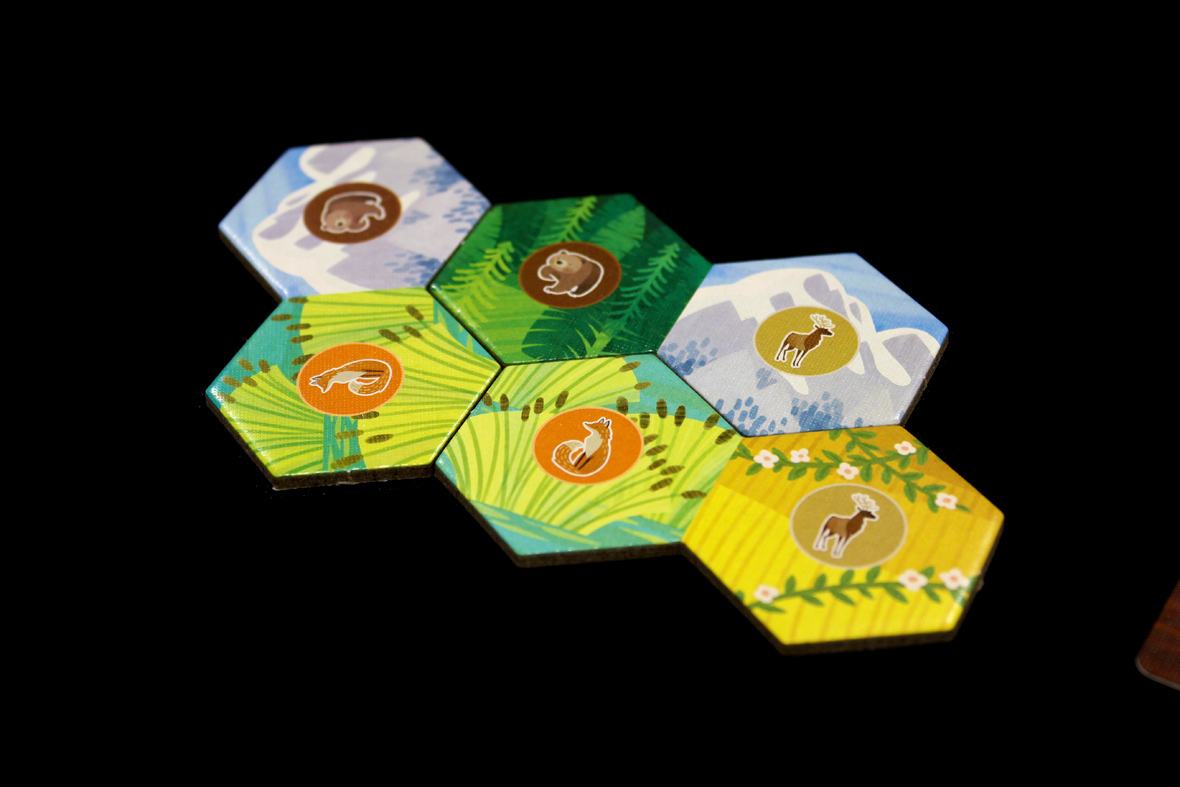
This one’s almost alarmingly simple.
On your turn, you take a tile from the market. You can pick either. Then, place it such that at least one edge of one of the hexagons is touching another hexagon on your board. Nothing more complicated than that; it just has to be touching another tile somewhere. If, as a result, three animals of the same type are now adjacent to each other, cover them with Wildlife Tokens and add the matching Wildlife Sighting Token to your player board. Don’t flip it over yet.
Then, draw a new tile. That’s pretty much it.
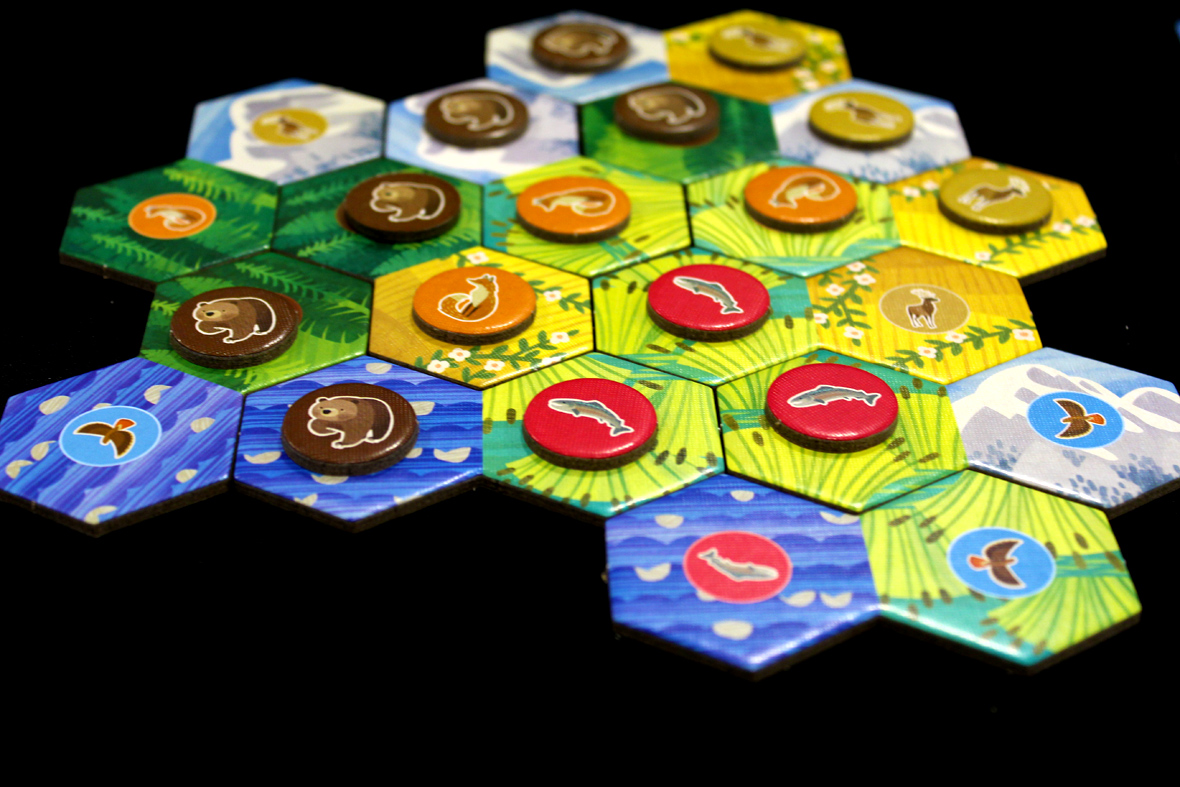
Once every player has taken 10 turns, there will be only one tile left in the Market. That marks the end of the game. Now, check to see if players have groups of three or more of the same Habitat tile adjacent on their board. If they have 3 – 5, take a Habitat Sighting Token of that type and add it to their player board. If they have 6+, they get two.
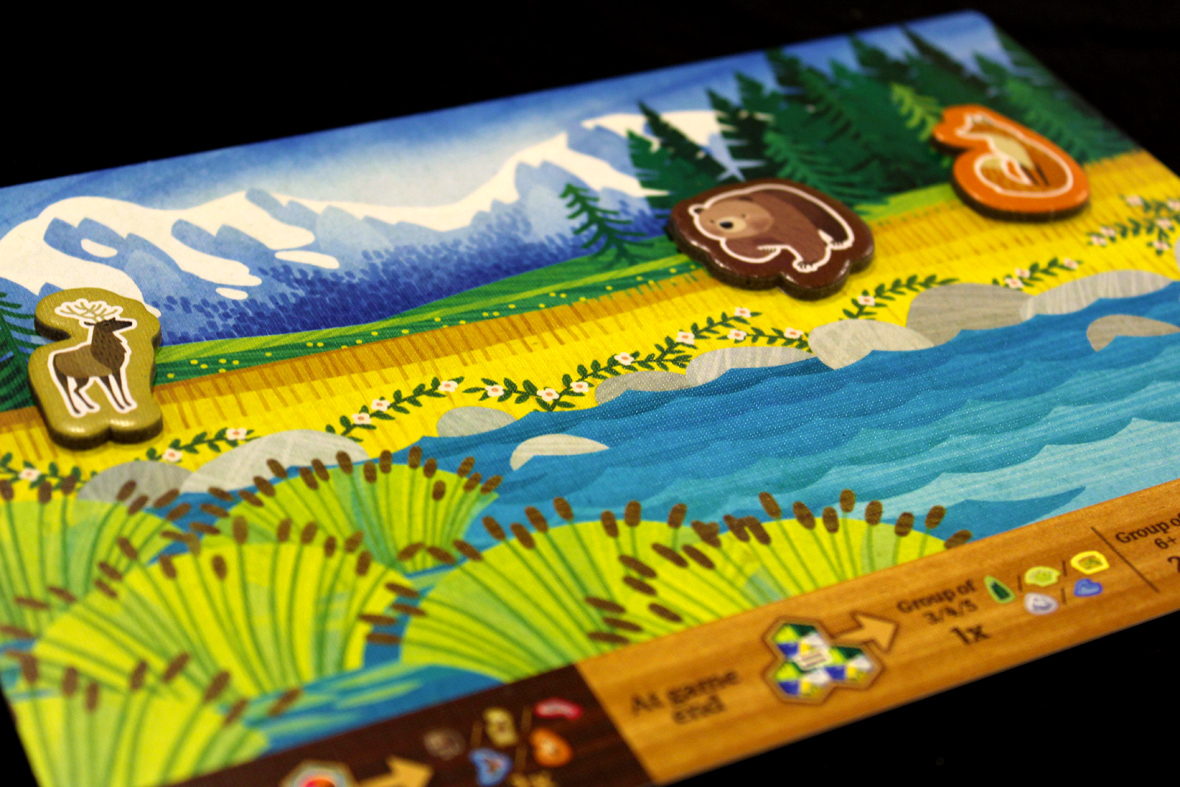
After doing that, reveal everyone’s face-down Sighting Tokens and tally your pinecones on the backs of each. The player with the most cones wins!
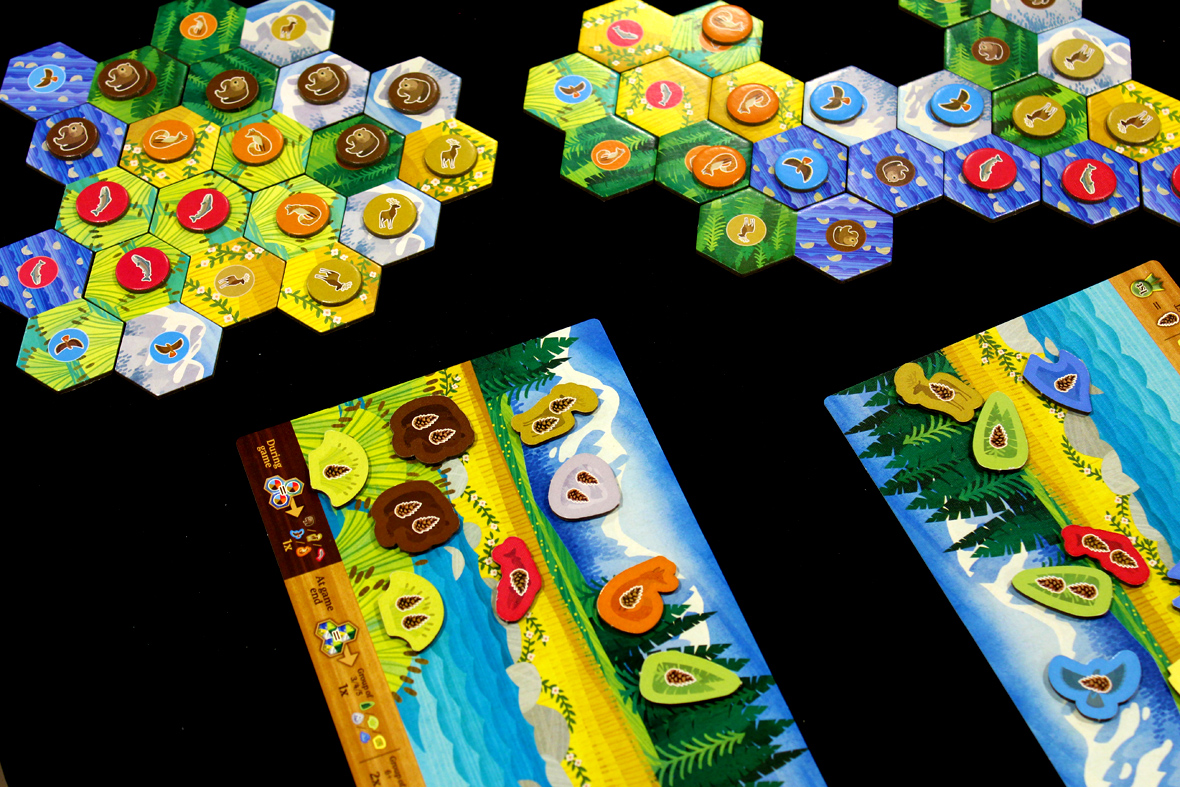
For advanced players, use Side B of the Wildlife Cards. Here, you’re required to have the Wildlife on the tiles in specific positions (that can be mirrored or rotated). That should add a little bit of extra challenge!
Player Count Differences
Not a ton of differences, here, which is nice. The major thing you’re going to see is that there’s just more players pulling from the market, but everything starts out pretty random. You don’t know what the distribution is going to be of tiles, so you can’t necessarily plan for any one thing. Also, you know, it’s a kids’ game, so if this is where you break out your true strategic genius to dunk on a nine-year-old, I mean, that is the best use of it. Dunk that kid. I’m excited for you. But otherwise, I don’t think you’re going to notice a ton of differences, but it is going to be fun with more players. I enjoyed it plenty at two as well.
Strategy
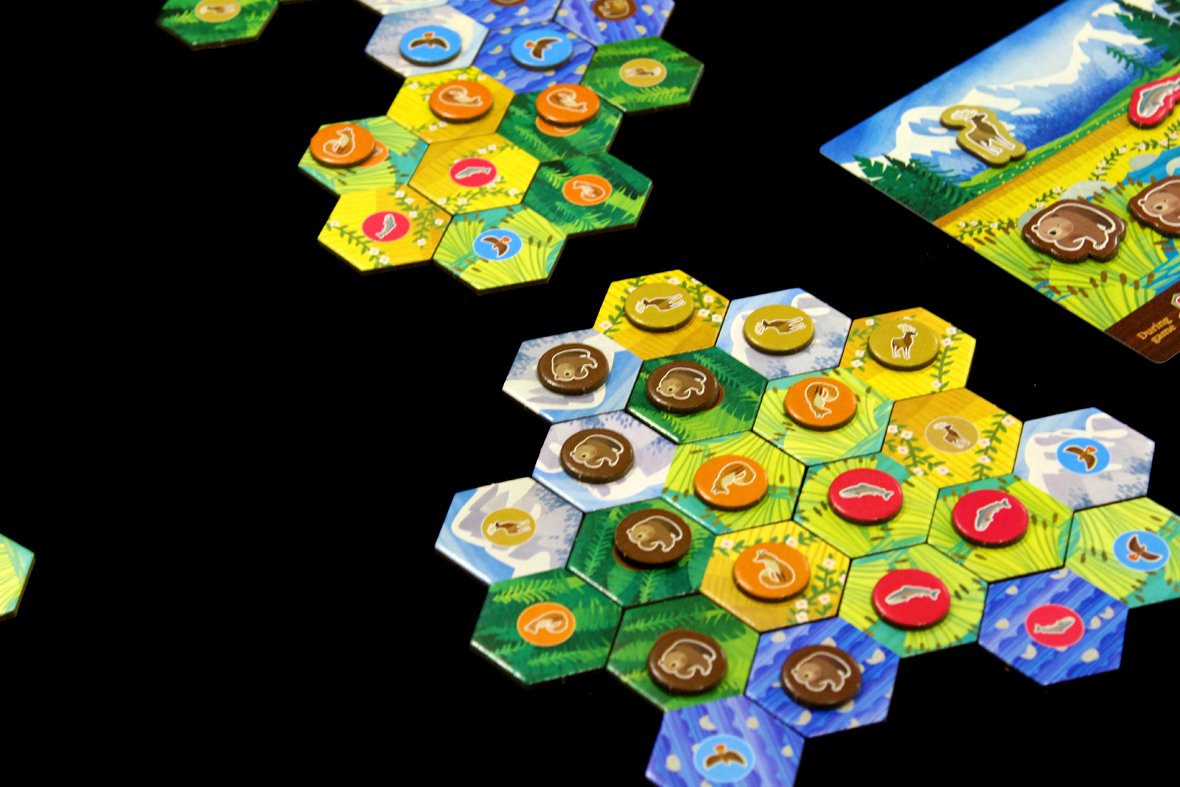
- Group your animals! Every three you place, you get a scoring Wildlife Sighting Token! Once you have them there’s no real benefit to adding more to that one unless you place three more.
- Group your habitats! These actually do benefit from adding more than three. At the end of the game, three gives you one Habitat Token; six gives you two. Is that better than placing a second set of three elsewhere? Possibly not, but it is aesthetically pleasing.
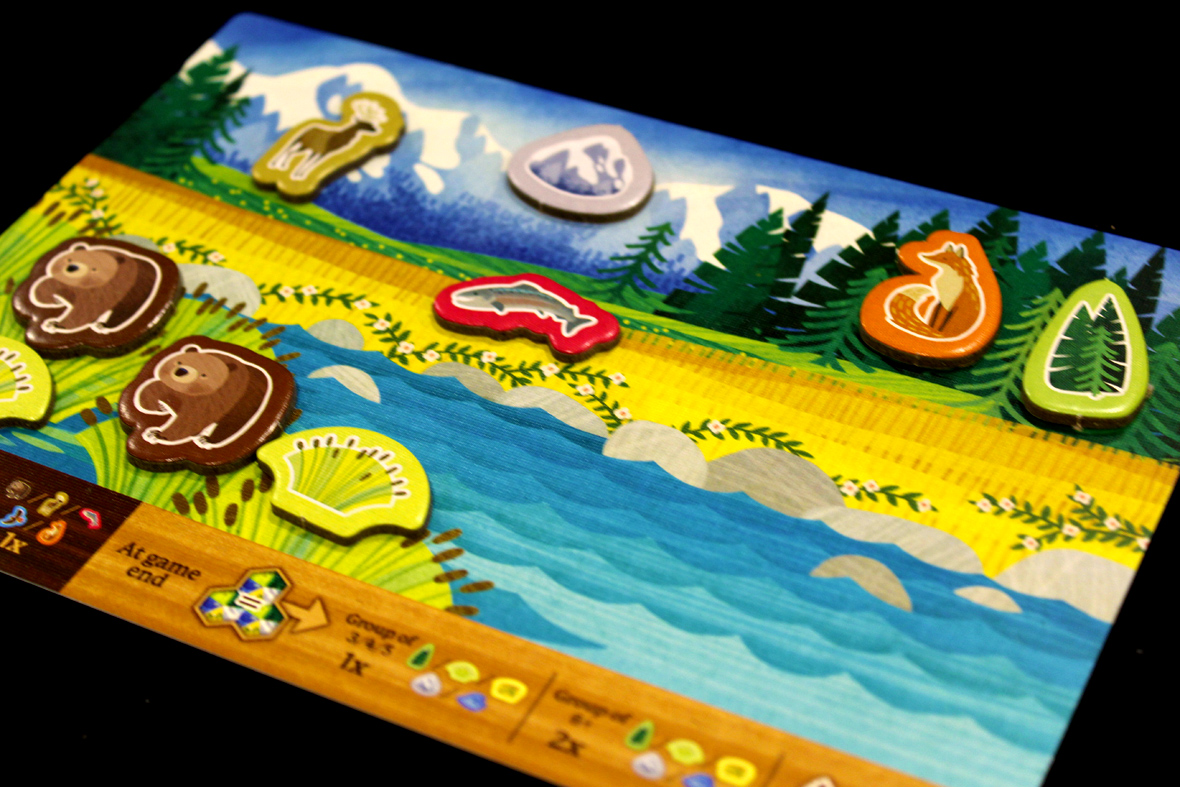
- Your Panorama Board is a place for you to artistically express yourself; there is no strategy there. Just have a nice time, free of your burdens. Don’t try to play for a specific strategic move when you’re placing there; just enjoy the art of making a lovely little wildlife scene. Please.
- You can’t necessarily anticipate whether or not the Wildlife Sighting / Habitat Tokens are going to be 1 or 2 points. There’s not a whole lot of planning you can do around that, unfortunately. You should just aim to get as many tokens as possible, I suppose. If you figure that you place 10 tiles and so, in total, have 22 valid spaces (and 22 animals), you could potentially get quite a few! Again, not a math guy.
- If you’re playing on the Advanced Side, you do need to make sure the Wildlife are in the correct orientation. Don’t forget about that, and make that clear if you’re transitioning to the Advanced Game for the first time! You don’t want to bum players out by having them realize they’ve been playing wrong. That’s no fun.
Pros, Mehs, and Cons
Pros
- The art style continues to be great. I haven’t seen a lot of family-weight game art from Beth Sobel, but I’m excited to see it here. The animals are cute and the color work continues to be excellent; it’s one of my favorite things about her art. It’s bright and rich without necessarily being unrealistic or over-the-top, and here it’s just cute. Strong work, as always.
- I love this light introduction to Cascadia, and it’s still fun as someone who enjoys the core game a lot. It’s a nice way to introduce younger players while still maintaining some of the core mechanics of Cascadia. It’s also materially different than the roll-and-write games, which I still like, though they clearly all share the same DNA. Cascadia is just a good core game, and it’s true in that even the spinoffs are still quite fun.
- The Prairie Salmon endures! The king of Cascadia is the legendary Prairie Salmon; he lives on Prairie tiles and is, I guess, a fish that lives in the grain? Now, are there likely bodies of water on prairies? Yes. Do I believe in a fish swimming through the grains like a slippery cryptid? Absolutely. He endures in Cascadia Junior, too. All hail.
- The game plays super quickly. It’s very much a tile-placement game with an extra reward for some match-3 mechanics. It’s great, quick to play, and teaches pattern recognition with some pleasant art and colors. Big fan.
- I love that you can set up the Panorama board however you want. You can style the board and place animals however you’d like. It’s a great way to let some players just kind of … do their own thing if the actual game part of the game isn’t for them.
- Advanced rules are a nice step up as players are ready for more complexity. Now it’s not just match-3; it’s the extra sets of three along with their relative placements so that players can learn not just to recognize patterns but also to recognize how to arrange and strategize to get those patterns into specific configurations! It’s very good. Want something more complex than that? This dovetails extremely nicely into the Family Variant of Cascadia proper.
Mehs
- I think this is a great game, though I wonder if it’s going to get as much traction as it should since Cascadia is also a fantastic game. I’ve been talking about this a lot lately on the video game side as we look at games like Hades II, Tears of the Kingdom, Fields of Mistria, and other games that fundamentally owe some nontrivial part of their existence to another, earlier game. All of those games are, in my opinion, “better” than their predecessors (for approachability, expansiveness of content, Hades II adding even more hot people, things like that), but they all suffer a bit because they’re not necessarily transformative in the way that their predecessors were. For instance, despite Cascadia Junior being a perfectly reasonable candidate for the Kinderspiel, I wasn’t surprised it didn’t win. Not as a comment on the game itself, but because Cascadia already won the Spiel in years prior. It’s not really any particular reflection on the game itself, just a musing that I keep having as I see more and more games come out.
Cons
- You might encounter some frustration from players if you end up with a player having bad luck on the 1 / 2 cone tokens. This is the same problem with games like ICECOOL, which I love: since the actual value of the tokens is random, theoretically, the player with more tokens has a better chance of winning, but it’s certainly not a guarantee.
Overall: 8.5 / 10
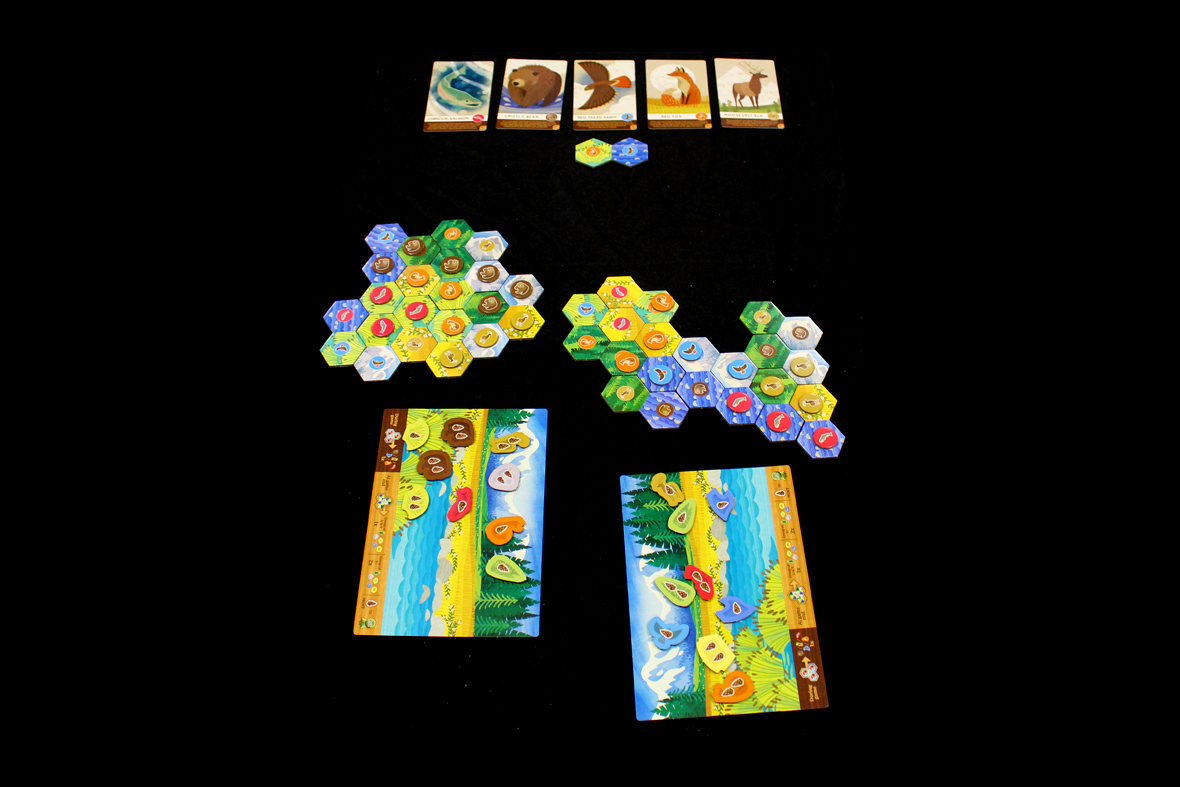
Overall, I think Cascadia Junior is a slam dunk! It’s a game that I wish existed when I was learning more about board games instead of trying to figure out how to play some of the games my parents had (though, to be fair to them, I still enjoy Pit quite a bit). I might actually end up getting this for some of my friends who have recently had kids since, honestly, I have no idea what to get for new (new being, in my informed opinion, <= 10 years ago) parents. Do they need an SAT prep book yet? I legitimately do not know and have not invested resources into learning, yet. I’m sure it’ll come up. But Cascadia Junior does that thing that you always want games like this to do (to the point that it’s becoming trite for reviewers like us to say): it’s approachable for kids but has enough depth that it’s still fun for everyone to play. It’s not fun in the same way that, say, Rhino Hero or that weird game about poop that I saw at Target (it’s been a while since I’ve been to a Target) likely are, but it’s fun in a gaming-forward way rather than a dexterity or goofy way. This presents a nice contrast from what you see from a lot of (non-HABA) “kids’ games”. Sometimes you want to place tiles and build something up, and Cascadia Junior does that with the (frankly, brilliant) extra flourish of letting players set their own Cascadia scene on their player boards. You still get some creativity out of the deal while rewarding strategy, planning, and pattern recognition. Those are likely good things for your kids to develop (and helpful things for you, parents and Concerned Family, to practice), so this all works out in my extremely-uninformed-about-kids opinion. Plus, it has nice art, it’s quick to play, and it’s fun. And the Prairie Salmon is in it. If any of those things sound good, you’re looking for some light strategy, or you’re just a big fan of the Cascadia series, I’d definitely recommend Cascadia Junior! It’s a solid introduction.
If you enjoyed this review and would like to support What’s Eric Playing? in the future, please check out my Patreon. Thanks for reading!
 What's Eric Playing?