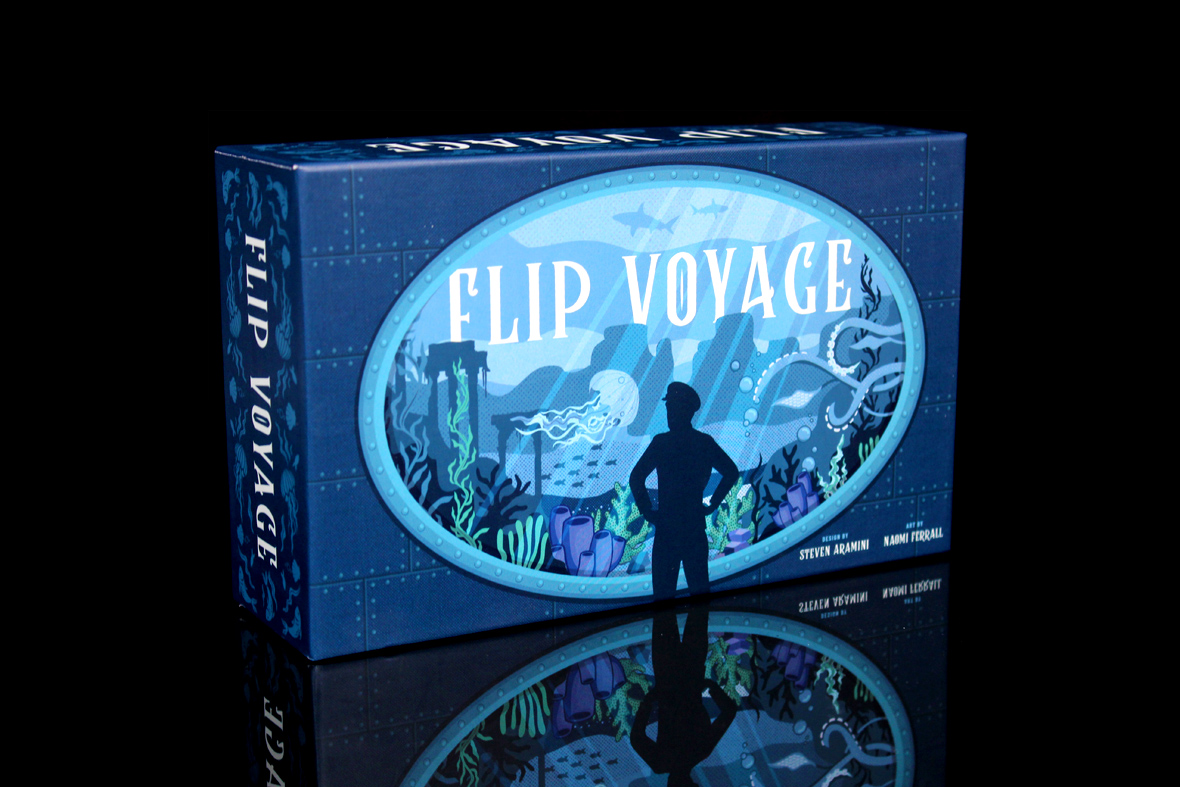
Base price: $XX.
1 – 4 players.
Play time: ~45 minutes.
BGG Link
Check it out on Kickstarter! (Will update link when Kickstarter is live.)
Logged plays: 2
Full disclosure: A preview copy of Flip Voyage was provided by Write Stuff Games. Some art, gameplay, or other aspects of the game may change between this preview and the fulfillment of the Kickstarter, should it fund, as this is a preview of a currently unreleased game.
I guess it’s water week for What’s Eric Playing?. I got High Tide and Flip Voyage, and both games are distinctly nautical. I love themed weeks, accidental or otherwise. It’s part of the joy of just … accidentally picking things up and playing them at different times. Plus, there’s one more Good Week before Gen Con happens, so I’ve got one more shot to try and chat about games that you may want to check out. I’m kind of leaning Picture Perfect? I thought that one was a lot of fun. Maybe we’ll mention it on the podcast. Either way, wait for next week to find out.
In Flip Voyage, Captain Nemo is kind of done with the whole thing. Something about a giant squid and a sequel that almost nobody talks about. I read it a long time ago when I was in my Classical Literature Phase. It wasn’t a bad phase, but I’m doing more modern afrofuturism now. Anyways, Nemo wants a successor to take a ship and continue his voyaging and general cool activities. Seems fun, but not anyone can pilot the Nautilus. So therein lies the challenge. Compete against your fellow prospects and see who can carry on the Captain’s legacy. What will you find under the sea?
Contents
Setup
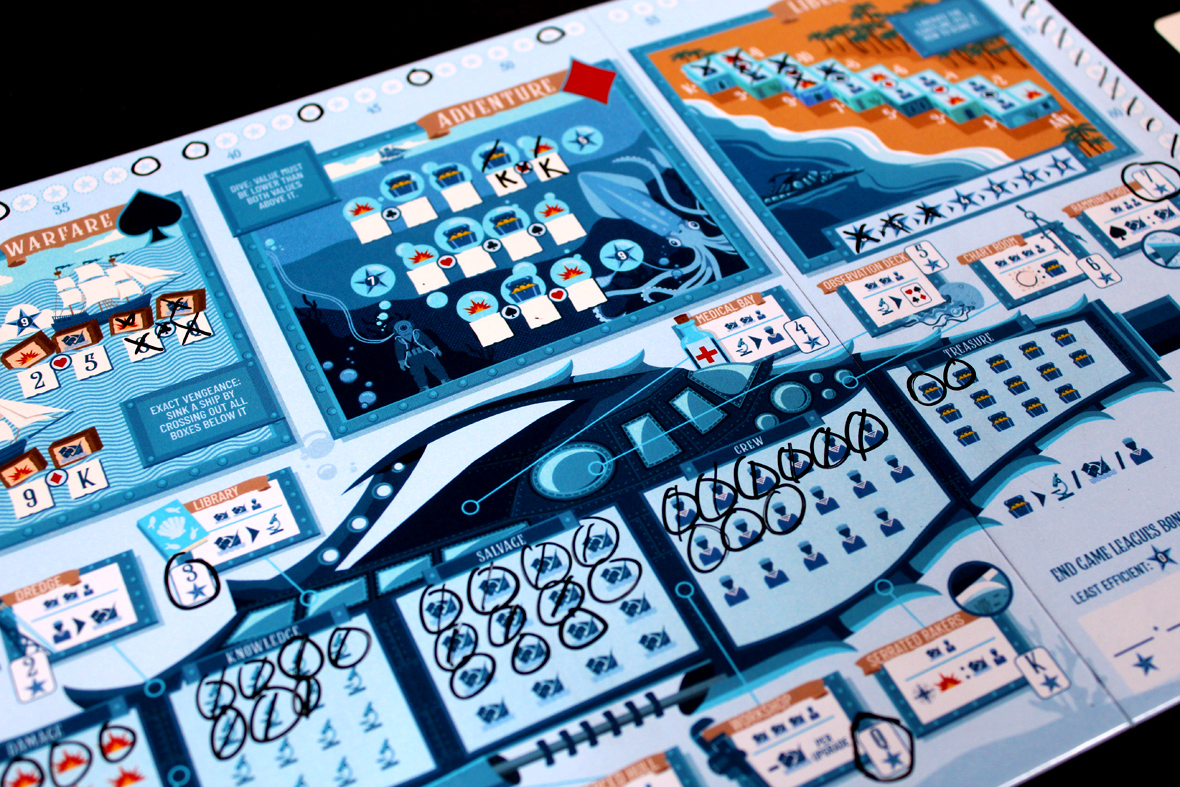
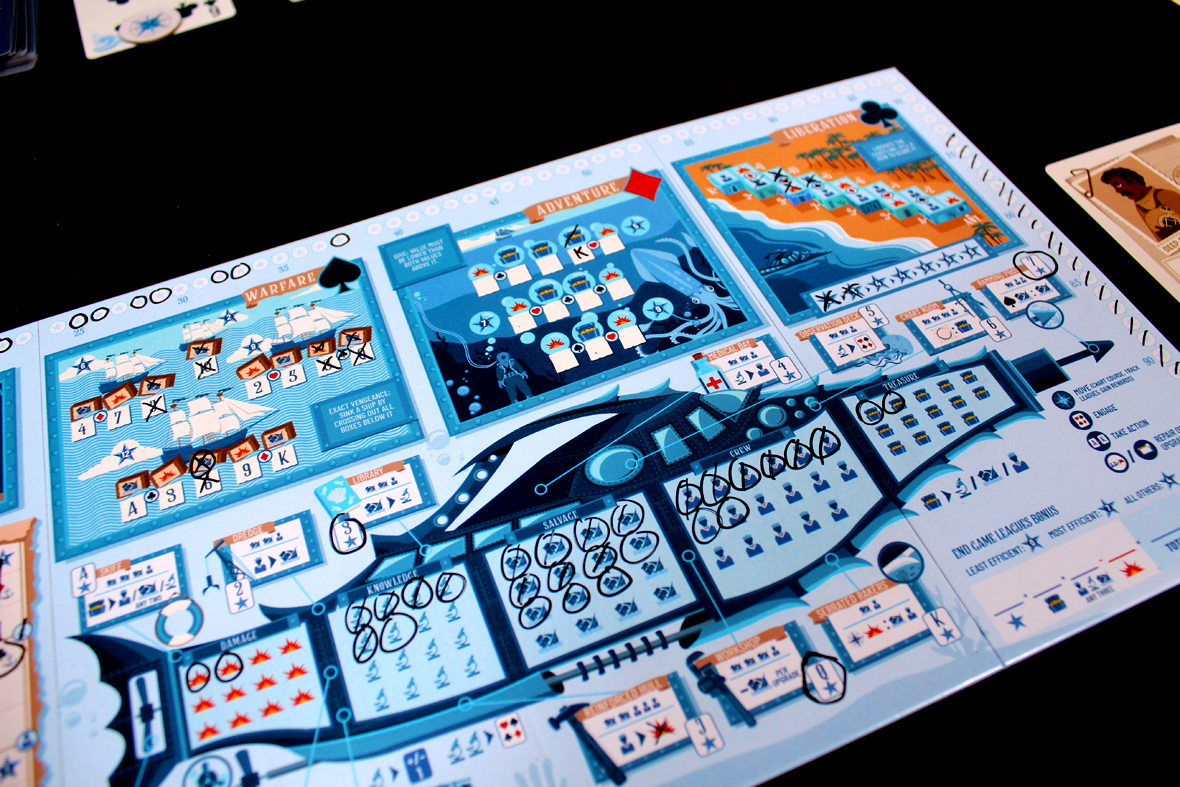
The nice thing about flip-and-write games is that even the more largely complicated ones don’t have as much setup to do. For this one, everyone gets a player board:
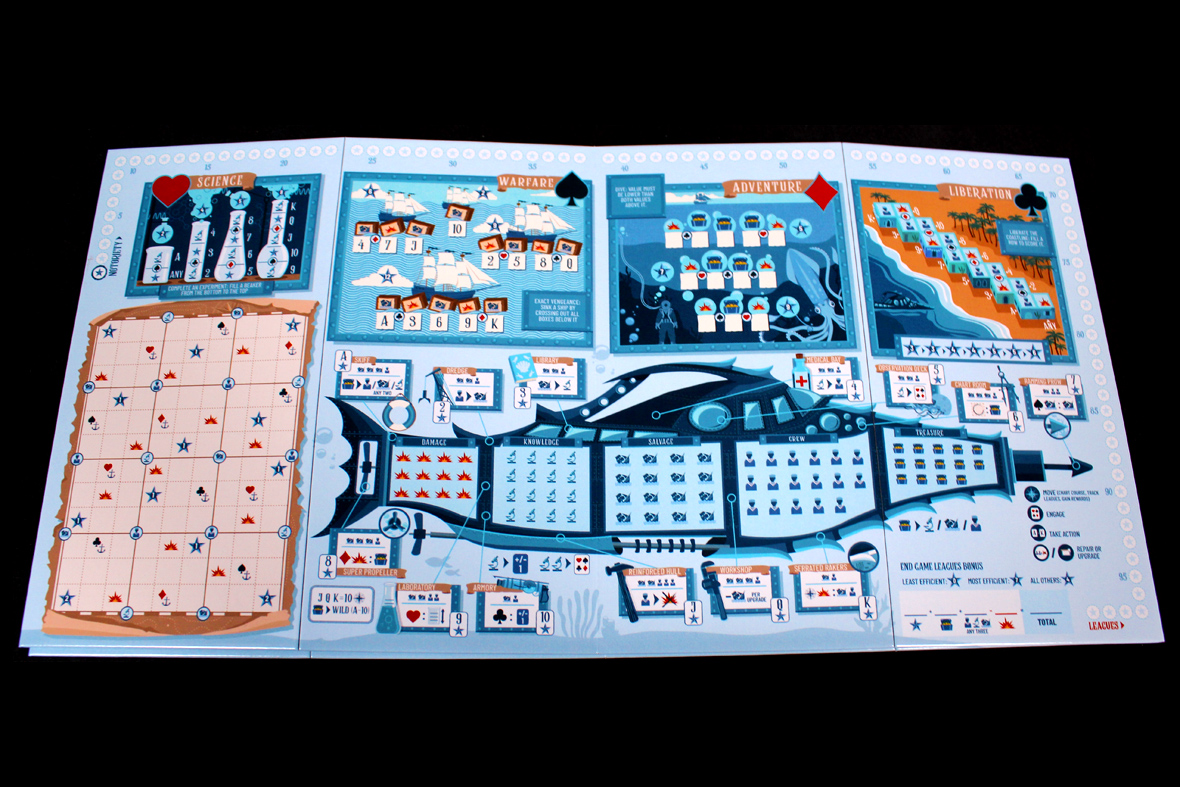
Everyone gets a marker, too; I don’t know what supplier Steven uses for his markers but they’re shockingly good. Not relevant, but worth mentioning. Shuffle the Character Cards and deal each player two. They should keep one and return the other to the box. They provide starting resources as well; circle them on your board.
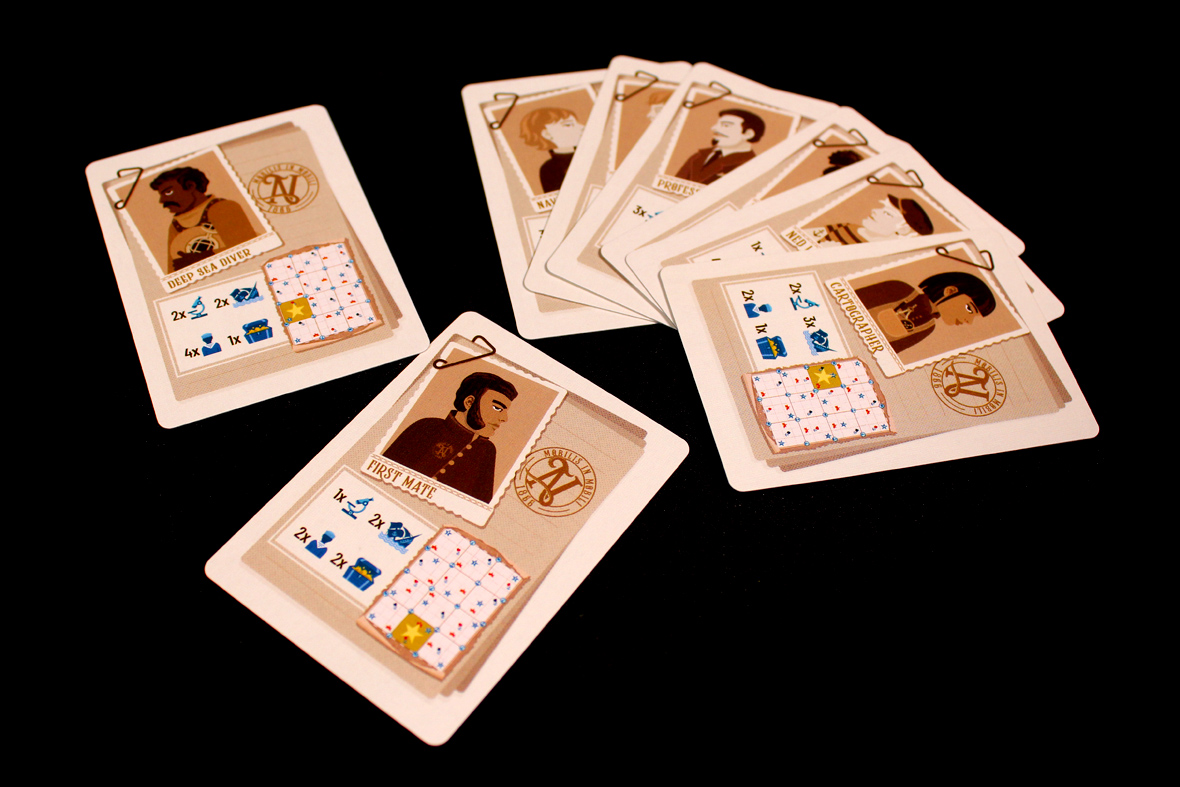
They’ll show you where you start as well. Circle the starred space in the indicated spot on the board; that’ll be your starting location. Then, flip the Character to the Item side; you’ll be able to use that once during the game. Give each player the four Phase Tokens in the color of their choice as well:
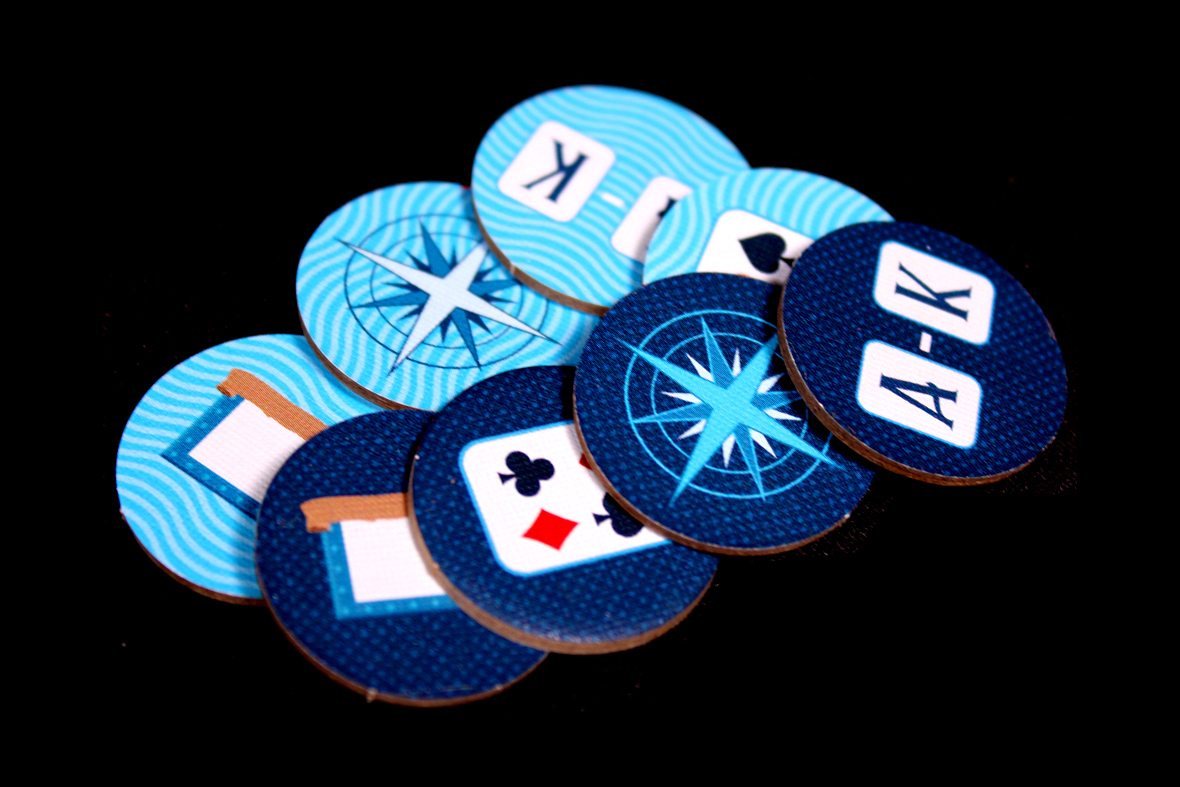
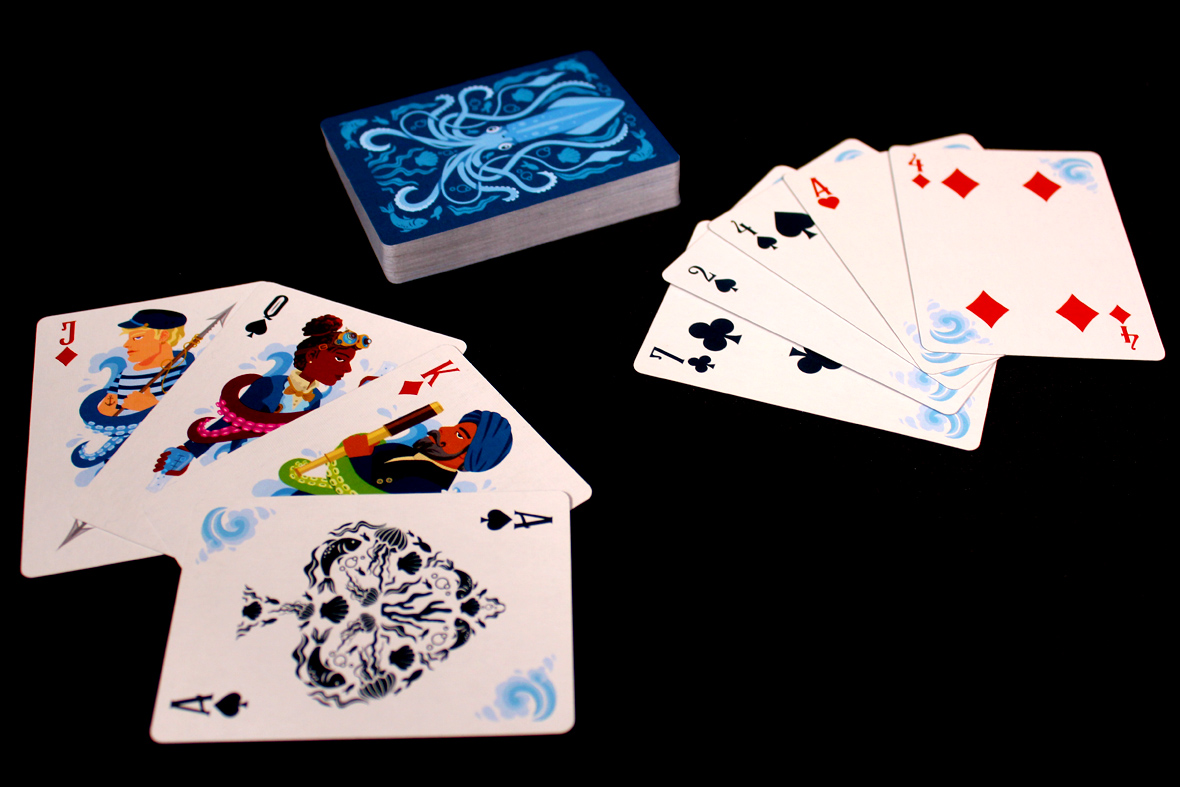
Shuffle the playing cards without the Jokers, revealing three in the center of the play area.
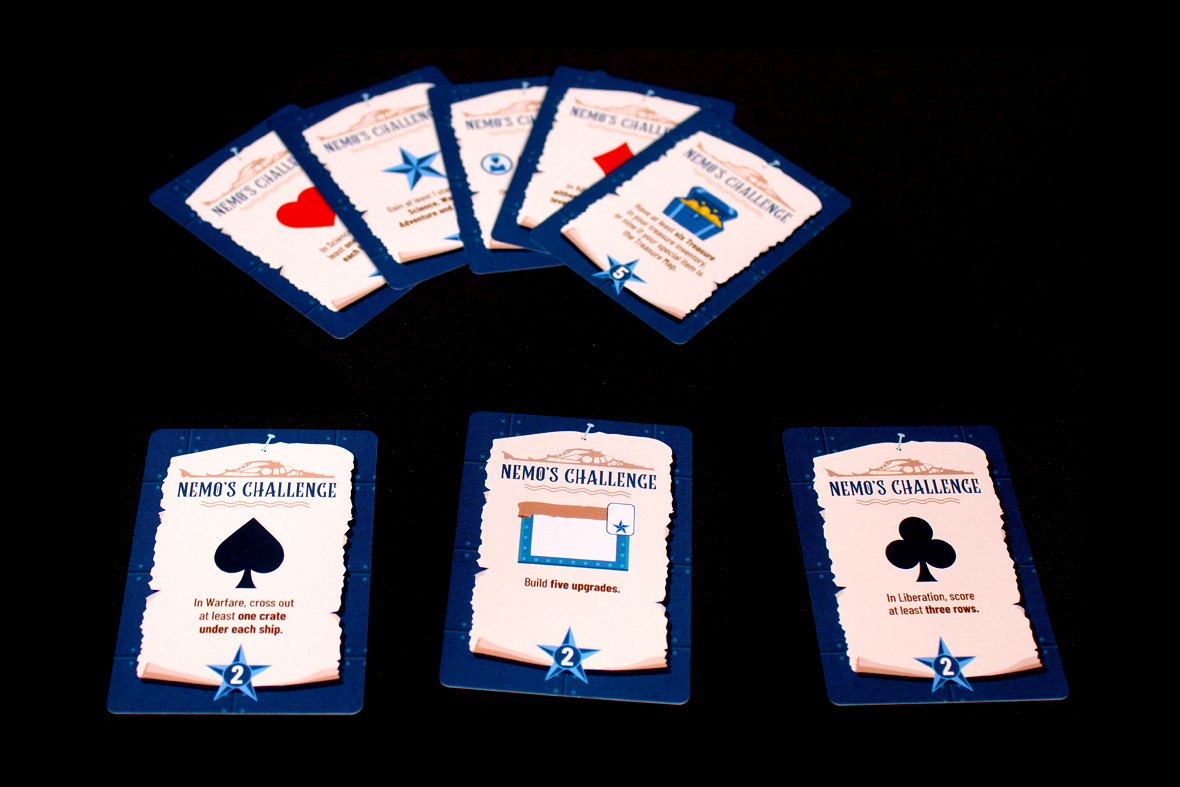
Shuffle the Nemo’s Challenge Cards, reveal three of those on the 5-star side.
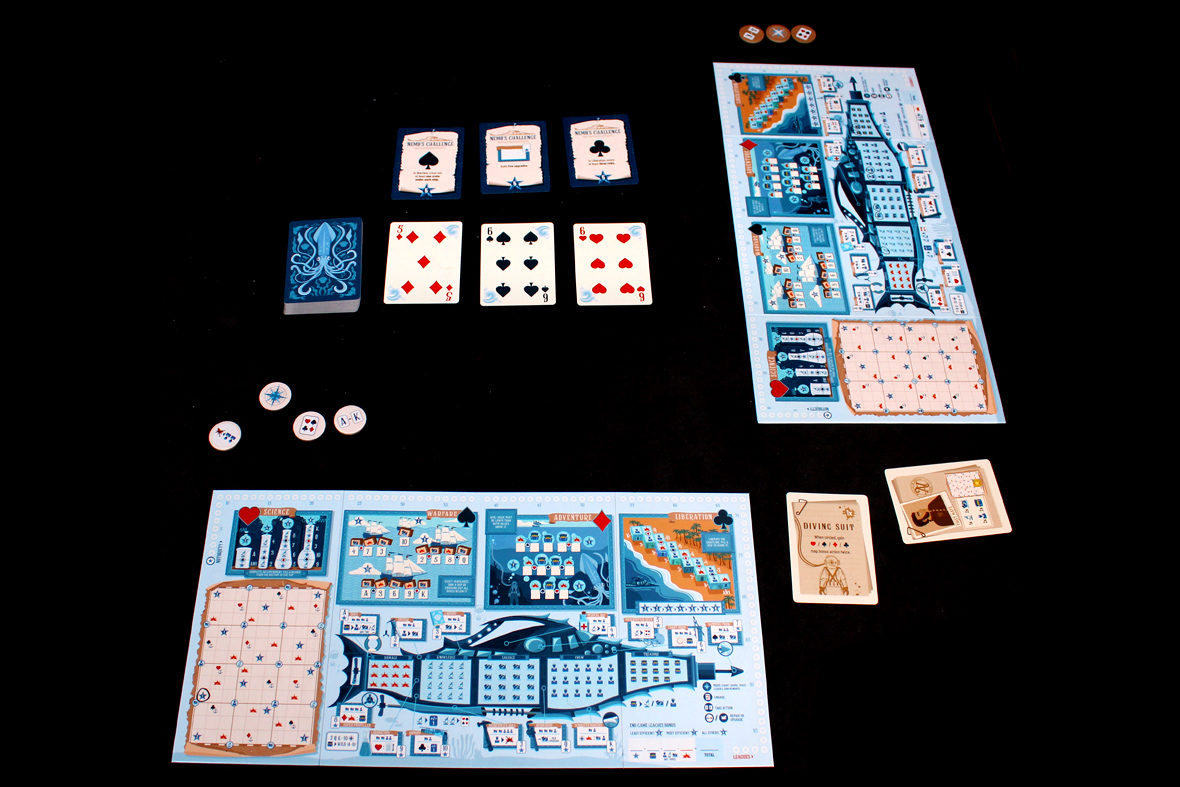
Should be ready to start!
Gameplay
You flip and you write; that’s the name of the game. Over the course of your voyage, you’ll travel, gain notoriety, and take actions to prove your place as Captain Nemo’s successor. All things considered, a pretty good gig. Let’s find out how.
Each turn, you’ll reveal three cards. Then, players choose where to place their Phase Tokens. One for Move, one for Engage, and one for Take Action. The fourth one comes later.
Move
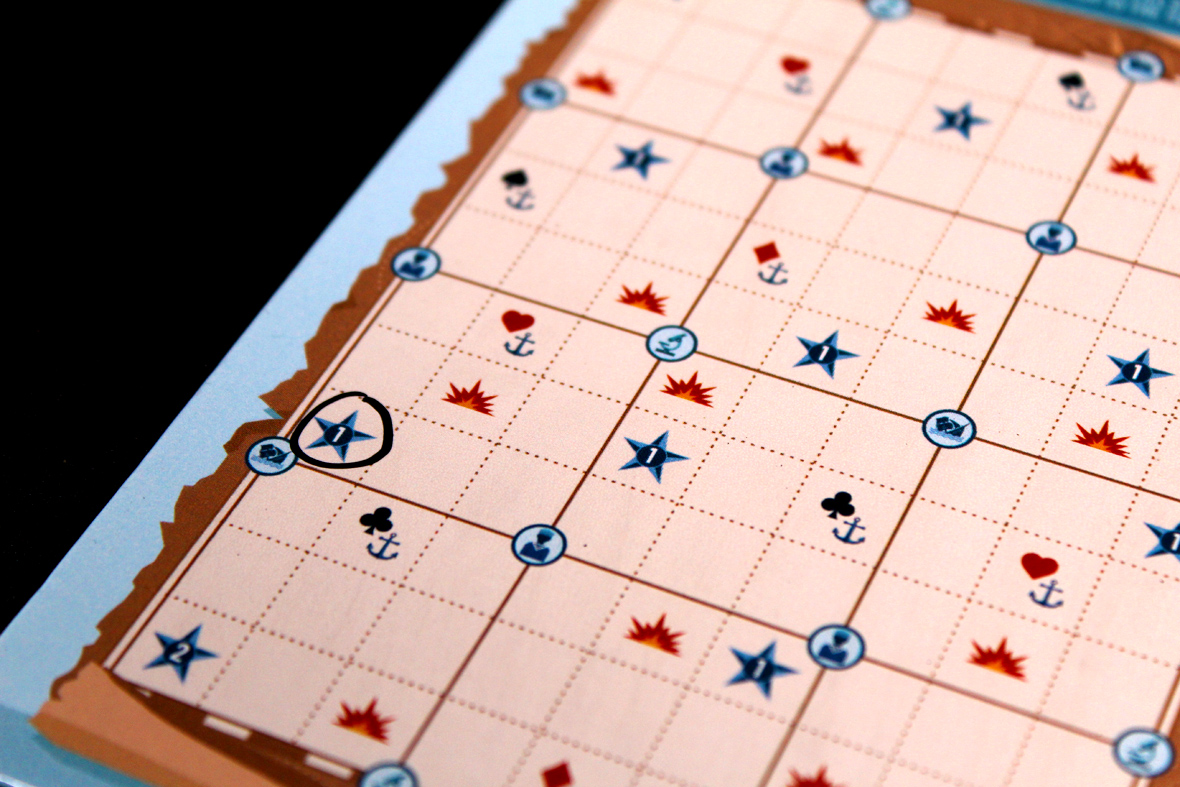
When you move, you use the value of the card to determine how many spaces your ship will move. This is required; you can’t not move. 10 and all face cards have a value of 10. If you move through a space with a star or damage, you get the points or the damage, respectively. If you stop on a space with a bonus action, you can immediately take the bonus action with whatever value you want. You can also modify your value with Knowledge (1 per Knowledge) or Treasure (one Treasure, any value).
Move one space orthogonally per value and mark the number of leagues traveled on your player board.
Engage
Engage is a really simple step. Based on the suit of the card, you can take one of the four major actions: Science, Warfare, Adventure, or Liberation.
You can spend two Knowledge to change the suit of your card to any other suit.
Take Action
Take Action is where the bulk of the game happens. Using the third card you selected, you use the action for any of the major actions.
- Science: Fill beakers from the bottom to the top based on your chosen value.
- Warfare: Defeat ships to claim salvage based on your chosen value.
- Adventure: Fill out spaces to venture to the bottom of the sea floor. The only trick is: lower rows must be lower values than the spaces above them!
- Liberation: Free coastal cities from invaders! Use your chosen value to mark off a space and collect points based on how many rows you complete.
As you fill things out, you might unlock additional bonus actions or gain resources; use those bonus actions or circle those spaces on your board as needed.
Repair / Upgrade
This final action you get to pick. You can spend two crew to fix one damage on your ship (once per turn), or you can spend resources to purchase an upgrade from your player board. They usually discount things or add further ways to convert resources. Pretty useful.
End of Game
The game ends the turn that one player’s Notoriety crosses over their Leagues. Total up your points (including a bonus for the player that traveled the fewest Leagues [and 0 points for the player who traveled the most]), subtract points for damage, and see who got the most points!
Player Count Differences
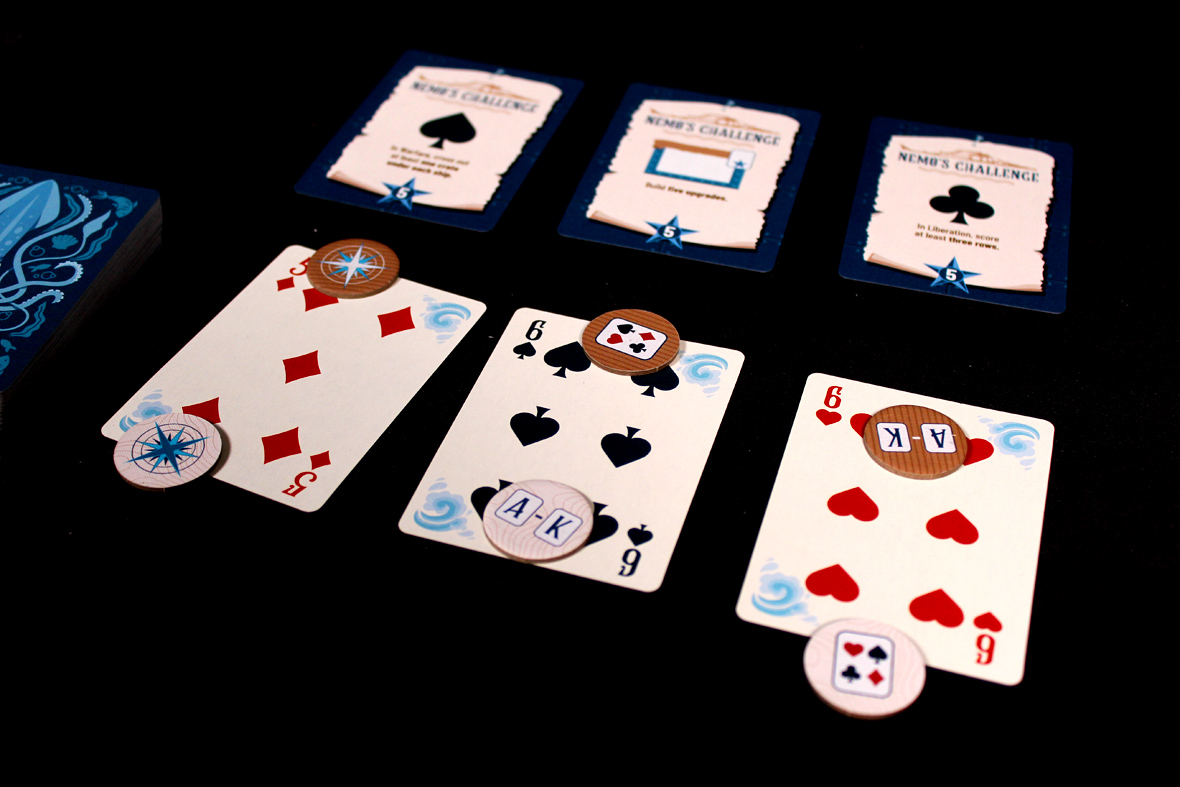
Relatively few, as is often the case for this style of game. Nemo’s Challenges are about the only thing you need to watch out for, as players independently choose their actions based on the three cards that are drawn each round. Nobody can really block you from doing whatever it is you want to do but you; there are certain actions you can’t take without resources, so that’s pretty much all you need to keep track of. The game strongly recommends that you don’t tell players when you’ve completed a Nemo’s Challenge until they finalize their action, though. Otherwise, players can occasionally reconfigure their turn to also complete that action and gain 5 points along with you instead of 2. Particularly enterprising characters might use the time to snoop on their opponents’ boards, though, and there’s nothing terribly wrong with that. Just don’t hold up the game to snoop. There’s a pretty robust solo mode, but you know me: I mostly review solo games and multiplayer games; I rarely try solo variants of multiplayer games. No player count recommendation for this one! It’s pretty similar regardless.
Strategy
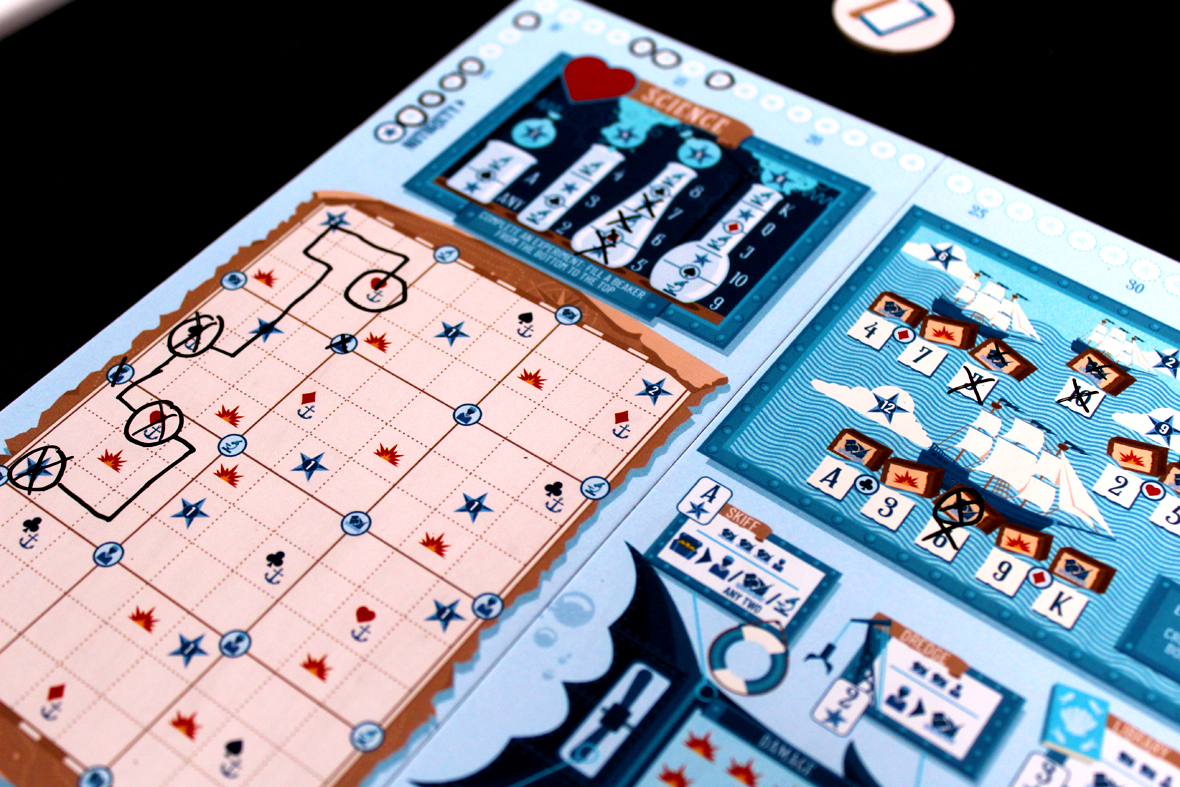
- The Upgrades are almost always a good starting point. There’s one that makes subsequent upgrades cheaper, which, I mean, there’s something for you. If you feel like you’re going to be doing more on the Repairs side, you might want to go after the Upgrade that lowers the cost of doing Repairs. Either way, there’s something for everyone.
- Staying flexible with combos will help you get more combos. Try to set things up so that you have either more cards clustered together so that it’s easier to activate those numbers or so that you can more easily activate bonuses. The rulebook, for instance, notes that clustering your Liberation actions together can make that much easier.
- Sometimes it’s worth sacrificing the Most Efficient Bonus for moving to get something you really want or need. I had a 30-point turn activated once by throwing a bunch of things together; it’s much better to do that than to fall short and potentially risk it for 7 points. That’s a false dichotomy, granted; there’s a spectrum of options, but this is meant to make a specific point.
- The bottom-up requirement for Science can throw you off; use combos to potentially fill in the gaps. You have to start at the bottom, like Drake, but unlike Drake, you don’t have to stay there. This restricts what values you can play and when, but there is an upgrade that lets you ignore the bottom-to-top requirement. Or you can just use Bonus Actions as wild values to check off whatever you’d like.
- For Warfare, it’s often better to upgrade so you get double salvage before you invest too heavily. You don’t want to wait the entire game to get that upgrade and start filling out Warfare, granted, but try to make things happen. Getting that will provide you plenty of salvage to power your upgrade machine.
- For Adventure, early combos can lock down high-value spaces so that’s easier to fill them in later. Specifically, you want to put as many Kings in the top row as possible. Bonus Actions let you write any value. There is no reason to write any value other than the highest-available value in an Adventure space if you’re using a Bonus Action, unless you’re trying to make a specific and dangerous flex.
- Liberation can lead to a lot of damage if you’re not prepared, so think of how to mitigate all that damage. Sometimes it doesn’t matter; you’re making points faster than you lose them to damage, after all. Other times it might be worth looking into the occasional Repair if there’s really nothing you want (or you just don’t want to spend resources).
Pros, Mehs, and Cons
Pros
- 20,000 Leagues isn’t a particularly common theme, so I’m always excited to see more of it. I always say that the deep ocean is just as interesting as space, so I like seeing games that are willing to take the plunge. Plus, classic lit is a fun backdrop for games, especially Jules Verne’s works.
- I think the asynchronous playstyle works quite well for this genre of game. Everyone doing their own thing rather than having to wait turns is nice when you’re comboing and figuring out Bonus Actions and all that; makes the game run much faster overall.
- I do like that even if you didn’t love the game you still end up with a good-looking poker deck. This is not to say I don’t like the game (I quite enjoyed it) but I do like that there’s still a nice deck of cards that comes with it.
- Why are the markers so good? These are the best roll-and-write markers I’ve used, at least. Where is he getting these?
- The combo-heavy potential of the game is nice; gives you a lot of different ways to accomplish your goals. You really can bounce around if you set up a big enough megaturn, which can be a lot of fun. You can potentially activate every action in one turn (at least) if you plan it out, which is very satisfying.
- There’s also many different ways to approach things, since you can take four or five different paths. The four different actions give you a lot of breadth to choose from, which is nice.
- I know it’s not the most novel thing, but having the game end when Notoriety and Distance sync up is fun. I’ve seen it in other games but I think this is the first time I’ve played a game with this feature. It’s nice to have a very visual indicator that the game is approaching the climax, and you can plan around that.
- Genuinely a good amount of flexibility; you can modify values and suits to fit your needs. You need to have resources to do so, is the one major caveat, but this helps prevent the beginning of the game from stalling out.
- The Navigation element is one of my favorite parts of the game; both from moving around and also managing the efficiency of it all. I just like path-building in pretty much every game I’ve come across, and this is no exception. I particularly enjoyed that my first game had me playing as a character that could wrap the map, so I zipped around to great success. I need to play more path games.
Mehs
- This is definitely on the more complex end of flip-and-writes; be warned if you’re playing this with new-to-gaming players that this might stress them out. I generally play a lot of light to medium weight games here at What’s Eric Playing?, This is not not something that’s in my wheelhouse. It’s just up there in complexity with, like, Motor City (a little less, actually), so maybe don’t just slap a new player with this one.
Cons
- The nature of the beast is that sometimes you’re going to get a genuinely unlucky draw that won’t let you accomplish much, and that’s … the nature of the beast! We’ve had that happen before, but it’s usually at the end of the game (or towards it). It helps if you keep track of what’s been played so you know what to expect, but even then it still feels bad when you just get a bummer turn.
Overall: 9 / 10
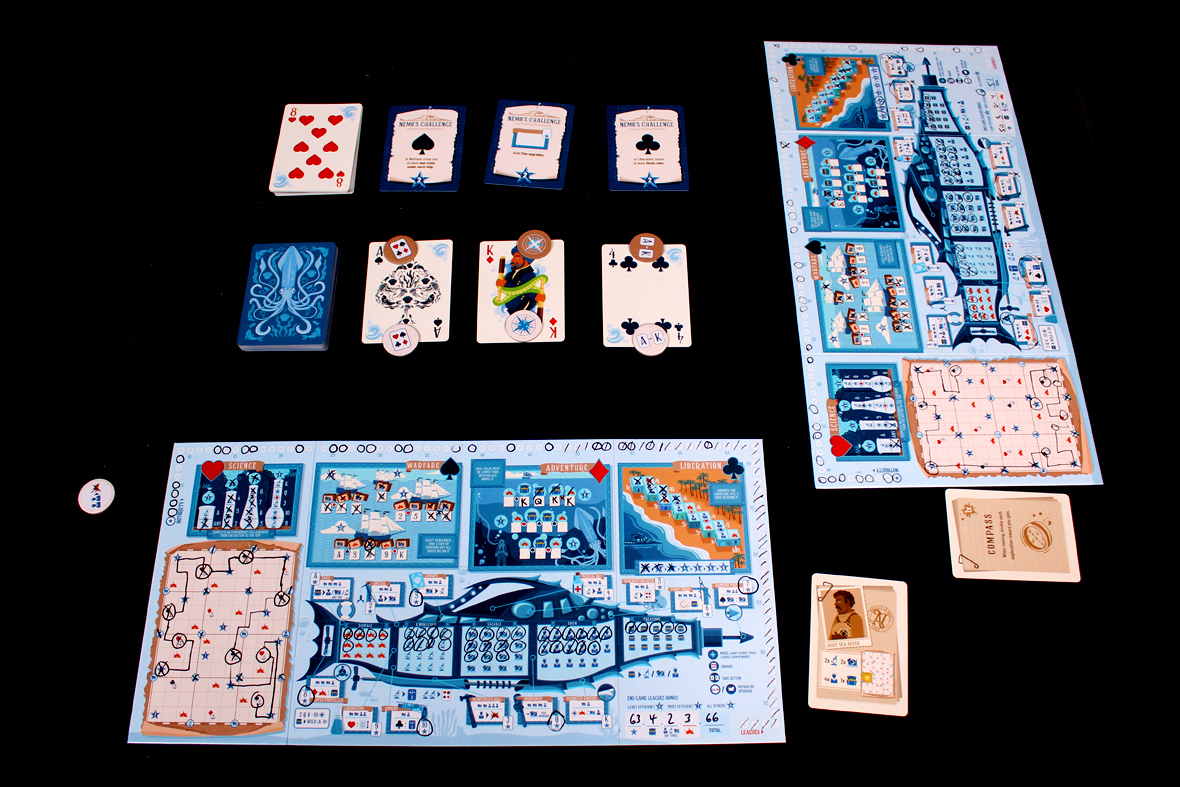
Overall, I think Flip Voyage is great! I thought Fliptown was great, too, granted, but I like the theme of this one better. Steven Aramini is very high up on my Designers I Like List already, but this is a focused effort in a genre I’m already a big fan of, and this sophomore shot for Write Stuff Games is far from a slump. I think the big win for me is the addition of a navigation element to the game. I love making paths and getting to feel like I’m making progress and exploring, and this game cleverly makes that not just the fun thing and the thing that helps you win, but also one of two competing elements that can end the game. So you aren’t just going as far as possible; you need to be smart about how much movement you do if you don’t want to end the game before you can make a big play. And there are so many big plays to make! The flexibility this game allows with Bonus Actions can really dig you out of a hole, provided you have resources to spend. That’s probably the only place the game hits a bit of a rough patch, is that there’s not really anything to do if you get a bad draw without resources. You have to get a really bad draw, granted, but it can still happen! Flip Voyage is a smart flip-and-write, and that escalation of complexity doesn’t make the game hard to play, but it does give you, the player, plenty to think about on your turn. It smartly balances complexity against player agency to produce a result that’s fun, engaging, and just looks good. If you’re looking for an adventure, you love 20,000 Leagues Under the Sea, or you just like path games a lot, check out Flip Voyage! I’ve had a great time with it.
If you enjoyed this review and would like to support What’s Eric Playing? in the future, please check out my Patreon. Thanks for reading!
 What's Eric Playing?