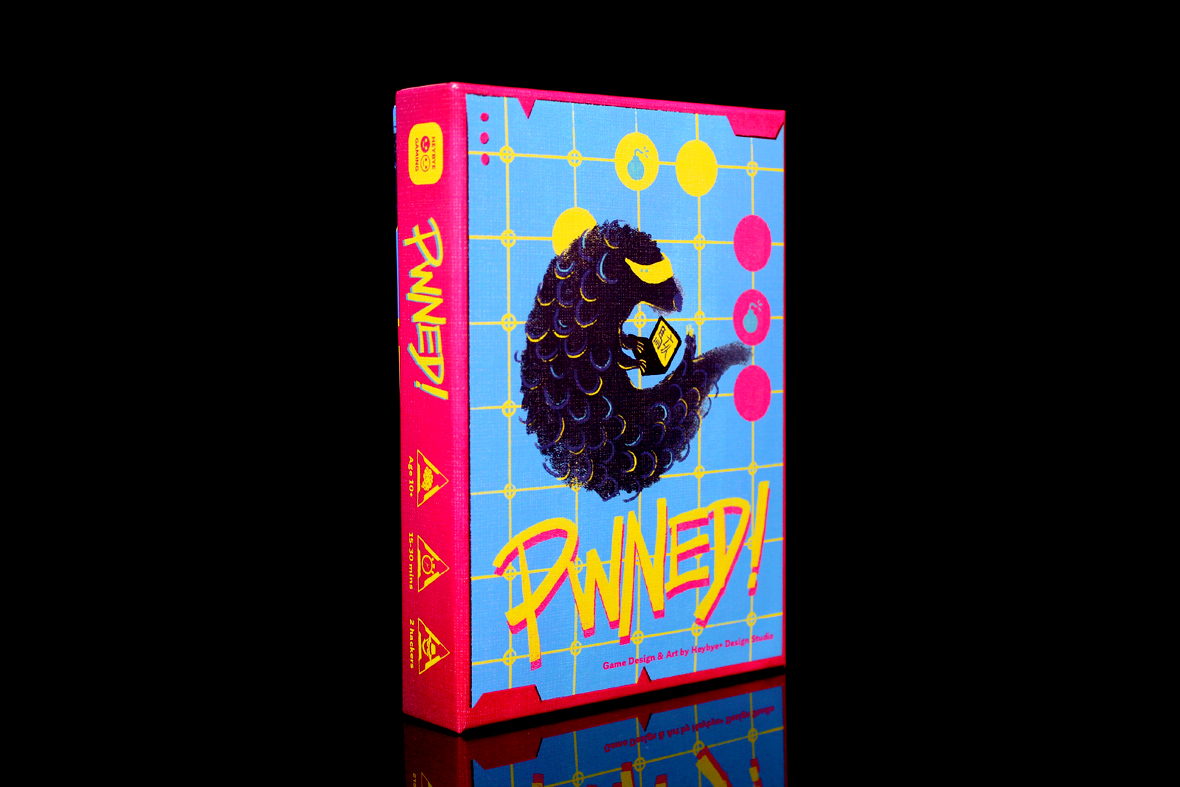
2 players.
Play time: 15 – 30 minutes.
BGG Link
Logged plays: 3
Full disclosure: A review copy of PWNED! was provided by EmperorS4 Games.
God, Gen Con wipes me out. And yet, here I am, at midnight, writing a new review. I think I needed some decompress time; there’s a lot of people and since the pandemic that’s all been a bit much for me. I spent some time in the stadium this year, which I haven’t done for five or more years, but it might be my last jaunt over that way. I have an unbelievable headache from the lights and it was farther than I expected from my hotel, alas. Other than that, though, it’s been a very enjoyable Gen Con! I have lots of games to tell y’all about in the near future, and I’m hoping to be able to get to them relatively soon. Let’s check out a new game from abroad in the meantime, PWNED!
In PWNED!, hacker armies are setting in on each other, each led by a skilled pangolin hacker. Their goal? Complete shutdown of their opponent’s system. Firewalls in place should protect you, though you’ll have to break through theirs if you want to get at the core. So fire up the computer, grab your fingerless gloves, and get ready for a neon cyberpunk adventure. Will you be able to outhack your opponent?
Contents
Setup
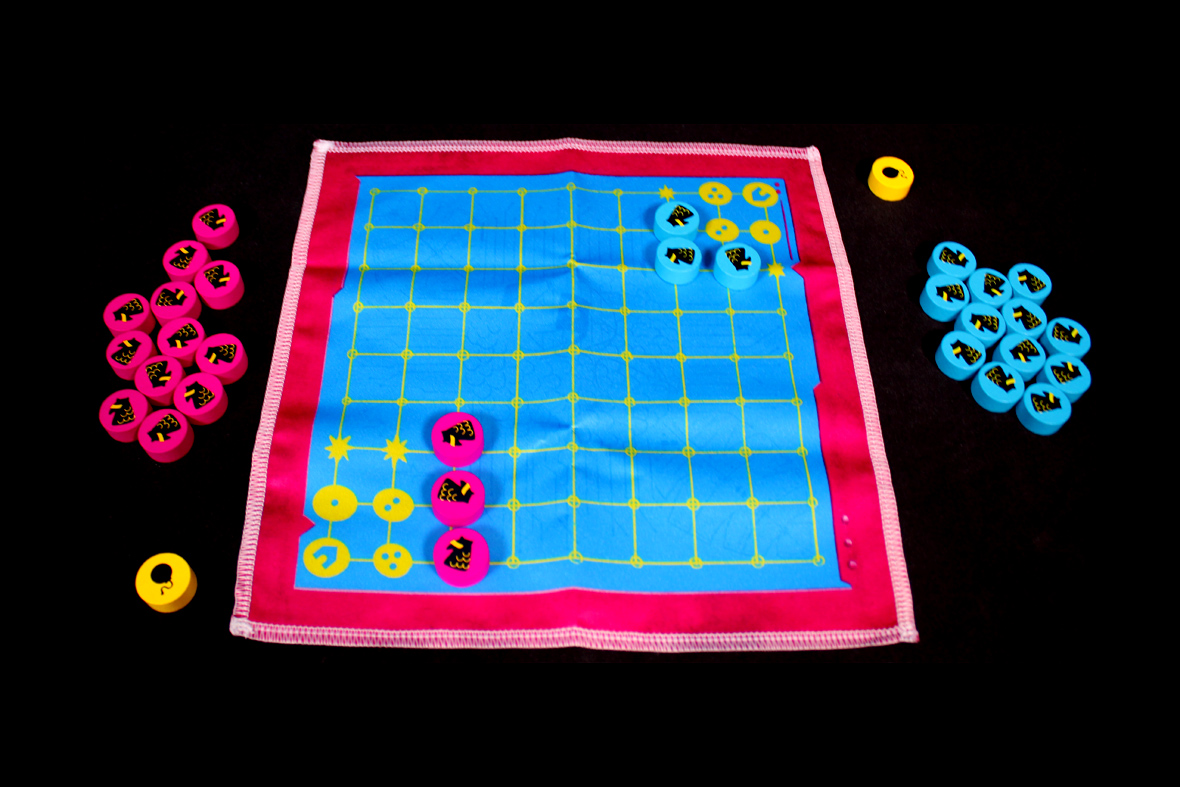
Not much! Each player gets their pieces, including their secret Trojan Bombs:

Give each player a random Firewall Bomb, keeping the number face-down:

You should be ready to start! Each player places three pieces on any of the five spaces adjacent to their numbered Firewall spaces.
Gameplay

This one’s not too tough. Your goal is to get to your opponent’s home base and bust through their firewall! The problem is, as you hack them they’re going to hack you right back. Better be fast and good!
On your turn, you can take any two of four actions:
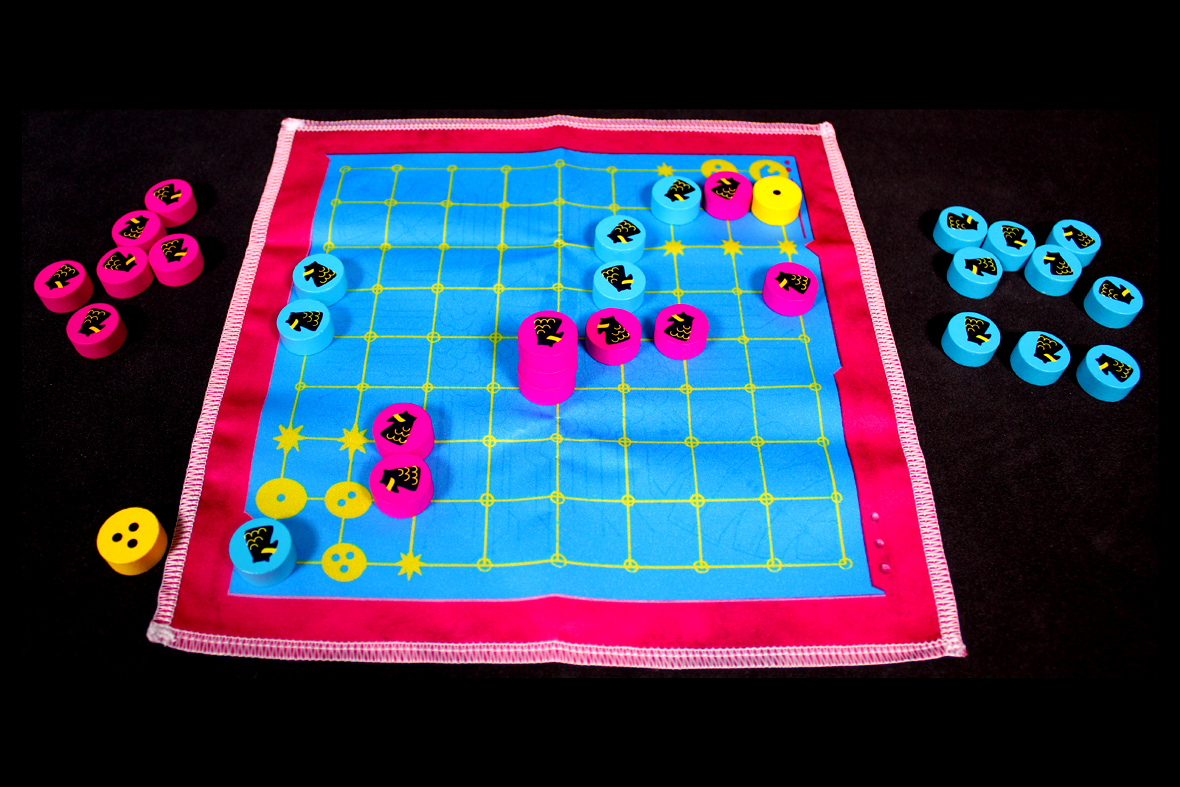
- Move: Take any piece or zipped stack and place it in a space adjacent to its current space.
- Copy: Take a piece from your supply and place it orthogonally next to an existing piece.
- Zip: Take any three pieces in a horizontal or vertical connected line and stack them up into a .zip on either end of the original segment.
- Unzip: Take any zipped stack of three pieces and separate the stack, placing the three pieces in a horizontal or vertical line that starts or ends on the stack’s original space.

There’s also a free action: Delete. When you delete, you must have two pieces or two zips surrounding an opponent’s piece. If you do, you remove your opponent’s piece and return it to them. Only two zips can Delete a zip, though.
Sometimes, you either place a bomb face-up between two pieces of your opponent’s or they reveal a Trojan Bomb when their piece gets deleted. If that happens, remove the two pieces surrounding the bomb as well as the bomb. If they’re zips, unzip them and then remove the two closest pieces.
You cannot block off the path to your home server. If it’s ever blocked (usually by an explosion destroying a zip), you must move pieces next turn to restore it.

Play continues until one player makes one of their piece’s into their opponent’s server. That player wins!
Player Count Differences
None! Two-player only game.
Strategy

- You can try to force players towards your Firewall Bomb. Leaving only one pathway open makes it a little predictable, but be careful; once your Firewall Bomb blocks a route, you can’t necessarily just cut off access. You’ll have to create a new route on your turn to follow the rules. Granted, if that route goes between a few of your pieces so you can delete theirs efficiently? Them’s just the breaks.
- Trapping players in a delete also works. Like I said, guide players through spaces where you can delete their pieces.
- Zipping and unzipping is a great way to traverse a lot of distance relatively quickly. It lets you move a bunch of pieces at once, which is good if you’re testing spots for bombs or if you just want to try and hammer away at your opponent’s defenses.
- You really do not want to get one of your zips deleted. It takes six of their pieces to do it, but losing three pieces in one go absolutely sucks.
- The Stratego-style strategy of making your opponent worry that a token may obviously be a bomb is often a good fake-out. Sometimes making it very clear that a token is a bomb and will explode if deleted is a useful technique. Even more so if it’s not actually a bomb and you just convince them that it is.
- You can’t entirely block your opponent, but you can force them into choke points if they’re not paying attention. Try to direct their routes to make it difficult for them to reach your home server before you can get to theirs.
- Try to punch through your opponent’s defenses and use that to turn the tide. You can do a lot with Trojan Bombs or with deleting your opponent’s pieces yourself. Do that to try and create gaps in their defenses that you can sneak through.
Pros, Mehs, and Cons

Pros
- The art style here is incredible. I really like when cyberpunk aesthetics embrace the like, neon vibes of the 70s and 80s. I think that’s the most fun way to do things, rather than trying to make things like gritty and dingy. Cyberpunk is fundamentally punk, but just the trappings of it can be bright and inviting even without having a more compelling commentary beneath.
- There’s not a lot of rules overhead here. You really just move or place or surround; it’s a fairly pick-up-and-play game.
- I like the simple elevation of abstract strategy. I like abstract strategy games a lot, generally speaking, so I’m always partial to newcomers.
- Pangolin hackers are a welcome thematic conceit. It’s not something I’ve seen before, surprisingly, but I’m pretty into it. I generally like pangolins; they’re a fun shape. Why couldn’t they be the secret leaders of hacker collectives? Have you asked them?
- Plays pretty quickly. Abstract strategy tends towards short, punchy games, and this is certainly no exception.
- Very portable. A bunch of the games in this shipment are relatively small boxes; I’m happy to see that, but I also wonder if that’s going to be a trend for a little bit with the increased prices around manufacturing and shipping due to regressive tariffs.
Mehs
- Cloth boards take forever to flatten out; they’re convenient, but bumpy. This is an ongoing extremely mild complaint. It’s nice to have something that can be folded or rolled out and isn’t more cardboard or plastic, but cloth tends to retain creases for a while, which can make piece placement tricky.
Cons
- The rulebook could use a little more clarification. One place where we ran into trouble was around bombs. It seems like two zips destroying one bomb will experience some damage, but losing both zips feels like a disproportionate retribution for a single bomb. Some play examples in the rules would go a long way.
Overall: 6.75 / 10
Overall, PWNED! is a cute little game. I think it’s a nice fit for folks who are huge fans of quick and punchy abstracts or for players who are looking for a little quick game with a fun theme and a great color scheme. For me personally, I think I need a bit more complexity layered on top of it for PWNED! to move into my all-time list, but it’s hard not to find Hacker Pangolin endearing on her face. She’s a necessary part of the cyberpunk future; at least far more so than AI or whatever. I think, though, there’s a lot to say here within a simple framework, and I think that’s pretty cool! It’s a solid design and the network-style movement is a lot of fun. You feel immersed, to some degree, in the hacking experience like you’re trying to surreptitiously ping your opponent’s server, only to get your hacks destroyed. Reminds me a bit of Nier: Automata, but that’s neither here nor there. I do wish that there were more play examples in the rulebook, but that’s the worst thing I can say about an otherwise clean and compact game. If you’re a fan of quirky little abstracts, you’re looking for a new travel game, or you just want to salute the majestic pangolin, PWNED! will be right up your alley! I had fun with it.
If you enjoyed this review and would like to support What’s Eric Playing? in the future, please check out my Patreon. Thanks for reading!
 What's Eric Playing?