
Base price: $40.
1 – 4 players.
Play time: 20 – 30 minutes.
BGG Link
Buy directly!
Logged plays: 6
Full disclosure: A review copy of Twinkle Twinkle was provided by Allplay.
My friends took me to see Demon Slayer: Infinity Castle (part 1 of 3???) today. I’ve never seen Demon Slayer before, but I’m a joiner. My review: it was fun. Guess I’ll see what everything else is about. Who knows. I do kind of love joining a series in media res, though; you have no idea who anyone is so if people get together or leave the show or die or power up you don’t really know how to react because you just totally lack context. It’s nice. Plus I’ll have probably forgotten most things if I end up watching the show which also works out for me. Win-win. Anyways, I basically immediately got how and set up shop on this. Lots to do this week and I’m already beat. So let’s see what’s going on in Twinkle Twinkle!
Your goal in Twinkle Twinkle is simple: chart the stars! Or, chart the night sky or something at least. You’ll want to add planets and asteroids and the occasional satellite to your chart (not to mention comets) as well; stars alone aren’t going to cut it. Thankfully there’s a lot of sky and plenty of people to share it with! Less thankfully, they’re trying to make an even better night sky chart than you. Are you just going to let them get away with that?
Contents
Setup
Not a ton! Each player gets an astronaut:

Each comes with their own board:

You’re going to want to choose scoring criteria; you can use the Green or Blue sides, but Green is best for your first game:

Now, shuffle the tiles in the bag:

Place them on the correct space for your player count (at two, you’ll be using two astronauts each):

Should be ready to start!

Gameplay

Not too tough. You move in player order, from the leftmost standee to the right. When your standee comes up, you move it to a space in the market you want and take that tile, placing it on any empty space on your map. Once all standees have been placed, move them up in order to the top of the sheet again and fill the now-empty current round spaces with the tiles from the next round spaces. Note that when filling any space, if there’s a clock icon on the tile, it gets placed in the rightmost empty space, rather than the leftmost empty space, as is generally the case.
Once you’ve done that, refill the next round spaces from the tile bag.

After everyone’s chart is filled up, the game ends! Tally up scores and the player with the most points is the winner!
Player Count Differences
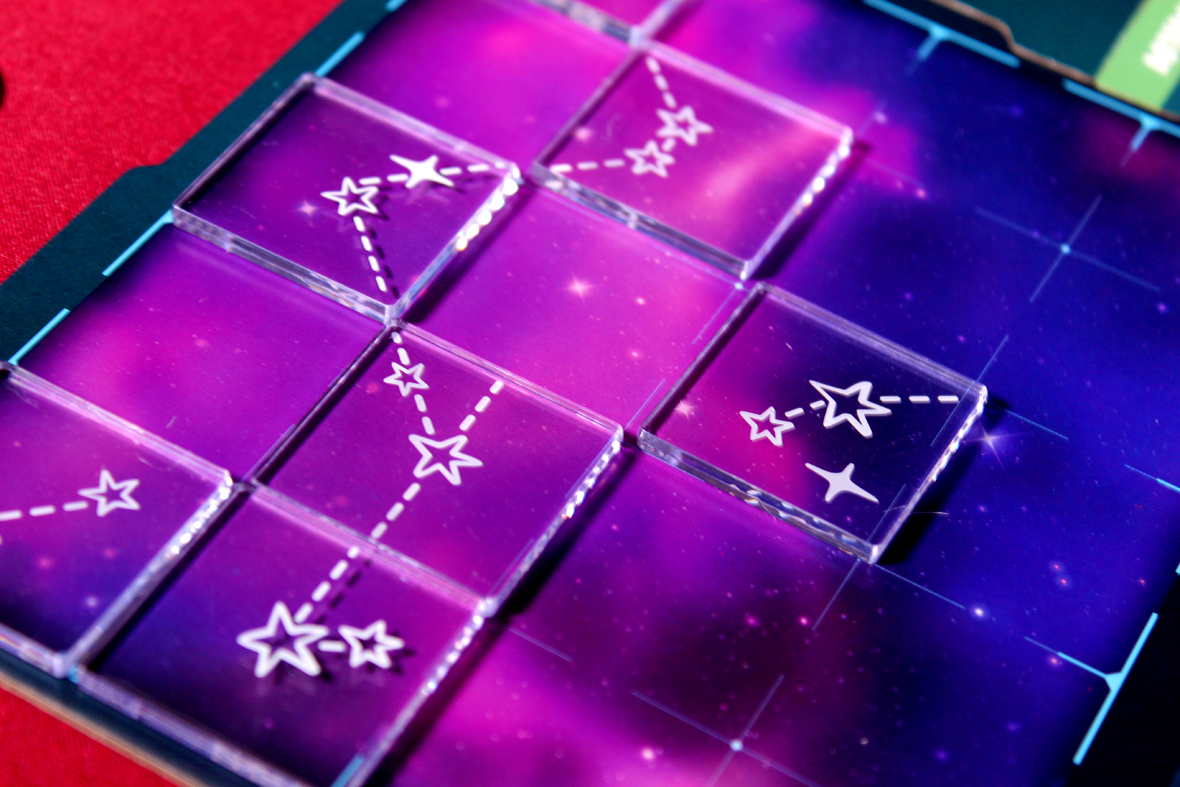
Not a ton, here, since you’re really just drafting tiles from a shared market. With more players there’s a bit more entropy, and the tile you choose directly impacts your place in the next round’s turn order. So you not only have to balance what you want this round, but you have to also consider how that will affect your placement going forward. Some “high-value” tiles are always pushed to the back, so you don’t necessarily have to worry about some player just taking the first tile forever and never relinquishing first pick. If someone does do that, well, that’s a weird strategy; it could work. You’ll have more choice at two players but you’ll also frequently get saddled with tiles you don’t like, based on luck of the draw. The same could happen at any player count, however. Not much plasyer interaction beyond the market draft, so, I’m not going to have a huge player count preference with this one.
Strategy

- You want at least two large constellations, if you can. You score both of those and you’ll need to do well on at least one if you want to have a pretty good shot. It may not always win you the game, but making a big constellation is also fun! Unfortunately, this is the strategy section, not the fun section; please don’t hold that against me.
- Minimum constellation size is two; having a bunch of those can be pretty healthy. In addition to your two largest constellations, you also score the number of constellations (of at least size two) on your board. That can add up quickly.
- If you’re going for lots of stars, Comets are your friend. Comets generally score for adjacent starts, so that’s good.
- Asteroids can stack up pretty quickly, especially since diagonals work in their favor. Any place where diagonals count for scoring is explicitly called out, but it’s nice that you can make an asteroid belt or whatever you’re feeling.
- If you can’t get your hands on stars, Planets are decent for scoring a few points. I wouldn’t make them your whole strategy; they’re only at their best when blocking a Black Hole or something that would cost you additional points. You can use
- Satellites work best as a buffer between Black Holes and other things. Like Planets, Satellites can block off Black Holes without losing any points on the Black Holes themselves. In certain scoring configurations, they even score bonus points for being in the same row or column as planets or black holes.
- Look to the next round to influence where you should go on your turn if you don’t have better ideas. Seeing a lot of satellites? Might be time to lay some planets down. If it’s all black holes, you might want to go after satellites. It’s an important part of your emotional development through the process.
Pros, Mehs, and Cons

Pros
- Love an astronomy theme. It’s consistently great for a reason; there’s so much cool stuff in space. Frequently colorful, even more frequently extremely on fire. What’s not to love?
- Plays pretty quickly. You’re just drafting tiles and then placing them based on scoring conditions; it’s not necessarily something players are going to absolutely agonize over partially because the scoring conditions are fairly straightforward and there’s not much room to fight over them.
- I like the art style as well! It’s more the color work than the line work, but I still think it’s a good-looking game.
- I appreciate that you can randomize the scoring conditions; prevents any one strategy getting overused. It doesn’t necessarily long-term improve replayability (especially if any green sides are too close to blue sides. That said, it encourages you to understand the rules and maybe figure out that you’ve played it wrong a few times and that’s part of why Christina Ha absolutely demolished you every game. It’s not the whole reason, but it’s part of it.
Mehs
- I get why the crossed diagonals rule is in place, but it’s not the most intuitive thing. I don’t think I’ve seen a piece with two diagonal lines crossing over each other on the board, but it can definitely happen in the corners of tiles. I’ve messed that up myself, and frequently lost the game because my constellations were much smaller than I expected.
Cons
- I like the transparent tiles from a vibes standpoint, but I’m not sure that as a schtick it adds much to the game. It’s kind of a “deluxe component upgrade” style of thing but in every version of the game. That could be cool, depending on how you feel about your tile options? I was a little underwhelmed. They’re decently nice tiles, though!
Overall: 7 / 10

Overall, I think Twinkle Twinkle is fun. I’m, granted, not absolutely dazzled by the game, but I think it sets a reasonable goal for what it wants to be (a light tile-laying game for everyone with low rules overhead and a low barrier to play) and accomplishes that admirably, save for one minorly confusing rule about how constellation paths overlap. Aesthetically, the game lives up to Allplay’s goals: the player backgrounds are really nice, and laying the transparent tiles over them can give the impression that I think they’re going for, which is constellations and celestial bodies set against the colorful sky. I don’t think that makes the transparent tiles critical, though, and whether or not that drives up the price of the game is anyone’s guess. I’m not a manufacturer. I think there is something crucial to a game’s first impression with certain audiences, though, and maybe the tiles being transparent is a killer feature for that crowd. I do wonder how resilient the tiles are to scratching the constellations or other features off, but I haven’t been brave enough to test that one out. I need the game to look nice for review photos. The one place the game did surprise me the most was in the modular scoring criteria, though I do wish it had been more distinct between the two types. I suppose there’s not much you can do that wouldn’t add a lot more complexity to the game, however, and I distinctly got the impression that more complexity was a non-goal for this one. It’s simple, it’s clean, and it’s got a good theme. If that’s what you’re looking for for game night, you like an astronomy theme more generally, or you just like tile drafting, you’ll probably be right at home with Twinkle Twinkle!
If you enjoyed this review and would like to support What’s Eric Playing? in the future, please check out my Patreon. Thanks for reading!
 What's Eric Playing?