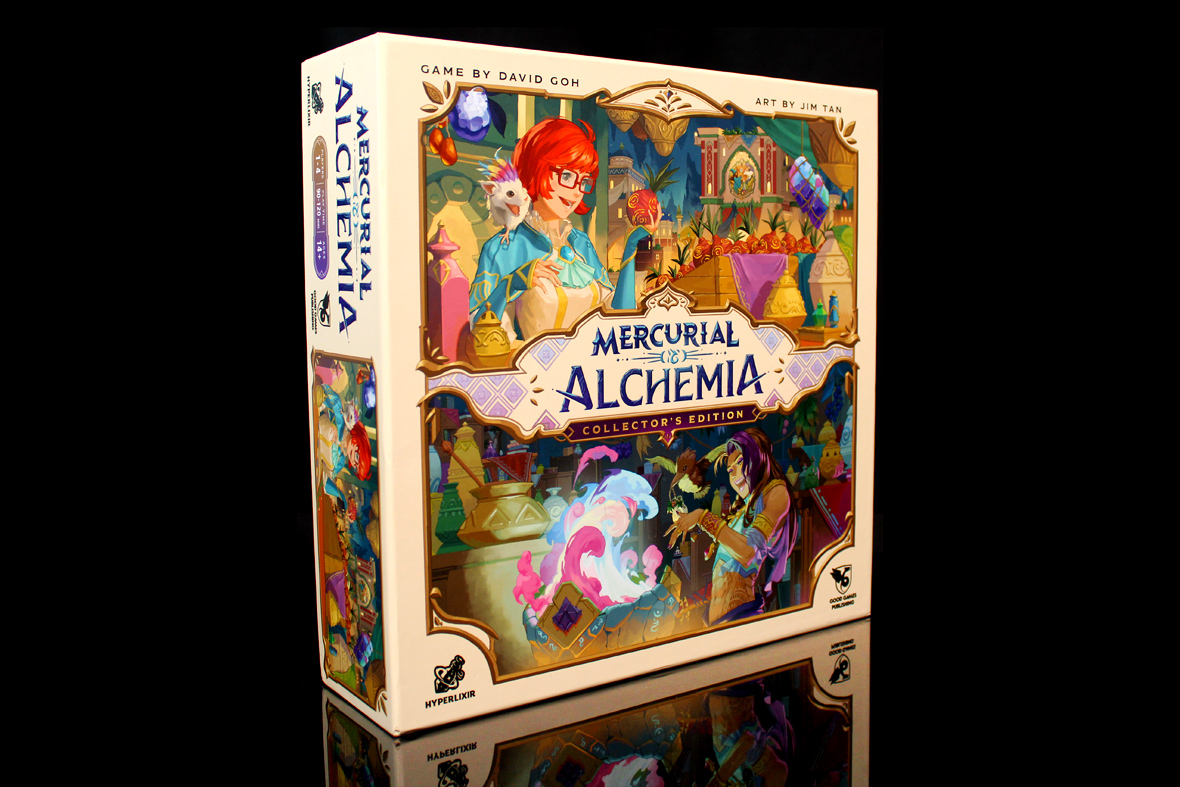
Base price: ~$66.
1 – 4 players.
Play time: 90 – 120 minutes.
BGG Link
Check it out on Kickstarter!
Logged plays: 2
Full disclosure: A preview copy of Mercurial: Alchemia was provided by Hyperlixir. Some art, gameplay, or other aspects of the game may change between this preview and the fulfillment of the Kickstarter, should it fund, as this is a preview of a currently unreleased game.
It’s Kickstarter season! It’s happening! There’s a Fall period after Gen Con when there’s just a bunch of games that (in my opinion, wisely) avoided launching during Gen Con and launch in the Fall when us suckers are just finally getting post-Gen Con paid and we haven’t bought our flights for PAX Unplugged yet. It’s a pure, idyllic time, like the first snow of the year or San Francisco during Burning Man. Like a real 10% of the city bails. It’s wild. But as a result, there have been Kickstarters previously I’ve previewed (Crash & Grab) and there are Kickstarters yet to come (more on those later), so we’re currently in the Kickstarter Present with Mercurial: Alchemia! This is a sequel to Mercurial from a few years back, with a heavier weight and all-new gameplay. Let’s dive in!
In Mercurial: Alchemia, the world has changed and so you must change along with it! As an up-and-coming potions seller, you leverage your home-grown flora and the occasional bug to brew fantastic potions in all senses of the word fantastic. You seek prestige, though; it’s good advertising. So you’ll set your sights even higher against your potion-slinging rivals in this tense deckbuilding game of elemental prowess and mastery. Each round, you’ll hit the shops by day to buy new flora or improve your snail’s living conditions (as one does). By night, you’ll do a bit of rune magic to enhance your deck, reduce your blight, or occasionally just make your potions better. As you do, your potions will eventually become ready to brew! After brewing, you sell your potions for both fame and fortune, which is pretty cool. But beware! There’s weeds and then there’s magic weeds, and these Vilethorn plants can cause you to become afflicted with Blight. It’s bad. So gather your goods, use the elements to your advantage, and make the greatest potions in town!
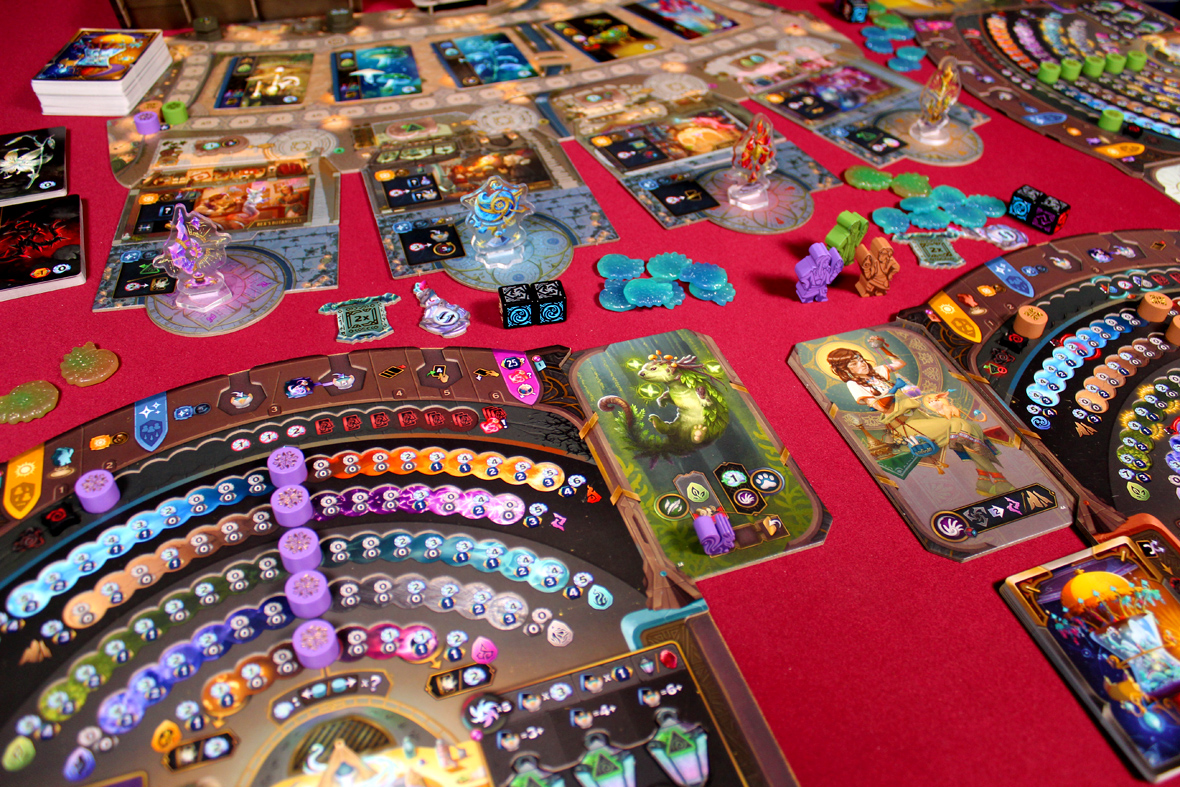
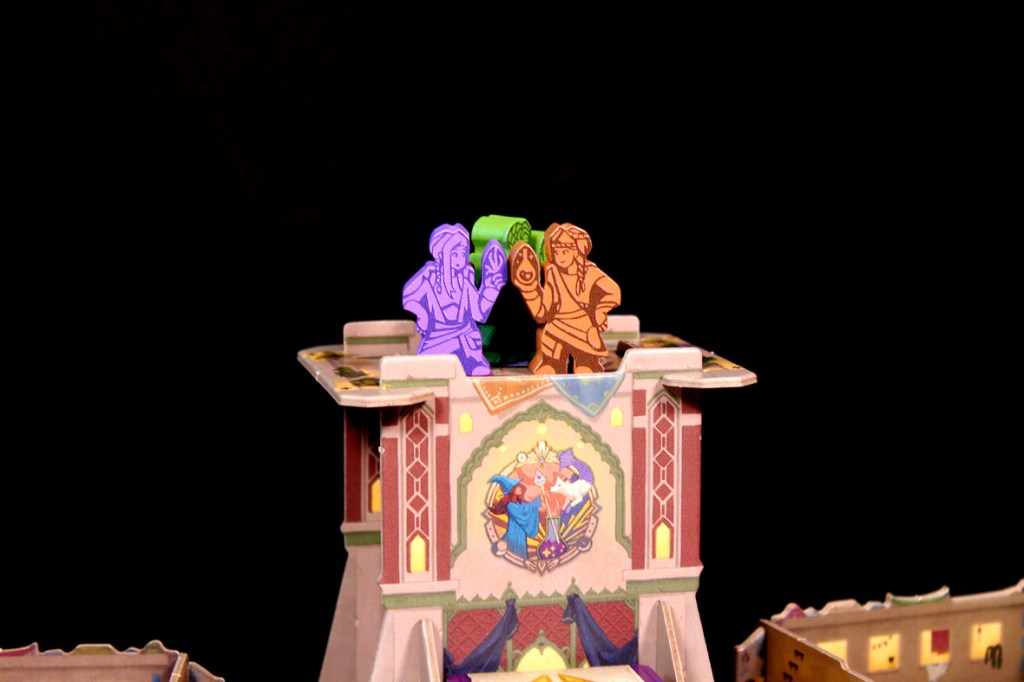
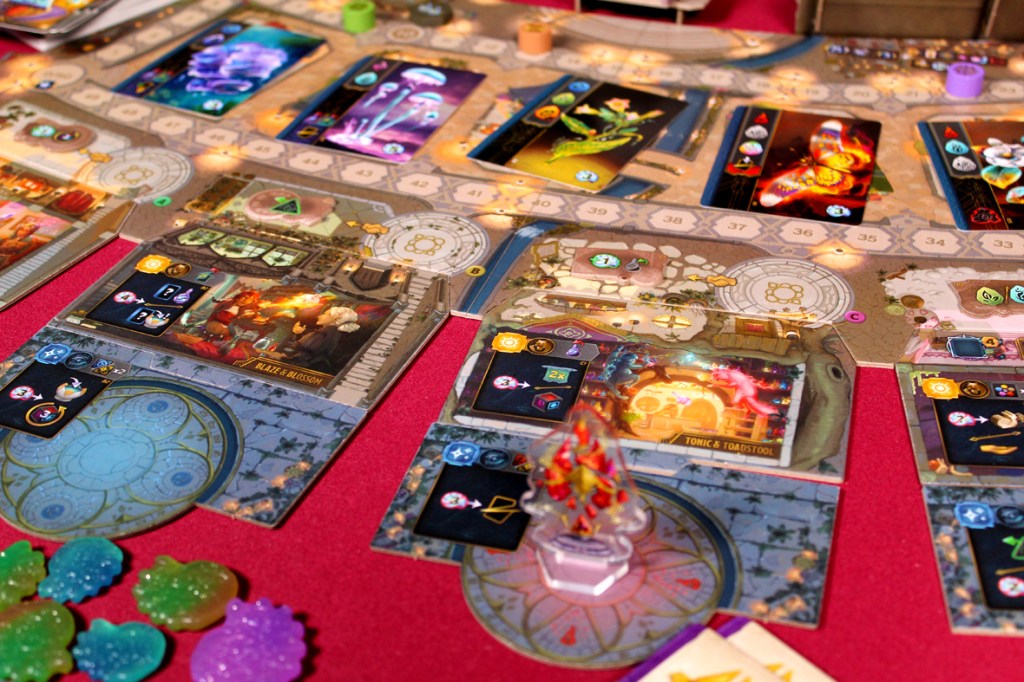
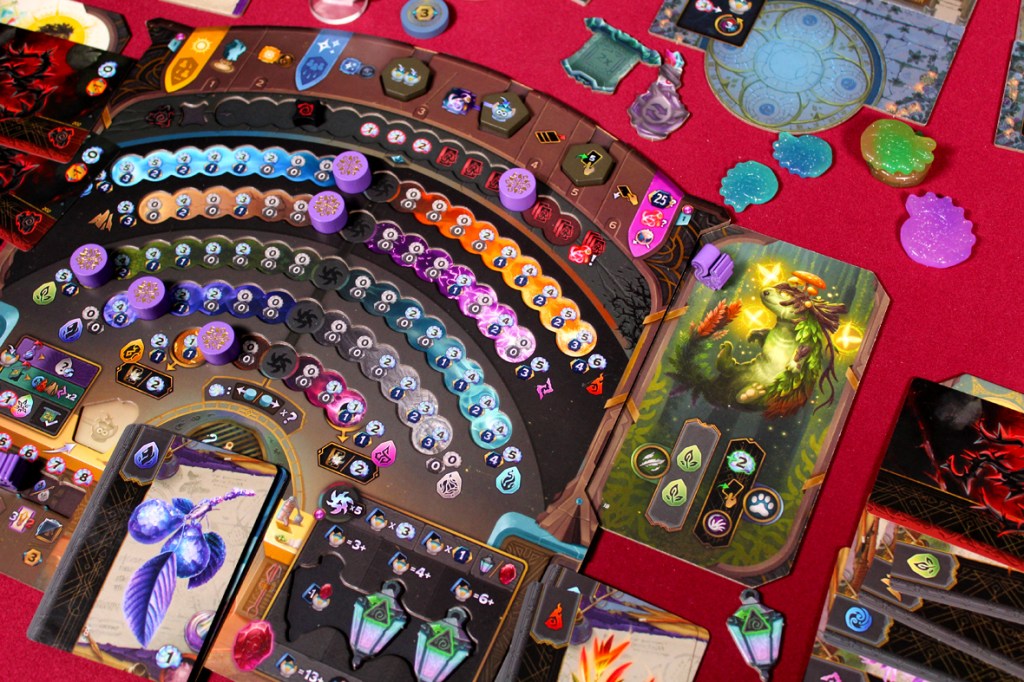
Contents
Player Count Differences
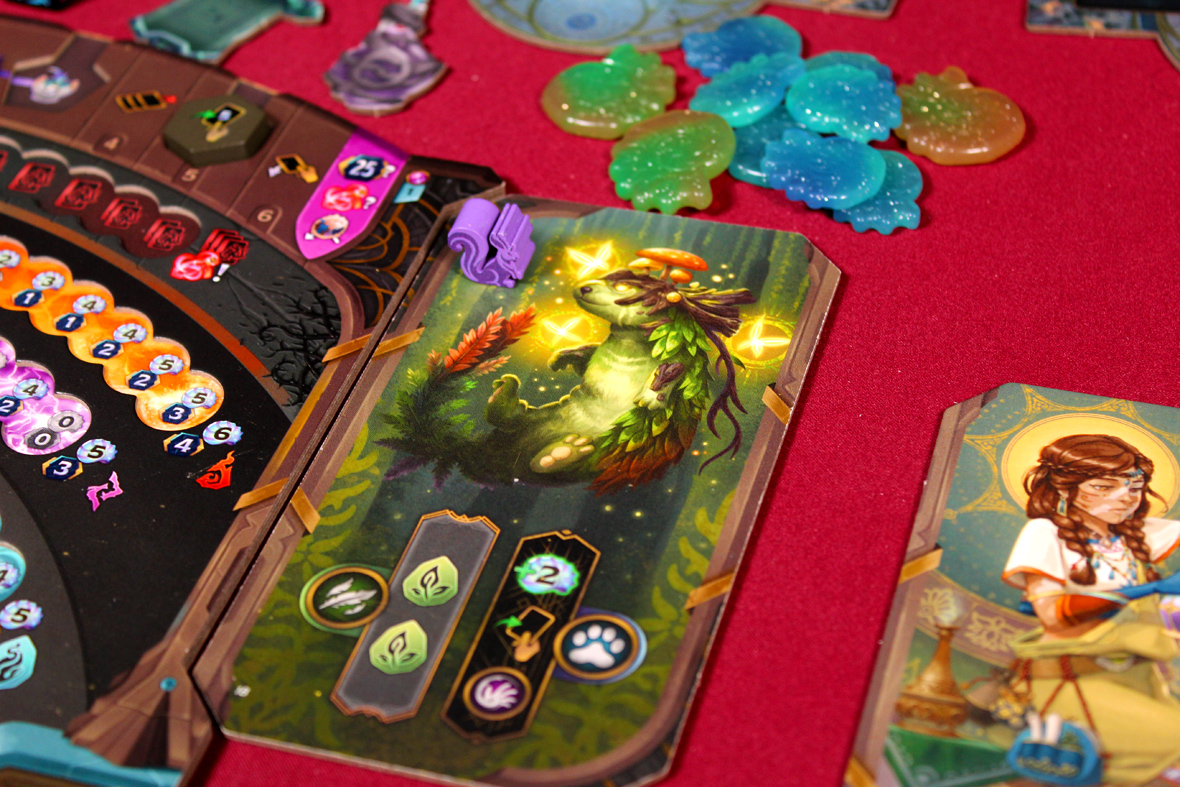
Honestly, not many. I don’t have a strong preference here because functionally, two and three players plays the same, just with two, I don’t have to worry about the third person beating me because they’re a dummy player just designed to take up spaces and occasionally help me get free stuff. With four, I figure that some of the potential resource constraints start to emerge, but I’m more worried about table space than resources at that point. But Mercurial: Alchemia is almost zealously designed to have players doing the maximum amount of simultaneous play that they can. Your first game will be slower with more people, do not get me wrong. There’s stuff to learn and if anyone is unfamiliar with the concepts they will slow the pace down for the group (again, because so much simultaneous play). Otherwise, though, more people is generally not bad! You get a Handshake if someone moves onto the same shop that you’re at, you can Join players’ actions when it’s not your turn; good things. It’s nice to see more complex fare shooting for increasing complexity and keeping the game moving. You can have both!
Strategy
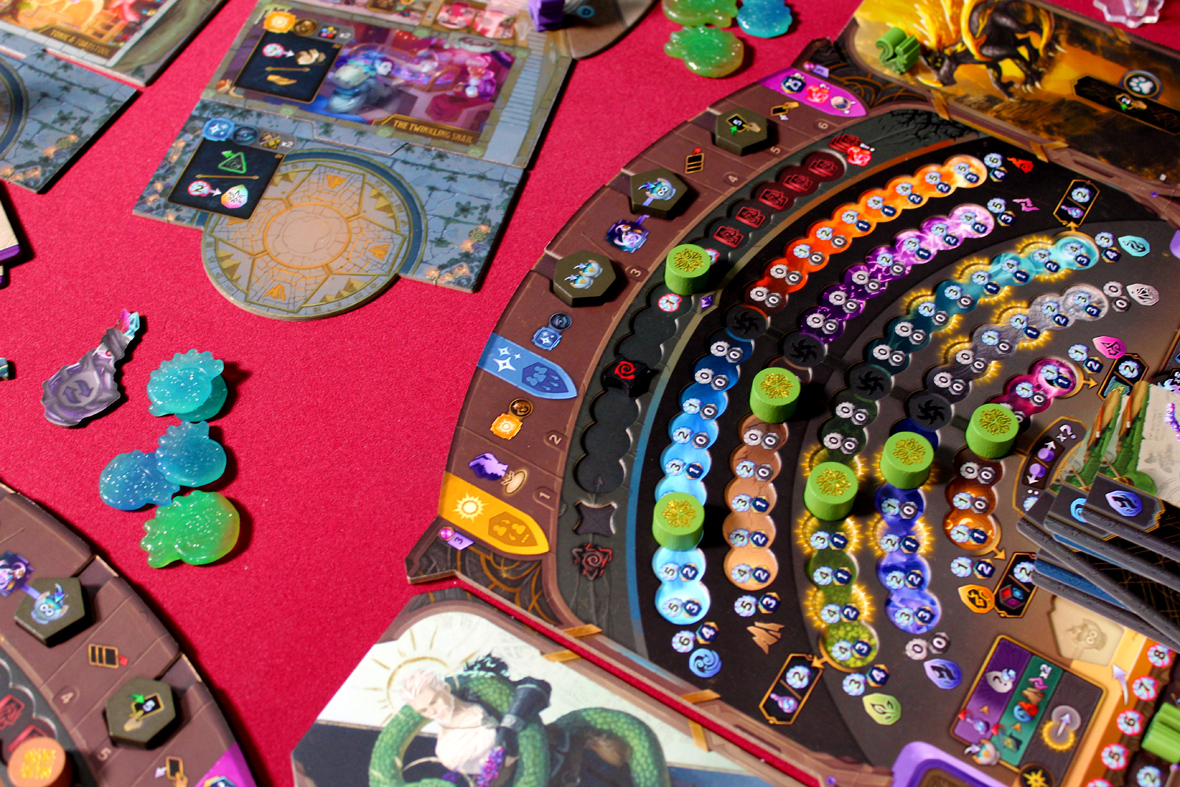
- Don’t just brew recklessly! Every time you brew, you advance your base Blight marker by one. This means that you start one farther up the Blight track, even though your Blight resets. So if you brew a bunch and you don’t score enough points, eventually you’re going to be taking negative points from the Blight Track (or worse, Corruption, which forces you to take a Brew Action).
- Drawing more cards isn’t necessarily your friend. If you have Veilthorns in your deck, when you draw and play them you gain Blight. That’s bad! So while it may seem useful to immediately go for the Draw 5 Upgrade, you may want to be careful. You’ll also go through your deck faster, which does earn you Income but also adds two Blight each time you reshuffle. Try to have a plan in place.
- A thin deck is not typically your friend. Here, thin decks mean more shuffling and unless you’ve managed to thin out your deck alarmingly well, it means you’re usually not getting the cards you need for a strong Infusion before you can Brew. Weak potions don’t earn you many Shells or many points.
- Keep an eye on your snails. Going to the D shop lets you spend Shells to advance your Snail, which improves your Income that you get when you reshuffle your deck. I love being the first person to ever type a specific sentence in the English language. But improving your Income means you get more when you reshuffle so you don’t necessarily have to be as stressed about being strapped for cash.
- Keep some resources handy in case you want to Join another player’s action. Are they buying cards? Might be worth it if you have the money, so that way you can do something else on your turn. You could even spend the money and then go take income or upgrade your Snail on your turn. Joining is super good! It just usually requires a Reagent or a Catalyst, so I tend to use it sparingly. New players tend to forget about this!
- Void Dice aren’t the worst. Keep a couple Voids around! You can use your Alchemist ability to Transmute them to other elements and then spend them when you’re Brewing a potion! That’s just free resources. That said, you don’t always have to spend all your resources when you Brew; keep an eye on the track. Sometimes you lose money in lieu of points, which may not be what you need; sometimes you lose both.
- Look for ways to get things for free. This is economically a tight game. You will be out of money sometimes. Can you advance a material to earn a free Catalyst, Reagent, or die? If so, worth a shot. Can you use an Aether die face to advance something for free? Maybe worth considering. Free is your friend, here.
Pros, Mehs, and Cons
Pros
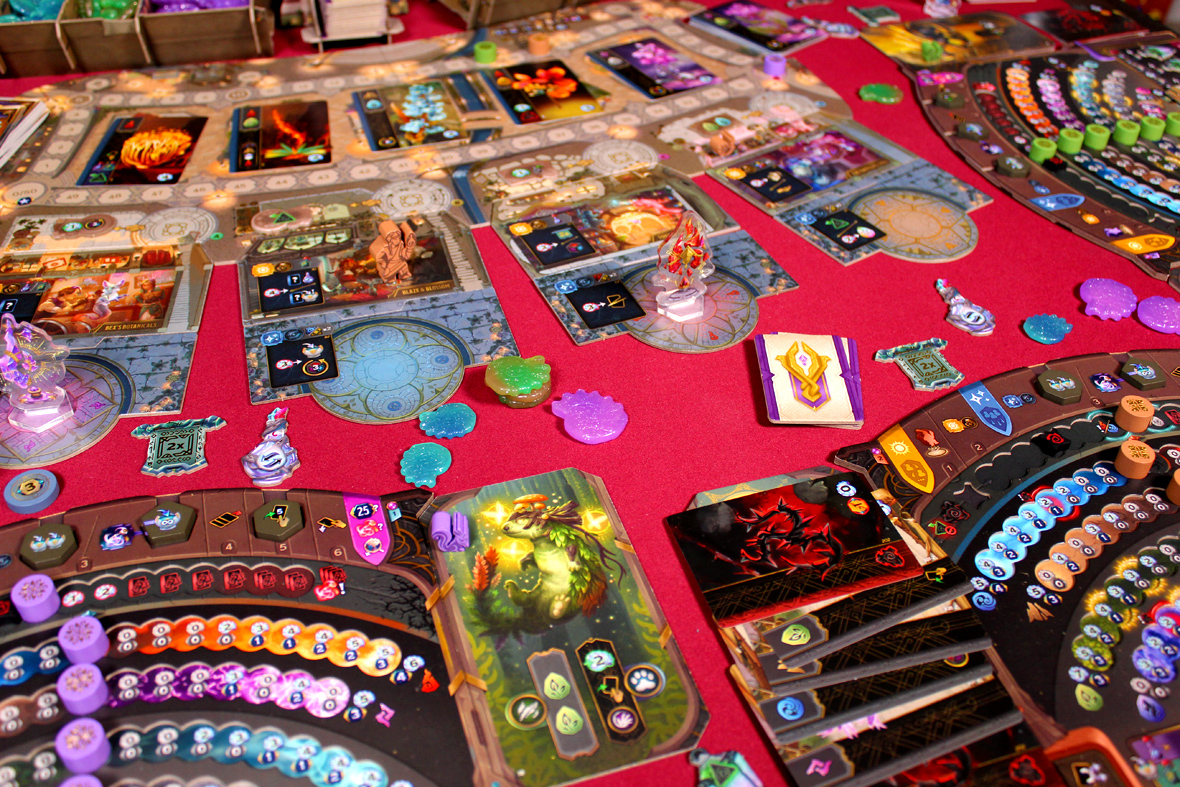
- Oh, the art in this is pretty exceptional. I’m not surprised, given Mercurial, but the plants and such on the Market Cards are exceptional. There’s a really in-depth use of color to indicate primary, secondary, and sometimes tertiary resources granted to the point that if you picked up a card you could likely guess and you’d be right without even needing the symbols. That’s a powerful visual language and consistency. That said, they still bothered to have good graphic design anyways, and I respect and love that for them. The icons make sense after you read the rules, the cards have a strong left side icon set to indicate on play and on Infuse effects, and their left side color indicates what stack they go in. They even have specific Starter Cards for each player color! They’re a bit more subtle but very nice.
- There’s a lot of design work being one specifically to speed up the game, reduce downtime, and make things interesting when it’s not your turn. This is my main thing about Alchemia. I played a three-handed game where I control all players and it took about three hours because I obviously can’t do multiple simultaneous actions. A normal three-player game, if everyone’s with it? I bet you could get that down to 90 minutes eventually. All players play their cards and brew their potions independently; the only thing that really requires turn order is what shop you move to, and that’s only so that you can gain a specific benefit if another player moves there or other players can spend resources to also take your action, which is really cool! You essentially always can be doing something even when it’s very explicitly someone else’s turn, so everyone stays engaged and interested.
- I really like when dice are used in deckbuilding to add essentially a persistent resource between turns. Cards are great, but deckbuilding has you discard them every turn. In Mercurial: Alchemia, you also get dice, which you keep until you brew a potion (and then you can spend / reroll them). These dice can be used for other effects and spent, but they’re essentially bonus public resources available to you that don’t depend on your deck being thin. I think that’s cool!
- There are a lot of additional modules and such to add more complexity for those who are looking for it. Not all of them landed for me (one of the Advanced Classes I just went hog-wild on Veilthorn [curse; bad] cards and completely tanked my game) but there’s cool stuff! I like that there are player-specific builds and Objectives and all that sort of stuff if you really want to dig into it. I also think that the Philosopher’s Stone route is a wild, shoot-the-moon kind of crazy and I think it’s hilarious to include a shoot-the-moon option in a medium-weight deckbuilding game. Props.
- I just kind of love crunchy deckbuilders with a lot of depth and complexity. I think it’s because I’ve been playing all of those damn roguelike deckbuilders and now I want all my regular deckbuilders to be complicated also. I can’t help it! Monster Train 2 is great! I’m obviously buying Slay the Spire 2 as soon as it comes out! Cobalt Core was a highlight of my previous year and now I own the soundtrack on vinyl! It’s a really good soundtrack! Seriously. Listen to that. Then play the game. But now I want all these heavier deckbuilders and Mercurial: Alchemia hits that sweet spot for me. As soon as I saw the player boards with all the little doodads and such I told my friend “oh, yeah; this is the stuff”.
- There’s plenty of room for different strategies. I’m a bit confused because I’ve played this game a couple times now (and played one game three-handed, where I played as everyone) and still didn’t manage to ever use the right side of the board? I just never had the cards and the combos come up in the right way for me. You definitely can and you can win doing it that way, but it’s just interesting that there’s so much.
- The two-player mode uses a dummy player, but it’s not bad. If you’re anything like me, you’d be wondering “why is a dummy player for two-player games in the ‘Pros’ column?” and that’s a very valid question. We almost all hate it when games do this. However, and this is an important point, the dummy player is just there to occasionally benefit you by moving onto your space and increasing market churn so that old, stale cards get rotated out. They don’t collect points and they don’t have any pesky bookkeeping, and that’s awesome. So, yeah, here’s to you, dummy player in a two-player game; there had to be a good one.
Mehs
- Everything fits in the box except for the tower, which you have to disassemble and rebuild every game. I don’t fully understand why the tower doesn’t fit, but I like to imagine it may fit in the final version. Either way, it’s not a huge deal to reassemble it each time, but it is vaguely annoying, hence the Mehs.
- I appreciate the Shops and Runes having alternate sides to increase variety, though they don’t really change the game that much. I think if they did it would cause all kinds of balance issues, so, honestly, I’m relieved. There’s some apocryphal belief that more variety equals more replayability, and while I sometimes agree, I don’t think this example lends itself well to that specific hypothesis.
Cons
- That first game has a lot of setup based on some rules choices. The major gripe I have here is that so many words in the rulebook are that specific kind of Gamer Thing where it’s a common concept rephrased as a Complicated In-Universe Lore Word. It’s not following a player’s action; it’s Joining (that one’s easy). It’s not adding a card to your currently-brewing potion; it’s Infusing. That’s all well and good and it makes the game sound better as you play it, but it makes the game very difficult to teach for the first time because the player reading the rules has no idea what the difference between Infusing and discarding and Purging and banishing are. I also have some gripes with rules layout, but that’s mostly just a matter of preference. Several spots in the rulebook they choose to not lay things out in A – D order but rather an order that follows the flow of where and how those things are used. That’s, again, perfectly fine, but it makes the first game really hard to teach. I think our first teach took us an hour? After that, smooth sailing though. Once you’ve played a game, you better understand how to relate the core concepts to new players without giving yourself a headache.
Overall: 8.5 / 10
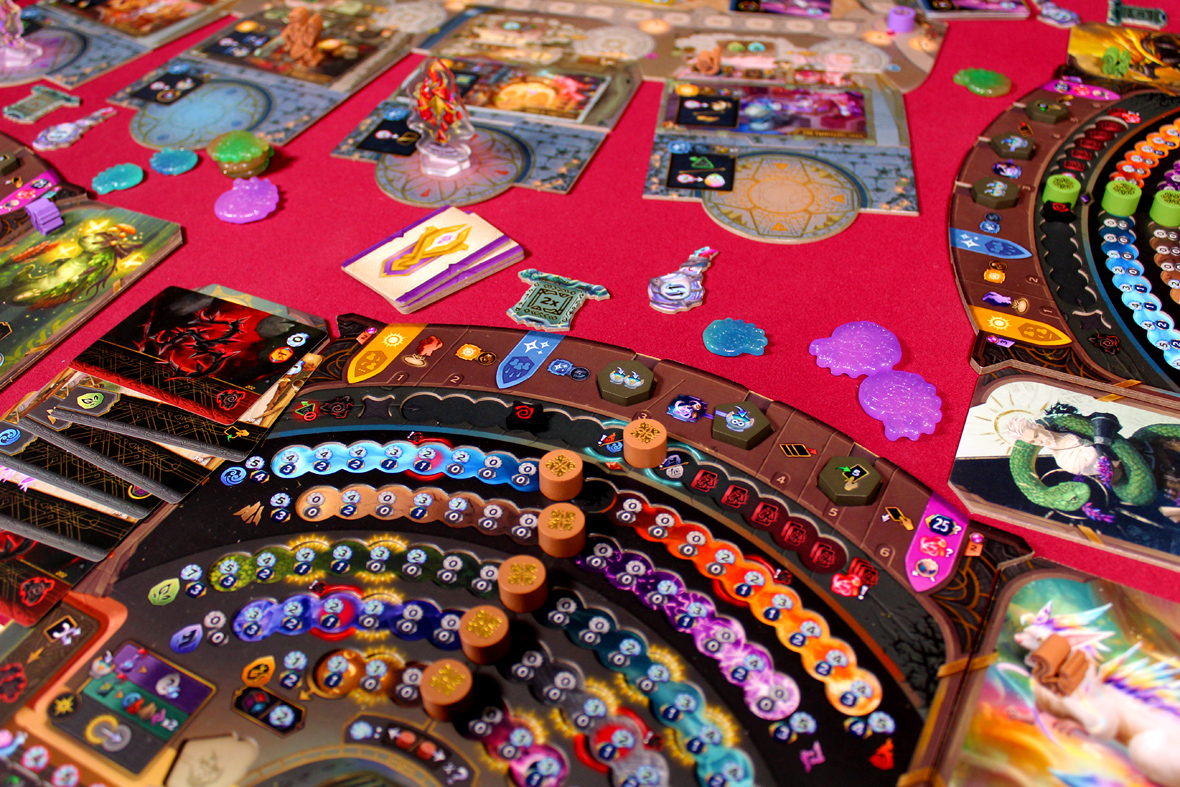
Overall, I think Mercurial: Alchemia is great! I was surprised by the physical weight of the game, as I always am. I don’t really know why that is, but every time I get a board game to review and it’s physically heavy I hand it to one of my friends and I’m like, “can you believe how heavy that is?” as though I don’t own a wood copy of Monopoly or something. I think it’s just a reflex. But within that heft is some delightfully complex and strategic gameplay that rewards multiple plays through different modules, a fun and straightforward gameplay loop, and just some good deckbuilding. For one, it defies one traditional tenet of deckbuilding. Here, you’re occasionally adding ingredients to your potions, which essentially puts them in a separate discard pile from your standard flow. Now you need to decide if it’s worth having a card to play or a card to infuse! And that’s just the surface. There’s all kinds of facets to explore, from your Arcana familiar who you can upgrade to improve your potions and gain effects to seeking the Philosopher’s Stone by making intensely dense potions that do nothing to just, I don’t know, snails? I love when magic stuff uses snails; they do genuinely seem like a remnant of a more whimsical society than ours. I think Mercurial: Alchemia’s sterling selling point, however, is that I can point to it and explain why it’s important from a design standpoint. It’s a perfect example of how iterative design pushes us into the future. There are design elements that I remember from games in the past where that was a Major Component of the Design being used as minor things in Alchemia, and they’re used seamlessly. Like the Blight token resetting one higher each time you brew. It reminds me of Quacks of Quedlinberg (in a very positive referential way) but now it’s being used to hurt you. Classic stuff. I think Alchemia demonstrates a very solid level of design chops and gaming knowledge, and the product feels more refined both as a game and as a product as a result. I particularly love how much effort it feels like went into perfecting how much of the game is played simultaneously. It’s inspired and well-executed, and makes the game flow interesting and keeps players super engaged even if another player is taking their turn. You love to see it, and these hallmarks of good design just keep popping up all over Alchemia. I think if you’re looking for a medium-weight deckbuilder (or a complex one for folks who mostly play deckbuilding by way of Dominion and Ascension rather than Millennium Blades or Lost Ruins of Arnak), this will be a fun one to check out, and I’d definitely recommend giving Mercurial: Alchemia a try! I had a lot of fun playing it.
If you enjoyed this review and would like to support What’s Eric Playing? in the future, please check out my Patreon. Thanks for reading!
 What's Eric Playing?