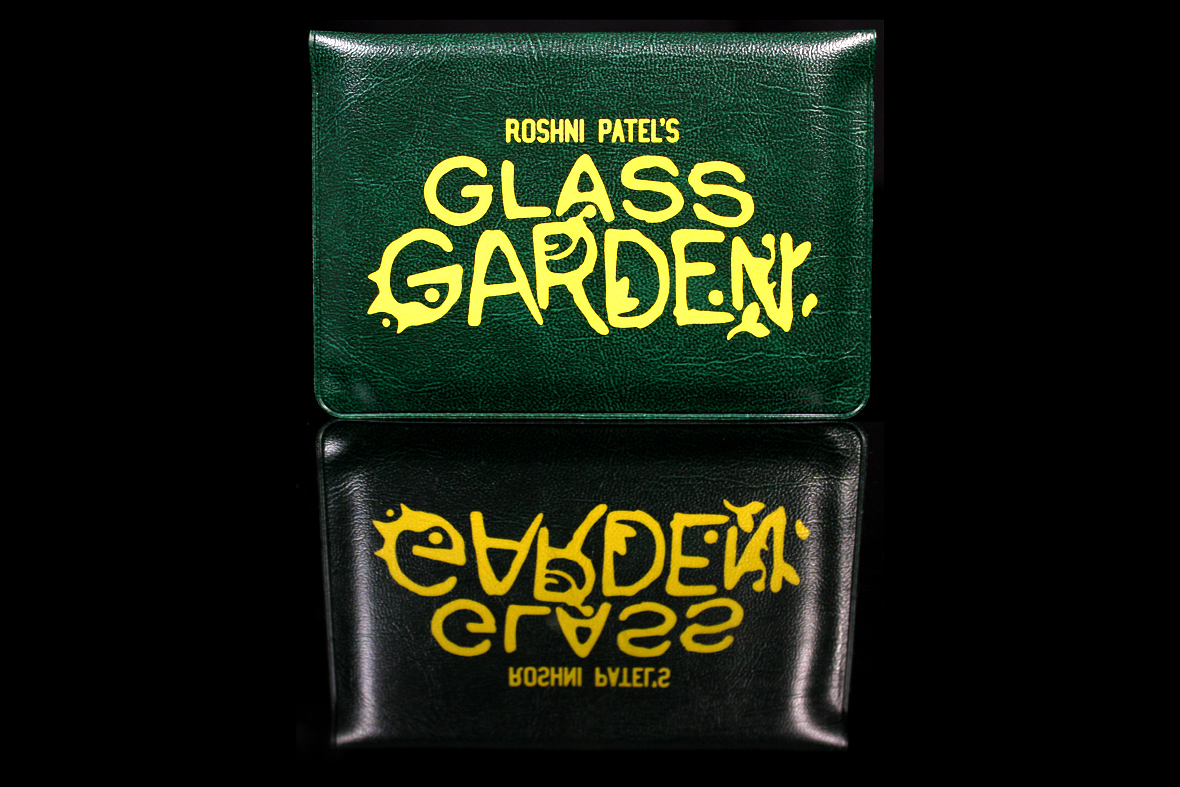
Base price: $12.
1 player.
Play time: ~15 minutes.
BGG Link
Buy directly!
Logged plays: 2
Full disclosure: A review copy of Glass Garden was provided by Button Shy.
I do often wonder which publisher I’ve reviewed the most games for. There’s a very good chance it’s Oink Games, but there’s an equal shot of it being Button Shy. Both are fairly prolific with several new games a year and they combine fun and portability in a way that I really like. I could probably just look this up very easily, but I’d prefer to prolong the magic of not knowing. One day I’ll hire someone to run some basic statistics for a dashboard or something. Love a dashboard. In the meantime, though, let’s check out another Button Shy title: Glass Garden!
In Glass Garden, players will construct the ideal terrarium to be sealed away; one that’s completely self-sustaining. The plants inside will generate their own oxygen and the little moisture will form a near-complete water cycle, making sure that the little plants grow up and continue the cycle of life. Some terrariums are ancient, so this can really work if you do it well. Just make sure the plants get the nutrients they need and watch out for the occasional bug that got stuck inside. Can you make a perfect system?
Contents
Setup
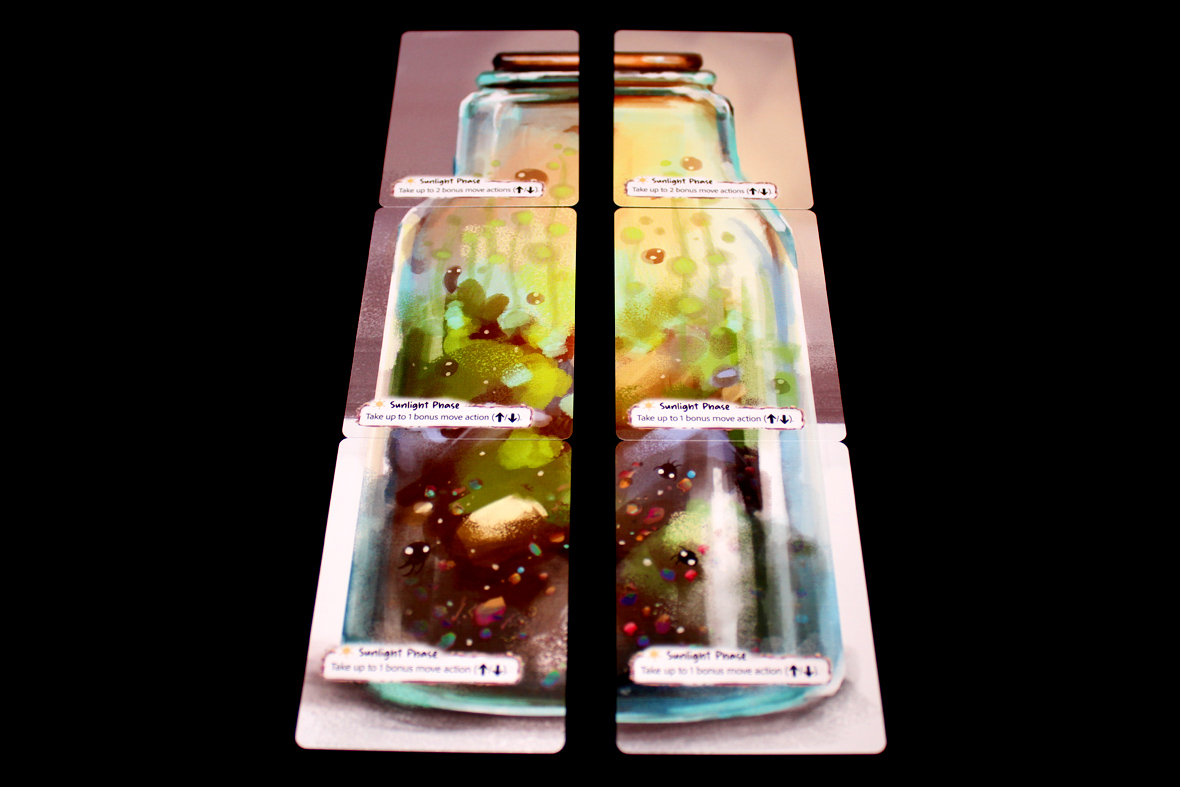
Not a ton! You’re going to flip the Bottle Cards to their Dark Side and place them on either side of the play area:
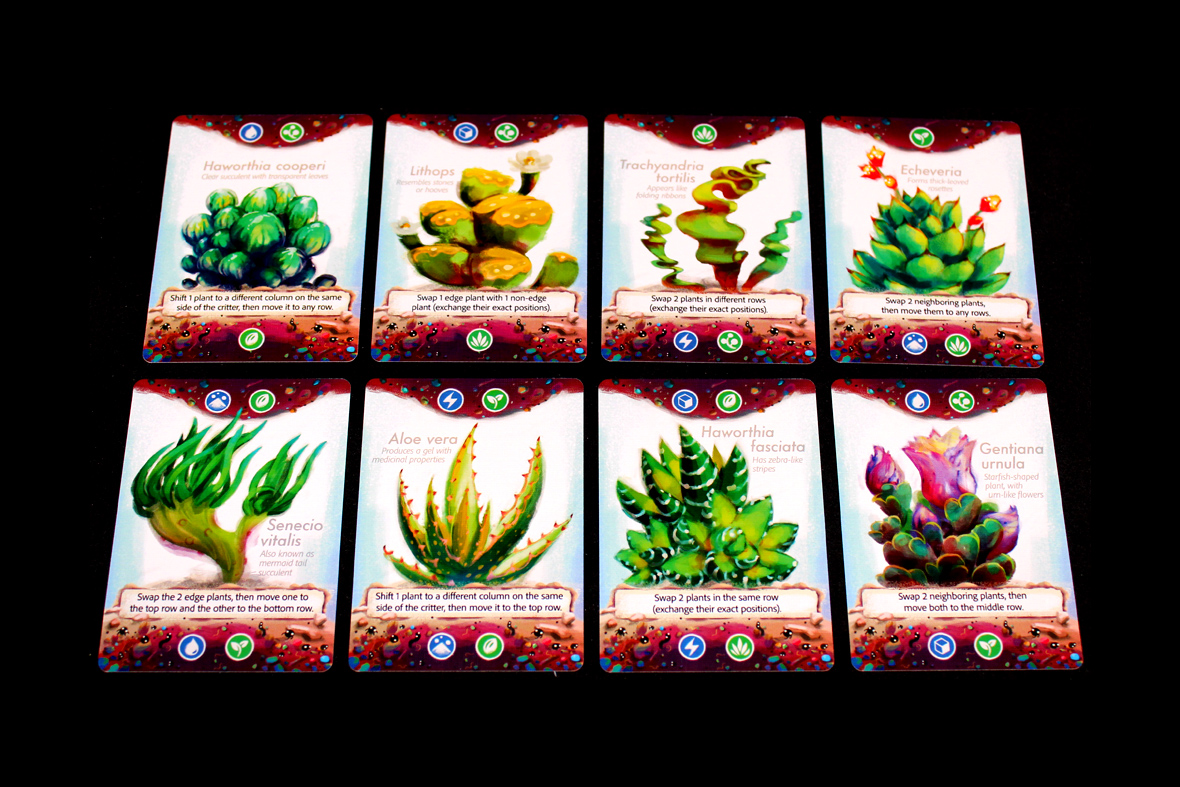
There are Plant Cards, which can be fully grown at some point:
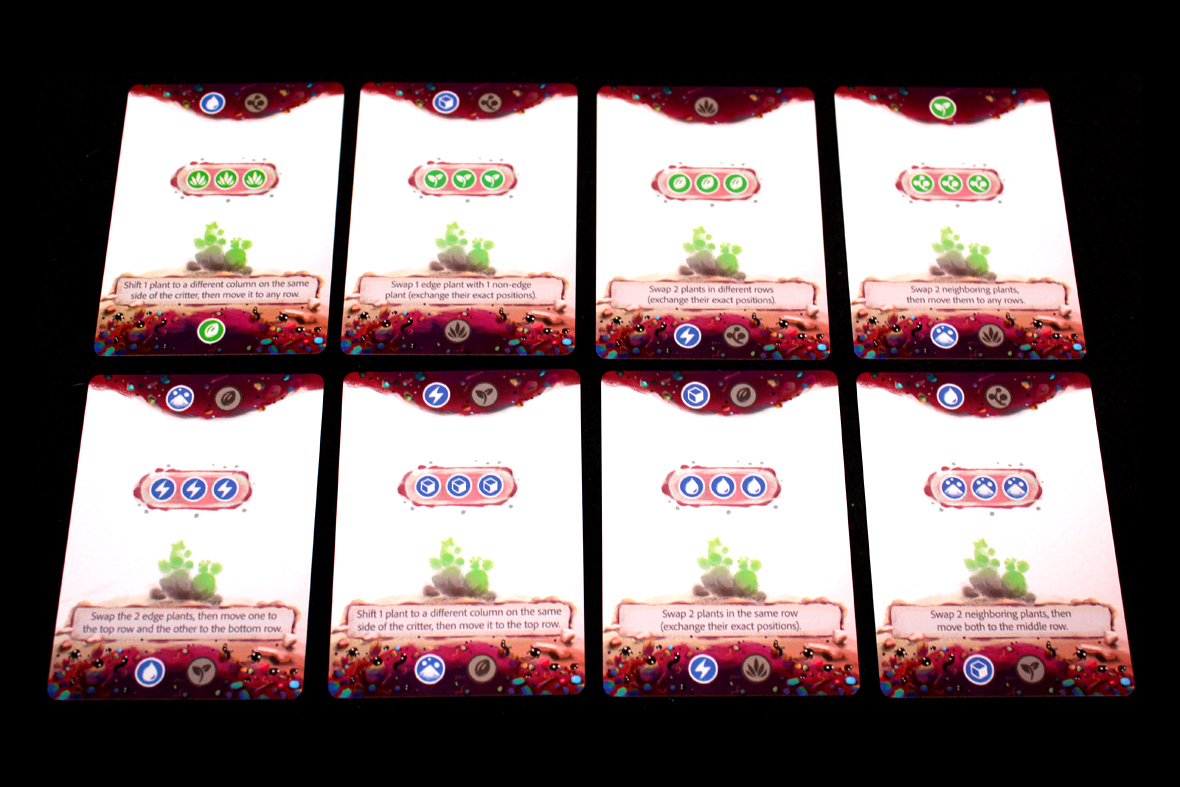
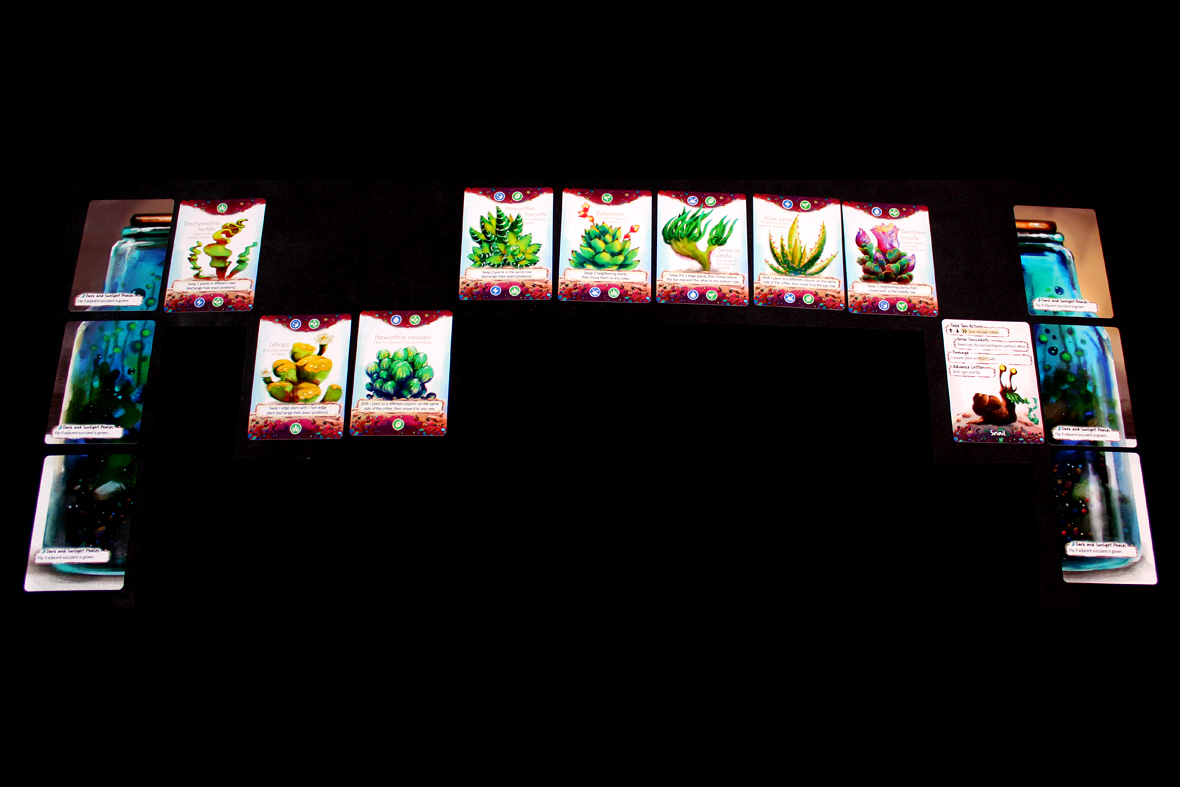
But right now you’re going to flip them to the sprout side, shuffle them, and make a row of eight connecting the two Bottle Card columns. Leave one space to the left of the row, though! (So nine card spaces, total.)
On the left in that empty space you’ll add a Critter Card of your choice (start with the Fly if you’re new):
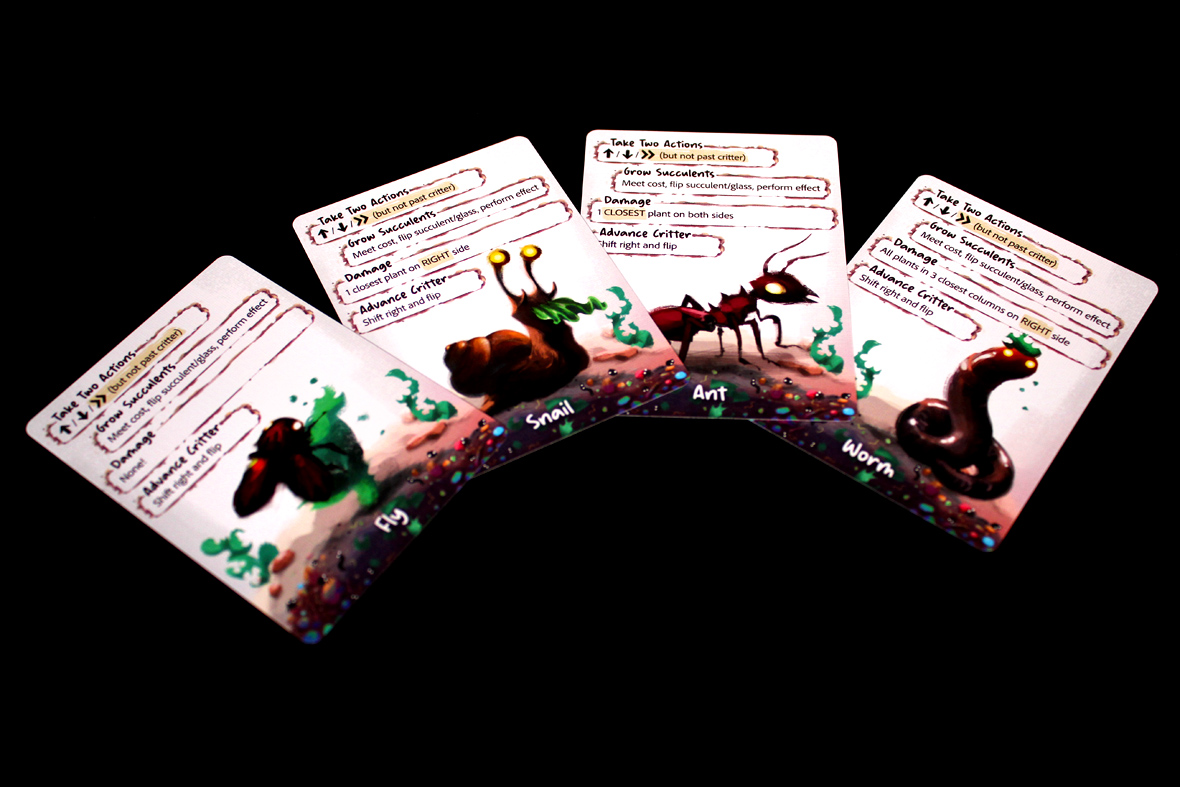
You should be ready to start!
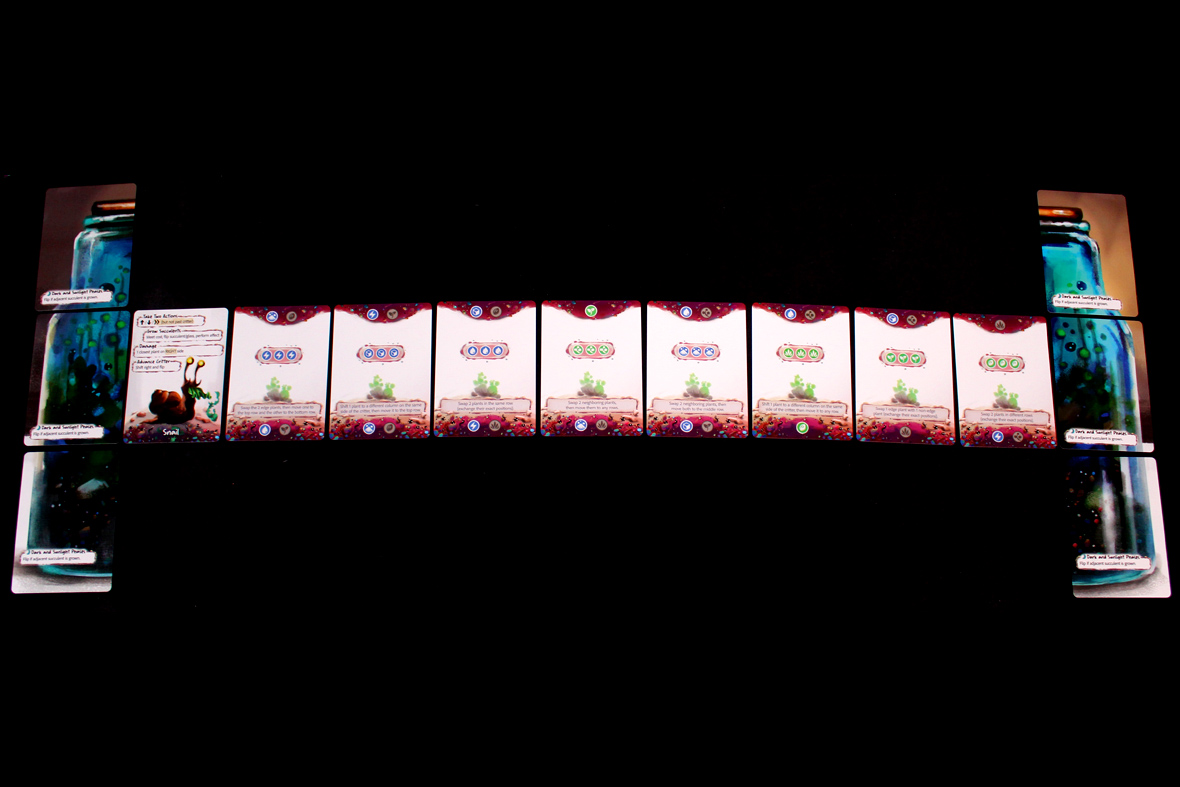
Gameplay
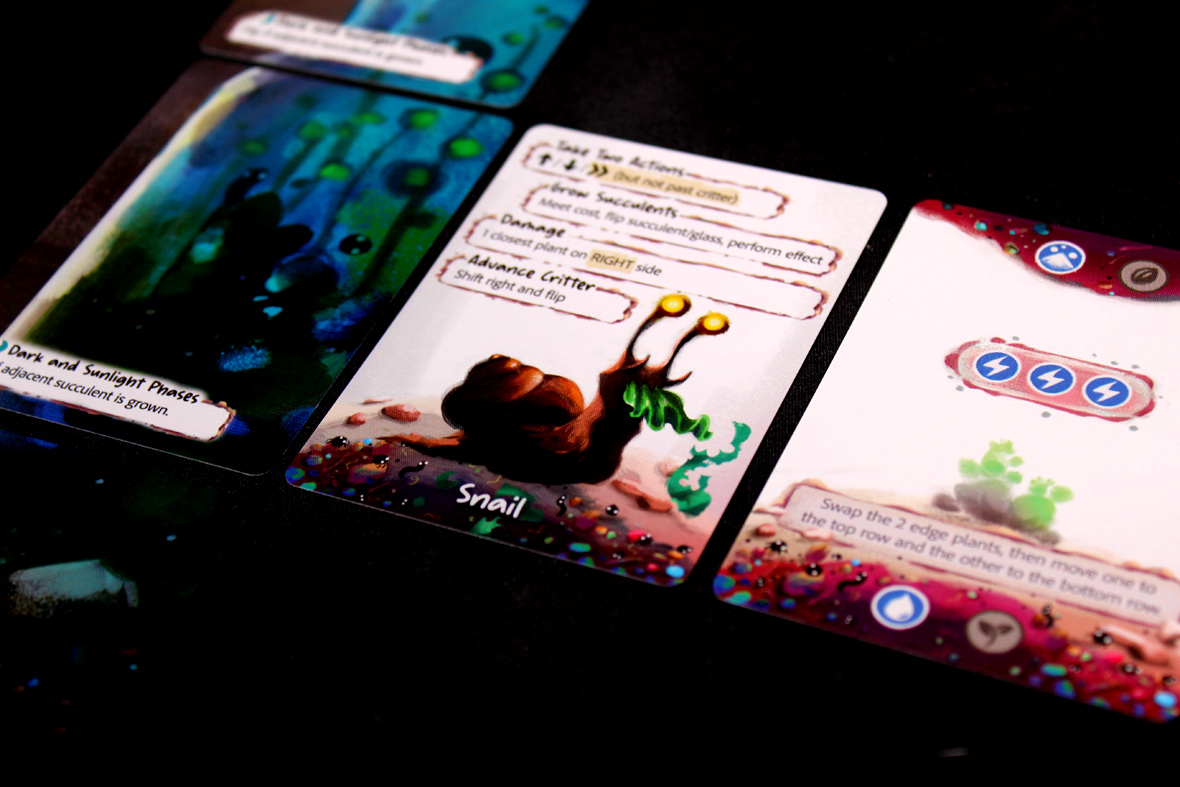
In Glass Garden, your goal is to get your terrarium growing and thriving! Unfortunately, you’ve sealed at least one angsty critter in there who might damage your plants, which seems like a small recompense for being essentially imprisoned for the rest of your life. That’s not very anti-carceral of you; just saying. So you have to get your plants the nutrients they need to thrive!
Most of the game takes place in the Dark Phase (nine turns), where you’ll take two actions (and you can take the same action twice). You can shift a card in your terrarium in the direction indicated on the Critter Card as one action, moving displaced cards into the now-empty spots. You can instead move a card up or down a row as an action; there are three rows in the game, each marked by a Bottle Card.
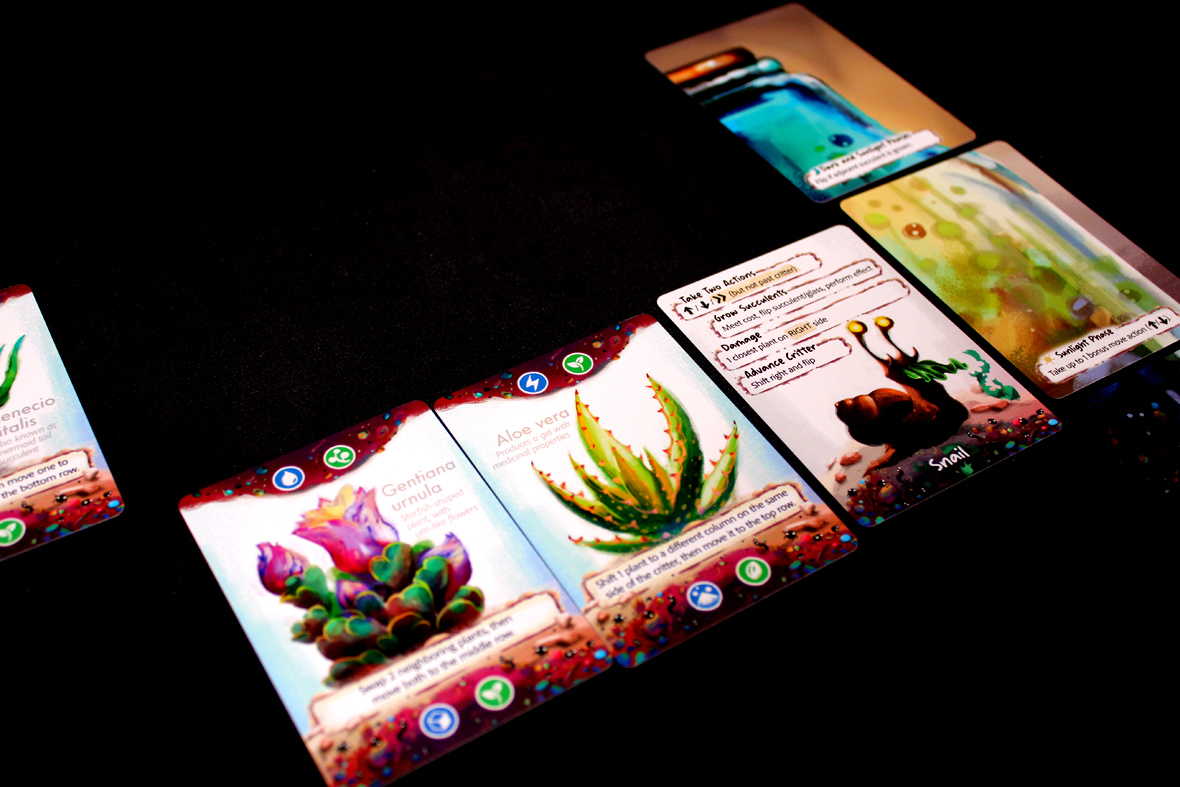
After taking your actions, it’s time to grow! If three of the same nutrient are in the same contiguous “Fertile Zone” (the top and bottom of each card define Fertile Zones; some cards may have the needed resource on the bottom or top, so row placement matters) and not separated by the Critter, you can grow the corresponding plant wherever it is in your terrarium! Do that by flipping it to the Grown side and immediately taking its action. If it’s on the edge (or separated from the edge by the Critter), flip the Bottle Card next to it to the Light side as well!
Now, it’s the Critter’s turn. First, they damage plants indicated on their Critter Card. Then, they inexorably shift one column to the right, pushing the card in that column back into their now-vacated column. They’ll do that each turn for the whole game. On the ninth turn, they cannot move again, so you’ll enter the Sunlight Phase.
In the Sunlight Phase, you have one last chance to grow plants! For each Bottle Card you have on the Light side, you can flip it back to the Dark side to shift a plant up or down a row. If, by doing so, you meet the conditions to grow a plant, it grows immediately. It can even re-flip the now-Dark Bottle Card back to its Light side, if placement is right! That’s tough to do.
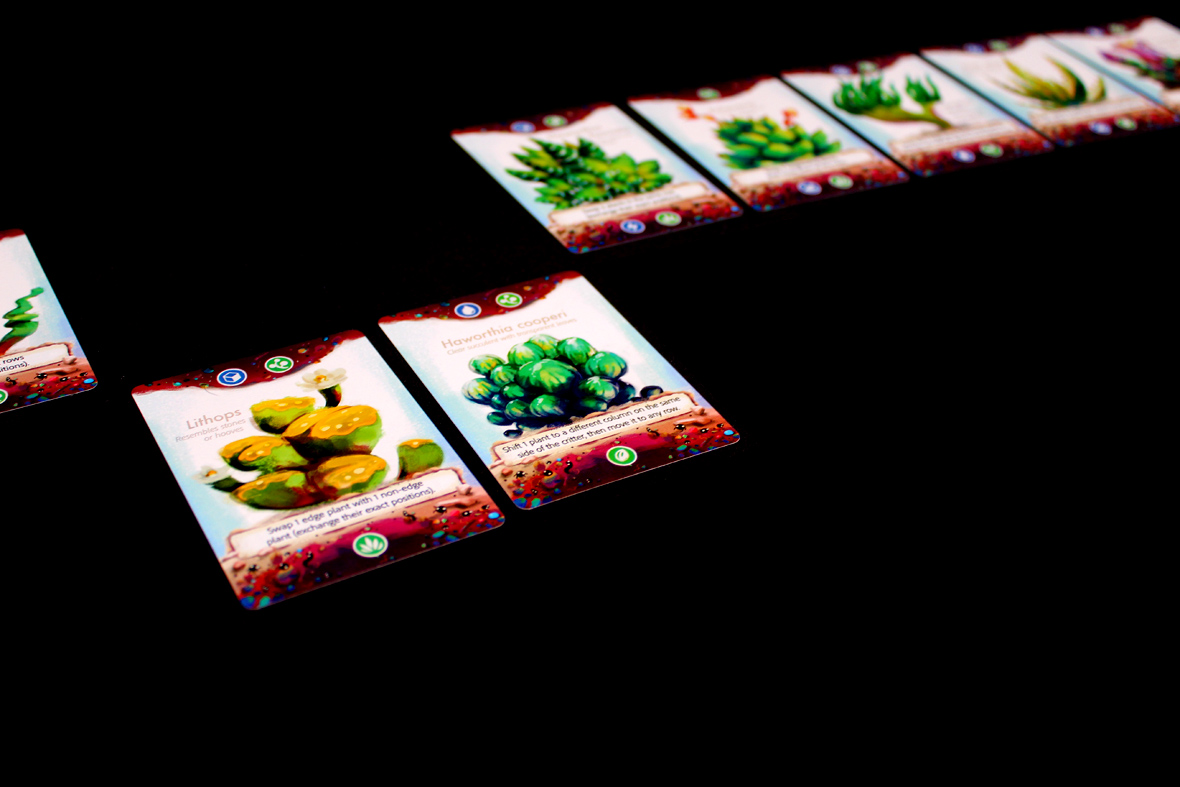
After you’re done with the Sunlight Phase, the game ends! Each plant scores 2 points if it’s in the top row and 1 point otherwise. If the plant isn’t grown at all, it scores 0. Try to get over 14 points!
Player Count Differences
This one’s purely solo! This does mean that you could play it with someone else and kind of team up on it, but it’s not designed for a unique multiplayer experience otherwise.
Strategy
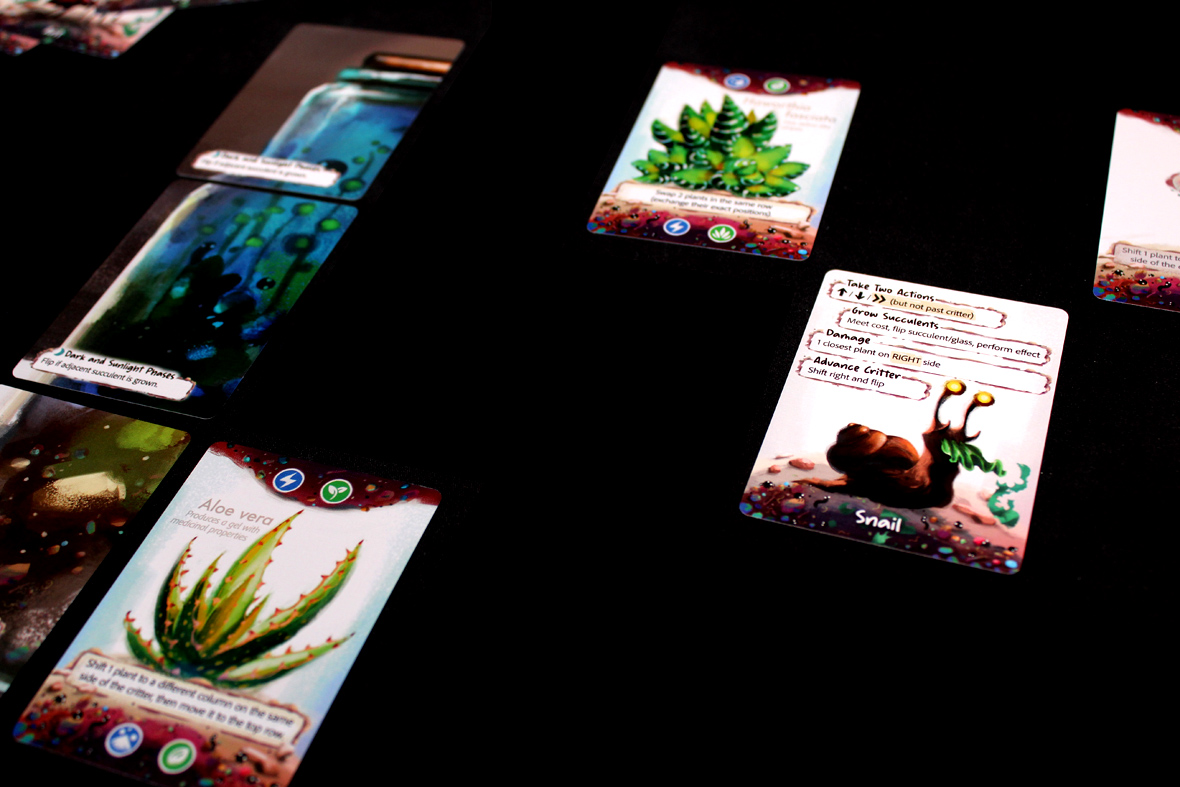
- Ideally, getting plants to the top row should be a goal. They’re worth more points up there, but you have to be careful since you might need their resources. It doesn’t feel great to move a card up and then have to move it back down later.
- Try getting your edge plants flipped, too! Flipping an edge plant can give you an extra up or down move action in the final round, which can often let you get an extra plant grown or score some more points!
- The Critter forces plants down each round; that doesn’t necessarily have to work against you. You can use the Critter’s damage action to force down plants that you need in a specific spot for growing other plants. It’s letting the snail do the work for you.
- Watch out for splitting necessary components across the Critter’s column! It’s pretty difficult to get cards from one side to the other. This can be pretty annoying; once a card gets moved to the other side of the Critter, there’s not a lot you can do to get it back outside of plant abilities. Even worse, at the beginning and end of the game the partition is too small to be useful, so you just have a card that’s stuck on the outer edge.
- Use card abilities to combo! You can use card abilities to move other cards into place to grow plants that then use their own abilities. It’s more than allowed; it’s encouraged! Try to find places to make that work.
- In the final round, you should either be moving cards to activate the final ungrown plants you’ve got or moving cards into the top row. The extra move actions are specifically to help you finish strong. Make sure you’re using them!
Pros, Mehs, and Cons
Pros
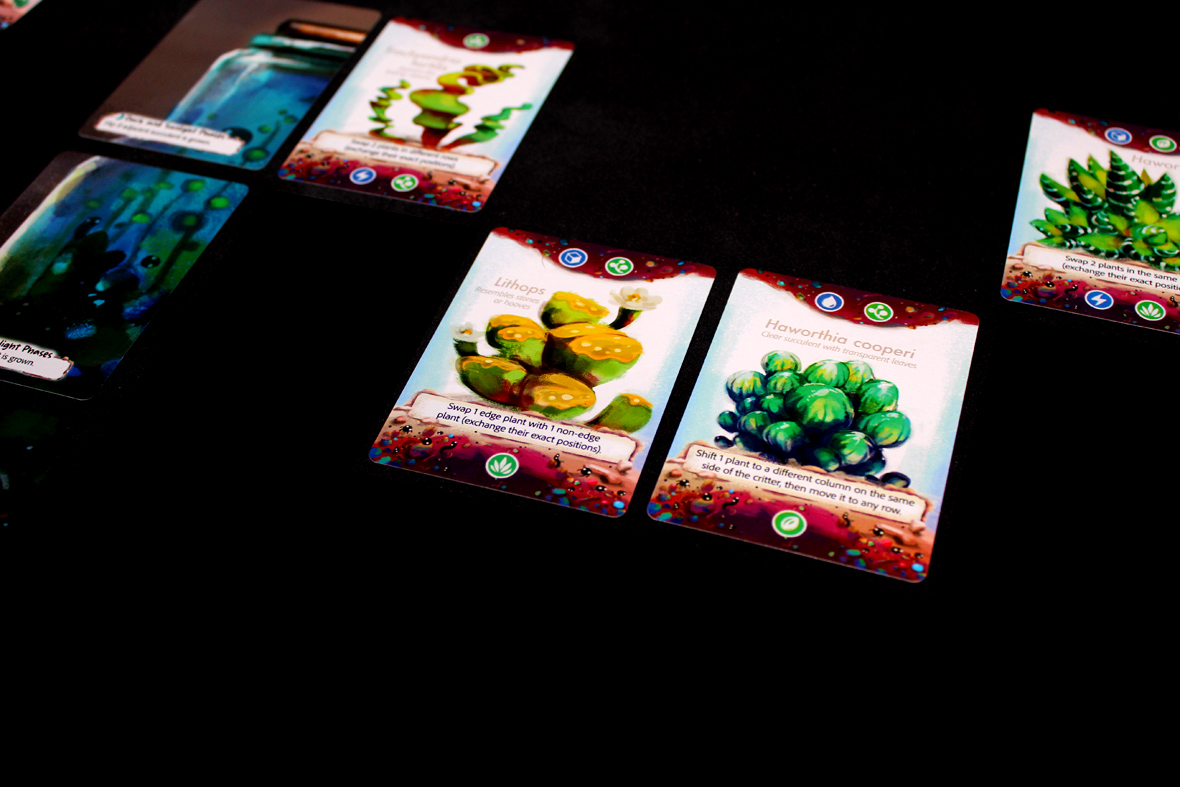
- Great art from Kwanchai Moriya. He’s the guy you get when you want great art. I mean, one of them certainly. I think it’s a lot of fun here, though, because Kwanchai just does great weird art, and what’s more fun and weird than a Snail, a Worm, or a Fly?
- I like how much of the game is just shifting cards around, actually; it’s interesting since most of the game’s playable space is visible at the start of the game, making it feel pretty strategic and smart. I love those kinds of card-shifting puzzles, and I think this one is a bit more interesting than others I’ve played since the resources to be managed are tied to the cards themselves and fundamentally partitioned into two halves. It’s an interesting mix of pacing and complexity since sometimes the best you can do is just wait for the card you need to get onto your side of the worm, as they say.
- Fun theme! I don’t think we cover terrariums enough, personally. Plenty of gardens, but I want sealed off, self-sustaining things. I think that’s neat.
- Pretty quick to play. It’s really only nine turns, which is cool. The progression is simple, but almost so simple that I occasionally forget things. It’s good to be careful on that front.
- Not too complicated on the rules, either. They’re mostly just about picking up and moving certain cards to get groups of resources together. Not too bad.
- Portability is always a draw for Button Shy as well. I love these tiny wallets and the fact that I can take them anywhere.
Mehs
- A lot of this game is swapping and flipping cards, so you’ll want to play this on a playmat if you have one. I get stressed watching my friends try to pick up cards that are flat on a wood table or something. Since you’re moving a lot of them around over the course of the game, it helps to have them on something that makes them easier to pick up.
- I think the easiest rules to forget here are shifting and flipping the Critter each round, so make sure you stay vigilant on that front. At the very least, it’s what I’m most likely to forget, so it’s worth mentioning. The Critter has the steps printed on it, so it’s really my fault.
Cons
- The physical width of this game makes it more difficult to play in travel situations, but at least it’s bounded. This is a physically long game for a not-real-space Button Shy game, I’ll tell you what. Between the Critter, the Plants, and the Bottles, you’ve got 11 cards in a row vertically. That’s kind of wild. Just plan accordingly when setting up your play space!
Overall: 7.5 / 10
Overall, I think Glass Garden is a lot of fun! There’s something to be said for a game that’s strategically compact, and I like how well it presents itself. There’s really nine cards you need to care about all the time, and the strategic movement of it all is really neat! I haven’t seen much like it, though I suppose it reminds me a bit of ROVE but approached very differently. Thematically, excellent choice. I know gardening is an increasingly-popular game theme, but terrariums are really cool and I don’t think we talk about them enough. Kwanchai’s art is also a consistently stellar choice for any game, and it really pops, here. My only real complaints with the game are largely logistical. I have a playmat for games like these, now, because it stresses me to mess with the cards and trying to pick them up off of a flat surface. It can lead to card damage! Plus, 11 cards all in a row is surprisingly long, so good luck if you want to play this one on a tiny table or an airplane tray table. Now, if you play with someone else and let them help and contribute, you might have more luck selling them on sharing a tray table with you, but this isn’t an advice column. I think, as usual, Button Shy consistently picks winners, and I had a blast playing Glass Garden! If you’re a fan of solo puzzle games, you like terrariums, or you just want something quick and fun, I’d recommend checking Glass Garden out!
If you enjoyed this review and would like to support What’s Eric Playing? in the future, please check out my Patreon. Thanks for reading!
 What's Eric Playing?