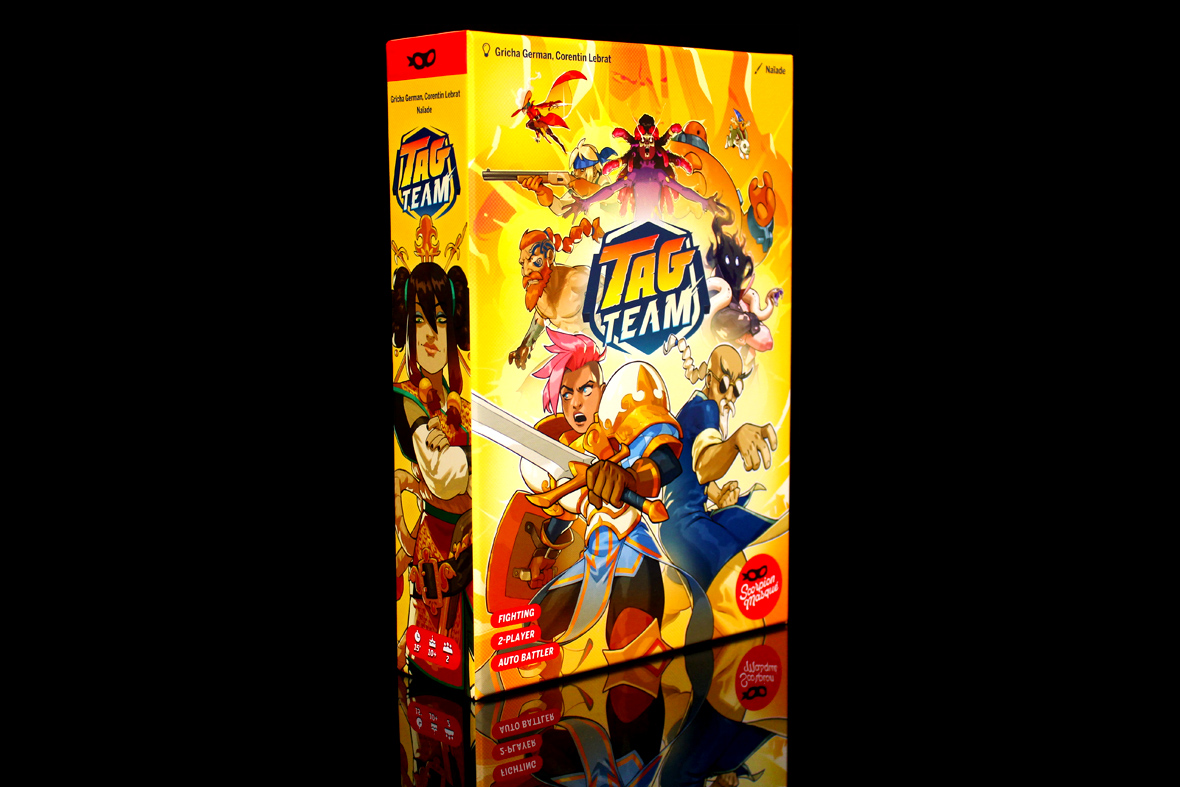
Base price: $XX.
2 players.
Play time: ~10 minutes.
BGG Link
Logged plays: 15
Full disclosure: A review copy of Tag Team was provided by Hachette Board Games and Scorpion Masqué.
It’s never a bad day when a Scorpion Masqué game comes across my desk. I’ve said on numerous occasions that, as a studio, they pretty aggressively don’t miss, so seeing a two-player deckbuilding autobattler coming from them is certainly enough to pique my interest. Of course the thing launches with twelve characters and forces you to figure out how to work a pair of characters together with their own synergies and hilarious combos to discover. That’s their entire sort of vibe. But I don’t want to get too into the review, here; just a little bit to keep y’all reading. Though I don’t really check time on page analytics, so, I guess it doesn’t matter? Anyways, let’s get to the game.
In Tag Team, you’ve got a bone to pick with your opponent. Both of them, in fact. You’ve gathered fighters from across history and mythology to fight it out, last team standing. Two v. two is the way it’s going to be, which would be fine, but everyone fights weird. It’s not just about learning what you do; it’s about figuring out what they do and how to counter it. Thankfully, you’ll have a lot of chances to figure it out, hopefully. So grab a partner and duke it out! Who will win and who will get KOed?
Contents
Setup
Very little, here. Each player is going to need a pair of characters:
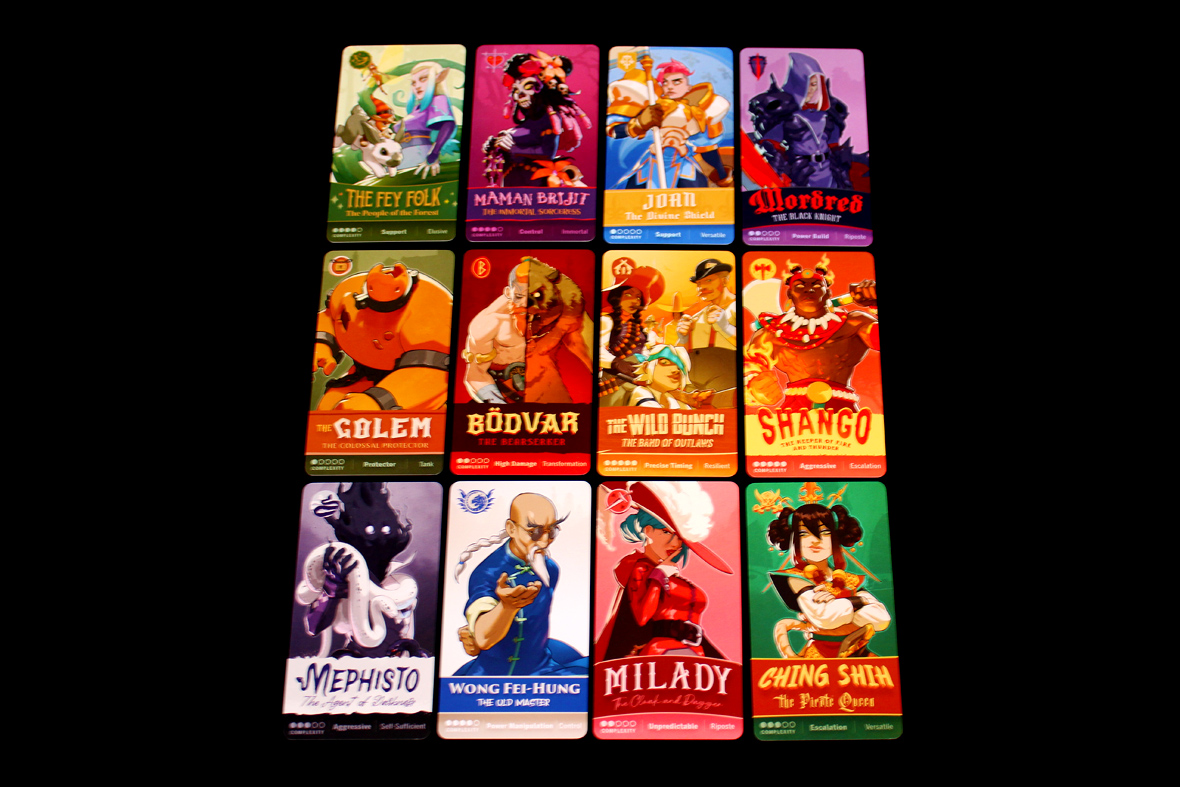
You can do this a few ways; I prefer the “each player gets six, picks one, discards one, and then passes the rest”, but you can do the “each player gets dealt two; deal with it”, “each player gets dealt three and discards one”, or “each player gets dealt six, picks one, passes the rest”; it’s not a huge deal how you draft characters as long as everyone agrees. Once you have two, take the corresponding character cards (the big ones):

Your new characters might need their own special tokens:
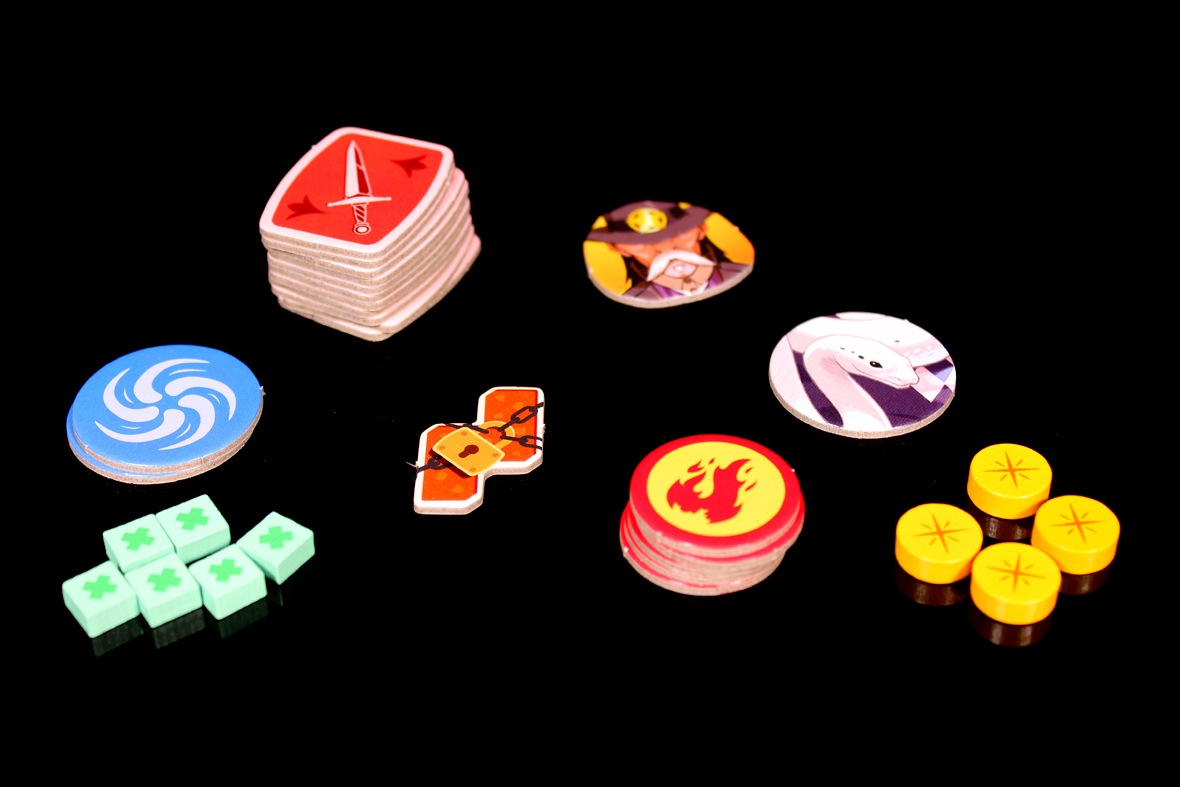
Either way, you’ll likely need the Power Tokens:

And then, of course, you’ll need each character’s cards:

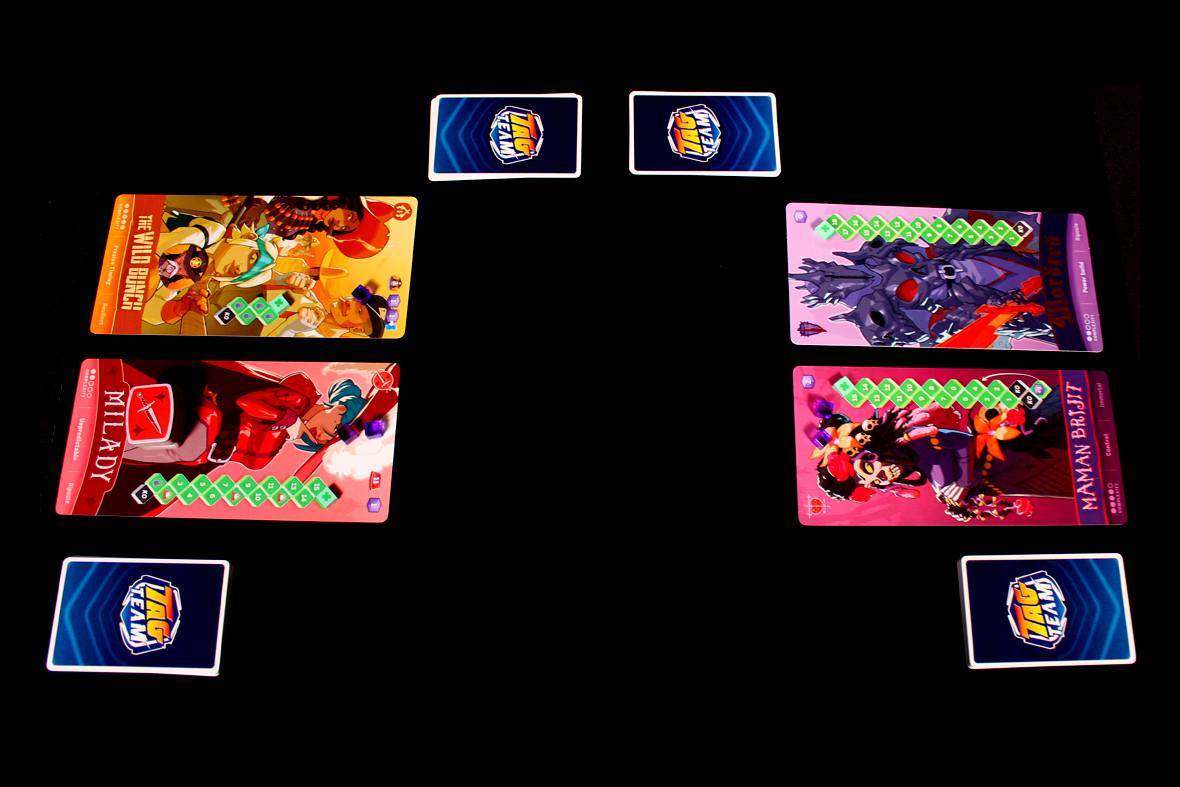
The black-bordered cards are the starting cards; each character has one. Take those, shuffle the rest together to make your Build Deck. Place the green token on your max health (unless otherwise stated), and choose which of the two starting cards is going first and which is going second; put them together to make your Fight Deck. You should be ready to start!
Gameplay

It’s a two v. two throwdown in Tag Team! Your goal is to knock out one or both of your opponent’s fighters before they can take you down!
Each round plays exactly the same. Both players reveal the top card of their Fight Deck and resolve it functionally simultaneously. There are a few things that have their own priority, but they’re pretty easy to figure out and resolve. The key is this: at the end of the round, do not shuffle your deck. Stack your cards back up in the order you played them. Then, the kicker: draw three cards from your Build Deck, choose one, and discard the other two to the bottom of your Build Deck pile in any order you want. You may add or insert the card you selected anywhere in your Fight Deck (you can look at your cards to help). Then, begin the next round!
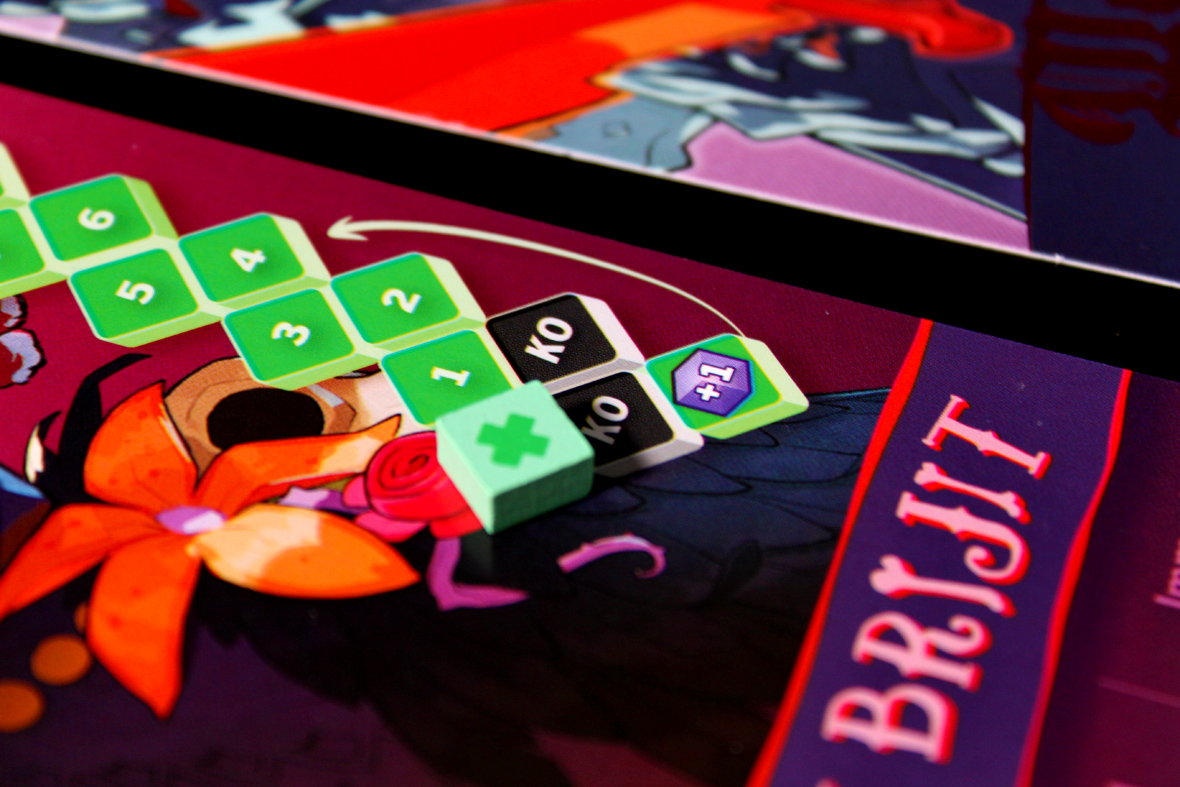
Play continues until one fighter is KOed. The opposing team wins! In the rare event that both teams lose a fighter on the same turn, it’s a draw!
Player Count Differences
This game is primarily designed as a two-player game.
Strategy
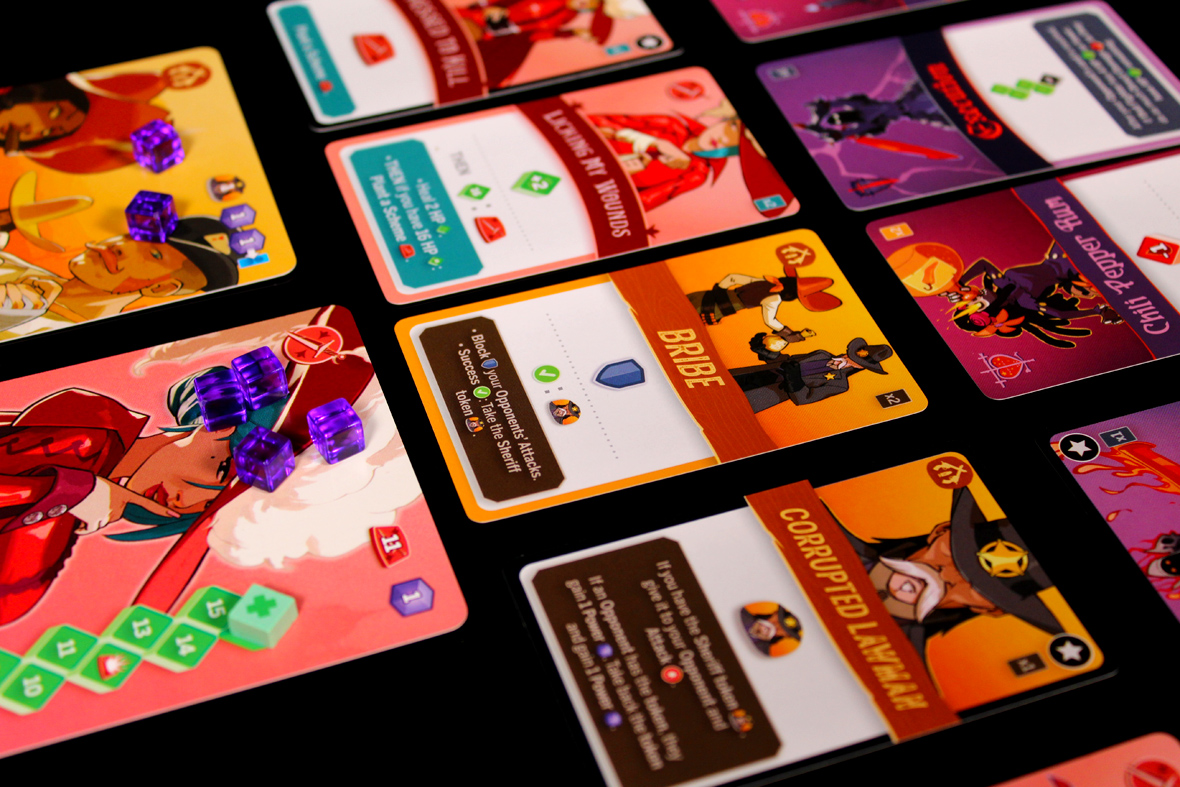
- Focus on what your character does well. Everyone has strengths literally printed on your Character Card. Lean into those.
- Keep in mind that generally, your opponent only attacks the player whose card is up that turn. This is pretty important because it lets you set up who is going to take damage once you’ve got the pattern of your opponent’s actions down. You can also use this to set up a powerful attack if one of your Fighters has more power than the other.
- Healing is an important part of the game. Depending on the character, at least; several characters are all about taking hits and then discreetly healing damage afterwards. Some are more about avoiding damage. But if you need to heal, do it! If your opponent needs to heal, either attack during the lull or, if you’re playing the right character, steal that healing for yourself.
- Sometimes the best offense is a good defense as well. If you can clock and block all their attacks, they can’t really easily do damage to you, no? Just remember that you can run out of cards in your Build Deck eventually. It’s a draw, but it feels bad.
- Did you get countered? Remember that and insert a card before it to mess with your opponent’s counter. They might do the same to you, but next round you can counter their counter of your counter or you can counter just their counter. The only important thing is that you don’t lose track of who has the moral high ground.
- Some characters have specific loss conditions; keep those in mind so you don’t waste actions. Some need to hit a specific health value to die or they only lose one health per turn regardless of damage or they are a fey collective. Pay attention to that so you know how to manage (and hopefully avoid) their loss condition.
- Remember to up your characters’ Power! It helps attacks hit harder. You can actually get pretty clowned here if you’re not paying attention; I had a few rounds where I was attacking near-constantly … for one damage, because I had given my character almost no additional Power. It’s a bit embarrassing.
Pros, Mehs, and Cons

Pros
- The character variety is super fun, and I really like how they all synergize in different interesting ways. They went with a “real-inspired” set, which can be risky but honestly turned out really fun and unique! Lots of time periods represented and various forms of folklore and mythology. Big fan, though I would love some future / sci-fi Fighters next time around.
- There’s an interesting memory aspect here of trying to remember what the order of your opponents’ cards is so that you can counter them. Whether or not you like that part of the game is going to depend on how you feel about memory aspects, but if you can remember the order of your opponent’s cards you can usually find a pretty good spot to try and place a counter or a trap if you get the right cards from your Build Deck.
- Each character’s special like, finishing move is really neat! Most characters have a few unique cards in their Build Deck (not all of them), and those cards usually lean more aggressively into their theme or their schtick. They can be pretty powerful and a lot of fun, from cards that let you attack everyone to cards that essentially render you immortal or, specifically, a card that lets you execute your opponent with prejudice. Lots to like.
- Very expandable, which I’m always excited about. I think they already have more characters planned? It’s a great system, so it works.
- Players will develop favorites, but I don’t think I dislike any character. I think half of the fun is not just finding a favorite character but also finding a favorite pairing. If you’ve got good ones, let me know in the comments! Always interested to hear how other folks are playing.
- Pretty quick rounds since you’re essentially rattling off a few cards each time. The rounds get longer each time (one extra card per round) but by then you’re pretty experienced with every card you’ve seen, so things always move at a good clip.
- I like the general building action of the game; it’s suspenseful and tense. You have to be prepared to counter certain things while losing ground on the actions you didn’t cover; it’s a lot of fun! The back-and-forth can be intense without being unpleasant, which is great. There’s also a lot of room for growth for players and characters as they figure out their preferred styles or combos.
Mehs
- I don’t always love memory aspects, but it is an important part of the game here. You’ll really do better if you lock in and try to remember key cards that your opponent played at key times. Even something like “did they Attack or Defend on turn 3” can be useful to determine where you should play a card, especially since certain Defend actions give you bonuses if they’re successful. This is just tough for players who struggle with memory game aspects.
- Sometimes you just get outplayed! There’s definitely a “getting stomped” version of this where you start on your back foot and you just never get ahead. Doesn’t feel great but it is what it is.
Cons
- There can be a bit of luck to triggering certain character synergies. It can range from “did you have a useless draw from your Build Deck” to “does your character depend on hitting the same fighter over and over”. Some effects can be thrown off by bad luck and some just depend on the right cards. It can be frustrating if you’re not getting what you need, but card luck isn’t always on your side.
Overall: 8.75 / 10
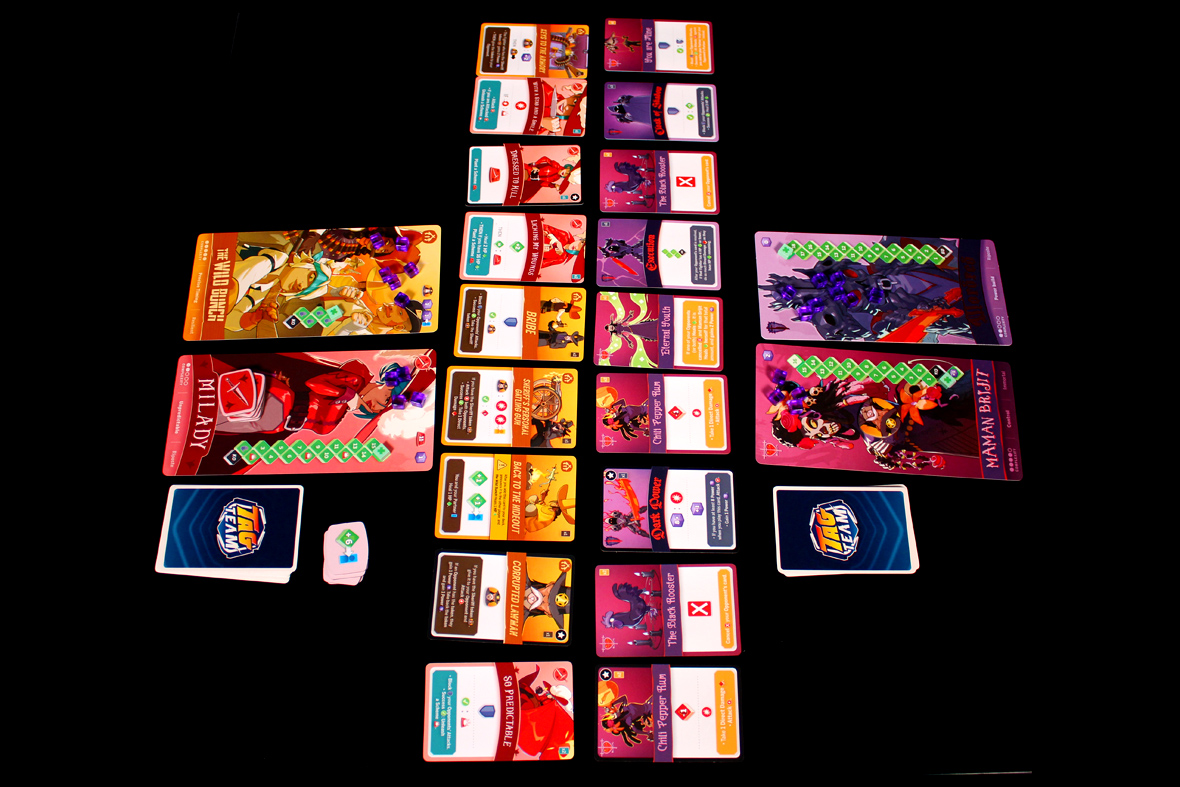
Overall, I think Tag Team is excellent. It fits nicely with Challengers from a while back in that they’re both infinitely approachable and very fun auto-battling deckbuilding games. Unlike Challengers, though, this one is very optimized for two players, and it sings. Each character has their own interesting playstyle and finding ways that they all work together is pretty much always possible, provided the cards cooperate with you. You can use the Golem to protect a character who will essentially just build up power, or you can just keep chipping away at your opponents with both characters, or you can do some weird stuff with the Fey and the outlaws. We love a Weird Character. Thankfully, there are more on the way, so the weirdness will continue until morale improves. It’s a quick game with a nice balance of luck and strategy, even if it’s a bit frustrating if you don’t draw particularly useful cards for where you are in the game. That happens sometimes. The one place where players may find some frustration is that the memory aspect of the game matters. If you remember what cards your opponent played in what order, you can come up with a compelling counter (provided they don’t do the same to you), and that back-and-forth can be a major game event, especially if you get your opponent on the back foot trying to react to your plays. Granted, sometimes none of that matters and you can just play with reckless abandon, too; I’m not in charge of your life. I see this as the kind of game that couples or friends will love just going back and forth with each other, learning strategies, trying new things, losing, winning, and losing again, and then trying something completely new (very much like another favorite of mine, Santorini). Every play of Tag Team has been exciting and compelling for me, and I can’t wait to try it again soon. If that’s up your alley, you’re a fan of messing with deckbuilding, or you just want to meet your opponent in the pit, Tag Team might be right up your alley! I certainly think it’s great.
If you enjoyed this review and would like to support What’s Eric Playing? in the future, please check out my Patreon. Thanks for reading!
 What's Eric Playing?