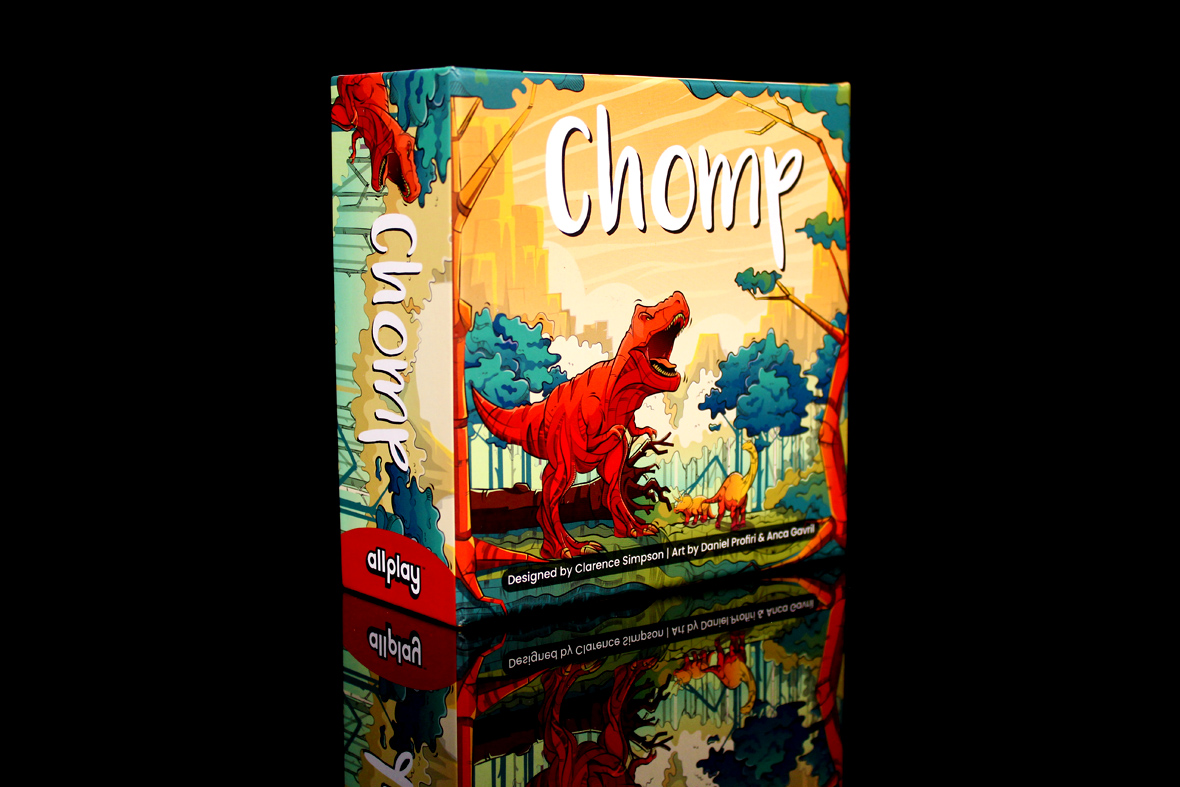
Base price: $24.
1 – 4 players.
Play time: ~20 minutes.
BGG Link
Buy on Amazon (via What’s Eric Playing?)
Logged plays: 3
Full disclosure: A review copy of Chomp was provided by Allplay.
Due to a overwhelming amount of life happening, I had to stop updating my review score tracker spreadsheet, which is causing all manner of problems a year and a half later. The sheet was already unwieldy (as any spreadsheet with 1200+ rows tends to be), but now it’s missing information and that’s going to be a whole thing. I’m trying to fix it, but who knows whether or not I’ll be able to use some tooling for that since the WordPress API is a mess. Oh well. That’s a problem for another time or for some kind of bot to solve; it’s highly-structured information so I’ll be able to retrieve it eventually. In the meantime, while that’s chomping data, let’s talk about Chomp.
In Chomp, players are stewards of herds of dinosaurs. You want them to live happy dinosaur lives and get fed without falling into tar pits. Even though, you reason, them falling into tar pits means that they’ll become oil to power the cars of the future, but you don’t know about cars yet. Try not to think about it. Plus, if you don’t feed the carnivores, they’ll munch on the herbivores. That’s bad. So try to keep them separated and score big while taking goals to match your terrain. Can you help your dinos survive?
Contents
Setup
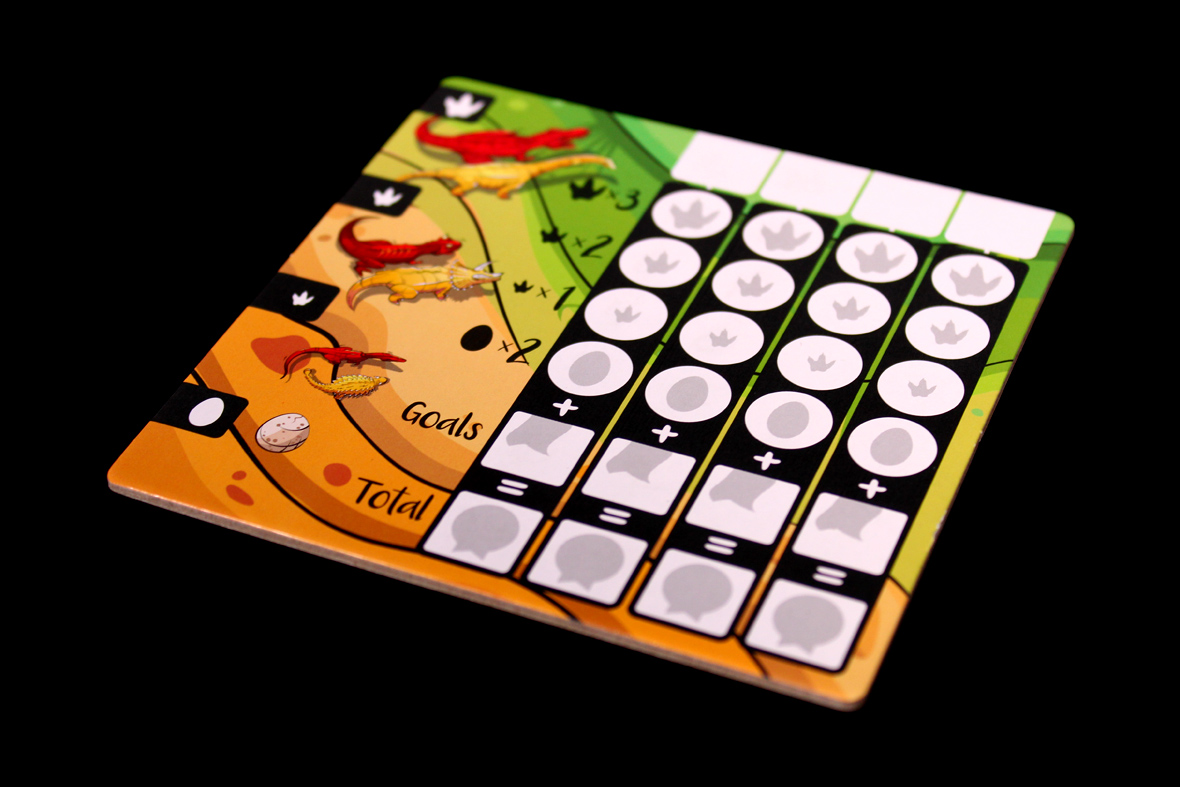
Almost none! You’ll set aside the score card for now:
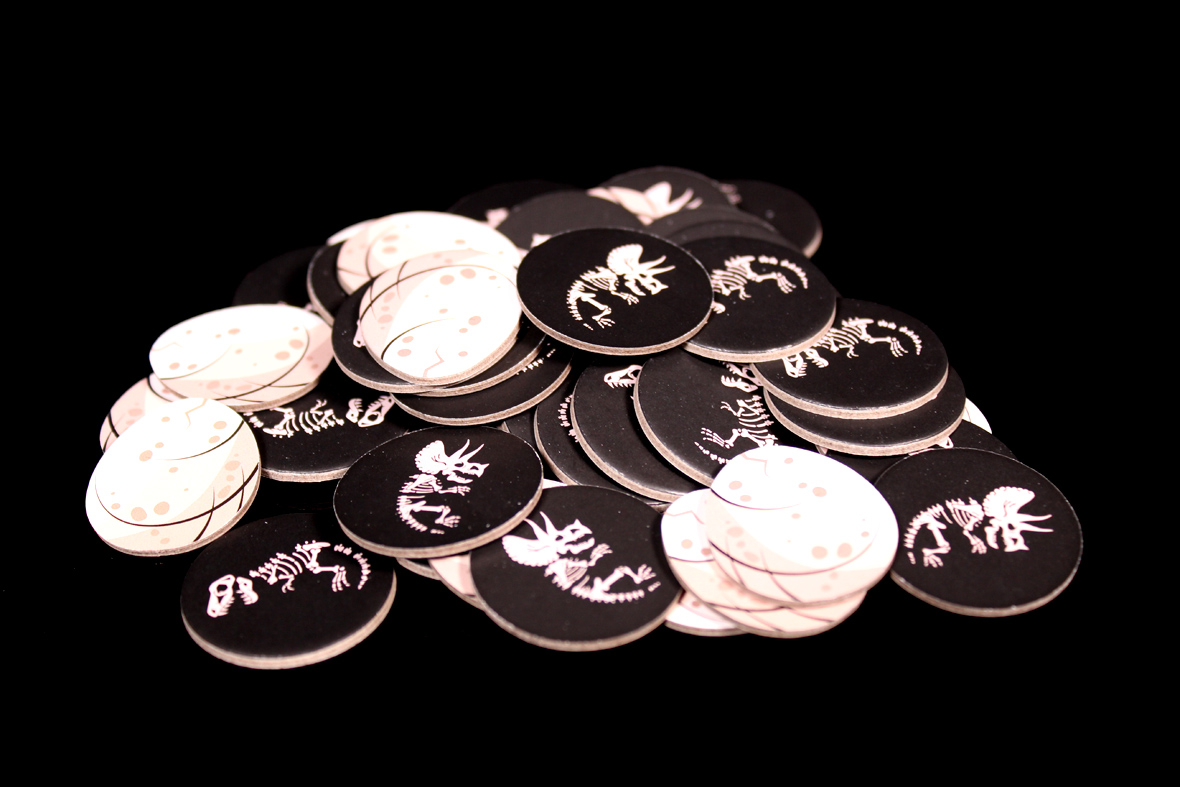
Make a pile of the eggs and extinct tokens:
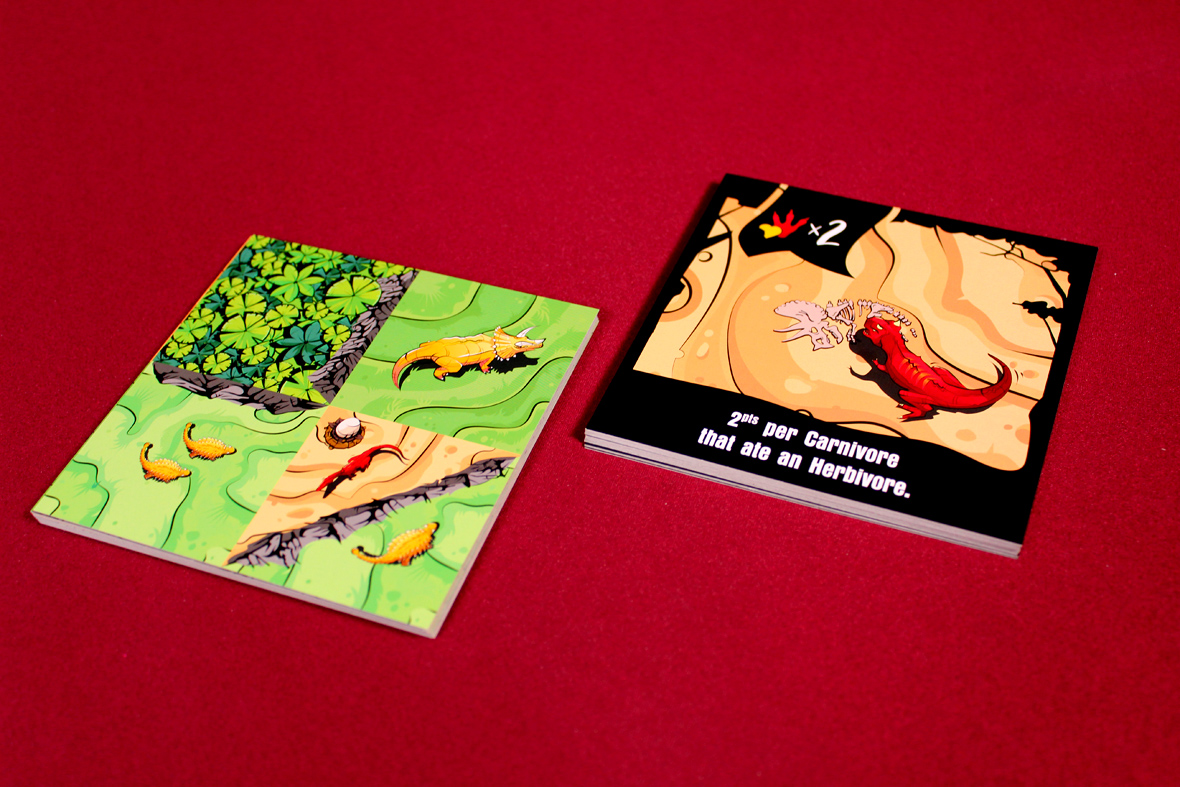
Then shuffle the cards. You’ll need 9 per player. Deal each player one to form their starting play area and then put the rest in a pile. Reveal three land-side-up and three goal-side-up:
You should be ready to start!
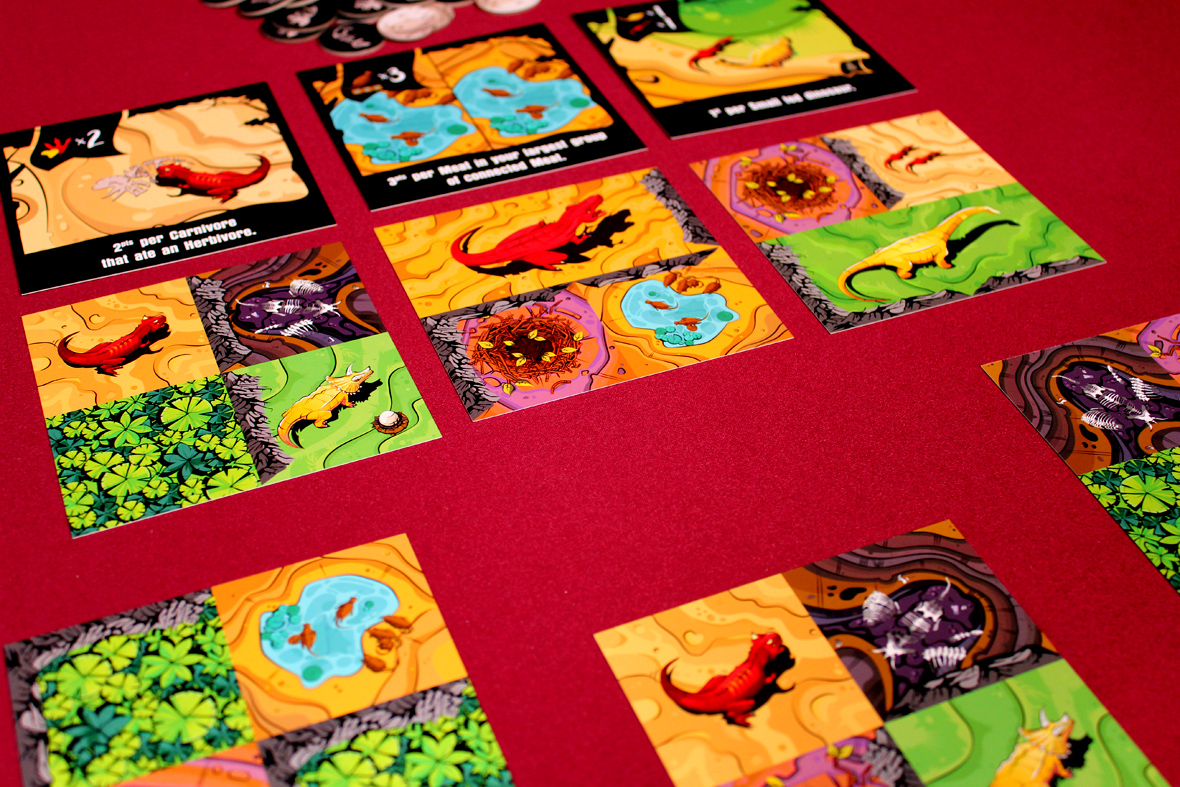
Gameplay
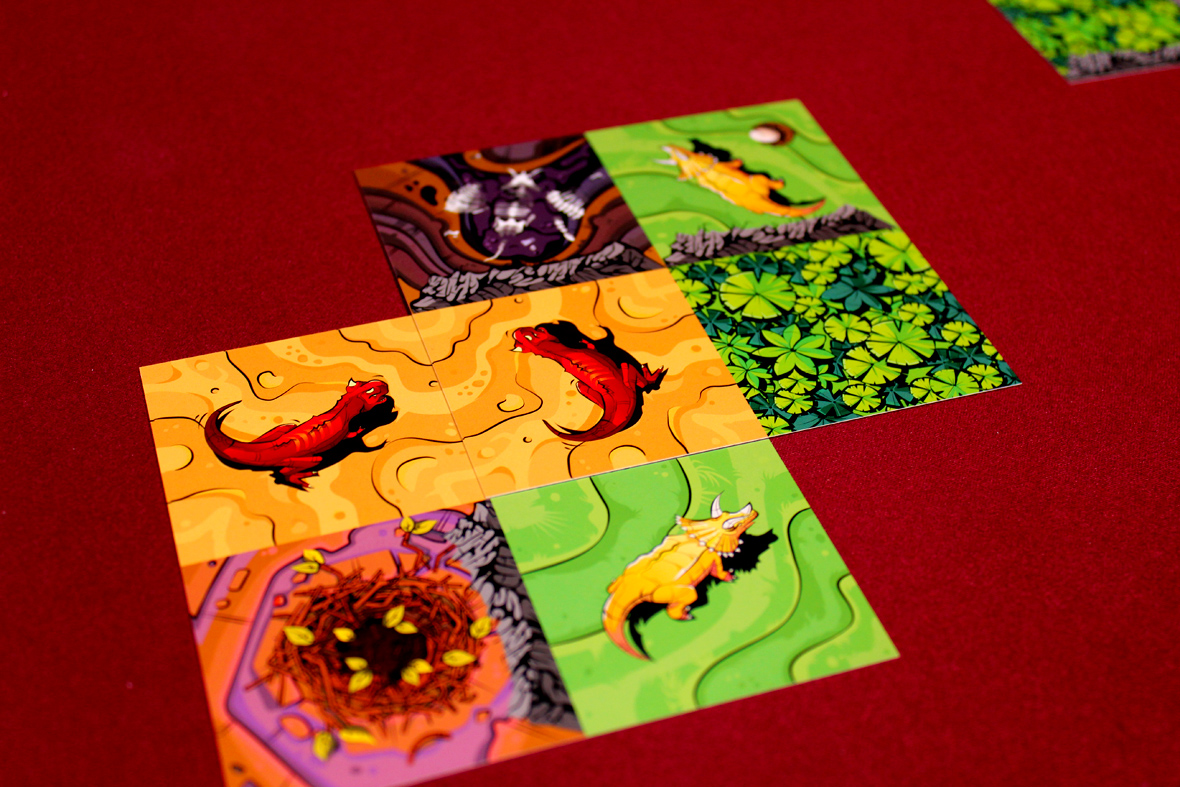
This is pretty simple, too. Your goal is to score big points while keeping your dinosaurs happy and well-fed. Each turn, you’ll take either a Goal Card or a Land Card, and once you do, you can’t flip them. If it’s a Goal Card, set it aside for later. For a Land Card, you may place it on or adjacent to any card or cards in your land as long as you’re covering 0, 1, 2, or 4 squares completely. You cannot split up big dinosaurs (it’s messy), but you don’t have to worry about mountains when placing. If you place a card with an egg on it, you can add an egg to any available nest in your land. Note that covering up that nest loses you the egg.
If you took a Land Card, flip the Goal Card above it and draw a new Goal Card. If you took a Goal Card, just replace it with the card on top of the deck.
Once all the cards have been played, the game ends! Now, to see who goes extinct! Each group of adjacent dinosaurs of the same size not separated by mountains forms a herd. Let’s see what happens next:
- All dinosaur herds adjacent to Tar Pits go extinct. They all wander in. Sad!
- All unfed dinosaur herds go extinct. First, check Carnivores. If they’re adjacent to meat, they’re fed. If not, they’ll eat any Herbivores they’re adjacent to that are their size or smaller. Those Herbivores go extinct. Any Herbivores that survive go extinct if they’re not adjacent to any plants. Remember to watch out for mountains! They can separate herds and keep herds from food.
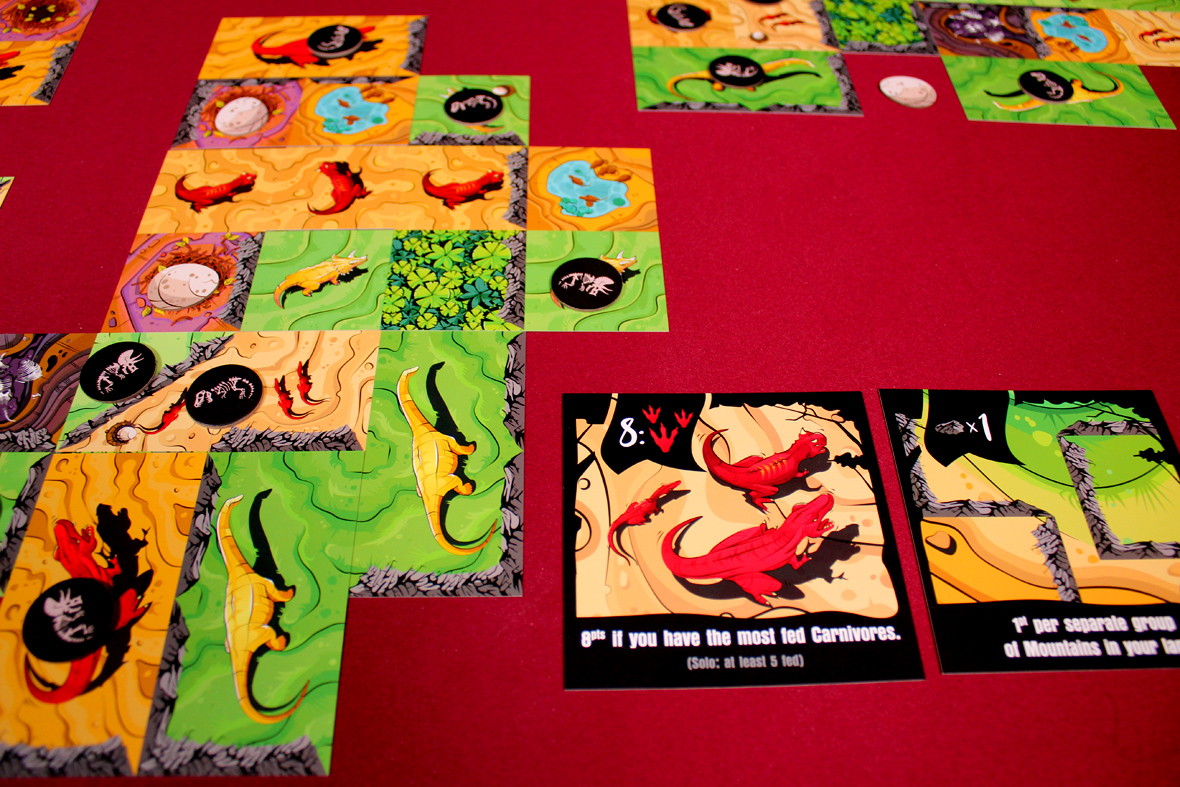
Then, score! Extinct dinosaurs score 0. Small / Medium / Large herds score 1 / 2 / 3 points per dinosaur in them. Eggs in nests score 2 points each. Goal Cards score according to their text. The player with the most points wins!
Player Count Differences
The core of the game is just drafting, so, there aren’t a ton of differences. Two major things pop up as the player count increases, though. For one, if you want a card that pops up when you finish your turn, you’re very unlikely to get it at higher player counts. Just the nature of how the market works. You’ll also find more challenges for certain goals. At two, you just need to beat the other player to have the most Carnivores or the most Small Dinosaurs. With three or four, suddenly, other players can swoop in and knock you out of the running without you really being able to do much. It’s worth considering that those might be less valuable assets to go after at higher player counts since the actual score you get doesn’t scale with player count (or offer any consolation prizes). They’re riskier, as a result. Personally, I think the game runs best with two if you’re looking for more control over what you’re doing, but with higher player counts you’re going to see a lot more chaos.
Oh, there’s also a solo game, here.
Strategy
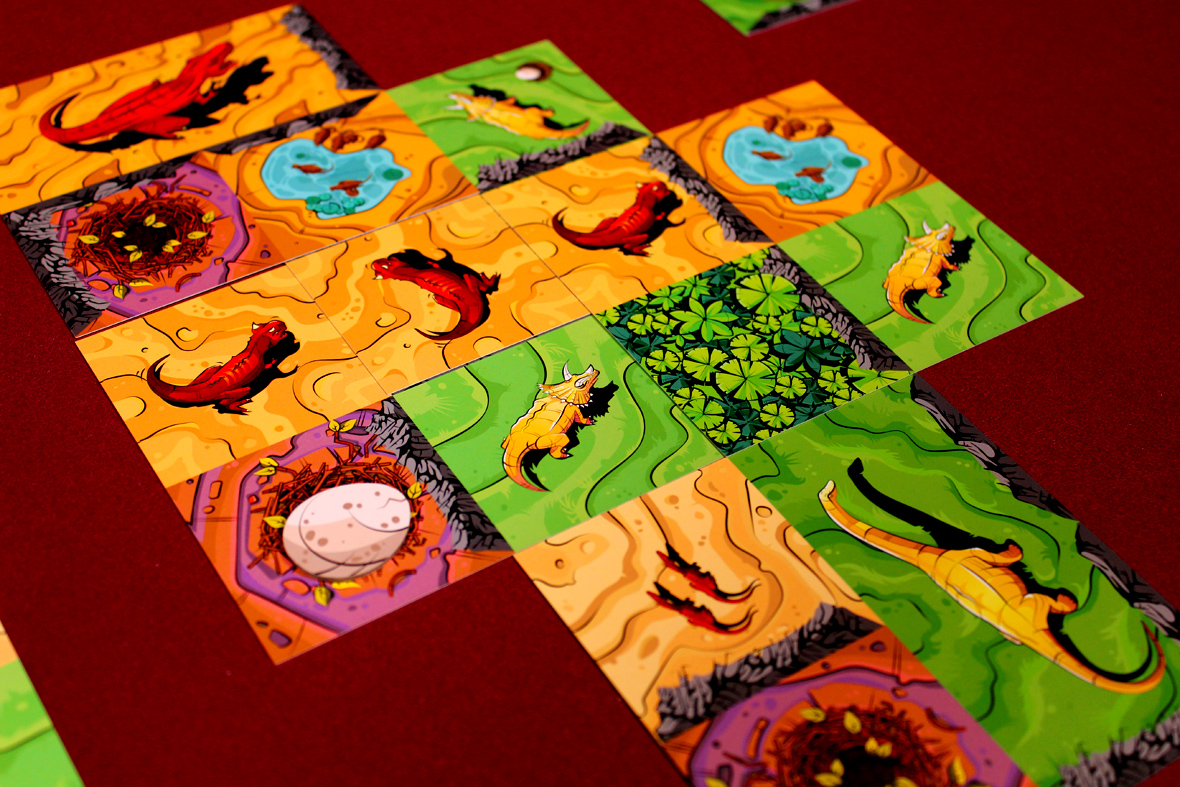
- Plan ahead. If you take certain Goal Cards, you need to work on them to make sure you get points. Just make sure the conditions you need to meet actually happen, or they’re worthless.
- Watch out for the mountains. The mountains work to separate areas from each other. This means that you might be cutting a herd in half or you might be separating a dinosaur from its food source, which is bad. You can, however, use them to wall off Tar Pits, as well, to protect your herds from their siren song. That’s a better use case, at least.
- Remember how feeding works. You don’t want to end up getting all of these nice herds and dinosaurs placed for your Goal Cards and then they all went extinct because you didn’t place any Meat or Plants. Keep an eye on that.
- Getting big herds together is a useful way to get them all fed, but it can get them preyed upon if you’re not careful. If you have a big herd and you forgot to feed the adjacent Carnivores, they’re going to eat everyone in that herd if they can. That will usually cost you a ton of points.
- Nests and eggs are basically free points? 2 points each and they’re a good buffer between Carnivores and Herbivores or anything and a Tar Pit, so they’re not bad to have in your play area. If you need to cover a nest, cover an empty one; don’t lose points for no reason.
- Extinction can chain negatively if you’re not careful and wipe out a ton of your points. I mostly mean that losing a bunch of Carnivores can ultimately cost you a ton of points if your Goals depended on them; losing Herbivores is usually because you didn’t feed your Carnivores or you forgot to place down plants.
- You can shoot the moon with a Tar Pits-forward strategy, but the best you’ll do with that is like, 27 points. What, one set of 3 points per card? I haven’t seen a card with multiple Tar Pits, though it could exist.
Pros, Mehs, and Cons
Pros
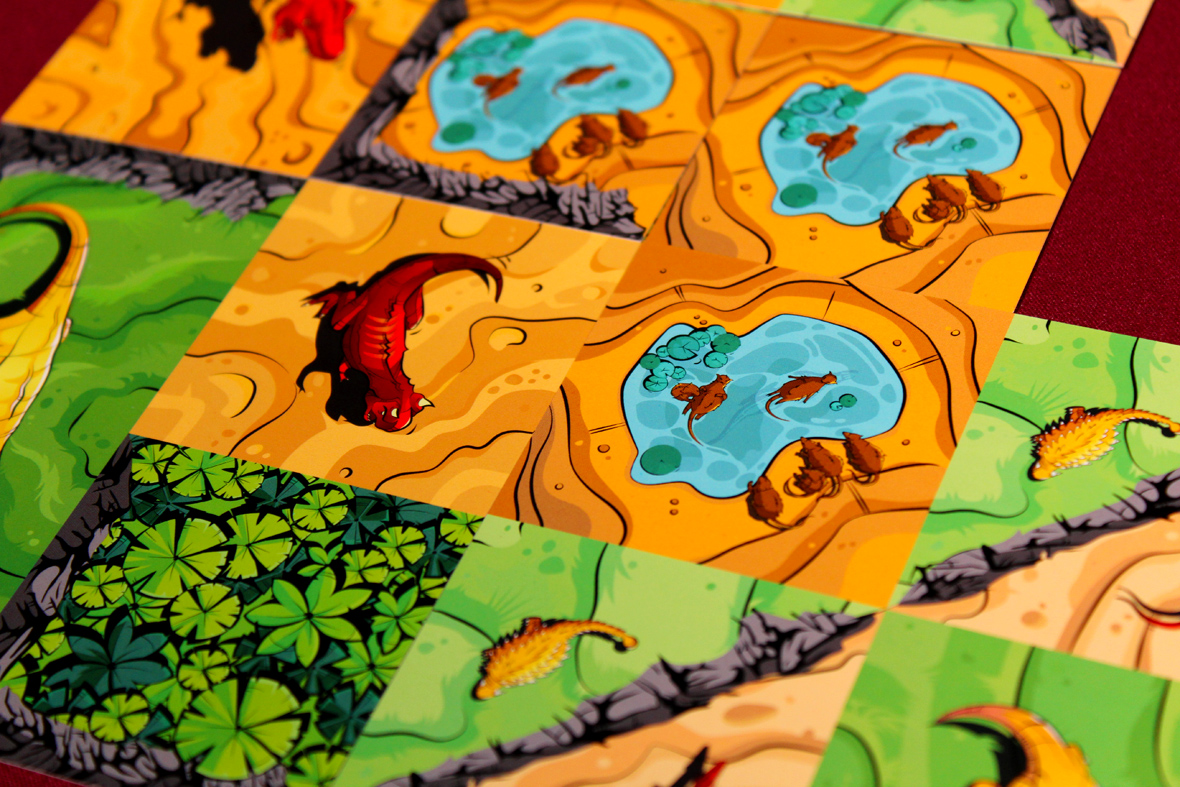
- Are there people who don’t like dinosaur games? I certainly don’t want to play games with them. Dinosaurs are always a fun theme, though it can sometimes feel a bit “kiddy”. Thankfully, that’s not the case here, though the colors and theme might get kids who want to play.
- Very easy to teach. You just pick a card and play a card. Don’t let the ease of play make you think that there’s nothing to scoring, though! Make sure you teach how critical feeding rules are.
- I like the Point Salad-style approach where you decide what matters to you and how you want to score it. I think it gives players a lot of variety and flexibility, though then it means that your failure can always be a combination of bad luck and bad choices.
- I also like this box size a lot. They’re very portable and easy to pick up and take along with you. They also stack and store nicely, though you’ll likely need a BESTA or equivalent small IKEA shelf to make the … best-a it. Sorry.
- The color scheme is a lot of fun, as someone who doesn’t care about dinosaurs having feathers or whatever at all. I find that the scientific accuracy of dinosaurs gradually pushes them closer and closer to birds, and I think that’s a bummer. I’m here for big lizards; I am not here for big chickens.
- I’m interested in seeing how the expansions change the core game. They seem to add some cool stuff! I’ll get to it eventually; I’m sure.
Mehs
- This takes up a fair amount of space since the cards are so large. The same problem with a lot of these games is that unlike, say, their Button Shy peers, they’re fairly expansive. Just absolutely gigantic. It’s not the worst thing in the world but it can definitely be a shocker if it’s unexpected.
- Dinosaur games tend to skew towards a younger player base, so if you want to play this with younger players you may need to just ignore the rules and let them just try to build big herds. I think that’s fine, personally; just let the younger kids make cool shapes on their turn while everyone else plays a strategy game. That seems … fun, actually? I’d love to hear a kid describe their ideal dinosaur park that they built.
Cons
- The whole game collapsing on you because you missed something that led to extinctions and a ton of missed points can be frustrating for players. Losing one herd can basically wipe out your score if they were a critical scoring point for you, which is never fun. The best way to help avoid this is usually making sure to emphasize how important feeding and extinction rules are so that players don’t just focus on the Goal Cards at the expense of everything else.
Overall: 7.25 / 10
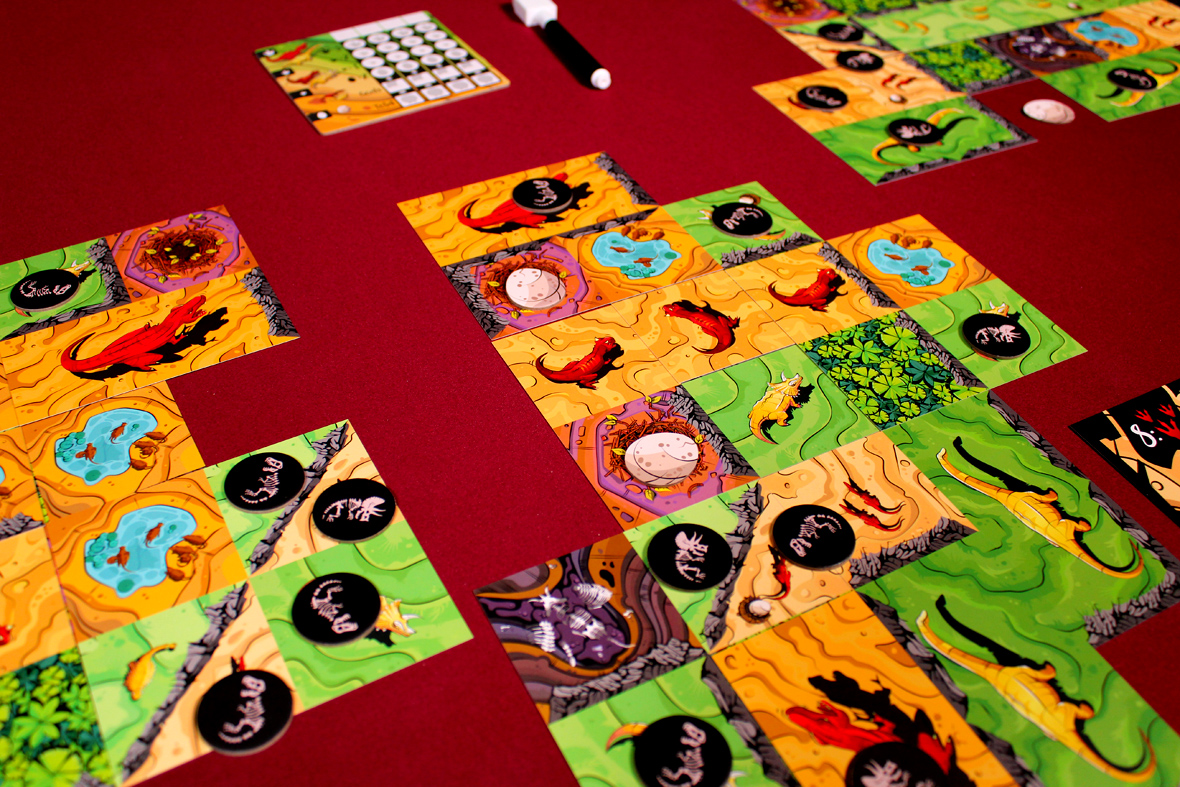
Overall, I think Chomp is fun! Allplay has been doing a lot of these small box games over the past few years, I think to both let designers stretch their legs and get players some quick and fun games at a relatively tolerable price point. There’s been a lot of success here with a variety of genres of game and themes and designers, even if the games aren’t necessarily hitting my “top games of all time” list. I think variety is a nice thing to bring to the table, and if I’m trying to get specific players hooked on board gaming, games like Chomp are always going to be a great choice. It’s quick, easy to learn, and has a fun-but-specific theme that will definitely work for some people I know. I appreciate the bite-sized approach for those kinds of things. I may personally think that, for instance, Point Salad does the general mechanic of this game better, but I like the tile-based approach that Chomp has for letting me build an area. I also like dinosaurs better than salad, which I feel like is true for most people. I think the closest similarity for Chomp is the recent Oddland, though. They score differently but the general vibe of placing cards to build an area is similar, though Oddland is by nature more aggressive since it’s a shared area and Chomp lets you have your own space. You may find, as I did, that taking a big swing and failing in Chomp can be frustrating since you lose so much if certain herds go extinct. Your mileage may vary on which game you prefer. That said, if you like dinosaurs, building a big area, or quick and light games, Chomp might be just what you’re looking for!
If you enjoyed this review and would like to support What’s Eric Playing? in the future, please check out my Patreon. Thanks for reading!
 What's Eric Playing?