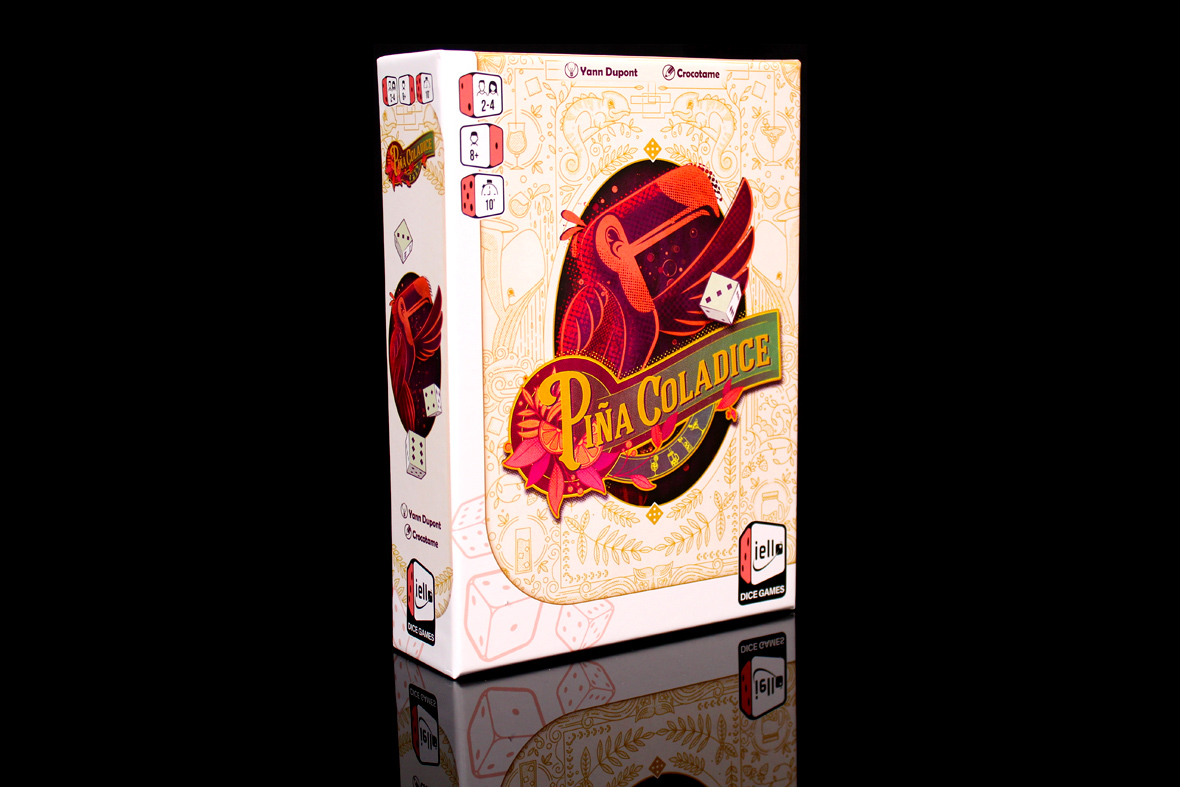
Base price: $22.
2 – 4 players.
Play time: 10 – 20 minutes.
BGG Link
Buy on Amazon (via What’s Eric Playing?)
Logged plays: 3
Full disclosure: A review copy of Piña Coladice was provided by IELLO / Flat River Games.
My God, it’s only 10:30PM and I’m actually done with reviews for the week. I might have a couple minutes to myself to decompress before the week starts, nearly unprecedented. Am I going to use that time wisely? Almost certainly not. But it’s nice to dream. PAX Unplugged is coming up, so there’s some urgency to actually get some more reviews done, but that might be a Tuesday problem rather than an explicitly today problem. I think moving along with the last few years has really thrown me off my rhythm, but we’re getting things back together and all that. We will see. In the meantime, have a drink without me with Piña Coladice!
In Piña Coladice, players are making drinks and enjoying them by randomizing their recipes. If you can get four in a row, that’s a cocktail and, well, you win! A winner is whoever has a cocktail. Otherwise, your goal is to place your dice and score points so that you can end up with the most! Will you risk it for the Piña Coladice, or will you shoot for a high-scoring game? Only one way to find out!
Contents
Setup
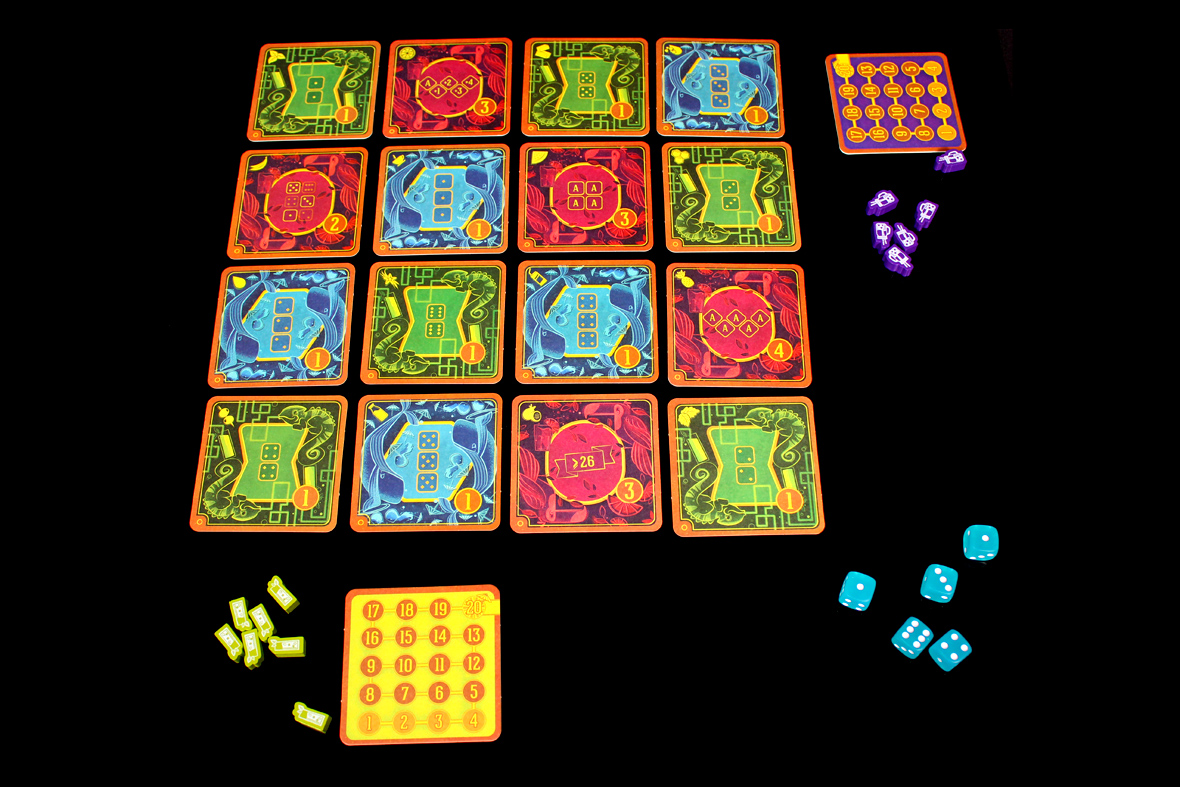
This one’s easy, too. Shuffle the coasters:
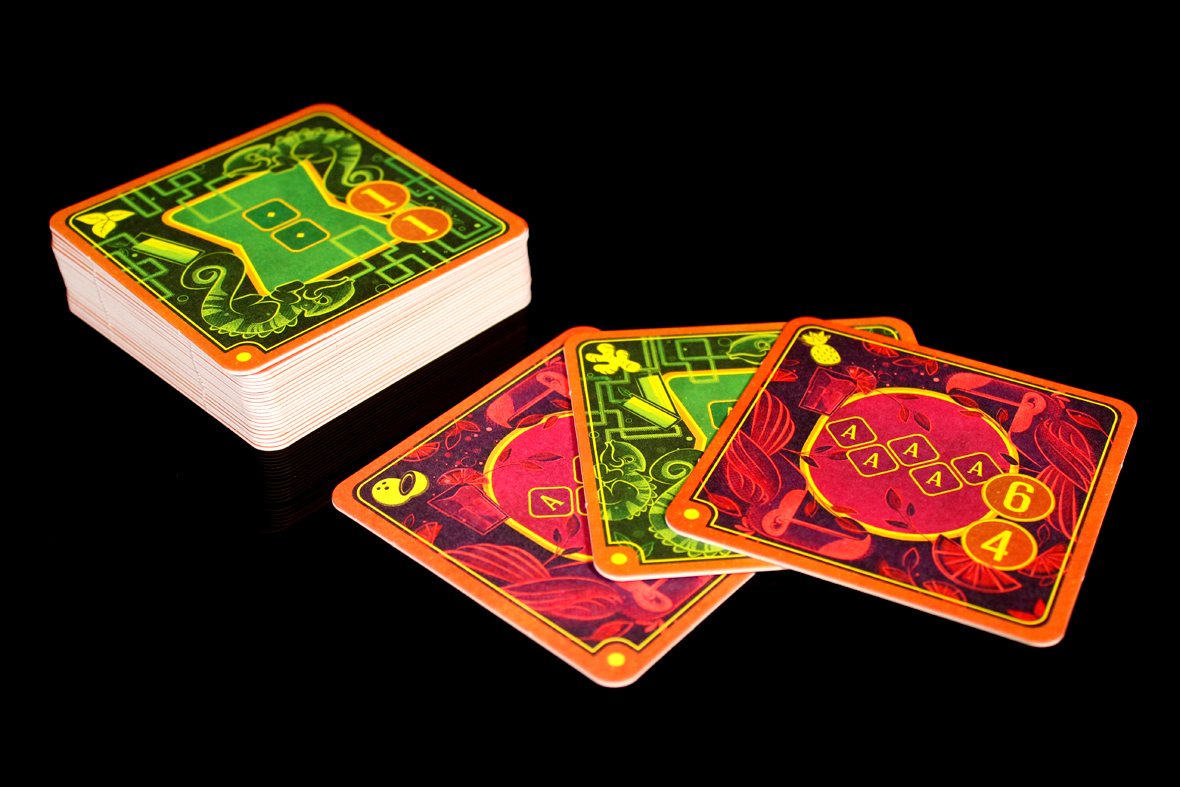
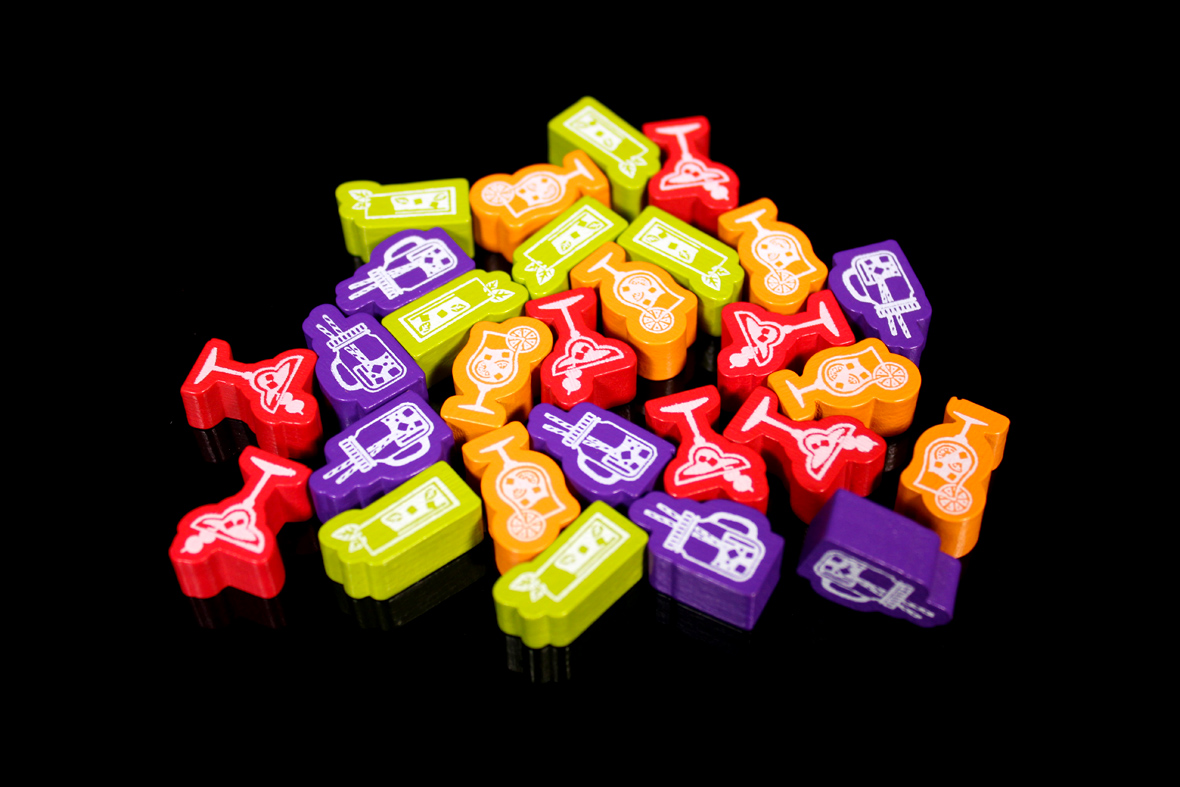
They should be all on the unfilled side at two players or the filled side at four players. Make a 4 x 4 grid of them. For a three-player game, the middle two coasters on the top, bottom, left, and right should be on the unfilled side. Give each player a set of cocktail tokens and a matching player board:
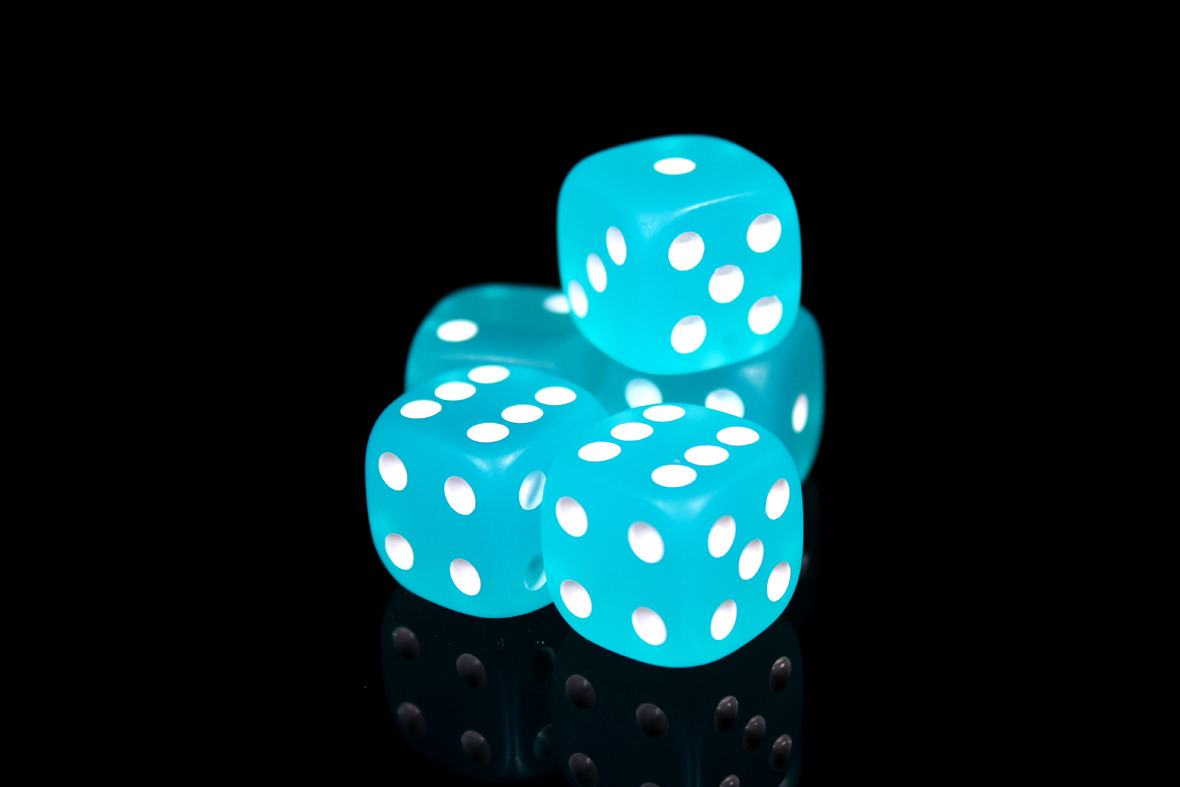
Then set the dice nearby.
If you’re playing with the Happy Hour rules, you can flip the First Player Marker over to make that clear. Either way, choose a player to start!
Gameplay
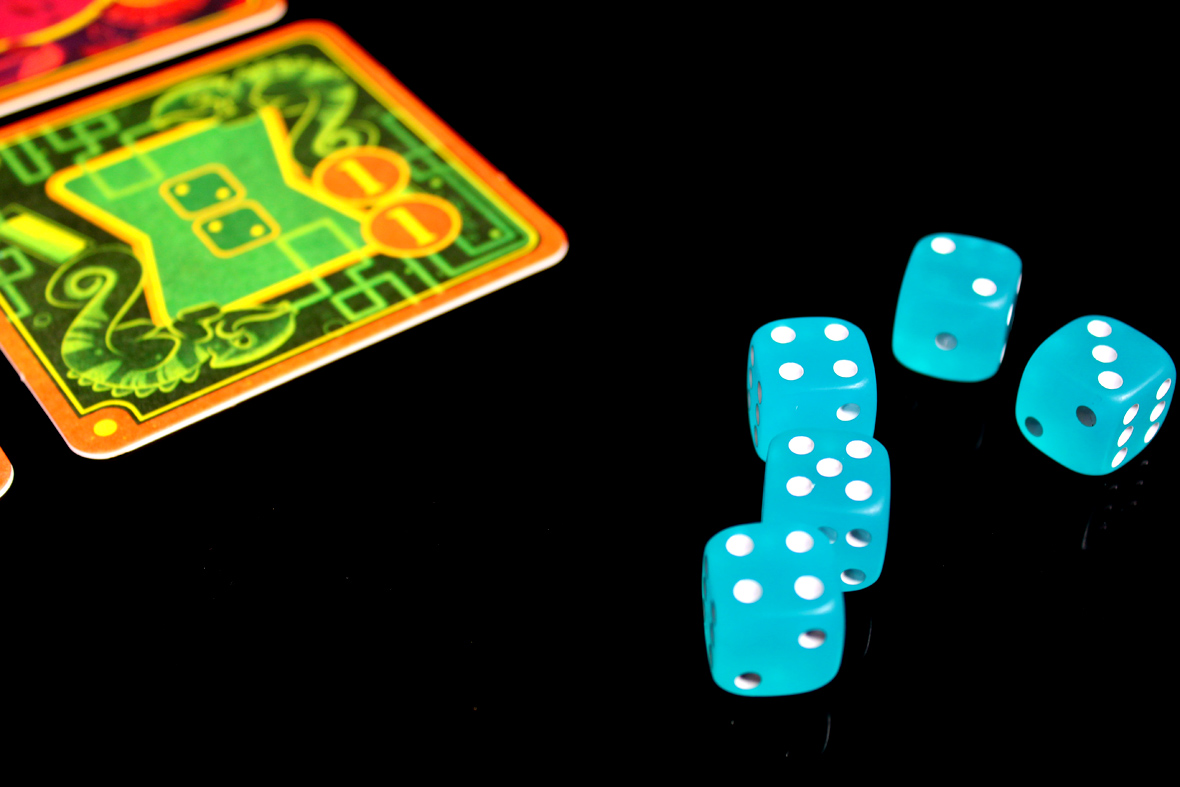
Piña Coladice is all about rolling dice and making drinks! Your goal is to get the most points or get four in a row for a Piña Coladice and win instantly!
Each turn, you can roll dice up to three times. After your first roll, you can set aside dice to keep and reroll (and then do that one more time). You can reroll set-aside dice in a subsequent reroll, if you want. Once you decide to stop rolling, you place a token on the board.
You can only place a token on a coaster that matches your roll. This means if it has two 1s on it, you have to have at least two dice with 1s on them. There are all kinds of placement challenges: straights, full houses, pairs, triples, four and five of a kind; the works. The coaster must also both have a free space and not already have one of your tokens. When you place a token, you place on the highest-available numbered space and score that many points. You also score 1 point for each token orthogonally and diagonally adjacent to the coaster you placed on. After that, your turn ends!
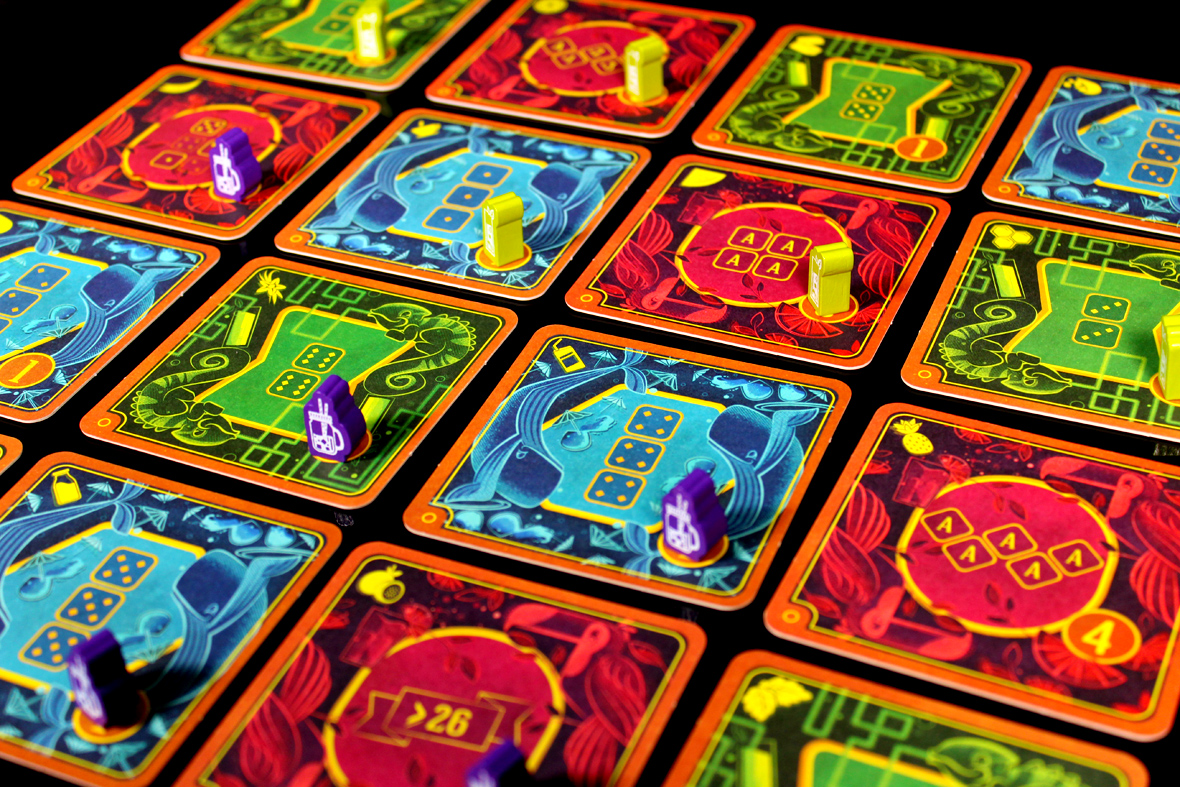
If you place all of your tokens or go over 20 points, the end of game is triggered and you finish the round (so that everyone gets the same number of turns), then the player with the highest score wins! If you ever place a token such that you make four of your tokens in a line (horizontal, vertical, or diagonal), you get a Piña Coladice and win instantly!
If you’re playing with the Happy Hour variant, if you can’t place a token due to your roll, roll a die and see what happens!
Player Count Differences
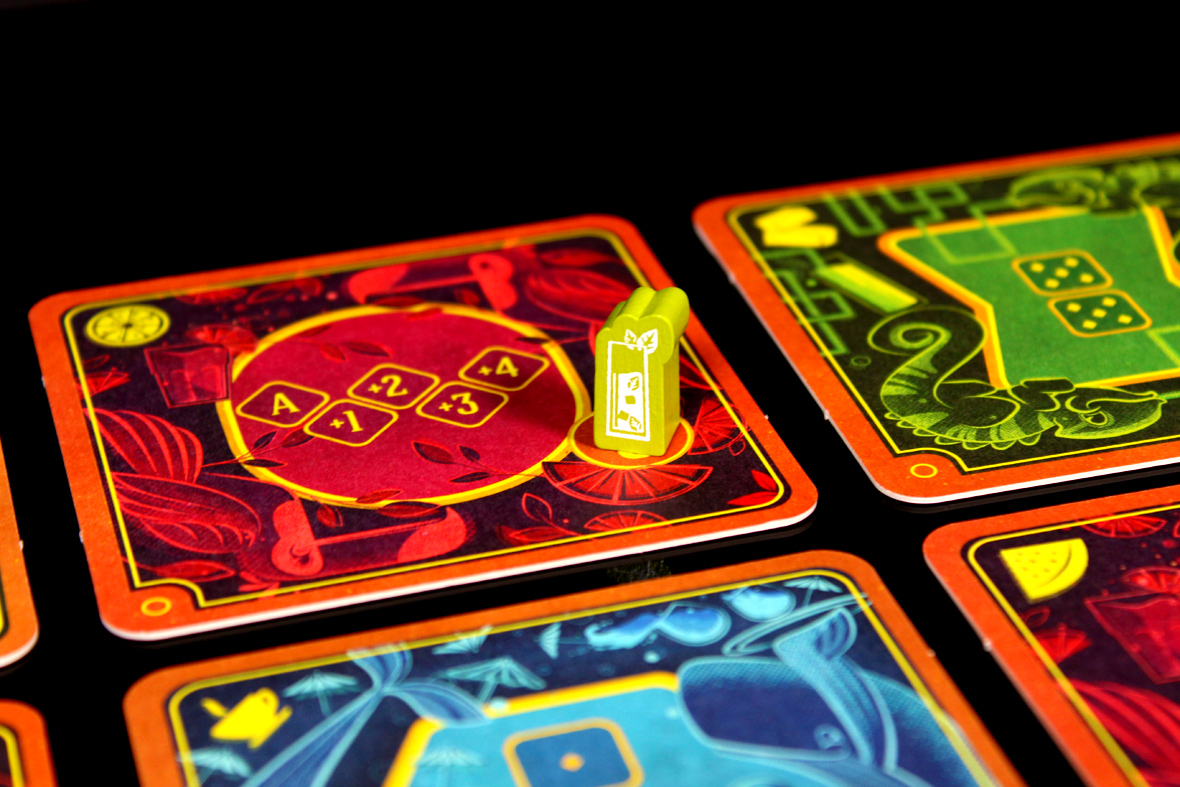
The major one is flexibility, here. With more players, a bunch of spots on the board open up! This means that at three players, to block an opponent you need both players on board. That can be tricky! With four players, every spot on the board accommodates two people, so there will be higher scores and potential Piña Coladice all over the place. It’s pretty wild! That said, the game never really strays away from its core as a quick party game, so I tend to like it with more people. You can’t always predict what’s going to happen!
Strategy
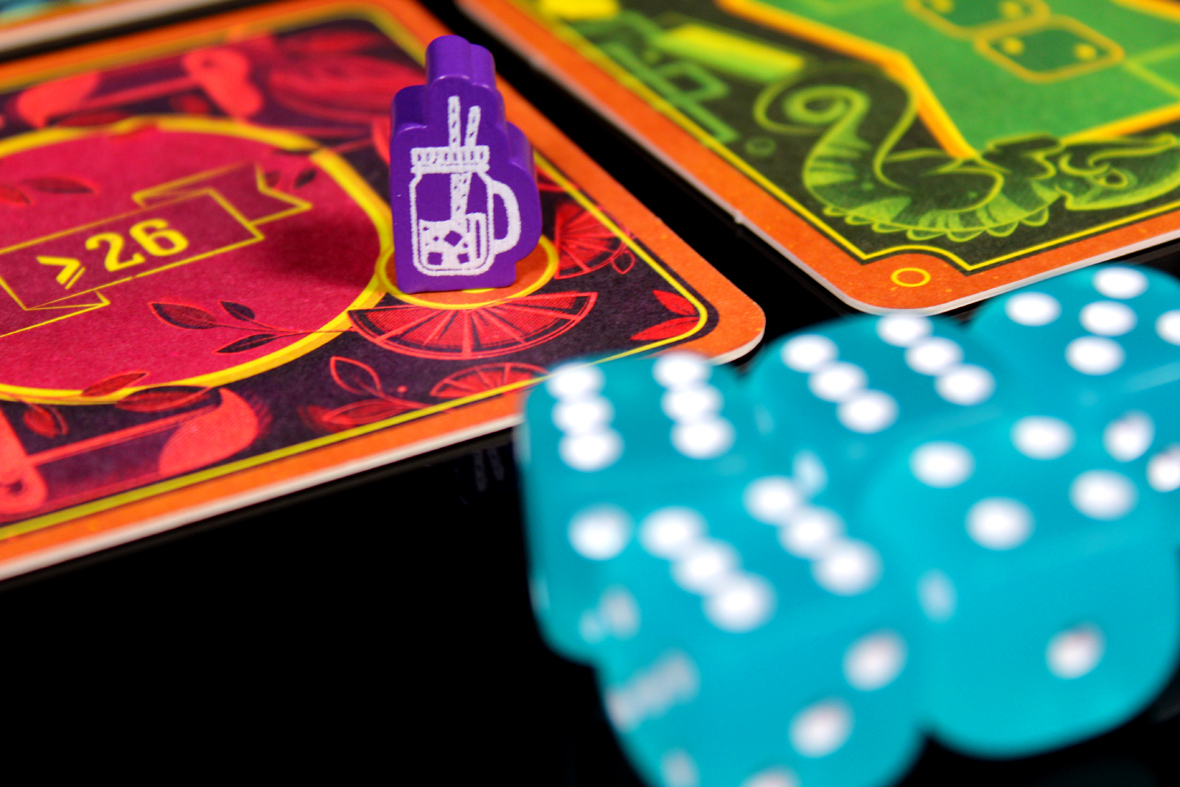
- Four in a row is a good idea, but adjacency is how you hedge your bets. You win if you get four in a row. It’s a very simple concept. If you don’t think you’re going to win that way, then you want the most points. Four in a row does not give you the most points, so you need to be flexible and clever. Going for high scores from adjacency can honestly be a better strategy most of the time, but if nobody is going after a Piña Coladice you risk an opportunistic opponent snatching it up.
- Placing in the center gives you the most future flexibility. They do have the most adjacent tiles, so it makes you harder to block, as well.
- On your first turn, just go for something that scores points and is legal. Ideally, the highest-possible thing you can place on is good, but no matter what you should be able to place somewhere. It’s later in the game that your options begin to diminish.
- If you need to make a suboptimal move to block your opponent, well, it’s better than losing the game. If that’s your only choice, technically, from a player standpoint, you don’t have a choice at all. You have to block them so that the game continues and you still have a chance to win. It just might mean that you lose because you didn’t score enough points. You can always hope that they miss the roll, but the tile itself will be pretty clearly “easy” or “hard”.
- You can try and pass off a suboptimal turn to another player, but unless you’re going to tell them (rude) they might not notice. I think telling someone else what to do on their turn is bad form, so I don’t. But that means if I don’t want to block a player and I rely on another player, I’m also relying on that player paying enough attention to that rule that they make the hard call to block that player. That might not happen! If it doesn’t, that’s on me, too.
- Keep in mind probabilities and how they influence risk! There are a lot of probabilities around how likely certain rolls are and how they end up landing. A basic understanding of them (rolling any particular dice face on fair dice is a 1/6 chance, for instance) will help you play this game.
- A bunch of the Happy Hour consequences aren’t really good? Try not to not place when it’s your turn, regardless of whether or not you’re playing with Happy Hour. That’s the strategy: make sure you score points. You’re welcome; maybe I’ll make that merch one day along with TRY TO WIN. That and “The Prairie Salmon Endures”, as long as Flatout promises not to sue.
Pros, Mehs, and Cons
Pros
- Short and sweet. Love a quick dice-chucking game. I think other people do, too, since they keep getting made, but this one’s simple and I like that.
- I think it’s fun that if you make a Piña Coladice you use the line to determine what’s actually in the drink. Do you want to risk actually making the drink? That’s up to you and how many ingredients you have. It’s like how cocktail recipe books assume I have an entire garden of fresh fruit and vegetables or that I live in New York City. It’s part of why I suffer through three page stories about trips to Milan on recipe websites, instead.
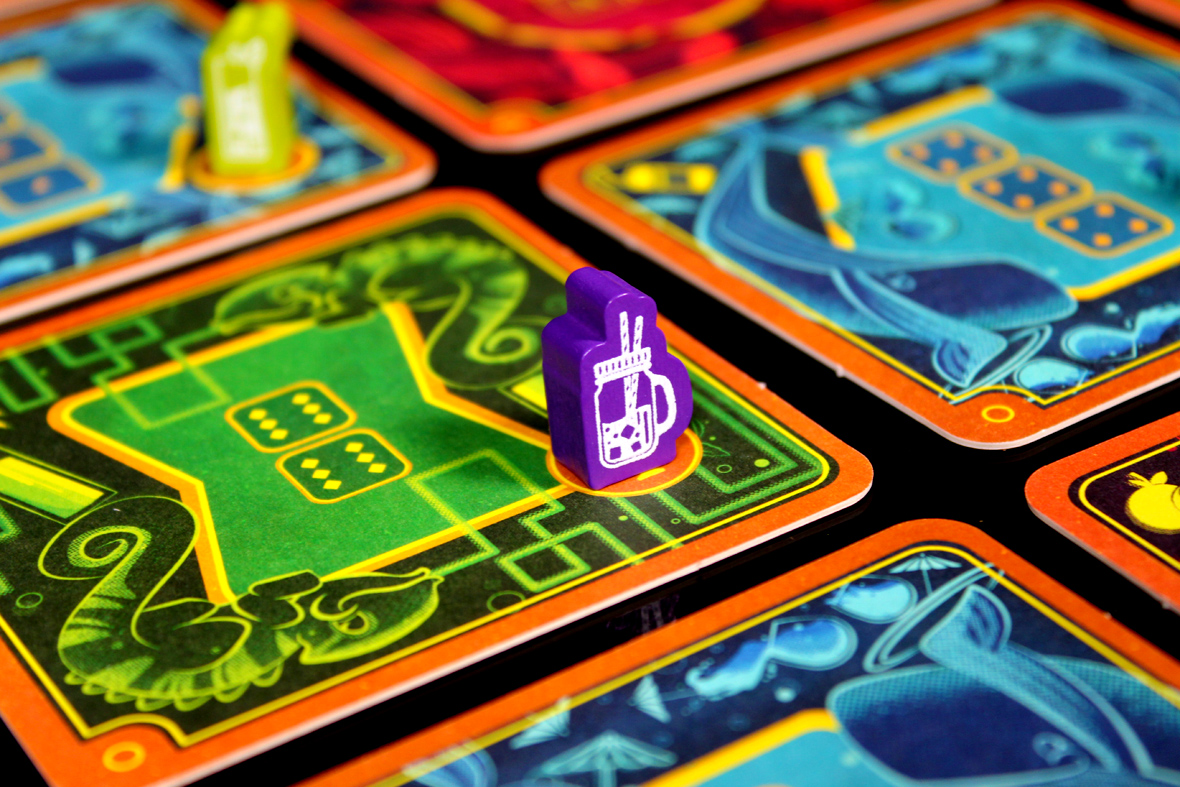
- I like the coasters instead of cards. They’re super cheaply made, but it’s about cultivating an aesthetic. These are not nice coasters, but there are several of them, so, it’s fine. They’re trying to make it seem like a bar game with its own coasters and such, and I frankly think that would work in the right bar with the right aesthetic.
- A very simple concept, since it’s essentially Connect Four Yahtzee. You’re trying to make four in a row and doing so with Yahtzee-style scoring rules and placement. It pretty much works.
- That adjacency scoring is just enough of a twist to be interesting. It got my attention! It keeps the game from feeling too static and too much like a Connect Four + Yahtzee hybrid. It’s definitely still that, but it has its own thing, too!
- Pretty portable! I also like this box size a lot? It might be one of my favorites since a bunch of them fit in a small bag without much trouble.
- I like the dice color. It’s got a blue curaçao vibe to it, though I had to Google Search the exact little dangly below the c in curaçao. This review has been full of special characters. Lots of copy-and-paste since for the life of me I don’t know the shortcuts. I guess you can just hold down the “c” on a MacBook, I’m learning at this exact moment.
Mehs
- Luck is a major component of this game. Probability, too; sometimes you just won’t have the rolls to block a player and they’ll sail on to a big win. Curse your own misfortune for being born under the wrong star, I suppose, but if luck is anathema to your play preferences this is not going to suddenly fix that.
Cons
- It’s kind of odd that they’re marketing this as a family game when it’s very cocktail-forward? I suppose the name Piña Coladice makes it hard for it to be anything but cocktail-forward, though notably I don’t think the drinks themselves are explicitly alcoholic. I guess there’s something to be said for not prepending “Virgin” to everything and then trying to sell that as a family game. I don’t think it really matters but your personal comfort with family game themes may not be the same as mine.
Overall: 7.75 / 10
Overall, Piña Coladice is pretty fun! I think there’s a lot to be said for the consistency of a nice, simple, and quick dice game being targeted at families and newer gamers, even if the cocktail theming is a bit baffling for such a thing. Maybe it’s the American Puritanical Instinct still baked somewhere into my upbringing. I’d still teach a child how to play this but I can imagine some would not and would potentially be upset at the implication of alcohol. Alas. That said, this is a great game in the “bar game” spirit of board games that are quick to set up and play without taking up too much space while you wait for something else. Now, nobody’s stopping you if you want to play Piña Coladice all night with no breaks. If you do, fantastic! Love that for you. But these kinds of games tend to be warm-up or wind-down games for me, and I like them. Maybe we play Gin Crafters afterwards? I still need to dig into that one more formally. That said, I appreciate how simple Piña Coladice is to learn and how it adds one mild rules thing to make it interesting enough to stand on its own. That’s good! I think I’ll be interested to play a few more games to see how it plays with different members of my gaming groups. If you’re looking for a new bar game, you enjoy dice games, or you just like getting caught in the rain, Piña Coladice might be right up your alley!
If you enjoyed this review and would like to support What’s Eric Playing? in the future, please check out my Patreon. Thanks for reading!
 What's Eric Playing?