
Base price: $33.
2 – 4 players.
Play time: ~30 minutes; maybe 10 minutes per round.
BGG Link
Buy on Amazon (via What’s Eric Playing?)
Logged plays: 12
Full disclosure: A review copy of Take Time was provided by Asmodee.
Got distracted, as per usual, but got to spend some time with one of my buddies plugging away on a game before dinner, so I had something to write about this week. As you might guess from getting 12 plays in a day, in, the game was interesting. Interesting good, or interesting bad? Well, you’ll have to keep reading to find out. You could also scroll to the bottom and just check the score to satisfy your curiosity, but know if you do that I will be sad. I’m a review, not a cop, so do whatever you please. But to at least provide the illusion of a preference, let’s get things started.
In Take Time, players are adrift between universes with only a clock as their guide, trying to navigate across space and time through various realms towards the conclusion of their journey. Different clock lands? Time zones? Don’t think too much about it. Along the way, you’ll work together to face various tasks and trials to prove that you’re worthy of the game’s conclusion. Journey from Awakening to Rebirth and use the power of the sun and moon to light your path. Can you complete all of your trials?
Contents
Setup
Each round doesn’t have too much setup. There are a set of sleeves per chapter, each with four clocks in them:

Take out the clocks and make a face-down stack, then flip the top one up. Shuffle the Solar and Lunar Cards together:

Deal out 12 cards total to each player some according to your player count:
- 2 players: Each player gets a stack of four cards and a stack of two cards.
- 3 players: Each player gets four cards.
- 4 players: Each player gets three cards.
Don’t look at your cards but you’re ready to start!

Gameplay
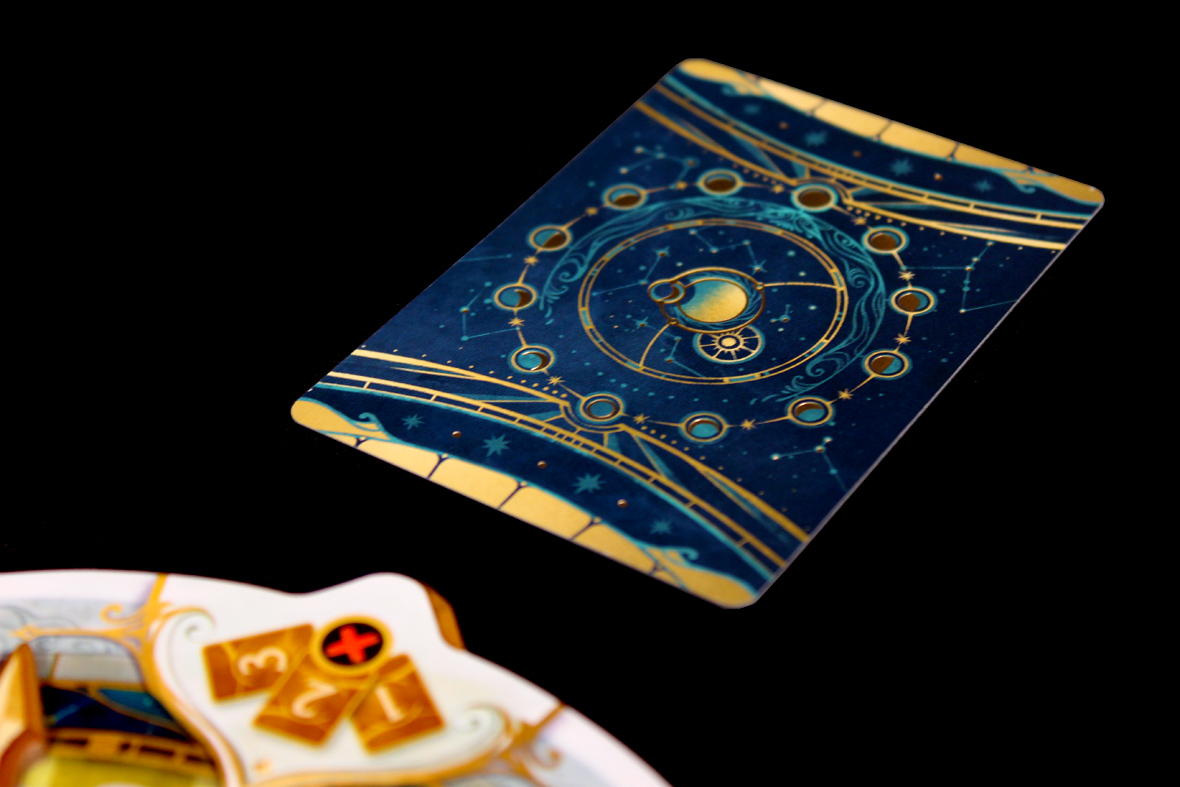
Gameplay is simple. There are six segments, each of which need to have at least one card played to them. Here’s the challenge: most of your cards (numbered 1 – 12 in Solar and Lunar) have to be played face-down and you can’t talk to your teammates. So you have to learn and figure out what they’re going to play so you can help get across the goal line.
Before you pick up your hand of cards, you have a Discussion Phase. Talk strategy, figue out what you’re going to do when you play. Once someone touches their cards, they cannot participate in discussions or planning anymore. Once everyone has, we move on.
When playing cards, you play one at a time, with each player adding a card as they progress (to a total of 12). Your goal is simple. For each segment, the total number of points on cards on that segment is its score. A score should not exceed 24 and the segments’ values must increase clockwise (repeated values allowed). In a two-player game, once the second card is played, draw both of the cards in the face-down two card group you were dealt earlier.
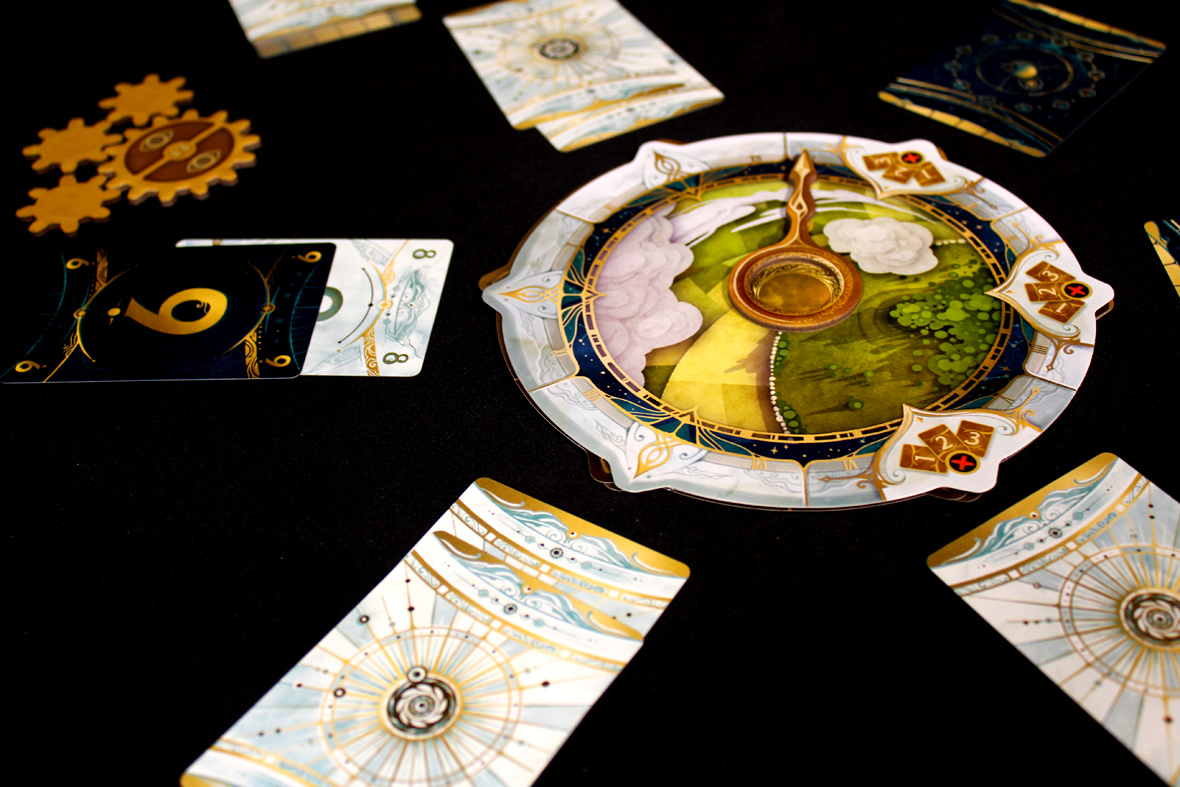
Once all twelve cards are played, do the big reveal! If everything’s perfect, you win! Otherwise, shuffle the cards back in, deal each player three cards, and flip a Bonus Token. This will allow you to play one additional card face-up in subsequent rounds. If you’re stumped, you can always place the clock in the shelf of shame instead. Either way, set up for another round and play again!
Player Count Differences
The major one is how many cards you get to play. With more players, there’s still twelve cards, so, you just play fewer turns yourself with more people, which feels less sporting. It’s definitely easier, since there are more people putting their heads together (and that usually helps), but there’s something fun and intense about sitting down with one other person and just going to bat on a quick abstract strategy game. I digress, but my point remains. Yes, you get to see more face-up cards with more players, but the 1:1 thrill isn’t there with more players. Personally, two players is a nice spot for me, but I’d also be fine with more.
Strategy
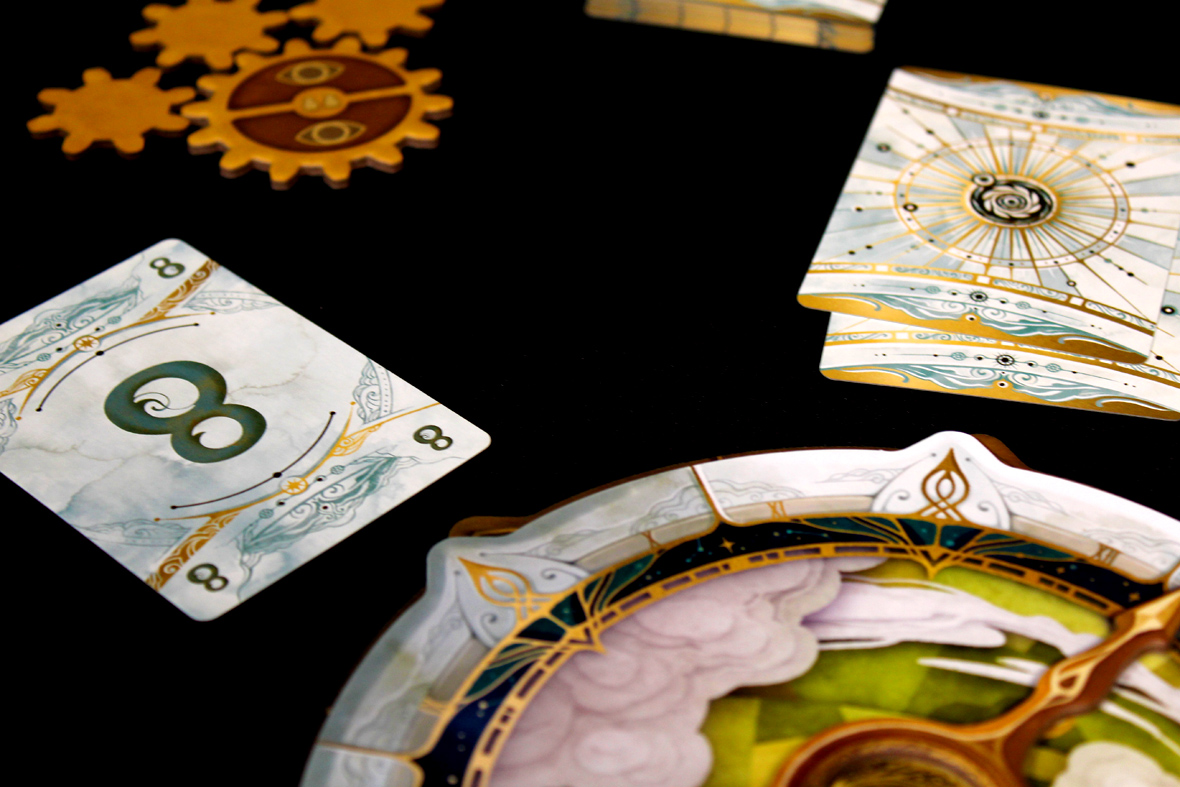
- Remember what you can signal based on what you play, where you play it, and when you play. For instance, playing an early card to the first spot usually tells people you played a 1 or 2; playing to the high spots provides similar information (you have high cards). Figuring out how to interpret your partners’ plays is part of the game.
- There are generally good strategies (clock-dependent). Playing 2 (1+1) at the start and 24 (12 + 12) are generally useful; nothing will be lower than a 2 (because both 1s are played as part of it), you get rid of two cards, and you can signal your intent by waiting to take a turn action at the start of the round when you’re deciding who to play with each round.
- Playing duplicate values is a good way to waste a bunch of cards. You can play 6 + 4 (10) on one segment and then play 5 + 5 (10) on another. Since they’re equal-value segments, they’re essentially just one big menu with their own options.
- Watch out for having mostly low- or high-value cards. You can’t really signal anything useful about a hand of 8s, but even then, people assume you do because that’s whey you’re around,: you’re needy. Try to figure out how to make some progress, even if your hand isn”t that good.
- Your face-up cards can be critical information! Use them wisely. You only get a few each round! You can use them to signal a break between certain groups of cards, for instance, and then move the game off BGA or try something else in person.
- Communication before you draw your cards is also key. You need to have the trappings of a general strategy of who and how to play before you draw your cards and look at what the table state is. Once you draw cards, no more talking allowed!
- Watch out for effects that manipulate gameplay. Some will block where you can place or what you can actually do once you have those segments in play. It’s grueling, but still pretty fun.
Pros, Mehs, and Cons
Pros
- There’s a ton of content. 40 distinct replayable levels? Count me in. Rumor has it that the Rebirth sleeve at the bottom of the box holds even more ways to make the game fresh and new! I was sitting with a friend and mentioning that the advantage of games like this is that they’re like Magic Maze or something in that you usually end up taking this game to new groups and playing with new players each time (and therefore replay the same first five levels each time you play with a new group. So you don’t even need 40 levels if the core audience is just going to be shopping the game around, you’ll always find something new to do.
- Intuitive scaffolding! There’s a lot of good advice and strategy for ramping up and you, the player, learn a lot from each round, even if you lose! That’s always nice.
- The art is quite nice. I wish there were more of it, but I like the little bits that we get to see periodically.
- Cooperative campaign games are a crowd-pleaser. I think some people just really like playing the same game over and over for a while, and cooperative campaign games give that in spades. You could even stretch the game out for a long period of time just learning the first set of things and trying again with a new group.
- I do think this is a nice alternative to The Crew in case anyone in your group really hates trick-taking. You’re not trick-taking here! You’re just doing hand management. That’s good, but this really captures the same idea of playing a simple mission over and over and slowly leaning how your partners play.
- The use of Solar Cards (white) and Lunar Cards (blue) allows for some neat strategies. I like that, for instance, if you have two blue cards or two white cards by a specific segment, you know that it can’t be less than two (two cards with a minimum value of 1, each) or more than 24 (highest two cards in white are 11 and 12, so no way their sum could exceed 24).
- I like how tolerant the game is of failure! It never bullies you or makes fun of you (except for putting things you genuinely can’t finish into the Storage of Shame and it potentially comes out later. Here, you just reset, flip a bonus token, and go again! It’s the quick resets and no major penalties that make failure easy and ok.
- The cards are unbelievably nice. They’re embossed, a little bit? I like the art style a lot, too. They’re just nice cards.
Mehs
- I do think the cards are rather nice, which makes the other components of the game seem less-nice by comparison. A deluxe version of Take Time would go incredibly hard. I’d probably buy one just to have nicer tokens and such for my subsquent playthroughs (and second podcast).
- There’s a lot of silence in this game; maybe find a soundtrack to listen to while you play? Nobody’s allowed to talk to each other! I definitely recommend the Time’s End album because it’s so clock-coded that it feels right. But anything to avoid sitting around for multiple hours doing nothing.
Cons
- There are some thematic trappings, but it can sometimes feel like the theme is more there for the aesthetic than for an actual end-to-end thematic reason. That happens! Sometimes a theme is just a theme. Why are we in some mysterious universe? No idea. What happens when we lose? Don’t worry about it. There’s no real hook between the gameplay and the theme, and that’s just how it is sometimes.
Overall: 9 / 10
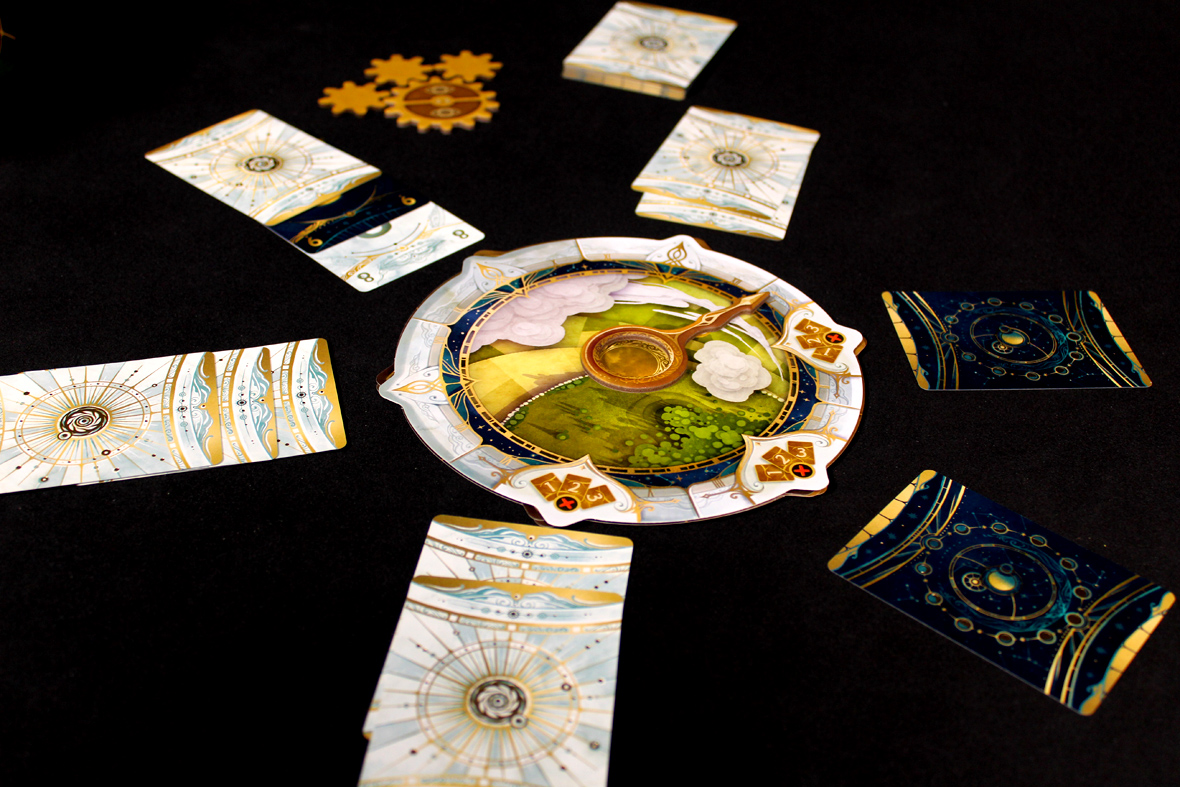
Overall, I think Take Time is fantastic! It’s a great cooperative game experience that’s simple hand management and trust that your co-players will slowly learn how to play and you can help them! I do particularly like the cards and art. There’s a lot there as you travel through these universes with new tasks and new restrictions each round. Plus, like The Crew and other similarly-good campaign games, it’s easy enough to set up that you can play multiplayer games pretty much whenever you want. I do with the theme were a little more front-and-center in the game itself, though; right now I get that there are clocks, but I don’t get while they’re there and there’s not much in the way of plot to guide us from round to round. More plot would be nice, and more art would be nice too. I’d also be down to see what a Deluxe Edition would look like with upgrading the cards and tokens and sleeves. The cards are already wonderful, but the other tokens would not be missed if they were suddenly placed with better-quality tokens. Lastly, I think the real strength of Take Time is its scaffolding. You can tell the designers understood both game and fun. There’s so many slow, progressive ways to let you fail gently and learn to play in the process. I think this is a real winner, as a result. Even if you’re designing something that’s not fairly simple and straightforward campaign game, you could potentially do well to think more about education and learning outcomes for players and how that dovetails into the game design and overall experience. I think it’s cool! Even if you mess up, you can just quickly reset the round and go again as many times as you need. If that sounds fun to you, you enjoy hand management, or you just wanted to see a clock hand component, Take Time is a fantastic choice to play! I recommend it.
If you enjoyed this review and would like to support What’s Eric Playing? in the future, please check out my Patreon. Thanks for reading!
 What's Eric Playing?