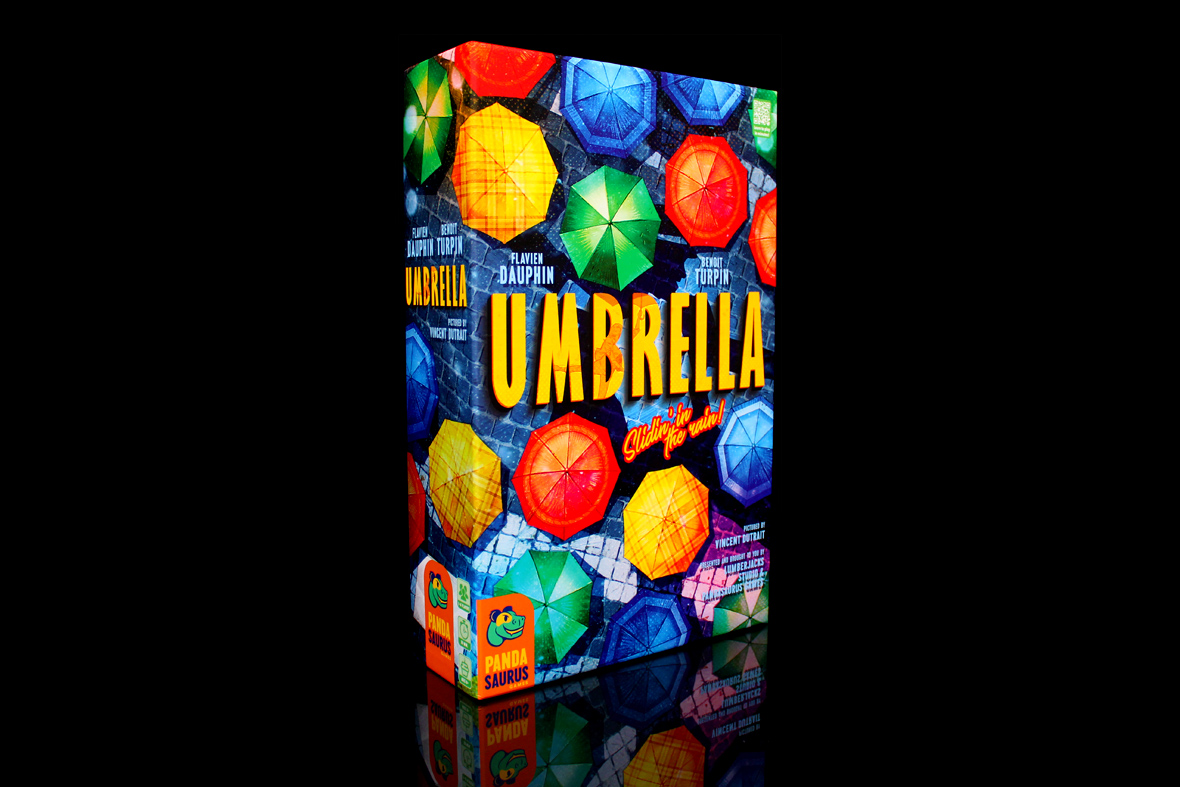
Base price: $40.
1 – 4 players.
Play time: ~30 minutes.
BGG Link
Buy on Amazon (via What’s Eric Playing?)
Logged plays: 4
Full disclosure: A review copy of Umbrella was provided by Pandasaurus Games.
So, it’s the rainy season in Seattle. The nice thing about Seattle is that it’s almost always the rainy season, but it’s certainly the rainy season now. I think it’s rained for the last two weeks straight? Love it. Rain is the ideal weather to be indoors for. You can look out the window, say something to the effect of “nah”, and then crawl back into bed or cozy up on the couch. It’s really the appropriate way to feel up here. That said, with rain comes the occasional board game night, and I’m here to tell you about a few of those. Haven’t had much time to knock into the PAX Unplugged titles, but they’ll come in due time. In the spirit of situationally-appropriate games, let’s check out Umbrella, from Pandasaurus!
In Umbrella, players are living the dream. It’s raining and you’re effectively coordinating a dance of colorful umbrellas in a street crossing. Is it convenient for foot traffic? No, but you’re in New York City; nothing is convenient for foot traffic. So have these colorful circles slide up and down and left and right to create patterns and inspire a bit of joy and whimsy in dreary weather. I’d rather not be outside in it anyways. Can you brighten up a rainy day?
Contents
Setup
It’s not too bad. Each player should get a player board:
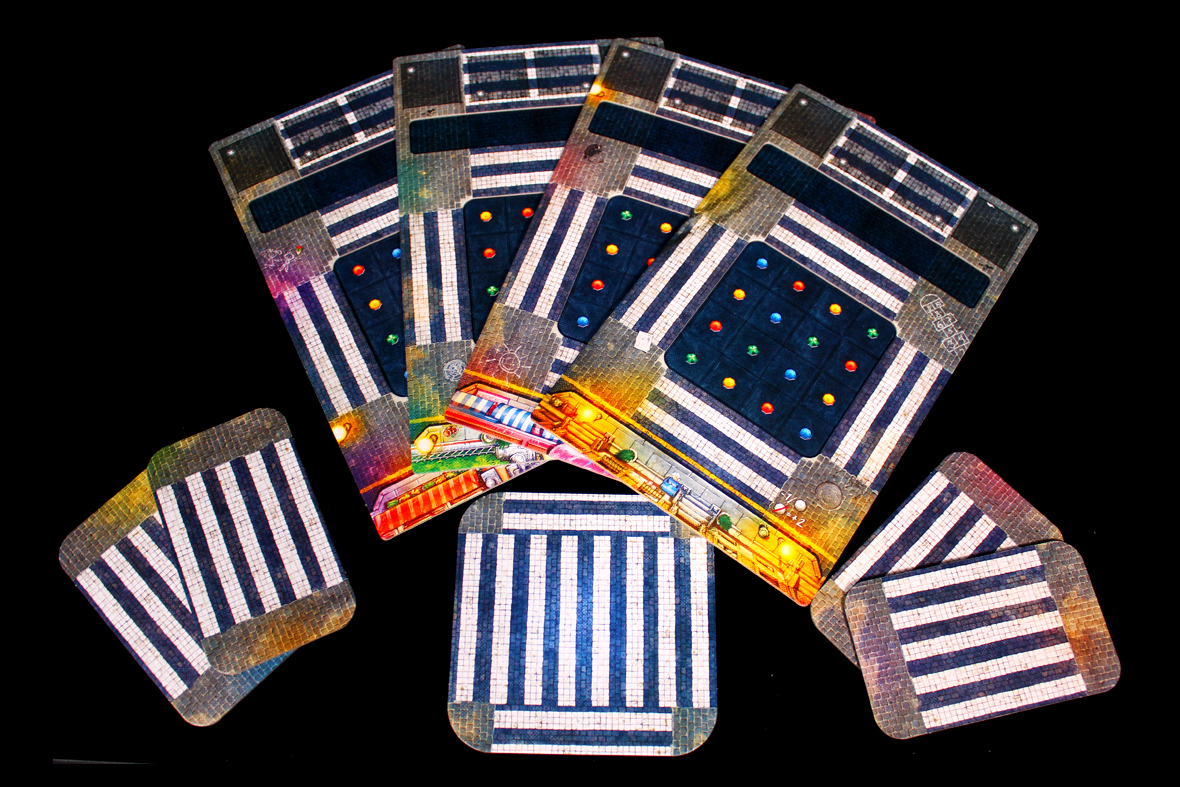
And then set up crosswalk tiles between them on the left and right sides, as well as one in the middle of the play area. Each player should get a scoring tile too, on the same side, and slide them into their player boards.
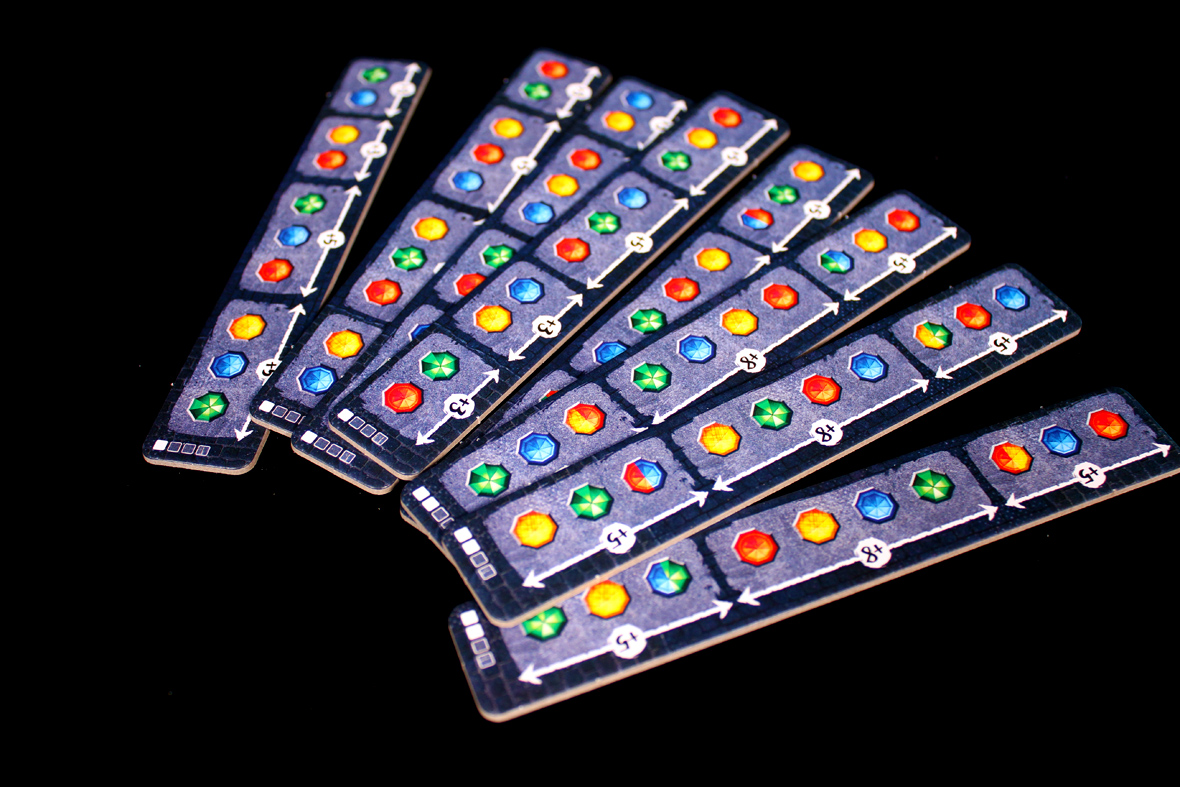
Set the scoring tokens nearby as well, based on your player count:
- 2 players: 11 Scoring tokens
- 3 players: 17 Scoring tokens
- 4 players: 22 Scoring tokens
Have each player place tokens in their 4×4 grid matching the colors of the umbrellas:
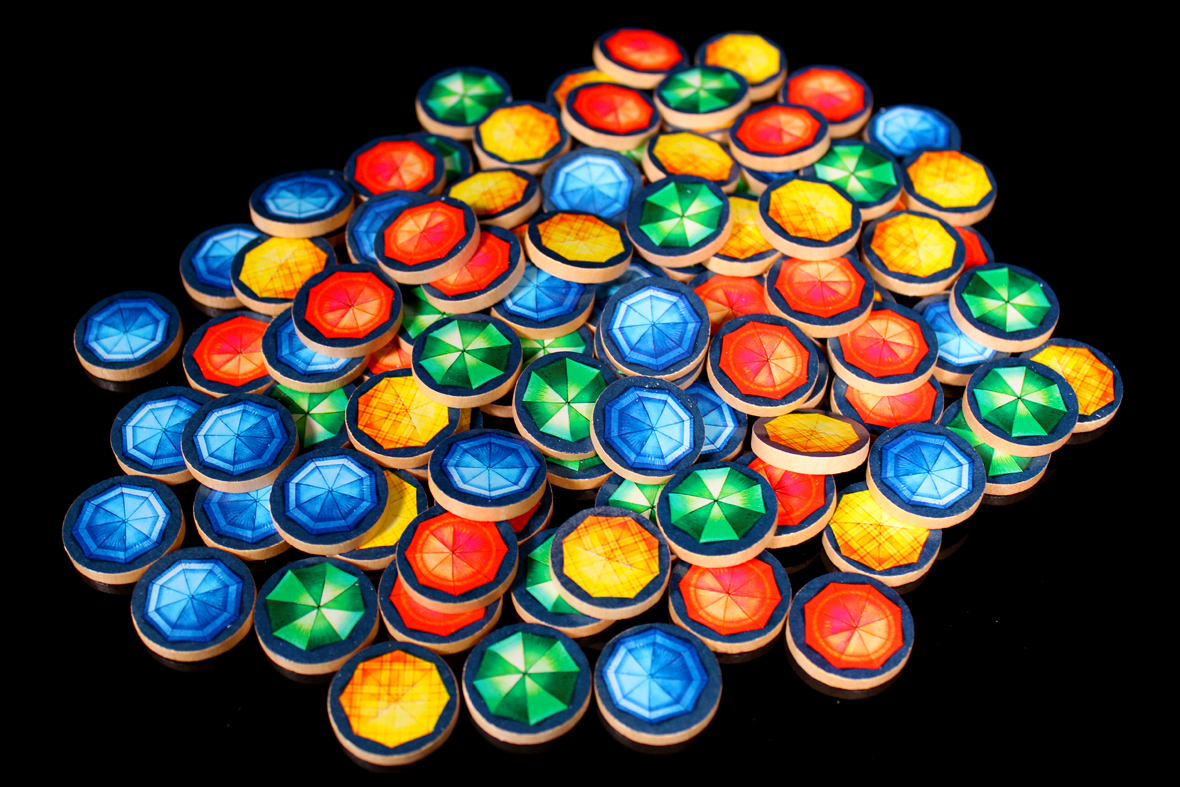
One of each color token should be placed on each crosswalk and at the bottom of each player board. Finally, give each player two Pattern Tiles, placing them on their player boards so that the *s match up with the indicators on those spots.
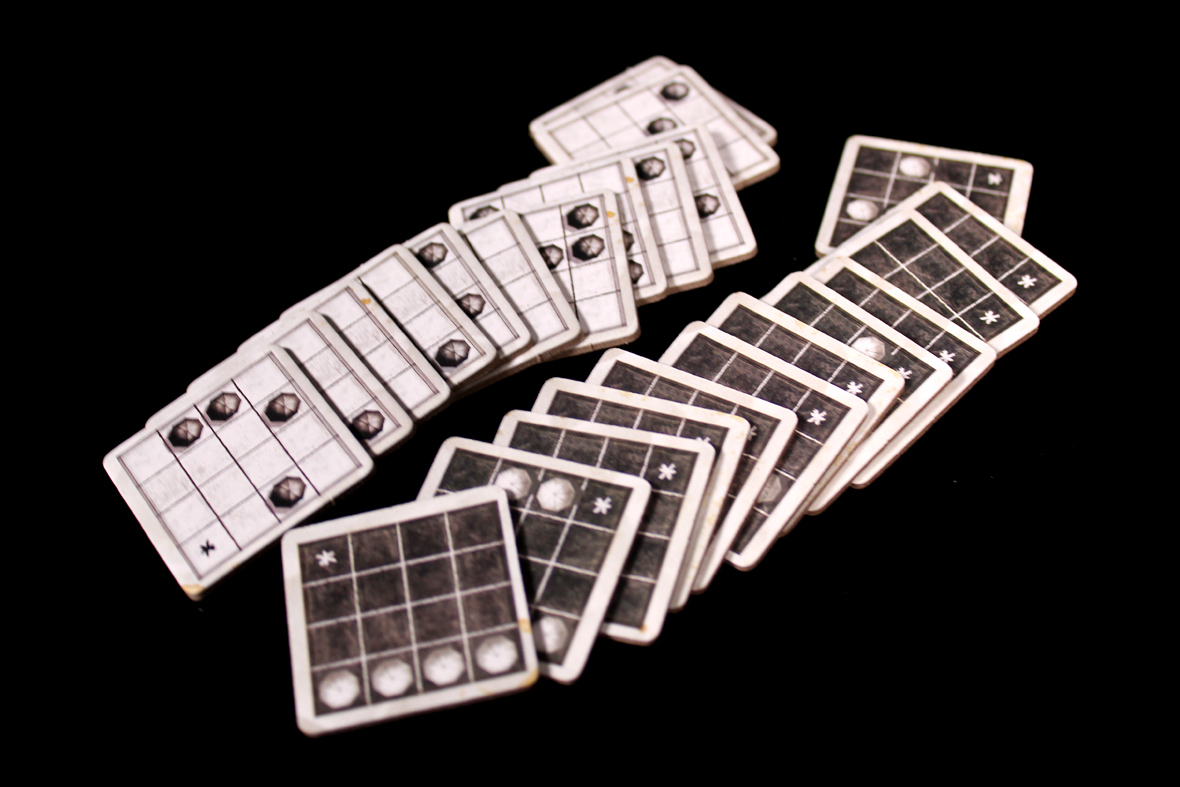
You should be ready to start!
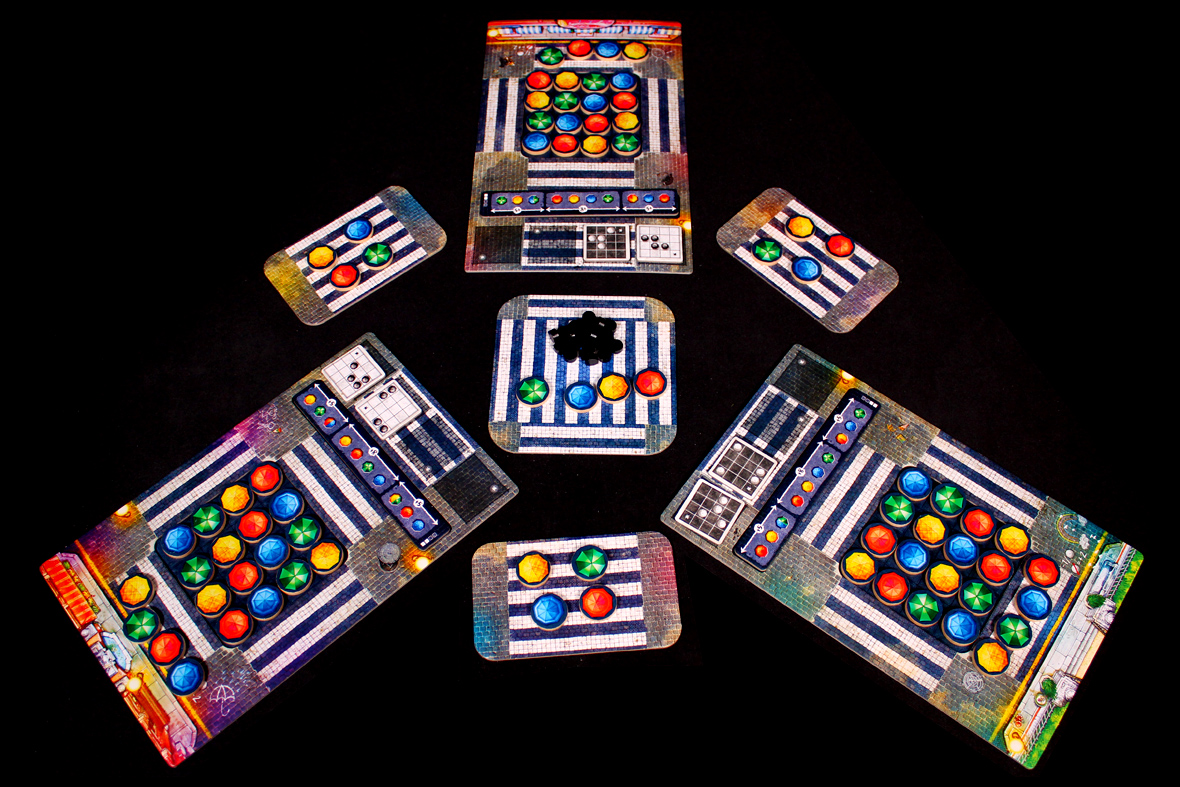
Gameplay

This one’s not too challenging. Each turn, your goal is to get your umbrellas to match one of the patterns on your board! You can do this by taking a token from above, below, the left of, or the right of your board and sliding a row or column away from the direction you selected. When you do, you push a token out of the board, and that token gets placed on the opposite crosswalk. So if you push from the bottom, the token that exits your board gets placed in the central crosswalk, for instance.
If you complete a pattern, you score it! Take a scoring token and place it on your scoreboard, covering one of the spaces whose color you used in your pattern. If you don’t have any left, you can’t score that pattern. When you score a pattern, you pass that pattern to the left and your opponent places it on the first available square, rotated into the correct position. Certain scoreboards have different rules, but in general, the more the merrier.

Play continues until either a player has no patterns left, they have more than 10 scoring tokens placed, or the final scoring token is removed from the stack. Each player gets one final turn, and then the game ends! Tally up your scores:
- 2 points per placed scoring token
- -1 point per Umbrella token in your bottom crosswalk
- 2 points if your bottom crosswalk is empty
You also get bonus points based on your scoreboard! The player with the most points wins!
Player Count Differences

I actually like this one most at two! Let me elaborate. At higher player counts, when you complete a pattern, you pass it to the left and it’s rotated to the correct position. At lower player counts, specifically two players, you can (optionally) flip the tile before you pass it, so you do get a bit of variety between them. At the very least, it feels like more variety, since there’s tiles flipping and such. Beyond that, though, there aren’t too many differences. You’re most frequently interacting with the players on your left and right (or, generally, the center). With more players there are likely to be more tokens in the center (since all players can contribute), but otherwise it’s going to depend on how players play as to where the tokens are going to show up the most. I think I’d enjoy the game more with more variety between the various pattern tokens.
Strategy

- Clearing out your bottom crosswalk is usually a good idea. You get two bonus points if you clear it, which is good, but you also lose out on having the full suite of token options in each color, which can be critical for actually landing some patterns.
- The center, as a result, gets stuffed with tokens, which usually means you can find what you need. Naturally, taking one means a -1 point later in the game unless you clear it out, though, so be careful taking too much from the center!
- Keep an eye on not just what you’re going for, but what color(s) you’ll need next.
- You can hate-draft and be a jerk, but you have to be clever about it. If you know your opponent is looking for yellow tokens, you can take a bunch of them on your turns and clear the nearby crosswalks (or make their move inconvenient), but then you end up with a ton of yellow. If that’s what you want, great! If not, don’t do that?
- Your scoreboard gives you a lot of bonus points, but it’s not the be-all-end-all if you can make points in other ways. Placing quickly and clearing your board of pattern tiles can, for instance, occasionally work in your favor and end up with a quick sweep. It’s just hard to do.
- This game thrives on efficiency. Your goal isn’t just picking tokens and moving them around; it’s setting yourself up to score as frequently as possible with as few additional moves as possible so that you can get as many points as possible before the game ends! It moves pretty quickly towards the end as well, so efficiency is key.
- Try to make sure you’ll have something useful to do on your last bonus turn. If you can clear out your bottom crosswalk or score something that’s at least more points for you.
Pros, Mehs, and Cons
Pros
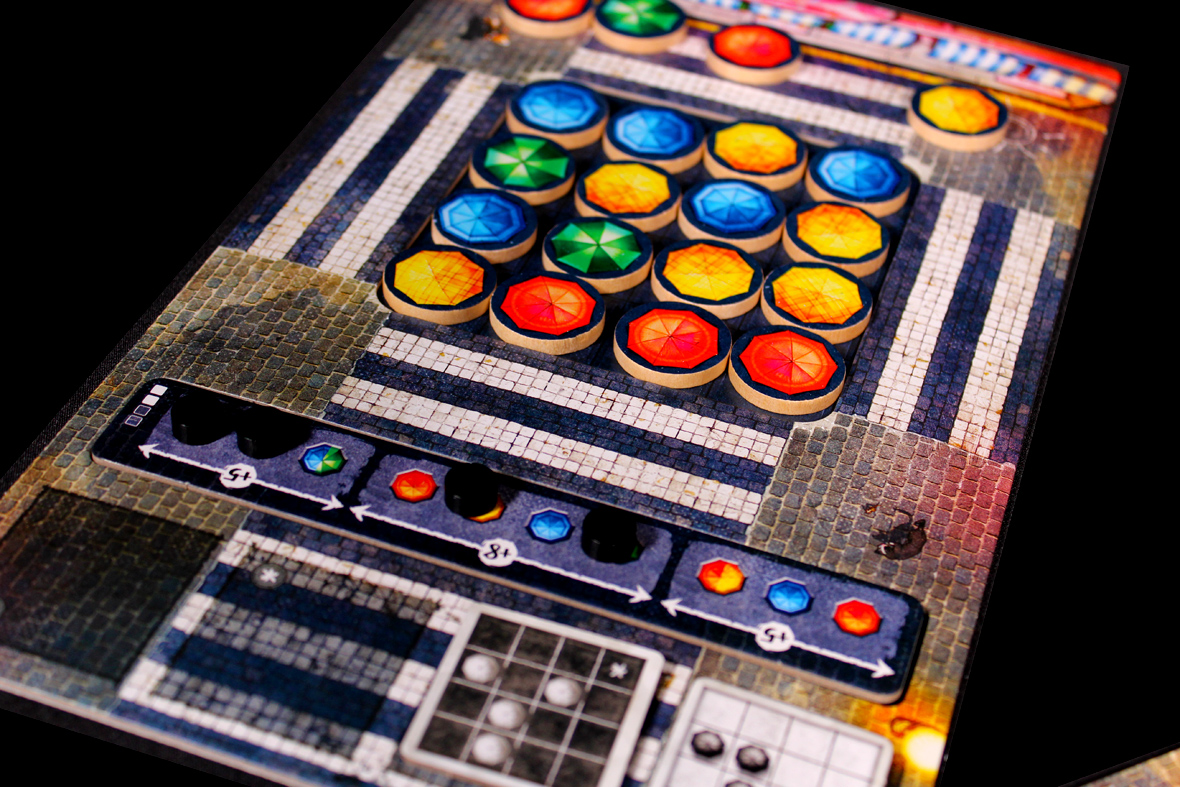
- Can Vincent Dutrait miss on art? I don’t think so. The game looks super good! I really like the color work and I think that everything ended up looking super nice, but that’s to be expected from Dutrait’s art.
- The general theme is pretty nice, too. A fun bit of coordinated dancing in the rain, but as a spatial puzzle? Sure, why not.
- Sliding puzzle games used to vex me but now I like them quite a bit. I think when I was younger I just couldn’t figure out most of how they worked, I guess? That part of my brain was still developing. Now I think they’re a lot of fun! Always glad to try one.
- The general flow of tokens is fun, too; you can actually hit points in the game where you’re in a bad way because you don’t have any tokens of the color you need surrounding you. It’s a high-interactivity game where you can’t really hurt your opponents, which is nice. You contribute to what their options are, yes, and you can play to spite them, sure, but it’s challenging to do that effectively. Some players are definitely up for that challenge, though!
- Turn-to-turn is pretty quick. You just pull a token and push in the opposite direction you got it from. Not a whole lot of complexity there.
- The figures rotating is a good way to keep things fresh. I wish there were more figures rotating from turn to turn so I got a bit more variety, but what can you do.
- The catch-up mechanic is subtle, which I like. I like that the players who are falling a bit behind end up with extra patterns, so by virtue of a weird variant of the pigeonhole principle they mostly end up having more shots to fulfill a pattern.
Mehs
- I wish there were more in-game variety of what figures you get during a game, though I understand why there’s not. Having a limited pool of figures forces players to move things around if they want to actually get each color knocked off of their scoreboard. It makes sense. I just would like to not be stuck doing the same pattern all game.
- It would also be nice if there were an easier way to slide one or all of the tokens you need out without having to lift them. I think thicker tokens would have helped, there. This is mostly me being lazy. Thicker tokens would be easier to pick up.
Cons
- There are some “lull” turns where nobody is quite in a spot to get what they need done done, and that makes the game drag a bit. Sometimes you just miss the pattern by … a lot, or you just don’t quite have the tokens you need. This happens sometimes, unfortunately. That drag can potentially take a while to resolve, which isn’t great.
Overall: 7.25 / 10
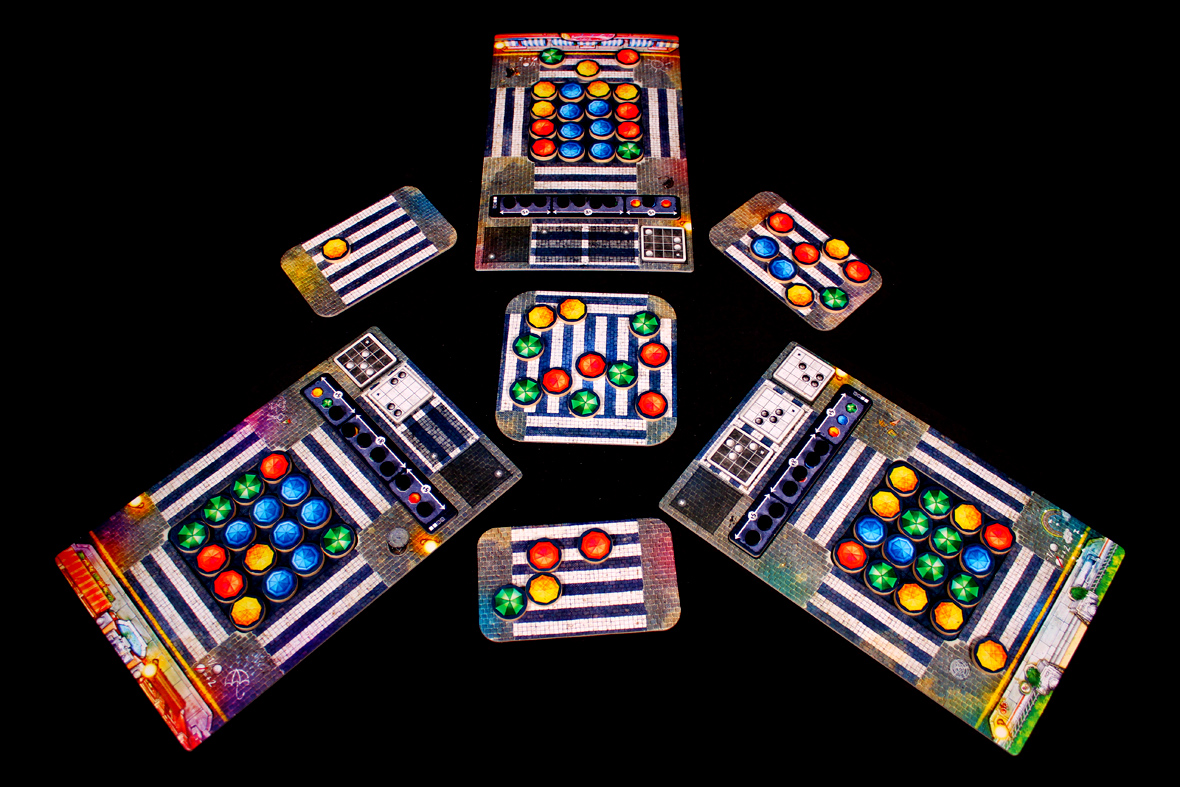
Overall, Umbrella is fun! It’s got a nice spatial puzzle to it, and the small scope of the tokens makes figuring out how to make the patterns work. It’s honestly more of an efficiency puzzle than a pure spatial puzzle; you want to be scoring a pattern every turn if possible, so you can rack up points. That efficiency makes it much different than a game like, say, Flash 8, where the sliding token puzzle is all about speed. This can lead to some issues, especially if the efficiency puzzle of it all breaks. Then you’ve got everyone working on trying to take turns to fix what was messed up about their grid. With more players you at least get a few more options (from the center play area) and may even get more patterns passed around! The game is definitely improved by Vincent Dutrait’s art though! The colorwork here even makes the sidewalks light up and everything looks super colorful against the rain setting. I think that the things I’d like to see from the game would be a way to solve those lull turns, for one. It breaks up the pacing of the game and feels like a tripping motion in the run that is the efficiency puzzle. I’d also love to see thicker tokens or an easier method for getting a piece out since, you know, you’re doing that pretty constantly. Beyond that though, Umbrella is a nice light strategy game for people who like color or sliding tokens. If you enjoy those things, like an efficiency puzzle, or you just want to experience a game about being in the rain, Umbrella might be up your alley!
If you enjoyed this review and would like to support What’s Eric Playing? in the future, please check out my Patreon. Thanks for reading!
 What's Eric Playing?