
Base price: $15.
2 – 5 players.
Play time: ~15 minutes.
BGG Link
Buy on Amazon (via What’s Eric Playing?)
Logged plays: 5
Full disclosure: A review copy of Kado was provided by Pandasaurus Games.
It’s the holidays! That means that I’m loosely justified in talking about games where presents or gift-giving are a major theme. I’m actually just okay at giving presents, but I’m working on it. I think some people just have the knack for it, but I can’t really force myself into figuring out the right gift for someone unless I just kind of happen into it. I think my sister is definitely the better gift-giver in the family, alas. But I digress. KADO’s the next game up for review, so, let’s unwrap this thing.
In KADO, players are giving gifts and receiving them! You’ll have a bit of trouble if you get too many different things, though; it kind of messes with the overall vibe of the collection. Try to instead focus on aligning your collection for good vibes and, more functionally, a bunch of points.
Contents
Setup
This is actually about as easy as it gets! You just take the cards and shuffle the deck.
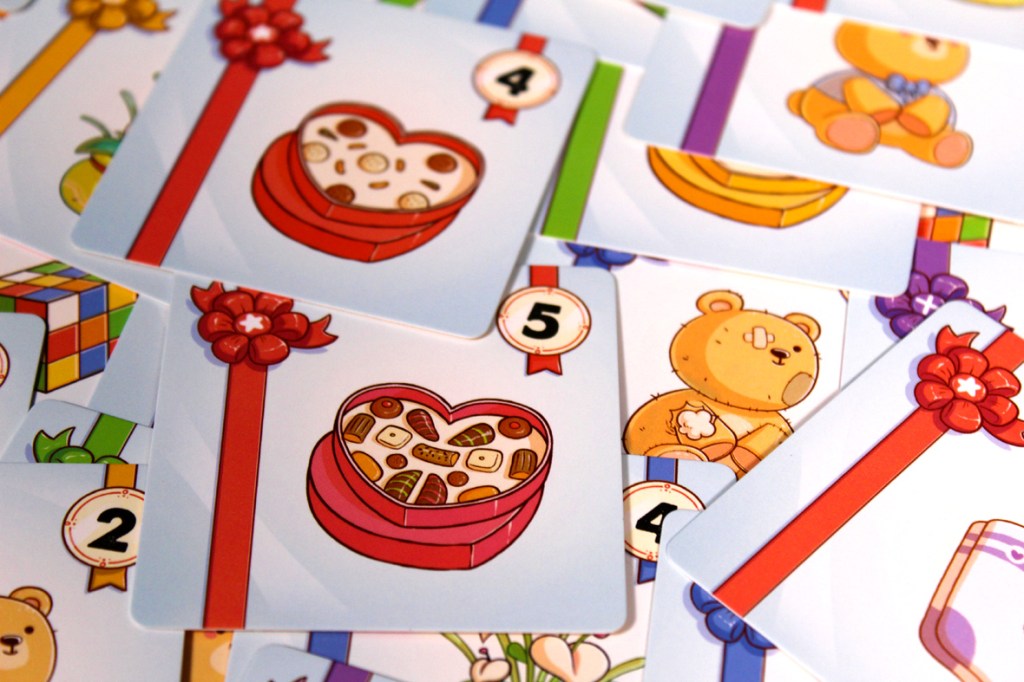

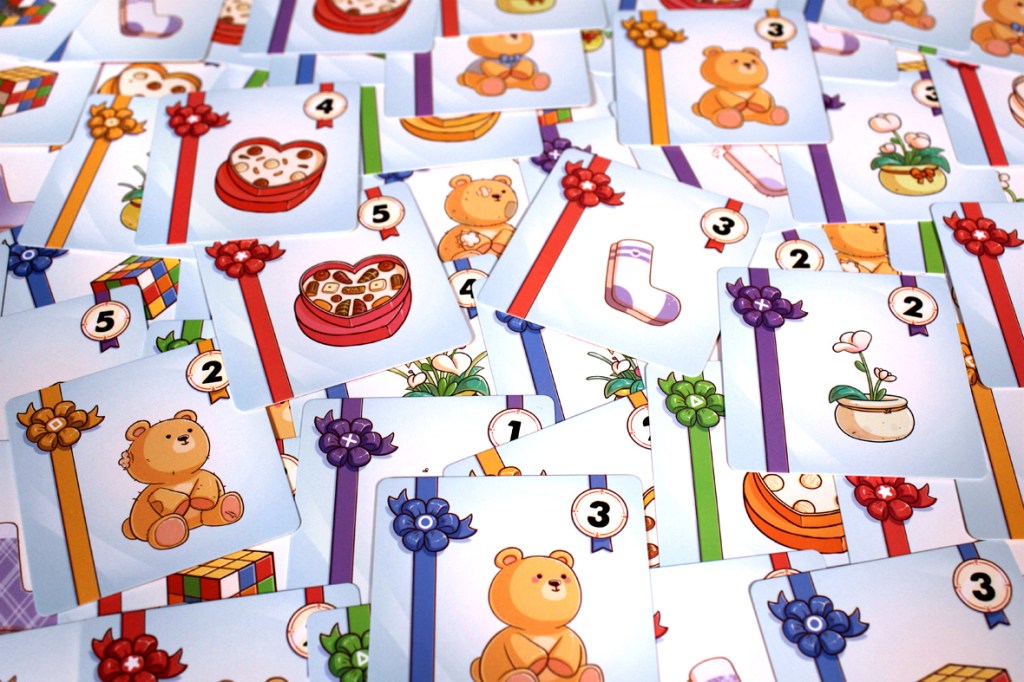
Then you can start! Choose any player to go first.
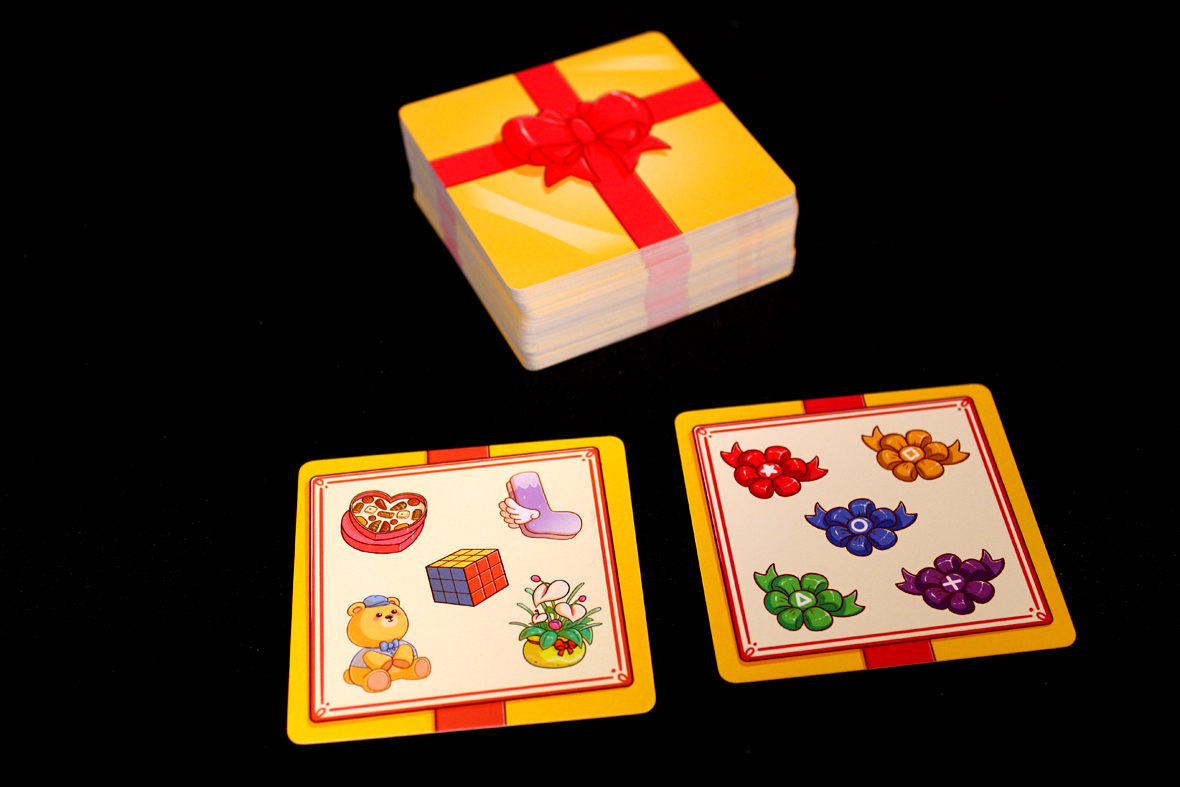
Gameplay

The core game itself is pretty simple as well: give gifts, and then get challenged. Each turn, one player is the gift-giver. They, one at a time, draw a card and immediately decide (before drawing another) which player they want to give the gift to. The player receives it face-down, but they can choose to look at it if they want. At two players, the gift-giver can also decide to discard the current card instead of giving it to anyone, but only once per round.
Once every player has a gift, it’s time to challenge! Starting with the player on the gift-giver’s left, everyone gets a shot (well, everyone potentially, I suppose). You can choose to challenge or not. If you do, name an item and a ribbon color. If the gift-giver’s kept gift matches either of those, you must swap your gift with theirs (and the challenge phase ends). Otherwise, nothing happens. If your challenge matches both elements, you also get a card face-down from the deck to keep for a bonus two points.
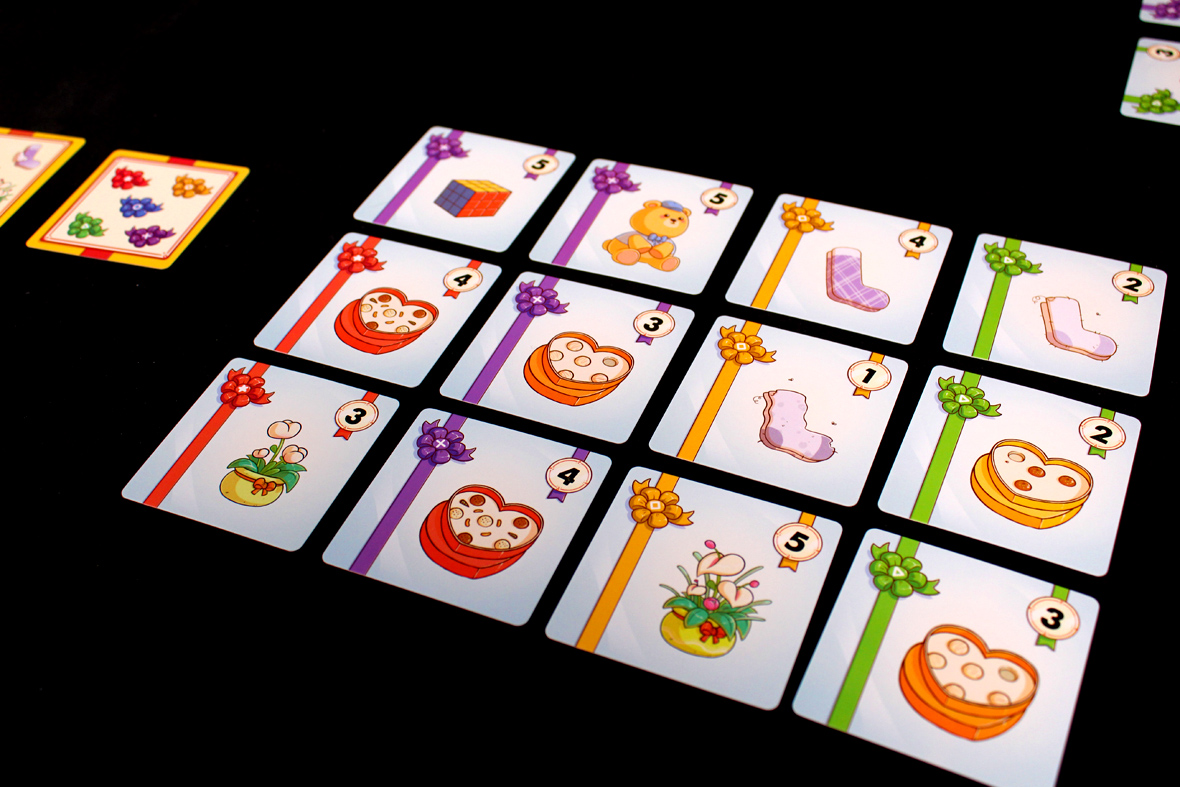
After the challenge phase, each player adds their card to their grid. A grid must be three rows and four columns, and cards must be placed orthogonally adjacent to other cards. Once a card is placed, it cannot be moved.

Play until each player has twelve cards in their grid, and then score! Each column scores its item values if all ribbons in that column are the same color. Each row scores its item values for one item type that you choose. You can choose different types for each row if you want, and the type you choose does not have to be the type you have the most of in that row. The player with the most points wins!
Player Count Differences
With more players, it does get a bit easier to guess your opponent’s card. Everyone gets a turn! So if you go last and nobody has gotten a feature right, well, you might be able to get it by process of elimination. That doesn’t necessarily mean that that’s the right move; the point value might be significantly lower than the card you got. Bad trade. With two players, it shifts to a weirder “duel” system where you give each player a gift, but you can also discard one card, giving you a bit more flexibility. It’s mostly to make it more interesting, but it does add a bit of tension for your turn. Did they keep a card that you want or did they keep a card that’s good for them? With more players, it usually just makes sense to ask about specific cards that would be good for you. I do think I would prefer the game with more players, though. You want to keep the decision space open (so not five players), but you also want to have a few more players to interact with.
Strategy
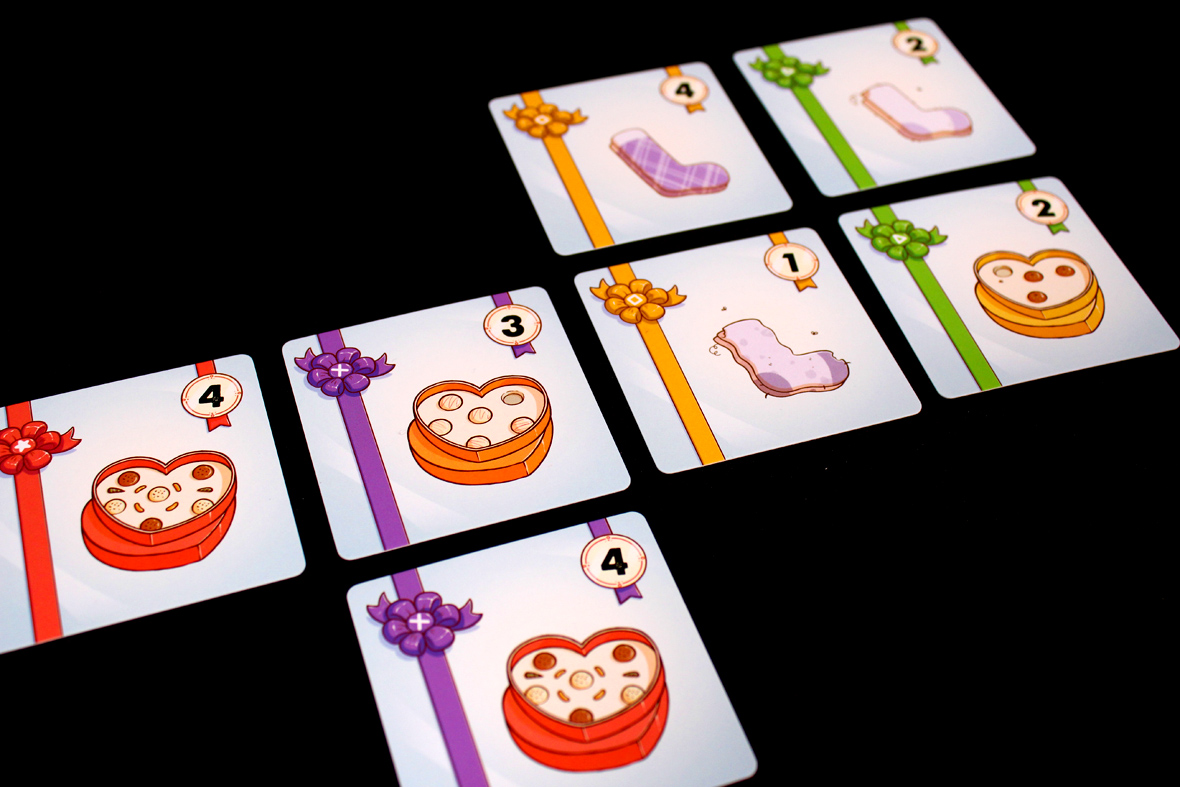
- You really want rows and columns aligned. Column scoring in particular is difficult because you only score a column if all the cards are the same color, which comes down to luck as much as it does getting generous gifts from the round’s gift-giver. Rows are more forgiving, since you just pick one item type and score it in that row, but it’s still worth trying to invest and get high-value cards.
- Trades are forced, and that might not be necessarily be what you want. If a card is workable it might be better to keep it than challenge the gift-giver and get whatever they have. You may end up with something even worse!
- Watch for the ordering of who gets what cards when. If the gift-giver gives themself a card last, it might not be a card that was particularly good for them. Even if your card is terrible for you, this should affect your judgment. If not for whether or not you want to challenge, then for what you might guess they have.
- At two players, discard cards that are good for your opponent. That way you don’t have to risk them getting it or you having to deal with getting swapped for it if you keep it. That said, you only get one discard per round, so you might get stuck with something every so often; that’s just chance.
- Something that’s good for someone else does not, by default, need to be good for you. A 5 in a color you don’t have is not necessarily a must-get card, unless you’re building a new column or your current row is garbage. Both things can happen, but sometimes your best move is just not to challenge.
- Giving someone a card that will definitely wreck their columns is good, albeit mean. If they have their columns defined, give them a different color! Even better if it’s a color you have, so that if they swap you then you win either way. Again, rude, but useful.
- A bunch of low-value cards, even in the correct rows and columns, are going to get you nowhere. You might think that it’s of paramount importance to score every column, for instance, but if you can get a couple fives and fours in the right place you can pretty easily outscore a player that ends up with a bunch of ones. Yes, that’s how math works, but it’s not necessarily going to feel as obvious during the game itself.
Pros, Mehs, and Cons

Pros
- The card art is nice and pleasant. They’re gifts! The gifts are simple and pleasant, though anyone who’s giving someone dirty socks as a gift needs to get their life together.
- I do like that the lower-value cards look dirtier and grimier. It is funny that the lower-value cards look believably lower-value. The sad 1-value Rubik’s cube looks absolutely trashed, for instance.
- The box is impeccably designed. It has this really clean magnetic hinged lid that’s under the box’s cardboard, so the entire box’s design is very clean and elegant. It looks great and is really nice to open and shut. Good box design is really underrated.
- Very portable, which is also great. It’s a small-box, quick game that you can even play on an airplane if you want. Frankly, it’s the right size for a stocking stuffer if you know board gamers who like that sort of thing in a stocking.
Mehs
- I wish the bluffing element was more pronounced. There’s almost no reason to try to trick someone into swapping with you; why wouldn’t you have just done something different with the card you gave them? Obviously there’s a sense of timing, but the only reason to go after the gift-giver’s card is if you think it’ll benefit you or you’re genuinely worried that it benefits them beyond a reasonable means.
- I still don’t love square cards. They’re just weird to shuffle. It makes sense here both because of the box shape and size and the whole grid format, but I’m still never a huge square cards fan.
Cons
- I think it’s a clear misprint on the back, but … 45 minute playtime? That can’t be right. The German version says 25 on the box, BGG says 15 minutes? I wouldn’t normally complain about a misprint, but this is a misprint that actively impedes my desire to play the game (since I scope it differently based on how much time I have and the approximate weight). Hopefully that gets fixed; there’s no actual language-dependent texts on the cards!
Overall: 5.5 / 10
Overall, I think KADO is okay. When it comes to bluffing and trickery, there’s usually more to do in games that I end up enjoying. Here, your best bluff is, I suppose, trying to hide that you took a card that was great for you. You could potentially try to give your opponent a card that’s great for you and trick them into forcibly swapping with you for something that’s bad for them, but that’s a psychological flex that borders on … mean? They don’t really get anything out of a correct challenge and players losing nothing for a failed challenge is also strange to me. What’s the benefit, then? KADO ends up feeling like it’s missing something that would make the game feel more urgent or more critical, since players are often more concerned with the (frankly, a bit aggressive) column-scoring rules than they are with trying to figure out who gets what from them. Just give everyone a bad card and let them figure it out. A great recipe for a bad White Elephant exchange, I suppose. That said, there’s nothing particularly wrong with the game, from a gameplay standpoint. It’s neither frustrating nor cruel; it just has very little that engages me beyond when you get cards. A friend and I played it a bit more on Board Game Arena and ran into a similar issue. If KADO had more to grab our attention or incentivize bluffing or punish a gift-giver who gets correctly challenged, I think it would end up being a more genuinely interesting game! In the meantime, though, unless you’re really obsessed with shuffling around presents or you really love the form factor (and I’ll admit; the box is pretty impeccably designed), I think there are other ways you can bluff that will end up being more compelling.
If you enjoyed this review and would like to support What’s Eric Playing? in the future, please check out my Patreon. Thanks for reading!
 What's Eric Playing?