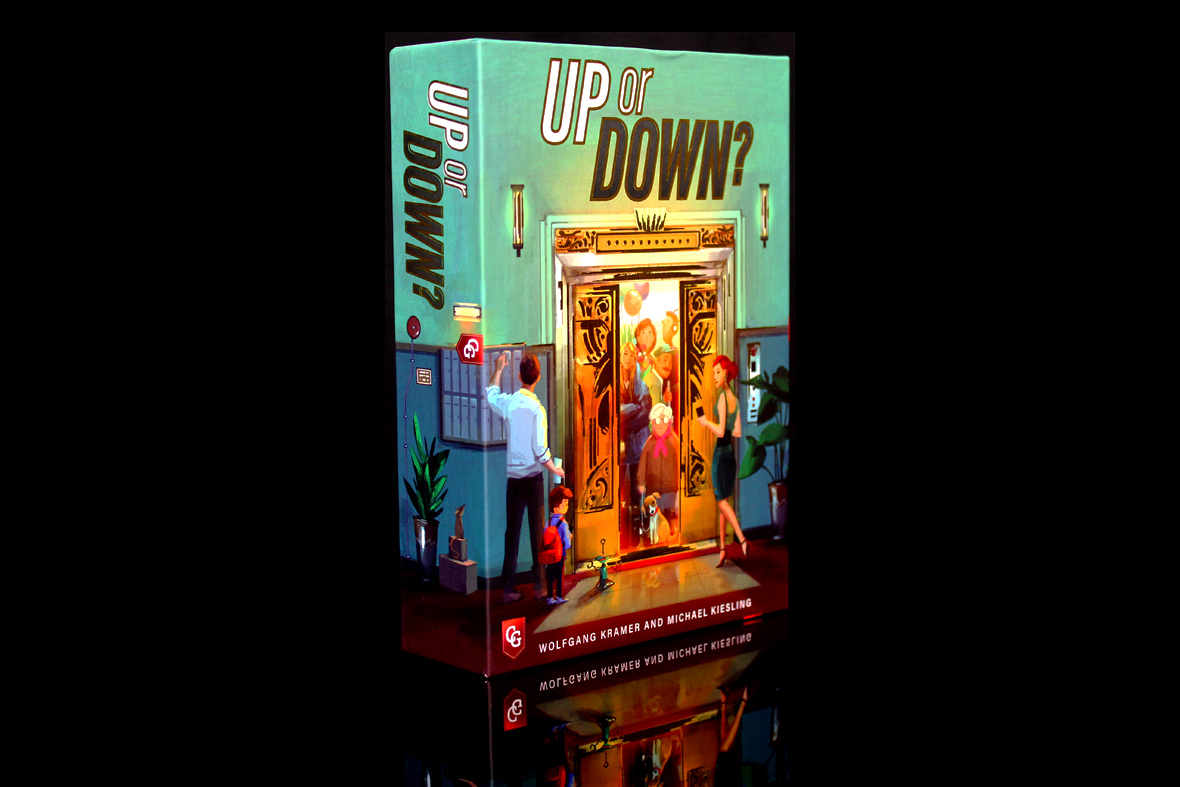
Base price: $17
2 – 6 players.
Play time: ~30 minutes.
BGG Link
Buy on Amazon (via What’s Eric Playing?)
Logged plays: 3
Full disclosure: A review copy of Up or Down? was provided by Capstone Games.
This week in weird themes, it’s “games with a prominent teal component on the box”! Are you excited about the prospect? It’s kind of like Thing Thing where you can really make any pair of things into a category if you believe in yourself. And I do, so here we are. I guess they’re both card games, but that’s not nearly specific enough, so, we’re locking it down this time around. Anyways, let’s check out a new game from Capstone, all about elevators!
In Up for Down?, players ride elevators with reckless abandon, never quite sure where they’re going. Going up is fine; going down is fine. You just don’t want to change directions a lot; that’s annoying. So ride away by playing cards and adding to your stacks, scoring even more for big stacks of the same color. Will you be able to make it to the top? Or, conversely, the bottom?
Contents
Setup
Shuffle up the cards based on your player count and how long of a game you want to play!
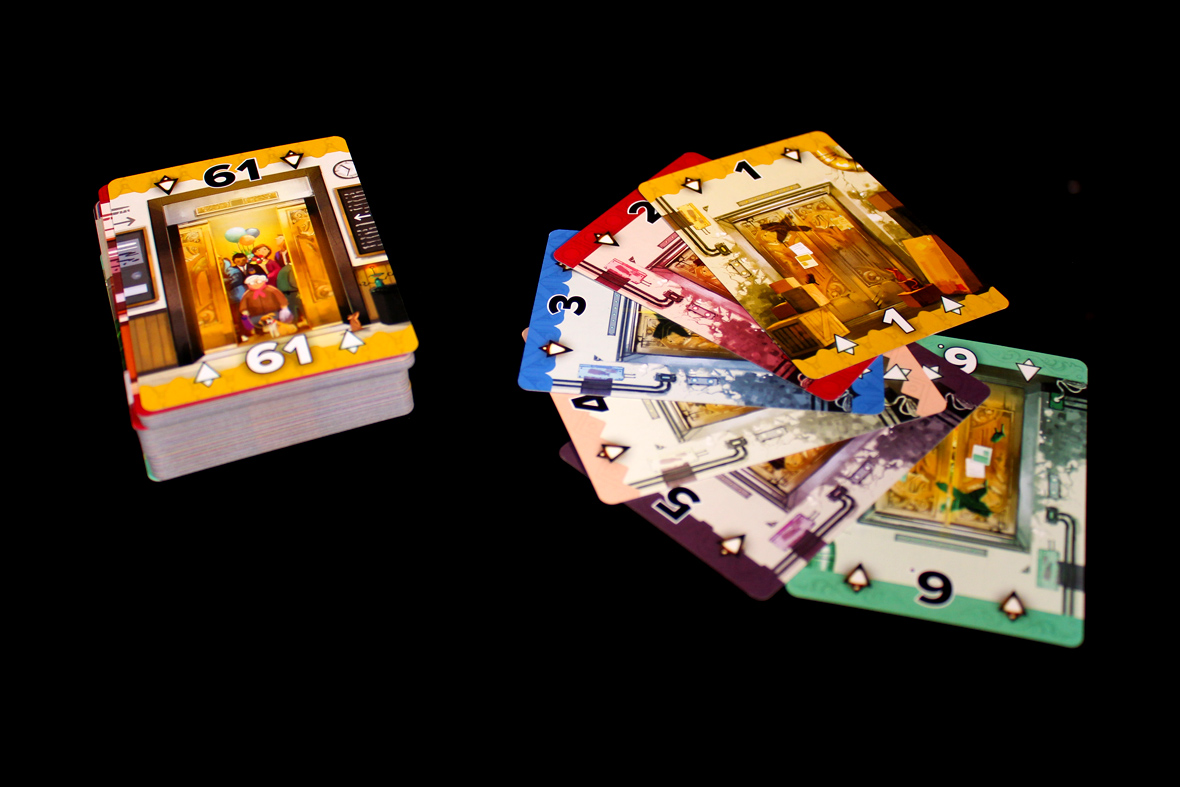
- 2 players: 1 – 40 for a short game, 1 – 54 for a long game
- 3 players: 1 – 60 for a short game, 1 – 78 for a long game
- 4 players: 1 – 78 for a short game, 1 – 102 for a long game
- 5 / 6 players: 1 – 96 for a short game, 1 – 126 for a long game
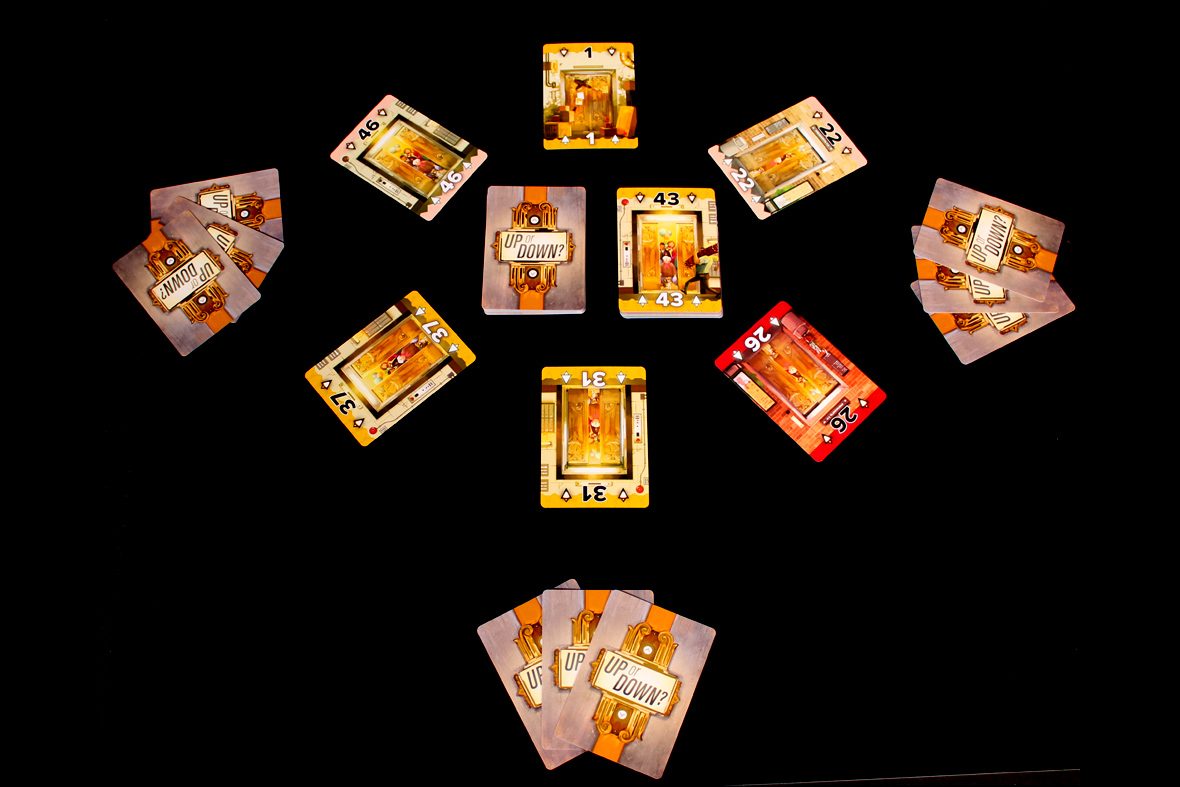
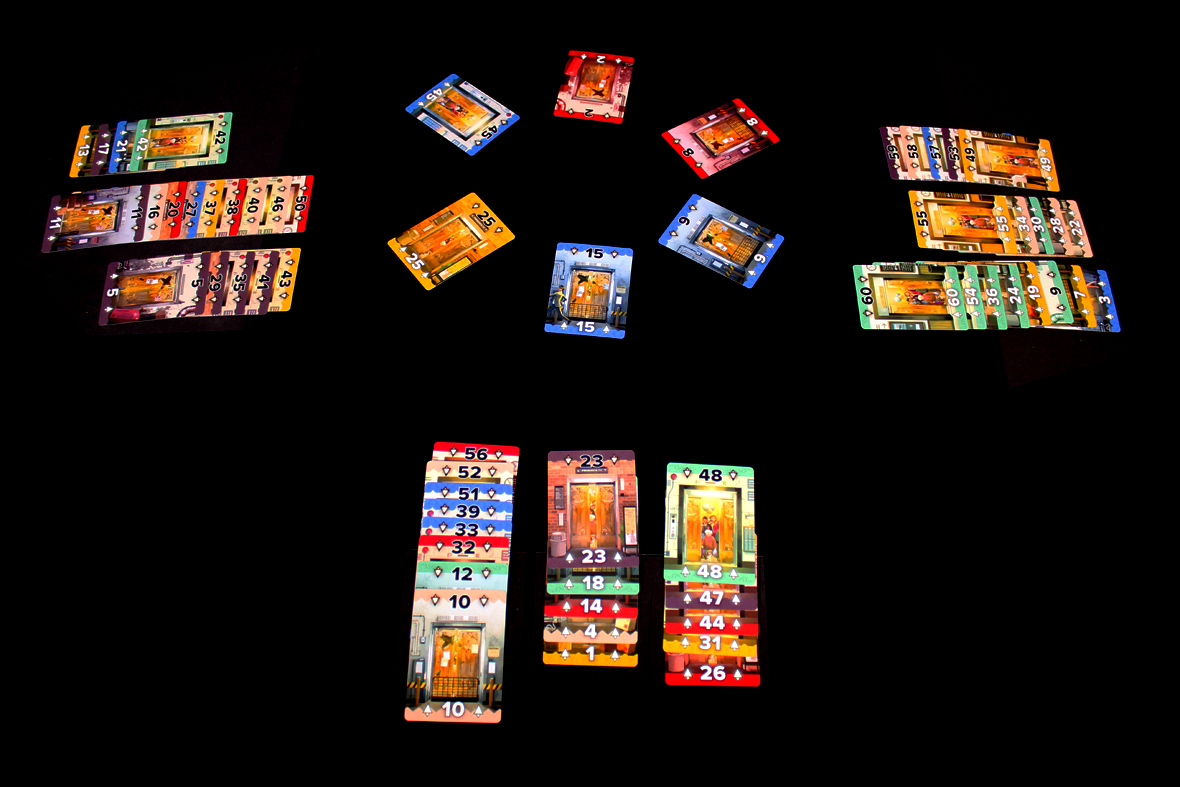
Deal each player three cards, and then reveal six more. Place them in numerical order around the center, and split the remaining deck into two equalish stacks. One goes face-up, the other face-down. You should be ready to start!
Gameplay
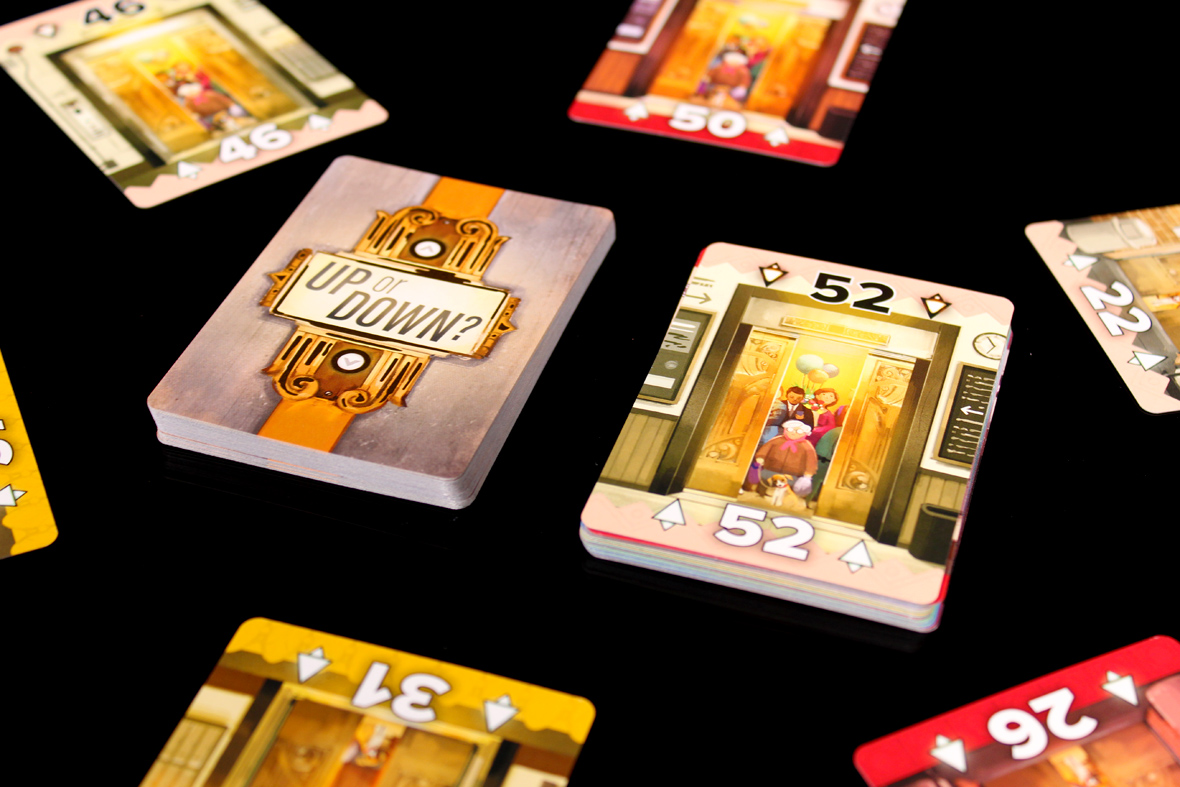
Actually, not too hard. Each turn you’ll play a card from your hand to the center, placing it between the two cards higher and lower than it (wrapping around if, say, you place a 1 between the 55 and the 3 or something). When you do, you can take either of the cards surrounding it and add it to one of three columns in your play area. The first card? No problem. Once you add a second card to a columns, however, it’s locked to either ascending or descending order. All subsequent cards played to that column must follow that ordering, or you can burn that column and discard all the cards to start fresh.
Once you’ve played a card, you can draw from either deck. Play continues until all cards have been played and both decks are depleted. Then, to scoring!
For scoring, per column, you score the number of cards in that column times the number of cards of the most common color of that column. Once you’ve totaled that, you also get 1 point for each card in your discard pile. Player with the most points wins!
Player Count Differences
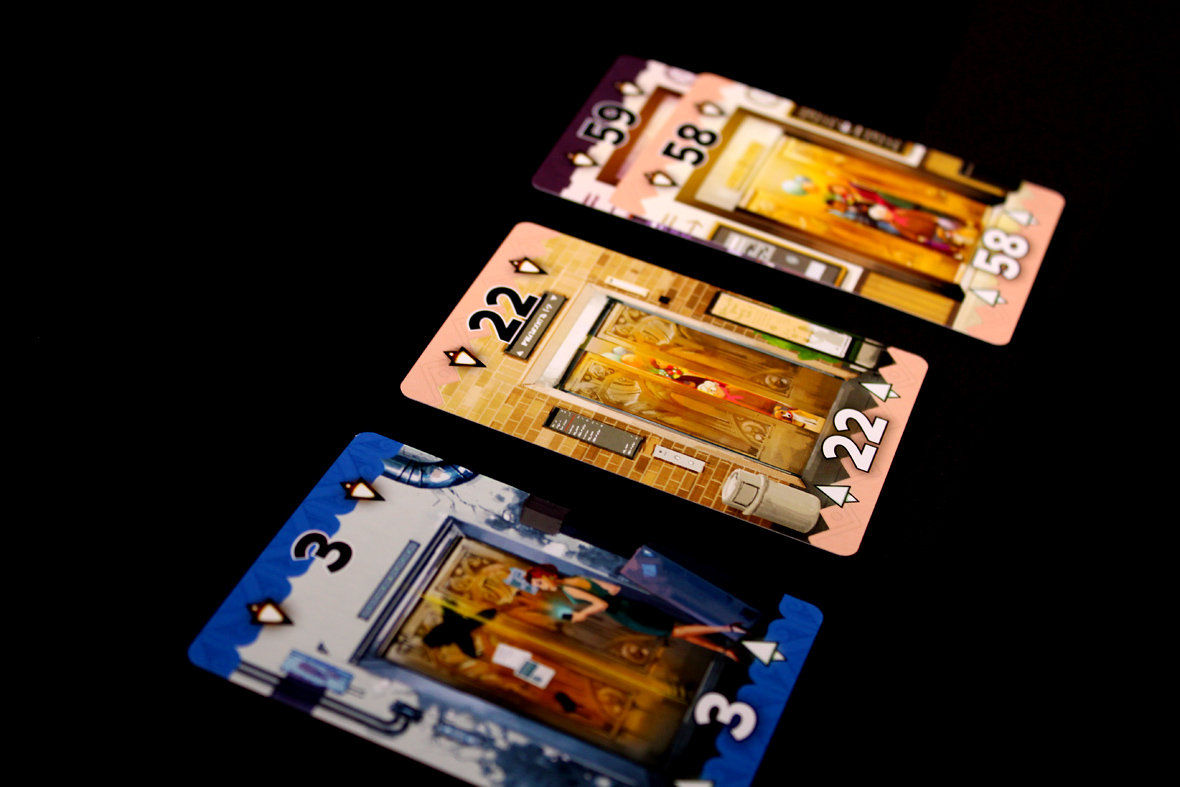
I think Up or Down? does shine a bit more with more players, based on how scoring and combos are set up. At two, in a short game, there aren’t a ton of cards and players are competing pretty aggressively to try and secure certain cards for a run or such. As you add more players, more cards are also added. Yes, the average amortizes out a bit, but there are still a lot more opportunities to secure certain spaced-out cards. I think it reduces fighting a bit, but that means you’re also reliant on luck to get certain cards? I do think it’s easier to focus on collecting a lot of the same color, to a point. Once there are enough players, there may be some fighting over colors, but hopefully there are enough cards in play to mitigate that.
Strategy
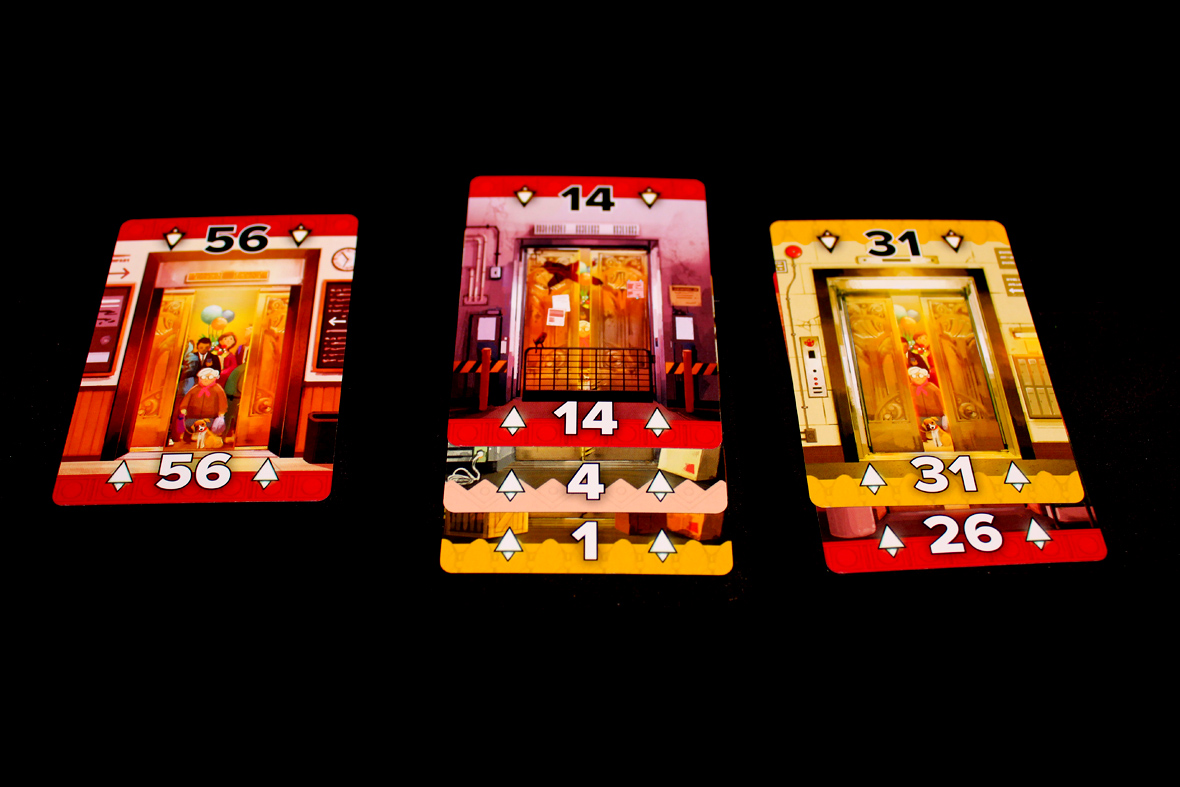
- Just getting every card sequentially isn’t enough. You get a lot of cards, yes, but the key is getting the multiplier from having multiple cards of the same color. Try balancing them out if you want to get as many points as possible.
- Have a plan. You don’t want to get to the end of the game and be forced to dump an entire column because of some bad math. Make sure you have an actual plan for what you’re going to do in the long-term. It helps to leave a column open as long as you can.
- You can try and mess with your opponents if you want (and have the cards to do so). Did you see them place a 25 and take a 24? They might want that 25 next turn. If you take it by placing a 23, you’ve now (probably) ruined their plans. Bonus points if doing so lets you score a card you need.
- Starting at the high or low end is pretty good! If you can claim the 1 or the 2, pretty much every card you place is going to be higher than that, and that’s not bad!
- Big skips are sometimes unavoidable, but not bad. The Game and Beasts both have a similar situation where sometimes you have to hop from 23 to 70 because of some card shenanigans. It’s not great to lose a ton of real estate, but it does happen sometimes. Just kind of grin and bear it.
- You can see what the face-up card is going to be, so choose wisely. If it’s not going to help you in any way, you might as well draw a random face-down card. It, at the very least, might be vaguely more helpful? It’s anyone’s guess.
- Don’t just throw a column away. I suppose it’s okay if you genuinely messed up a column (played 1 then 35 then 60 in a three-person short game, hitting the min and max value and making that column unplayable). Otherwise, just try to get cards and place then in a column, even a crummy one, to try and maximize that score.
Pros, Mehs, and Cons
Pros
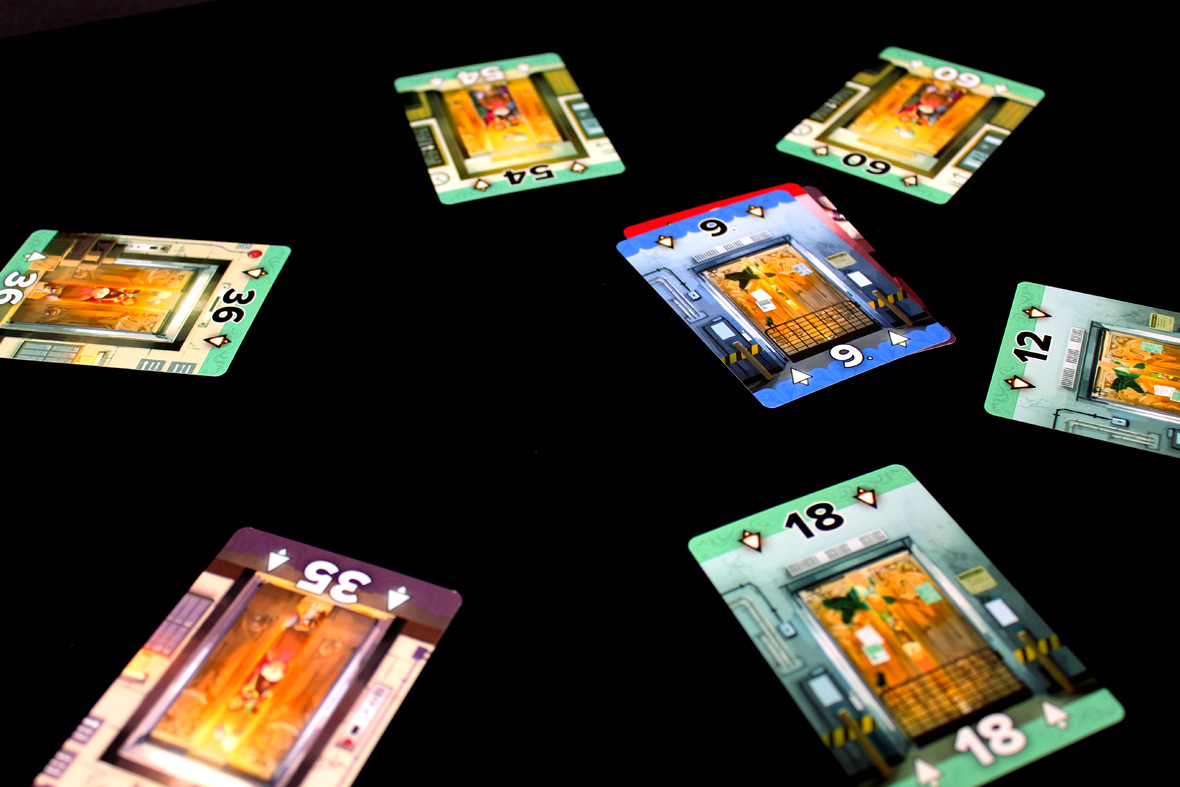
- The art style is pleasant. It’s just one elevator, but there’s a lot of motion to it and a lot of characters? It’s nice.
- The cards are nice, too. High-quality! They’re thick and they have some light embossing on the back. It’s not quite like, Leaders-quality, but there are a lot more of them. It makes sense.
- Portability is good. This is a pretty good small-box game size, though since it’s just cards it’ll easily fit in a Quiver or equivalent if you’re using one of those.
- It’s nice that the game itself isn’t too complicated to play or explain, but has some interesting strategy to it. You’re really just playing a card to take any adjacent cards and then stacking the card you take in ascending or descending order. Not too complicated, but still interesting.
- I appreciate the subtle double-coding for colors. When you’re making players care about the color of the cards, it’s very nice to have an extra layer of distinction for players who can’t distinguish the colors being used. Smart design choice.
Mehs
- Having to remove cards for lower player counts can be a pain. There are over a hundred cards and sometimes you have to remove a good chunk of them to play with fewer people. It’s not ideal, but it is necessary to play.
Cons
- I found it just okay at two players. I was definitely more interested with more players; at two, it just felt very contentious as we were fighting over a pretty small decision space.
Overall: 7.25 / 10
Overall, Up or Down? is fun! I think I’d like it better with a two-player variant that either expands scoring or makes things a bit more hectic, but with more players I do find the game to be pretty quick and fun. There’s not a ton of requisite knowledge that you need to play the game, either, so this one ends up being pretty friend…ily placed as a light card game. Kind of surprising, given how much Capstone is relatively synonymous with the heavier end of the gaming spectrum. I think a lot more companies are expanding into a wider spectrum of offerings because of, well, imagine me gesturing vaguely at the economy. Expanding a customer base is important and there’s some level of diminishing returns for folks adding games to their collection. The Spiel des Jahres has done similar things as the market has grown. But I digress. Up or Down? is a clever and quick little card game that’s a great way to spin up or spin down a game night. I’m not as excited about the elevator theme in particular, but what can you do? If you’re a big elevator fan, you’re looking for a quick and strategic card game, or you just like columns, Up or Down? might be for you! I’ve enjoyed it.
If you enjoyed this review and would like to support What’s Eric Playing? in the future, please check out my Patreon. Thanks for reading!
 What's Eric Playing?