
Base price: $19.
2 players.
Play time: ~20 minutes.
BGG Link
Check it out on Kickstarter!
Logged plays: 2
Full disclosure: A preview copy of Logic & Lore: Variance was provided by Weird Giraffe Games. Some art, gameplay, or other aspects of the game may change between this preview and the fulfillment of the Kickstarter, should it fund, as this is a preview of a currently unreleased game.
Alright! February is going to be a Kickstarter-heavy month, likely for the next few weeks. it’ll certainly delay my writeup of 7 Wonders Dice, which is a bummer, but I enjoyed that game so you can just kind of keep that in your pocket for now. More on it later. Also need to figure out some upcoming convention plans soon, but we’re iterating on that as we speak. GAMA Expo? Who knows. PAX East? It’s possible. Gen Con? Ideally, depending on both hotels and press credentials. I’m at the point where I’m too grouchy to go to Gen Con if I have to stay outside of walking distance, and I’m not cool enough to get a room at the JW Marriott, so, here we are. I want to stay in one of the train car rooms someday. It’s good to have stupid dreams. But in the meantime, let’s get to the reviews!
In Logic & Lore: Variance, the mice and dragons are back to help you divine the numbered stars and return them to their proper locations. This time, however, you’re introducing true randomness: dice! These dice will affect the questions you ask and how your deduction works out. Will they help you or hurt you? Can you roll a natural 20? Does that have any actual impact on the game? More than one of those questions might have “Yes” for an answer, but who knows? Let’s find out!
Contents
Setup
Easy. Shuffle each player’s cards as you would in the base game, and place them in two face-down rows on either side of the alignment cards, set to the number side. Then, choose a game mode and give each player a corresponding player aid card:
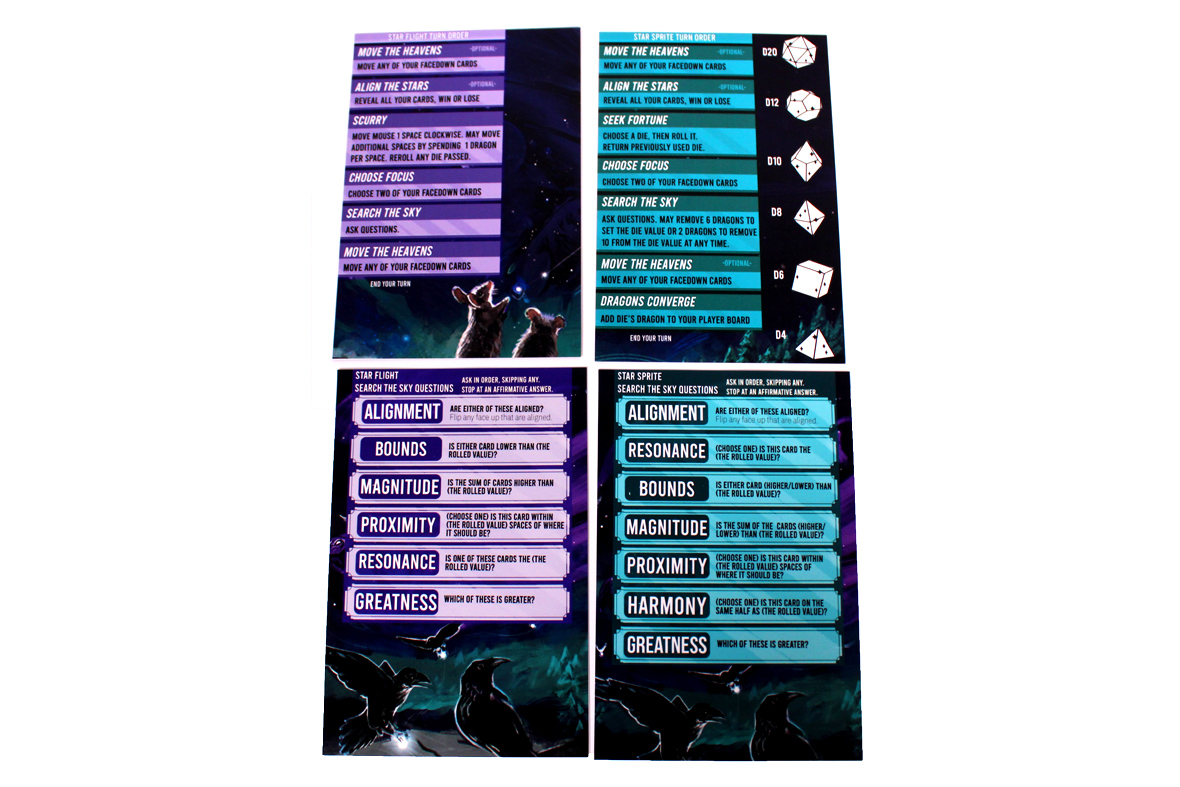
Generally, you’ll want to set the dice aside.

Give each player some A – J tracking tokens as well:
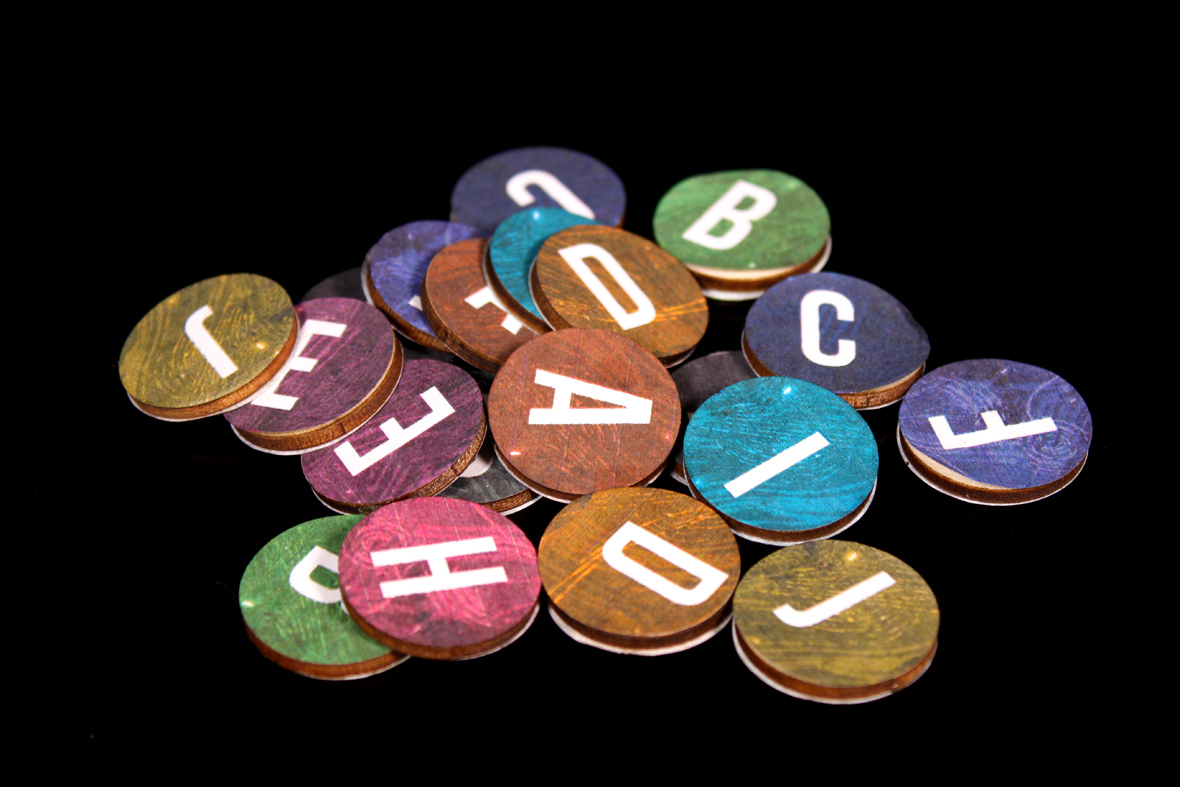
For Star Flight, each player places a Mouse Token on the corresponding space and takes four of their Dragon tokens, setting the rest aside. Roll the dice, place them on the corresponding spaces on the board.
For Star Sprite, roll the dice and set them nearby. Each player gets all seven of their Dragon Tokens. Either way, you’re ready to start!

Gameplay

Logic & Lore: Variance adds two new game modes, each of which can be played on their own as a game or together, at times.
In both, you have the same goal: get your numbers in order from 1 – 9. To start a turn, you can move your face-down cards around. You can then optionally reveal them all. If they’re in order, you win; if not, you lose.
Then, the questions start! In Variance, regardless of whether or not you’re playing Star Flight or Star Sprite, you’ll have one die assigned to you. In Flight, you’ll move your Mouse Token around the card, getting a new die each turn (and rerolling the old one). In Sprite, you’ll choose a die and roll it, placing the die you had previously back. Flight lets you spend Dragons to modify how many spaces around the track you move; Sprite lets you spend Dragons to modify the value.
Either way, you’ll then choose two of your cards. Move from top to bottom on the question sheet asking your opponent one question at a time (you may skip any questions, if you’d like). If they answer no, you can ask the next question. If they answer yes, you’re done. You can move your cards again and then end your turn. Don’t forget to use your notepad to track things!

As you progress through some questions, some cards may become aligned and confirmed via questions. Either way, if you have all 9 of your cards face-up in the correct positions, you win! If not, your opponent’s turn starts. Play until you have a winner!
Player Count Differences
None! This is a two-player game exclusively.
Strategy
- Use questions to your advantage! Don’t just ask from top to bottom; you might get information you can’t use. Skip things if you don’t think the answer will help you.
- The dice are also there to help, even when they’re too high. You can do a lot with various dice! You can also modify them (or skip them, depending on the mode). If they’re too high, shoot for things like sums, or skip the question and go for something else.
- Remember the logical implications of inequalities. For instance, if A > B, then you know A can’t be 1 and B can’t be 9. There are others, especially as you start to eliminate certain numbers from consideration. Think about that! Also there are logical implications; if you ask if A > B and you get “no”, then not only can A be less than B, but A can also be equal to B. Don’t forget things like that.
- “No” is a pretty helpful answer; try to structure your questions to get as many answers as possible. Even a no is some information. The more information you get, the better off you might be. You just have to end your turn if you get a Yes.
- You don’t necessarily have to have all your numbers confirmed to win. Sometimes you just have to guess! Just make sure you’re making an educated guess and not just winging it; if you’re wrong at all, you lose.
- Try to move your cards around to reflect their relative relationship. I think that’s the best move; if you know two cards are higher than 3, move them around so that you don’t forget! You can use your notepad and the letter tokens also, if you want.
Pros, Mehs, and Cons

Pros
- Still a very pleasant competitive deduction game. It’s very easygoing, which I appreciate. You can really go at your own pace and it’s still a fun puzzle to solve.
- Look, dice are fun. Everyone likes rolling math rocks; they proved it with science a while back.
- Plays quickly! 20 minutes per game, essentially, which is nice for some light deduction.
- I actually really like how the dice integrate into gameplay. Having some limitations on the questions you can ask is interesting, and it’s nice how the dice can influence what questions you want to ask. Asking if either of your numbers is less than 10 is pointless, for instance, but asking if their sum is less than 10 might not be!
- Since it adds some game modes, it’s actually pretty easy to teach, which is a relief for an expansion. Not fundamentally changing the game as much as it is grafting additional nodes onto it. You can choose!
- It’s also cool that you can play desynchronized modes; one player playing one mode and the other playing the other. You can even mix and match! Some people prefer different game modes and while it might be “easier” with some configurations than others, I kind of figure all the random elements (dice and cards and questions) kind of even out, somewhat.
- The flow of the game is good, too; you just kind of start at the top with questions and work your way down. It’s very logical and easy to understand and play, which I appreciate. Knowing isn’t a requirement, but understanding eventually helps.
- Having letters and a notepad is critical for some deductions. I’m glad they added some extra tokens to help you keep track of things, but the notepad is the most critical. I wanna write things down! Now I can!
Mehs
- I did laugh that we were missing a “G” token in the prototype, but it hardly matters for gameplay. Sometimes not all the tokens make it to the prototype. It usually just makes me laugh, but thankfully, there are also a J and a K token that we can use to cover the gap.
- The dice are … fine, but I don’t love the font from a readability perspective. I understand that 9s and 6s are pretty specifically denoted, but the 4 still looks like a 9 at a quick glance, which isn’t ideal.
Cons
- There’s still a decent amount of luck inherent to the game’s flow. If the dice are working against you that’s one thing, but also, if your opponent just starts with more of their cards aligned than you, there’s not much you can do about it, you know? Thankfully, the game is quick so it doesn’t matter, but like I said, try to let both players finish the game.
Overall: 8.5 / 10

Overall, I was pleasantly surprised by Logic & Lore: Variance! I had forgotten how much I enjoyed the original game (one of the best in Weird Giraffe’s catalogue, if I do say so myself), and this was a pleasant reminder. Normally, reviewing expansions is genuinely like pulling teeth. I play a lot of different games with different people and most folks just won’t have the base game experience required for the expansion to be anything other than a mess, which adds a bunch of extra cycles to my review process. Here, though, there are just two totally new game modes that you can just teach like the base game and nothing bad happens. It’s remarkably easy to pick up, especially for new players. Love that for the game, but more importantly, love that for me. Now, granted, the dice introduce variance (hence the name), which may lead to luck-based outcomes you don’t like, but the game is short enough that it hardly matters. I find the best way to reduce the impact of that issue is to play a polite game where the winner still lets the loser play until they finish their deduction so that they, too, get to solve their puzzle. Generally speaking, when applicable, I enforce that for most deduction games I play (particularly useful in the Kronologic series, for instance). I think it works here quite well. It’s also cool that since you’re basically both playing solo games, you can each play with a different game mode if you want. It’s almost not competitive at that point; you’re just both playing together. And I like that a lot. If you’re a deduction game fan, you like sharing space with someone, or you just want to spend more time looking at nice card art, I’d recommend Logic & Lore: Variance! It’s been pretty fun.
If you enjoyed this review and would like to support What’s Eric Playing? in the future, please check out my Patreon. Thanks for reading!
 What's Eric Playing?