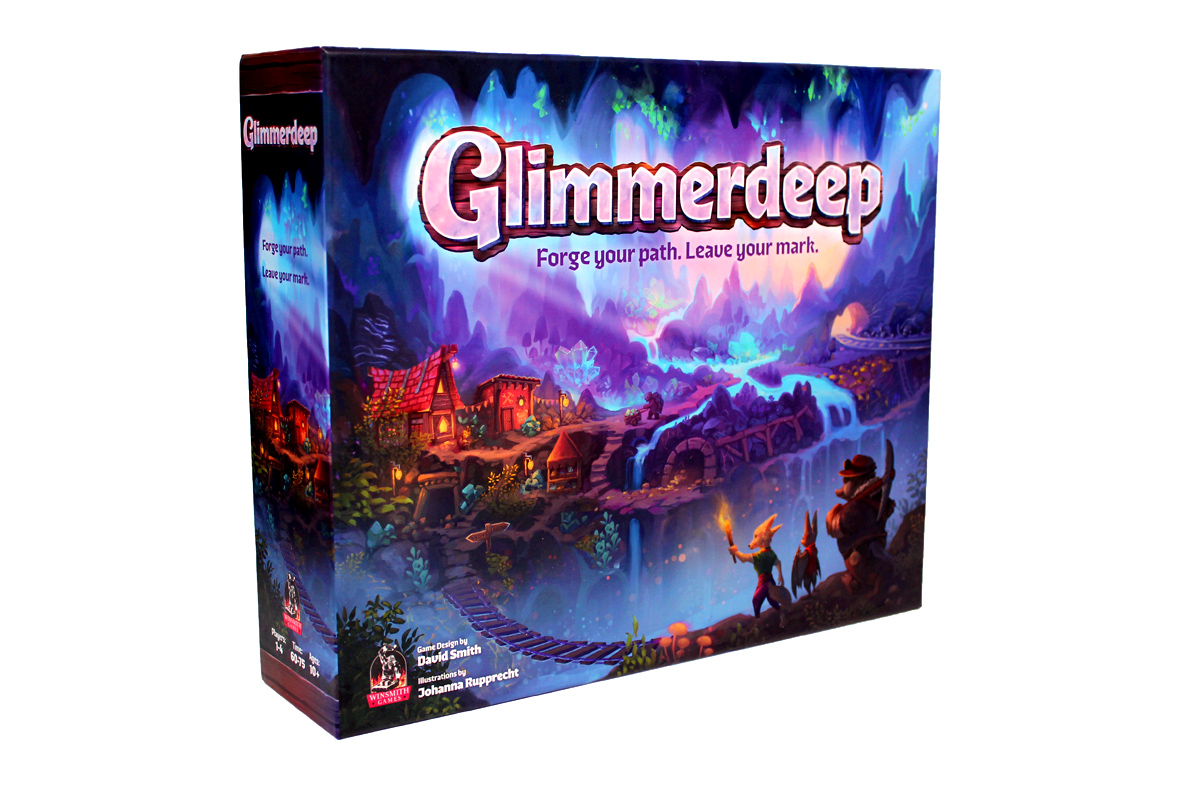
Base price: $XX.
1 – 4 players.
Play time: 60 – 75 minutes.
BGG Link
Check it out on Kickstarter! (Will update link when Kickstarter is live.)
Logged plays: 1
Full disclosure: A preview copy of Glimmerdeep was provided by Winsmith Games. Some art, gameplay, or other aspects of the game may change between this preview and the fulfillment of the Kickstarter, should it fund, as this is a preview of a currently unreleased game.
Another week, another pair of Kickstarters! This one’s coming to us from Winsmith Games, who’ve previously published games like Junk Drawer and 10 Gallon Tank, among other things. I was interested here since this one’s a bit beefier than other games they’ve published, and it’s always interesting to see folks try branching out a bit. It’s similar to Capstone’s recent increase in publishing lighter fare (though in the opposite direction). I’m also a sucker, generally, for a flip-and-write game, so let’s check it out and see what we find!
In Glimmerdeep, various animals plumb the depths in search of rare finds: gems, gold, and even basic iron to help with tasks and such. You play one such animal, and just like a child, you yearn for the mines. Your plan is to usher in a grand underground area with workshops and prosperity and all of that. Or you just love digging holes; your motivation is opaque to me by necessity. The more you dig, the more resources you’ll have for your workshops and forges, and the more you can produce! You have to spend money to make money. The dream. What will you find in the great below?
Contents
Setup
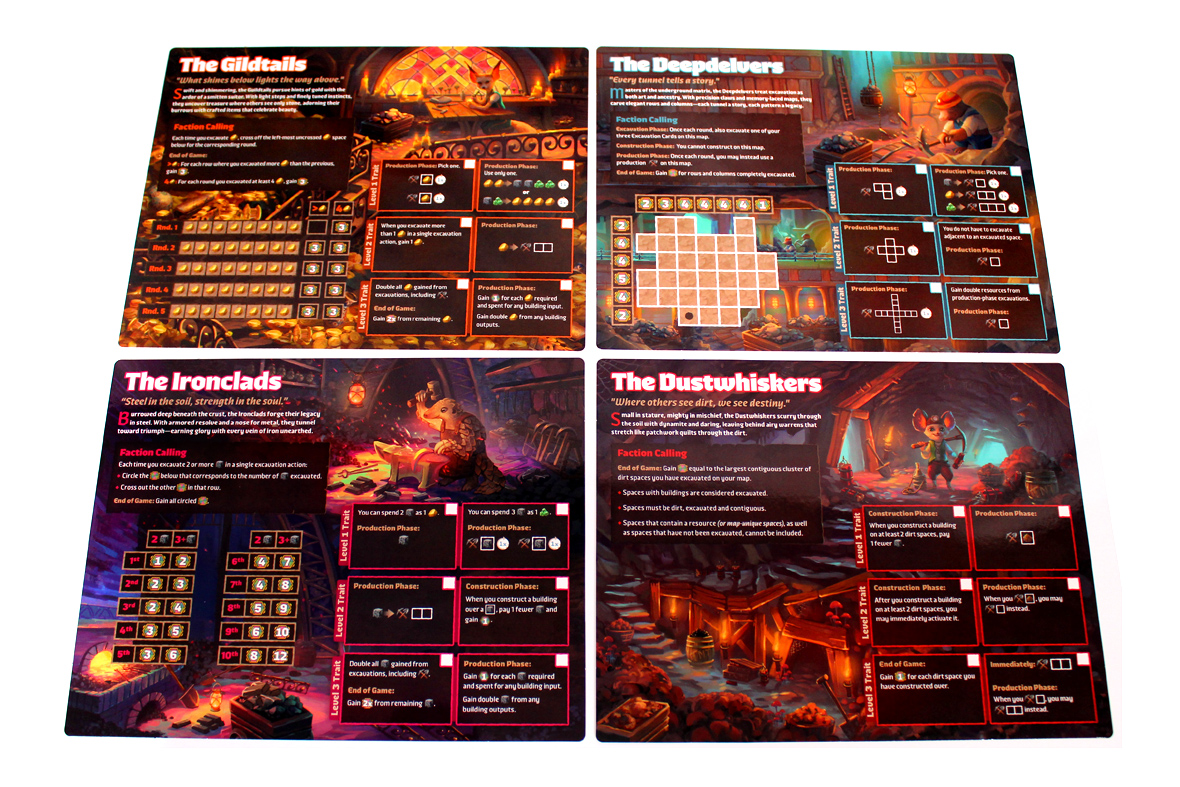
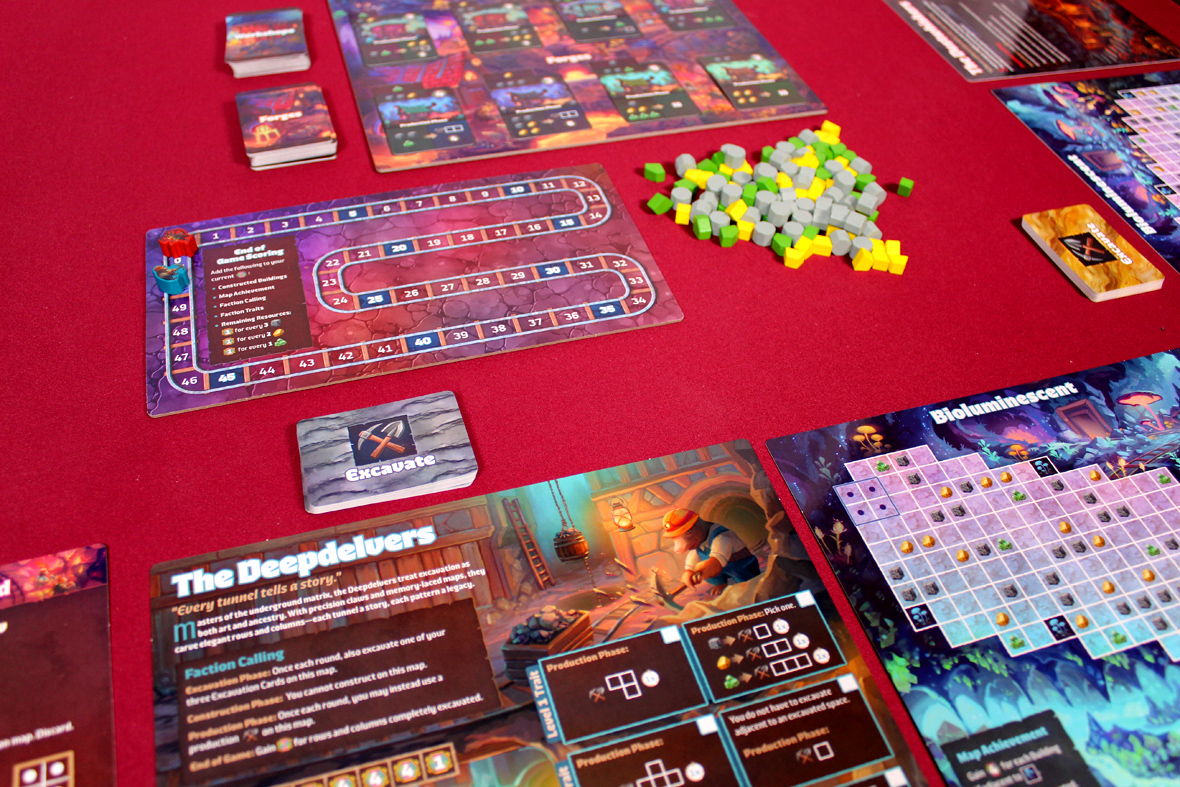
Actually, not a ton. Each player gets a character sheet:
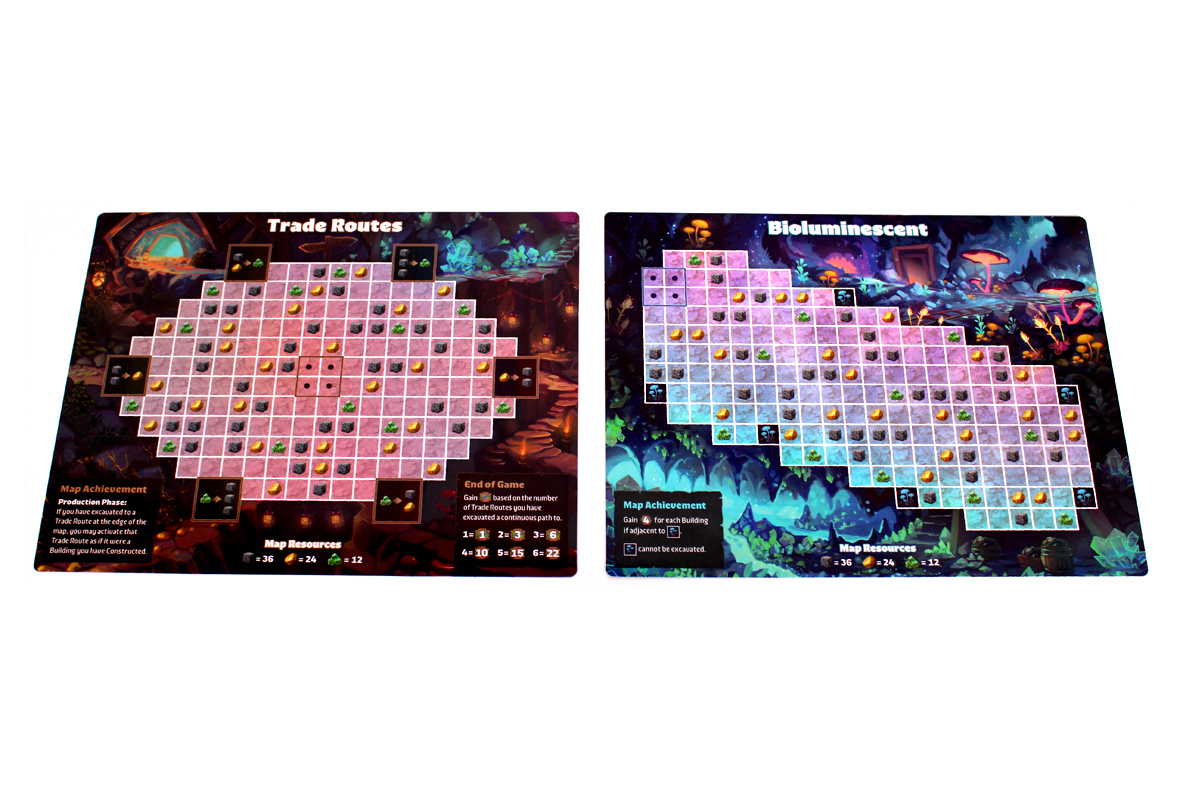
Choose a board to play on and give each player one:
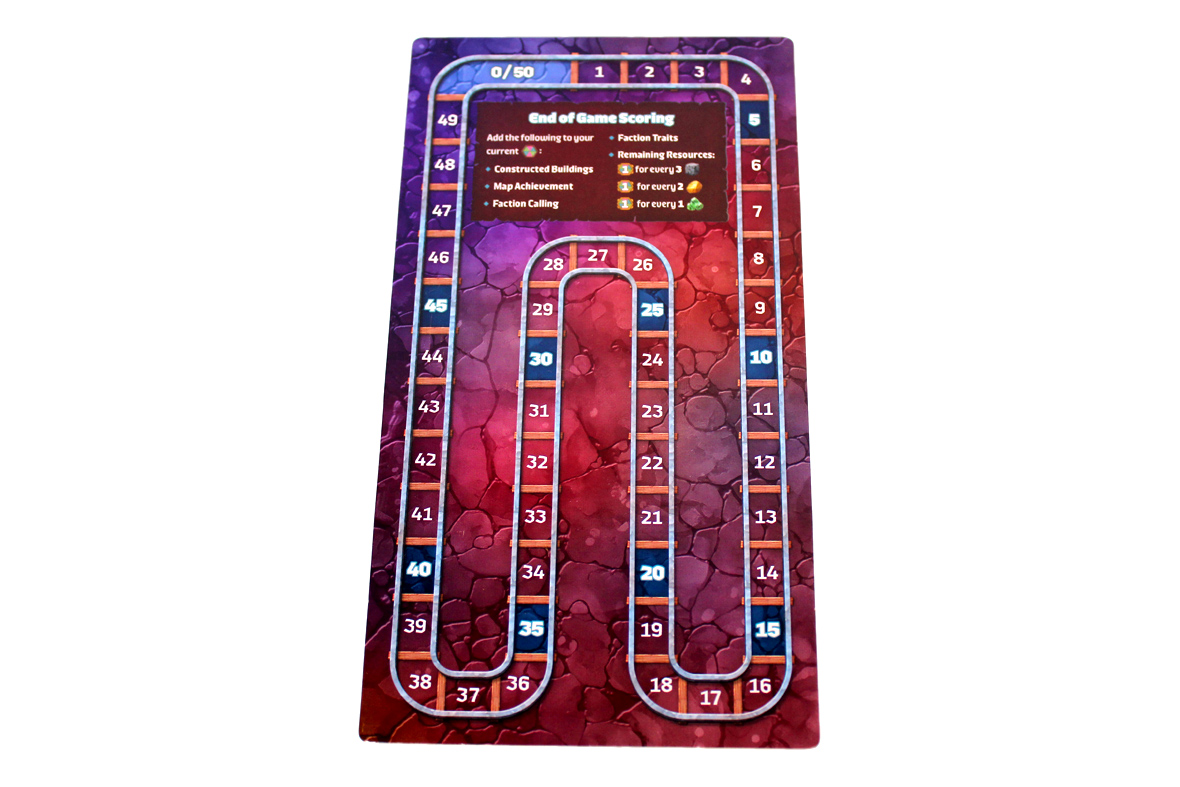
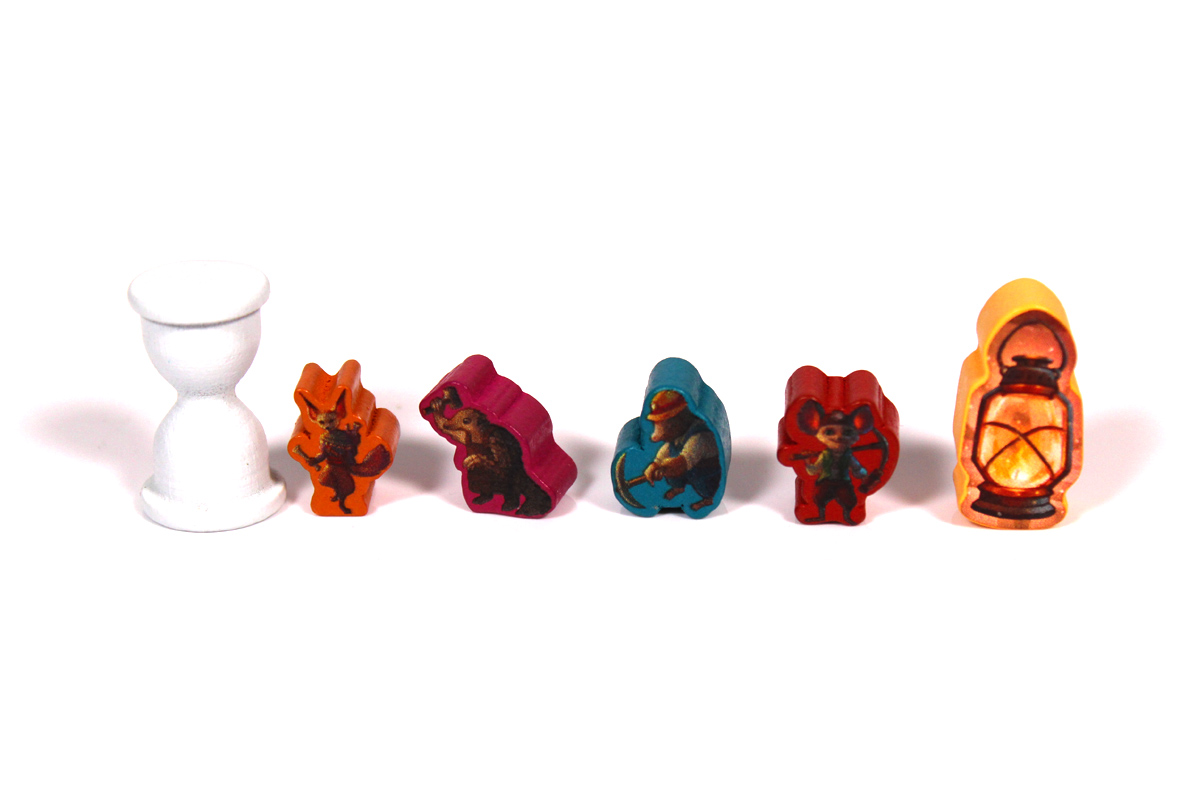
Place their corresponding player token on the scoreboard:
You can place the Round Token on Round 1 and give a player the First Player token:
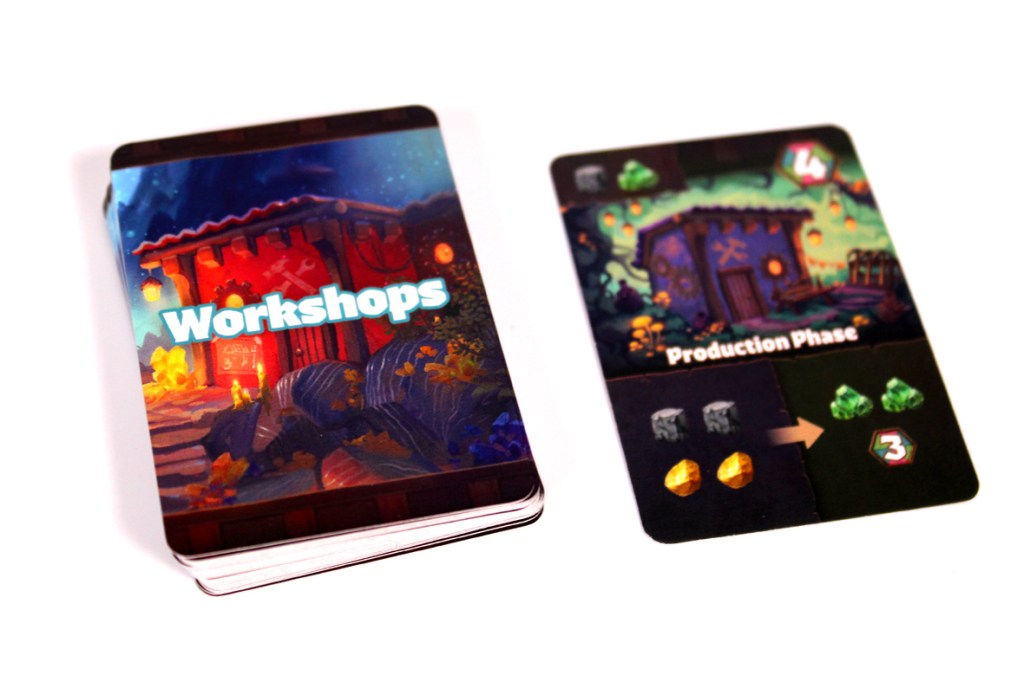
Shuffle the Workshops and Forges:

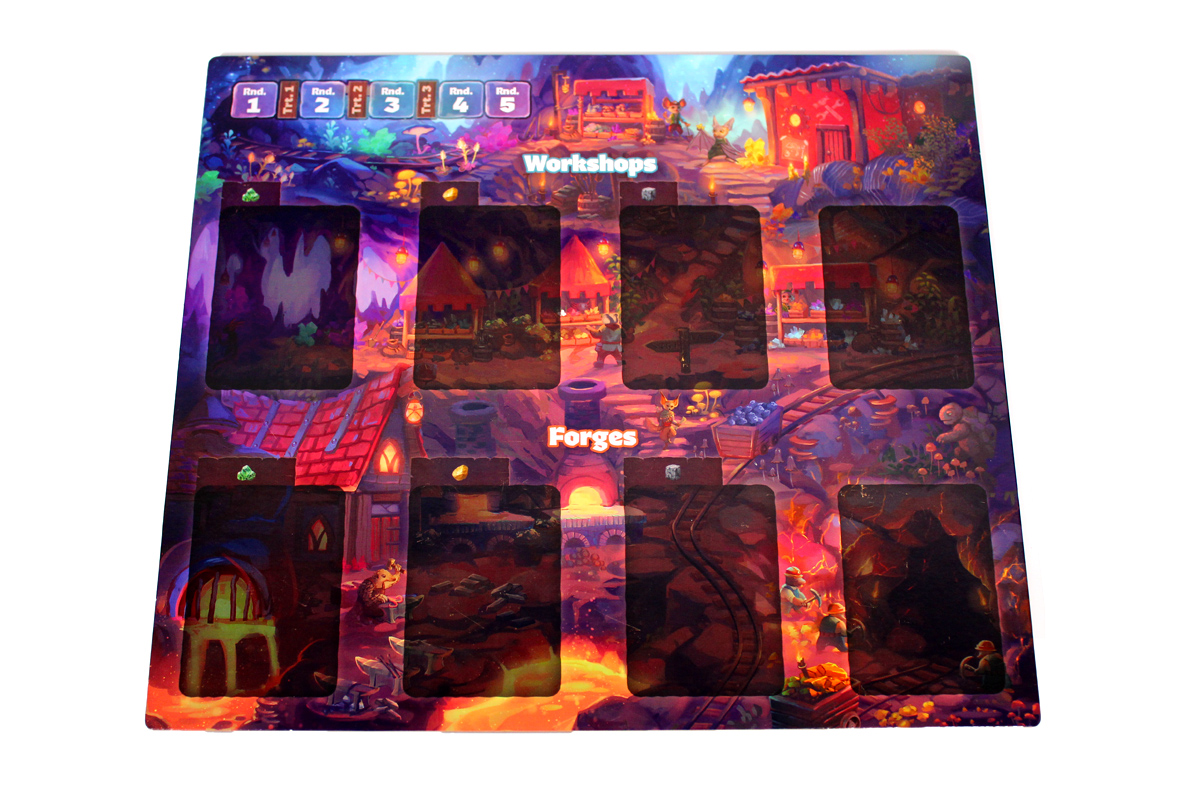
Fill out each row on the main board:
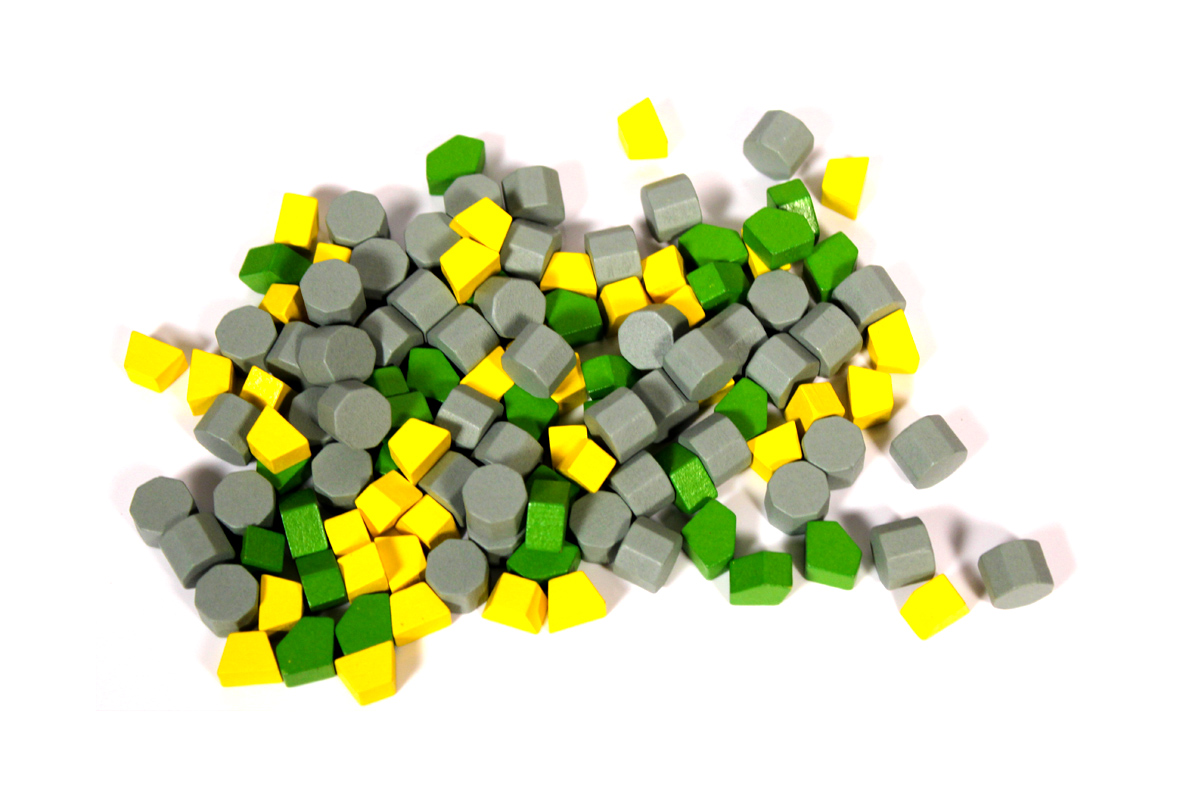
Set the resources nearby. Each player gets one of each, and players 2 / 3 / 4 get an extra iron / gold / gem, respectively.
You’re all ready to start! Handle any faction-specific setup, if there’s something for your character.
Gameplay
Your goal in Glimmerdeep is simple: get the most points. Getting there is, of course, the game, so let’s dig in. Pun intended, I guess.
To start a round, you’ll usually develop a Trait (except in the first and last round). This lets you pick one of the two player powers on your board (starting with Level 1, then 2, then 3). You keep one and lose the other. This will give you a new additional way to play as you progress deeper underground.
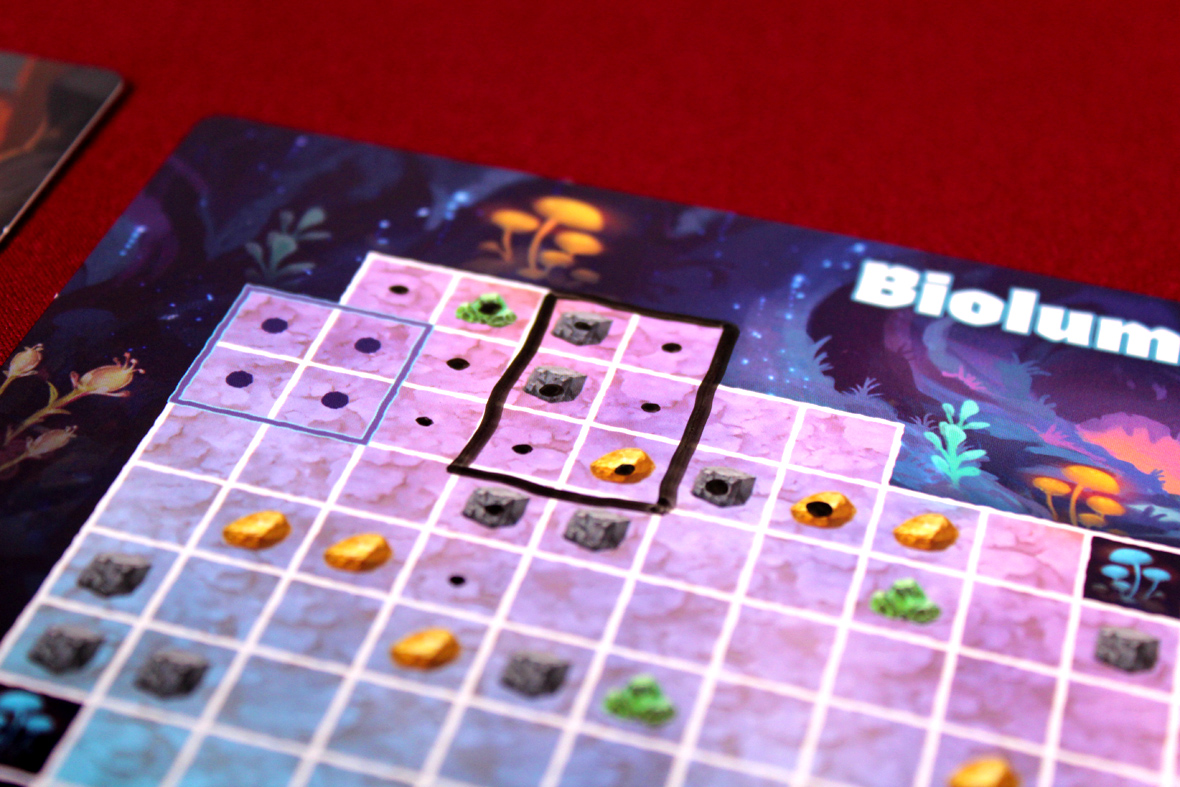
Then, you Excavate! Each player can do this at the same time. Flip the top card of the deck, mark off the indicated shape of spaces on your board with a dot (you can flip or rotate or do fewer spaces, but you have to start on a space sharing an edge with an already-excavated space). Do that three times. If you put a dot on a resource, you get that resource from the supply. Then, you can shop!
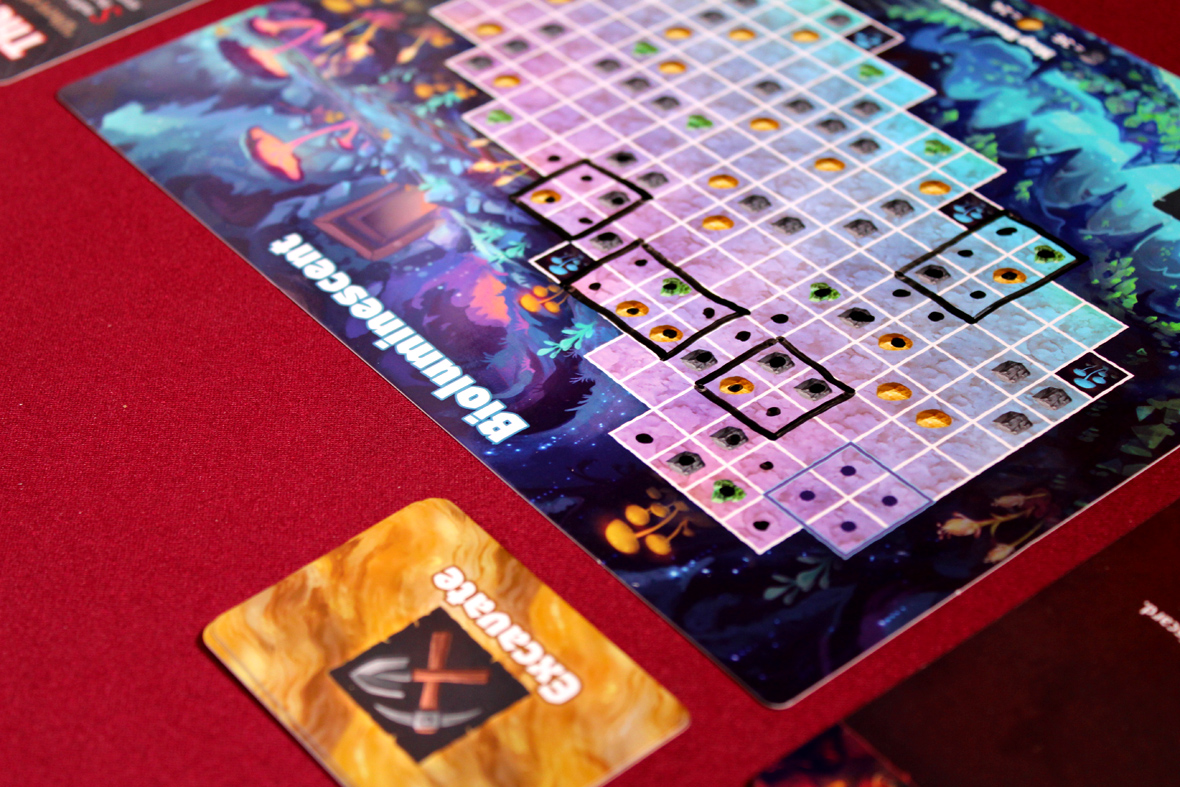
During the Market step, each player goes in turn order either buying a building or passing. Workshops are 2×2 buildings, and Forges are 2×3. To buy a building, pay the associated cost (top-left, including any extra costs on the board) and then take the card. You must then immediately draw the 2×2 or 2×3 shape on your board. You can rotate it, but the key thing is that it cannot be adjacent to other buildings (corners can touch). If you can’t place the building, you can’t buy it. After buying a building, slide the other buildings right to fill the space and then draw a new building into the left-most space. If you can’t or don’t want to buy a building, you can pass. This continues until every player passes (you may buy more than one building, but you can only buy one building per turn).
Then, Production! This is the engine at the heart of the engine-building game. You can activate each of your buildings (or powers, if relevant) once per round, usually providing resources as input and gaining other resources, extra Excavate actions, or points as outputs. If you don’t have the resources to activate a building, you cannot activate it … yet. You might be able to get those resources from another building! Try messing around with your ordering.
After Production, the round ends. Discard the rightmost two cards from the Workshop and Forge rows, refill the Market, and then pass the First Player token to the left. You can start a new round!
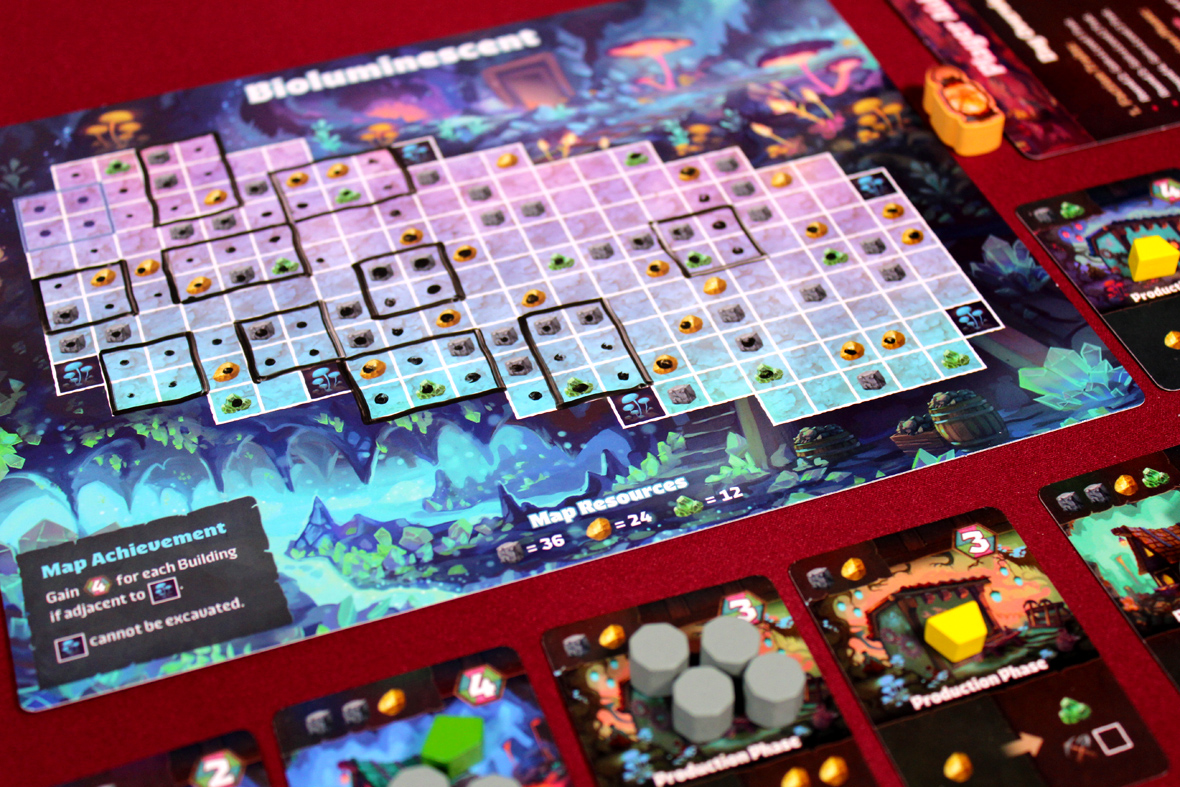
Following the fifth round, the game ends! Each player totals their points along with bonus points from resources (1 point for every 1 / 2 / 3 gem / gold / iron). The player with the most points wins!
Player Count Differences
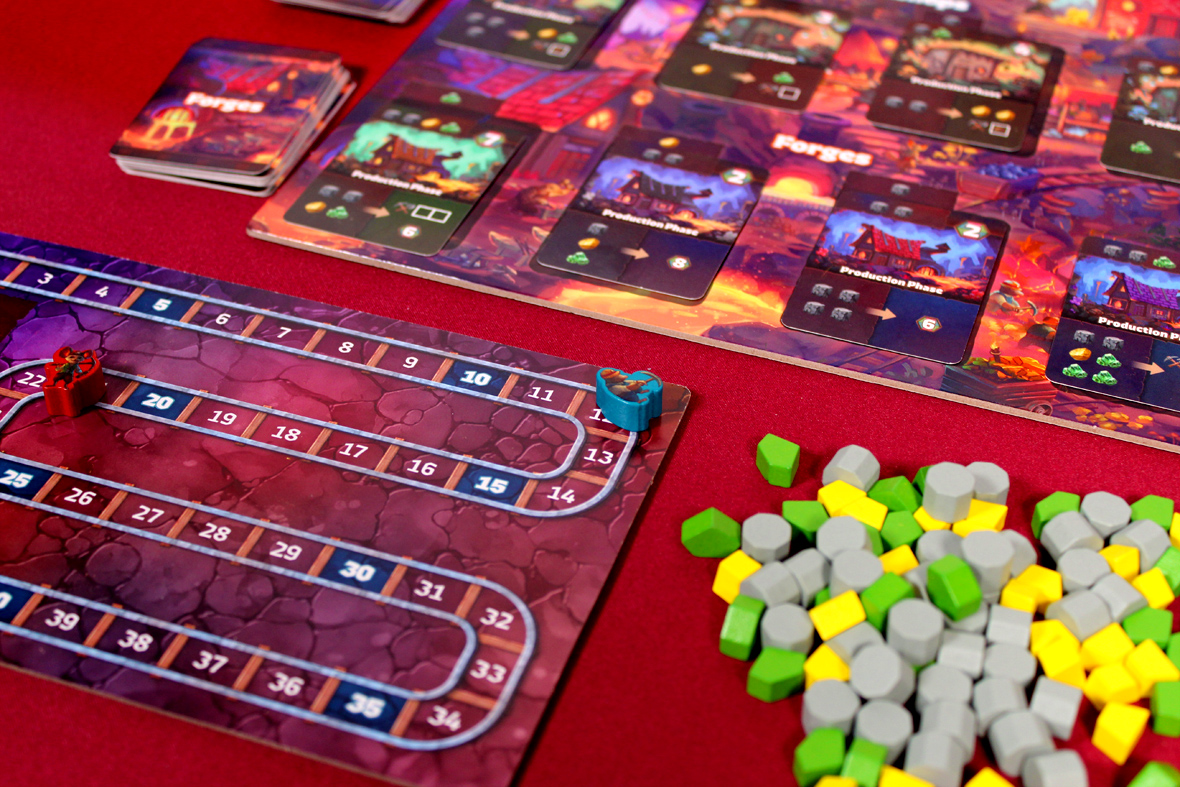
Not a ton, with this one. Here, the major difference between the players is largely going to come down to their abilities and trait choices, and, well, you aren’t playing on each others’ boards. The only way you can affect another player is by taking a card they wanted from the Workshop / Forge market. That’s not a really highly-interactive game (in what we think about as player interaction). Instead, you’re usually kept busy with the simultaneous play and then a little bit of a lull with more players individually buying Workshops or Forges. There’s also a larger table footprint required (since the player boards and the character boards are both so large), but that’s kind of expected as the player count increases, generally speaking. I lean slightly more towards the two-player game, but I wouldn’t necessarily say that higher player counts are out of the question.
Strategy
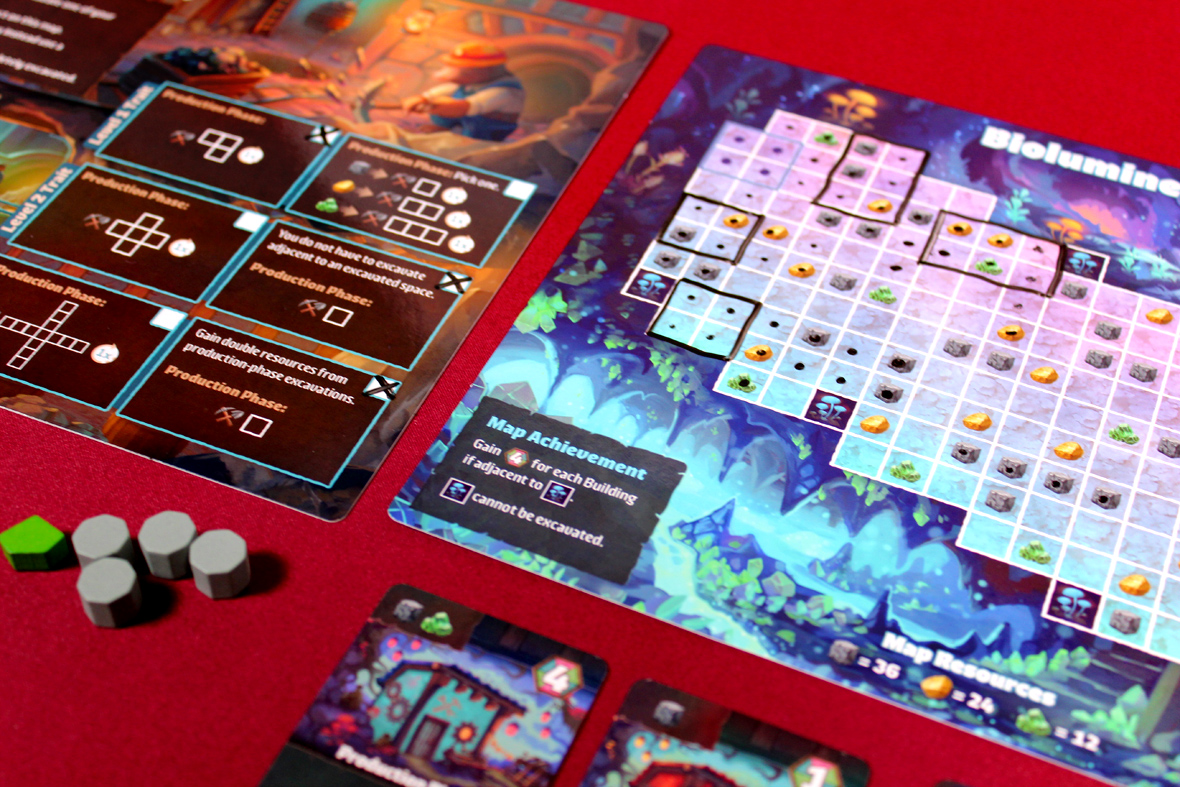
- Less of a strategy thing and more of a gameplay tip, but placing resources on the card to indicate that you’ve used the card is a very helpful way to keep track of things (or you can flip the card over, I suppose). It took me several rounds to start doing this and it saved me a lot of the cognitive load of trying to figure out what I wanted to do versus what I’ve done. Since you can only activate each building once per Production Phase, this matters! Just make sure you’re not hoarding resources that other players need; worst case, just place one on there to make it clear it’s been spoken for and discard the rest.
- You should have something resembling a plan. You should be seeking out resources that your buildings need so that you can produce and gain points and further excavations. This isn’t really a fly-by-the-seat-of-your-pants game (most engine building games are not), so think a bit ahead.
- Keep in mind that while planning is important, you can’t be 100% sure what buildings will be available to you. You need to stay flexible since even if a building is available to you, its cost might change if cards to its right are purchased. This may render a previously-purchasable building outside of your price range. It happens.
- Don’t neglect your player ability or your traits! Those are important ways for you to do something other players cannot, and that difference should be one of many you exploit to win yourself the game.
- Getting resources is critical, but don’t do that to the exclusion of finding a place to put buildings. If you just go after resources, you’ll be rich with absolutely no way to score points, which is bad. Plus, Production Buildings tend to be more efficient than just standard actions, so it’s worth making sure you can place (and use) as many as you want.
- For the Trade Routes map, going after sections that give you the ability to swap for resources you struggle to get can be helpful. Especially early in the game, your resources are going to be tight; try to have ways to figure out what to do next.
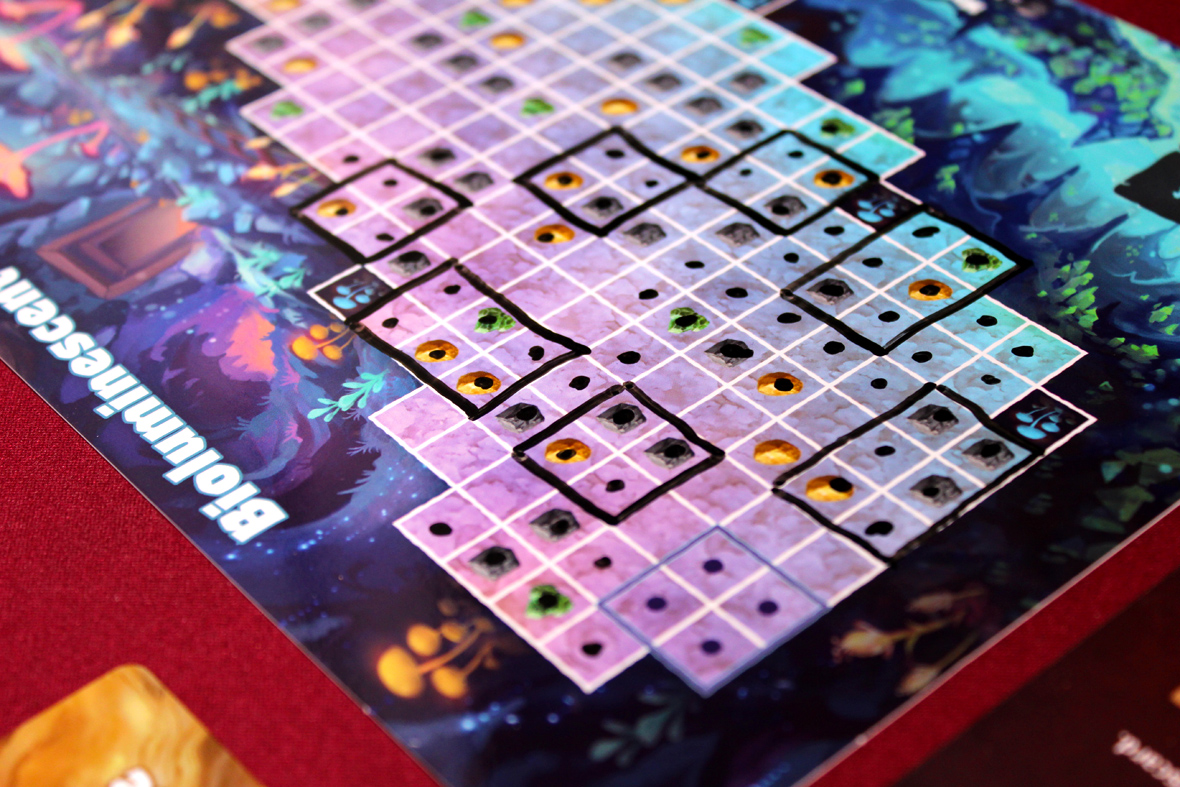
- For the Bioluminescence map, keep in mind that some of the glowy mushrooms can have two buildings adjacent to them if you place them right. That’s just a useful bit of corner-to-corner shenanigans.
Pros, Mehs, and Cons
Pros
- The art is quite nice! I like it! It’s got that deep underground feeling but it’s not, say, unwelcoming or something like that.
- I appreciate an engine-building game where you don’t need to know all the cards. This is more resource-based than like, having certain Buildings that are critical to your engine’s function and your game completion, which is nice. I’d say it’s a good entry-level game, but 60+ minutes is a lot for your first one.
- The flip-and-write aspects of play are very satisfying. I think I just like excavating; I have ever since Pokemon Diamond and Pearl, and it feels like you get to do that to some degree here.
- I like how much choice you have between your character ability and which trait you choose to learn each round. It feels like every game you can make different choices and plans and see where that takes you, so even though I want to try more characters, I want to also try a completely different loadout for the character that I ended up choosing.
- The game has a nice flow, and nothing feels like it takes too long. Sometimes these games can hang because players have too much to do or there’s too much downtime. I didn’t notice either of those being issues in this, and that was nice. I was initially worried about 60 – 75 minutes, but that was clearly unwarranted.
- I’m excited to see more maps and characters. That sounds like a great and easy way to add on more to a game that’s already looking great.
Mehs
- The player pieces are alarmingly small. The scoreboard could have been larger, but I worry about those player pieces. They’re like, “accidentally eaten” small, which isn’t good for a board game.
Cons
- There is a slight rich-get-richer element to how the engine-building aspect of the game works; it may be worth helping players new to the genre with the first round or playing a friendly game so that folks don’t get frustrated if things aren’t coming together for them. If you don’t connect your Workshops and Forges together usefully, you’re going to be missing out on a lot of production resources and extra excavations and points and such. That may not be super intuitive for some players, so show them how a few things work or help out if you can.
Overall: 8.5 / 10
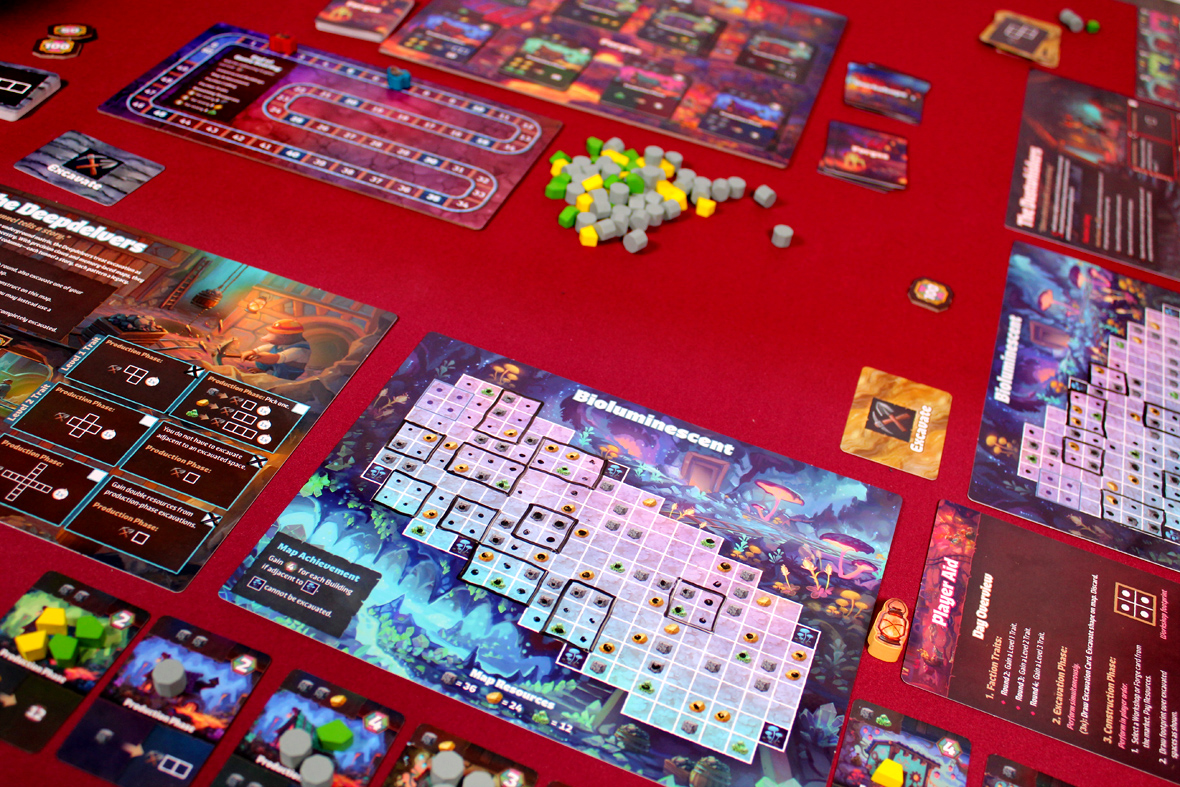
Overall, Glimmerdeep is a lot of fun! I was initially a bit skeptical of the playtime since, from the read, it seems like a lighter game, but it ends up being a great example of an engine-building game that actually lets you build the damn engine. I’ve played a few in the past where you end up constructing the engine and then getting kneecapped in the final round by not being able to fully execute it in its full glory. Glimmerdeep has no such problem. Not only do you get to do the fun part, but the actual building of the engine is also quite entertaining. You’re digging for resources and placing buildings as you dig and then using the buildings you placed to get more resources. It’s a hoot. Plus, there’s a good amount of variability as you play! Not only are there different characters, but as you level up their traits you can modify their playstyle to suit yours. Plus, a few maps to boot. It was fun to explore, and I think the combination of exploration game and engine-building game really suits it. You’re not really getting into what I hate about engine-building games (players benefitting from knowing all the cards), but there’s still a nicely-placed skill ceiling for players who are willing to engage with the game at a deeper level. I’m certainly interested in playing more. If you’re looking for a cool engine-building game, you like a flip-and-write with a bit of depth, or you just want to dig a hole and see what happens, you’ll likely enjoy Glimmerdeep as well! I’m looking forward to my next game.
If you enjoyed this review and would like to support What’s Eric Playing? in the future, please check out my Patreon. Thanks for reading!
 What's Eric Playing?