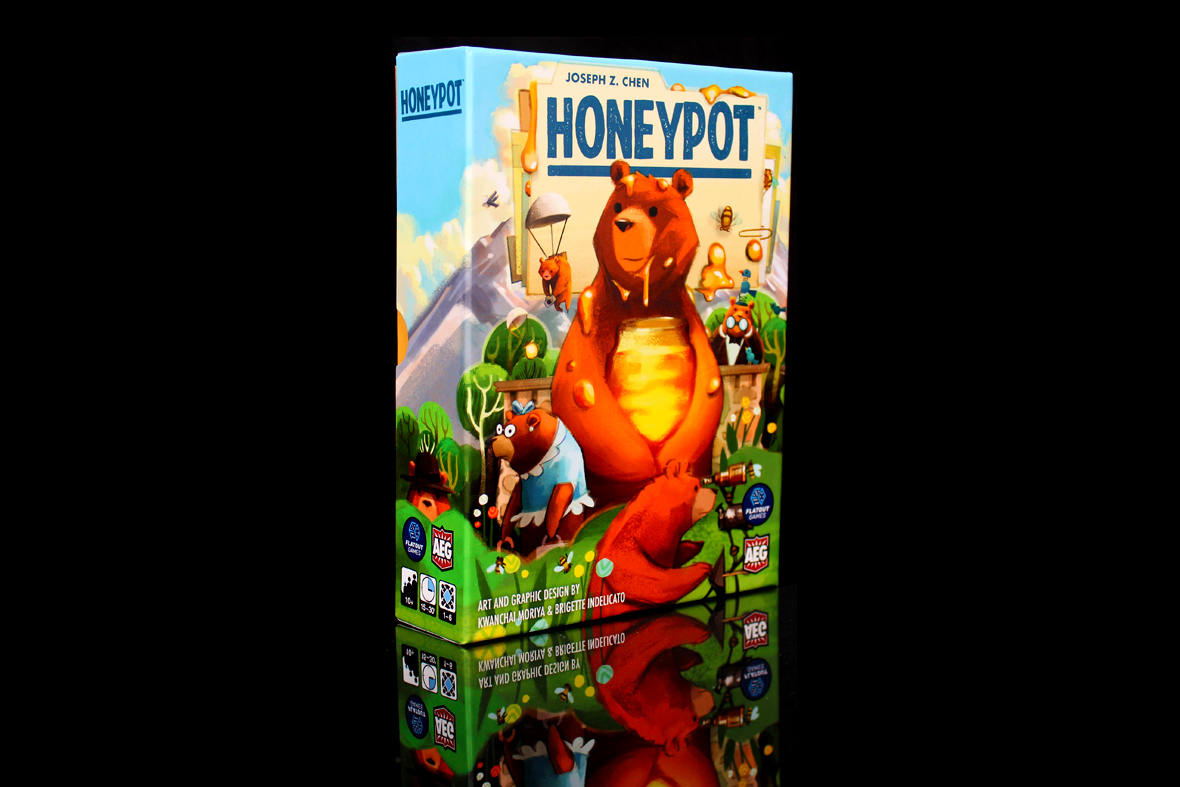
Base price: $XX.
1 – 6 players.
Play time: 15 – 30 minutes.
BGG Link
Check it out on Kickstarter! (Will update link when Kickstarter is live.)
Logged plays: 1
Full disclosure: A preview copy of Honeypot was provided by Flatout Games. Some art, gameplay, or other aspects of the game may change between this preview and the fulfillment of the Kickstarter, should it fund, as this is a preview of a currently unreleased game.
Nothing says Valentine’s Day quite like me being behind on reviews, but I’d rather not work on them tomorrow for a variety of reasons, so we’re plugging away today! It’s not like I have plans, so I’m particularly unburdened, though there’s a Pokemon GO thing somewhere near my house that I should pay a little attention to. We’ll make it all work. This week is another strong Kickstarter week, which is particularly tough since last week was and next week is looking strongly like it’s going to be also. Maybe February and March are just big launch months? Who knows. Either way, this week is some cool stuff from our friends at Winsmith and Flatout, so let’s check out one of Flatout’s small box releases: Honeypot!
In Honeypot, you’ve cracked the secret to high-quality espionage: bears. Bears are stealthy, difficult to track, and virtually unnoticeable in the right circumstances. What circumstances those are, I don’t know, but I’m not a spymaster (which is exactly what I would say if I were a spymaster, heh heh heh). To become the best spy, you obviously need secret spy caches, and intel, and codebooks, and no bees. These are critical ingredients to espionage. Bees are anti-espionage. Berries are neutral but tasty, so might as well have them. Unfortunately, your opponents have set up the caches, so there’s no way to know what will help and what will ultimately be bees. Can you bear the burden of becoming the best spy?
Contents
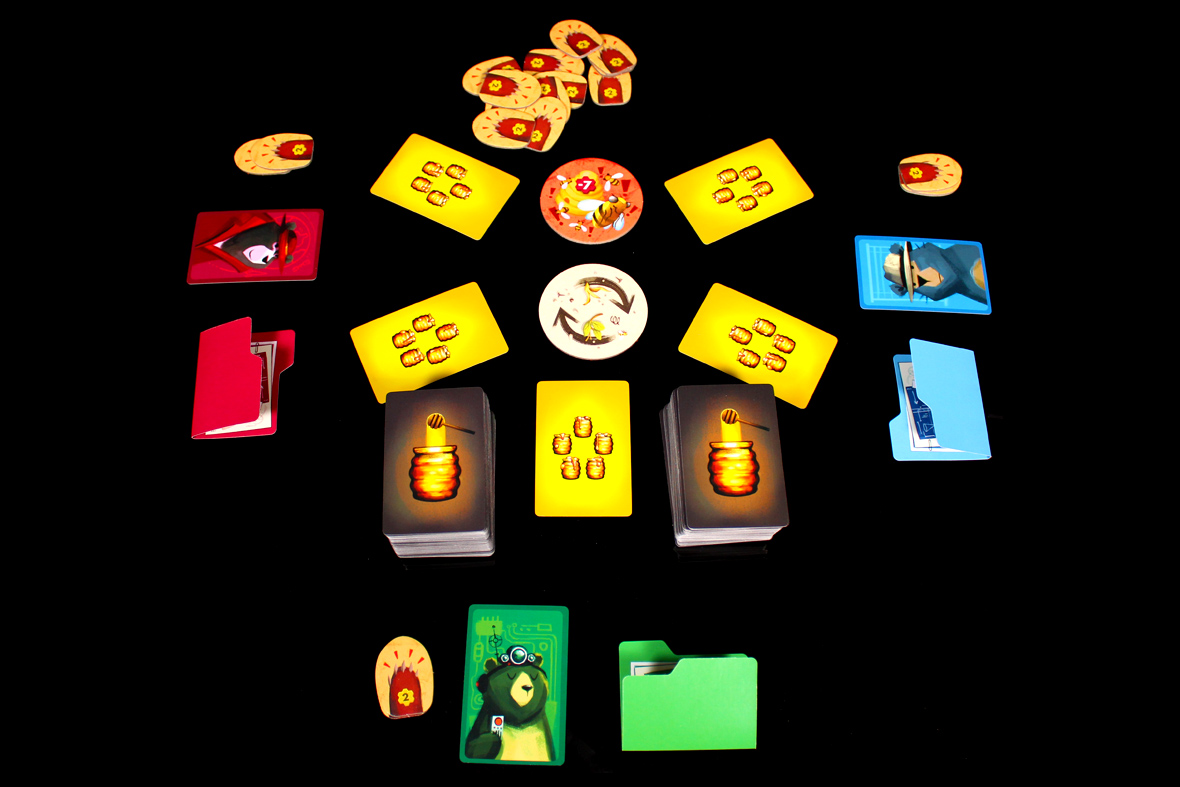
Setup
Pretty straightforward. Shuffle the cards:
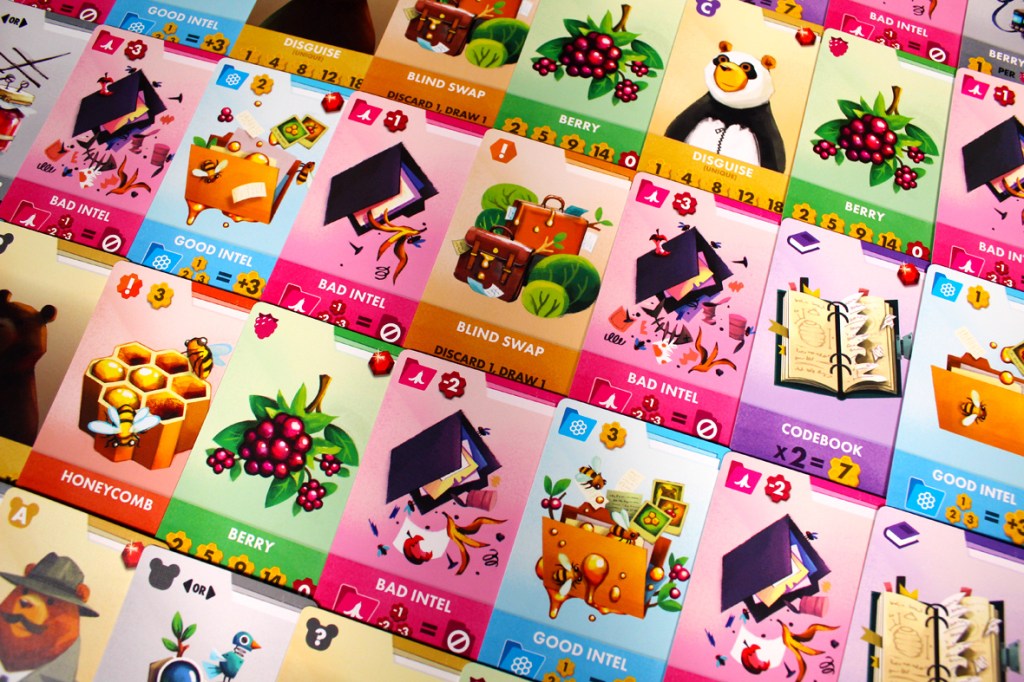
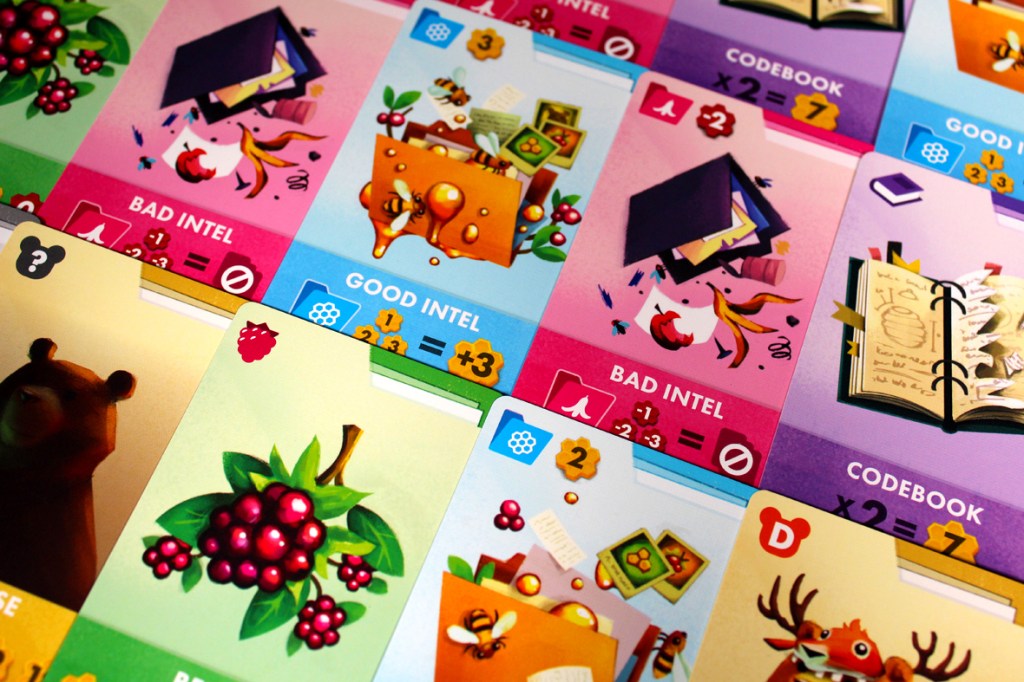
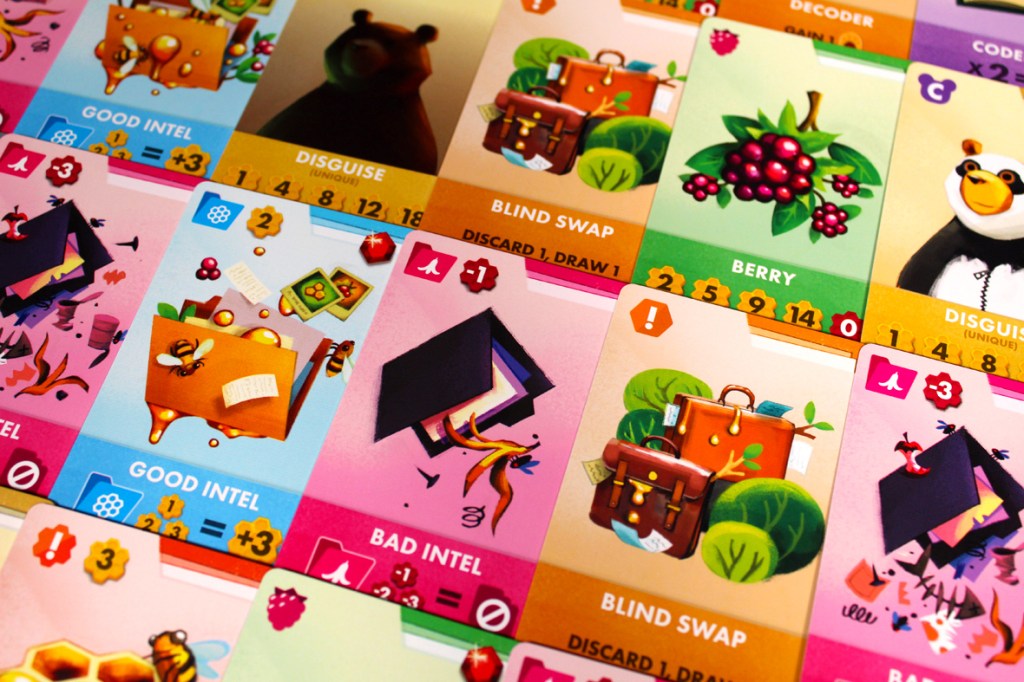
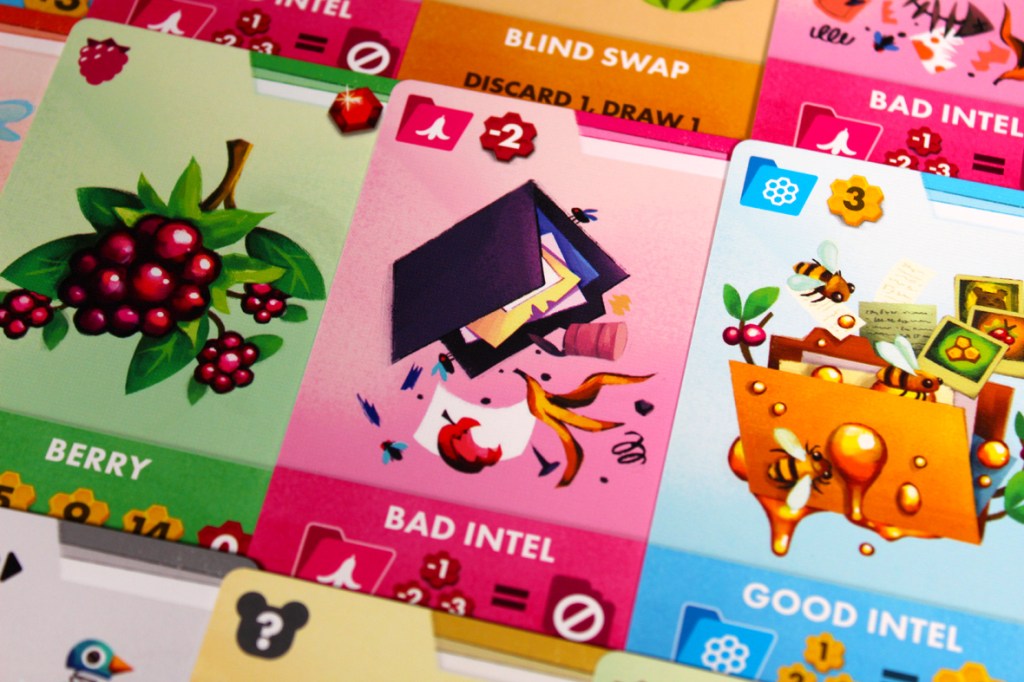
You can make one or more decks as needed. Each player gets a character and a Secret Cache Folder:
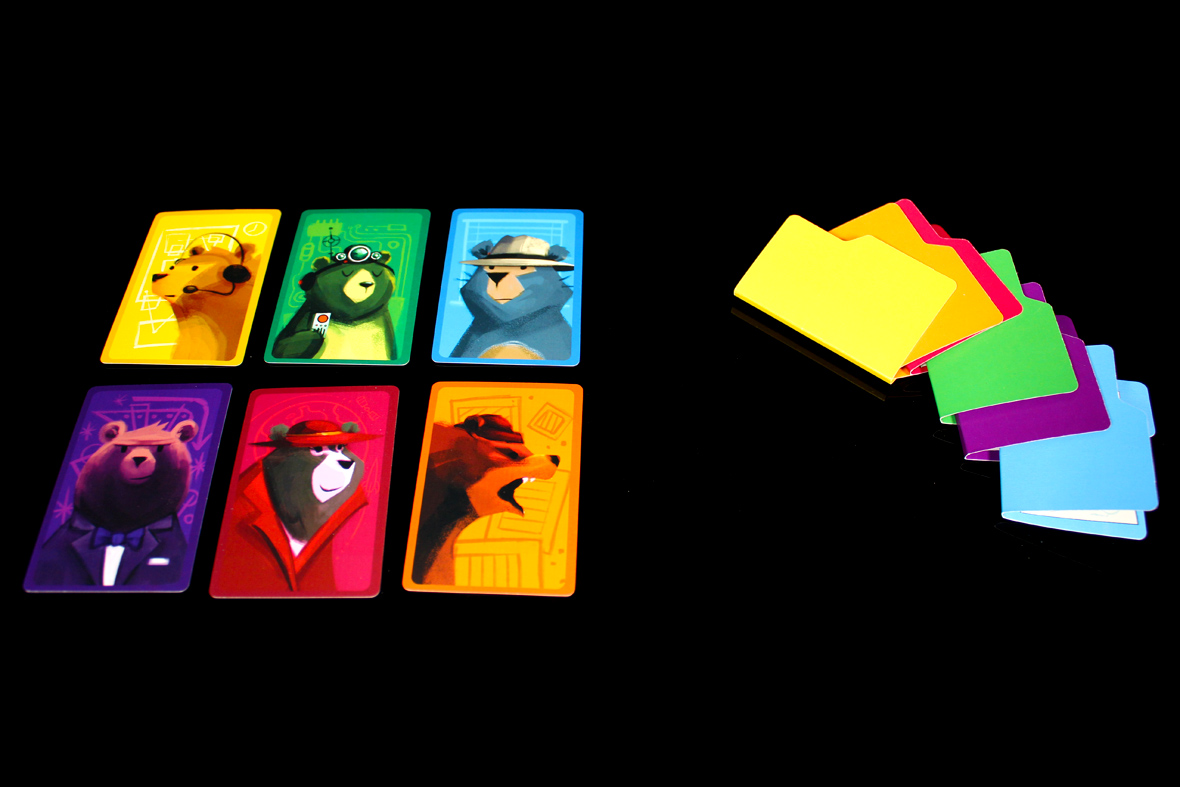
Set out five Round Bonus Cards, face-down:

Each player gets two Swiping Tokens:
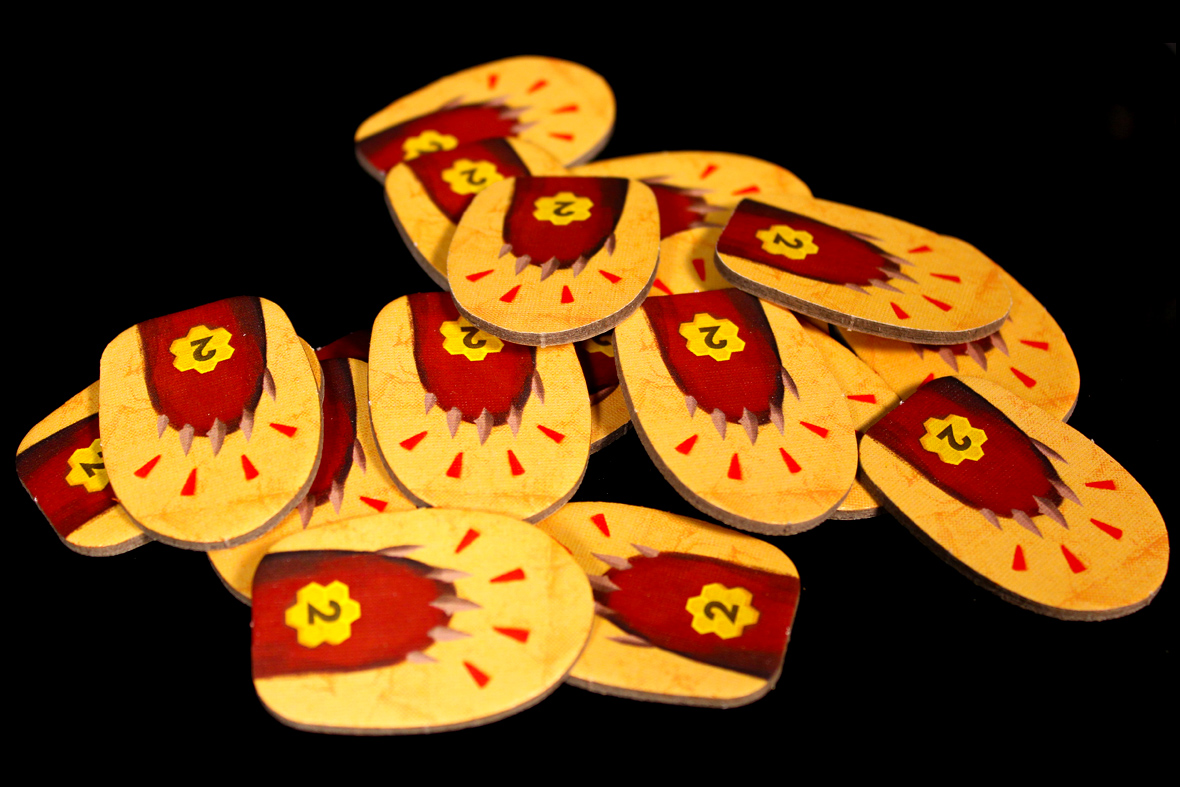
Set the Bees token nearby and give one player the Turn Rotation Marker to indicate that they’re first player.
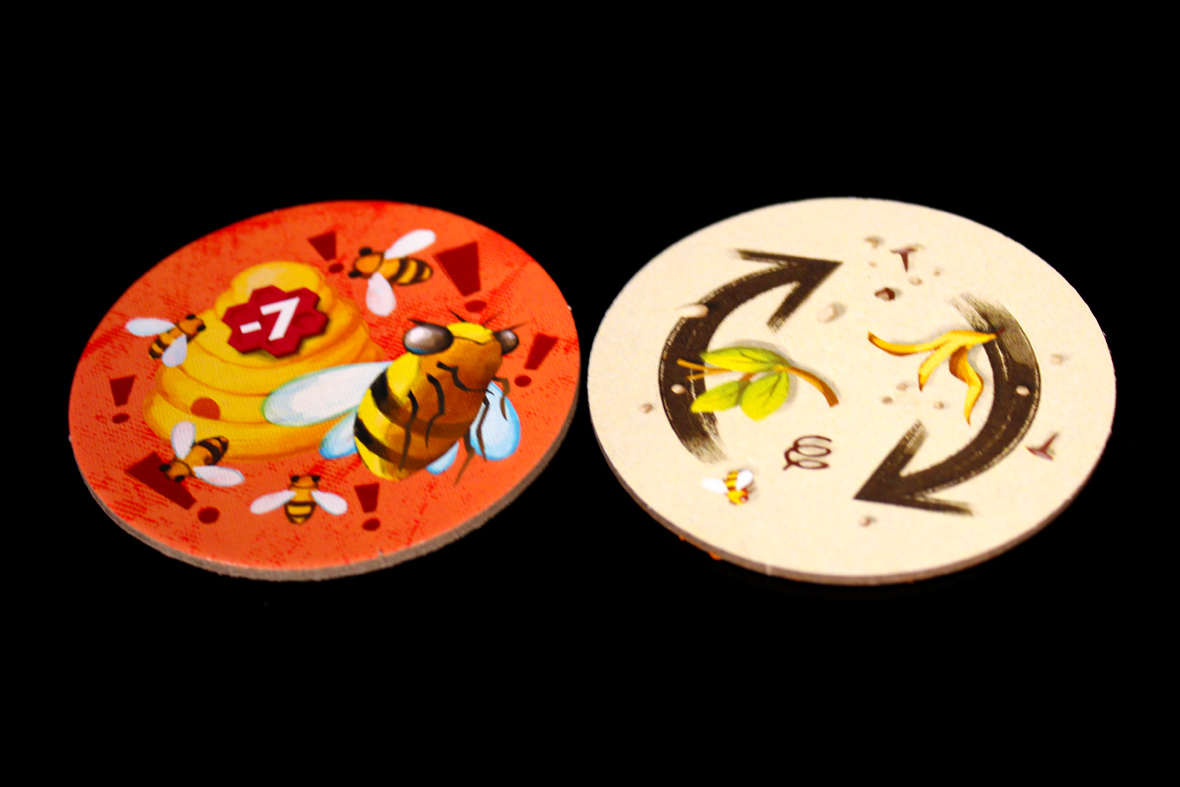
And you’re all ready to start!
Gameplay
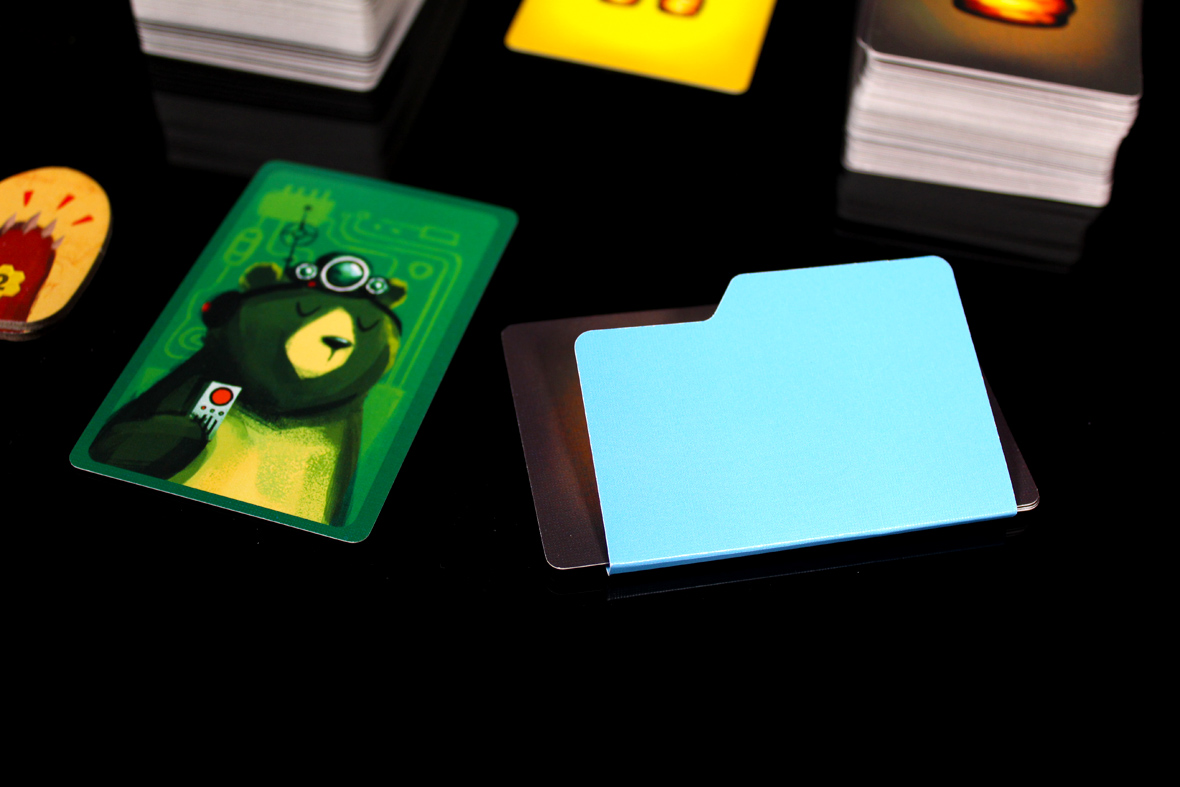
Honeypot isn’t too complicated, but it’s very fun. Each turn, you’re going to try to trick your opponents into taking cards they don’t necessarily want.
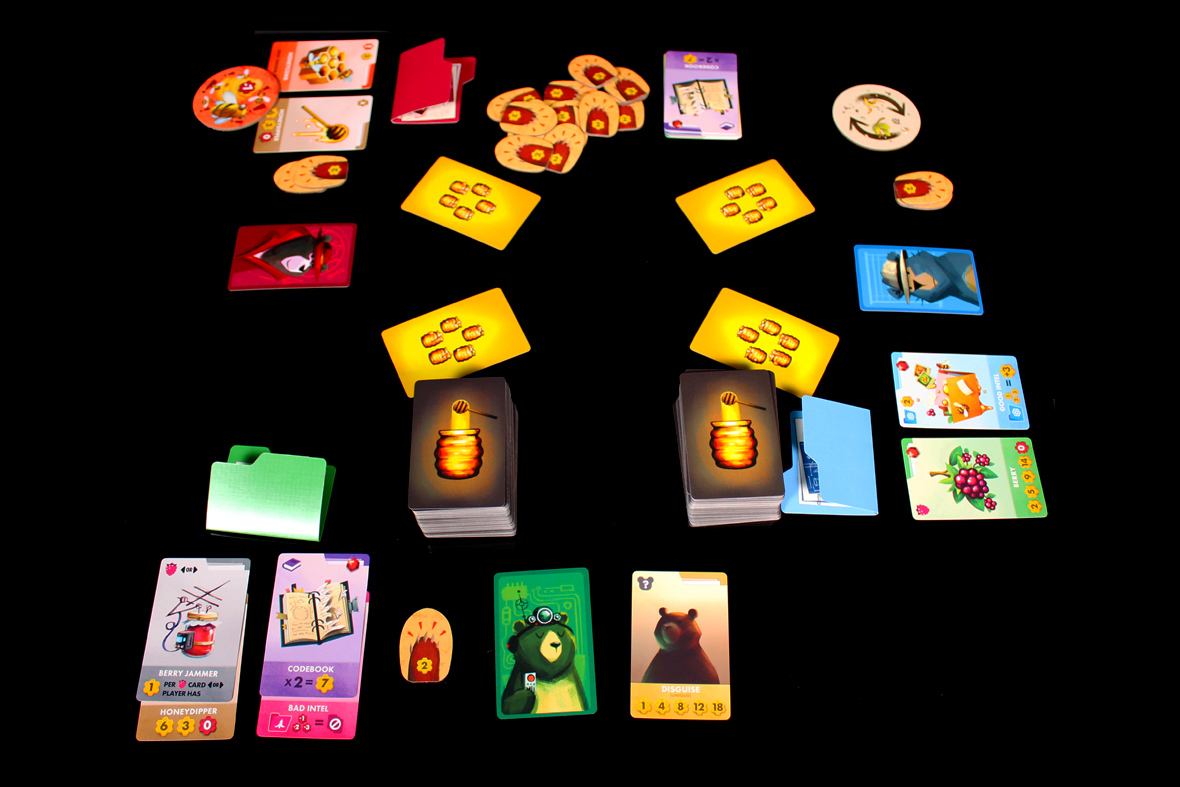
To start a round, each player draws six cards from the top of the deck. Then, look at them and place them face-down in a stack inside of your folder and pass your folder to an opponent following the Turn Rotation Marker. Once everyone has done so, the first player starts with the reveal.
Each player, on their turn, will reveal from their cache. You do this by flipping the top two cards of the cache and then making a decision: do you keep them or discard them? If you discard them, you reveal the next two and make the same decision. If you discard those, well, you must keep the final pair. So be careful! If you decide to keep the pair early, then the next player in turn order has a fun decision: they can spend a Swiping Token to swipe your cache and keep going, following the same rules (keep or discard, then must keep the final pair). The player after them can swipe too, if there are any cards left! If they choose not to swipe or cannot swipe, then the remaining cards in your cache are discarded.
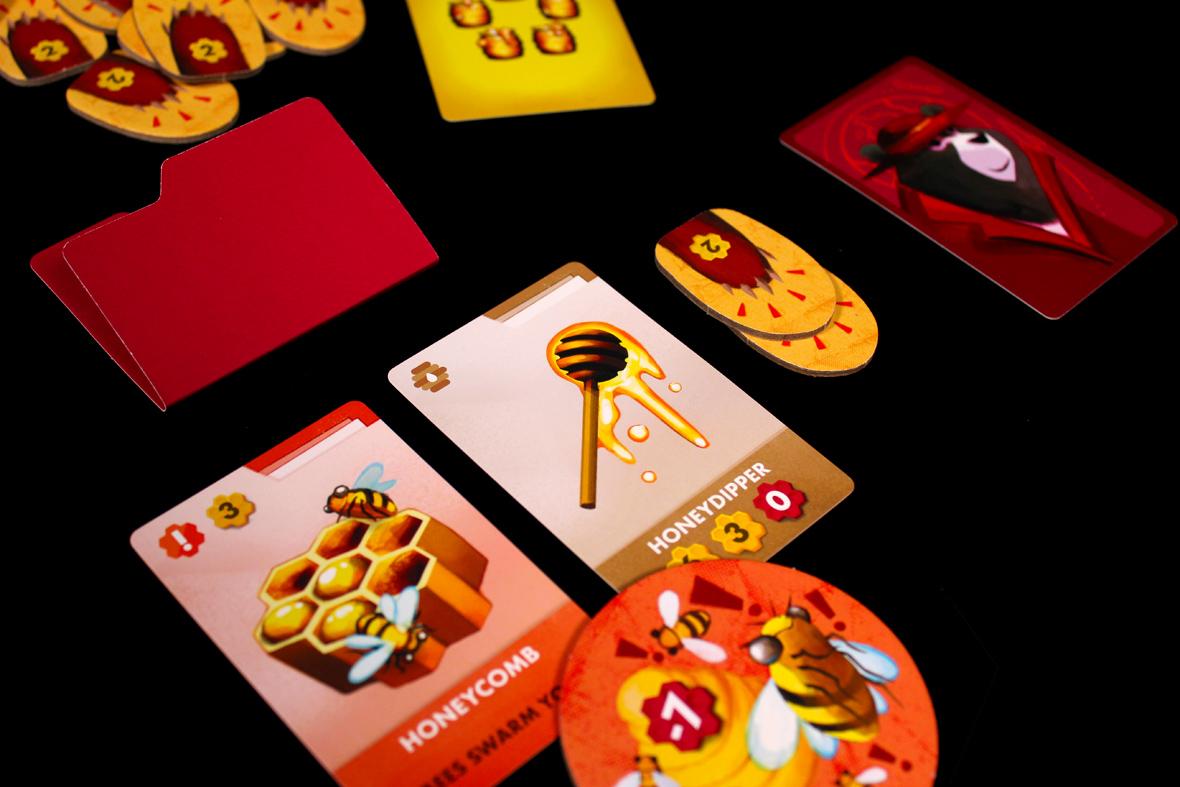
Cards have many different effects based on how they’re collected. Some work best in unique triples, some just score per unique card, some are just negative points, and various other effects. One particular one, Honeycombs, earn you points but also attract Bees! The last player to play a Honeycomb card claims the Bees token, and it’s worth -7 points if you still have it at the end of the game.
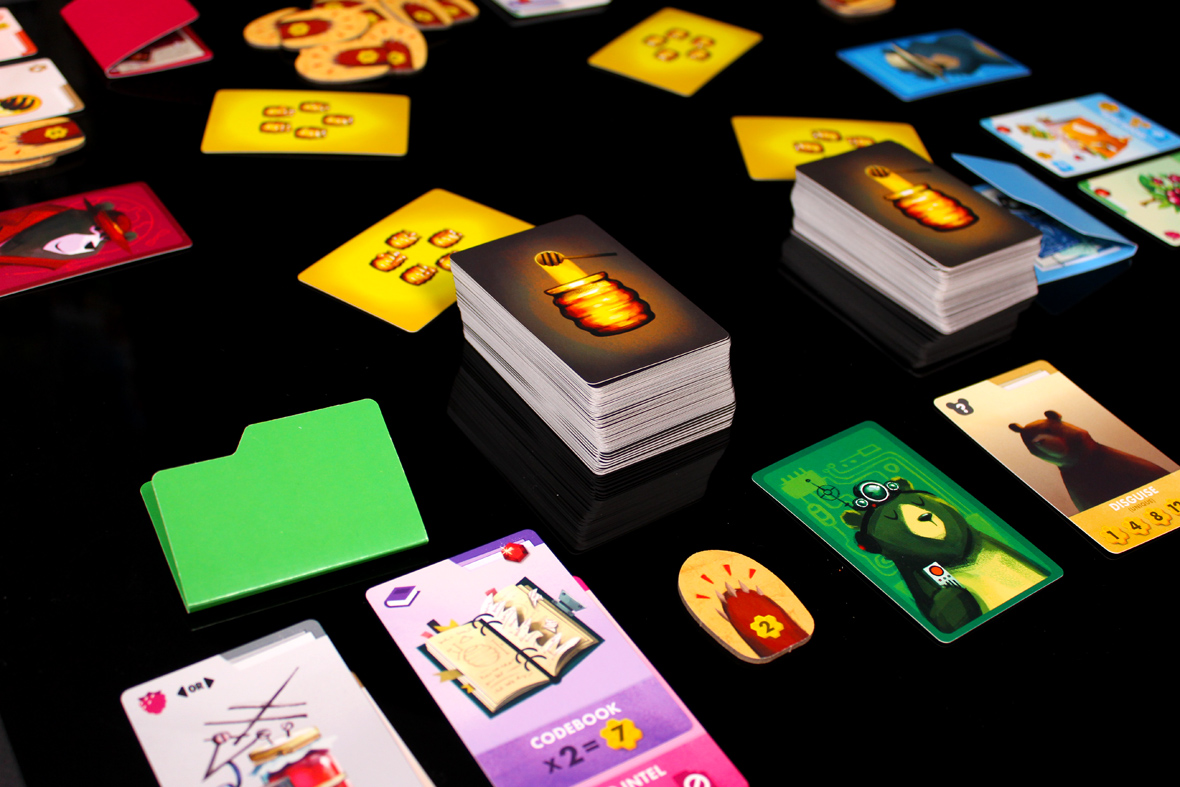
When all players have kept and discarded cards from their cache, the round ends! The player with the most negative points from Bad Intel Cards specifically (sorry, Bees person) gets to claim a Round Bonus Card! If it’s an Action Card, you immediately do that action. Either way, flip the Turn Rotation Marker, pass it to the left, and start a new round.
After five rounds, the game ends. Total your points (including bonus points for the player(s) with the most rubies) and the player with the most points wins!
Player Count Differences
I was initially worried there would be more, but there aren’t too many here either. The major thing is that as the number of players increase, your zone of influence stays pretty much the same: the players to your left and right. This means that you don’t really have much sway over what ends up in the Secret Cache of the person across from you at four players, or five or six either. You just kind of have to hope that the players around you aren’t just giving them incredible caches full of priceless treasures, I suppose, which can sometimes be out of your hands. You do the best with what you have. You do still get to mess with players on your left and right. One specific difference at two is around Swiping. You obviously can’t swipe from the cache you gave your opponent; you already know what’s in there. Instead, at two players, playing a Swiping Token lets you essentially continue your turn with your current cache after you’ve decided to keep a pair. You flip the next pair and can potentially keep or move on from that (unless it’s the final pair, which you then must keep). That’s a pretty elegant solution to the problem, so I’m inclined to give it to them. There’s also a pretty robust-looking solo mode. No major preference otherwise.
Strategy
- Never let your opponents know what you’re thinking. I mean, don’t always set up your cache a certain way. Don’t always put the worst cards first or the best cards last; try rotating which set of cards are the “best” or even potentially mixing up what you put where. If you really want to mess with them, look them dead in the eyes while you shuffle or pretend to shuffle and then pass them that cache. Who knows what’s waiting below the first pair? Certainly probably not you!
- Also, don’t give them useful stuff if you can avoid it. Mess with them a bit more. You don’t want to give them particularly useful cards if you can avoid it, so you just have to always convince them that they’re getting the best of an otherwise-bad situation. That can be tough if you draw good cards, but feel free to say whatever you want. Mind games are always allowed.
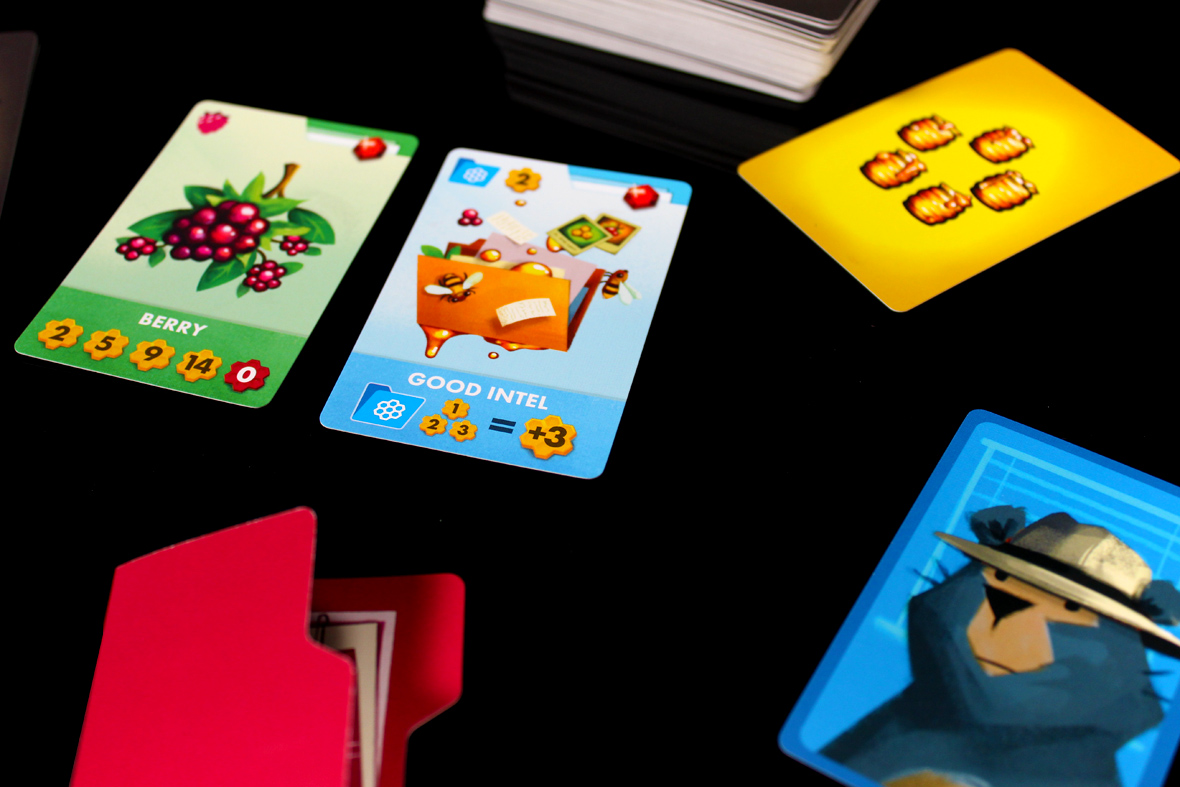
- Action cards are useful, but they don’t always get you points. If you just keep playing the “Discard 1 Draw 1” Action Card, you’re not going to win. That’s nice and all, but that’s a new card for the price of two (the original card + the Action Card). You want to net more cards, not fewer. For getting rid of terrible cards (a fifth Berry, extra Honeydippers), you can’t go wrong with Action Cards, though.
- Swiping is a useful action also! Just keep in mind that once you start swiping, you’re going to end up with two more cards. If those two cards aren’t great, well, you’ve only yourself to blame. And, I suppose, the player who assembled that cache.
- Taking Honeycomb first / early in the game may not be a particularly bad idea. Someone else is almost certainly going to end up taking one, either by a Secret Cache draw or just by drawing from the top of the deck. Taking the first one may seem bad, but it also may make you less of a target since you’ll have that -7 hanging over your head. Plus, while you have it, taking more Honeycomb cards isn’t terrible (though it’s not necessarily optimal, since plenty of other cards are worth 3 or more points.
- Making the third pair something really nasty is often fun. Make it the fifth Berry or a pair of Honeydippers or a single Honeycomb and a Bad Intel or something that will make your opponents scared to take the third pair for the rest of the game. It only needs to happen once to stick in their brain for a while.
- Taking a Bad Intel or two isn’t necessarily a bad idea. If you have negative points from Bad Intel, you get to choose and keep one of the Round Bonus Cards at the end of the round. This means that if you have one -1 point card and nobody else has any for the whole game, you’ll end up getting five free cards in exchange for 1 point. That’s not a terrible trade. If you collect a -1, a -2, and a -3, you can discard all three of them immediately, so it’s not necessarily terrible to gather more, either.
Pros, Mehs, and Cons
Pros
- This actually feels similar mechanically to a bit of Secret Hitler that I really liked: namely, that random chance may make your stack better or worse than other players’, even if you aren’t putting thought into the sort of it all. I like that you draw six random cards and have to set up the stack. It means they’re all inherently unbalanced and unequal, and your personal influence over what goes where turns that random noise into something that exists between shenanigans and hijinks. You love to see it. In Secret Hitler, this was often used to insert Plausible Deniability about what you played. Maybe you only got bad cards! You’re not bad, you just had no choice. Here, your opponent has no clue if the cards after the first pair will be better or worse, because they didn’t see what cards you drew! Similar energy and I like it even more in Honeypot.
- The mind games alone are half of the fun. You’re allowed to say basically whatever; it’s in the Bill of Rights. Here, you can lie and scheme and manipulate your opponents however you’d like within the scope of the rules. Sometimes I just tell them the next pair will be better and see what they do. It’s fun!
- The art is impeccable. I think Kwanchai Moriya is still one of the best artists in the business, and teaming up with Brigette Indelicato makes the whole end-to-end of the game look even better. It’s a hell of a team.
- I like the concept through execution. Bears, spies, and the honeypot. It’s goofy and excellent. Honeypot is a legitimate term and definitely something you’d hear about with bear spies. Plus, it’s a theme that’s relatively novel, which I always appreciate.
- Low intensity setup, which is always a plus. Just shuffle some cards and you’ve done most of the work.
- A nice casual game. We played it while we were waiting for dinner and then a bit after, and it was still plenty of fun as players slowly faded from being too tired.
Mehs
- A player aid for the different types of cards and their general scoring conditions would make the game easier to learn, I think. Some players struggle to know what’s good and bad, and while I think the cards are helpful and explain enough, I’ve also played a ton of games, so it might be easier if players have a reference that they can easily consult.
- It’s too many cards to shuffle. I can riffle shuffle with the best of them, but that’s too many cards for me. You end up having to break it up into sub-decks and shuffle those, which never make me feel like the cards have been completely shuffled properly.
Cons
- I do wish, at higher player counts, there were ways to more directly impact players who aren’t on your immediate left and right. This is mostly because I dream of being a nightmare, but in lieu of that there’s always trash-talking, I guess.
Overall: 9 / 10
Ok, so, I was a little worried when I agreed to review this game because, for those of you who appreciate Deep Lore, I don’t particularly like I-cut-you-choose as a genre. I have trouble with abstract valuations of things, so I always feel like I’m making the wrong choice both when I cut and when I choose. It’s stressful. That all said, I’m burying the lede. Honeypot is great. It smartly hybridizes I-cut-you-choose with push-your-luck into something new that’s very compelling. Now, you might worry, doesn’t that add rules overhead and make the game harder to learn? Surprisingly, the answer is no! Honeypot is super easy to pick up and learn, though a player aid for just the types of cards available would probably make the game a bit easier for new players. I’ve played a few of Joseph Chen’s games, at this point (mostly the criminally-underrated Fantastic Factories) and I think he’s got some rock-solid game design chops, and working with the Flatout folks to deliver Honeypot is one of the best examples yet. An excellent example of your favorite game in your least favorite genre. That alone would be enough, but Kwanchai Moriya and Brigette Indelicato on art and graphic design really ties the whole thing together. During the game, players are constantly engaged even when it’s not their turn by either having to deal with each others’ mind games or actively participating in said mind games. A particular highlight was one person commenting that another player had been given a particularly nasty pair of cards, only to remember that she was the person who gave her those cards. It was her stack. Nightmarish. But you’ll have moments like that all the time. You’re incentivized to mess with your opponents because if they decline to keep going, you have a shot at snatching some cards yourself! It all comes together nicely in a game that’s surprisingly new-player-friendly to boot. I’m a big fan of Honeypot, and if you’re looking for a great game for up to six, you like I-cut-you-choose, or you just want to see a bunch of stealthy bears, I’d definitely recommend checking it out!
If you enjoyed this review and would like to support What’s Eric Playing? in the future, please check out my Patreon. Thanks for reading!
 What's Eric Playing?