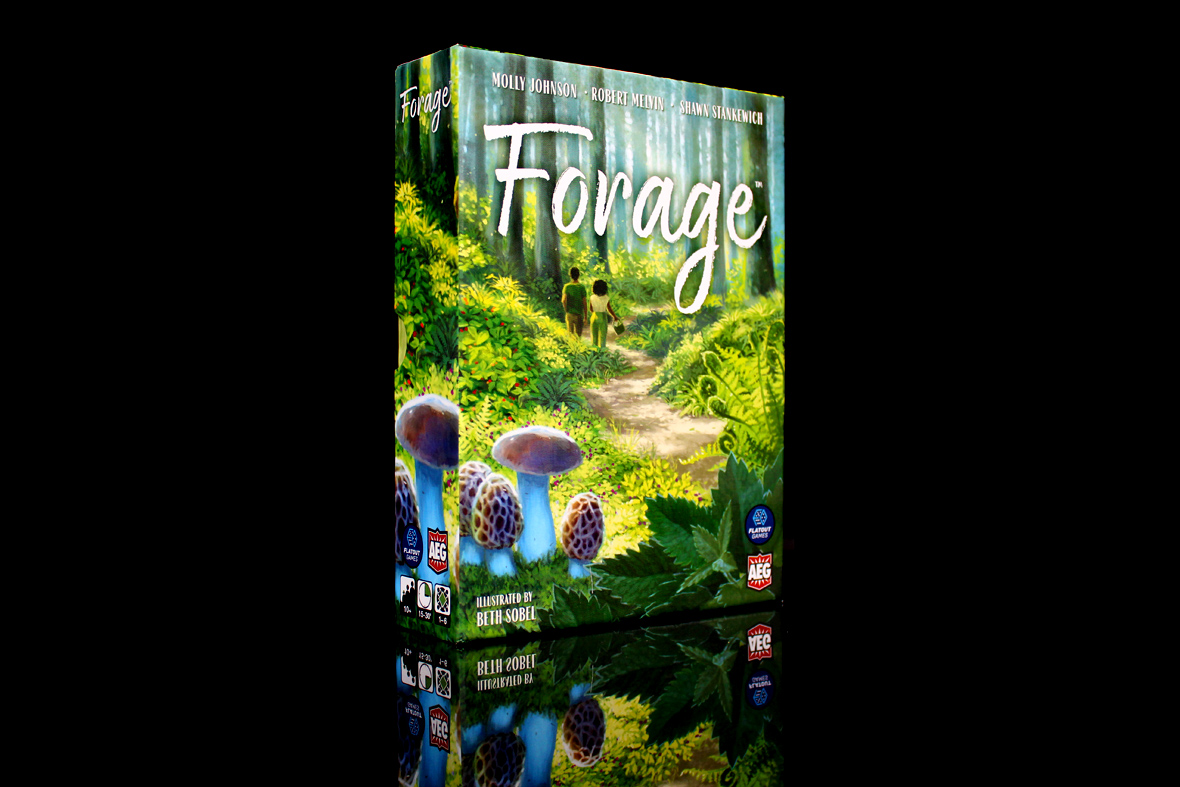
Base price: $19.
1 – 6 players.
Play time: 15 – 30 minutes, though I’m suspicious of this.
BGG Link
Check it out on Kickstarter!
Logged plays: 2
Full disclosure: A preview copy of Forage was provided by Flatout Games. Some art, gameplay, or other aspects of the game may change between this preview and the fulfillment of the Kickstarter, should it fund, as this is a preview of a currently unreleased game.
It is unfortunate and to my great annoyance that after a few years I’m realizing I’m significantly more productive in my office than I am on my very warm and comfortable couch. Is part of that that it’s very cold up here and I’m typing and editing photos as fast as I can to get back under a blanket? Probably. Is that some weird form of self-torture? Probably. Is any of this relevant to you personally? No. But, this does mean that we’ve got new reviews for you this week, fresh off the presses before I fly to GAMA Expo next week in … Kentucky. Maybe I’ll rejoin GAMA once they move the Expo, but I really can’t reward any organization for this kind of silly behavior at present. This is the first layover I’ve had since I moved to Seattle. I’m preemptively irritable about it even though Slay the Spire II is coming out in like, two weeks. Expect that to negatively impact the pace of my reviews for a day. But I digress. Let’s see what the next Flatout game has in store for us!
In Forage, well, you’re doing that. You love a mushroom. You put them in your pantry, you find them in the forest, you give them as gifts to your friends. It hasn’t made you popular, but people do call you Shroomy and Redcap and, one day, DJ Mush. This, sadly, isn’t a game about that last thing. You can also find leaves and berries, but let’s be honest; we know what you’re about. Roll some dice and get in there to see what you can find and let the experience help you grow! Just, you know, don’t waste too much time. Forests can be a little weird if you spend too much time hanging out in them. Will you be able to find what you need in the wilds?
Contents
Setup
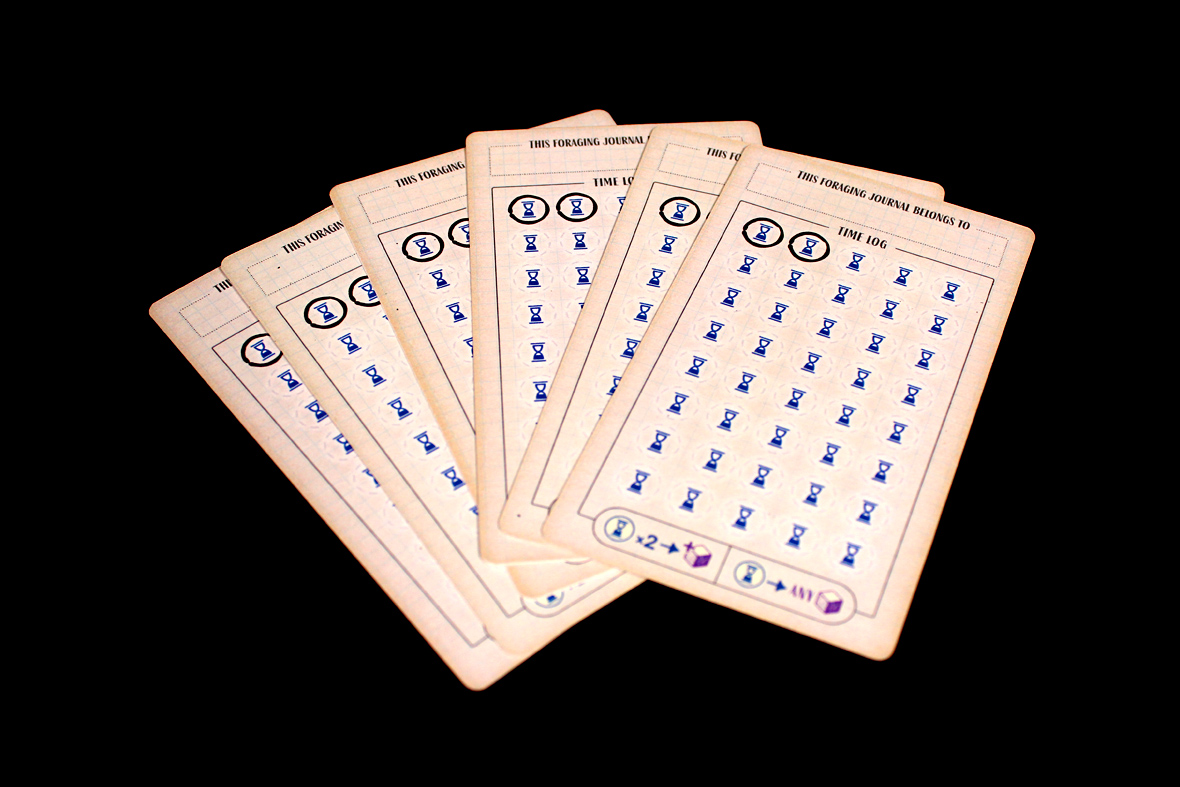
Not too bad, here. Each player gets a Time Tracker:
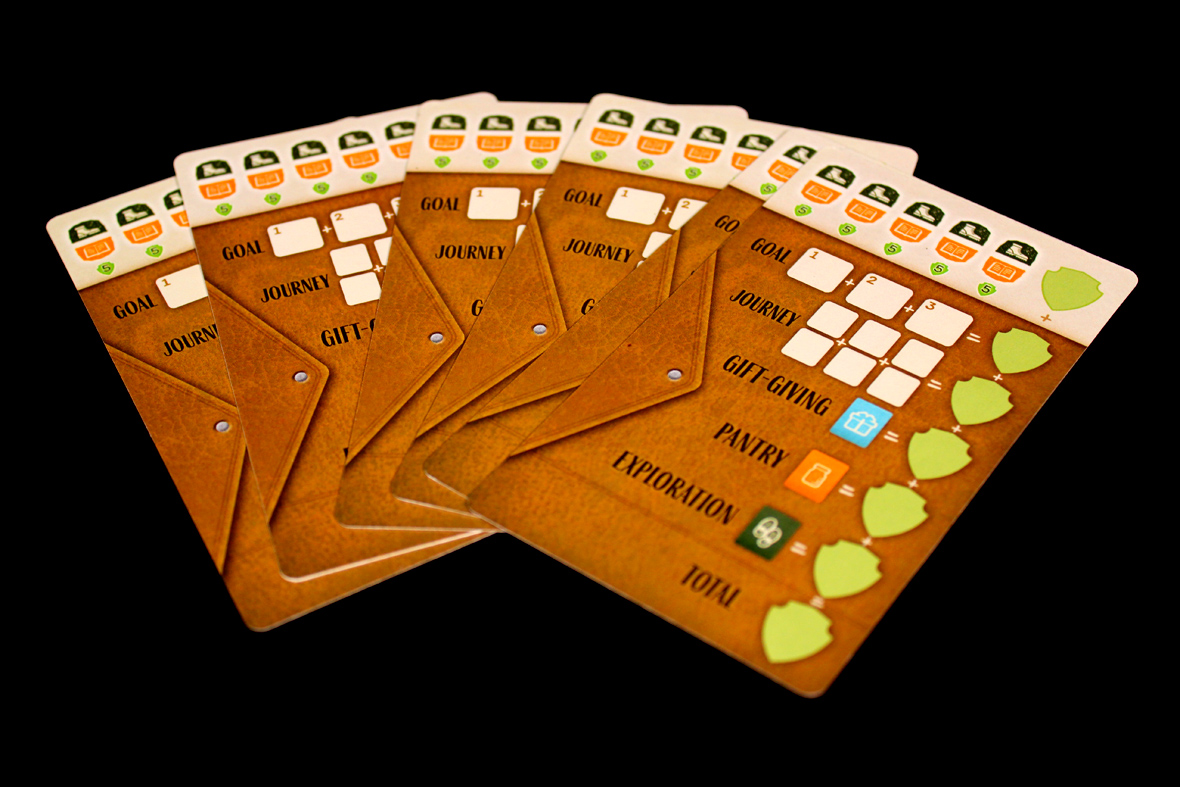
They also get a Scoring Card:
Shuffle up the three decks of Starter Cards and give each player one:
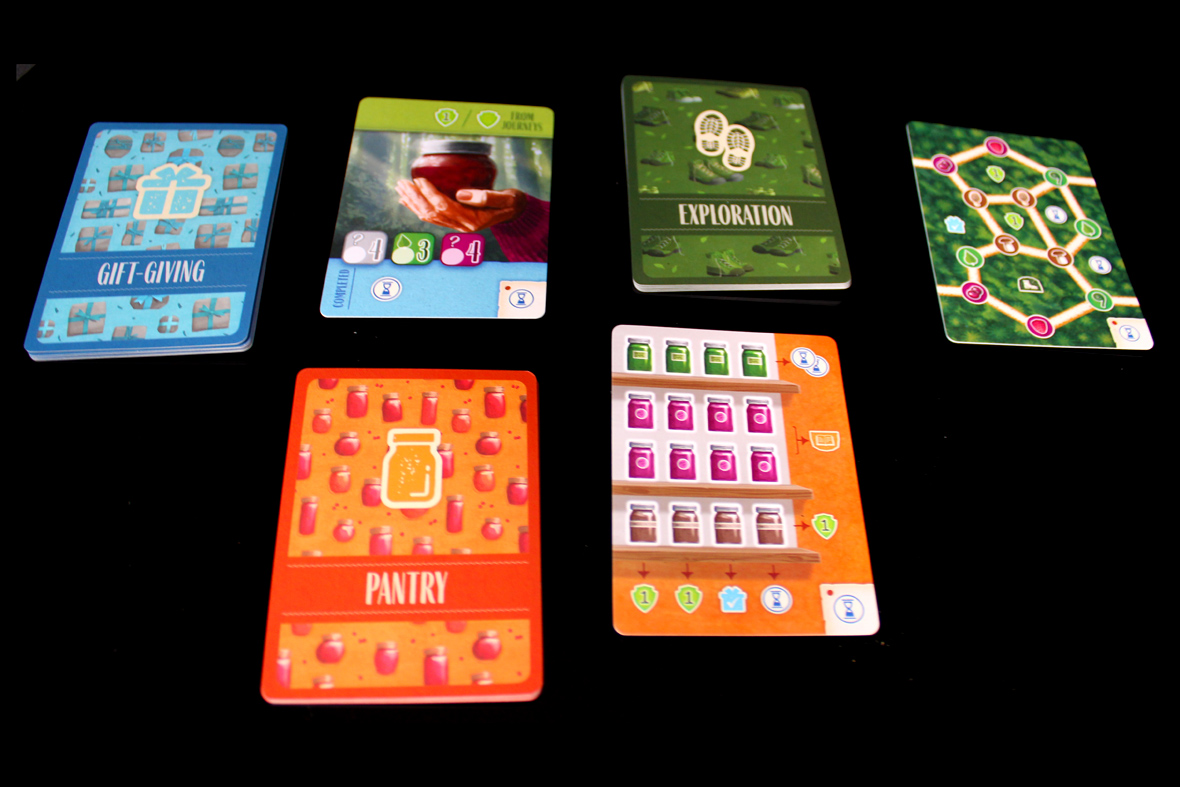
They have darker backs compared to the standard Foraging Cards, which you should also shuffle and place in the center (Pantry then Gift-Giving then Exploration):
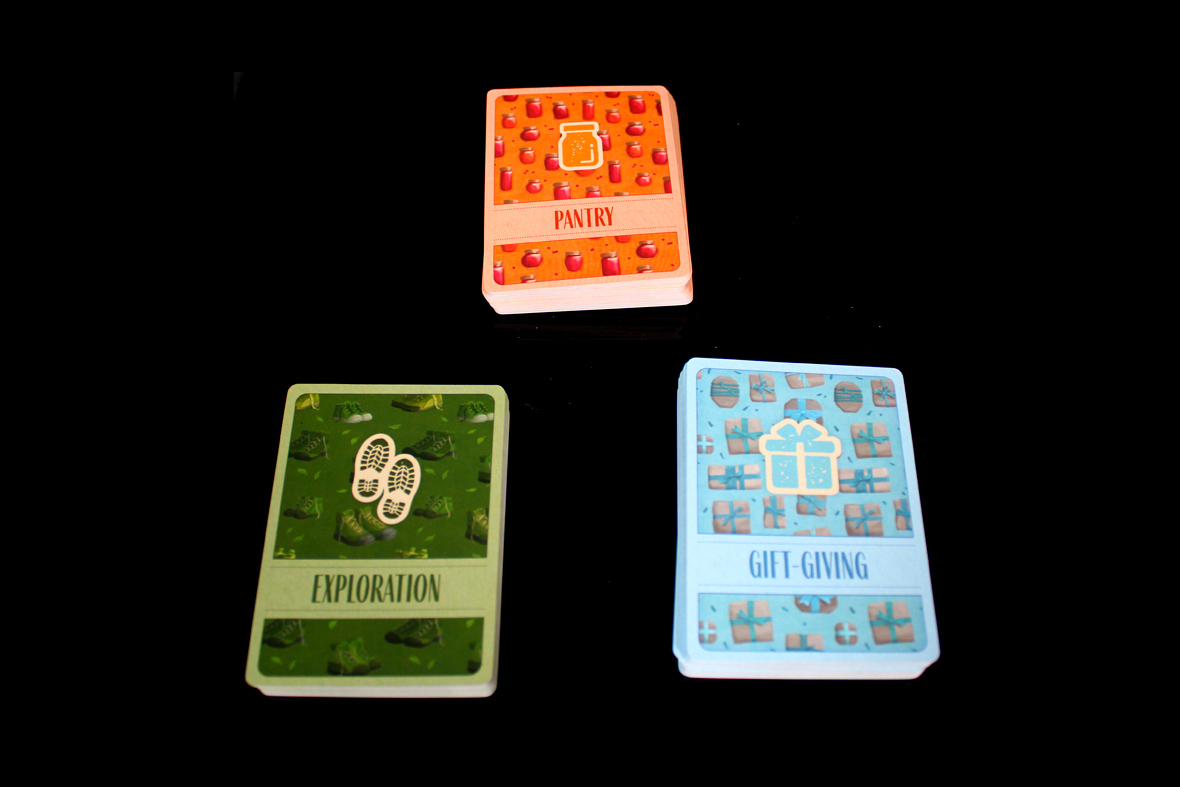
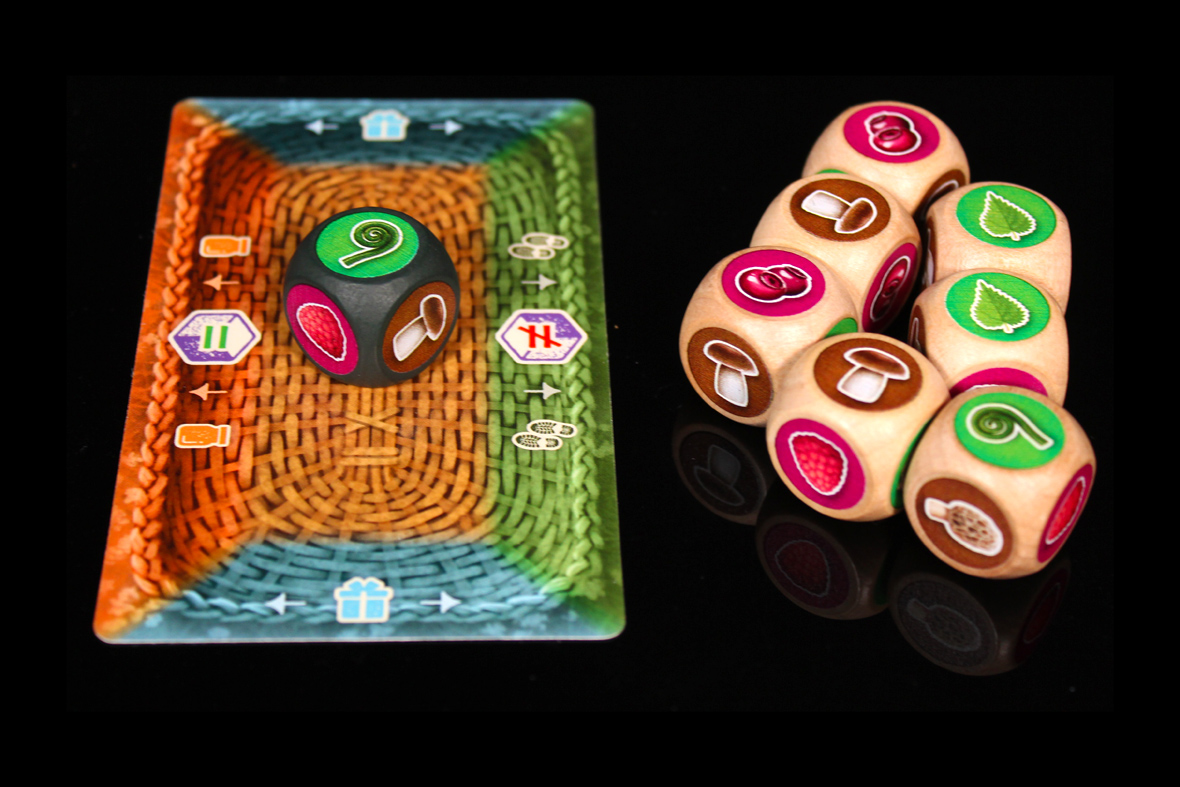
In case you think I’m just being difficult, there’s an actual reason for this. The Foraging Basket Card goes under them, with the sides matching the various color decks. Set the dice nearby:
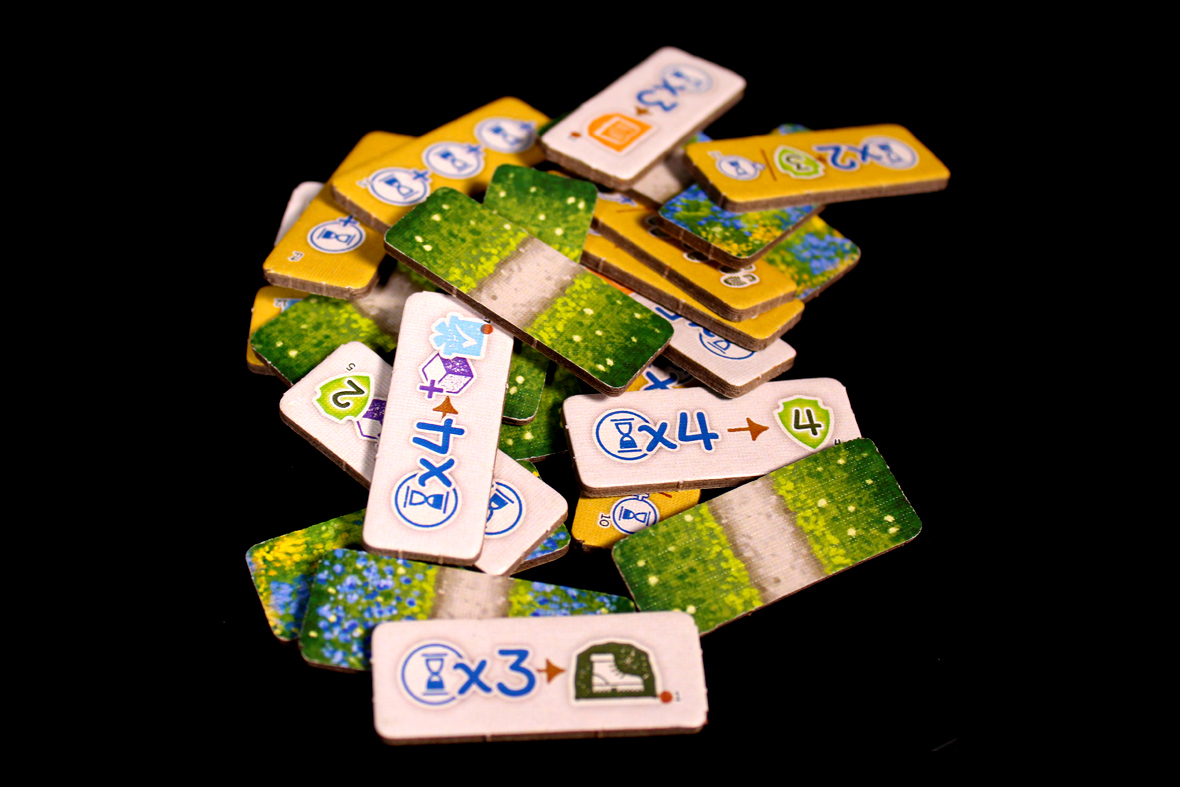
There are three types of Journey tiles. Starter Journey Tiles have no path; shuffle them, reveal three, and set the rest out of the game. The green-pathed Journey Tiles get shuffled next; make a face-down line of ten. Then the Final Rounds Journey Tiles get shuffled; add three to the end of the line of ten and set the rest out of play.
With that, you should be ready to start!
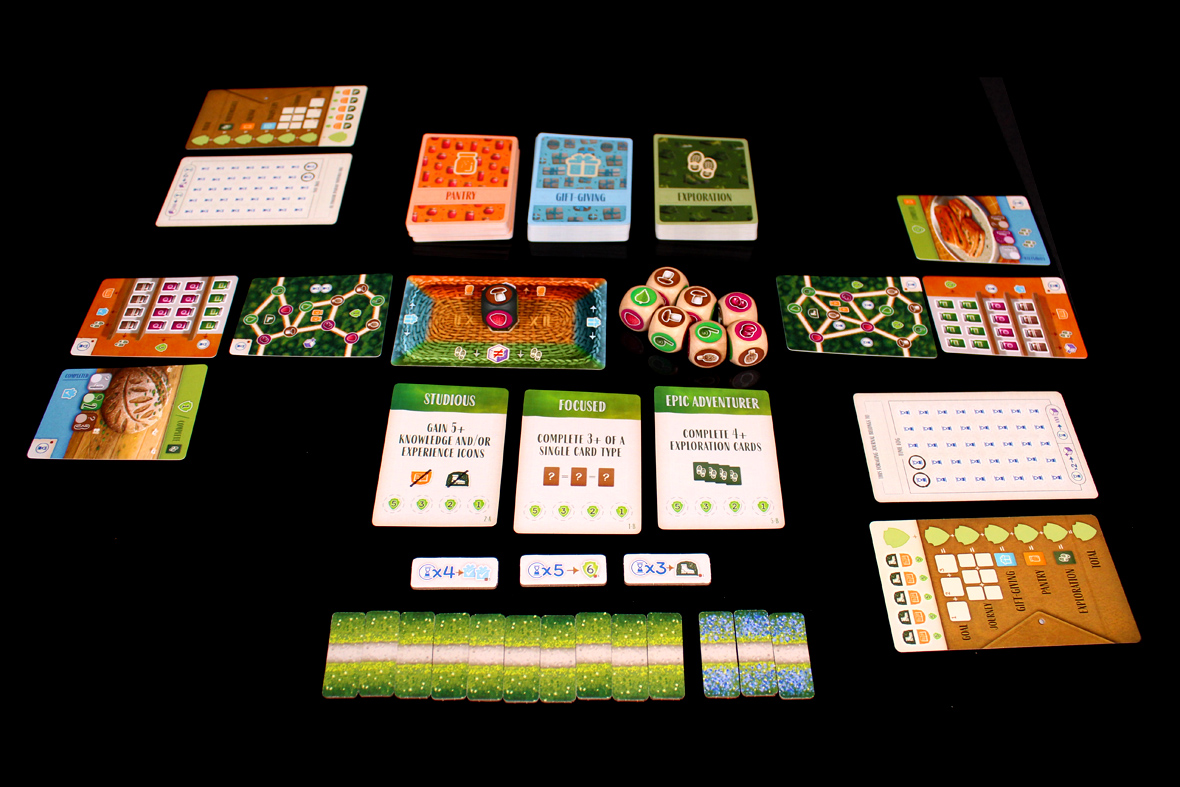
Gameplay
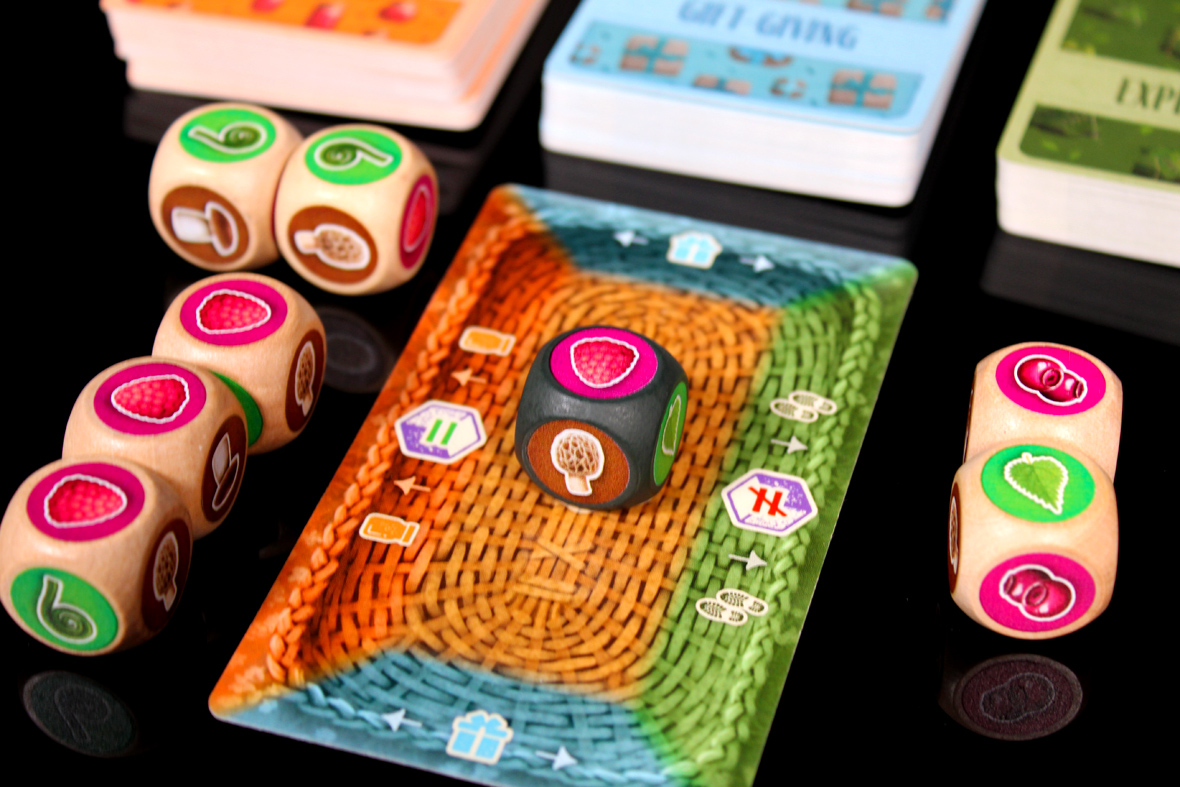
The actual core loop of Forage is not too complex, which is nice! Your goal is to explore, give gifts, and fill up your pantry to earn points over the course of thirteen rounds.
To start a round, a Journey Tile is revealed. If it’s yellow, an immediate action occurs; otherwise, it’s set aside for later. Then, the dice are rolled and grouped. The black die is always placed inside the basket. Any sets of the same die face are placed together on the orange “Pantry” side of the basket card. Any remaining singletons are set on the green “Exploration” side of the basket card. Then, you can take dice actions!
You get one dice action for free. Pick any group of dice and use them based on what side they’re on. Pantry-side lets you take a Pantry or a Gift-Giving action; Exploration-side lets you take a Gift-Giving or an Exploration action.
- For the Pantry, you can cross off any jars of the matching color of your group of dice taken (including the black die). Completing rows or columns can earn you bonuses!
- For Gift-Giving, you can cross off one space that corresponds to the group you took. Completing a card earns you bonuses.
- For Exploration, you can cross off one space per icon on the group of dice on the Exploration side (again, including the black die). If you encircle a section, you get that bonus, but some sections can only be completed across two cards.
You may spend one Time to augment any action with the die face of your choice as many times as you want / have time. You may spend two Time to take an additional Dice Action with a new set of dice (you include the black die again). Once you’re done taking actions, draw a card from any deck. You can look at it and either add it, face-down to your play area or discard it face-up for one Time. Once everyone has done so, reveal it.
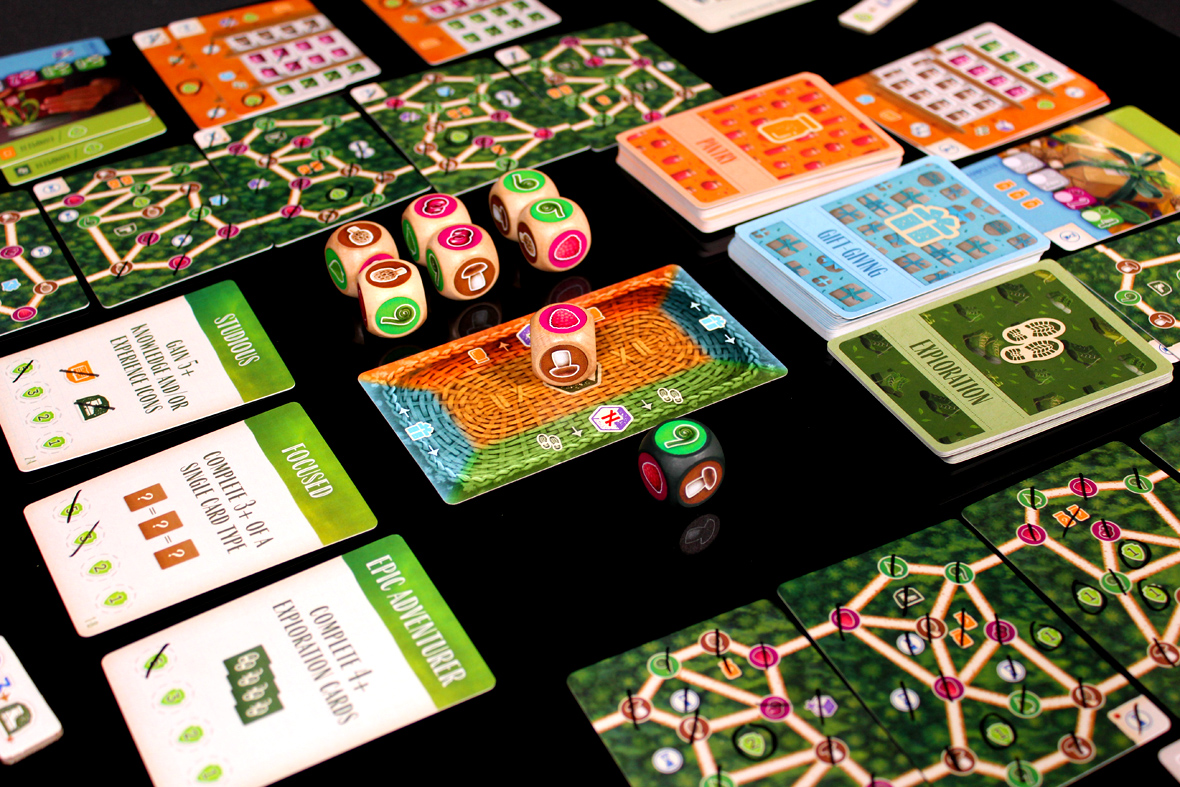
As you complete actions and earn Time, you can also cross off Goals and potentially spend Time on Journey Tiles. This happens at the end of the round so that players who want to do the same thing at the same time can both do it, rather than it being a weird first-come, first-serve situation.
Play continues for thirteen rounds! At the end of all that, tally up your scores and the player with the most points wins!
Player Count Differences
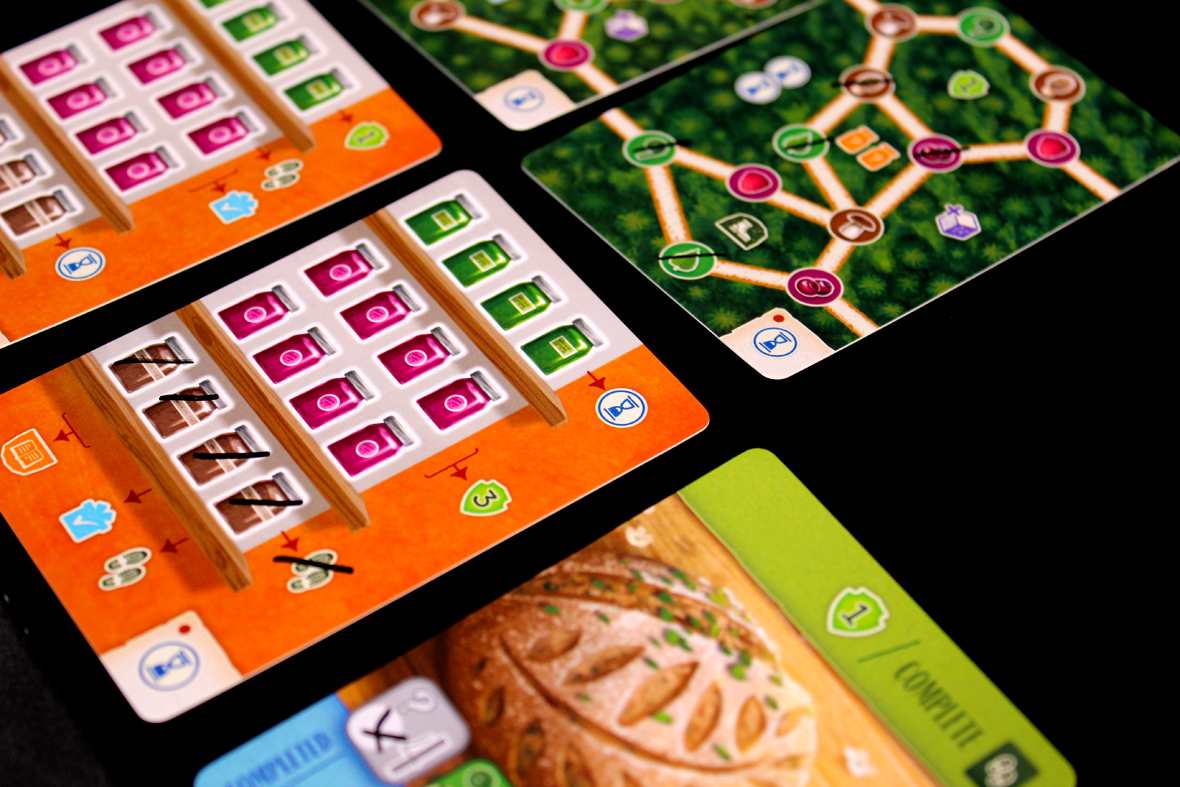
The major thing that happens as the player count increases is, at least in my games, despite the simultaneous action the playtime goes up. I think if everyone knows what they’re doing and people are committed to playing somewhat quickly you might be able to get a six-person game played quickly, but I’m obliged to side-eye that 15 – 30 minute playtime on the box. With new players, you’re not going to get anywhere near that. Players are reading cards and adjusting to strategies and figuring out dice and deciding what they want to spend time on and looking at Goal Cards and planning with Journey Tiles and there’s just a lot of moving parts. With more people, I’ve found that that increases. Our first six-player game was a bit of a doozy, especially because I struggled to fully understand how time management fit into a cohesive strategy. As players become able to chain actions and extend them with additional time, it takes even longer. With what, 13 rounds? Sure, you might be able to do a minute per round with extremely experienced players, but I’m not convinced otherwise. At lower player counts it can still be a more intense experience, but I think that’s just a function of this being a more complex roll-and-write. Less than, say, a Motor City-type game, but still fairly weighty on its own. I’d probably lean towards fewer players until you’re pretty experienced with it.
Strategy
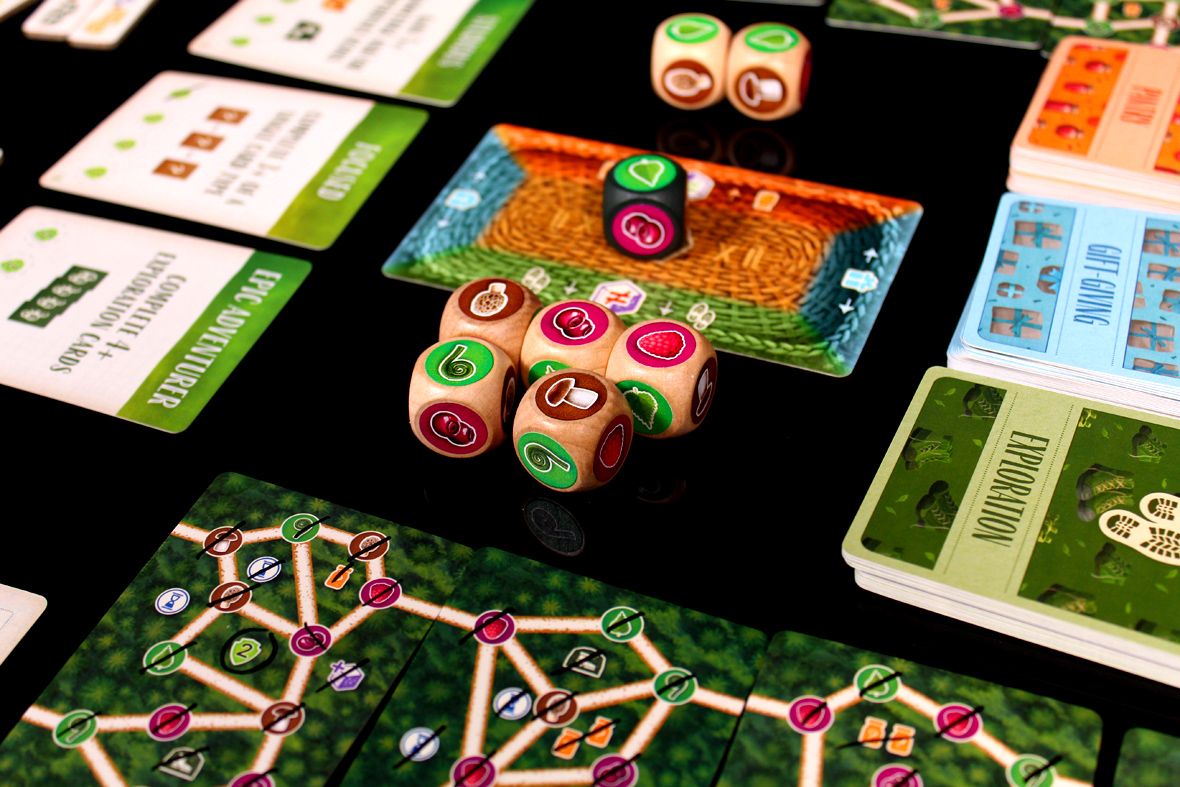
- Manage your time wisely. Time is just about the most singularly valuable thing in this game. You can spend it to augment actions, take new actions, or purchase really potent Journey Tiles. If you run out of it, you’re losing a significant amount of flexibility. Plus, spending Time can often be the way to earn additional Time. You really need to take it seriously as you play.
- Getting additional cards with reckless abandon won’t always serve you. You won’t be able to complete every card you grab, in all likelihood (unless you take too few). Instead, be judicious: sometimes you can burn a card for one Time and put that towards a better, more useful decision.
- Focus on completing cards, to some degree; you earn additional time and often a bonus of some kind. Don’t forget about the 1 Time you earn from completing a card! The bonus you usually get is good, but that 1 Time can be particularly clutch for certain things.
- You can place Exploration Cards on the left or right of your line to create areas with bonuses you care about. Making shapes that serve you is good; sometimes you don’t want an extra point and you’d rather have a 2 Time and free Dice Action creating a big zone for you to complete.
- I wouldn’t necessarily recommend neglecting any one card type, but it does depend a fair bit on the Goal Cards. If you have no real reason to go after Gift-Giving Cards, then don’t. I usually recommend having one card of each type available, though, just in case the dice aren’t really going your way. You don’t want four of the same berry rolled when you have no Pantry cards to store them in, after all.
- Saving up a bunch of time to spend on Journey Tiles isn’t bad, either. They’re a better conversion rate than almost anything else (7 Time to 9 points is pretty good, for instance).
- Spend out the rest of your time before the game ends; it’s not worth much after. Yes, it breaks ties, but you know what else breaks ties? Outscoring your opponent so you’re not tied in the first place. It’s worth considering.
Pros, Mehs, and Cons
Pros
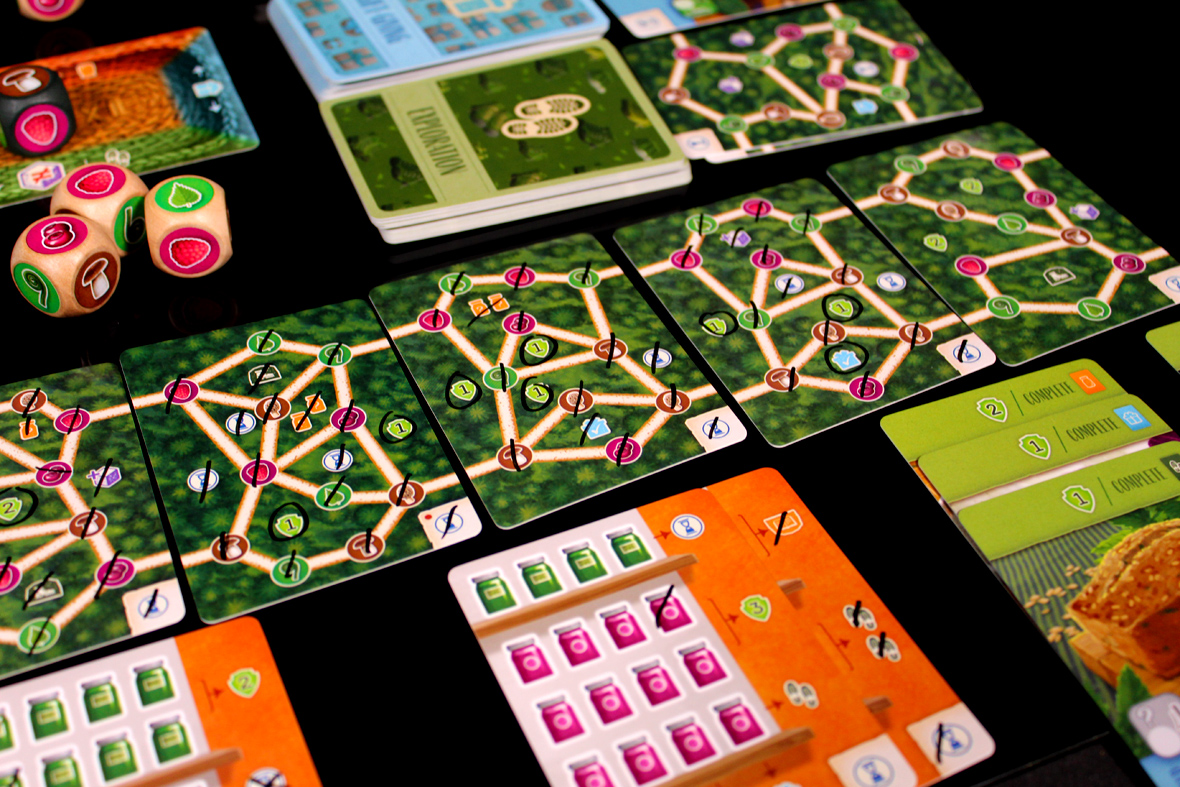
- Another visually striking game with Beth Sobel’s art; you love to see it. I really like Beth’s skill at depicting something on the artistic end of realism. It makes the various things seem colorful and real while still being maybe a step away from actual photorealism (intentionally, for the art of it all). There’s a real developed skill to her work that is clear with every game I get to review, so I never get tired of seeing it. Also, I mean, game look nice.
- For folks looking for a quick-yet-crunchy roll-and-write, this is definitely it. There’s a solid level of basic complexity that spins upwards as you grab more and more cards to try and create a base that you can play off of. It’s interesting!
- I like that you can choose the direction you want to expand your play towards, and that each of them seem relatively balanced and fun. I think I like Exploration Cards the most because of the path-building of it all, though you’re really just crossing off spaces to claim region benefits. Some folks like the set collection elements of the Pantry or the Gift-Giving Cards as well; different tastes.
- Good portability. I really like this box size, in general. It’s not so small that it’s a micro-game, but it’s not huge either. Perfect size to throw a few games in a bag and have a game night, which I do need to consider starting back up again.
- Setup isn’t too complicated either. Everyone gets a few of each thing and you go for it. Honestly, the hardest part is shuffling six sets of cards and a bunch of little tiles.
- The actual action selection mechanic and how it’s dice-driven is very interesting. My favorite part of the game, I think. I like how the dice are grouped and you can select any valid group for an action. It means that the strength of various actions waxes and wanes as the dice determine what your options are, and planning for that is a big chunk of what makes Forage interesting.
Mehs
- The space requirements for this one can get a little intense, just because there are so many cards. Everyone starts to spread out as the game continues, which means you can rapidly see the table space get eaten up.
- Since everything is on cards, some of the rewards and Exploration elements can be a little small. Sometimes it’s easy to get lost in just the tableau you’re building for yourself. I think I wish the cards were larger, but then even more table space would be lost.
- As with plenty of dice games, you’re relying a fair bit on luck. Sometimes you just have a truly garbage roll for the final roll of the game, which can really take the wind out of your sails. It just happened to me, which sucks, but hopefully with Time you can mitigate some of that risk.
- A lot of players will struggle wanting to touch the dice they claim so that they can remember which symbols they’ve already used; not much to do about that. Players love touching stuff. For dice with a variety of icons, there’s a real desire to be able to claim the dice into your space so you can know which dice faces you’ve used out of the available ones rolled. That does not work in this game; everyone needs to be able to see all the dice at all times. It can lead to some consternation.
Cons
- There’s a rich-get-richer element to time management that you would do well to make sure players understand for their first game or they’ll get left behind pretty aggressively. I think a couple of us missed this in our first game and struggled quite a bit. We weren’t making enough Time to actually add on to our actions, and as a result we struggled to complete cards and gain more time and just mostly stayed towards the rear of the pack for the whole game.
- Cleanup for this game is a bit of a pain; hopefully they’ll include cloths or something in the game itself. It’s mostly that you have to wipe down every card that got used and there aren’t really any things in the game that work well for that and you don’t want to just wipe them on the tablecloth, you know?
Overall: 7 / 10
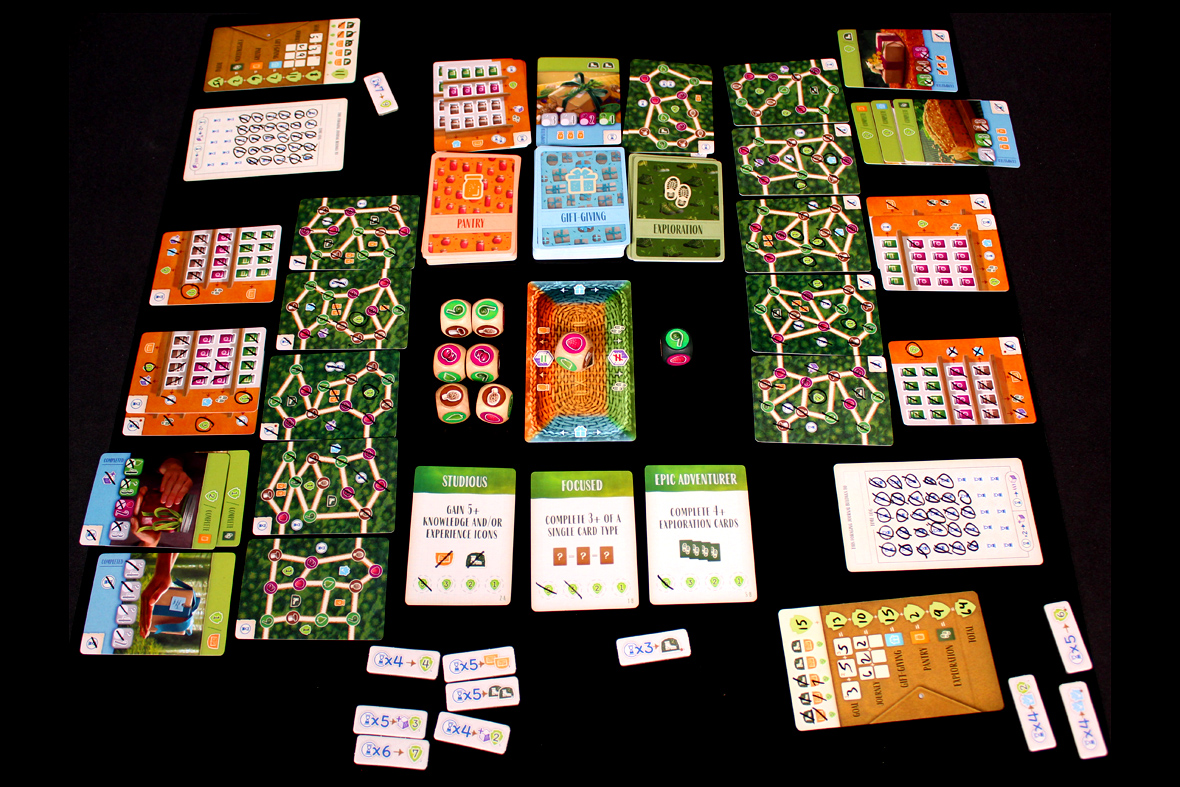
Overall, Forage has been an interesting experience! I like it, though I think it’s kind of in a weird space between my complexity comfort zones. A little bit more complex, and I think I would intuitively understand that when I sit down to play, I’m sitting down for a challenge and I need to focus. Personally, I think I’d prefer if it had pulled a little less complex in terms of decision-making. One factor might just be that as a result of using cards, everything feels so tiny when I’m playing. I’m worried I missed things or I didn’t take the right symbols into account, and as a result that makes it hard for me to keep track of other players so I can’t quite figure out how I’m doing relative to the group. I’m sure that improves as you play more, but it really threw me during my first game. I’ve since gotten better, but I wonder if other players have had the same experiences. Add in that the sprawl of cards also adds to the cognitive load of the game and you have a great game for people looking for something on the lower end of crunchy and complex. It’s not fully at a Fleet: The Dice game level of complexity, if that worries you, but it does seem a bit more full than a 15-30 minute on-the-box playtime would lead you to believe. I do love the theme, though, and Beth Sobel’s art is a perfect match for the game, I’d say. She does well with a certain vibe of woodsy realism, and you immediately feel right in the forest looking around as you play. I also like how the dice rolls lead to action selection options: grouping same dice together and then leaving all the singletons together for one action can lead to big swings on turns and it’s a cool way to do each turn. With all the different cards and tiles and rolls out there, this leads to a game that’s going to feel very different in terms of your focus as you play. And that’s pretty cool! I do hope they include some useful way to clean off those cards; I apologize to anyone who gets the preview copy I reviewed if I missed erasing any. But if you’re looking for a quick-yet-challenging roll-and-write, you want a high-player count experience, or you just want to pretend to go into the forest and find a weird mushroom to eat, Forage might be right up your alley! It’s pretty neat.
If you enjoyed this review and would like to support What’s Eric Playing? in the future, please check out my Patreon. Thanks for reading!
 What's Eric Playing?