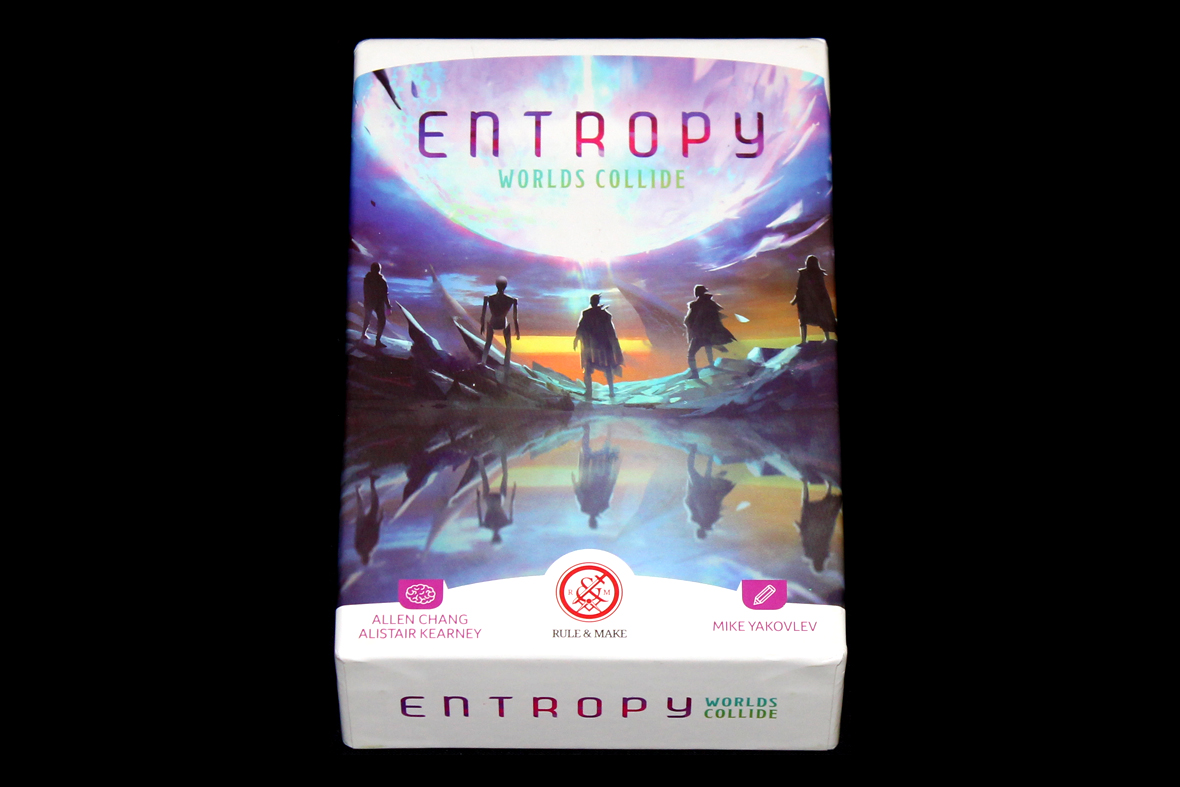
Base price: $20.
2 – 4 players.
Play time: 10 – 30 minutes.
BGG Link
Buy on Amazon (via What’s Eric Playing?)
Logged plays: 8
Editor’s Note: This review was written … a while ago. You’re welcome.
Not every day you’ve been reviewing enough that you see a reimplementation of a game you’ve already reviewed. It’s fun for several reasons — you get to look back and see how you used to review games (poorly, but hey, whatever, we all improve over time), and you get to see how complicated having a numerical rating system is given that your preferences change over time. Oh well, here we go.
In Entropy: Worlds Collide, you’re facing, well, the same premise as the original Entropy: you’re in the Nexus, as your world has been shattered into four shards and mixed with other worlds (a total of six). The Nexus has given you some abilities, sure, but you’re not the only person who would like to reform your world. Unfortunately, you can’t all leave. Will you be able to escape the Nexus? Or will you remain lost and trapped forever?
Contents
Setup
Setup won’t take long. Have each player choose a character. Each character has a corresponding set of Shards:
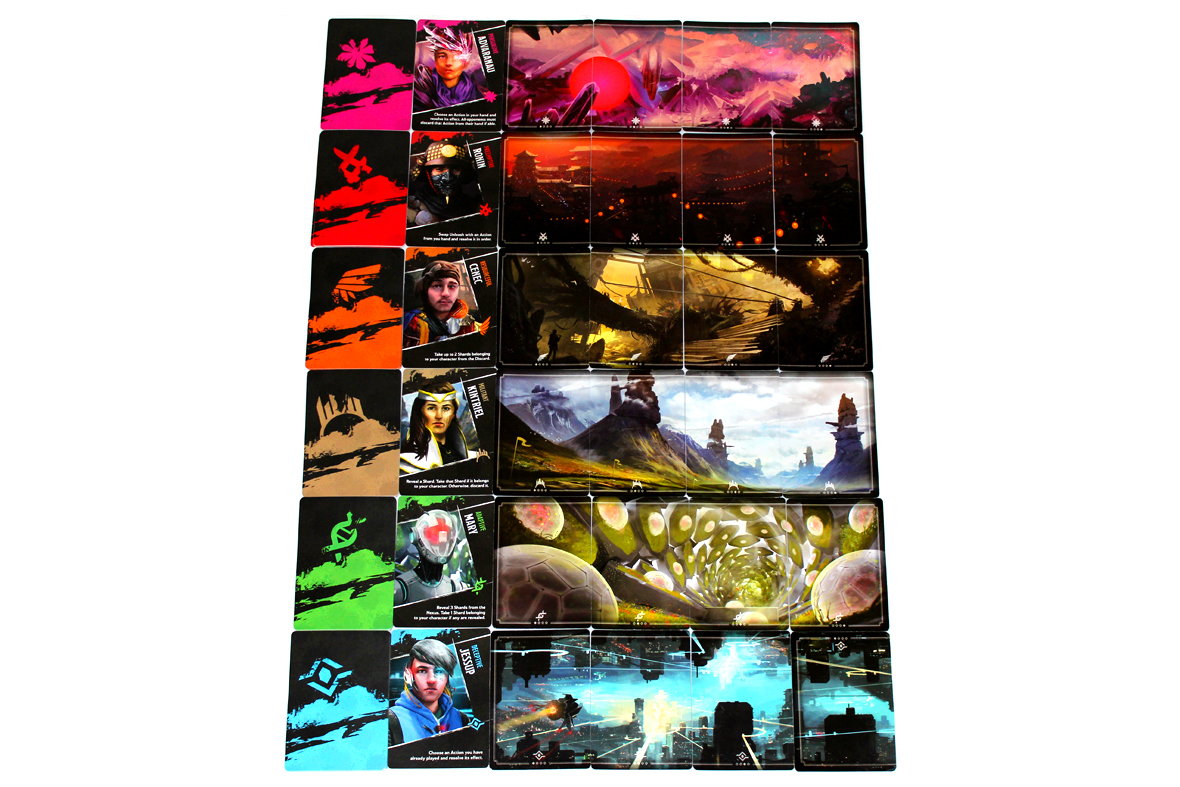
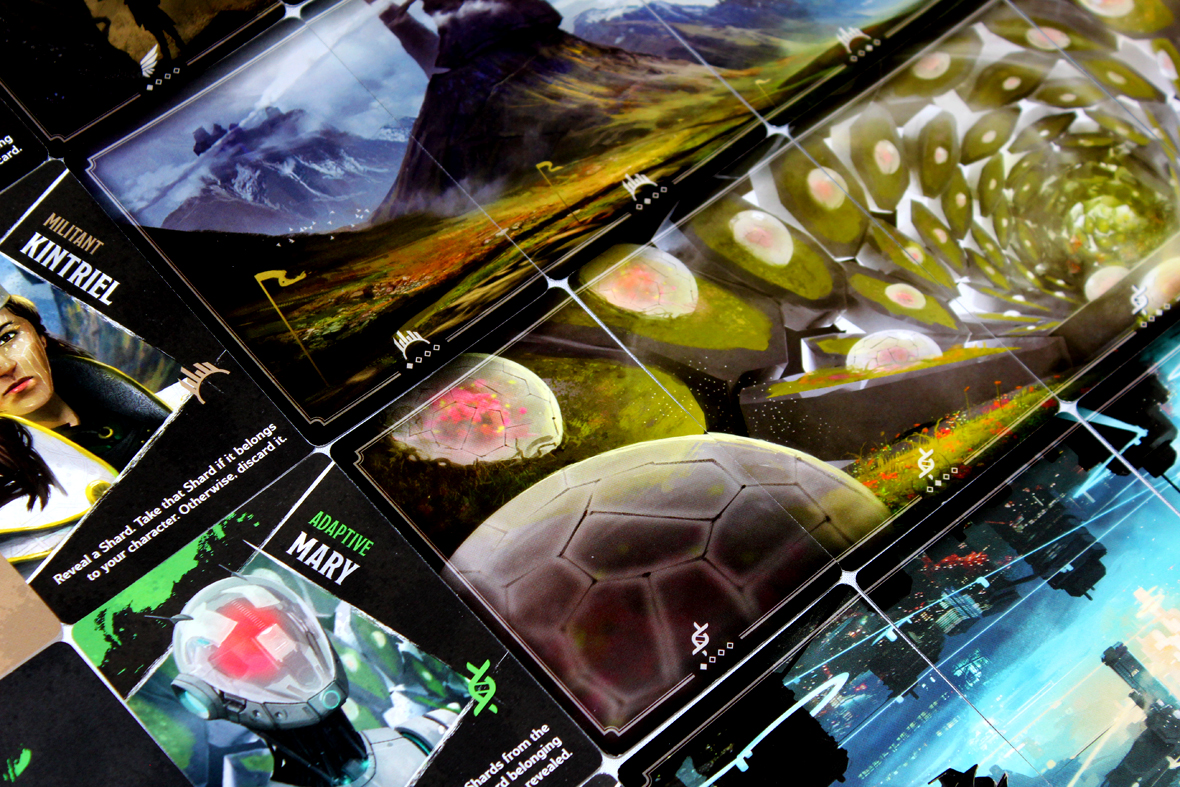
To see it a bit closer:
They also have a corresponding set of Abilities (the Ability cards are marked with their symbol on the back):
Have each player choose a character, but add all Shards from those characters into a central pile. Also, add the Shards from one additional character to that pile. Shuffle it; that’ll become the Nexus (the draw deck). You’ll also want to add the Wild Shard:

Also, set aside the Anchor card:
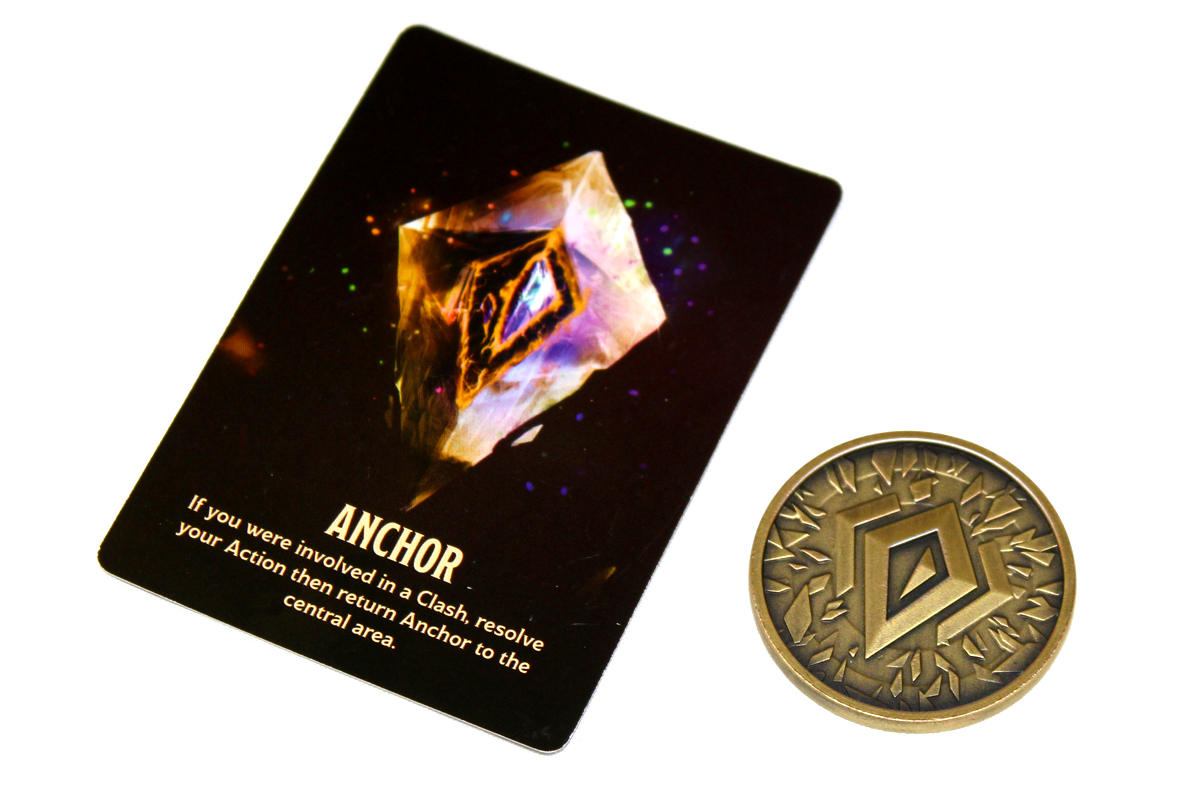
The Kickstarter came with a pretty rad coin, so we just use that, instead.
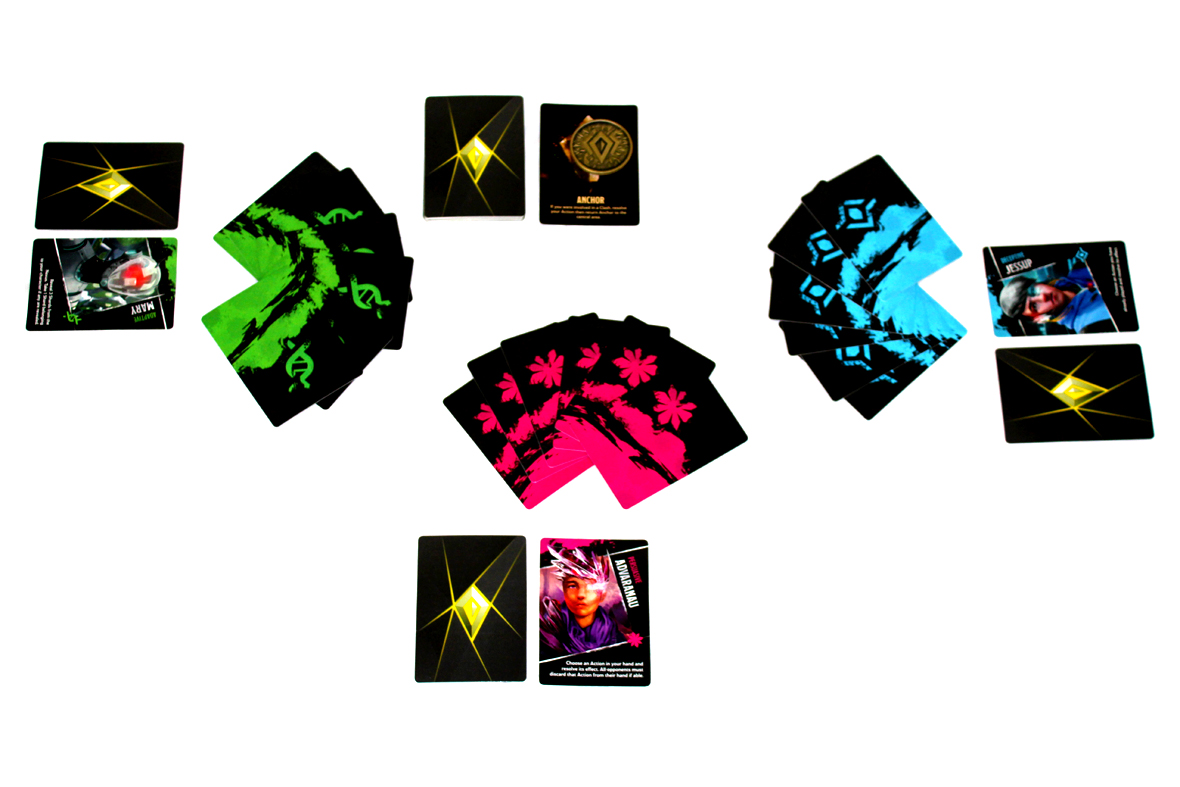
Once you’ve done that, you’re basically ready! Give each player a shard from the Nexus, face-down, and have them keep it on the left side of their character’s card:
Gameplay
So, the game’s premise is simple. If you can collect all four pieces of your reality, in any order, you win. Done. Getting them, obviously, is the hard part.
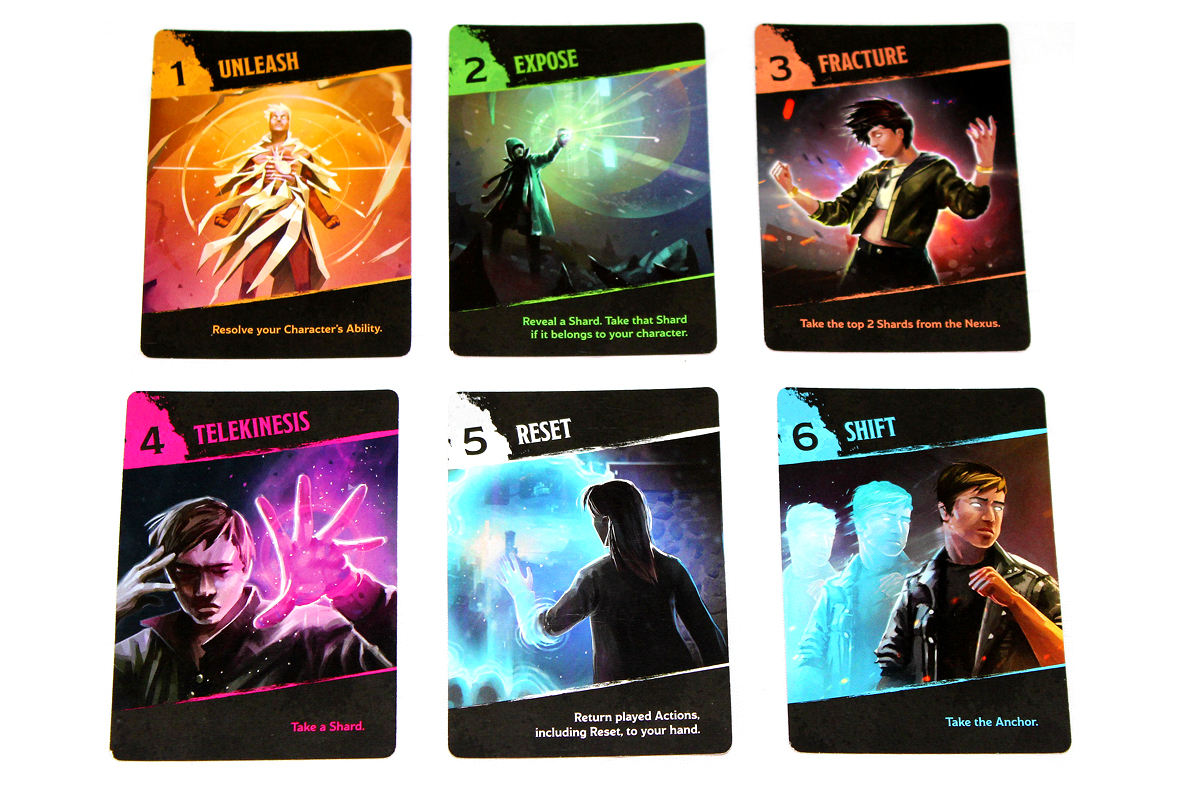
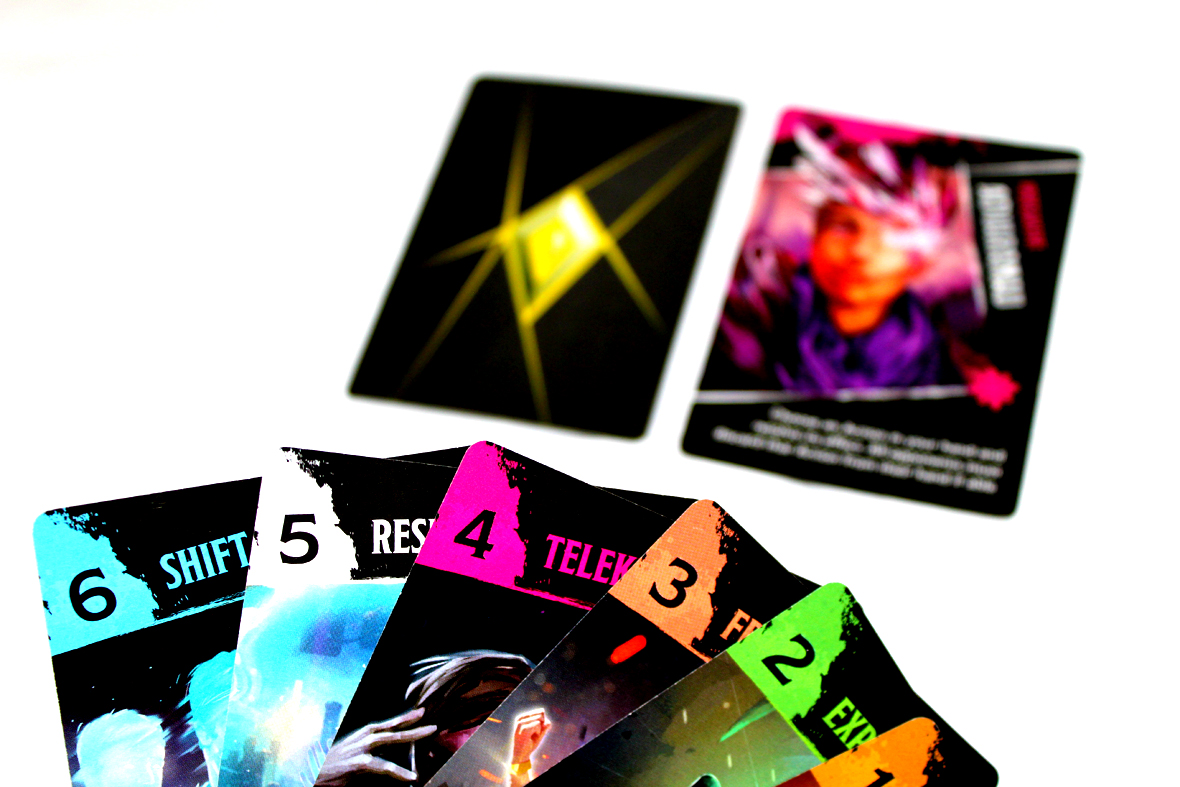
You play Entropy: Worlds Collide using the actions in your hand:
Each one gives you a certain ability. These are:
- Unleash. Resolve your Character’s Ability. For each character, these are:
- Kintriel: Reveal a Shard. If it belongs to you, take it; otherwise, discard it.
- Jessup: Choose an Action you have already played or discarded and resolve its effect.
- Mary: Reveal the top 3 shards of the deck. Take any 1 that belongs to your character, if some appear.
- Advaranau: Reveal an action and immediately resolve it (without discarding it). Your opponents must now discard it from their hands, if they can.
- Cenec: You may take up to two of your Shards from the discard pile.
- Ronin: You may swap Unleash with a card in your hand and resolve that card as though you played it instead.
- Expose: Reveal a Shard. If that Shard belongs to any player, they take it. This does not let you get the Wild Shard.
- Fracture: Take the top 2 Shards from the Nexus. You may choose any one of the two (or three) Shards in your Hold to keep; discard the rest.
- Telekinesis: Take a Shard from the Nexus, the Discard, or from an Opponent. You may not take a Shard that’s locked into their Reality.
- Reset: Return all played Actions, including Reset, to your hand. If, for some reason, you are forced to discard Reset or play it without activating its effect, you must instead play every card in your hand before you can reclaim them.
- Shift: You may take the Anchor from the center or from any player.
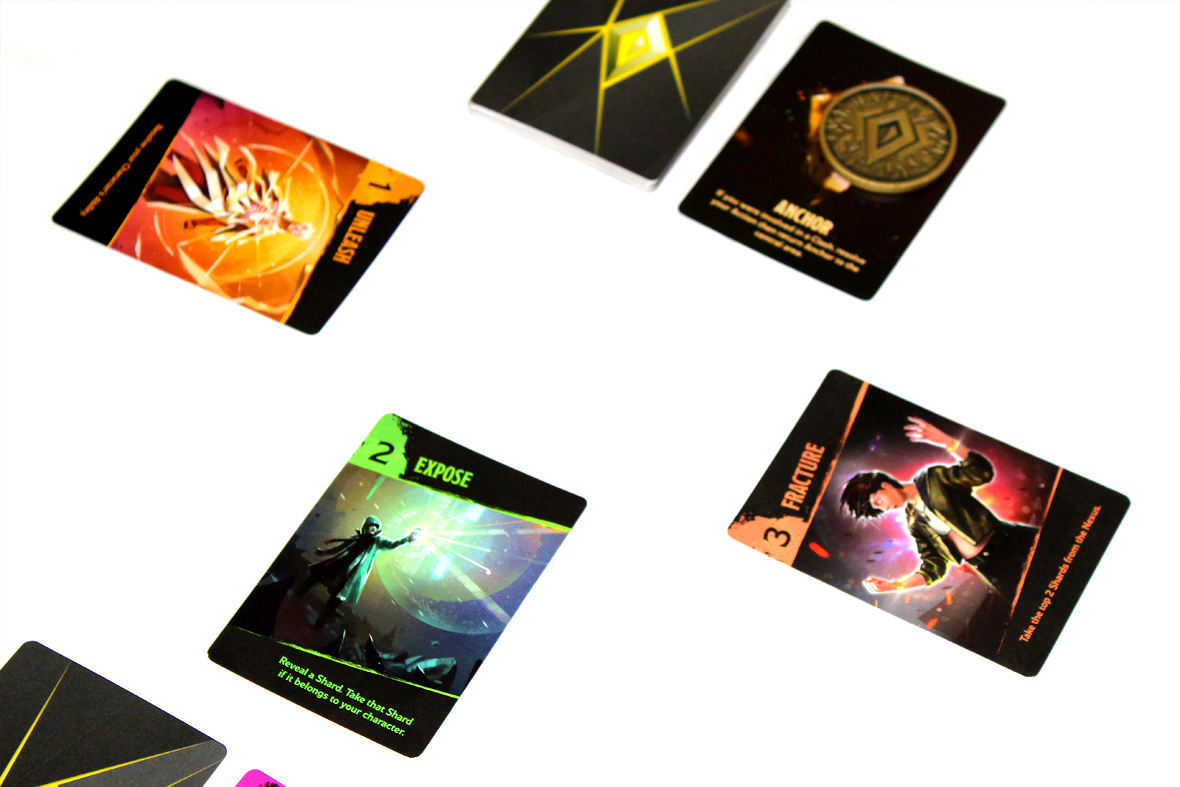
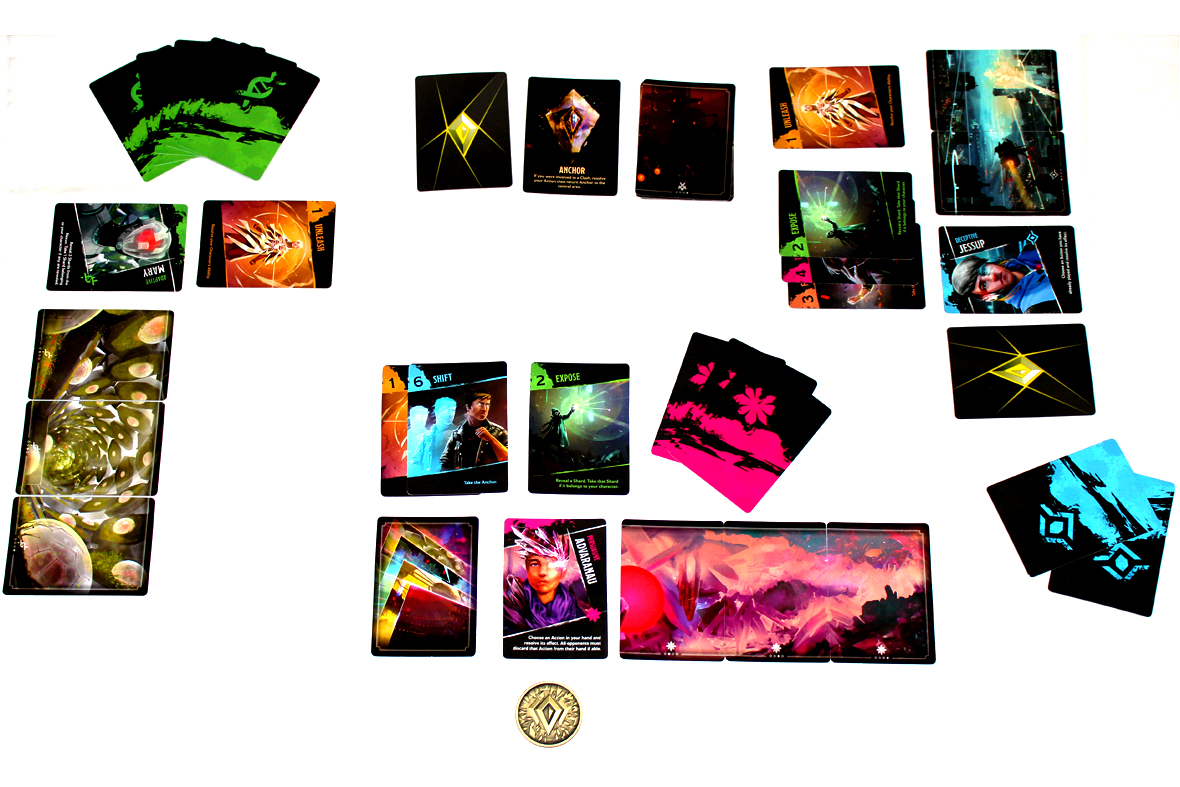
Rather than having turns, all players choose secretly which card they’d like to play, and then the card is revealed. Cards resolve in numerical order. If a Shard of your Reality is revealed, it locks into your Reality. Represent that by placing it on the right side of your character (while keeping your Hold on the left).

If any of the cards revealed are the same, a Clash occurs. In a Clash, all players who revealed the same number are unable to resolve their cards. They are just discarded without effect. If, however, one player holds the Anchor, the card that player played does not Clash. They instead resolve their card’s effect and return the Anchor to the center.
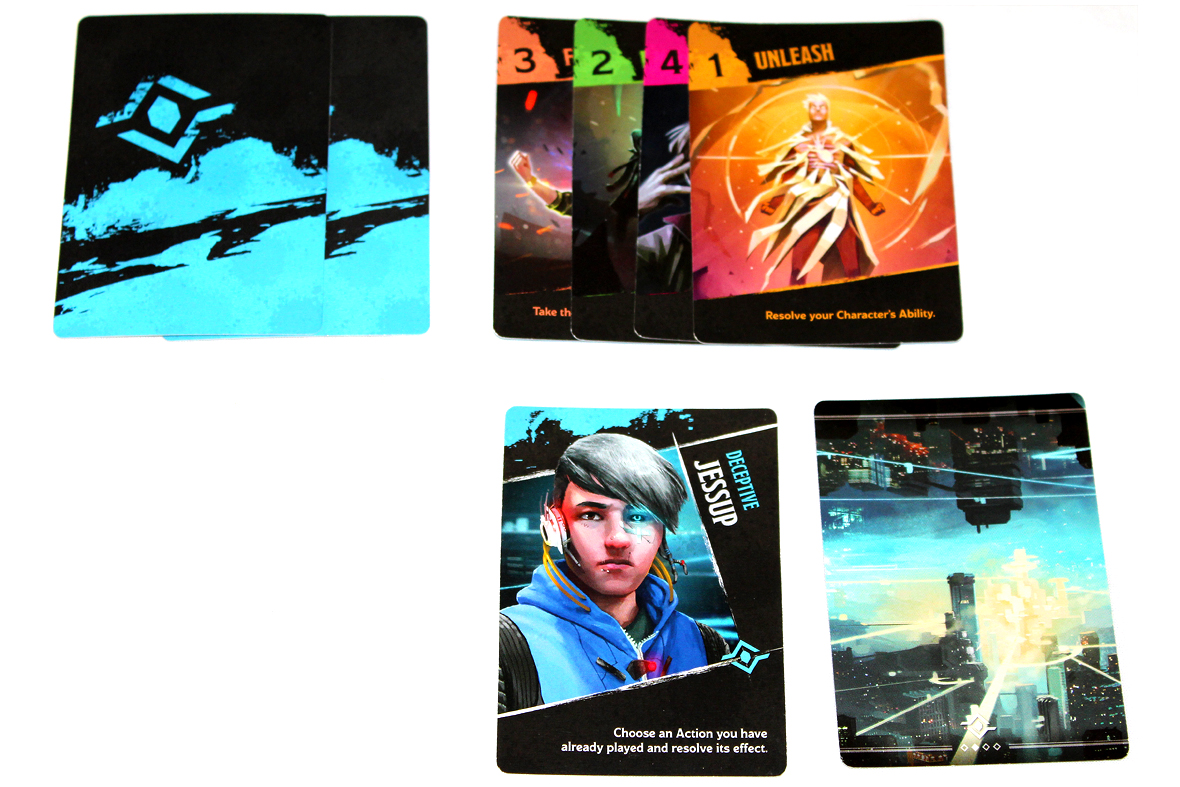
That’s pretty much about it. Major clarification points are:
- Cards maintain state. If you take a card from the Nexus, it stays face-down. If you pick up a card from the discard pile, it stays face-up. The only exception to this is that a card moving to the discard pile is revealed.
- You cannot lock the Wild Shard into your Reality. Once revealed, it stays face-up in your Hold (and blocks you from having another card there). It must be face-up in order for you to win with it.
- If you have no cards in your hand, you take the cards you’ve played and return them to your hand. Then you play a card from your hand.
- If the deck runs out of cards and a player needs to draw, shuffle the discard pile. That is now the new deck.
- If a card is revealed from the deck, it is discarded unless otherwise stated.
Play continues until any one player has all four Shards! As soon as they do, they immediately win.
Player Count Differences
Your Clash frequency is going to skyrocket. At two or three you’re reasonably likely to be able to avoid Clashes, generally, but at four you’re suddenly going to be hitting other players a lot. That said, the game will take a bit longer at four players as a direct result of that, but that’s not a bad thing. At two, it’s much more of a game of (essentially) chicken. I think three is a solid number, with a slight preference for four over two, but not much of one. I’ve enjoyed it at any player count.
Strategy
- Know yourself. Your Character’s ability is super powerful and it’s critical to know both how to use it and when to use it. Several of the Characters should lead / go early with a 1 so that they can get ahead of the other players with their power (Mary / Advaranau), whereas other characters should go later (Jessup, really). Others, well, it’s unclear (Ronin). You’ll just have to feel that one out.
- Careful with Expose. If you reveal someone else’s Shard, they get to take it. You really want to use it when you’ve got a good idea of what you need to do.
- One of my favorite Advaranau tricks is to Unleash into a Reset. This wastes my turn, sure, but it forces every other player to discard their Reset without effect. Now, they have to play every card in their hand before they can Reset, and I get to be a bit more predictive. One game in particular, this strategy led to two players Clashing twice, essentially giving me two free turns.
- Cards in the discard pile are great. You can just Telekinesis them out, or, better yet, Cenec can pull two out with his ability. You should try to keep his cards out of the discard pile. That said, there are ways to deal with people trying to discard all their cards.
- If you see people trying to get cards from the discard pile, try to force a reshuffle. If you draw another card when the deck needs replenished, you can shuffle the discard back into the deck and thwart their plans. It’s a risky move, but it works.
- The Anchor might be critical to winning. If you’re nearing the endgame, it’s likely to become pretty clear what actions you want to take to try and win the game. If you can be predicted, you can be stopped. Being stopped is not good, so, rather than being stopped, get the Anchor. For one thing, most people don’t expect you to Shift when doing something else would win you the game, so you can juke them a bit; additionally, you are then absolutely safe, assuming Jessup doesn’t use Unleash to repeat his Shift, take the Anchor from you, and then another player Clashes with you to block your win. That’s rough, but, I mean, fair.
- You may need to make some sacrifices to avoid letting another player win. My general etiquette around this is “don’t tell another player what to do on their turn”, and the game is short enough that coordinating to prevent another player from winning (in a “you play a 3, I’ll play a 4; now there’s no way that they can take the card without clashing” sense) seems outside of the spirit of the game. That said, there’s nothing stopping you from independently arriving at that conclusion. Forcing a Clash to block a player is both a valid and useful strategy.
- People generally lead with Expose and Fracture on their first turn. Try to avoid those, if you want to avoid a Clash. Maybe an early Shift?
- Keeping another player’s Shard in your Hold is a decent idea. For starters, early on you discarding another card (especially one from your Reality) makes it seem like your Hold card is also from your Reality, which disincentivizes other players using Expose on it. If they can’t see it, there’s no way to know beyond Telekinesis, and even then they’d have to flip it over for it to be useful, so that’s a second (easily blocked) turn. Naturally, since this is a game of mild deception, it’s also perfectly reasonable to fake doing all of that, too.
Pros, Mehs, and Cons
Pros
- The core is really interesting. It’s a set-collection game with a simultaneous action element in the vein of Coup: you want to be able to bluff what you play, but sometimes you need to do a certain action and you’re worried other players will read you. I find the tension here to be a lot more satisfying than I found it with Coup, and I imagine this will be a much longer mainstay in my collection, now, as a result.
- The art remains pretty incredible. It’s still one of the first games I really found artistically captivating, and it’s really only improved from there. It’s some parts subtle, other parts bold, and all-around bright and vibrant. It’s a pleasure to photograph and a delight to get to the table.
- The graphic design has been improved. Bolder icons for the Characters and keeping the icons on the backs of their action cards are both really good choices for making things easier to see and easier to handle while you’re playing (or setting up) the game.
- The game has been significantly streamlined. It’s interesting since this almost functions as a follow-up review, but there really is something to revisiting a game a few years later (or revisiting it through a reimplementation, as I have done with Tsuro / Lost Legacy / games in that vein). For this one, it’s pretty easy to say that Entropy benefitted from the previous game’s existence, sure, but it also enjoys the benefit of iteration. In the original, you could hold tons of cards in your hand and there was no reset so you might just consistently get caught in the Clashes and be unable to do anything. Now, they’ve taken the core of what made Entropy excellent and slimmed it down to a fast, light, and frenetic card game. If nothing else, it’s a great example of how you shouldn’t give up on a design just because you shipped it; if anything, that just means you’ve gotten started and still have a fair ways to go with making it excellent. And they certainly made it excellent, here; it really is a marked improvement.
- It’s also been pared down, a fair bit. They got rid of a few things that made it more difficult to transport (like the board), meaning you can very easily just throw this into a Quiver or a bag or something and take it with you. I appreciate when a game is willing to get rid of things (even though I do like the inclusion of additional stuff).
Mehs
- Invites some analysis paralysis, but not too much. The decision space is relatively minor (you can play one of six cards, max, so there’s never too much agonizing. Besides, sometimes you do need to be thoughtful if you want to successfully Clash another player and block them, especially if you need to do that to win the game.
Cons
- The game can invite some aggressive metagaming if you’re not careful. There’s a real incentive to telling another player what to play to prevent other players from winning, but that doesn’t seem to be within the spirit of the game. You can play it No Talking, if you want, or you could always shoot for the classic “don’t tell other players what to do”. Even then, should you trust the player giving you advice? Perhaps not.
Overall: 7.75 / 10
Overall, Entropy: Worlds Collide is a satisfying reimplementation of the base game! I quite like what they’ve done with it, and I’d even call it a marked improvement over the original. They managed to distill the game’s core and package it all up into a game that is very much Entropy, but not quite as lengthy or chaotic as it had once been. What’s left is a nice, light, beautiful game with a lot of interesting strategies, a lot of fun characters, and a super novel theme; all of which makes for an awesome little game. If you’ve got two to four people and you’re looking for a game to start off an event with, I’d recommend checking out Entropy: Worlds Collide!
 What's Eric Playing?