Base price: $12.
1 – 4 players.
Play time: ~15 minutes.
BGG Link
Check it out on Kickstarter! (Will update link when Kickstarter is live.)
Logged plays: 2
Full disclosure: A preview copy of Adventurous was provided by Button Shy. Some art, gameplay, or other aspects of the game may change between this preview and the fulfillment of the Kickstarter, should it fund, as this is a preview of a currently unreleased game.
Barely had time to write reviews this week; had a big Work Event that ran me absolutely ragged for five days straight. Like, full-on leave the house at 8AM and get back at 8PM days for an entire week and sit in a room working with the team the entire time. I think I passed out on Thursday for a few hours just from exhaustion, and that’s not conducive to playing board games. I had a friend visiting but we couldn’t work up the energy to do much, either. Guess next week is a rest week. I already have some reviews planned for that, so there’s at least something. Writing this review from bed so I can straight drop asleep after, but here’s Adventurous, from Button Shy!
In Adventurous, you’ve finally taken to the sea for a voyage, but the sea is strange and unfamiliar. Myths and legends abound and these Marvels will define your journey and give you a hell of a story, should you survive. Work with the other members of your crew to chart a course as close to these incredible finds as you can, but be mindful that the ocean doesn’t take any prisoners. Will you be able to craft a tale worthy of the effort you put into the experience? Or will your boat join countless others on the ocean floor?
Contents
Setup
Not a ton, here. Set out the Ship Card, first:
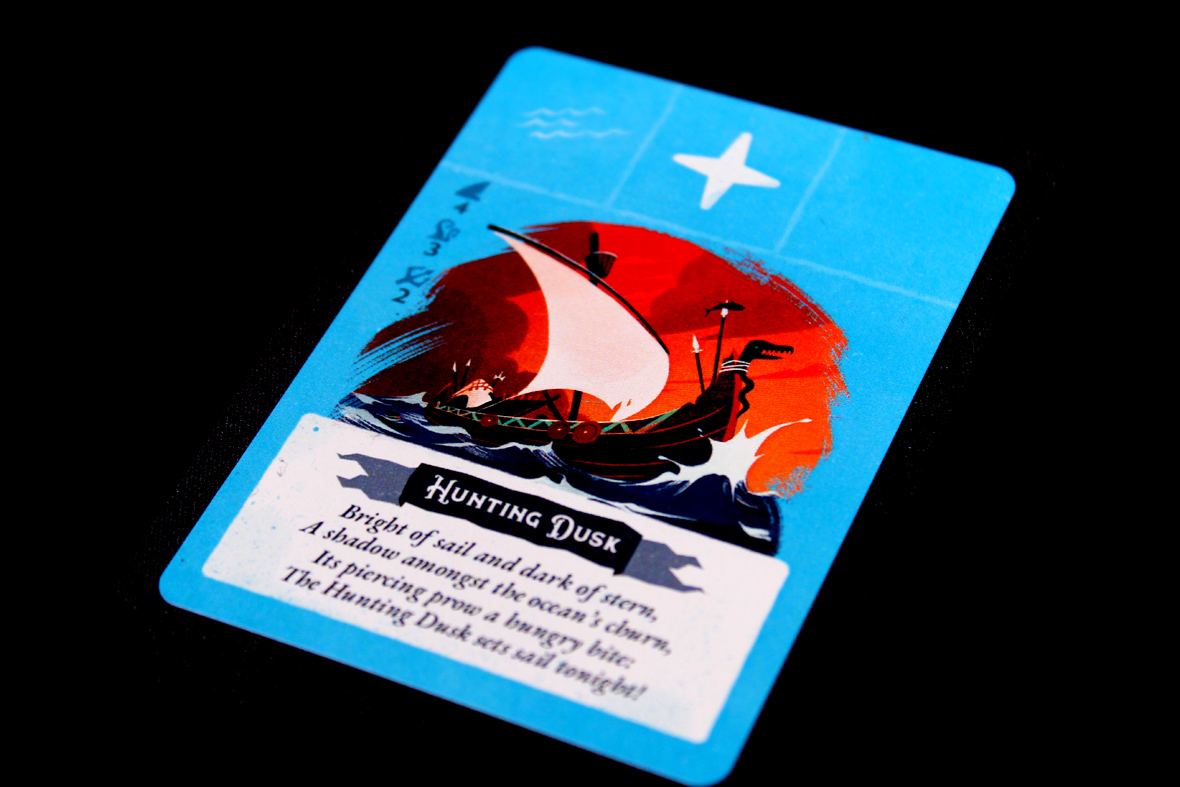
Then, set up the Marvel Deck. It’s based on your preferred difficulty, but you’ll use the Marvel side of the cards:
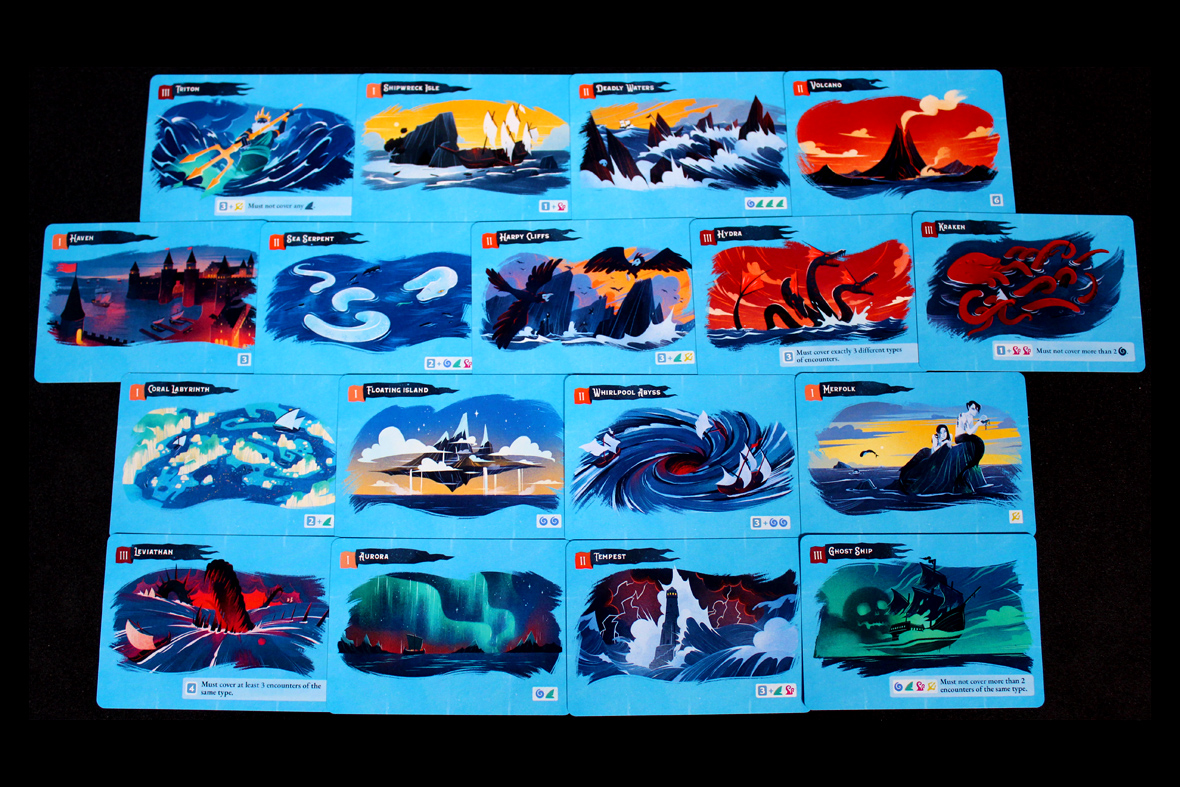
- Novice: 3 Is, 1 II, and 1 III.
- Seasoned: 2 Is, 2 IIs, 1 III.
- Veteran: 1 I, 2 IIs, 2 IIIs.
- Legend: 1 I, 1 II, 3 IIIs.
Shuffle up the remaining cards on the Map side:
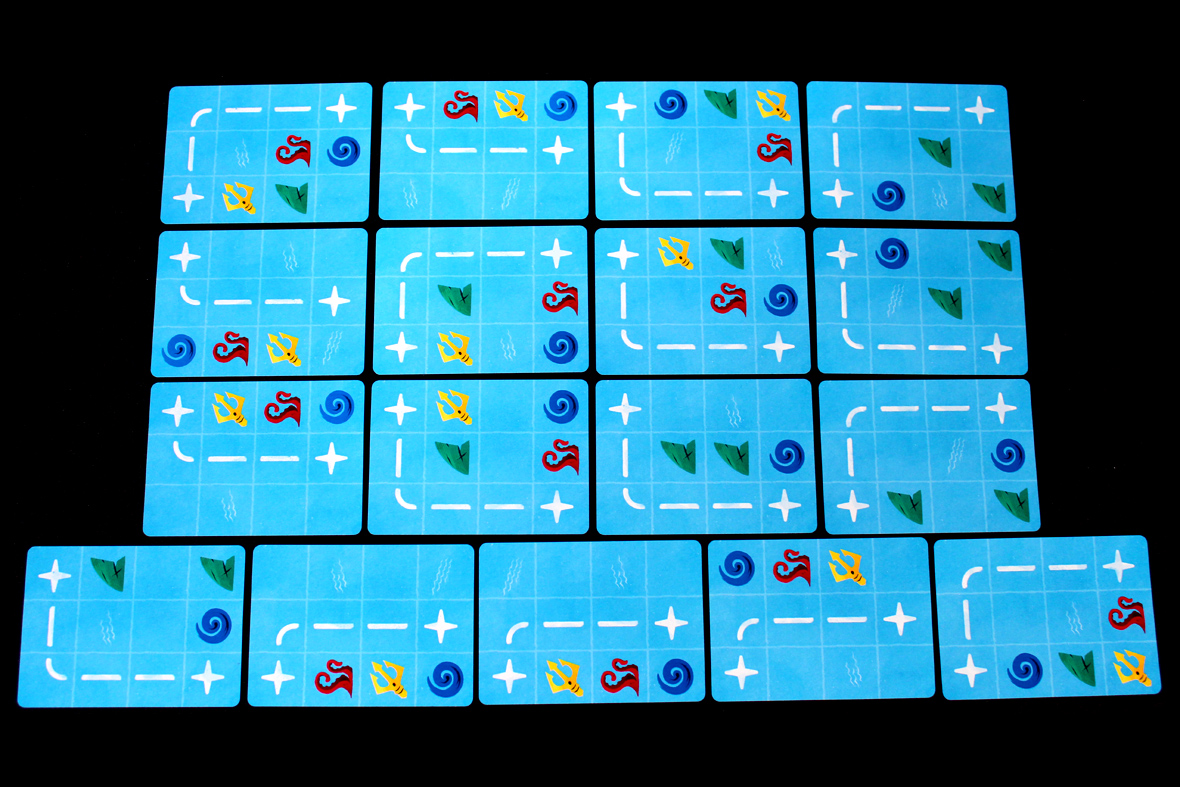
Set the top card of the Marvel deck near the Ship Card, and you’re ready to start!
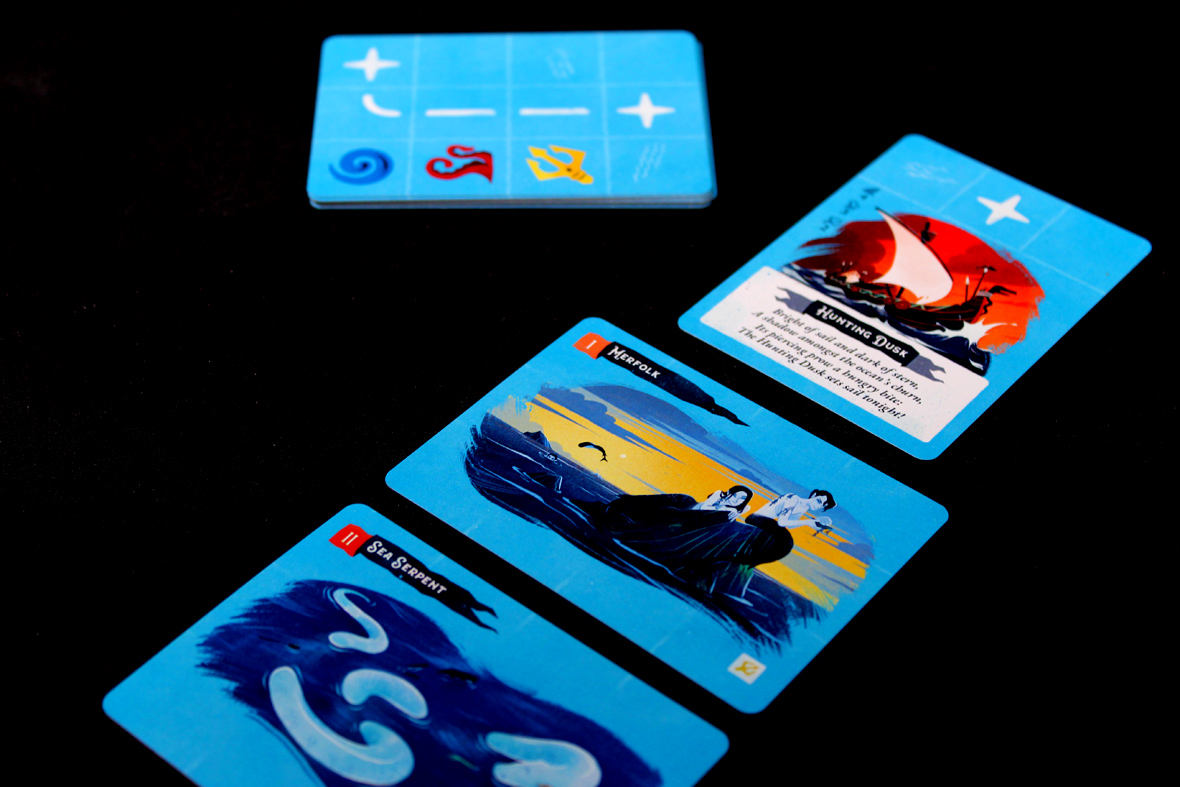
Gameplay
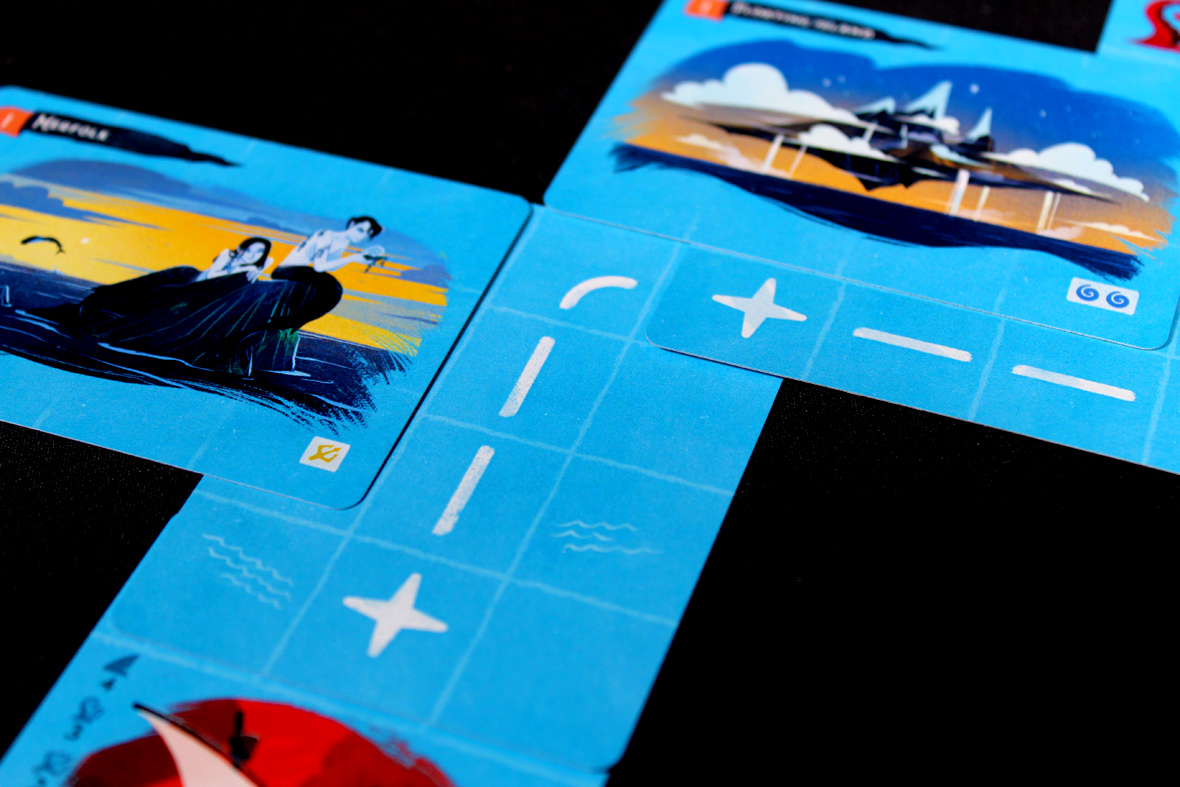
Pretty simple, this one! Your goal is to start at your Ship Card on a grand adventure and make it to the end! Score enough points and you win! Too few and you’re lost at sea!
On your turn, you either Explore or Discover. To Explore, draw two cards (they can both or either be from the top or bottom of the deck) and then place them to continue the map’s path. One waypoint on the card must be placed over the previous card’s waypoint, and you can’t cover up any images (like the Ship or the Marvels). Icons are fair game to cover up, as long as the path isn’t broken and doesn’t diverge. You can even play the waypoint farther back to shorten the path!
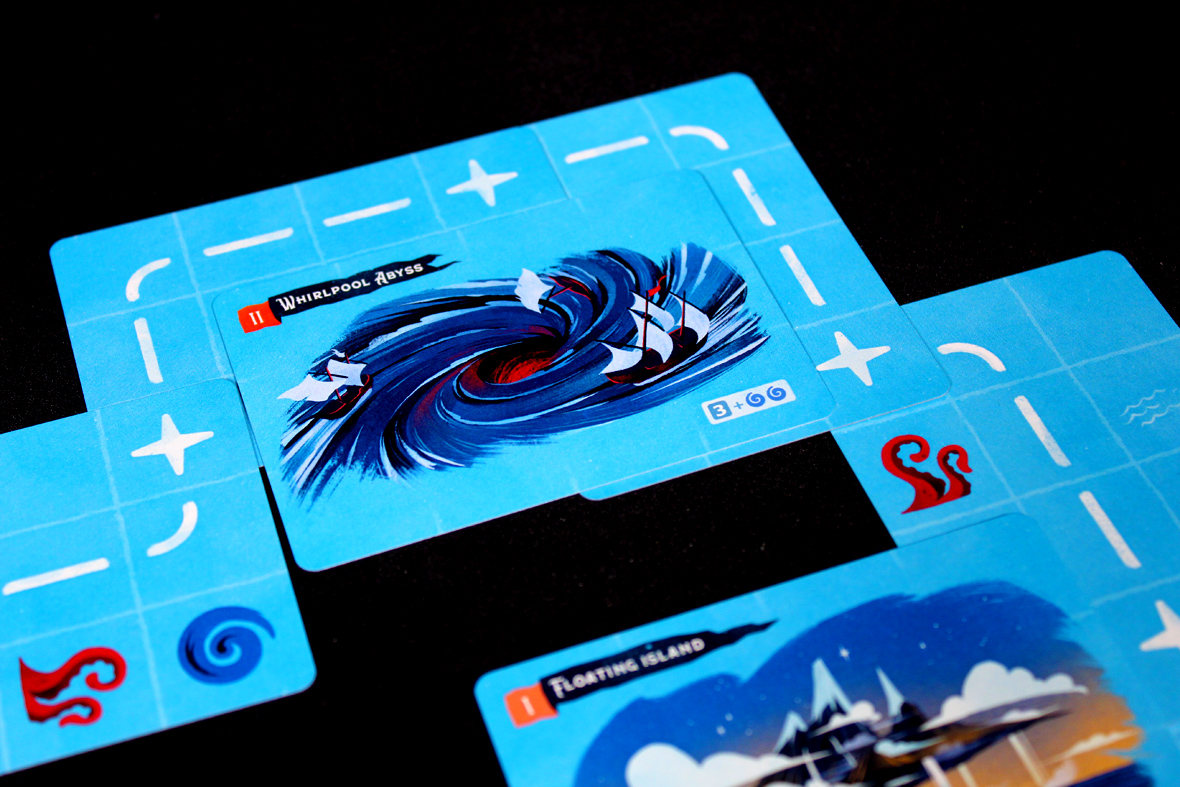
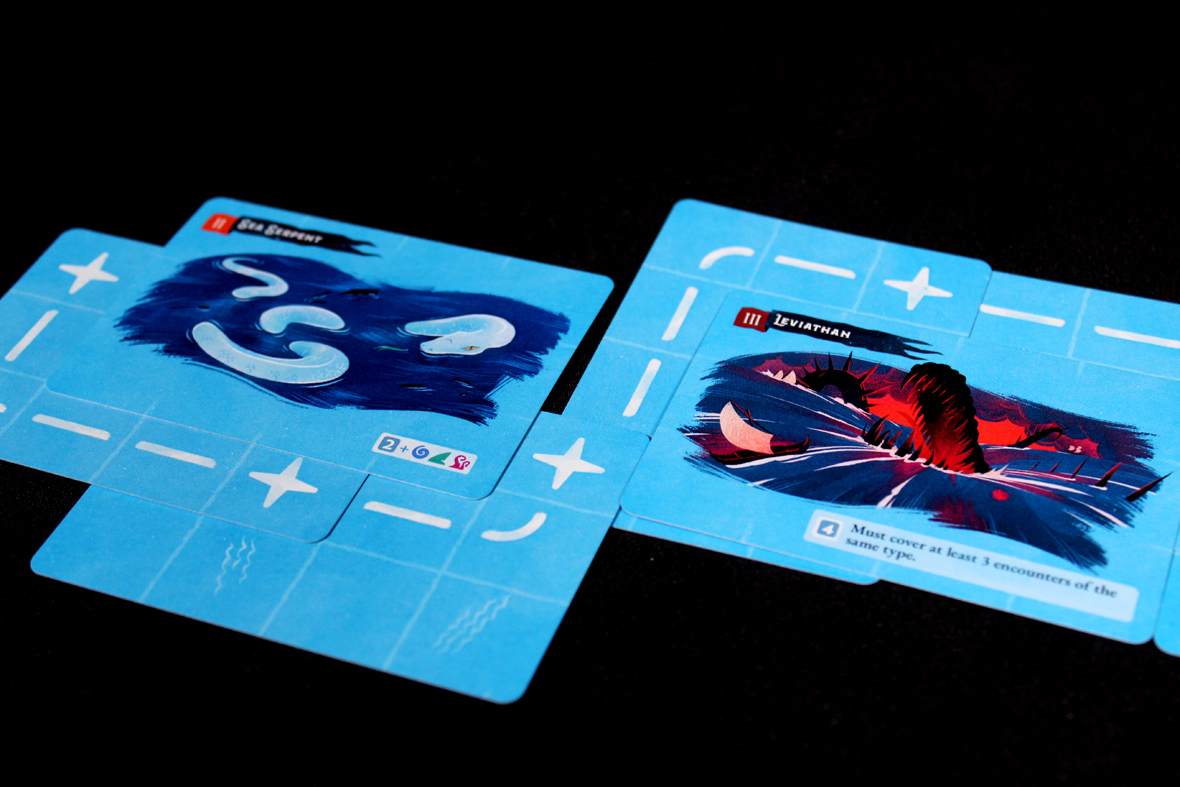
To Discover, take either the Active Marvel or the top Marvel of the deck and place them so that they’re covering sea and icons, not the path. Each Marvel has its own placement requirements; they’re usually some icons and one or more additional icons of any type (represented by a number). Some Marvels have more complicated placement rules; be mindful! They must always be placed in “landscape”, which means they can’t match the orientation of the ship (“portrait”). A good way to think of this is that if you look at the ship, everything should be correctly placed from that side of the table.
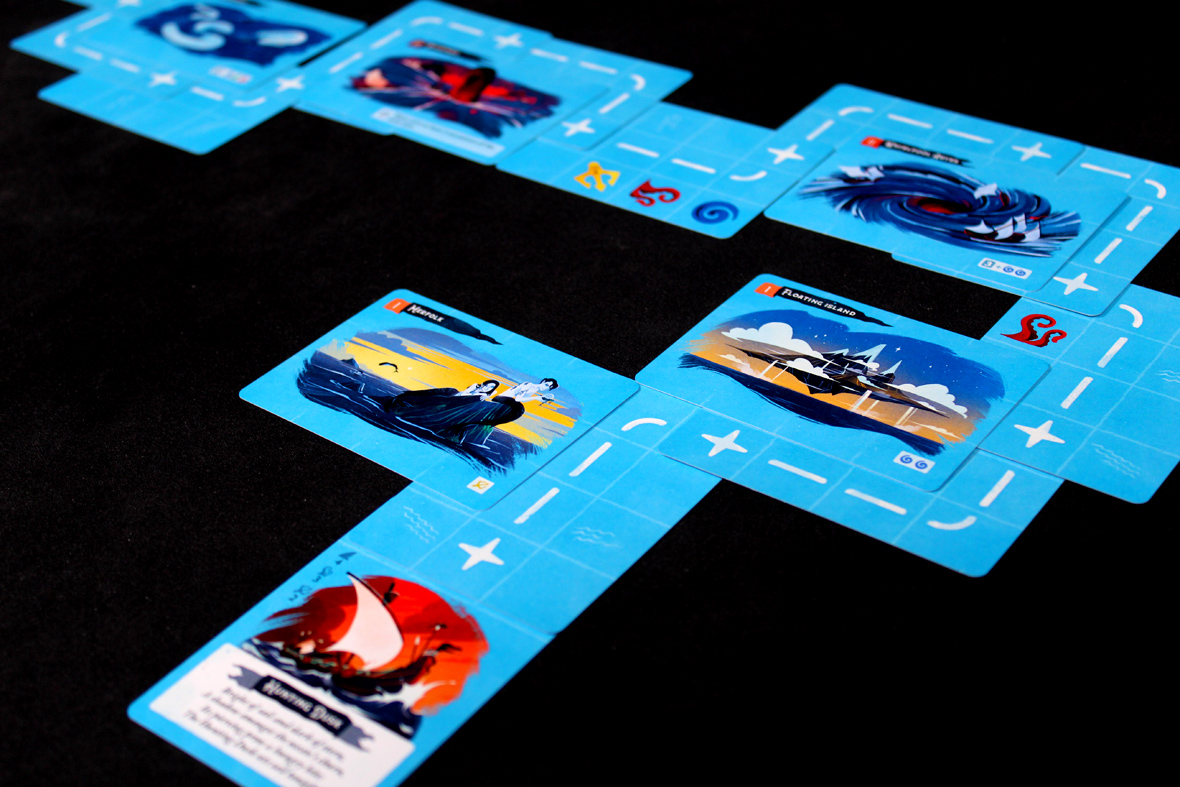
Once you run out of cards or can’t legally place more cards, the game ends! If you have more than 4 Shark Fins, 3 Tentacles, or 2 Tridents, you instantly lose. Otherwise, score:
- 1 point for each segment in your path. Don’t count waypoints.
- 2 points for each visible non-Whirlpool icon. They’ll count later, unfortunately.
- 5 points if you played all the Marvels.
- -5 points for every unplayed Marvel. Tough.
- -3 points for every visible Whirlpool. Told you they’d come up.
If you beat 39 points, you win! 50+ is even better!
Player Count Differences
Two-player is a bit of a tough break, just because of the way the actions work. At two, it’s possible that the actions just alternate and one player doesn’t get to do much mapping. It’s not the biggest deal, since it’s a short game, but it can sometimes be polite to let the other player do some mapping if they haven’t gotten a chance to do so. It could happen in four-player games, given the pattern still exists, so be mindful of that too. I don’t necessarily think that the game is worse at two; you just need to be paying attention to both winning and making sure that both players have fun.
Strategy

- Keep in mind that there are limits to how many of each symbol you can have. Make sure you’re paying attention to that over the course of the game! If you exceed those limits at the end, you just straight-up lose! And that’s not … fun.
- Try to set your next player up to place a Marvel, if you can. It is cooperative, after all, and it’s a perfect information game. You can tell them what you think they should do, granted, but that’s not always the funnest thing to do. Instead, try to set up a strategy so that they can pick it up on their turn. Then you both get to feel smart!
- If you can’t place a Marvel, try to either extend the path or cover up whirlpools to the best of your ability. Both of those things score points, since you lose points for every visible whirlpool at the end of the game. The other icons give you points, though, so it’s a balancing act to keep some and hide others.
- You can place either the top Marvel of the Deck or the Active Marvel; it’s best to plan for that. I tend to place the more complicated one of the two whenever I get a chance, just so we have more flexibility at the end of things.
- You’d rather not have unplayed Marvels at the end of the game. This is mostly because they’re worth -5 points each, which sucks.
- Shortening the path isn’t always a terrible move. Sometimes it lets you place a new card that covers up some of the symbols on the older ones, which can potentially save your game. Other times it lets you better set up a Marvel. Just keep in mind you’re earning fewer points as a result!
- Don’t necessarily just place the cards in order; think about what should go next. It’s not draw 1 / place 1 / draw 1 / place 1; it’s draw 2 / place 2. You can have both and then choose the ordering, which may matter if you’re close to the end and worried about icons.
Pros, Mehs, and Cons
Pros
- This is kind of fun! It’s not quite Greek mythology, but it’s seafaring and entertaining. The mix of various legends and tall tales is pretty nice, especially since it’s not all bad! There are pretty impressive things to see out on the ocean, though part of me was sad to see that the Edge of the World wasn’t one of them. I guess we don’t want to encourage flat-Earthers, since they’re dumb.
- The art is pretty great. I really love how blue the game is at its core, but the extra color work makes everything pop! It looks really great on the table and it’s a blast to play as a result.
- I like the variable difficulty and challenge mode! I think that should be a part of every cooperative game. It’s nice to have a difficulty level where I feel like I can beat it every time I play, and then have levels that progressively lower that percentage. Plus, there’s a challenge mode, which lets you add some more fine-tuned granularity to the difficulty curve. Veteran too difficult? That’s fine; try Standard but with Journey Effects! It essentially adds an extra in-between stage that’s got slightly different rules.
- As usual, very portable. I hear that Button Shy makes some boxes, these days, and there were those really good roll-and-write booklets of yore, but their games are on the whole unbelievably portable, and that works to their advantage! I take them most places.
- It’s nice to play some more cooperative Button Shy games! I’ve missed these a bit (though the last one I reviewed was also cooperative). It’s just nice to mix it up and team up with your friends every so often. Plus, I find that more people I know are generally down to learn a cooperative game, so it’s a good entry point for new players.
- The actual path-building and Marvel placements are fun too. I love path-building, especially with rules, and it keeps hitting for me. Part of it is the strategy, granted; I really love having to think and visualize ahead, and spatial games are some of my favorites as a result. The other part of it, though, is that I really enjoy getting to look at the end state of a game and see the thing that I built. With path-building, you have this route that goes all sorts of zany directions before arriving at the goal, and I get a certain level of satisfaction from that.
Mehs
- There’s some rules things that don’t especially translate from text to understanding. For me, it’s mostly that the game asks you to place the ship in Portrait orientation and the Marvel cards in Landscape orientation, which is … relativeish, or at least, can depend on where you sit. I settled for “Marvel Cards can’t be placed in the same orientation as the Ship Card” and that sorted it nicely.
- Some examples of correct Marvel placement in the rules would have helped. They provided a text explanation but one example would have helped nicely.
Cons
- It’s difficult to backtrack, so make sure you don’t screw up your game early on. You can do that if you end up doing something silly like playing too many tridents, and you can’t exactly head too far backwards if you don’t have the cards for it. This can be frustrating if you realize it too late.
Overall: 7.75 / 10
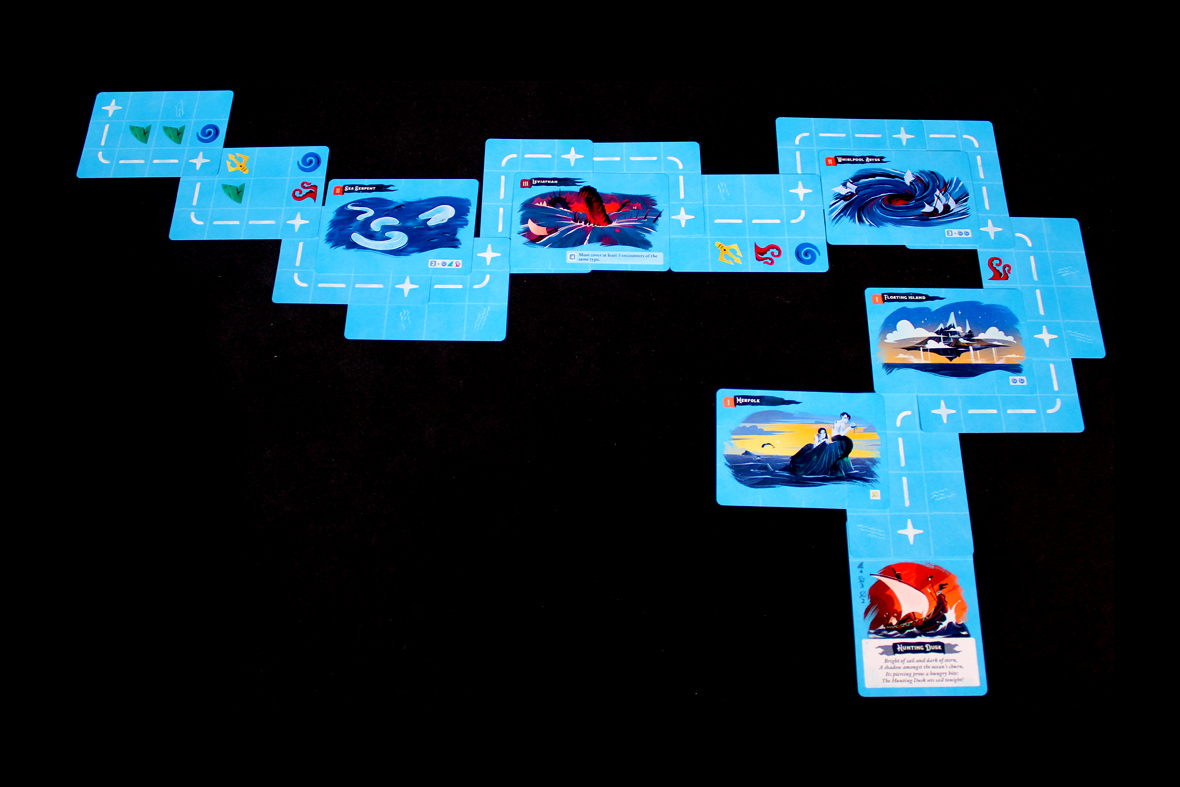
Overall, I think Adventurous is fun! It’s got that cooperative vibe of sailing the seas and looking for adventure, and path-building and tile-laying are two of my favorite genres, so this hits quite nicely for me. I need to experiment with the difficulty a bit more, though; I did pretty well on Seasoned, so I want to mess around a bit more with the various other options, like Journey Effects and higher difficulty levels. There’s a nice gradient to the difficulty curve, so you’re not exactly going to find yourself overwhelmed if you start at the bottom and work your way up. Plus, the theme is fun! A nice mix of myth and legend to accompany you on your seaward voyage; what’s not to like? You can screw yourself over early with poor placement, though, and that’s never fun. Thankfully, this game has the Button Shy Advantage: it’s short, so, you know, just play it again and don’t do that. Similarly, it’s portable; an extensive ocean journey you can fit in your back pocket with friends. Never gets old. The scoring system is okay, though I would have liked a few more levels between Lose, Win, and Super-Win. I’m picky, sure, but it would have been fun. Beyond that, though, this is another game I can see myself playing in the future, so going to be interested to see what extra content comes with the Kickstarter. If you’re a cooperative game fan, you like the thrill of a legend-filled sea trip, or you just love path-building, check out Adventurous! I had a good time playing it.
If you enjoyed this review and would like to support What’s Eric Playing? in the future, please check out my Patreon. Thanks for reading!
 What's Eric Playing?