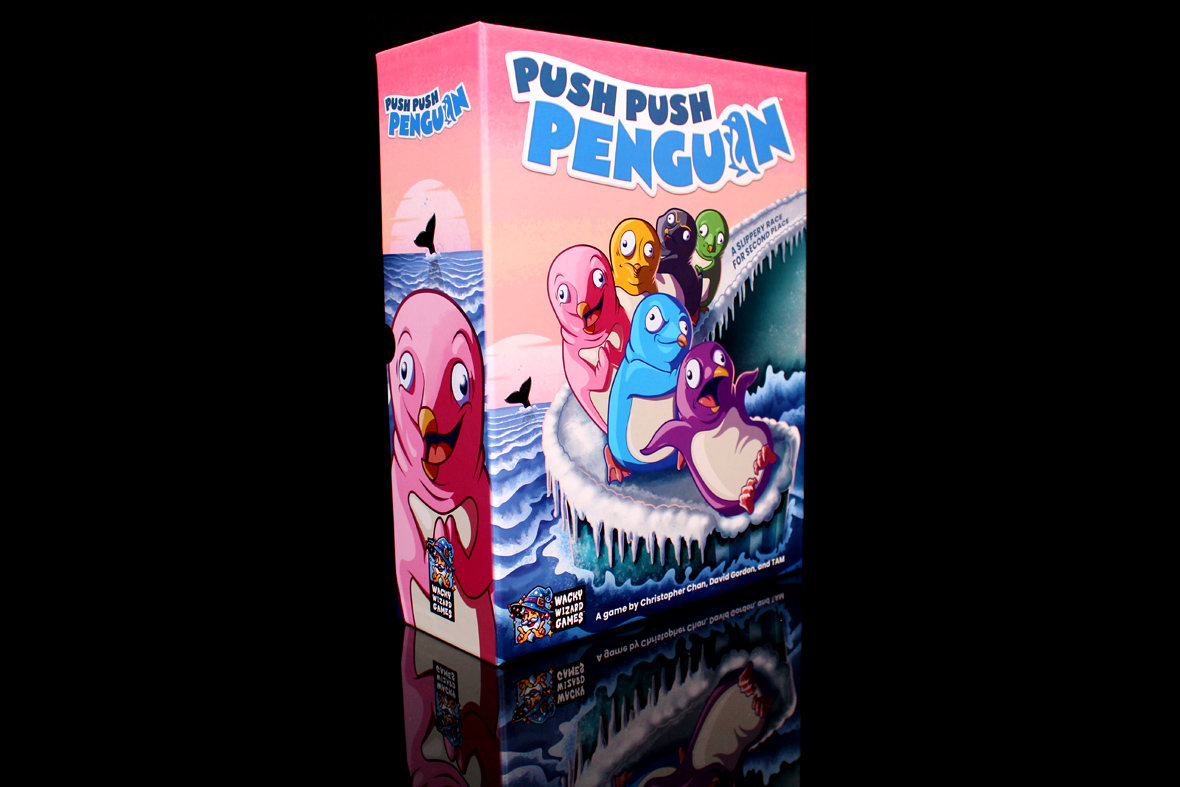
Base price: $30.
2 – 6 players.
Play time: 10 – 20 minutes.
BGG Link
Buy on Amazon (via What’s Eric Playing?)
Logged plays: 2
Full disclosure: A review copy of Push Push Penguin was provided by Wise Wizard Games.
Last review of the week! Or first review of next week. It’s a peaceful pattern, having done reviews every week for the last decade or so, but it does make you start to lose track of how many games you’ve reviewed. That was easier when I was numbering them, but I also made a few numbering errors and ended up with duplicates across the count. Not great. You do start to wonder, though: what percentage of those games are even still being printed? Certainly nothing from IDW Games, for instance (though in a lot of cases, that’s probably for the best). Maybe one day I’ll try to go back and glean insights, but in the interim, all we can do is press forward. Let’s do so, with Push Push Penguin, from Wise Wizard Games! Technically, it’s their Wacky Wizard Games imprint.
In Push Push Penguin, it’s a race to second place! You’re sliding down the ice with your penguin friends, but there’s a very hungry orca lurking around. That makes things a lot more fun and a lot more dangerous! Don’t worry, though: the orca isn’t going to eat anyone (probably); he will just scare off the first penguin to cross his path! That means that you definitely don’t want to be first! Thankfully, if you would move to where another penguin is, you can just shove them a bit forward. Who knows where they’ll end up? Will you end up getting the coveted silver medal?
Contents
Setup
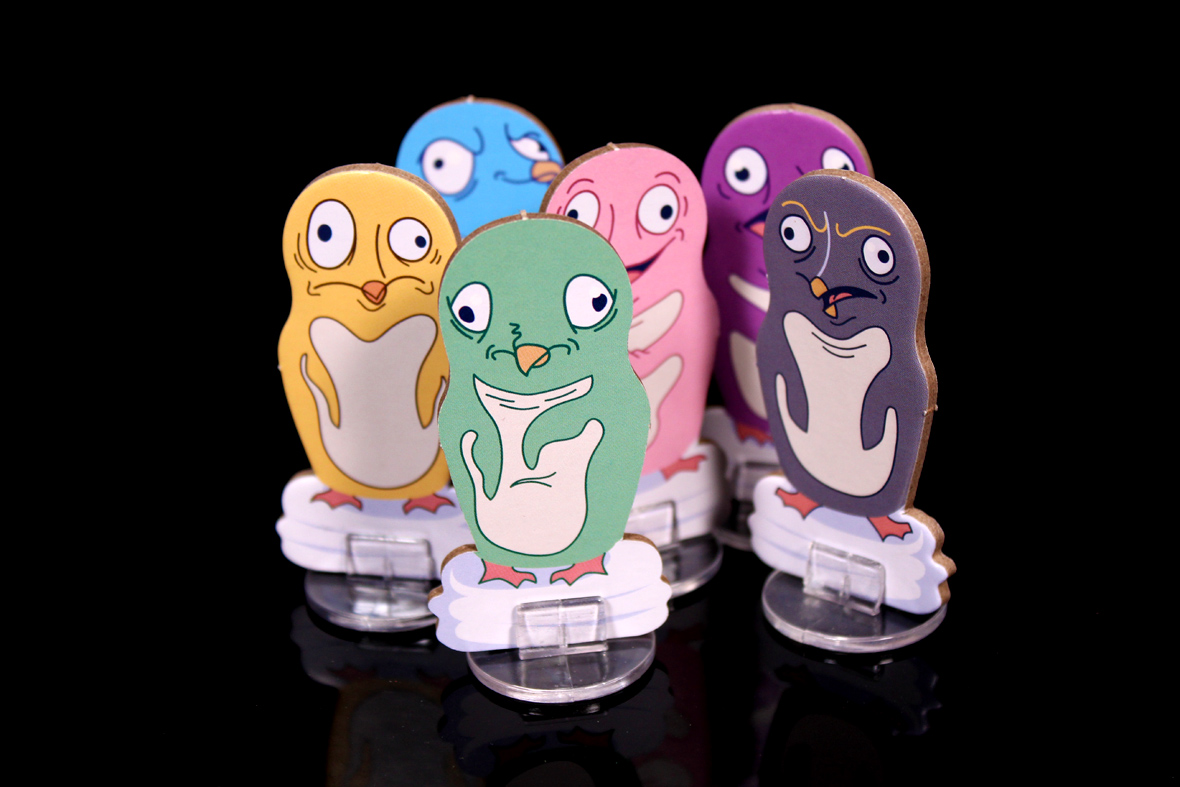
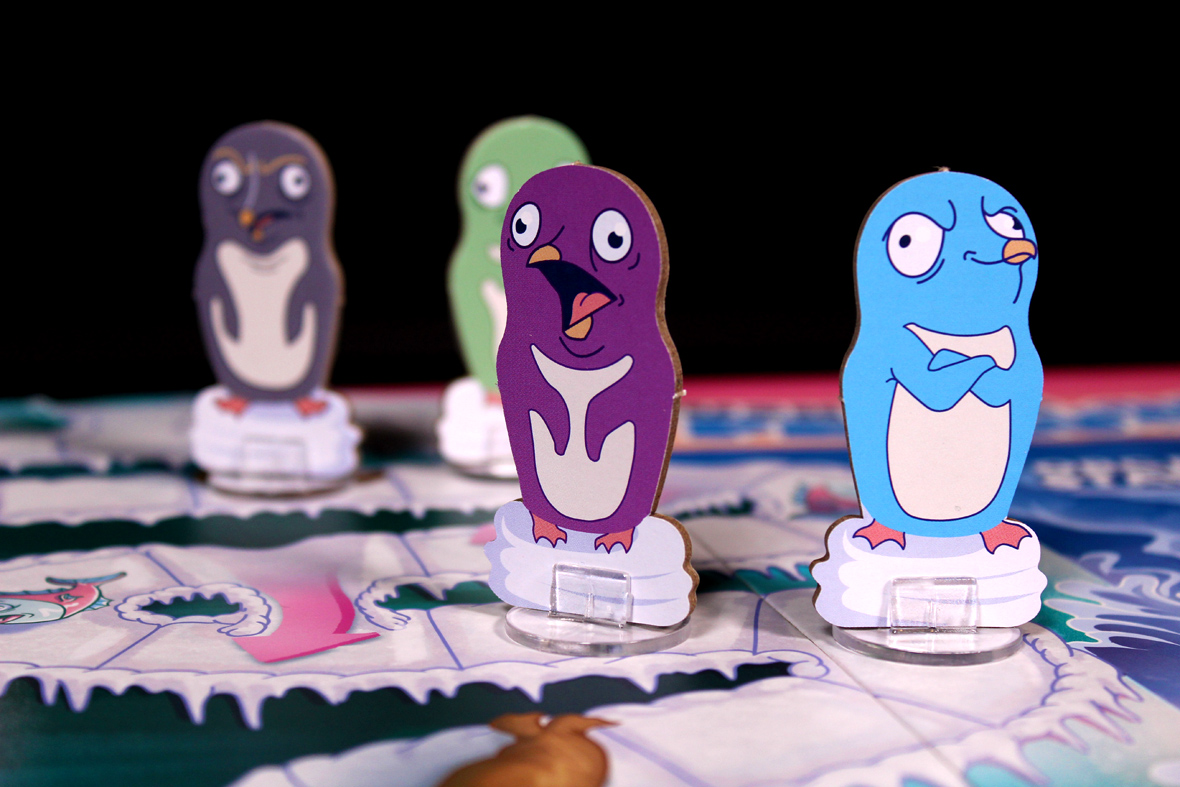
Not much here. Each player gets a penguin in a color of their choice:
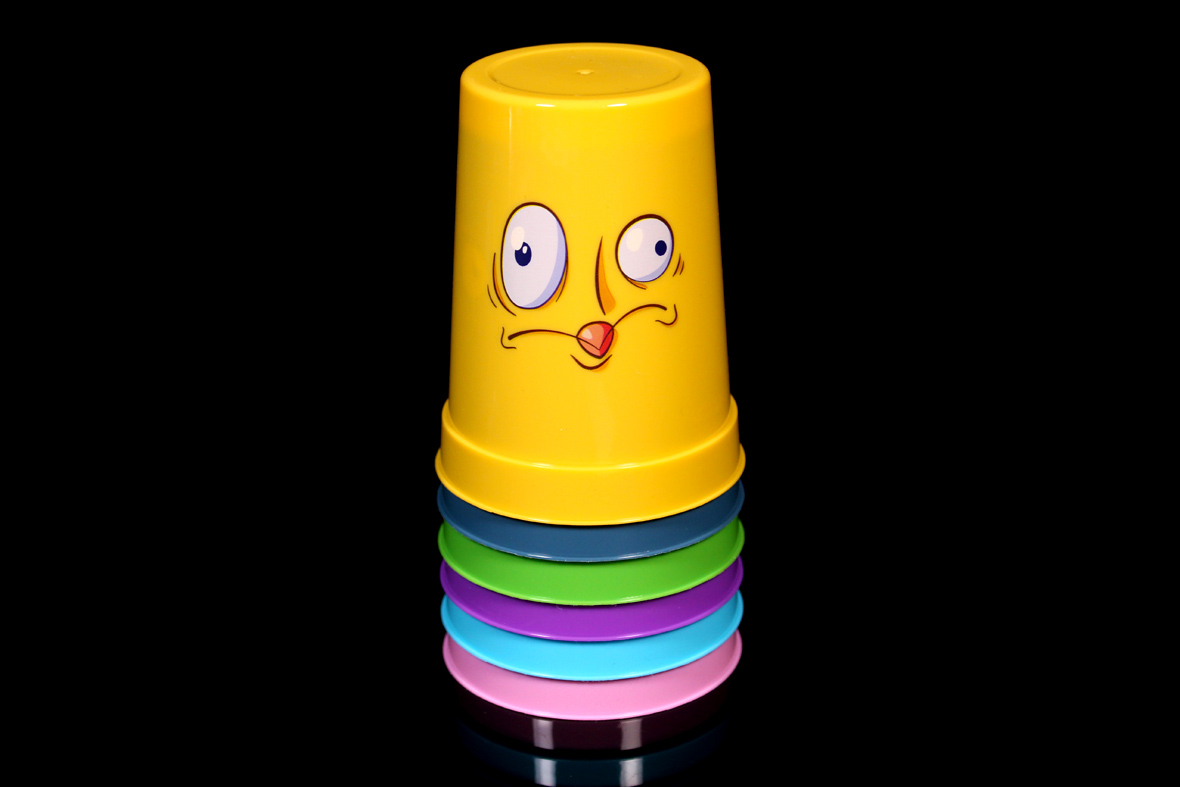
That means they get the matching cup:
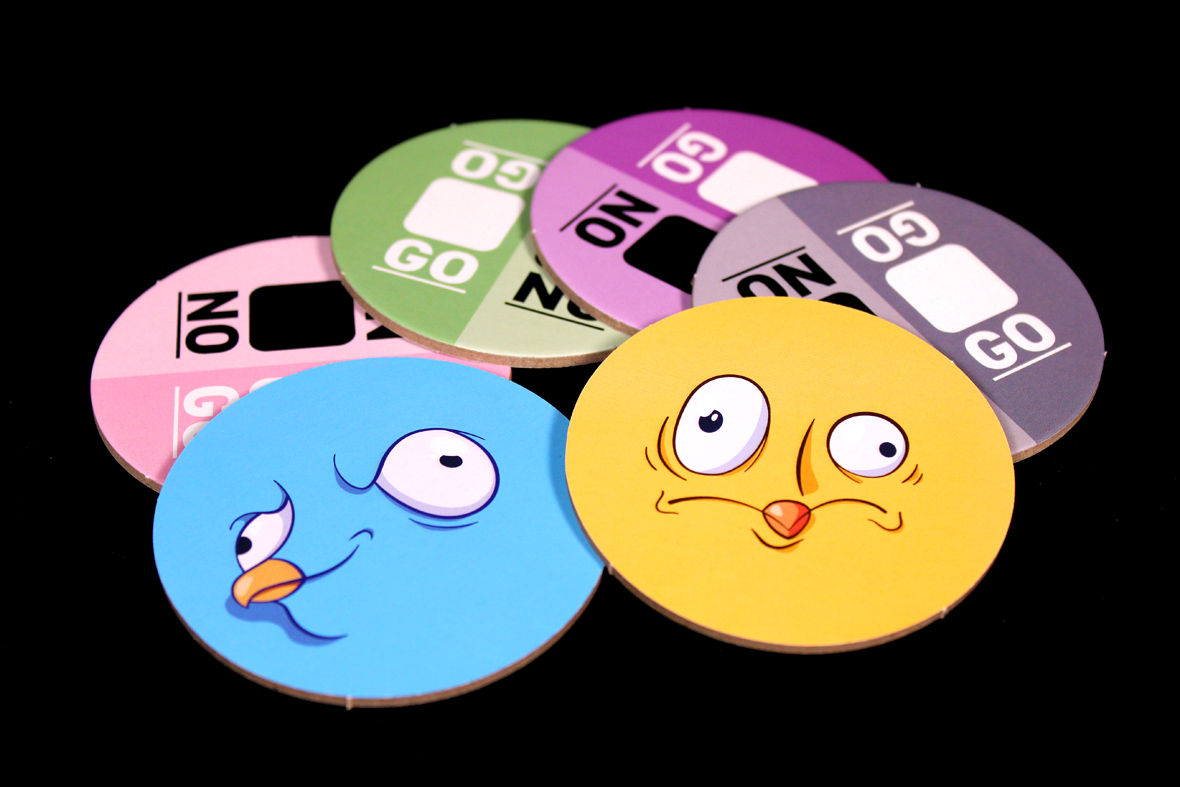
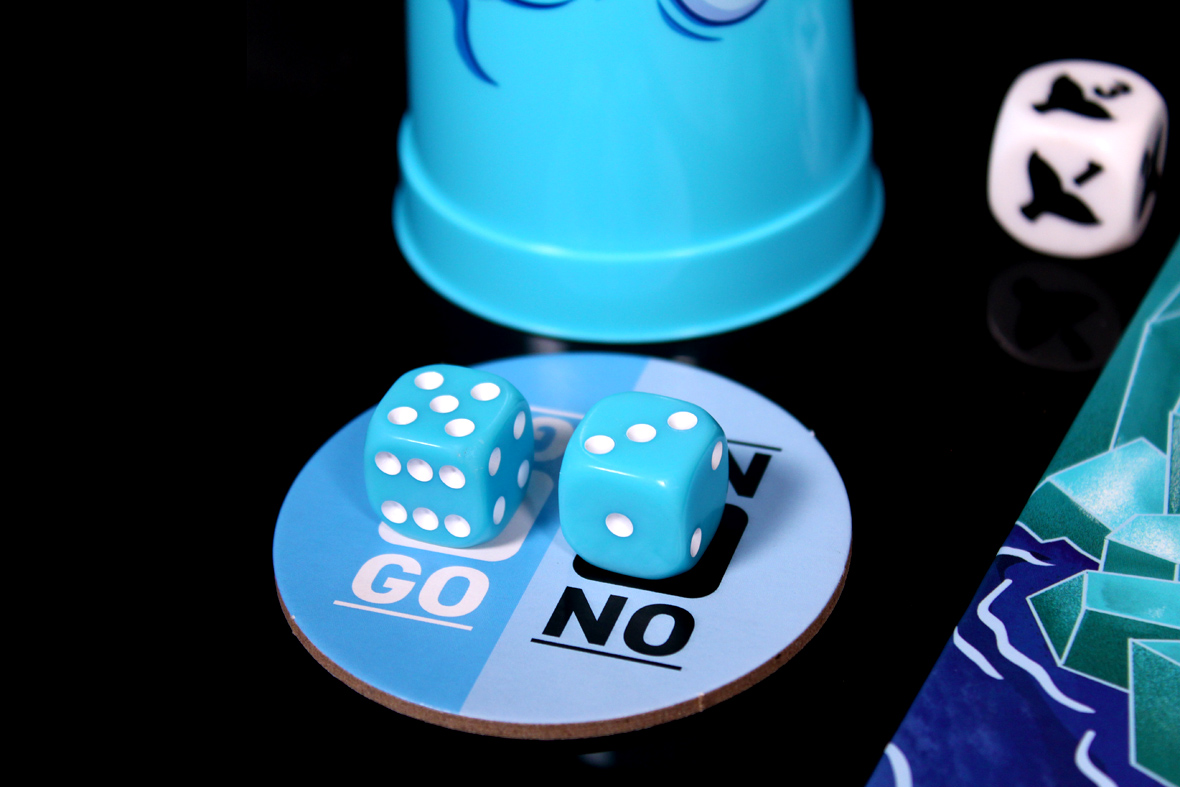
The matching GO / NO tile:
And the matching dice.
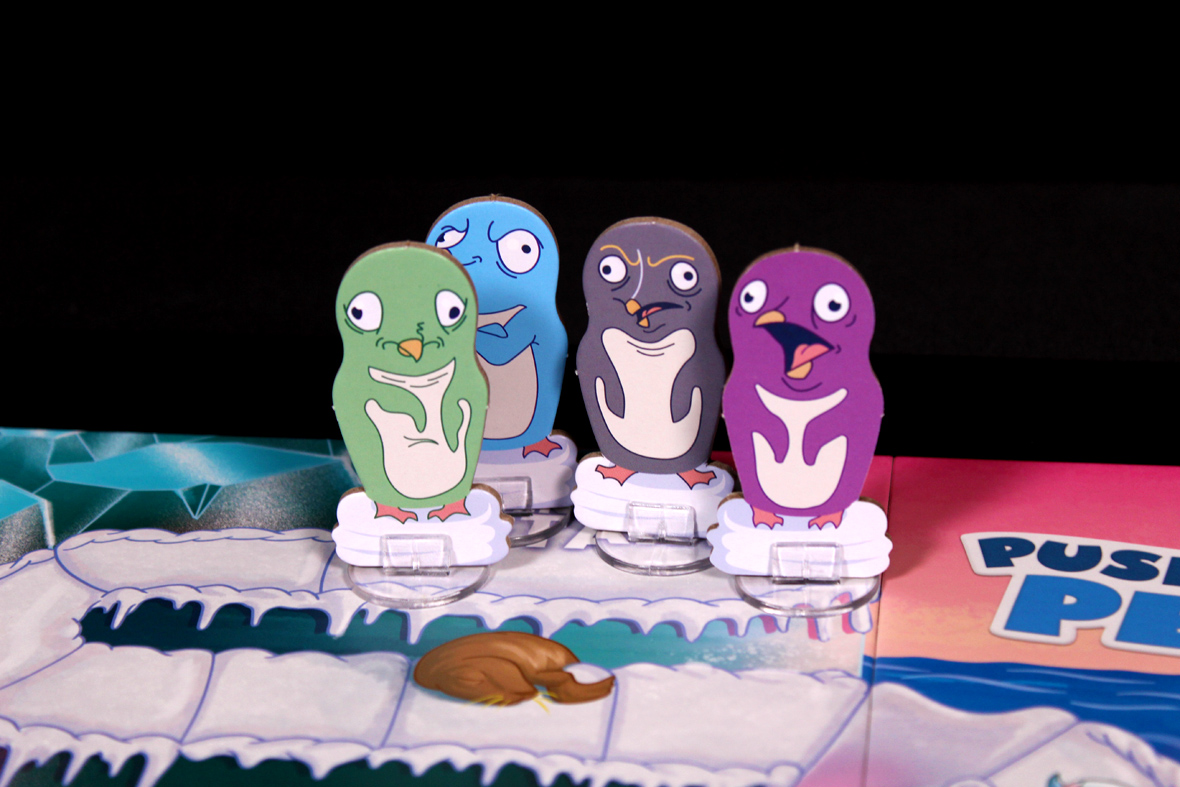
Place the penguins on the Start Space on the board:
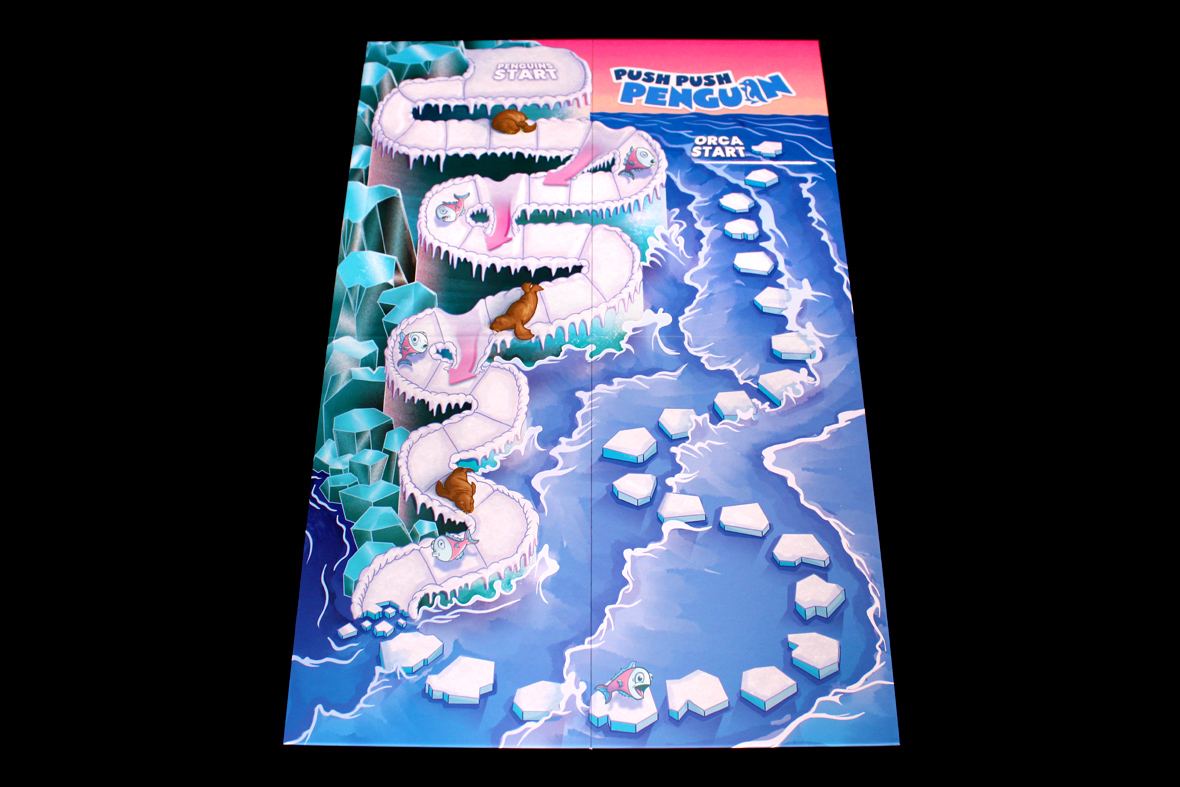
Place the Orca Tail on the Orca Start space:

Place the Fish Tokens nearby and give each player one:

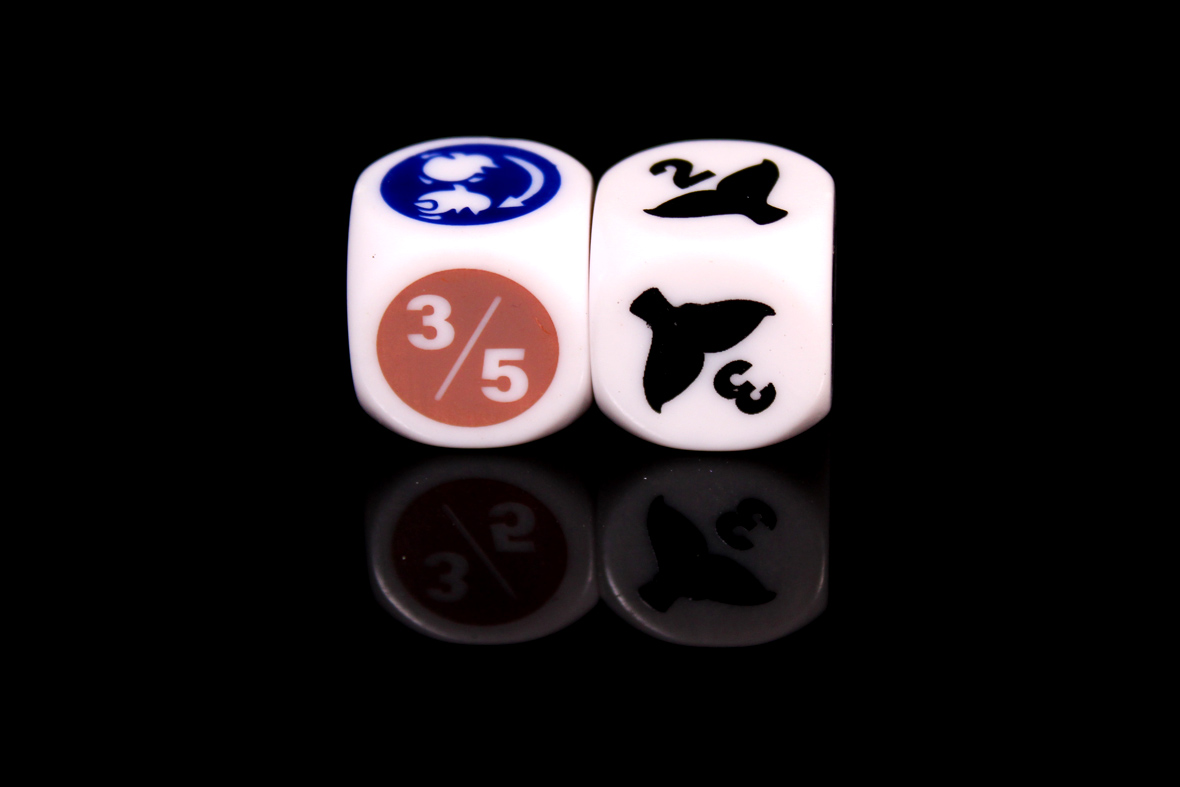
Give one player the Orca Die and set the Seal Die aside:
You should be ready to start! The player with the Orca Die goes first.

Gameplay
This one isn’t too complicated! You’re racing towards the bottom, with one caveat. The first penguin to unsuccessfully escape the orca loses, and then the second-place player wins! Here’s how it works.
Each player rolls their dice and secretly places one on the GO space and the other on the NO space under their cups. Once they’re ready, they reveal them!
Starting with the player with the Orca Die, each player then takes their turn. If any player has rolled doubles, on their turn they may reroll and reassign their dice. They move the number of spaces on their GO space forward (or can spend a fish token to combine their GO and NO numbers and move that many spaces). Once they stop, a few things can happen. They can slide down a slide, roll the seal die, collect a fish token, or push another penguin (who can then do any of those things)!
After every player has taken their turn, the player with the Orca Die rolls it and moves the Orca up that many spaces. They pass the die left and the next round starts!
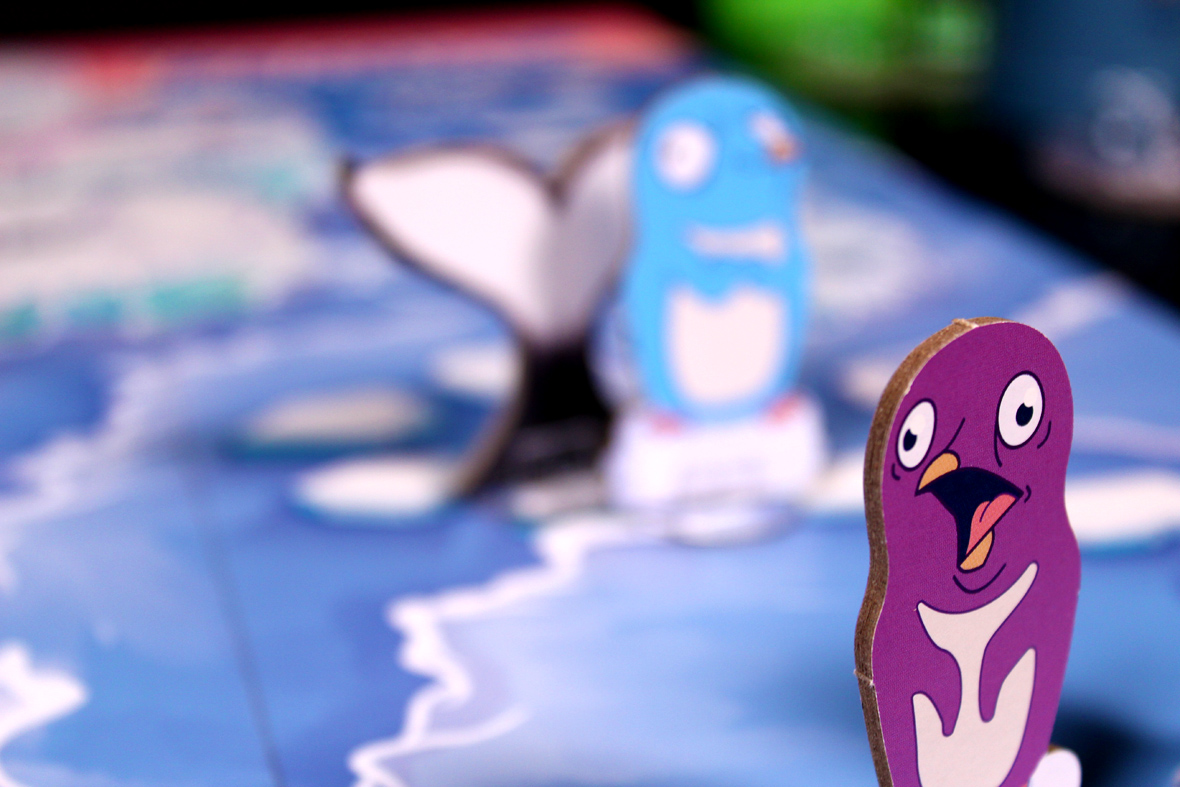
If the Orca ever moves onto the same space as a penguin or vice-versa, they might end the game! They roll the Seal Die and unless it shows the Orca Tail, they must spend a Fish Token to reroll. If they eventually roll the Orca Tail, they get moved to the space behind the furthest back penguin! If they don’t manage to ever roll the Orca Tail, they’re scared off and the second-place penguin wins!
Player Count Differences
In a shocking change of pace, there are pretty substantial differences based on player count, but that’s mostly that the game moves faster with more players. There are more penguins on the board, so, naturally, there’s more collisions. More penguins and more pushing gradually moves the game farther down the board and closer to the orca even faster, so you can expect the game to end a bit quicker (unless everyone’s rolling perfectly). At two, you do play with two Waddlebots, which are essentially players who can’t reroll any dice but the final fish dice. They’re interesting in their own right since they can win on their own, and are fairly pleasant dummy player alternatives, to boot. You can even fold the Waddlebots in at higher player counts if you want more bumping and pushing, or you just want more chaotic games. They’re on nobody’s team, though; Waddlebots cannot be tamed. I’ve enjoyed both lower-penguin and higher-penguin games, though I like the chaos of more penguins better.
Strategy
- Moving up too fast can be an issue. You don’t want to be so far out in front of other players that it’s just everyone going for broke before you end up the game. Maintain some decorum?
- Collecting fish tokens is a good idea too! You really want those if you’re worried about ending up in front of the Orca or you want to double up a dice roll at some point, I suppose.
- Using a fish token to surge forward is great, especially if another player is about to get jumped by the orca and potentially end the game. You can use them to jump up to second place, though I wouldn’t recommend going farther than that.
- Seal spaces are a bit of a mixed bag. You can use them to move up, but they can also jump you directly in front of the frontmost penguin, which can be wildly bad. It’s more fun to have them move the Orca ever closer, like an inexorable reaper who only scares you.
- Pushing other players can be useful, especially if you push them onto slides or seals. You can even push them into the Orca! Ideal outcome, but pushing them onto slides or seals can lead to either humorous outcomes our just shoot them forward with reckless abandoned. I’m good either way.
- Not that you can try to roll doubles, but they are useful! Don’t necessarily just reroll them. Wait to see what other players do on their turn! You might be able to make a different decision if you get to reroll.
- Keep in mind that the player with the Orca Die moves first. That can be a big deal, especially towards the end of the game. The player moving first can push other players into the Orca or potentially end up there himself.
Pros, Mehs, and Cons
Pros
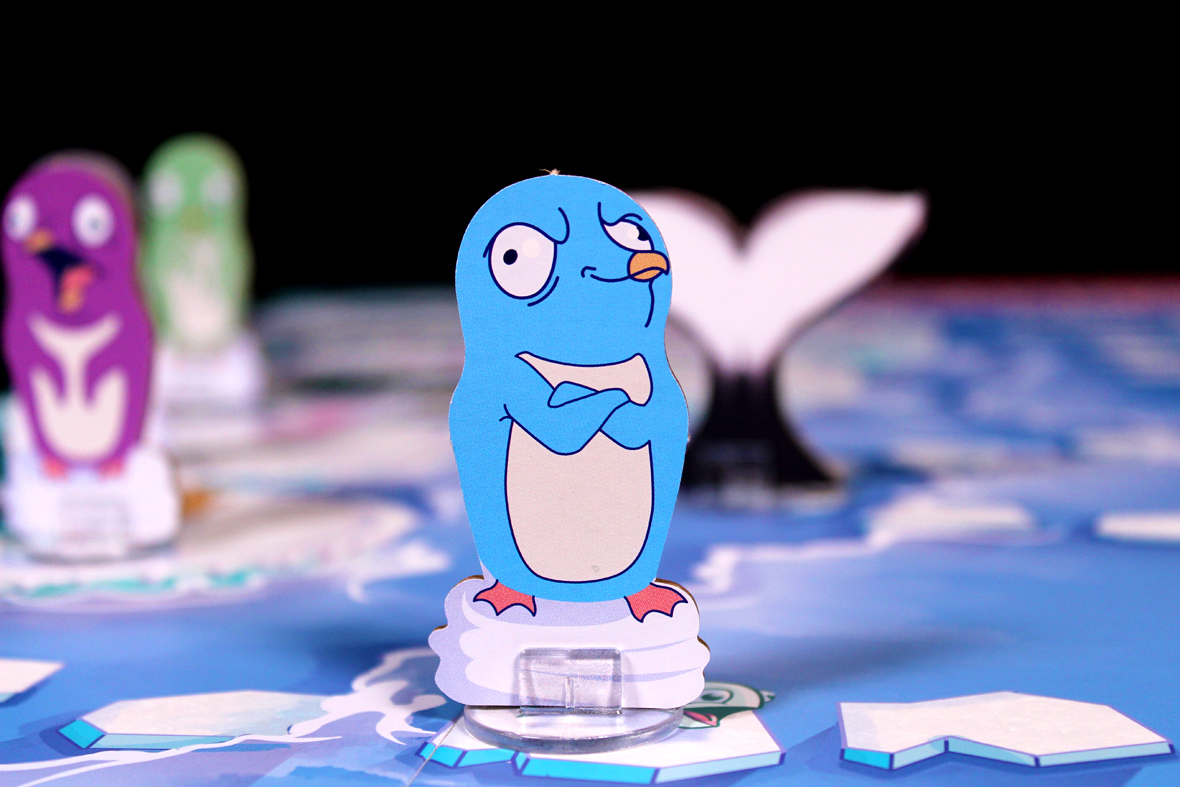
- You know what? I like the art. It’s goofy and memorable. I’ve been told that there are people who don’t like the art? I guess? I don’t get it. I love it. They’re so weird. Just, not like any penguin I’ve ever seen in my entire life. I think I’ll remember this weird little penguins forever.
- Plays very quickly. It’s simultaneous dice rolling with individual advancement, which is nice. You don’t really need to think too much or do much and the turns are short and very fast, which is nice.
- The color scheme is a lot of fun, too. There aren’t enough pink boxes!
- The GO / NO distinction makes the game very easy to understand. You can pretty easily determine what goes where even without a particularly lengthy explanation of the rules, which is nice. A very approachable game for everyone.
- Getting to push other penguins around is fairly harmless fun. It’s not particularly rude, even if you’re pushing other penguins around a lot. You’re not really taking it too personally. High player interaction without it being particularly negative.
Mehs
- My pink penguin cup doesn’t have a face! Not sure what happened there; must have been a misprint. Just sad.
- They gave us a surprising number of unnecessary plastic bags. I think I only ended up using one or two?
Cons
- The game does suffer from a bit of a Munchkin issue, where at the end it’s often the person who is second after everyone has used all of their fish tokens trying not to get eaten. It’s not the worst thing in the world, but there is a tendency for players to just hoard fish tokens so that they can ward off the orca, should they end up there. That said, even if they have plenty of fish tokens, they get forced to the back of the penguin queue. So you’re really waiting for everyone to run out of fish tokens and then going for second place.
Overall: 7.25 / 10
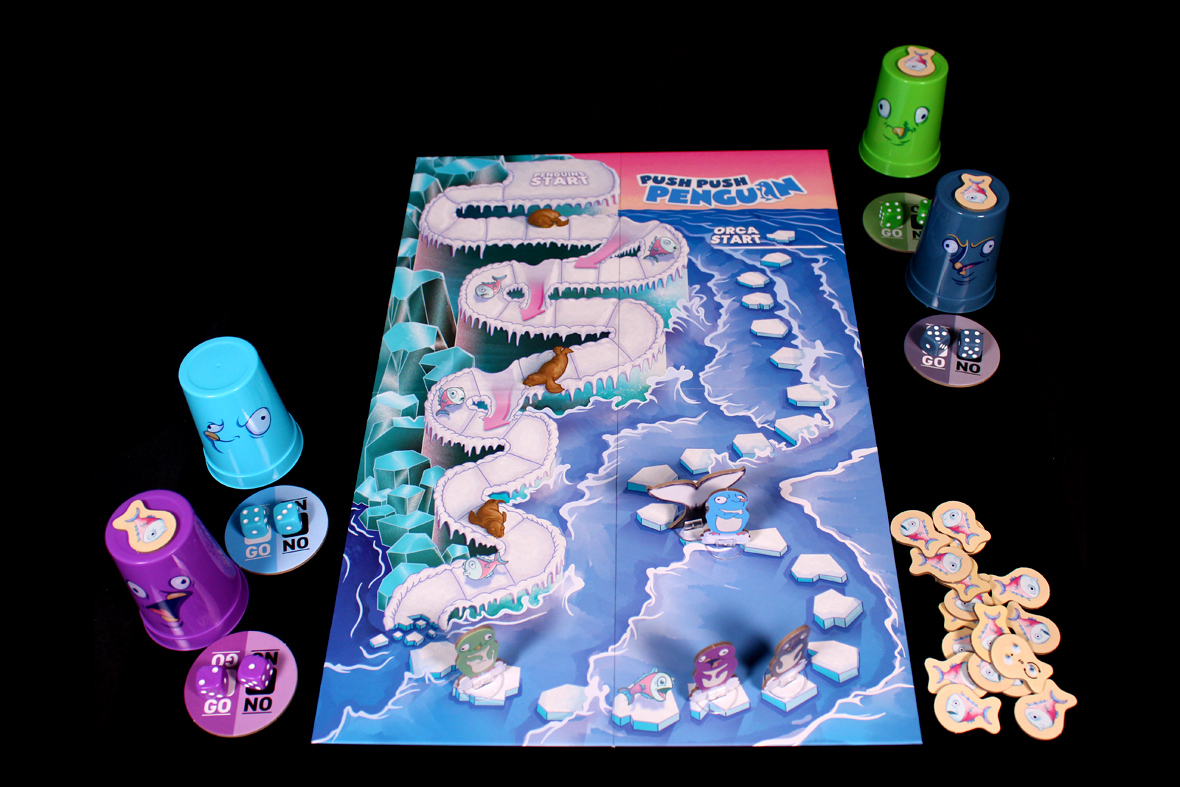
Overall, I think Push Push Penguin is a hoot. A little simple for my tastes, but certainly not bad, especially if the goal is to get younger or newer players interested in light gaming. It does a few things extremely well. First off, the art is extremely memorable. Once you see it, it lives in your head forever. It’s also goofy in a way that plenty of people will find entertaining. I kind of love it and am kind of haunted by it, which is high praise that I haven’t really been able to give out since Pigasus. Good work. It’s also dead simple to pick up. The GO / NO distinction is great and very easy to explain, and even doubles make sense in context. Every question you might have is almost always best answered in the moment, and in the moment it’s always a quick answer to boot. I also appreciate how quick the game is. Family-weight games almost always have to fight to not overstay their welcome. If you lose someone on the simpler games, they may not want to come back for higher-complexity fare (or you might not get them to play the simple games at all). This is snappy. Granted, there are consequences to that. Dice-driven gameplay can often lead to dice-driven outcomes, which can be more random than some players are looking for. I personally think that, as a problem, concerns me less the shorter the game is. Here, it’s a short game, so it’s less of an issue. Like I said, my main issue is that the game is a bit simple for me, and I’d love to see what this would look like with a bit more meat to it, but I still like it as-is. If you’re a penguin fan, you are looking for a way to introduce the whole family to gaming, or you just need a quick gaming break, Push Push Penguin is a goofy good time! I’d play it again.
If you enjoyed this review and would like to support What’s Eric Playing? in the future, please check out my Patreon. Thanks for reading!
 What's Eric Playing?