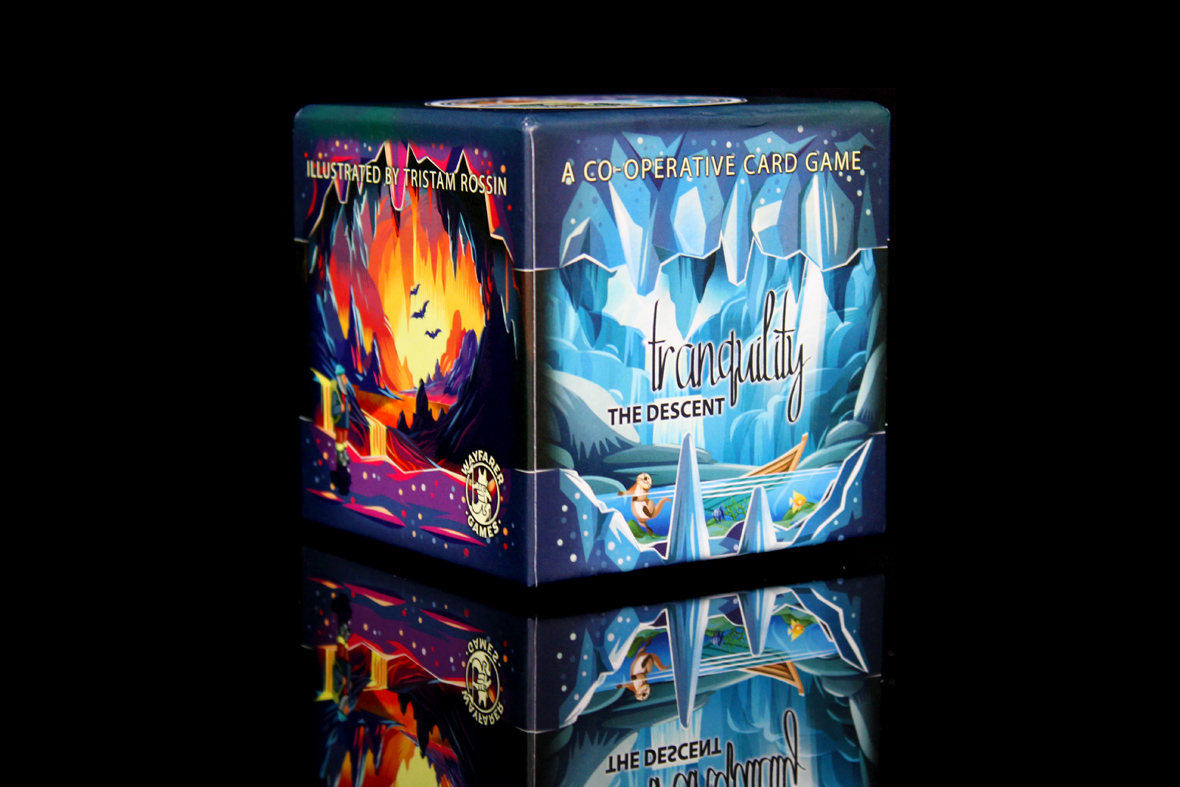
Base price: $XX.
1 – 5 players.
Play time: 20 – 40 minutes.
BGG Link
Check it out on Kickstarter!
Logged plays: 2
Full disclosure: A preview copy of Tranquility: The Descent was provided by Wayfarer Games. Some art, gameplay, or other aspects of the game may change between this preview and the fulfillment of the Kickstarter, should it fund, as this is a preview of a currently unreleased game.
It’s rare to see game series, anymore; I think it’s an economic thing. Sometimes you get two games in a series before it gets dashed into the night, never to be seen again (Honshu and Hokkaido, two of the Nippon Trilogy); sometimes you get one game in a trilogy and then it just sounds silly forever (Daemon Trilogy: Subrosa). Who knows why anything happens. But I have here, today, for y’all, a game with three complete entries spaced apart reasonably. Tranquility, Tranquility: The Ascent, and today’s Tranquility: The Descent. And I’ve almost learned to spell tranquility correctly on my first try. Truly, we’re all blessed. If you’ve played the others, you’re probably wondering what this one’s all about; so let’s dive in and find out!
In Tranquility: The Descent, well, you’ve gone, you’ve gone up, and it seems perfectly reasonable that now you go down. Somewhere deep in the earth has gotta be the peace you’ve been searching for. If you find it, let me know, but I’m rooting for you either way. Along the way you’ll see ancient untouched caves and catacombs, mysterious statues, and the occasional fox / rabbit ecological event, depending on how many expansions you want to try. Work together to build five rows and eight columns down into the underground to find what you seek. Will you be able to make it all the way down?
Contents
Setup
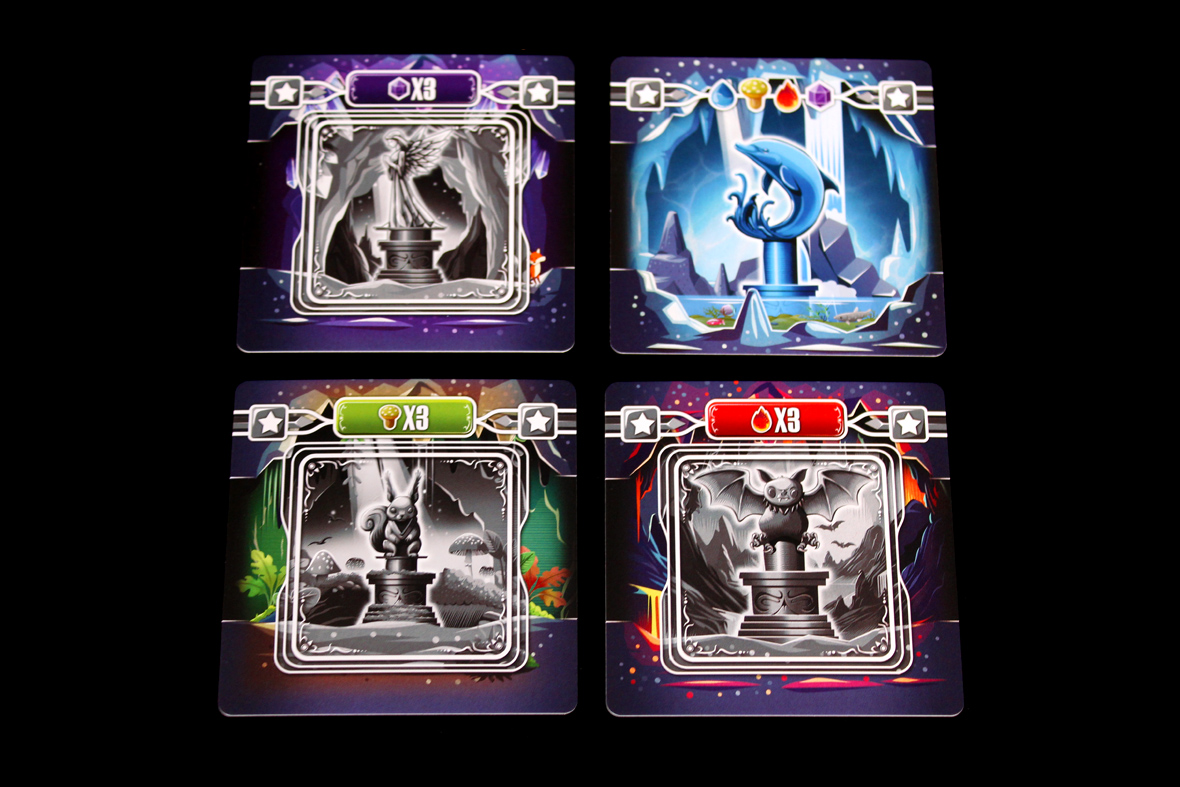
Regardless of player count, set the Wild Statues aside:
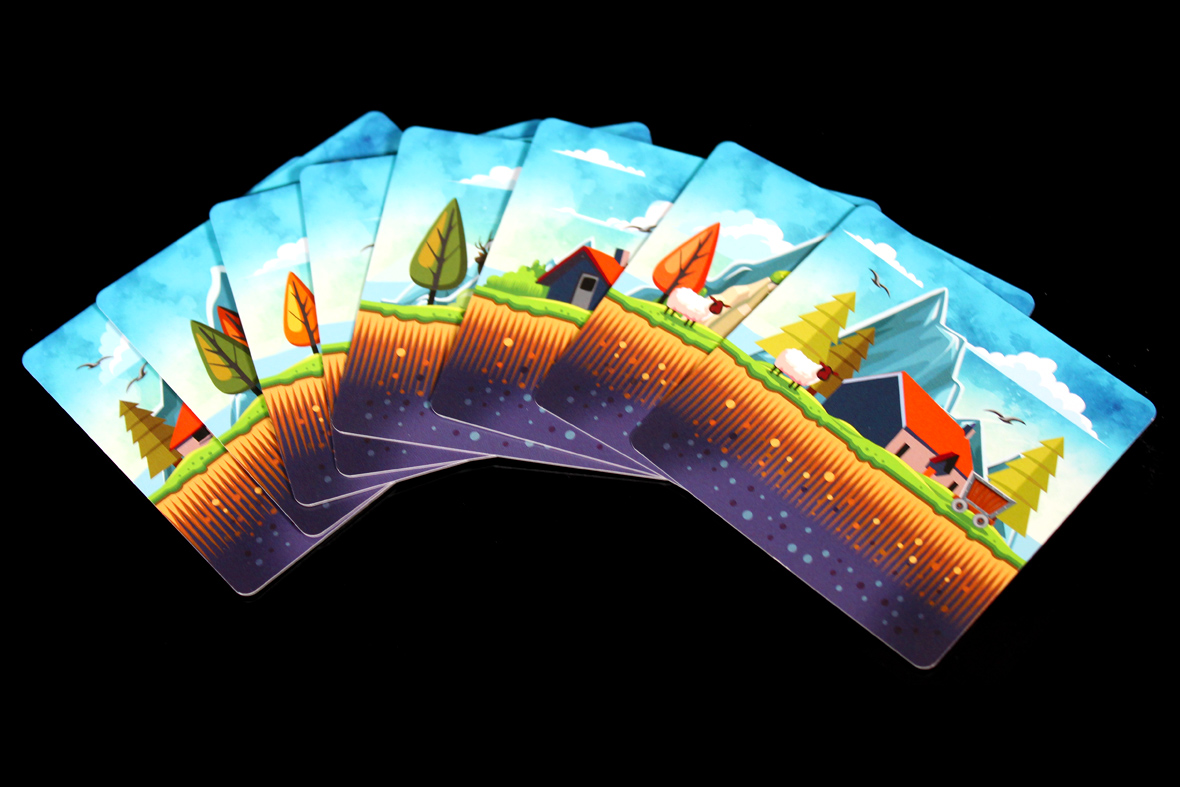
Set the Wild Elements aside as well, and make a line of the Surface cards at the top of the play area:
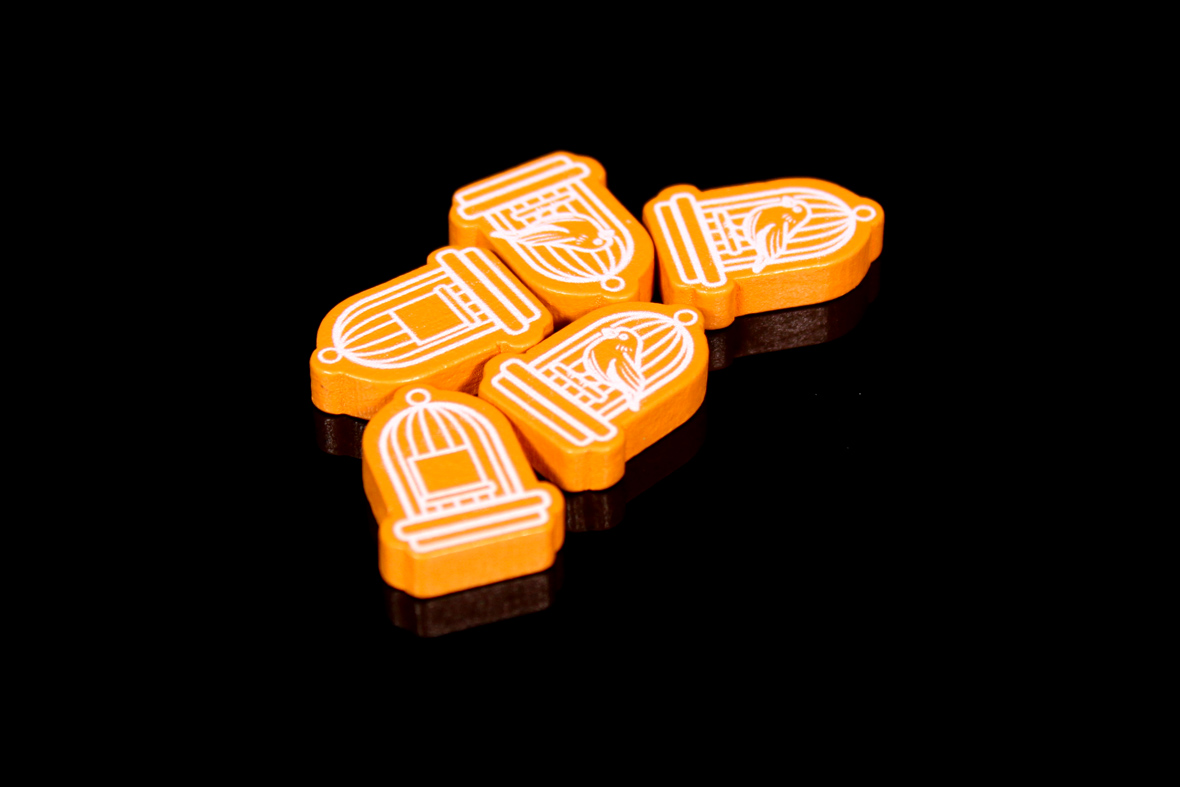
You can set the Canary Tokens aside, as well:
Now, this starts to depends on player count. With more than two players, shuffle the deck up and place the Wild Element Cards on the bottom, then deal each player five cards:
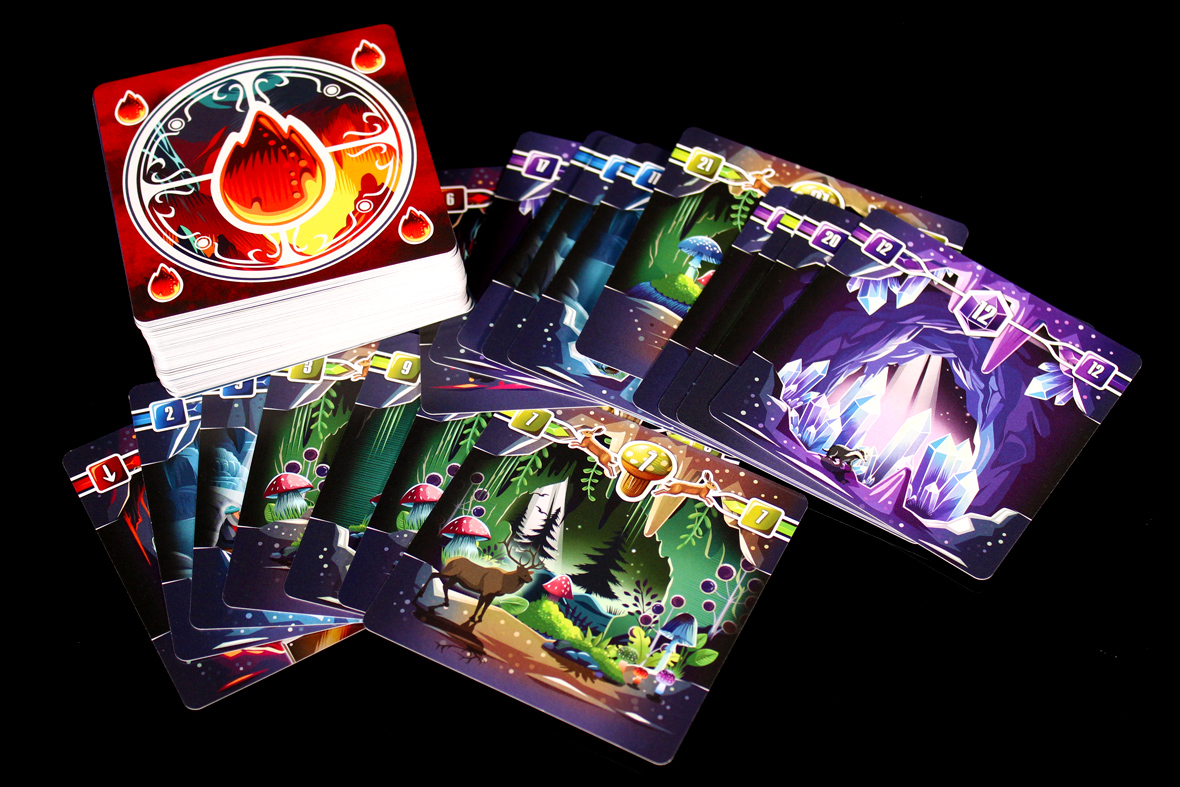
With two, make two half-decks with one Wild Element on the bottom of each, and each player gets four cards. Solo? Four quarter-decks and set the Wild Elements aside. You get four cards. Either way, set your hand so your lowest-value cards are on the left, and then your hand increases to your highest-value cards on the right. Descent cards (a downward arrow) are considered to be less than 1. Now you’re ready to start!
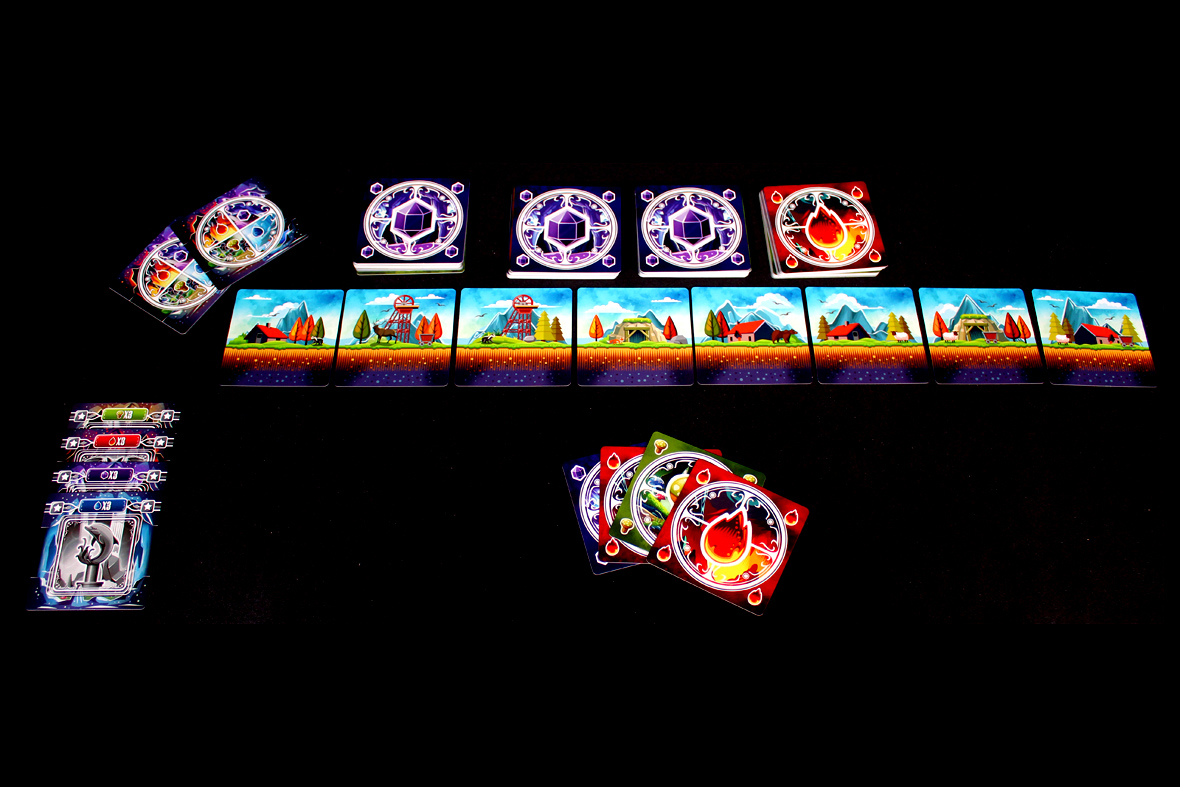
Gameplay
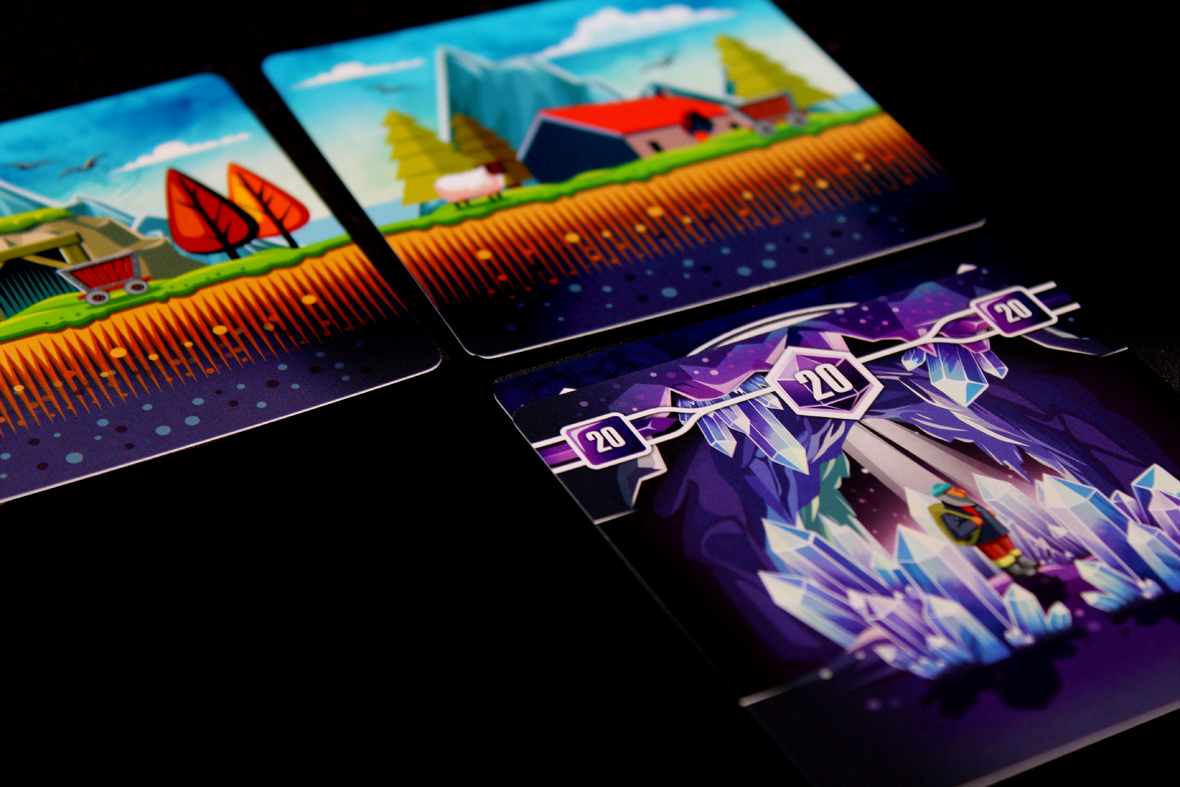
This one’s not too bad either. Your goal is a 5 row, 8 column grid! Playing the cards is the tricky part, though. Each turn you can either play an Element, a Number, or a Wild Statue to the current incomplete row. To play an Element, place any card in your hand face-down. It can cover another Element; no big deal. For Numbers, they must be placed on top of an Element of the same color. If the “Number” is a Descent, you can either push a card of the same color (and its Element) down a row or play it to a blank spot to pull the Number (and its Element) down from above.
Wild Statues work a bit differently. To earn one, you must discard three cards of the same color. They can come from any players’ hands, but you have to choose without knowing what cards they are. Discard them and then place a Wild Statue on any Element. They’re wild. Wild Elements may end up in your hand later in the game; they similarly are any Element and any Number can be placed on them.
You can also spend a Canary Token to ask any player what a card in their hand is or to tell the group to pay attention to your turn. Once your turn is finished, draw back up to the hand limit.
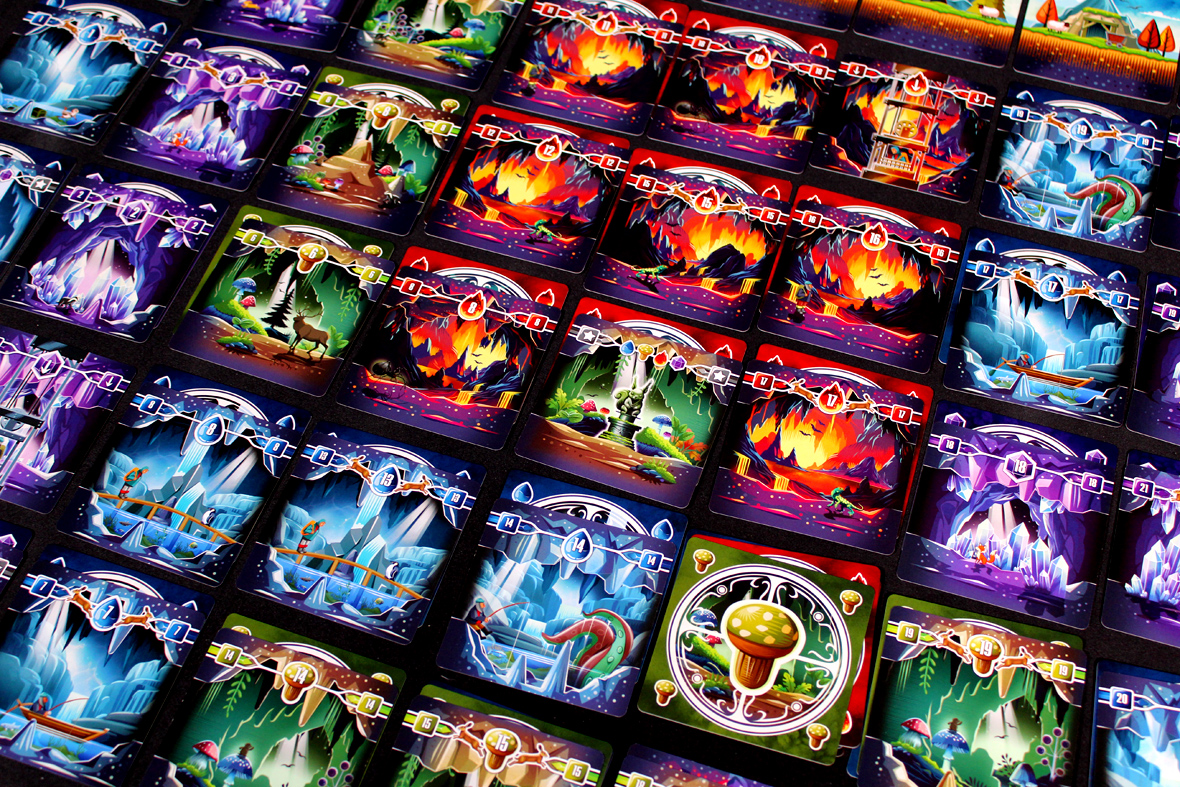
Play continues until the grid is finished or any player starts their turn with an empty hand. In the first case you win, and in the second, you lose!
Player Count Differences
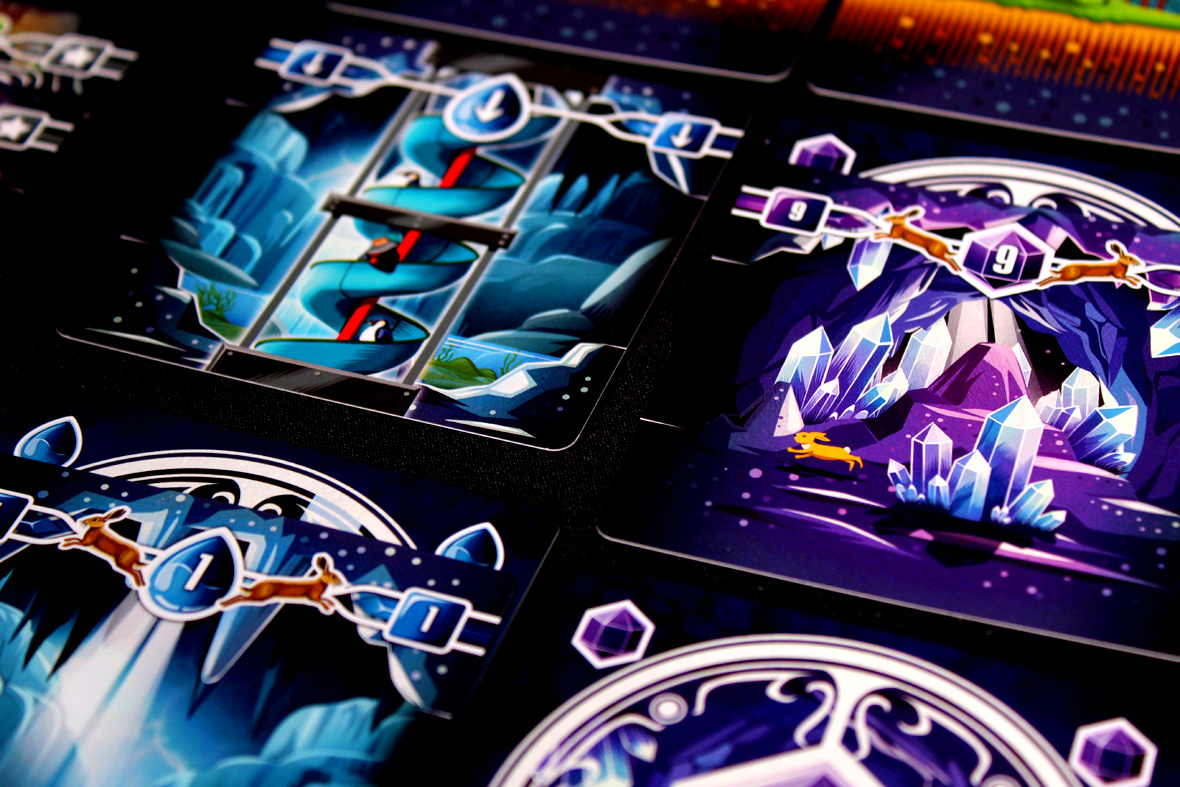
Kind of the standard difference set for this kind of game. With more players, you have more cards in play to look at (since you can see the element type on the back), but there are more players with turns between yours, so you can make fewer impactful choices (or, critically, sometimes you’re keeping important cards locked out of play). The one movement made usefully here is that you can discard cards from other players’ hands to play Wild Statues, so if you’re noticing someone’s got some useless purples or something, you can discard them for them even if it’s not their turn and make progress on their behalf. It’s very kind. Great at two, though, as well.
The solo game is a bit of an interesting bear since it plays so differently. Here, you actually aren’t limited to just the current row, but you can only place elements either in the topmost row (below the Surface) or orthogonally adjacent to an element of the same type. That makes the game … tough. Fun, but tough. On the plus side, you have four decks instead of one or two, so you have more elemental flexibility, but on the minus side, you have to make it to the fifth row before you can draw Wild Elements. Good luck!
Strategy
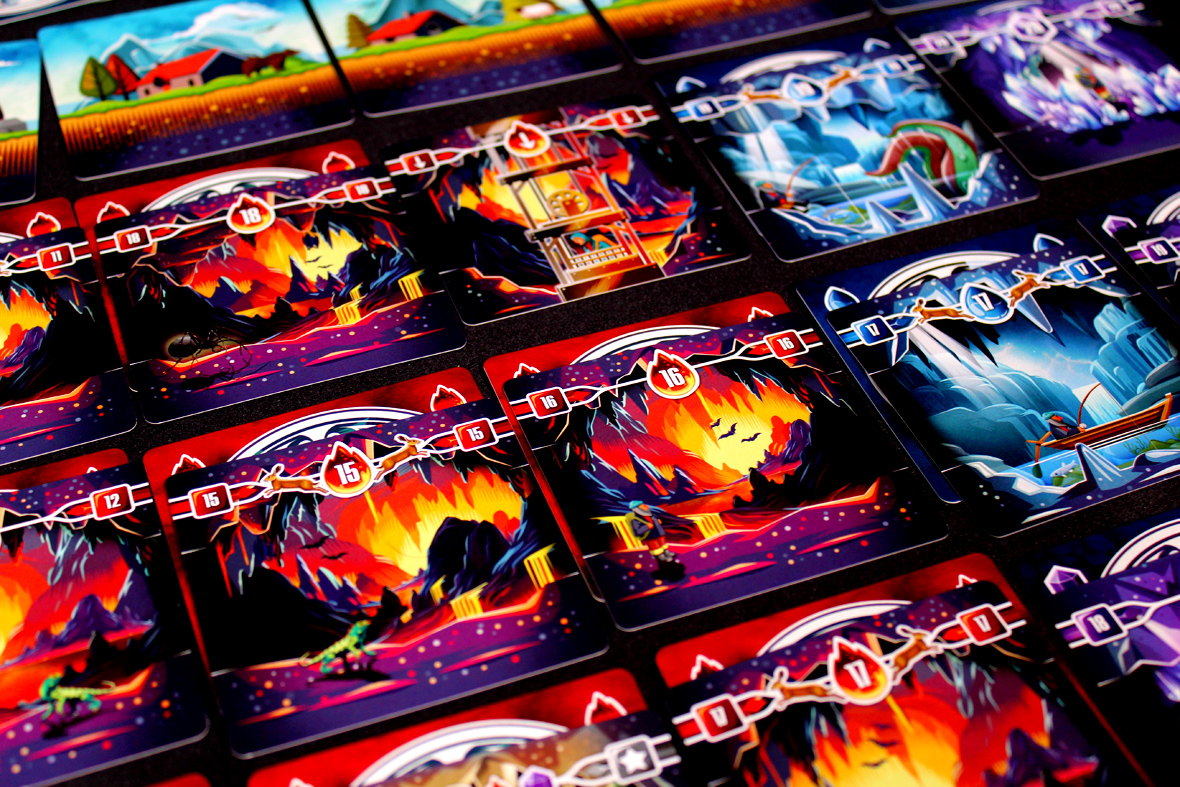
- Pay attention to how your partners order their hands. This is critical. You can see things like which Elements they have and what their values are (relatively speaking). If I already have a Known Quantity (like a 1 or a 21 because they’ve used a Canary Token), I’ll put other 1s or 21s to their left or right (respectively) to clearly communicate that they’re the same value. Descent Cards can mess this up (because they’re considered lower than 1s) but each card is unique, so if you have a blue card to the left of your blue 1, it’s clearly the blue Descent. All useful to know!
- Try to play in ways that give you information. If, for instance, you play an Element and your opponent doesn’t play their number of that element, you can usually deduce that it might not be the right spot for that element. Maybe you thought it was a 6 but it’s actually a 12; they just have a lot of high numbers in hand. That’s still useful information!
- Watch pretty much everything someone else is doing; even the cards they draw can be informative. Sometimes if I have little to do on my next turn, I’ll try to draw an element of the same type as a card in my partner’s hand so that maybe I can play it as a number or an element if I have the opportunity to help.
- Try to keep a general idea of what cards you’ve seen discarded; you’ll never be able to track them all but it’s still helpful. Part of the issue is that you will have no idea what cards one of your partners discarded for a Wild Statue (or what you took from their hand). It can be helpful then to have one player do most of the discarding, but they still can’t communicate what they’ve seen.
- Wild Statues are a useful way to make progress forward. If you’re stuck, you can use that to get rid of cards you don’t want and you don’t think your partner needs. Unfortunately, you still have to have three cards of the same color, which can be its own issue.
- Covering up another player’s element isn’t the worst thing. Sometimes a misplay happens or a play that seemed good at the time but now on reflection isn’t particularly useful also happens. You can just cover it up with another element; we aren’t precious about them.
- Try to play to help your co-players; don’t just focus on your hand to the exclusion of all else. Playing an element that your partner needs can be useful, but remember! Their hand isn’t necessarily always as accurate as can be. If they have a 1 and a 21 in their hand, the rest of their hand is … definitely between those two! That’s less helpful. Consider using a Canary Token to eliminate some options if your best move is playing an Element Card to help them.
Pros, Mehs, and Cons
Pros
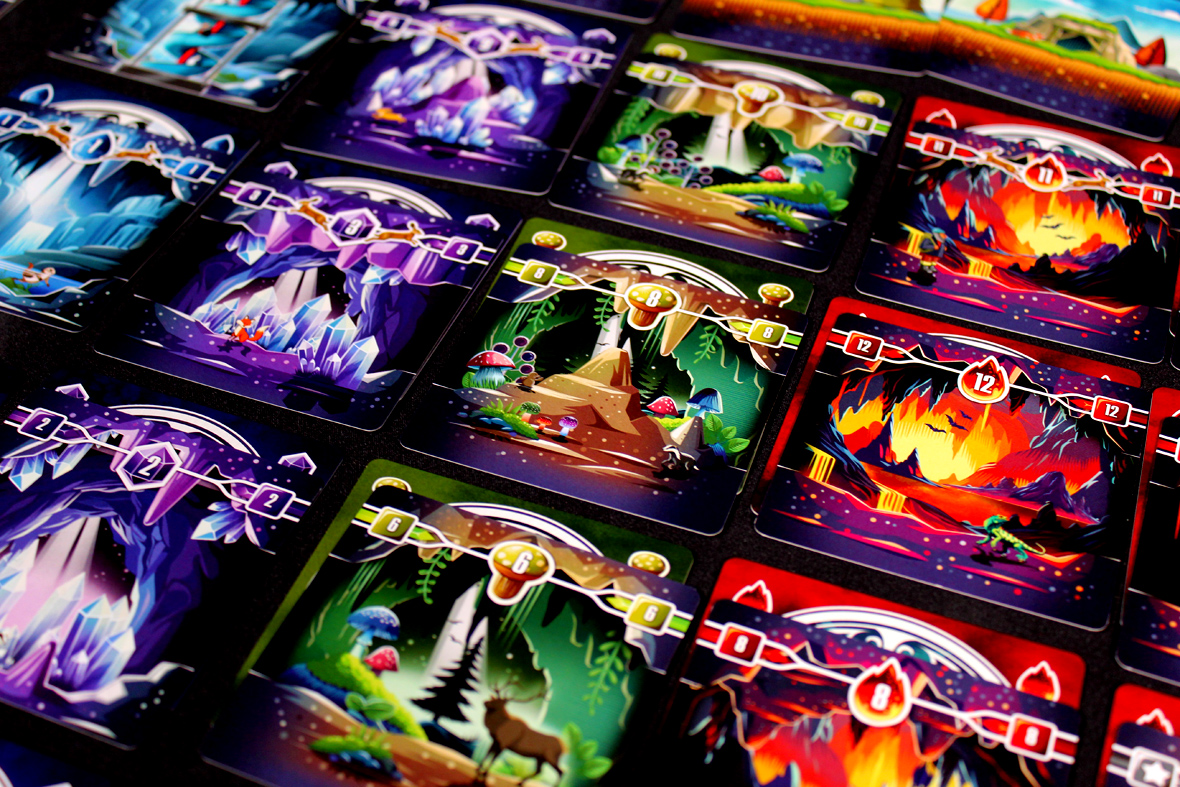
- Love the art. It’s always been great in the series, but I think the caves and the stuff below ground (crystals, magma weird fungi) really work with the art style. It’s very fun.
- Plays pretty quickly. Each turn is pretty simple; you’re usually just playing a card. There are a bunch of cards to play, but once you get used to the game you can probably bust through it in 20 minutes or so.
- Tranquility as a series really devotes itself to the idea that you should be in control of the game’s difficulty, and I’ve always respected that. There are a bunch of expansions that let you ramp it up or tweak it down from the base difficulty and I think that’s pretty cool! Most of these make the game harder, but you can definitely reduce the difficulty that they add.
- Not too complicated to teach. You’re playing cards in increasing order from left to right in each row, and each card can only be played on a face-down card of the same color. Complete a row to move on. It’s not too bad, honestly, and it’s even a bit simpler than Ascent.
- That forced card ordering in a player’s hand lets you communicate a lot of interesting strategy work. It reminds me a bit of Hanabi but without a ton of irritating metagaming (though you can add some if you really miss it). I think the extra information from the card backs works in the game’s favor, as well.
- There’s a lot of very satisfying plays that can happen as players get better at the workings of the game. You can go back and forth with almost no verbal communication once you learn how your partners plan to play and making all that work is really fun; I’m a big fan.
Mehs
- I really would like if, one day, they sold a Tranquility Series box that was a normal size and shape for storage and transport. These cubes are endearing but impractical. I think I might be able to stack all three of them up on a standard-sized shelf, but cubes aren’t the easiest thing to store as-is.
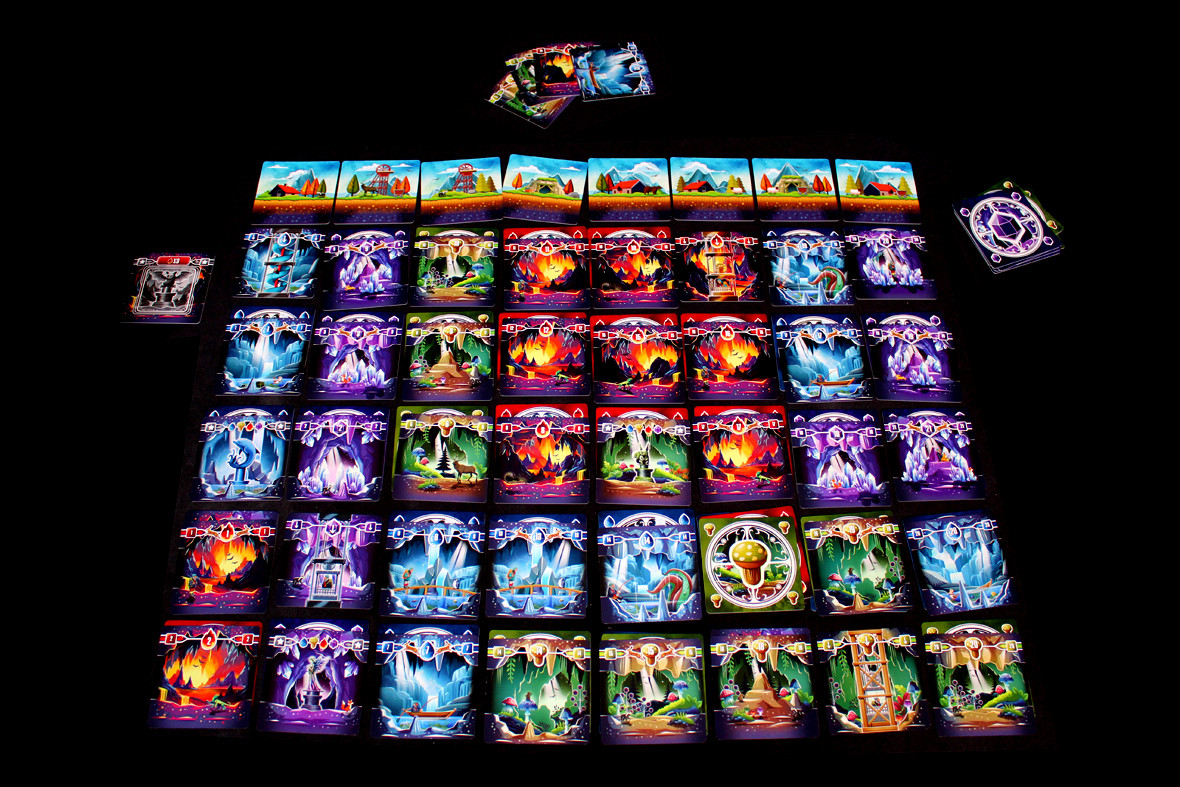
- This one takes up a pretty solid amount of table space. It’s a 6×8 grid of square cards, so it’s not nothing for as small as the box is.
Cons
- The Canary Tokens are fine? I think their intended use as a “let me see a card in your hand” makes perfect sense, but the “I’m going to spend one to let the table know I’m taking an Important Action”, while useful, kind of fell flat in my plays.
Overall: 8.25 / 10
Overall, I always think it’s interesting to have games with kind of the same general “schtick”; people are always going to ask “well, do I need this one if I have the others?”. As a reviewer, I try very hard to stay away from the term need; this is a luxury hobby and I got the game for free, so I’m not the best person to ask. I’m also burying the lede. I think Tranquility: The Descent is quite a lot of fun, and importantly, it’s fun in a way that’s related to yet wholly distinct from the other games in the series. You can see how aspects of each influence the other, but they present different puzzles to sort out in different ways. That said, if you like one, you’ll likely like the other two as well (though I’d personally be interested to know what your favorite is). I think I’m roughly split between Ascent and Descent for my favorite. On one hand, I like the art a lot in Descent. It’s colorful and rich and mysterious. It’s also challenging without necessarily being overwhelming, though as with the other games, you can add expansions to make the game more or less difficult to tune your challenge to your preference. I love it when games do that; it lets you really play the game on your terms and, frankly, if you don’t want a hard game, you don’t necessarily have to play one. The challenge is still interesting no matter the difficulty, though even the solo mode presents novel challenges that I’m hoping to come back to. Like the other games in the series, it requires a decent amount of table space, though, so plan accordingly. If you’re looking for a nice and challenging cooperative game where you can scale the difficulty to your preference, you’re pretty much never going to go wrong with the Tranquility games. I think Descent is a well-earned third game in a series I’ve really come to enjoy, and a treat in it of itself. I’m looking forward to playing it again, and if you’re up for a cooperative game, you enjoy a puzzle, or you just want to dig a hole down and see how far you can get, you’ll likely enjoy Tranquility: The Descent as well! I’d recommend it.
If you enjoyed this review and would like to support What’s Eric Playing? in the future, please check out my Patreon. Thanks for reading!
 What's Eric Playing?