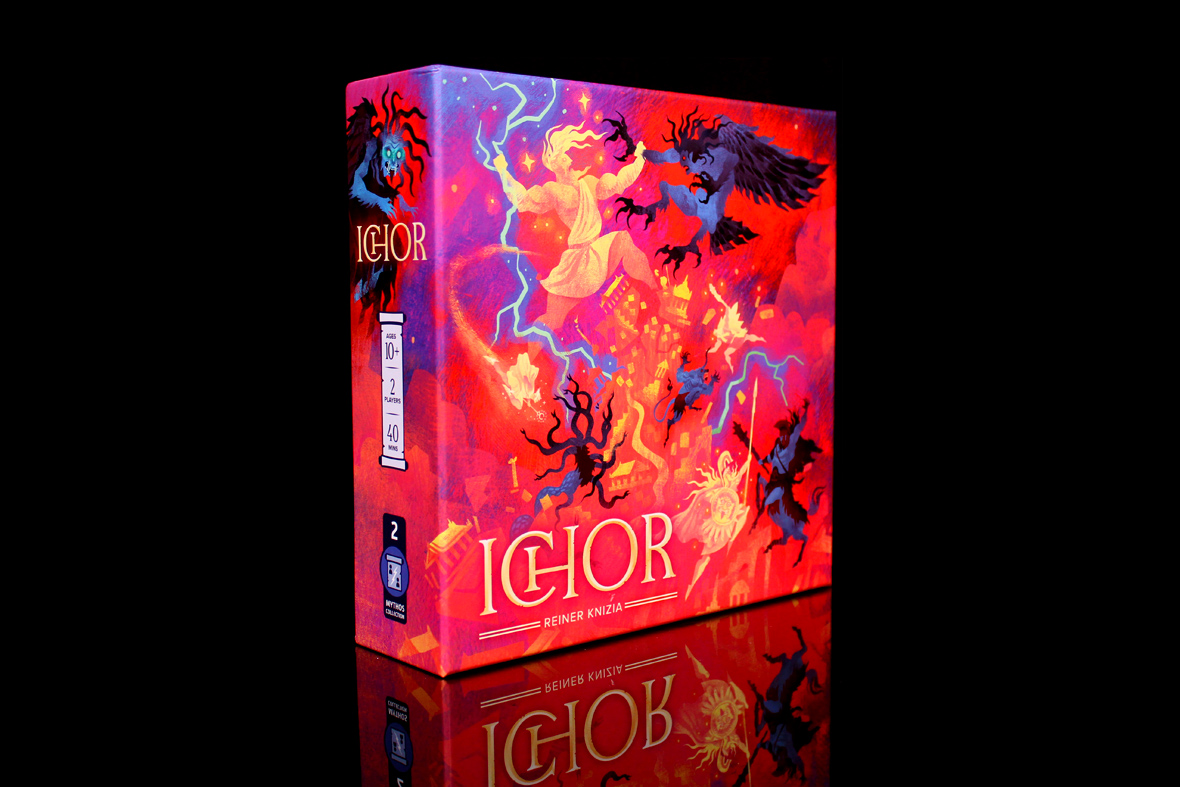
Base price: $29.
2 players.
Play time: ~40 minutes.
BGG Link
Buy on Amazon (via What’s Eric Playing?)
Logged plays: 2
Full disclosure: A review copy of Ichor was provided by Bitewing Games.
I swear I was going to just write, but then I saw that the Oscars were on and I really am emotionally invested in the long-term success of the movie Sinners, so I turned it on just in time to catch it win Best Original Screenplay and I’ve been very hyped about it. That actually did a better job motivating me, so now I’m just plugging away on what’s next. What’s next is obviously Ichor, continuing my ongoing Greek Month-ology. I like the pun a lot better than I think the pun is, but we’re already in this deep, so might as well keep going.
In Ichor, Mount Olympus might be having a bad time. I say might because if you’re on the side of the monsters, you’re at least theoretically enjoying yourself. You should be allowed to take down Olympus. Zeus sucks. And while you’re not entirely wrong in your assertion, you’re going about it in a fairly aggressive way. Just, you know, climbing the mountain and killing anyone in your way. It’s a lot of bad energy. So now the Gods (and demigods) are getting involved as well and that’s going to be a whole thing. One player takes the Gods, and other takes the Monsters. Who will win? Hopefully you, I guess.
Contents
Setup
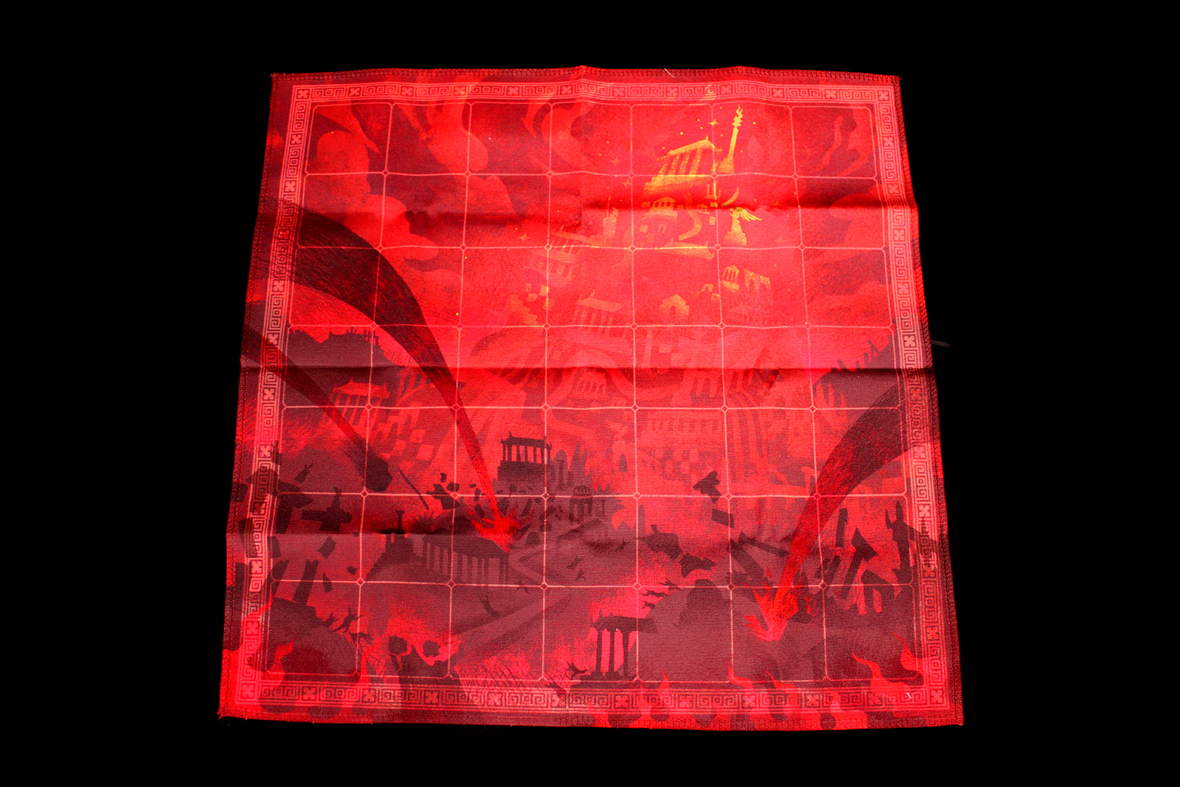
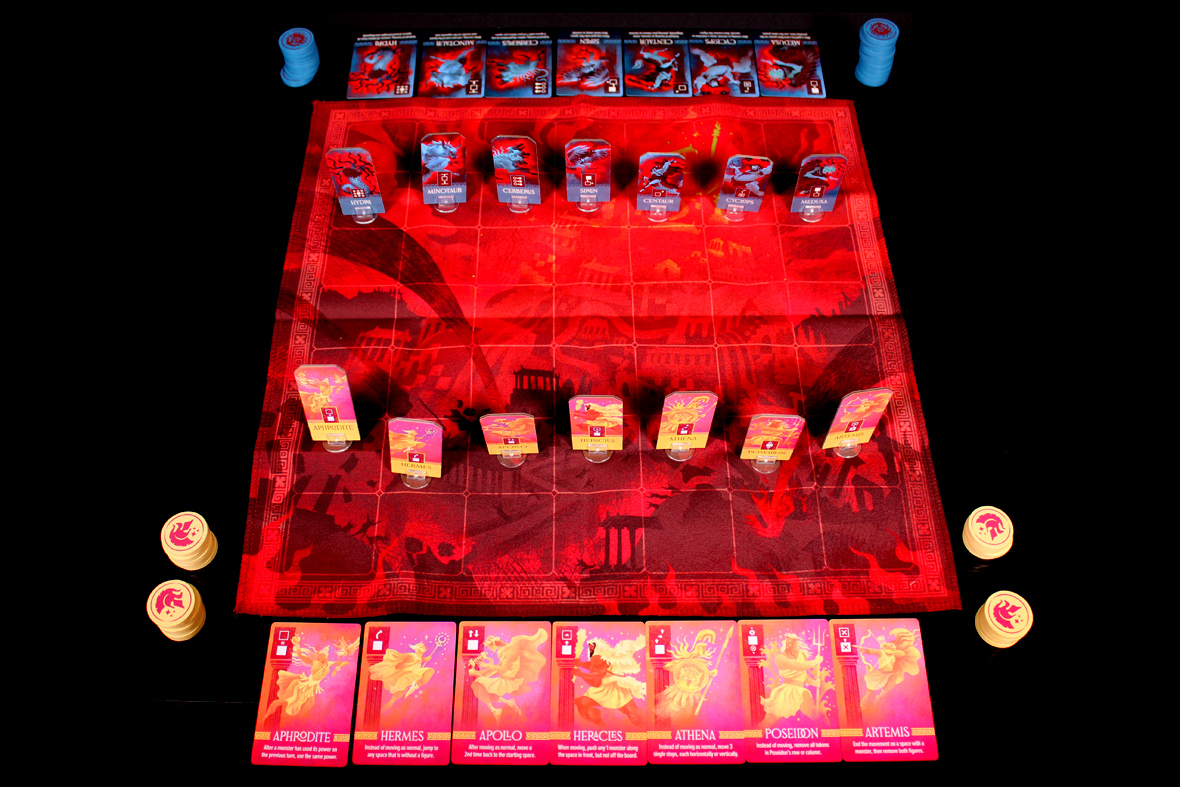
Not too bad. Set out the board:
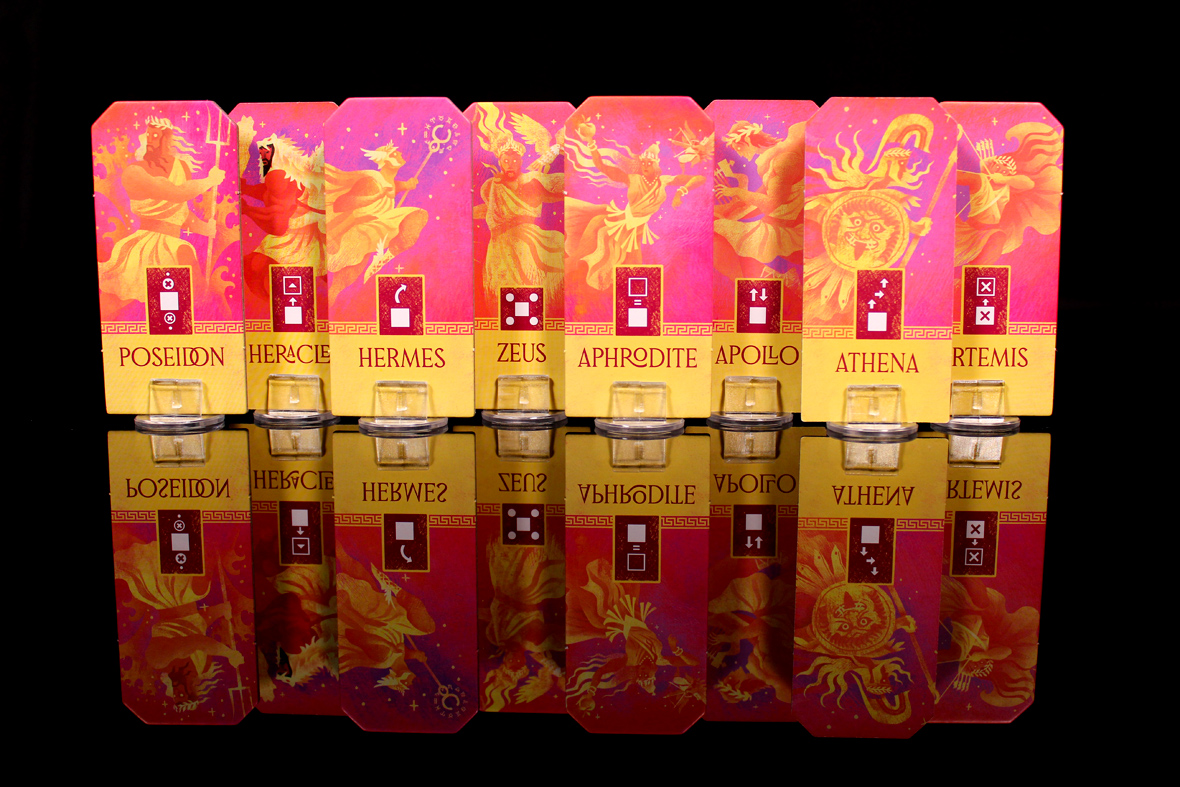
Have a player choose Gods or Monsters. The Gods player gets the Gods:
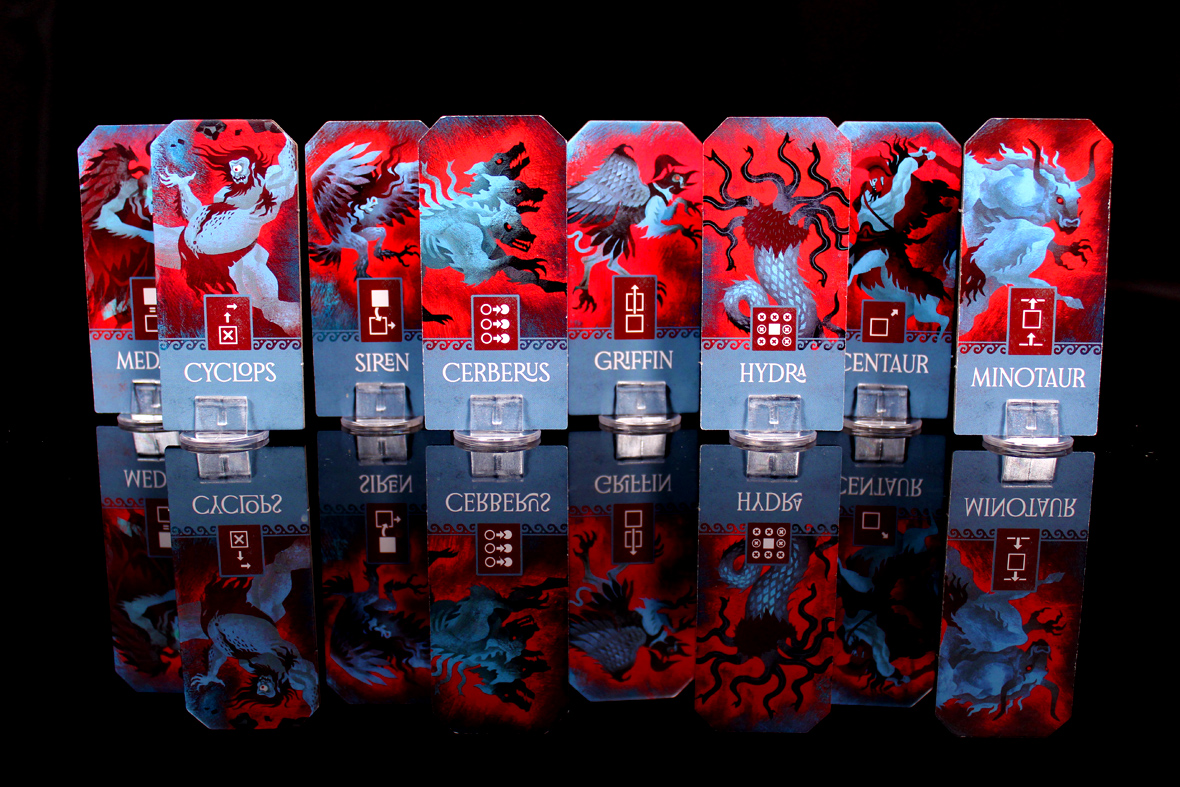
The Monsters player gets the Monsters:
Give each player the corresponding color of tokens:

Each player gets their corresponding cards. Shuffle them and place six (or seven, if you’re playing on the larger side) below the spaces on your side of the board:


Place the standees on the second space away from the cards and you’re all ready to start!
Gameplay

What’s nice about this one is how simple it is. Generally speaking, on your turn, you choose a God or a Monster and advance them as far as you’d like in one direction until you decide to stop or hit another God, another Monster, or the edge of the board. Then, place your tokens on every space between where you are and where you started (inclusive of where you started). If there are other tokens on those spaces, replace your opponent’s tokens with yours, and do nothing for your own tokens already there. If you would land on a token, remove it and return it to the appropriate player.
You may, in lieu of moving, use a God or Monster power instead. They’re single-use though, so once you use it, flip the card over to note that you can’t use it again. Either way, your opponent takes their turn next.

Once you’ve finished your turn, your opponent goes, and vice versa until one of you have successfully placed all of your tokens. The player who places all of their tokens first wins! To really drive home the point, swap sides and play again with the same setup. If the same player wins again, well, it really wasn’t a luck thing, now was it?
Player Count Differences
None! Two-player game.
Strategy

- Making long rows of tokens is nice, but protecting them isn’t easy. There’s an inherent balancing act to this game, in that you can move pretty symmetrically (you and your opponent, that is, and there aren’t that many ways to move). If you create a long row of your tokens, it’s not too difficult for your opponent to follow just behind you, cleaning up every mess you make. Ideally, you can still go out before that stalemate goes anywhere, but don’t necessarily just leave big open spots.
- Don’t be precious about using your powers; you don’t want to have lost the game with a full complement still available to you. It’s a use-it-or-lose-it kind of situation, in that if you specifically don’t use your powers, you can truly end up just straight-up losing. Don’t just use them with reckless abandon, of course, but sitting on them just means they end up largely wasted.
- You can occasionally just straight-up take out one of your opponent’s characters. This is kind of wild and funny, but … yes, you can just knock a player clean out of the board. Usually you have to lose one of your characters too, but sometimes that’s worth it. If you’re going to take out an opponent’s character, try to at least make sure it’s one that hasn’t used their power yet. Get yourself a little something.
- Keep in mind the length of the board. Generally speaking, players can only place 5 or 6 (depending on board size) max tokens in one turn. If you know that, then you can try to make sure that even if you can’t clear a lot, you can clear enough that they can’t win next turn.
- You can be aggressive if you want, but playing defense won’t win you the game. There are just too many spaces on the board for you to defend all of them forever. You’re eventually going to miss a spot and you’ll be stuck. Go on offense at least a bit.
- Removal powers aren’t bad, but don’t waste them. Using them to clear 5+ tokens is great, 7+ is excellent. Anything less than 3 and it begs the question of why you didn’t just move one of your characters yourself. Similar outcome or potentially better.
Pros, Mehs, and Cons

Pros
- Still a big fan of Greek mythology. It’s the reason for the season, yes, but I think it’s also an exciting theme for a game. Popular culture tends to agree (Hades, KAOS, Percy Jackson, things like that). The stories are well-known in the Western canon, so you have a lot of room to either play around in the gaps or adapt it in a familiar-yet-still-novel way.
- This one can play extremely quickly. Sometimes too quickly if someone doesn’t really understand how the game works, but it’s worth investing in making sure your opponent gets the rules. Your turns can be quick, but the spatial elements of this game can also present analysis paralysis for folks who are vulnerable to that sort of thing.
- The colors are fun. It’s a lot pinker than I would have expected? Maybe some mix of the fire colors and the light / white of Olympus. I’m not not into it.
- I like the concept as a series. Having a pair of Knizia Greek Mythology games is a cool product conceit.
- Very simple ruleset, too. You can move your standee and place tokens along the way. That’s kind of it.
- I appreciate that they give you a set of your opponents’ powers as well. It’s nice that they’re easy to reference since you do need to know them during the game.
Mehs
- Of all the gods available, you pick Heracles? It’s fine; I don’t mean to be rude or reductive, there are just … so many cool ones and it’s not that Heracles isn’t cool he’s just very … middle-of-the-road for a demigod. Maybe I’m still mad about Hades 2.
Cons
- I’m not a huge fan of Medusa’s design, here. Yes, I get it; she was transformed into something monstrous and terrifying but I think we’ve been, shall we say, interrogating that myth in popular culture a bit more lately? Any random Gorgon, perhaps, sure, why not, but cut Medusa a break. Plus, the snakes are somewhat indistinct so without the actual text I would have been hard-pressed to even note that she was Medusa.
- I think the cloth board works even less well here than in Iliad because the standees aren’t totally compatible with its creases. In Iliad, the tiles at least apply some light pressure to the cloth board to keep it in place. Here, you just kind of have to roll with what you got, unless you’re planning to roll up the board or … iron it? Can you iron it?
- I just generally don’t like it when expansion content that isn’t included in the game is included in the rulebook / references. It makes me, the player, feel like something is missing from my game, and it’s not; it was just stuff that was intentionally left out? Odd choice, product-wise, unless FOMO is the goal. And I hope it’s not.
Overall: 7 / 10
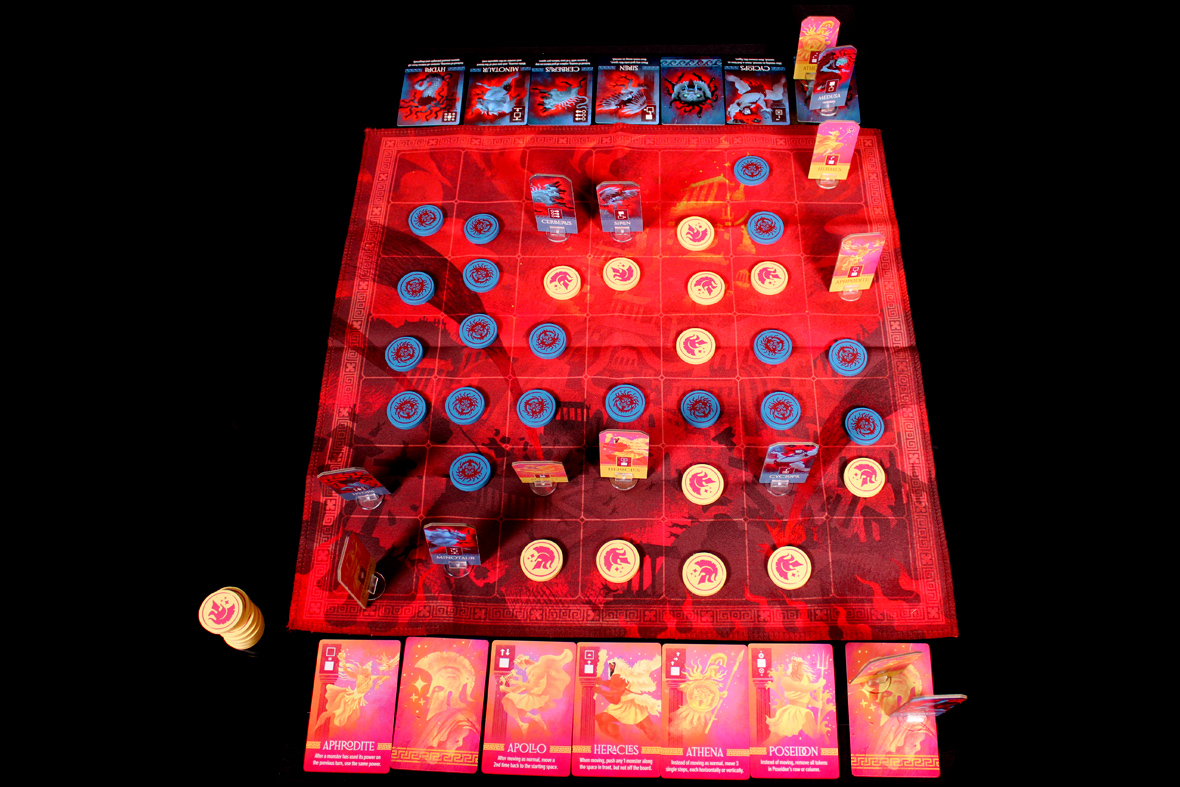
Overall, I like Ichor! I think I vaguely prefer Iliad, of the two, since it’s a bit more numerical and abstract (as opposed to Ichor, which feels like a combat game even though it’s not, due to how zero-sum it is). Here, your goal is to place all of your tokens by moving your gods or your monsters in a straight line each turn. As you do, you’ll find that your opponent wants to stop your plans and replace your tokens with theirs. Add in some special abilities and you’ve got an abstract strategy game. I don’t love that the game suggests a full “game” is actually two games where players swap sides after the first one, but I suppose you can just ignore that if you want. It’s your game. I like the art and art direction generally, but I think the decision to make Medusa hideous (and not terribly snake-looking) was an odd one. Then again, I’m very sympathetic to Medusa, so, who knows. The cloth board here does drive me nuts, as the standees aren’t particularly heavy and can’t weigh or press it down, meaning they can somewhat tip during the game if you’re not careful. Not a huge deal. But Ichor will certainly appeal to folks who want to balance area control and challenging movement, either on a small or slightly-small board. Pack it up, take it with you; totally an option, here. If you find Greek mythology thrilling, you like a bit of abstract strategy in your area control and vice-versa, or you just really think that Cerberus would have eaten an entire Greek god had he gotten the opportunity, you’ll likely find something to enjoy in Ichor!
If you enjoyed this review and would like to support What’s Eric Playing? in the future, please check out my Patreon. Thanks for reading!
Interested in reading more? Check out a random review!

Discover more from What's Eric Playing?
Subscribe to get the latest posts sent to your email.