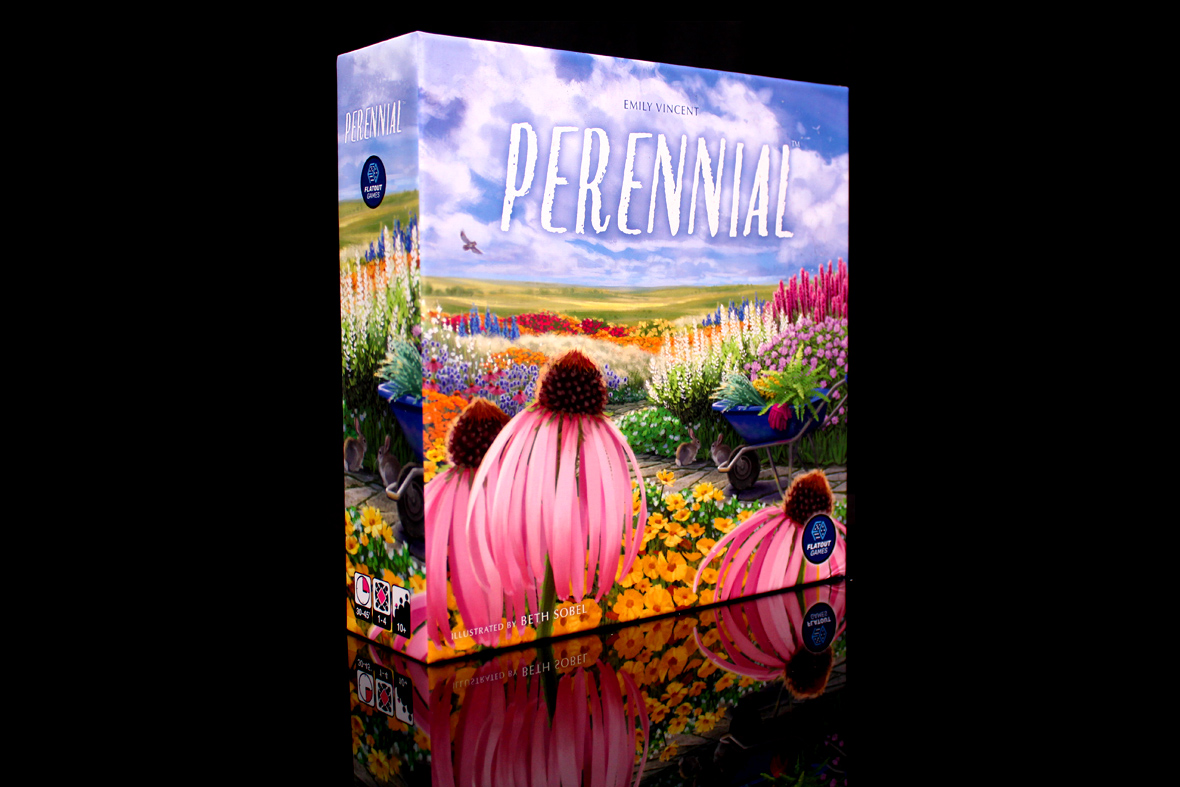
Base price: $29.
1 – 4 players.
Play time: 30 – 45 minutes.
BGG Link
Check it out on Kickstarter!
Logged plays: 2
Full disclosure: A preview copy of Perennial was provided by Flatout Games. Some art, gameplay, or other aspects of the game may change between this preview and the fulfillment of the Kickstarter, should it fund, as this is a preview of a currently unreleased game.
I’m always excited for Flatout’s annual releases. They usually do the three small games and one big game, and it looks like there’s another big game after the success of Cascadia: Alpine Lakes. So this one’s going to be Perennial, new by Emily Vincent. You might remember her work from Knitting Circle or Pirates of the High Teas, and I’m looking forward to checking out another one of her games. Let’s dive right in!
In Perennial, you’re setting up the ideal prairie garden! Hopefully with one of Cascadia’s legendary Prairie Salmon, but maybe that’ll be in an expansion or something. You’ll need tools and plants to get there, as well as seeds, but you might also find yourself benefitting from the local wildlife! Rabbits, chipmunks, and owls have their own ways to interact with a garden, after all. It wouldn’t be a Flatout game without some good puzzley placement, however, so figure out how to do all of that in groups of four or five tiles at once! Can you plant your way to the best garden around?
Contents
Setup
Each player needs a Garden Board, and you can put the center board in the middle:

Each player also gets a variety of stuff, including four Boulder Tiles, a Workshop Board, three Wild Animal tiles, a Starting Greenhouse tile, and four Pond / Feature tiles (pond on one side, feature on the other). You can actually bag all of these up to have player kits, but keep the Seed Tokens separate so that the unused ones can go in a shared supply.
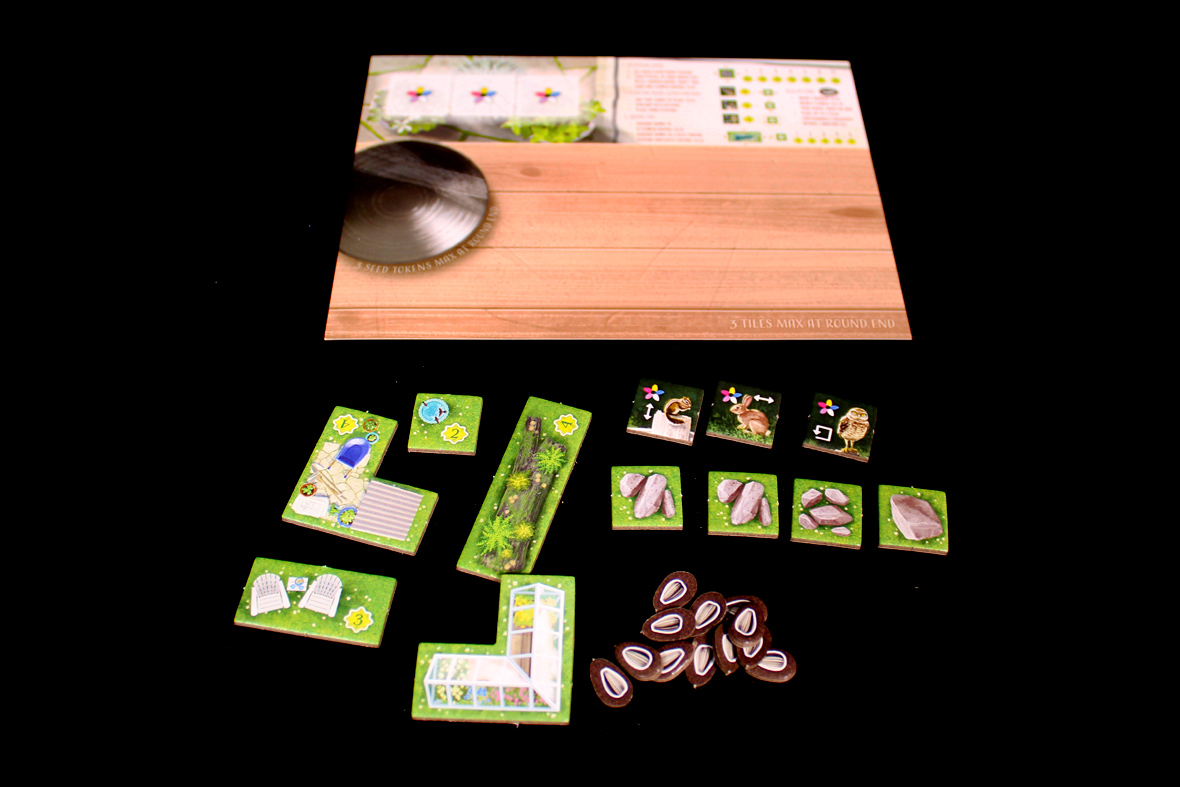
Place the other Flower Tiles and standard Animal Tiles into the tile bag:

Give each player a pair of Starting Tools in their color (check the back), and shuffle up the other, non-Starting Tool Cards into a deck:
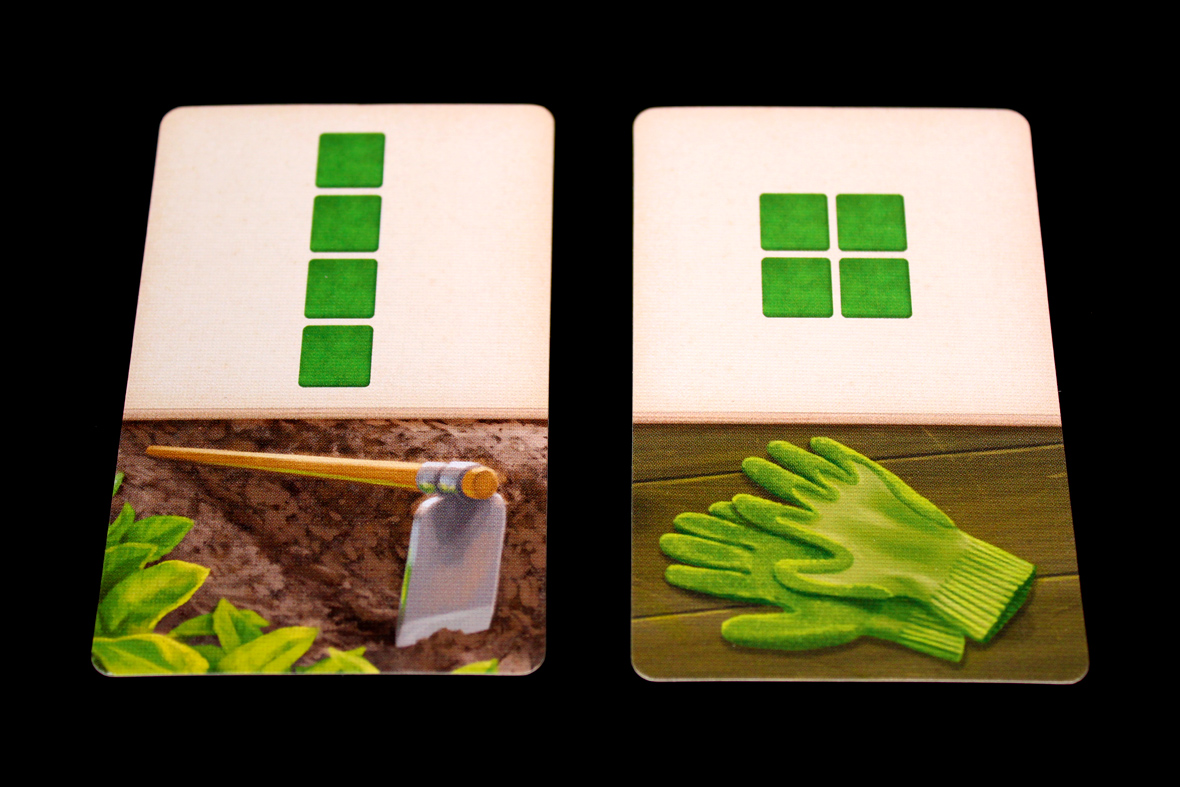
Finally, shuffle the Pond and Feature Cards into a little pile and place it near the center:

If you’re playing with Goal Cards, use up to one max of each type. You can use fewer than three total!

Draw sixteen tiles from the bag and place them on the center board, then draw one Tool Card from the deck and place it on each of the four sides of the center board. Give each player two random Flower Tiles from the bag (redraw if you pull an animal) and you should be ready to start!
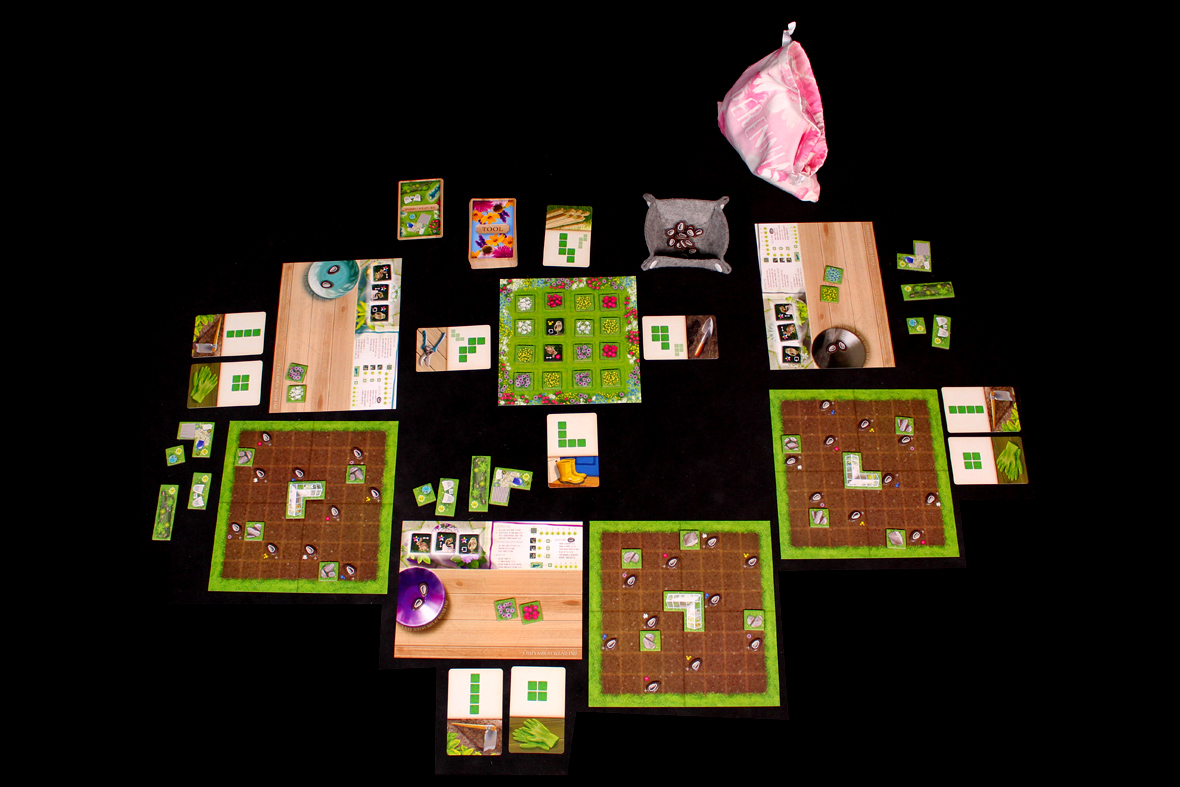
Gameplay

A game of Perennial isn’t too complicated in essence: it’s just four rounds! Within those rounds, however, you’re going to be drafting cards, taking tiles, and building up a garden!
To start a round, flip the top card of the Pond / Feature Card Deck. Each player adds the pictured tile to their Workshop Board, and will optionally add it to their Garden Board later. Then, player turns start in the Gathering Phase.

At the beginning of your turn, you’ll refill the board if there are any Tool Cards or tiles missing. Then, you’ll take a Tool Card and pull tiles in the matching shape from the board, adding them to your Workshop. If you see duplicate Tool Cards, you can discard them and replace them with new ones. You can rotate or mirror the shape; we’re all friends, here. Then, the next player does the same. Refill the board, then take. Each player does this twice (taking a total of two Tool Cards and ten tiles) and then the Gathering Phase ends.
Next up is the Planting Phase! Here, players act simultaneously since there’s no impact on each other. You’ll play two of your Tool Cards to add tiles to your board. Note that the game is kind and flexible; you don’t have to use the full size of the Tool Card, but you do have to discard any tiles you can’t fit. So if you want to fit a Tool into a three-tile space, you have to place three tiles and discard two. If you cover spaces on the board with a flower of the indicated color, you can take the Seed Token from that space. Seeds can be spent for abilities, like drawing a tile of your choice (or two random ones), removing a Boulder Tile, or placing up to three additional tiles from your Workbench. When placing tiles, you can use any tiles on your Workbench, including your Wild Animal tiles, but keep in mind that Chipmunks and Rabbits can’t score the same area twice. Owls can, but that’s because of bird stuff.

Before the end of the Planning Phase, every player must place or discard their Pond / Feature tile for that round. Ponds reward you for surrounding them with flowers of multiple colors; Features just score straight points. Once that’s done, the round ends. Each player can only keep up to three tiles (not counting Wild Animals) and up to three seeds at the end of a round. Pass the tile bag on to the next player and start the next round!

Play continues for four rounds and then the game shifts to scoring! Each group of 2+ flowers that are orthogonally adjacent and the same color score, animals score according to their flower color and rules (rabbits : rows, chipmunks : columns, owls : all-around [that is a weaker one, but I appreciate their attempt]). Score your Ponds, Features, and Goals and the player with the most points wins!
Player Count Differences

In a rare move for me, I gotta say that I think Perennial explicitly benefits from having more players. There aren’t really racing elements or something, but having more players pull from the center group of tiles keeps the market moving, which is good for everyone. More stuff gets cycled in and out, and even if you have a particularly bad market, odds are it’ll be bad for someone else as well. Plus, it’s kind of pleasant to see how players build up their own gardens when it doesn’t affect you that badly. The game is primarily focused on that draft, but since it’s refreshed every time that players draw, it feels somewhat similar to random tile draws. That’s not terrible! It’s actually pretty good because then it helps make the game scale for player count. And I think it ends up working out really well. With Perennial, I think that makes four players the most satisfying version of the game. You get to see what everyone else is trying to do and strategizing. That said, two or three players is still a good time as well!
There’s also a solo mode if you’re into that. A family mode as well!
Strategy

- Don’t go overboard on tiles of one color. You cap out at 7 tiles for 8 points in a group of one color; at that point, you’re much better off creating another group or breaking up two groups with some animals. You won’t get additional points for 8- or 9-tile groups.
- Try to do some planning; don’t leave all your Wild Animal placements for the end of the game. I do try to kind of anticipate where I’m focusing on a row or a column or a group of the game color and then place my Wild Animals accordingly. Similarly, you’ll want to at least have a semblance of a plan as you’re grabbing tiles from the center.
- Strike a balance between groups of the same tiles and groups of different ones, but try to keep scoring. There are plenty of ways to make small groups, but keep in mind that singleton tiles in any color usually don’t score any points. You kind of want a group of at least two for it to be worth your while. Big groups are easier in some aspects, but you need a lot of tiles, so you become dependent on the center board’s stock to score big there.
- It’s okay if you don’t have a good placement for a Pond! You can just make it a Feature instead. Sometimes the best spot for a pond is nearly completely surrounded by tiles of one (or two, I guess) colors. If you’re going to score less than the Feature’s value, just flip the Pond and leave it as a Feature. One less thing to worry about having to get in place.
- When taking tiles you explicitly have to balance between the tiles you want and the card you want to be able to use later. If you see a bunch of tiles aligned with a Tool that you want, that’s great and all, but you need to be able to actually use the Tool at some point to place them in your garden. You do get two bonus spots for Tools in case you don’t want to use some, but I’d treat those as sacred if you can. Better not to junk up your Tools early in case you need to save those spots for later.
- Seeds are great! Pretty much all the Seed Actions are (situationally) super useful. Getting more tiles is good, placing more tiles is better, and clearing Boulders is almost always useful (depending on when you do it). Keep an eye out for places where your Seed Actions can augment your strategy and use them accordingly. It’s pretty easy to get more Seeds; you just need to pay attention to where you’re placing your tiles.
- Your Starting Tools are perfectly reasonable; use them! Sometimes you don’t want to place a full five, or you’ve used Seed Actions to draw more tokens than you think you can play in one go. The smaller Starting Tools can be super useful! Don’t just leave them aside until the end of the game.
Pros, Mehs, and Cons

Pros
- Beth Sobel’s art once again really shines, here. Beth Sobel is a frequent collaborator with Flatout, and it’s not hard to see why that’s the case; she really does great work with the natural world, like flowers and trees and animals and such. The choice of pink for the front cover and the tile bag is stellar and makes the game look timeless but fresh, and the sharp horizon line is really striking on the box cover. You’ll love it, but she’s one of the top artists in the business for a reason and her skill and eye really show throughout the game.
- I think they really hit a great sweet spot between something like Cascadia and something like Calico, here. There’s a lot of great puzzle opportunity here, but it’s not making my brain hurt when I play, and I did try playing a three-handed game where I was every player. Keeping track of that many disparate strategies did fry my brain a bit, but not as much as expected.
- I’ve been playing a lot of games with tile bags that are too small for the contents, so I just want to say how much I appreciate everything fitting in the bag. This is an appropriately-sized bag for the first time in a while; thank you, Flatout Games.
- The simultaneous play elements of the round are smart, since there’s a lot of planning and tile-placement that need to happen. Tile-laying and spatial reasoning games are a bit notorious for player analysis paralysis, so having that phase happen simultaneously lets players plan and focus without having to wait on someone else or feel like they’re holding up the entire game. You’ll still get players who run over time, but that’s still somewhat acceptable. If it starts getting too bad, just gently bully them; they’ll love it.
- There’s enough configurability that you’re definitely not going to play the same game twice. Between the variable goals and boards and Pond / Feature ordering, and as your own strategy grows and develops, you’ll likely play the game very differently each time. Even the animals you draw can end up influencing your playstyle (if you want to score points, at least, which is kind of the goal).
- The Goals add a nice extra layer of game and strategy, and they let you shore up places where you’re not scoring as well in your particular tableau. I think player goals in general are nice, but I appreciate that they’re not specifically competitive, here. You can focus on building your garden your way without having to worry if another player is getting more red flowers than you. They might be drafting ones you need, but that’s usually less about you than what they actually just want for themselves.
- Achievements are a super engaging way to give players an additional challenge during the game. I haven’t seen the Scenarios or the Achievements yet, but I’m excited to!
- Setup isn’t actually too bad! Even writing it I was pleasantly surprised by how quick it went. It does go faster when everything is in a baggie, though, so putting away the game properly will save you tons of time down the line.
Mehs
- As is my perennial (pun intended?) complaint with a lot of Flatout’s puzzly games, I do occasionally wish there were a way to reset the Market, especially if it’s just full of Animal Tiles. We had a game where the market was maybe 50+% Animal Tiles, constantly. It’s just exhausting at a certain point to not be able to advance your score with flowers.
Cons
- Good luck inserting a little square tile into your grid if you haven’t gotten the placements pretty close to perfect. The game is a little finicky on that front, since the tiles aren’t gridded apart from each other. As a result, the entire grid can slide or buckle, making gaps where they shouldn’t be or compressing the grid in strange ways. If you’re worried, take a picture before you insert a tile so you can recreate it if things get too messy.
Overall: 8.75 / 10
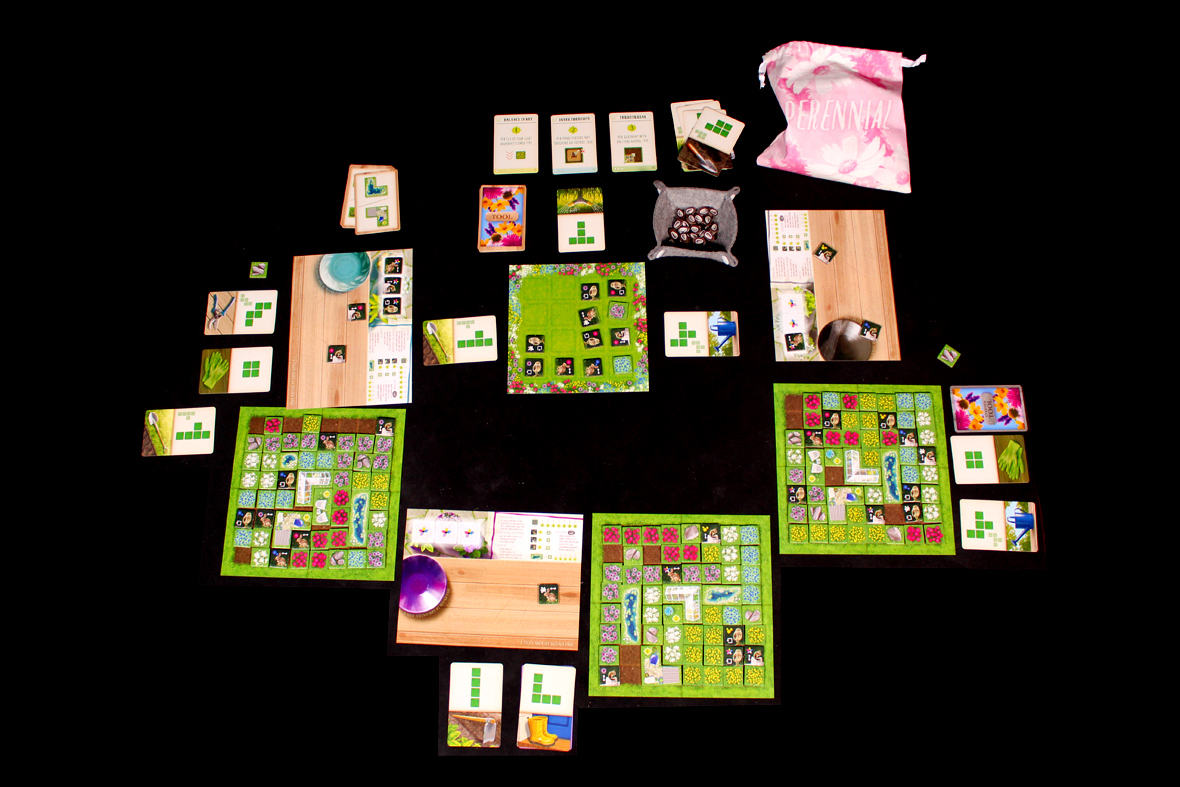
Surprising nobody, Flatout has another hit on their hands. Emily Vincent is already a favorite of the Flatout community after Knitting Circle, I imagine, but the increased complexity without the increased brain burn of Perennial is sure to deservedly win her some more fans. I think it’s great. There’s a lot to do, tons of options, and a lot of flexibility, which I really appreciate, as you can disassemble and shuffle and reassemble groups of tiles before you place them on your turn. That may stress out some players looking to min-max their score, but for some good, classic strategy gaming, I think this is a great choice! It’s maybe a step or two above Cascadia in terms of complexity, but still approachable and strategic in a way that I’m very fond of. Beth Sobel’s art, of course, almost makes me want to go out side (I say this sitting in a dark room writing this review, so this is high praise). You’re still doing something akin to path-building here by trying to create rows, columns, and groups of the same tile color, but there’s almost enough other things to do that it makes it perfectly reasonable and compelling to just focus on those instead. That point salad (not to be confused with the eponymous Flatout title) gives players a lot of opportunities, and figuring out how to take the most advantage of them is going to be the crux of your experience here. That’s quite the challenge, granted, but that also means that you’re never going to have nothing to do. It’s a well-scoped game that’s tightly designed and well-developed, so, I’m excited for y’all to get a chance to try Perennial. If you’re looking for a great tile-laying strategy game, you enjoy gardening as a theme, or you’re just a Flatout lifer (and you’d be within your rights to be), I’d definitely recommend checking Perennial out! I really enjoyed it.
If you enjoyed this review and would like to support What’s Eric Playing? in the future, please check out my Patreon. Thanks for reading!
Discover more from What's Eric Playing?
Subscribe to get the latest posts sent to your email.